

ASTM D2603-20
(Test Method)Standard Test Method for Sonic Shear Stability of Polymer-Containing Oils
General Information
- Abstract
SIGNIFICANCE AND USE
4.1 This test method permits the evaluation of shear stability with minimum interference from thermal and oxidative factors which may be present in some applications. Within the limitations expressed in the scope of this test method, it has been successfully applied to hydraulic fluids, transmission fluids, tractor fluids, and other fluids of similar applications. It has been found applicable to fluids containing both readily sheared and shear-resistant polymers. Correlation with performance in the case of automotive engine applications has, to date, not been established.
SCOPE
1.1 This test method covers the evaluation of the shear stability of an oil containing polymer in terms of the permanent loss in viscosity that results from irradiating a sample of the oil in a sonic oscillator. This test method can be useful in predicting the continuity of this property in an oil where no change is made in the base stock or the polymer. It is not intended that this test method serve to predict the performance of polymer-containing oils in service.
1.2 Evidence has been presented that correlation between the shear degradation results obtained by means of sonic oscillation and those obtained in mechanical devices can be poor. This is especially true in the case of automotive engines. Further evidence indicates that the sonic technique may rate different families of polymers in a different order than mechanical devices.2,3
1.3 Because of these limitations, the committee under whose jurisdiction this test method falls has developed alternative shear test methods using a diesel injector nozzle, Test Methods D5275, D6278, and D7109. While those test methods have found some utility in the evaluation of crankcase oils, the stress imparted to the sample has been found to be insufficient to shear polymers of the shear-resistant type found in aircraft hydraulic fluids.
1.4 This test method is used for polymeric additive specifications, especially in the hydraulic fluid market.
1.5 The values stated in SI units are to be regarded as standard. The values given in parentheses after SI units are provided for information only and are not considered standard.
1.6 This standard does not purport to address all of the safety concerns, if any, associated with its use. It is the responsibility of the user of this standard to establish appropriate safety, health, and environmental practices and determine the applicability of regulatory limitations prior to use.
1.7 This international standard was developed in accordance with internationally recognized principles on standardization established in the Decision on Principles for the Development of International Standards, Guides and Recommendations issued by the World Trade Organization Technical Barriers to Trade (TBT) Committee.
- Status
- Published
- Publication Date
- 30-Apr-2020
- Technical Committee
- D02 - Petroleum Products, Liquid Fuels, and Lubricants
- Drafting Committee
- D02.07 - Flow Properties

Overview
ASTM D2603-20 is the Standard Test Method for Sonic Shear Stability of Polymer-Containing Oils, developed by ASTM International. This standard provides a procedure for evaluating the shear stability of oils containing polymers by measuring the permanent loss in viscosity after exposing the oil to sonic oscillation. The test is particularly effective in assessing the continuity of shear stability in hydraulic fluids, transmission fluids, tractor fluids, and other lubricating oils where the base stock and polymer remain unchanged. By minimizing thermal and oxidative effects, this method accurately isolates the impact of shear forces on polymer degradation.
Key Topics
- Shear Stability Evaluation: Assesses the loss of viscosity in polymer-containing oils subjected to sonic oscillation, providing insight into the oil’s resistance to mechanical degradation.
- Test Method: Involves irradiating a specified oil sample using a sonic oscillator and measuring viscosity changes according to ASTM D445 or D7042 methods.
- Polymer Types: Applicable to fluids with both readily sheared and shear-resistant polymers, making it suitable for a range of hydraulic and transmission oil formulations.
- Reference Fluids & Calibration: Utilizes standard reference fluids to calibrate apparatus and ensure consistent severity levels across laboratories and equipment.
- Limitations: The method does not directly predict in-service oil performance, particularly in automotive engines. Differences in results between sonic shear and mechanical device tests highlight the importance of test selection.
- Quality Control: Daily calibration using reference fluids ensures repeatable and reliable results, allowing comparisons over time and between different labs.
Applications
ASTM D2603-20 is widely used in the hydraulic fluid market and other industries requiring strict control of lubricant performance. Key practical applications include:
- Quality Assurance in Lubricant Manufacturing: Ensures polymer additives maintain desired viscosity characteristics under high shear conditions, vital for fluid stability in hydraulic and transmission systems.
- Product Development: Assists formulators in screening polymer-containing oils for shear stability without interference from heat or oxidation, improving product consistency.
- Specification Compliance: Supports compliance with industry specifications for hydraulic and transmission oils, especially where polymeric additives are involved.
- Comparative Testing: Provides a standard approach for benchmarking new oil formulations against established reference fluids, facilitating product selection and development.
It is important to note that although ASTM D2603-20 is effective for evaluating oils used in hydraulic and transmission systems, the correlation between this sonic shear method and actual performance in automotive engine oils has not been firmly established. For crankcase or engine oils, other test methods such as ASTM D5275, D6278, and D7109 may be more appropriate.
Related Standards
To ensure comprehensive analysis and maintain consistency in evaluating the shear stability and viscosity properties of oils, consider referencing these related ASTM standards:
- ASTM D445 - Test Method for Kinematic Viscosity of Transparent and Opaque Liquids
- ASTM D7042 - Test Method for Dynamic Viscosity and Density of Liquids by Stabinger Viscometer
- ASTM D6022 - Practice for Calculation of Permanent Shear Stability Index
- ASTM D5275, D6278, D7109 - Alternative methods for shear stability testing using mechanical devices such as diesel injector apparatus
Practical Value
The ASTM D2603-20 method offers a reliable means of assessing the shear stability of polymer-containing oils, allowing manufacturers, quality control laboratories, and product developers to ensure that lubricants retain their protective viscosity in high-shear environments. By standardizing the approach, ASTM D2603-20 supports product consistency, technical comparability, and compliance with international lubricant specifications.
Relations
- Effective Date
- 01-May-2020
- Effective Date
- 01-Apr-2024
- Effective Date
- 01-Nov-2023
- Effective Date
- 01-May-2020
- Effective Date
- 01-May-2020
- Effective Date
- 01-Dec-2019
- Effective Date
- 01-Jun-2018
- Effective Date
- 01-May-2017
- Effective Date
- 01-Jan-2017
- Effective Date
- 15-Dec-2016
- Effective Date
- 01-Jun-2016
- Effective Date
- 01-Jul-2014
- Effective Date
- 01-Jul-2014
- Effective Date
- 01-May-2014
- Effective Date
- 01-Nov-2012
Get Certified
Connect with accredited certification bodies for this standard

Element Materials Technology
Materials testing and product certification.

ABS Group Brazil
ABS Group certification services in Brazil.

ABS Quality Evaluations Inc.
American Bureau of Shipping quality certification.
Sponsored listings
Frequently Asked Questions
ASTM D2603-20 is a standard published by ASTM International. Its full title is "Standard Test Method for Sonic Shear Stability of Polymer-Containing Oils". This standard covers: SIGNIFICANCE AND USE 4.1 This test method permits the evaluation of shear stability with minimum interference from thermal and oxidative factors which may be present in some applications. Within the limitations expressed in the scope of this test method, it has been successfully applied to hydraulic fluids, transmission fluids, tractor fluids, and other fluids of similar applications. It has been found applicable to fluids containing both readily sheared and shear-resistant polymers. Correlation with performance in the case of automotive engine applications has, to date, not been established. SCOPE 1.1 This test method covers the evaluation of the shear stability of an oil containing polymer in terms of the permanent loss in viscosity that results from irradiating a sample of the oil in a sonic oscillator. This test method can be useful in predicting the continuity of this property in an oil where no change is made in the base stock or the polymer. It is not intended that this test method serve to predict the performance of polymer-containing oils in service. 1.2 Evidence has been presented that correlation between the shear degradation results obtained by means of sonic oscillation and those obtained in mechanical devices can be poor. This is especially true in the case of automotive engines. Further evidence indicates that the sonic technique may rate different families of polymers in a different order than mechanical devices.2,3 1.3 Because of these limitations, the committee under whose jurisdiction this test method falls has developed alternative shear test methods using a diesel injector nozzle, Test Methods D5275, D6278, and D7109. While those test methods have found some utility in the evaluation of crankcase oils, the stress imparted to the sample has been found to be insufficient to shear polymers of the shear-resistant type found in aircraft hydraulic fluids. 1.4 This test method is used for polymeric additive specifications, especially in the hydraulic fluid market. 1.5 The values stated in SI units are to be regarded as standard. The values given in parentheses after SI units are provided for information only and are not considered standard. 1.6 This standard does not purport to address all of the safety concerns, if any, associated with its use. It is the responsibility of the user of this standard to establish appropriate safety, health, and environmental practices and determine the applicability of regulatory limitations prior to use. 1.7 This international standard was developed in accordance with internationally recognized principles on standardization established in the Decision on Principles for the Development of International Standards, Guides and Recommendations issued by the World Trade Organization Technical Barriers to Trade (TBT) Committee.
SIGNIFICANCE AND USE 4.1 This test method permits the evaluation of shear stability with minimum interference from thermal and oxidative factors which may be present in some applications. Within the limitations expressed in the scope of this test method, it has been successfully applied to hydraulic fluids, transmission fluids, tractor fluids, and other fluids of similar applications. It has been found applicable to fluids containing both readily sheared and shear-resistant polymers. Correlation with performance in the case of automotive engine applications has, to date, not been established. SCOPE 1.1 This test method covers the evaluation of the shear stability of an oil containing polymer in terms of the permanent loss in viscosity that results from irradiating a sample of the oil in a sonic oscillator. This test method can be useful in predicting the continuity of this property in an oil where no change is made in the base stock or the polymer. It is not intended that this test method serve to predict the performance of polymer-containing oils in service. 1.2 Evidence has been presented that correlation between the shear degradation results obtained by means of sonic oscillation and those obtained in mechanical devices can be poor. This is especially true in the case of automotive engines. Further evidence indicates that the sonic technique may rate different families of polymers in a different order than mechanical devices.2,3 1.3 Because of these limitations, the committee under whose jurisdiction this test method falls has developed alternative shear test methods using a diesel injector nozzle, Test Methods D5275, D6278, and D7109. While those test methods have found some utility in the evaluation of crankcase oils, the stress imparted to the sample has been found to be insufficient to shear polymers of the shear-resistant type found in aircraft hydraulic fluids. 1.4 This test method is used for polymeric additive specifications, especially in the hydraulic fluid market. 1.5 The values stated in SI units are to be regarded as standard. The values given in parentheses after SI units are provided for information only and are not considered standard. 1.6 This standard does not purport to address all of the safety concerns, if any, associated with its use. It is the responsibility of the user of this standard to establish appropriate safety, health, and environmental practices and determine the applicability of regulatory limitations prior to use. 1.7 This international standard was developed in accordance with internationally recognized principles on standardization established in the Decision on Principles for the Development of International Standards, Guides and Recommendations issued by the World Trade Organization Technical Barriers to Trade (TBT) Committee.
ASTM D2603-20 is classified under the following ICS (International Classification for Standards) categories: 75.100 - Lubricants, industrial oils and related products. The ICS classification helps identify the subject area and facilitates finding related standards.
ASTM D2603-20 has the following relationships with other standards: It is inter standard links to ASTM D2603-19, ASTM D445-24, ASTM D445-23, ASTM D7109-20, ASTM D6278-20, ASTM D6022-19, ASTM D7109-18, ASTM D5275-17, ASTM D6278-17, ASTM D445-16, ASTM D5275-16, ASTM D445-14e1, ASTM D445-14, ASTM D7042-14, ASTM D7109-12. Understanding these relationships helps ensure you are using the most current and applicable version of the standard.
ASTM D2603-20 is available in PDF format for immediate download after purchase. The document can be added to your cart and obtained through the secure checkout process. Digital delivery ensures instant access to the complete standard document.
Standards Content (Sample)
This international standard was developed in accordance with internationally recognized principles on standardization established in the Decision on Principles for the
Development of International Standards, Guides and Recommendations issued by the World Trade Organization Technical Barriers to Trade (TBT) Committee.
Designation: D2603 − 20
Standard Test Method for
Sonic Shear Stability of Polymer-Containing Oils
This standard is issued under the fixed designation D2603; the number immediately following the designation indicates the year of
original adoption or, in the case of revision, the year of last revision. A number in parentheses indicates the year of last reapproval. A
superscript epsilon (´) indicates an editorial change since the last revision or reapproval.
This standard has been approved for use by agencies of the U.S. Department of Defense.
1. Scope* 1.6 This standard does not purport to address all of the
safety concerns, if any, associated with its use. It is the
1.1 This test method covers the evaluation of the shear
responsibility of the user of this standard to establish appro-
stabilityofanoilcontainingpolymerintermsofthepermanent
priate safety, health, and environmental practices and deter-
loss in viscosity that results from irradiating a sample of the oil
mine the applicability of regulatory limitations prior to use.
in a sonic oscillator. This test method can be useful in
1.7 This international standard was developed in accor-
predicting the continuity of this property in an oil where no
dance with internationally recognized principles on standard-
change is made in the base stock or the polymer. It is not
ization established in the Decision on Principles for the
intended that this test method serve to predict the performance
Development of International Standards, Guides and Recom-
of polymer-containing oils in service.
mendations issued by the World Trade Organization Technical
1.2 Evidence has been presented that correlation between
Barriers to Trade (TBT) Committee.
the shear degradation results obtained by means of sonic
oscillation and those obtained in mechanical devices can be 2. Referenced Documents
poor. This is especially true in the case of automotive engines.
2.1 ASTM Standards:
Further evidence indicates that the sonic technique may rate
D445 Test Method for Kinematic Viscosity of Transparent
different families of polymers in a different order than me-
and Opaque Liquids (and Calculation of Dynamic Viscos-
2,3
chanical devices.
ity)
D5275 Test Method for Fuel Injector Shear Stability Test
1.3 Because of these limitations, the committee under
(FISST) for Polymer Containing Fluids
whose jurisdiction this test method falls has developed alter-
D6022 Practice for Calculation of Permanent Shear Stability
native shear test methods using a diesel injector nozzle, Test
Index
Methods D5275, D6278, and D7109.While those test methods
D6278 Test Method for Shear Stability of Polymer Contain-
have found some utility in the evaluation of crankcase oils, the
ing Fluids Using a European Diesel Injector Apparatus
stress imparted to the sample has been found to be insufficient
D7042 Test Method for Dynamic Viscosity and Density of
to shear polymers of the shear-resistant type found in aircraft
Liquids by Stabinger Viscometer (and the Calculation of
hydraulic fluids.
Kinematic Viscosity)
1.4 This test method is used for polymeric additive
D7109 Test Method for Shear Stability of Polymer-
specifications, especially in the hydraulic fluid market.
Containing Fluids Using a European Diesel Injector Ap-
1.5 The values stated in SI units are to be regarded as paratus at 30 Cycles and 90 Cycles
standard. The values given in parentheses after SI units are
3. Summary of Test Method
provided for information only and are not considered standard.
3.1 A convenient volume of polymer-containing oil is irra-
diated in a sonic oscillator for a period of time and the changes
1 in viscosity are determined by Test Method D445 and D7042.
This test method is under the jurisdiction of ASTM Committee D02 on
Petroleum Products, Liquid Fuels, and Lubricants and is the direct responsibility of Standard reference fluids containing either a readily sheared or
Subcommittee D02.07 on Flow Properties.
shear-resistant polymer are run frequently to ensure that the
Current edition approved May 1, 2020. Published May 2020. Originally
equipment imparts a controlled amount of sonic energy to the
approved in 1967. Last previous edition approved in 2019 as D2603 – 19. DOI:
sample.
10.1520/D2603-20.
The Effects of Polymer Degradation on Flow Properties of Fluids and
Lubricants, ASTM STP 382,ASTM, 1965.Available fromASTM Headquarters, 100
Barr Harbor Drive, West Conshohocken, PA 19428, www.astm.org. For referenced ASTM standards, visit the ASTM website, www.astm.org, or
Shear Stability of Multigrade Crankcase Oil, ASTM DS 49, ASTM, 1973. contact ASTM Customer Service at service@astm.org. For Annual Book of ASTM
Available from ASTM Headquarters, 100 Barr Harbor Drive, West Conshohocken, Standards volume information, refer to the standard’s Document Summary page on
PA 19428, www.astm.org. the ASTM website.
*A Summary of Changes section appears at the end of this standard
Copyright © ASTM International, 100 Barr Harbor Drive, PO Box C700, West Conshohocken, PA 19428-2959. United States
D2603 − 20
NOTE 1—The conditions to obtain the data for the precision statement
that satisfactory comparison can be made between tests run on
were a 30 mL sample, 10 min, and at 0 °C.
different days in the same unit and between tests run with
different units.
4. Significance and Use
7.2 The decrease in viscosity observed for a given polymer-
4.1 Thistestmethodpermitstheevaluationofshearstability
containing oil on irradiation in an oscillator unit depends on a
with minimum interference from thermal and oxidative factors
number of factors; these include sample volume, irradiation
which may be present in some applications. Within the
time, and oscillator power setting. These parameters can be
limitations expressed in the scope of this test method, it has
variedinordertoincreaseordecreaseseverityoftestexposure.
been successfully applied to hydraulic fluids, transmission
Tuning of the oscillator-horn combination is also required in
fluids, tractor fluids, and other fluids of similar applications. It
order to assure efficiency of energy coupling between the two
has been found applicable to fluids containing both readily
units. The procedure described in 7.3 and 7.4 is recommended
sheared and shear-resistant polymers. Correlation with perfor-
for establishing a reproducible performance level for a given
mance in the case of automotive engine applications has, to
unit.
date, not been established.
7.3 Introduce 30 mL of a reference fluid into the 50 mL
Griffin beaker. Immerse the beaker in ice water or in another
5. Apparatus
constant temperature bath until sample fluid level is below the
5.1 Sonic Shear Unit, fixed frequency oscillator and sonic
liquid level in the bath. The beaker shall be positioned in a
horn.
vertical position in the bath. Secure beaker in this position and
5.2 Auxiliary Equipment—To facilitate uniform
condition the sample for 10 min before commencing exposure.
performance, the following auxiliary equipment is recom-
Immerse the sonic horn into sample fluid until tip is exactly
mended:
10 mm below surface of fluid (see Fig. 1). The horn shall be
5.2.1 Cooling Bath or Ice Bath—To maintain a desired
temperature such as 0 °C.
5.2.2 Griffın 50 mL Beaker, borosilicate glass.
5.2.3 Sonic-Insulated Box—To enclose the sonic horn to
reduce the ambient noise level produced by the sonic shear
unit.
5.3 Viscometer—Any viscometer and bath meeting the re-
quirements for determining kinematic viscosity: Test Method
D445 or D7042. Whichever method is chosen, that same
method must be used for the before and after samples as well
as the calibration samples.
6. Reference Fluids
6.1 The primary reference fluid is ASTM Reference Fluid
A, a petroleum oil containing a polymer capable of being
broken down by turbulence at high rates of shear. This oil has
the foll
...
This document is not an ASTM standard and is intended only to provide the user of an ASTM standard an indication of what changes have been made to the previous version. Because
it may not be technically possible to adequately depict all changes accurately, ASTM recommends that users consult prior editions as appropriate. In all cases only the current version
of the standard as published by ASTM is to be considered the official document.
Designation: D2603 − 19 D2603 − 20
Standard Test Method for
Sonic Shear Stability of Polymer-Containing Oils
This standard is issued under the fixed designation D2603; the number immediately following the designation indicates the year of
original adoption or, in the case of revision, the year of last revision. A number in parentheses indicates the year of last reapproval. A
superscript epsilon (´) indicates an editorial change since the last revision or reapproval.
This standard has been approved for use by agencies of the U.S. Department of Defense.
1. Scope*
1.1 This test method covers the evaluation of the shear stability of an oil containing polymer in terms of the permanent loss in
viscosity that results from irradiating a sample of the oil in a sonic oscillator. This test method can be useful in predicting the
continuity of this property in an oil where no change is made in the base stock or the polymer. It is not intended that this test method
serve to predict the performance of polymer-containing oils in service.
1.2 Evidence has been presented that correlation between the shear degradation results obtained by means of sonic oscillation
and those obtained in mechanical devices can be poor. This is especially true in the case of automotive engines. Further evidence
2,3
indicates that the sonic technique may rate different families of polymers in a different order than mechanical devices.
1.3 Because of these limitations, the committee under whose jurisdiction this test method falls has developed alternative shear
test methods using a diesel injector nozzle, Test Methods D5275, D6278, and D7109. While those test methods have found some
utility in the evaluation of crankcase oils, the stress imparted to the sample has been found to be insufficient to shear polymers of
the shear-resistant type found in aircraft hydraulic fluids.
1.4 This test method is used for polymeric additive specifications, especially in the hydraulic fluid market.
1.5 The values stated in SI units are to be regarded as standard. The values given in parentheses after SI units are provided for
information only and are not considered standard.
1.6 This standard does not purport to address all of the safety concerns, if any, associated with its use. It is the responsibility
of the user of this standard to establish appropriate safety, health, and environmental practices and determine the applicability of
regulatory limitations prior to use.
1.7 This international standard was developed in accordance with internationally recognized principles on standardization
established in the Decision on Principles for the Development of International Standards, Guides and Recommendations issued
by the World Trade Organization Technical Barriers to Trade (TBT) Committee.
2. Referenced Documents
2.1 ASTM Standards:
D445 Test Method for Kinematic Viscosity of Transparent and Opaque Liquids (and Calculation of Dynamic Viscosity)
D5275 Test Method for Fuel Injector Shear Stability Test (FISST) for Polymer Containing Fluids
D6022 Practice for Calculation of Permanent Shear Stability Index
D6278 Test Method for Shear Stability of Polymer Containing Fluids Using a European Diesel Injector Apparatus
D7042 Test Method for Dynamic Viscosity and Density of Liquids by Stabinger Viscometer (and the Calculation of Kinematic
Viscosity)
D7109 Test Method for Shear Stability of Polymer-Containing Fluids Using a European Diesel Injector Apparatus at 30 Cycles
and 90 Cycles
This test method is under the jurisdiction of ASTM Committee D02 on Petroleum Products, Liquid Fuels, and Lubricants and is the direct responsibility of Subcommittee
D02.07 on Flow Properties.
Current edition approved June 1, 2019May 1, 2020. Published July 2019May 2020. Originally approved in 1967. Last previous edition approved in 20132019 as
D2603 – 01 (2013).D2603 – 19. DOI: 10.1520/D2603-19.10.1520/D2603-20.
The Effects of Polymer Degradation on Flow Properties of Fluids and Lubricants, ASTM STP 382, ASTM, 1965. Available from ASTM Headquarters, 100 Barr Harbor
Drive, West Conshohocken, PA 19428, www.astm.org.
Shear Stability of Multigrade Crankcase Oil, ASTM DS 49, ASTM, 1973. Available from ASTM Headquarters, 100 Barr Harbor Drive, West Conshohocken, PA 19428,
www.astm.org.
For referenced ASTM standards, visit the ASTM website, www.astm.org, or contact ASTM Customer Service at service@astm.org. For Annual Book of ASTM Standards
volume information, refer to the standard’s Document Summary page on the ASTM website.
*A Summary of Changes section appears at the end of this standard
Copyright © ASTM International, 100 Barr Harbor Drive, PO Box C700, West Conshohocken, PA 19428-2959. United States
D2603 − 20
3. Summary of Test Method
3.1 A convenient volume of polymer-containing oil is irradiated in a sonic oscillator for a period of time and the changes in
viscosity are determined by Test Method D445 and D7042. Standard reference fluids containing either a readily sheared or
shear-resistant polymer are run frequently to ensure that the equipment imparts a controlled amount of sonic energy to the sample.
NOTE 1—The conditions to obtain the data for the precision statement were a 30 mL sample, 10 min, and at 0 °C.
4. Significance and Use
4.1 This test method permits the evaluation of shear stability with minimum interference from thermal and oxidative factors
which may be present in some applications. Within the limitations expressed in the scope of this test method, it has been
successfully applied to hydraulic fluids, transmission fluids, tractor fluids, and other fluids of similar applications. It has been found
applicable to fluids containing both readily sheared and shear-resistant polymers. Correlation with performance in the case of
automotive engine applications has, to date, not been established.
5. Apparatus
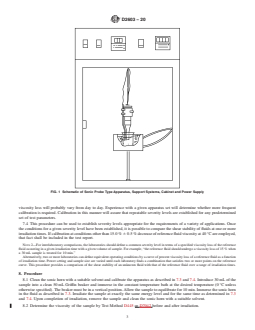
5.1 Sonic Shear Unit, fixed frequency oscillator and sonic horn.
5.2 Auxiliary Equipment—To facilitate uniform performance, the following auxiliary equipment is recommended:
5.2.1 Cooling Bath or Ice Bath—To maintain a desired temperature such as 0 °C.
5.2.2 Griffın 50 mL Beaker, borosilicate glass.
5.2.3 Sonic-Insulated Box—To enclose the sonic horn to reduce the ambient noise level produced by the sonic shear unit.
5.3 Viscometer—Any viscometer and bath meeting the requirements of for determining kinematic viscosity: Test Method D445
or D7042. Whichever method is chosen, that same method must be used for the before and after samples as well as the calibration
samples.
6. Reference Fluids
6.1 The primary reference fluid is ASTM Reference Fluid A, a petroleum oil containing a polymer capable of being broken
down by turbulence at high rates of shear. This oil has the following typical properties:
Petroleum Reference
Base Fluid A
Viscosity at 100 °C, mm /s (cSt) 5.4 10.8
Viscosity at 100 °C, mm /s (cSt) 5.4 10.8
Viscosity at 40 °C, mm /s (cSt) 32 58
6.2 A second reference fluid is ASTM Reference Fluid B, a petroleum oil containing a polymer capable of being broken down
by turbulence at high rates of shear. This oil has a viscosity of about 13.6 mm /s (cSt) at 40 °C.
7. Calibration of Apparatus
7.1 The reference fluid provides a practical way to define the performance (severity level) of a sonic oscillator unit so that
satisfactory comparison can be made between tests run on different days in the same unit and between tests run with different units.
7.2 The decrease in viscosity observed for a given polymer-containing oil on irradiation in an oscillator unit depends on a
number of factors; these include sample volume, irradiation time, and oscillator power setting. These parameters can be varied in
order to increase or decrease severity of test exposure. Tuning of the oscillator-horn combination is also required in order to assure
efficiency of energy coupling between the two units. The procedure described in 7.3 and 7.4 i
...