

ASTM D8289-20
(Test Method)Standard Test Method for Tensile Strength Estimate by Disc Compression of Manufactured Graphite
General Information
- Abstract
SIGNIFICANCE AND USE
4.1 By definition, the tensile strength of manufactured graphite is obtained by the direct uniaxial tensile test (Test Method C749). The C749 tensile test specimen is relatively large and is frequently incompatible with available irradiation capsule volumes, or oxidation apparatus (Test Method D7542). The splitting tensile test provides an alternate means of testing tensile properties on specimens that have severe geometric constraints and otherwise cannot meet the prescribed testing geometries of Test Method C749. By loading a disc-shaped specimen, on edge, under a compressive load, the resulting tensile stresses transverse to the loading axis provide an indication of the tensile strength properties of graphite. To obtain consistent and meaningful values of a splitting tensile strength, it is vital that the fracture initiate in the center of the disk and not along an edge. This standard test helps to ensure that the disk specimens break diametrally along the loading diameter due to tensile stresses that are perpendicular to the loading axis and that the fracture initiates at the center of the disk.
4.2 The stress determined using the diametral compression test is the maximum tensile stress at the center of the disk when loaded under the prescribed conditions and the fracture initiates at the center of the disk. It should be understood that this tensile stress value is obtained with the specimen in a complex biaxial stress condition. When the test is performed carefully and consistently these tensile stress values are comparable to each other, but the performers of this test should validate the values obtained. Any bias when comparing values with this standard to the uniaxial tensile stress values obtained using Test Method C749 should be identified and reported. Validation shall be performed on the same material and may not be applicable to other states of the same material (for example, oxidized, irradiated). Guidance on small specimen testing can be found in G...
SCOPE
1.1 This test method covers testing apparatus, specimen preparation, and testing procedures for determining the splitting tensile strength of graphite by diametral line compression of a disk. This small specimen geometry (Test Method D7779) is specifically intended for irradiation capsule use. Users are cautioned to use Test Method C749 if possible for measuring tensile strength properties of graphite.
1.2 The values stated in SI units are to be regarded as standard. The values given in parentheses after SI units are provided for information only and are not considered standard.
1.3 All dimension and force measurements and stress calculations shall conform to the guidelines for significant digits and rounding established in Practice D6026.
1.4 This standard does not purport to address all of the safety concerns, if any, associated with its use. It is the responsibility of the user of this standard to establish appropriate safety, health, and environmental practices and determine the applicability of regulatory limitations prior to use.
1.5 This international standard was developed in accordance with internationally recognized principles on standardization established in the Decision on Principles for the Development of International Standards, Guides and Recommendations issued by the World Trade Organization Technical Barriers to Trade (TBT) Committee.
- Status
- Published
- Publication Date
- 30-Apr-2020
- Technical Committee
- D02 - Petroleum Products, Liquid Fuels, and Lubricants
- Drafting Committee
- D02.F0 - Manufactured Carbon and Graphite Products
Buy Documents
ASTM D8289-20 - Standard Test Method for Tensile Strength Estimate by Disc Compression of Manufactured Graphite
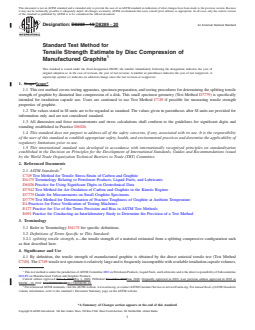
REDLINE ASTM D8289-20 - Standard Test Method for Tensile Strength Estimate by Disc Compression of Manufactured Graphite
Overview
ASTM D8289-20, titled "Standard Test Method for Tensile Strength Estimate by Disc Compression of Manufactured Graphite," is a key international standard developed by ASTM International. This method provides a reliable procedure for estimating the splitting tensile strength of manufactured graphite using diametral disc compression, particularly when conventional uniaxial tensile test methods are impractical due to size or geometric constraints. The approach outlined in this standard is especially suited for small graphite specimens, such as those required for irradiation capsule use.
Key Topics
- Alternative to Uniaxial Testing: The standard enables the measurement of tensile strength where standard uniaxial tensile methods (such as ASTM C749) cannot be applied due to sample size or incompatibility with testing apparatus, including irradiation capsules or oxidation devices (ASTM D7542).
- Test Methodology: This standard describes the apparatus setup, specimen preparation, and testing procedures for disc compression testing. Specimens are disk-shaped and subjected to a compressive force on edge, causing tensile stresses transverse to the loading axis.
- Data Requirements: Specimen dimensions, testing rate, fracture type and location, atmospheric conditions, and calculated splitting tensile strengths must be reported for each tested sample.
- Precision and Repeatability: The standard addresses statistical aspects of test results, including repeatability and reproducibility limits based on multi-laboratory studies.
- Safety and Compliance: Testing procedures must adhere to appropriate safety, health, and environmental practices, and follow international standardization guidelines.
Applications
- Nuclear Materials Testing: Due to the suitability of the small specimen geometry, this method is widely applied in research and quality assurance for graphite components intended for nuclear irradiation or experimental capsule environments.
- Quality Control for Graphite Manufacturing: Manufacturers of structural graphite utilize this test for product verification when large samples are unavailable or inappropriate.
- Comparative Material Studies: The disc compression method can support material development, allowing for the study of tensile properties in differently processed or treated graphite forms.
- Process Validation: This method is valuable where validation across different states of the same graphite material is needed, such as oxidized or irradiated states, provided the comparative basis remains consistent.
Related Standards
- ASTM C749: Standard Test Method for Tensile Stress-Strain of Carbon and Graphite – the primary method for direct uniaxial tensile testing of graphite, recommended when sample size allows.
- ASTM D7542: Test Method for Air Oxidation of Carbon and Graphite in the Kinetic Regime – relevant when testing graphite exposed to oxidation.
- ASTM D7775: Guide for Measurements on Small Graphite Specimens – provides additional guidance for small specimen testing.
- ASTM D7779: Test Method for Determination of Fracture Toughness of Graphite at Ambient Temperature – relates to the selection and qualification of specimen geometry.
- ASTM D6026: Practice for Using Significant Digits in Geotechnical Data – dictates rounding and reporting conventions for measurements.
- ASTM E691: Practice for Conducting an Interlaboratory Study – underpins the precision and bias evaluation for this test method.
Practical Value
ASTM D8289-20 is indispensable for laboratories and industries working with manufactured graphite who need to estimate tensile properties under strict specimen size limitations. Its standardized approach ensures consistency, repeatability, and reliability of results, making it an essential tool in graphite quality assurance, material research, and nuclear materials testing. By providing an alternative to traditional tensile strength testing, it opens avenues for robust material evaluation in advanced technological and scientific applications.
Keywords: ASTM D8289-20, disc compression test, splitting tensile strength, manufactured graphite, tensile strength estimation, small specimen testing, graphite material standards, nuclear graphite testing, ASTM graphite methods, quality control.
Relations
- Effective Date
- 01-May-2020
- Refers
ASTM D4175-23a - Standard Terminology Relating to Petroleum Products, Liquid Fuels, and Lubricants - Effective Date
- 15-Dec-2023
- Refers
ASTM D4175-23e1 - Standard Terminology Relating to Petroleum Products, Liquid Fuels, and Lubricants - Effective Date
- 01-Jul-2023
- Effective Date
- 01-May-2020
- Effective Date
- 01-Oct-2015
- Effective Date
- 01-Jun-2015
- Effective Date
- 01-Jun-2014
- Effective Date
- 01-May-2014
- Effective Date
- 01-Oct-2013
- Effective Date
- 01-May-2013
- Effective Date
- 01-May-2013
- Effective Date
- 01-Dec-2011
- Effective Date
- 01-Dec-2011
- Effective Date
- 01-Dec-2011
- Effective Date
- 01-Nov-2011
Buy Documents
ASTM D8289-20 - Standard Test Method for Tensile Strength Estimate by Disc Compression of Manufactured Graphite
REDLINE ASTM D8289-20 - Standard Test Method for Tensile Strength Estimate by Disc Compression of Manufactured Graphite
Get Certified
Connect with accredited certification bodies for this standard

Control Union Certifications
Global certification for agriculture and sustainability.

Hohenstein Institut
Textile testing and certification.

Bureau Veritas Bangladesh
Bureau Veritas certification services in Bangladesh.
Sponsored listings
Frequently Asked Questions
ASTM D8289-20 is a standard published by ASTM International. Its full title is "Standard Test Method for Tensile Strength Estimate by Disc Compression of Manufactured Graphite". This standard covers: SIGNIFICANCE AND USE 4.1 By definition, the tensile strength of manufactured graphite is obtained by the direct uniaxial tensile test (Test Method C749). The C749 tensile test specimen is relatively large and is frequently incompatible with available irradiation capsule volumes, or oxidation apparatus (Test Method D7542). The splitting tensile test provides an alternate means of testing tensile properties on specimens that have severe geometric constraints and otherwise cannot meet the prescribed testing geometries of Test Method C749. By loading a disc-shaped specimen, on edge, under a compressive load, the resulting tensile stresses transverse to the loading axis provide an indication of the tensile strength properties of graphite. To obtain consistent and meaningful values of a splitting tensile strength, it is vital that the fracture initiate in the center of the disk and not along an edge. This standard test helps to ensure that the disk specimens break diametrally along the loading diameter due to tensile stresses that are perpendicular to the loading axis and that the fracture initiates at the center of the disk. 4.2 The stress determined using the diametral compression test is the maximum tensile stress at the center of the disk when loaded under the prescribed conditions and the fracture initiates at the center of the disk. It should be understood that this tensile stress value is obtained with the specimen in a complex biaxial stress condition. When the test is performed carefully and consistently these tensile stress values are comparable to each other, but the performers of this test should validate the values obtained. Any bias when comparing values with this standard to the uniaxial tensile stress values obtained using Test Method C749 should be identified and reported. Validation shall be performed on the same material and may not be applicable to other states of the same material (for example, oxidized, irradiated). Guidance on small specimen testing can be found in G... SCOPE 1.1 This test method covers testing apparatus, specimen preparation, and testing procedures for determining the splitting tensile strength of graphite by diametral line compression of a disk. This small specimen geometry (Test Method D7779) is specifically intended for irradiation capsule use. Users are cautioned to use Test Method C749 if possible for measuring tensile strength properties of graphite. 1.2 The values stated in SI units are to be regarded as standard. The values given in parentheses after SI units are provided for information only and are not considered standard. 1.3 All dimension and force measurements and stress calculations shall conform to the guidelines for significant digits and rounding established in Practice D6026. 1.4 This standard does not purport to address all of the safety concerns, if any, associated with its use. It is the responsibility of the user of this standard to establish appropriate safety, health, and environmental practices and determine the applicability of regulatory limitations prior to use. 1.5 This international standard was developed in accordance with internationally recognized principles on standardization established in the Decision on Principles for the Development of International Standards, Guides and Recommendations issued by the World Trade Organization Technical Barriers to Trade (TBT) Committee.
SIGNIFICANCE AND USE 4.1 By definition, the tensile strength of manufactured graphite is obtained by the direct uniaxial tensile test (Test Method C749). The C749 tensile test specimen is relatively large and is frequently incompatible with available irradiation capsule volumes, or oxidation apparatus (Test Method D7542). The splitting tensile test provides an alternate means of testing tensile properties on specimens that have severe geometric constraints and otherwise cannot meet the prescribed testing geometries of Test Method C749. By loading a disc-shaped specimen, on edge, under a compressive load, the resulting tensile stresses transverse to the loading axis provide an indication of the tensile strength properties of graphite. To obtain consistent and meaningful values of a splitting tensile strength, it is vital that the fracture initiate in the center of the disk and not along an edge. This standard test helps to ensure that the disk specimens break diametrally along the loading diameter due to tensile stresses that are perpendicular to the loading axis and that the fracture initiates at the center of the disk. 4.2 The stress determined using the diametral compression test is the maximum tensile stress at the center of the disk when loaded under the prescribed conditions and the fracture initiates at the center of the disk. It should be understood that this tensile stress value is obtained with the specimen in a complex biaxial stress condition. When the test is performed carefully and consistently these tensile stress values are comparable to each other, but the performers of this test should validate the values obtained. Any bias when comparing values with this standard to the uniaxial tensile stress values obtained using Test Method C749 should be identified and reported. Validation shall be performed on the same material and may not be applicable to other states of the same material (for example, oxidized, irradiated). Guidance on small specimen testing can be found in G... SCOPE 1.1 This test method covers testing apparatus, specimen preparation, and testing procedures for determining the splitting tensile strength of graphite by diametral line compression of a disk. This small specimen geometry (Test Method D7779) is specifically intended for irradiation capsule use. Users are cautioned to use Test Method C749 if possible for measuring tensile strength properties of graphite. 1.2 The values stated in SI units are to be regarded as standard. The values given in parentheses after SI units are provided for information only and are not considered standard. 1.3 All dimension and force measurements and stress calculations shall conform to the guidelines for significant digits and rounding established in Practice D6026. 1.4 This standard does not purport to address all of the safety concerns, if any, associated with its use. It is the responsibility of the user of this standard to establish appropriate safety, health, and environmental practices and determine the applicability of regulatory limitations prior to use. 1.5 This international standard was developed in accordance with internationally recognized principles on standardization established in the Decision on Principles for the Development of International Standards, Guides and Recommendations issued by the World Trade Organization Technical Barriers to Trade (TBT) Committee.
ASTM D8289-20 is classified under the following ICS (International Classification for Standards) categories: 59.100.20 - Carbon materials. The ICS classification helps identify the subject area and facilitates finding related standards.
ASTM D8289-20 has the following relationships with other standards: It is inter standard links to ASTM D8289-19, ASTM D4175-23a, ASTM D4175-23e1, ASTM C749-15(2020), ASTM C749-15, ASTM D7775-11(2015), ASTM E4-14, ASTM E177-14, ASTM C749-13, ASTM E177-13, ASTM E691-13, ASTM D7775-11e1, ASTM D7775-11, ASTM D7779-11, ASTM E691-11. Understanding these relationships helps ensure you are using the most current and applicable version of the standard.
ASTM D8289-20 is available in PDF format for immediate download after purchase. The document can be added to your cart and obtained through the secure checkout process. Digital delivery ensures instant access to the complete standard document.
Standards Content (Sample)
This international standard was developed in accordance with internationally recognized principles on standardization established in the Decision on Principles for the
Development of International Standards, Guides and Recommendations issued by the World Trade Organization Technical Barriers to Trade (TBT) Committee.
Designation: D8289 − 20
Standard Test Method for
Tensile Strength Estimate by Disc Compression of
Manufactured Graphite
This standard is issued under the fixed designation D8289; the number immediately following the designation indicates the year of
original adoption or, in the case of revision, the year of last revision. A number in parentheses indicates the year of last reapproval. A
superscript epsilon (´) indicates an editorial change since the last revision or reapproval.
1. Scope* D6026 Practice for Using Significant Digits in Geotechnical
Data
1.1 This test method covers testing apparatus, specimen
D7542 Test Method forAir Oxidation of Carbon and Graph-
preparation, and testing procedures for determining the split-
ite in the Kinetic Regime
ting tensile strength of graphite by diametral line compression
D7775 Guide for Measurements on Small Graphite Speci-
of a disk. This small specimen geometry (Test Method D7779)
mens
is specifically intended for irradiation capsule use. Users are
D7779 Test Method for Determination of Fracture Tough-
cautioned to use Test Method C749 if possible for measuring
ness of Graphite at Ambient Temperature
tensile strength properties of graphite.
E4 Practices for Force Verification of Testing Machines
1.2 The values stated in SI units are to be regarded as
E177 Practice for Use of the Terms Precision and Bias in
standard. The values given in parentheses after SI units are
ASTM Test Methods
provided for information only and are not considered standard.
E691 Practice for Conducting an Interlaboratory Study to
1.3 All dimension and force measurements and stress cal-
Determine the Precision of a Test Method
culations shall conform to the guidelines for significant digits
and rounding established in Practice D6026.
3. Terminology
1.4 This standard does not purport to address all of the
3.1 Refer to Terminology D4175 for specific definitions.
safety concerns, if any, associated with its use. It is the
3.2 Definitions of Terms Specific to This Standard:
responsibility of the user of this standard to establish appro-
3.2.1 splitting tensile strength, n—the tensile strength of a
priate safety, health, and environmental practices and deter-
material estimated from a splitting compressive configuration
mine the applicability of regulatory limitations prior to use.
such as that described here.
1.5 This international standard was developed in accor-
dance with internationally recognized principles on standard-
ization established in the Decision on Principles for the 4. Significance and Use
Development of International Standards, Guides and Recom-
4.1 By definition, the tensile strength of manufactured
mendations issued by the World Trade Organization Technical
graphite is obtained by the direct uniaxial tensile test (Test
Barriers to Trade (TBT) Committee.
Method C749). The C749 tensile test specimen is relatively
large and is frequently incompatible with available irradiation
2. Referenced Documents
capsule volumes, or oxidation apparatus (Test Method D7542).
2.1 ASTM Standards:
The splitting tensile test provides an alternate means of testing
C749 Test Method for Tensile Stress-Strain of Carbon and
tensile properties on specimens that have severe geometric
Graphite
constraints and otherwise cannot meet the prescribed testing
D4175 Terminology Relating to Petroleum Products, Liquid
geometries of Test Method C749. By loading a disc-shaped
Fuels, and Lubricants
specimen, on edge, under a compressive load, the resulting
tensile stresses transverse to the loading axis provide an
This test method is under the jurisdiction of ASTM Committee D02 on
indication of the tensile strength properties of graphite. To
Petroleum Products, Liquid Fuels, and Lubricants and is the direct responsibility of
obtain consistent and meaningful values of a splitting tensile
Subcommittee D02.F0 on Manufactured Carbon and Graphite Products.
strength, it is vital that the fracture initiate in the center of the
Current edition approved May 1, 2020. Published June 2020. Originally
disk and not along an edge. This standard test helps to ensure
approved in 2019. Last previous edition approved in 2019 as D8289 – 19. DOI:
10.1520/D8289-20.
that the disk specimens break diametrally along the loading
For referenced ASTM standards, visit the ASTM website, www.astm.org, or
diameter due to tensile stresses that are perpendicular to the
contact ASTM Customer Service at service@astm.org. For Annual Book of ASTM
loading axis and that the fracture initiates at the center of the
Standards volume information, refer to the standard’s Document Summary page on
the ASTM website. disk.
*A Summary of Changes section appears at the end of this standard
Copyright © ASTM International, 100 Barr Harbor Drive, PO Box C700, West Conshohocken, PA 19428-2959. United States
D8289 − 20
4.2 The stress determined using the diametral compression
testisthemaximumtensilestressatthecenterofthediskwhen
loadedundertheprescribedconditionsandthefractureinitiates
at the center of the disk. It should be understood that this
tensile stress value is obtained with the specimen in a complex
biaxial stress condition. When the test is performed carefully
and consistently these tensile stress values are comparable to
each other, but the performers of this test should validate the
values obtained. Any bias when comparing values with this
standard to the uniaxial tensile stress values obtained using
TestMethodC749shouldbeidentifiedandreported.Validation
shall be performed on the same material and may not be
applicable to other states of the same material (for example,
oxidized, irradiated). Guidance on small specimen testing can
be found in Guide D7775.
5. Apparatus
5.1 Loading Device, to apply and measure an axial com- FIG. 2 Loading Fixture Diagram
pressive load on the specimen (Fig. 1) of sufficient capacity
and to apply the load at a rate conforming to the requirements TABLE 1 Fixture Dimensions That Maintain a 30° Contact Angle
Suitable for the Specimen Geometries in Table 2
in 8.3. The load cell/device shall be calibrated at suitable time
intervals in accordance with Practices E4 and shall comply Designation Fixture Dimensions, mm
Specimen Diameter 6 8 10 12.7
with the requirements prescribed therein.
R 3 4 5 6.35
A 30303030
5.2 Bearing Surfaces—The testing machine shall be
B 10101010
equipped with two curved tool steel bearing blocks (Fig. 2).
C 12121212
5.2.1 Curved Bearing Blocks—Must be used to reduce the
D 5555
E 17171717
contact stresses between the bearing blocks and the specimen.
F 1.55 2.07 2.59 3.29
The radius of curvature of the supplementary bearing blocks
G 10101010
shall be designed such that their arc of contact with the
H 5555
I 11.99 12.25 12.51 12.87
specimen shall be 30° and such that the width of contact (F in
J 1.5 1.5 1.5 1.5
Fig. 2) is less than R, where R is the radius of the specimen
α 30° 30° 30° 30°
(Fig. 2).
β 15° 15° 15° 15°
5.2.2 Spherical Seating—One of the compressive machine
platens (Fig. 1) upon which the bearing blocks are situated
should be spherically seated in order to facilitate correct load
train alignment.
Table 2. These dimensions maintain the critical 30° of speci-
men contact arc. An illustration of the loading fixture is given
5.3 Fixture Design—The test fixture shall be similar to that
in Fig. 3.
shown in Fig. 2.
5.4 Fixture Dimensions—Dimensions are given in Table 1
6. Sampling
for fixture sizing appropriate for the specimen dimensions in
6.1 The specimens shall be selected from the billet(s) to
obtain a representative strength for the grade and orientation of
the graphite under consideration.
7. Test Specimens
7.1 The minimum specimen diameter is 6 mm. Specimen
geometriesusedintheintra-laboratorystudyaregiveninTable
2. Note the thickness values represent the maximum allowed
thickness for the corresponding diameter.
TABLE 2 Acceptable Specimen Geometries
Specimen Dimensions
Diameter, mm Thickness, mm
10 5
12.7 6.35
FIG. 1 Proposed Testing Setup for Splitting Tensile Strength
D8289 − 20
8.2.2 Specimen Alignment—Ensure that the specimen is
oriented to within 10° of the appropriate reference mark with
the axis perpendicular to the loading direction, this being the
direction of tensile loading and the orientation of record. The
specimen’s alignment is critical in the case of anisotropic
graphite but is not important for isotropic graphite where σ
AG
= σ .
WG
8.3 Loading—Apply the load continuously, at a constant
rate of crosshead or platen movement, and without shock until
ultimate failure. Choose the rate of movement so that average
rupture time is greater than 30 s.
8.4 Fracture Orientation—The fracture, if visible, should
occur in the vertical plane initiating from the center of the
specimen as seen in Fig. 3.
FIG. 3 Illustration of the Loading Fixture
9. Calculation
9.1 Calculation of the estimated maximum tensile stress
3 4
follows Awaji and Hondros :
7.2 Number of Specimens—At least six
...
This document is not an ASTM standard and is intended only to provide the user of an ASTM standard an indication of what changes have been made to the previous version. Because
it may not be technically possible to adequately depict all changes accurately, ASTM recommends that users consult prior editions as appropriate. In all cases only the current version
of the standard as published by ASTM is to be considered the official document.
Designation: D8289 − 19 D8289 − 20 An American National Standard
Standard Test Method for
Tensile Strength Estimate by Disc Compression of
Manufactured Graphite
This standard is issued under the fixed designation D8289; the number immediately following the designation indicates the year of
original adoption or, in the case of revision, the year of last revision. A number in parentheses indicates the year of last reapproval. A
superscript epsilon (´) indicates an editorial change since the last revision or reapproval.
1. Scope Scope*
1.1 This test method covers testing apparatus, specimen preparation, and testing procedures for determining the splitting tensile
strength of graphite by diametral line compression of a disk. This small specimen geometry (Test Method D7779) is specifically
intended for irradiation capsule use. Users are cautioned to use Test Method C749 if possible for measuring tensile strength
properties of graphite.
1.2 The values stated in SI units are to be regarded as standard. The values given in parentheses after SI units are provided for
information only and are not considered standard.
1.3 All dimension and force measurements and stress calculations shall conform to the guidelines for significant digits and
rounding established in Practice D6026.
1.4 This standard does not purport to address all of the safety concerns, if any, associated with its use. It is the responsibility
of the user of this standard to establish appropriate safety, health, and environmental practices and determine the applicability of
regulatory limitations prior to use.
1.5 This international standard was developed in accordance with internationally recognized principles on standardization
established in the Decision on Principles for the Development of International Standards, Guides and Recommendations issued
by the World Trade Organization Technical Barriers to Trade (TBT) Committee.
2. Referenced Documents
2.1 ASTM Standards:
C749 Test Method for Tensile Stress-Strain of Carbon and Graphite
D4175 Terminology Relating to Petroleum Products, Liquid Fuels, and Lubricants
D6026 Practice for Using Significant Digits in Geotechnical Data
D7542 Test Method for Air Oxidation of Carbon and Graphite in the Kinetic Regime
D7775 Guide for Measurements on Small Graphite Specimens
D7779 Test Method for Determination of Fracture Toughness of Graphite at Ambient Temperature
E4 Practices for Force Verification of Testing Machines
E177 Practice for Use of the Terms Precision and Bias in ASTM Test Methods
E691 Practice for Conducting an Interlaboratory Study to Determine the Precision of a Test Method
3. Terminology
3.1 Refer to Terminology D4175 for specific definitions.
3.2 Definitions of Terms Specific to This Standard:
3.2.1 splitting tensile strength, n—the tensile strength of a material estimated from a splitting compressive configuration such
as that described here.
4. Significance and Use
4.1 By definition, the tensile strength of manufactured graphite is obtained by the direct uniaxial tensile test (Test Method
C749). The C749 tensile test specimen is relatively large and is frequently incompatible with available irradiation capsule volumes,
This test method is under the jurisdiction of ASTM Committee D02 on Petroleum Products, Liquid Fuels, and Lubricants and is the direct responsibility of Subcommittee
D02.F0 on Manufactured Carbon and Graphite Products.
Current edition approved Nov. 1, 2019May 1, 2020. Published November 2019June 2020. Originally approved in 2019. Last previous edition approved in 2019 as
D8289 – 19. DOI: 10.1520/D8289-19.10.1520/D8289-20.
For referenced ASTM standards, visit the ASTM website, www.astm.org, or contact ASTM Customer Service at service@astm.org. For Annual Book of ASTM Standards
volume information, refer to the standard’s Document Summary page on the ASTM website.
*A Summary of Changes section appears at the end of this standard
Copyright © ASTM International, 100 Barr Harbor Drive, PO Box C700, West Conshohocken, PA 19428-2959. United States
D8289 − 20
or oxidation apparatus (Test Method D7542). The splitting tensile test provides an alternate means of testing tensile properties on
specimens that have severe geometric constraints and otherwise cannot meet the prescribed testing geometries of Test Method
C749. By loading a disc-shaped specimen, on edge, under a compressive load, the resulting tensile stresses transverse to the
loading axis provide an indication of the tensile strength properties of graphite. To obtain consistent and meaningful values of a
splitting tensile strength, it is vital that the fracture initiate in the center of the disk and not along an edge. This standard test helps
to ensure that the disk specimens break diametrally along the loading diameter due to tensile stresses that are perpendicular to the
loading axis and that the fracture initiates at the center of the disk.
4.2 The stress determined using the diametral compression test is the maximum tensile stress at the center of the disk when
loaded under the prescribed conditions and the fracture initiates at the center of the disk. It should be understood that this tensile
stress value is obtained with the specimen in a complex biaxial stress condition. When the test is performed carefully and
consistently these tensile stress values are comparable to each other, but the performers of this test should validate the values
obtained. Any bias when comparing values with this standard to the uniaxial tensile stress values obtained using Test Method C749
should be identified and reported. Validation shall be performed on the same material and may not be applicable to other states
of the same material (for example, oxidized, irradiated). Guidance on small specimen testing can be found in Guide D7775.
5. Apparatus
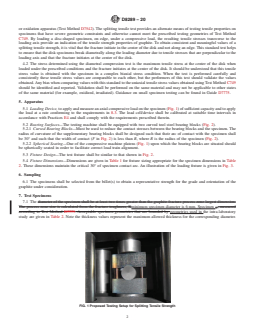
5.1 Loading Device, to apply and measure an axial compressive load on the specimen (Fig. 1) of sufficient capacity and to apply
the load at a rate conforming to the requirements in 8.3. The load cell/device shall be calibrated at suitable time intervals in
accordance with Practices E4 and shall comply with the requirements prescribed therein.
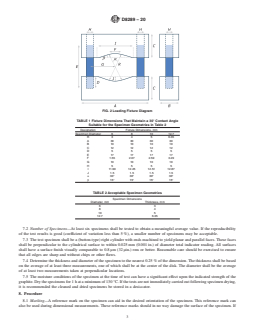
5.2 Bearing Surfaces—The testing machine shall be equipped with two curved tool steel bearing blocks (Fig. 2).
5.2.1 Curved Bearing Blocks—Must be used to reduce the contact stresses between the bearing blocks and the specimen. The
radius of curvature of the supplementary bearing blocks shall be designed such that their arc of contact with the specimen shall
be 30° and such that the width of contact (F in Fig. 2) is less than R, where R is the radius of the specimen (Fig. 2).
5.2.2 Spherical Seating—One of the compressive machine platens (Fig. 1) upon which the bearing blocks are situated should
be spherically seated in order to facilitate correct load train alignment.
5.3 Fixture Design—The test fixture shall be similar to that shown in Fig. 2.
5.4 Fixture Dimensions—Dimensions are given in Table 1 for fixture sizing appropriate for the specimen dimensions in Table
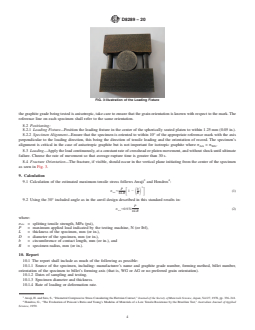
2. These dimensions maintain the critical 30° of specimen contact arc. An illustration of the loading fixture is given in Fig. 3.
6. Sampling
6.1 The specimens shall be selected from the billet(s) to obtain a representative strength for the grade and orientation of the
graphite under consideration.
7. Test Specimens
7.1 The diameter of the specimen shall be at least two times greater than the graphite fracture process zone largest dimension.
The process zone size is calculated from the fracture toughness, Kminimum specimen diameter is 6 mm. Specimen , measured
Ic
according to Test Method D7779. Acceptable specimen geometries that are bounded by geometries used in the intra-laboratory
study are given in Table 2. Note the thickness values represent the maximum allowed thickness for the corresponding diameter.
FIG. 1 Proposed Testing Setup for Splitting Tensile Strength
D8289 − 20
FIG. 2 Loading Fixture Diagram
TABLE 1 Fixture Dimensions That Maintain a 30° Contact Angle
Suitable for the Specimen Geometries in Table 2
Designation Fixture Dimensions, mm
Specimen Diameter 6 8 10 12.7
R 3 4 5 6.35
A 30 30 30 30
B 10 10 10 10
C 12 12 12 12
D 5 5 5 5
E 17 17 17 17
F 1.55 2.07 2.59 3.29
G 10 10 10 10
H 5 5 5 5
I 11.99 12.25 12.51 12.87
J 1.5 1.5 1.5 1.5
α 30° 30° 30° 30°
β 15° 15° 15° 15°
TABLE 2 Acceptable Specimen Geometries
Specimen Dimensions
Diameter, mm Thickness, mm
6 3
8 4
10 5
12.7 6.35
7.2 Number of Specimens—At least six specimens shall be tested to obtain a meaningful average value. If the reproducibility
of the test results is good (coefficient of variation less than 5 %), a smaller number of specimens may be acceptable.
7.3 The test specimen shall be a (button-type) right cylinder with ends machined to yield planar and parallel faces. These faces
shall be perpendicular to the cylindrical surface to within 0.025 mm (0.001 in.) of diameter total indicator reading. All surfaces
shall have a surface finish visually comparable to 0.8 μm (32 μin.) rms or better. Reasonable care should be exercised to ensure
that all edges are sharp and without chips or other flaws.
7.4 Determine the thickness and diameter of the
...