

ASTM D6254/D6254M-20
(Specification)Standard Specification for Wirebound Pallet-Type Wood Boxes
General Information
- Abstract
ABSTRACT
This specification covers the fabrication of new fully enclosed wire bound pallet-type wooden boxes intended for use as containers for domestic and overseas shipment of general materials and supplies, not exceeding a certain weight given. Wire bound pallet-type wooden box performance is dependent on its fabricated components; therefore, a variety of types, classes, and treatments reflecting varied performance are specified. According to type of material used in the manufacture of wooden boxes, four types are classified: Type I which are made with sheathed lumber, Type II which are made with sheathed lumber and veneer, Type III which are made of sheathed lumber and veneer with two different length sidewalls, and Type IV which are made of sheathed plywood. Four classes have been designated to wooden boxes, according to the number of entry ways: Class 1 which has partial four-way entry base, Class 2 which has two-way entry base, Class 3 which has partial four-way entry base with two different length sidewalls, and Class 4 which has two-way entry base with two different length sidewalls. And for the wooden boxes’ last classification, the way they are treated are described also as follows: Treatment A and B- with water preservative treatment and Treatment C without preservative treatment. All recovered, recycled, or virgin materials used in box manufacture shall meet the requirements of this specification and referenced documents. In addition, materials shall not affect or be affected by the product being packed. To determine the wooden boxes’ performance, the following tests shall be conducted: wood members moisture content test, coating adherence on galvanized wire test, wire tensile strength test, oxine copper preservative test, and zinc napthenate preservative test.
SCOPE
1.1 This specification covers the fabrication of new fully enclosed wirebound pallet-type wood boxes intended for use as containers for domestic and overseas shipment of general materials and supplies, not exceeding 2500 lb [1134 kg] (see 4.1 and 10.1).
1.2 Wirebound pallet-type wood box performance is dependent on its fabricated components; therefore, a variety of types, classes, and treatments reflecting varied performance are specified (see 4). This specification, however, does not cover wirebound pallet-type wood box performance under all atmosphere, handling, shipping, and storage conditions.
1.3 The use of other construction methods or techniques is acceptable and permitted (see 5.1.11), provided the resulting packaging systems shall be of equal or better performance than would result from the use of these specified materials and procedures. The appropriate distribution cycle provided in Practice D4169 can be used to develop comparative procedures and criteria.
1.4 Units—The values stated in either inch-pound or SI units are to be regarded separately as standard. Within the text, the SI units are shown in brackets. The values stated in each system are not exact equivalents; therefore, each system must be used independently of the other. Combining values from the two systems may result in nonconformance with the standard. See for conversion of units.
1.5 This standard does not purport to address all of the safety concerns, if any, associated with its use. It is the responsibility of the user of this standard to establish appropriate safety, health, and environmental practices and determine the applicability of regulatory limitations prior to use.
1.6 This international standard was developed in accordance with internationally recognized principles on standardization established in the Decision on Principles for the Development of International Standards, Guides and Recommendations issued by the World Trade Organization Technical Barriers to Trade (TBT) Committee.
- Status
- Published
- Publication Date
- 30-Sep-2020
- Technical Committee
- D10 - Packaging
Buy Documents
ASTM D6254/D6254M-20 - Standard Specification for Wirebound Pallet-Type Wood Boxes
REDLINE ASTM D6254/D6254M-20 - Standard Specification for Wirebound Pallet-Type Wood Boxes
Overview
ASTM D6254/D6254M-20 is the Standard Specification for Wirebound Pallet-Type Wood Boxes, issued by ASTM International. This specification addresses the design, fabrication, and performance requirements for new, fully enclosed wirebound pallet-type wooden boxes. These robust packaging solutions are intended for both domestic and international shipments of general materials and supplies, with a maximum allowable weight of 2500 lb (1134 kg). The standard provides a detailed classification system based on materials, box construction, entry type, and wood treatment, ensuring reliability and flexibility to meet a wide range of shipping needs.
Key Topics
Box Types: Four types defined by construction materials:
- Type I: Sheathed lumber
- Type II: Sheathed lumber and veneer
- Type III: Sheathed lumber and veneer with differing sidewall lengths
- Type IV: Sheathed plywood
Entry Classes: Base design for pallet access:
- Class 1: Partial four-way entry
- Class 2: Two-way entry
- Class 3: Partial four-way entry with different length sidewalls
- Class 4: Two-way entry with different length sidewalls
Wood Treatments:
- Treatment A: No water-repellent preservative
- Treatment B: Water-repellent preservative applied
- Treatment C: No preservative treatment
Material Quality:
- Specifies requirements for lumber, plywood, binding wire, staples, and nails
- Prohibits defects that compromise box integrity or safe handling
Performance Testing:
- Wood moisture content
- Adherence and quality of galvanized wire coating
- Wire tensile strength
- Effectiveness of wood preservative treatments
Marking & Compliance:
- Clear and permanent box identification for traceability
- Requirements for ISPM 15 phytosanitary marking and other regulatory compliance
Applications
Wirebound pallet-type wood boxes compliant with ASTM D6254/D6254M-20 are vital in logistics and transportation, providing secure protection for a variety of goods:
- Domestic and International Freight: Used widely for general materials, equipment parts, and non-hazardous supplies shipped by sea, air, or ground.
- Military and Government Use: Recognized by the U.S. Department of Defense and suitable for government supply chains.
- Warehousing and Distribution: Efficient for racking, mechanized handling, and long-term storage.
- Export Packaging: Meets ISPM 15 requirements for international shipping, protecting cargo and complying with global phytosanitary regulations.
- Industries: Common in manufacturing, automotive, aerospace, and construction, where durability and stackable design are essential.
Related Standards
Organizations referencing ASTM D6254/D6254M-20 may also need to consult these standards for comprehensive packaging solutions:
- ASTM D4169: Performance Testing of Shipping Containers and Systems
- ASTM D6199: Quality of Wood Members of Containers and Pallets
- ASTM D6253: Treatment and/or Marking of Wood Packaging Materials
- ASTM D3951: Commercial Packaging
- ASTM D996: Terminology of Packaging and Distribution Environments
- ASTM F1667: Specification for Driven Fasteners: Nails, Spikes, and Staples
- ISPM 15: International Standard for Phytosanitary Measures, applicable to wood packaging in global trade
Practical Value
Utilizing ASTM D6254/D6254M-20 ensures that wirebound pallet-type wood boxes offer reliable protection, enhanced safety, and standardized quality across transportation networks. Compliance with this specification minimizes shipping risks, reduces potential for cargo damage, and streamlines regulatory acceptance for both domestic and international logistics operations. This standard supports sustainability by accepting recycled, recovered, or virgin materials, provided they meet the outlined criteria, and underpins global trade by aligning with international regulatory requirements.
For those involved in supply chain logistics, packaging design, or procurement, conforming to ASTM D6254/D6254M-20 delivers confidence in product safety, durability, and performance.
Keywords: wirebound wood box, pallet-type containers, ASTM D6254, packaging standard, shipping boxes, export packaging, ISPM 15, wood treatment, shipping compliance.
Relations
- Effective Date
- 01-Mar-2024
- Refers
ASTM D4169-23e1 - Standard Practice for Performance Testing of Shipping Containers and Systems - Effective Date
- 01-Dec-2023
- Effective Date
- 01-Dec-2023
- Effective Date
- 01-Oct-2023
- Effective Date
- 01-Mar-2020
- Effective Date
- 01-Oct-2018
- Effective Date
- 01-Sep-2018
- Effective Date
- 01-Jul-2018
- Effective Date
- 01-May-2018
- Effective Date
- 01-Mar-2018
- Effective Date
- 01-Mar-2017
- Effective Date
- 15-Nov-2016
- Effective Date
- 01-Apr-2016
- Effective Date
- 01-Dec-2015
- Effective Date
- 01-Sep-2015
Buy Documents
ASTM D6254/D6254M-20 - Standard Specification for Wirebound Pallet-Type Wood Boxes
REDLINE ASTM D6254/D6254M-20 - Standard Specification for Wirebound Pallet-Type Wood Boxes
Get Certified
Connect with accredited certification bodies for this standard

BRCGS (Brand Reputation Compliance Global Standards)
Global food safety and quality standards owner.
Sponsored listings
Frequently Asked Questions
ASTM D6254/D6254M-20 is a technical specification published by ASTM International. Its full title is "Standard Specification for Wirebound Pallet-Type Wood Boxes". This standard covers: ABSTRACT This specification covers the fabrication of new fully enclosed wire bound pallet-type wooden boxes intended for use as containers for domestic and overseas shipment of general materials and supplies, not exceeding a certain weight given. Wire bound pallet-type wooden box performance is dependent on its fabricated components; therefore, a variety of types, classes, and treatments reflecting varied performance are specified. According to type of material used in the manufacture of wooden boxes, four types are classified: Type I which are made with sheathed lumber, Type II which are made with sheathed lumber and veneer, Type III which are made of sheathed lumber and veneer with two different length sidewalls, and Type IV which are made of sheathed plywood. Four classes have been designated to wooden boxes, according to the number of entry ways: Class 1 which has partial four-way entry base, Class 2 which has two-way entry base, Class 3 which has partial four-way entry base with two different length sidewalls, and Class 4 which has two-way entry base with two different length sidewalls. And for the wooden boxes’ last classification, the way they are treated are described also as follows: Treatment A and B- with water preservative treatment and Treatment C without preservative treatment. All recovered, recycled, or virgin materials used in box manufacture shall meet the requirements of this specification and referenced documents. In addition, materials shall not affect or be affected by the product being packed. To determine the wooden boxes’ performance, the following tests shall be conducted: wood members moisture content test, coating adherence on galvanized wire test, wire tensile strength test, oxine copper preservative test, and zinc napthenate preservative test. SCOPE 1.1 This specification covers the fabrication of new fully enclosed wirebound pallet-type wood boxes intended for use as containers for domestic and overseas shipment of general materials and supplies, not exceeding 2500 lb [1134 kg] (see 4.1 and 10.1). 1.2 Wirebound pallet-type wood box performance is dependent on its fabricated components; therefore, a variety of types, classes, and treatments reflecting varied performance are specified (see 4). This specification, however, does not cover wirebound pallet-type wood box performance under all atmosphere, handling, shipping, and storage conditions. 1.3 The use of other construction methods or techniques is acceptable and permitted (see 5.1.11), provided the resulting packaging systems shall be of equal or better performance than would result from the use of these specified materials and procedures. The appropriate distribution cycle provided in Practice D4169 can be used to develop comparative procedures and criteria. 1.4 Units—The values stated in either inch-pound or SI units are to be regarded separately as standard. Within the text, the SI units are shown in brackets. The values stated in each system are not exact equivalents; therefore, each system must be used independently of the other. Combining values from the two systems may result in nonconformance with the standard. See for conversion of units. 1.5 This standard does not purport to address all of the safety concerns, if any, associated with its use. It is the responsibility of the user of this standard to establish appropriate safety, health, and environmental practices and determine the applicability of regulatory limitations prior to use. 1.6 This international standard was developed in accordance with internationally recognized principles on standardization established in the Decision on Principles for the Development of International Standards, Guides and Recommendations issued by the World Trade Organization Technical Barriers to Trade (TBT) Committee.
ABSTRACT This specification covers the fabrication of new fully enclosed wire bound pallet-type wooden boxes intended for use as containers for domestic and overseas shipment of general materials and supplies, not exceeding a certain weight given. Wire bound pallet-type wooden box performance is dependent on its fabricated components; therefore, a variety of types, classes, and treatments reflecting varied performance are specified. According to type of material used in the manufacture of wooden boxes, four types are classified: Type I which are made with sheathed lumber, Type II which are made with sheathed lumber and veneer, Type III which are made of sheathed lumber and veneer with two different length sidewalls, and Type IV which are made of sheathed plywood. Four classes have been designated to wooden boxes, according to the number of entry ways: Class 1 which has partial four-way entry base, Class 2 which has two-way entry base, Class 3 which has partial four-way entry base with two different length sidewalls, and Class 4 which has two-way entry base with two different length sidewalls. And for the wooden boxes’ last classification, the way they are treated are described also as follows: Treatment A and B- with water preservative treatment and Treatment C without preservative treatment. All recovered, recycled, or virgin materials used in box manufacture shall meet the requirements of this specification and referenced documents. In addition, materials shall not affect or be affected by the product being packed. To determine the wooden boxes’ performance, the following tests shall be conducted: wood members moisture content test, coating adherence on galvanized wire test, wire tensile strength test, oxine copper preservative test, and zinc napthenate preservative test. SCOPE 1.1 This specification covers the fabrication of new fully enclosed wirebound pallet-type wood boxes intended for use as containers for domestic and overseas shipment of general materials and supplies, not exceeding 2500 lb [1134 kg] (see 4.1 and 10.1). 1.2 Wirebound pallet-type wood box performance is dependent on its fabricated components; therefore, a variety of types, classes, and treatments reflecting varied performance are specified (see 4). This specification, however, does not cover wirebound pallet-type wood box performance under all atmosphere, handling, shipping, and storage conditions. 1.3 The use of other construction methods or techniques is acceptable and permitted (see 5.1.11), provided the resulting packaging systems shall be of equal or better performance than would result from the use of these specified materials and procedures. The appropriate distribution cycle provided in Practice D4169 can be used to develop comparative procedures and criteria. 1.4 Units—The values stated in either inch-pound or SI units are to be regarded separately as standard. Within the text, the SI units are shown in brackets. The values stated in each system are not exact equivalents; therefore, each system must be used independently of the other. Combining values from the two systems may result in nonconformance with the standard. See for conversion of units. 1.5 This standard does not purport to address all of the safety concerns, if any, associated with its use. It is the responsibility of the user of this standard to establish appropriate safety, health, and environmental practices and determine the applicability of regulatory limitations prior to use. 1.6 This international standard was developed in accordance with internationally recognized principles on standardization established in the Decision on Principles for the Development of International Standards, Guides and Recommendations issued by the World Trade Organization Technical Barriers to Trade (TBT) Committee.
ASTM D6254/D6254M-20 is classified under the following ICS (International Classification for Standards) categories: 55.160 - Cases. Boxes. Crates. The ICS classification helps identify the subject area and facilitates finding related standards.
ASTM D6254/D6254M-20 has the following relationships with other standards: It is inter standard links to ASTM D6253-24, ASTM D4169-23e1, ASTM D4169-23, ASTM D3951-18(2023), ASTM D4442-20, ASTM D6199-18a, ASTM F1667-18, ASTM D4444-13(2018), ASTM D3951-18, ASTM D6199-18, ASTM F1667-17, ASTM D4442-16, ASTM D6253-16, ASTM D3951-15, ASTM F1667-15. Understanding these relationships helps ensure you are using the most current and applicable version of the standard.
ASTM D6254/D6254M-20 is available in PDF format for immediate download after purchase. The document can be added to your cart and obtained through the secure checkout process. Digital delivery ensures instant access to the complete standard document.
Standards Content (Sample)
This international standard was developed in accordance with internationally recognized principles on standardization established in the Decision on Principles for the
Development of International Standards, Guides and Recommendations issued by the World Trade Organization Technical Barriers to Trade (TBT) Committee.
Designation:D6254/D6254M −20
Standard Specification for
Wirebound Pallet-Type Wood Boxes
This standard is issued under the fixed designation D6254/D6254M; the number immediately following the designation indicates the
year of original adoption or, in the case of revision, the year of last revision. A number in parentheses indicates the year of last
reapproval. A superscript epsilon (´) indicates an editorial change since the last revision or reapproval.
This standard has been approved for use by agencies of the U.S. Department of Defense.
1. Scope mendations issued by the World Trade Organization Technical
Barriers to Trade (TBT) Committee.
1.1 This specification covers the fabrication of new fully
enclosedwireboundpallet-typewoodboxesintendedforuseas
2. Referenced Documents
containers for domestic and overseas shipment of general
2.1 ASTM Standards:
materials and supplies, not exceeding 2500 lb [1134 kg] (see
D996Terminology of Packaging and Distribution Environ-
4.1 and 10.1).
ments
1.2 Wirebound pallet-type wood box performance is depen-
D3951Practice for Commercial Packaging
dentonitsfabricatedcomponents;therefore,avarietyoftypes,
D3953Specification for Strapping, Flat Steel and Seals
classes,andtreatmentsreflectingvariedperformancearespeci-
D4169Practice for Performance Testing of Shipping Con-
fied (see 4). This specification, however, does not cover
tainers and Systems
wirebound pallet-type wood box performance under all
D4442Test Methods for Direct Moisture Content Measure-
atmosphere, handling, shipping, and storage conditions.
ment of Wood and Wood-Based Materials
1.3 The use of other construction methods or techniques is
D4444Test Method for Laboratory Standardization and
acceptable and permitted (see 5.1.11), provided the resulting
Calibration of Hand-Held Moisture Meters
packagingsystemsshallbeofequalorbetterperformancethan
D6199PracticeforQualityofWoodMembersofContainers
would result from the use of these specified materials and
and Pallets
procedures. The appropriate distribution cycle provided in D6253Practice for Treatment and/or Marking of Wood
PracticeD4169canbeusedtodevelopcomparativeprocedures
Packaging Materials
and criteria. F1667SpecificationforDrivenFasteners:Nails,Spikes,and
Staples
1.4 Units—The values stated in either inch-pound or SI
IEEE/ASTM SI 10Standard for Use of the International
units are to be regarded separately as standard.Within the text,
System of Units (SI): The Modern Metric System
the SI units are shown in brackets. The values stated in each
2.2 Code of Federal Regulations:
system are not exact equivalents; therefore, each system must
CFR Parts 107–180,Title 49, Hazardous Materials Regula-
beusedindependentlyoftheother.Combiningvaluesfromthe
tions
two systems may result in nonconformance with the standard.
2.3 National Institute of Standards and Technology (NIST)
See for conversion of units.
Standard:
1.5 This standard does not purport to address all of the
PS 1–07 Structural Plywood
safety concerns, if any, associated with its use. It is the
PS 20–05American Softwood Lumber Standard
responsibility of the user of this standard to establish appro-
2.4 Hardwood Plywood and Veneer Association Standard:
priate safety, health, and environmental practices and deter-
ANSI/HPVA HP-1-2004American National Standard for
mine the applicability of regulatory limitations prior to use.
Hardwood and Decorative Plywood
1.6 This international standard was developed in accor-
dance with internationally recognized principles on standard-
ization established in the Decision on Principles for the
For referenced ASTM standards, visit the ASTM website, www.astm.org, or
Development of International Standards, Guides and Recom-
contact ASTM Customer Service at service@astm.org. For Annual Book of ASTM
Standards volume information, refer to the standard’s Document Summary page on
the ASTM website.
1 3
This specification is under the jurisdiction ofASTM Committee D10 and is the AvailablefromU.S.GovernmentPrintingOffice,732N.CapitolSt.,NW,Mail
direct responsibility of Subcommittee D10.12 on Shipping Containers, Crates, Stop: SDE, Washington, DC 20401, www.access.gpo.gov.
Pallets, Skids and Related Structures. Available from National Institude of Standards and Technology (NIST), 100
Current edition approved Oct. 1, 2020. Published October 2020. Originally Bureau Dr., Stop 1070, Gaithersburg, MD 20899-1070, www.nist.gov.
approved in 1998. Last previous edition approved in 2013 as D6254/D6254M–13. Available from Hardwood Plywood andVeneerAssociation (HPVA), P.O. Box
DOI: 10.1520/D6254_D6254M-20. 2789, Reston, VA 22090-0789, www.hpva.org.
Copyright © ASTM International, 100 Barr Harbor Drive, PO Box C700, West Conshohocken, PA 19428-2959. United States
D6254/D6254M−20
2.5 National Motor Freight Traffıc Association: 3.2.8 plywood—panel built up of sheers of veneer called
National Motor Freight Classification plies, united under pressure by a bonding agent to create a
7 panel with an adhesive bond between plies.
2.6 Uniform Classification Committee Standard:
Uniform Freight Classification 3.2.9 staple—U-shaped piece of wire with pointed ends,
8 driven astride the binding wires in fabricating the blank or
2.7 American Wood Protection Association (AWPA):
attaching boards to battens.
AWPA P36Standard for Copper Naphthenate (CuN)
3.2.10 stringer—a runner to which the riser batten and
AWPA P37 Standard for Oxine Copper (Copper-8-
deckboards are attached and which serves as a spacer between
Quinolinolate) (Cu8)
top and bottom deckboards to permit mechanical handling
2.8 Material Handling Industry of America (MHIA)/ANSI
9 equipment entry.
Standard:
3.2.11 veneer—thin layer or sheet of wood.
MHIA/ANSI MH1–2005Pallets, Slip Sheets, and Other
Bases for Unit Loads
4. Classification
2.9 International Standard
International Standards for Phytosanitary Measures Publica- 4.1 Type:
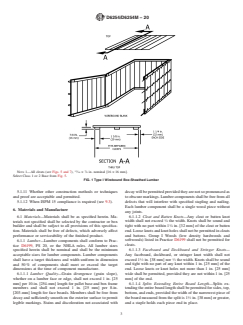
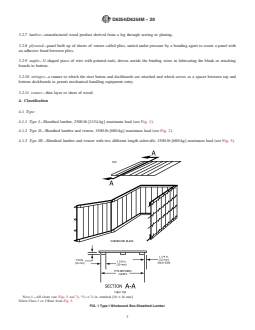
4.1.1 Type I—Sheathed lumber, 2500-lb [1134-kg] maxi-
tion No. 15 (ISPM 15)Regulation of Wood Packaging
Material in International Trade mum load (see Fig. 1).
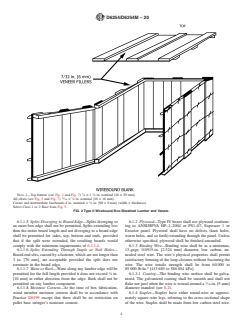
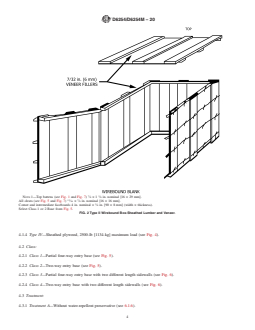
4.1.2 Type II—Sheathed lumber and veneer, 1500-lb [680-
2.10 U.S. Army Research, Development and Engineering
11 kg] maximum load (see Fig. 2).
Center (ARDEC)
4.1.3 Type III—Sheathed lumber and veneer with two dif-
MIL-DTL-2427H Box, ammunition packing: Wood, nailed
ferent length sidewalls, 1500-lb [680-kg] maximum load (see
Fig. 3).
3. Terminology
4.1.4 Type IV—Sheathedplywood,2500-lb[1134-kg]maxi-
3.1 Definitions—General definitions for packaging and dis-
mum load (see Fig. 4).
tribution environments are found in Terminology D996.
4.2 Class:
3.2 Definitions of Terms Specific to This Standard: The
4.2.1 Class 1—Partial four-way entry base (see Fig. 5).
wood box components discussed herein were selected on the
4.2.2 Class 2—Two-way entry base (see Fig. 5).
basis of part function.Alternate names are sometimes used by
4.2.3 Class 3—Partial four-way entry base with two differ-
the wood packaging industry and end-users.
ent length sidewalls (see Fig. 6).
3.2.1 batten—reinforcement used to hold the faceboards
4.2.4 Class 4—Two-way entry base with two different
together to create rigidity.
length sidewalls (see Fig. 6).
3.2.2 binding wire—round steel wire stapled to the face-
4.3 Treatment:
boards which ends in a loop, the prong of which is firmly
4.3.1 Treatment A—Without water-repellent preservative
anchored in a board or twisted to form a loop.
(see 6.1.6).
3.2.3 blank—aflatunassembledwireboundboxexclusiveof
4.3.2 Treatment B—With water-repellent wood preservative
pallet base and top.
(see 6.1.6).
3.2.4 cleat—lumber piece which forms the wirebound box
framework and to which the faceboards are stapled.
5. Ordering Information
3.2.5 deckboard—the material used to make up the pallet
5.1 Purchasers should select the preferred permitted options
base top and bottom surfaces referred to as top and bottom
and include the following information in procurement and
deckboards.
purchase order documents:
5.1.1 Specification title, number, and date.
3.2.6 faceboard—the material used for the front, end,
bottom, sides, and top. 5.1.2 Box type, class, and treatment required (see 4.1 – 4.3
and 7.1).
3.2.7 lumber—manufactured wood product derived from a
5.1.3 Contents weight.
log through sawing or planing.
5.1.4 Modifications to container manufacturer’s identifica-
tion (see 7.5).
5.1.5 Box dimensions specified in order of length × width ×
Available from National Motor Freight Traffic Association, Inc. (NMFTA),
depth (see 7.6 and Fig. 7).
1001 N Fairfax St., Ste 600, Alexandria, VA 22314, www.nmfta.org.
Available from the Uniform Classification Committee, Tariff Publishing 5.1.6 When preservative treatment is required (see 4.3 and
Officer, 151 Ellis St., N.E. Suite 200, Atlanta, GA 30335.
6.1.6).
Available from American Wood Protection Association (AWPA), P.O. Box
5.1.7 Whether boxes are to be shipped assembled or
361784, Birmingham, AL 35236-1784, awpa.com.
knocked down (see 9.1).
Available from Material Handling Industry of America (MHIA) MH1
Secretariat, 8720 Red Oak Blvd., Suite 201, Charlotte, NC 28217, www.mhiastore-
5.1.8 Whether additional markings are required (see 9.2).
.org.
5.1.9 Whetherdifferentstrappingmaterialsarerequired(see
AvailablefromtheInternationalPlantProtectionConvention(IPPC),www.ip-
S2.2).
pc.int.
Available from ASSIST Quicksearch, assist.daps.dla.mil/quicksearch 5.1.10 Whether additional support is required (see S2.2.3).
D6254/D6254M−20
13 7
NOTE 1—All cleats (see Figs. 5 and 7), ⁄16 × ⁄8 in. nominal [16 × 16 mm].
Select Class 1 or 2 Base from Fig. 5.
FIG. 1Type I Wirebound Box-Sheathed Lumber
5.1.11 Whether other construction methods or techniques decaywillbepermittedprovidedtheyarenotsopronouncedas
and proof are acceptable and permitted. toobscuremarkings.Lumbercomponentsshallbefreefromall
5.1.12 When ISPM 15 compliance is required (see 9.3). defects that will interfere with specified stapling and nailing.
Each lumber component shall be a single wood piece without
6. Materials and Manufacture
any joints.
6.1.1.2 Cleat and Batten Knots—Any cleat or batten knot
6.1 Materials—Materials shall be as specified herein. Ma-
width shall not exceed ⁄4 the width. Knots shall be sound and
terials not specified shall be selected by the contractor or box
builder and shall be sufject to all provisions of this specifica- tight with no part within 1 ⁄4 in. [32 mm] of the cleat or batten
end.Looseknotsandknotholesshallnotbepermittedincleats
tion. Materials shall be free of defects, which adversely affect
performance or serviceability of the finished product. and battens. Group I Woods (low density hardwoods and
softwoods) listed in Practice D6199 shall not be permitted for
6.1.1 Lumber—Lumber components shall conform to Prac-
cleats.
tice D6199, PS 20, or the NHLA rules. All lumber sizes
6.1.1.3 Faceboard and Deckboard and Stringer Knots—
specified herein shall be nominal and shall be the minimum
acceptable sizes for lumber components. Lumber components Any faceboard, deckboard, or stringer knot width shall not
1 1
exceed 1 ⁄2 in. [38 mm] nor ⁄3 the width. Knots shall be sound
shall have a target thickness and width uniform in dimension
and 50% of components shall meet or exceed the target and tight with no part of any knot within 1 in. [25 mm] of the
end. Loose knots or knot holes not more than 1 in. [25 mm]
dimensions at the time of component manufacture.
6.1.1.1 Lumber Quality—Grain divergence (grain slope), wide shall be permitted, provided they are not within 1 in. [25
mm] of the end.
whether on a lumber face or edge, shall not exceed 1 in. [25
mm] per 10-in. [254-mm] length for pallet base and box frame 6.1.1.4 Splits Extending Entire Board Length—Splits ex-
members and shall not exceed 1 in. [25 mm] per 8-in. tendingtheentireboardlengthshallbepermittedforsides,top,
[203-mm] length for face boards. Members shall be free from bottom,andends,providedthewidthofthenarrowestpieceof
decay and sufficiently smooth on the exterior surface to permit theboardmeasuredfromthesplitis1 ⁄2in.[38mm]orgreater,
legible markings. Stains and discoloration not associated with and a staple holds each piece end in place.
D6254/D6254M−20
7 3
NOTE 1—Top battens (see Fig. 1 and Fig. 7) ⁄8×1 ⁄8 in. nominal [16 × 29 mm].
13 7
All cleats (see Fig. 5 and Fig. 7) ⁄16 × ⁄8 in. nominal [16 × 16 mm].
Corner and intermediate faceboards 4 in. nominal × ⁄8 in. [90 × 8 mm] (width × thickness).
Select Class 1 or 2 Base from Fig. 5.
FIG. 2Type II Wirebound Box-Sheathed Lumber and Veneer.
6.1.1.5 Splits Diverging to Board Edge—Splits diverging to 6.1.2 Plywood—Type IVboxes shall use plywood conform-
an outer box edge shall not be permitted. Splits extending less ing to ANSI/HPVA HP–1–2004 or PS1–07, Exposure 1 or
than the entire board length and not diverging to a board edge Exterior panel. Plywood shall have no defects (knot holes,
shall be permitted for sides, top, bottom and ends, provided worm holes, and so forth) extending through the panel. Unless
that if the split were extended, the resulting boards would otherwise specified, plywood shall be finished unsanded.
comply with the minimum requirements of 6.1.1.4. 6.1.3 Binding Wire—Binding wire shall be as a minimum,
6.1.1.6 Splits Extending Through Staple or Nail Holes— 13-gage, 0.0915-in. [2.324 mm] diameter, low carbon, an-
Board-endslits,causedbyafastener,whicharenotlongerthan nealed steel wire. The wire’s physical properties shall permit
3 in. [76 mm], are acceptable provided the split does not satisfactoryformingoftheloopclosureswithoutfracturingthe
terminate in the board edge. wire. The wire tensile strength shall be from 60000 to
6.1.1.7 Wane or Bark—Wanealonganylumberedgewillbe 85000-lb⁄in. [413685 to 586054 kPa].
permitted for the full length provided it does not exceed ⁄8 in. 6.1.3.1 Coating—The binding wire surface shall be galva-
[10 mm] in either direction from the edge. Bark shall not be nized. The galvanized coating shall be smooth and shall not
permitted on any lumber component. flakenorpeelwhenthewireiswoundarounda ⁄16-in.[5-mm]
6.1.1.8 Moisture Content—At the time of box fabrication, diameter mandrel (see 8.2).
wood member moisture content shall be in accordance with 6.1.4 Staples—Staples have either round-wire or approxi-
Practice D6199 except that there shall be no restriction on mately square-wire legs, referring to the cross-sectional shape
pallet base stringer’s moisture content. of the wire. Staples shall be made from low carbon steel wire.
D6254/D6254M−20
13 5
NOTE 1—Top cleat ⁄16×1 ⁄8 in. nominal [16 × 35 mm].
13 7
Bottom cleat ⁄16 × ⁄8 in. nominal [16 × 16 mm].
7 3
Top battens ⁄8×1 ⁄8 in. nominal [16 × 29 mm] (thickness × width).
Corner and intermediate faceboards 4 in. wide nominal × ⁄8 in. thick [90 × 8 mm].
Select Class 3 or 4 Base from Fig. 6.
FIG. 3Type III Wirebound Box-Sheathed Lumber and Veneer with Two Different Length Sidewalls.
Thewiretensilestrengthshallbefrom95000to125000lb/in. flakenorpeelwhenthewireiswoundarounda ⁄16-in.[5-mm]
[655 002 to 861 844 kPa]. Staples shall be in accordance with diameter mandrel (see 8.2).
SpecificationF1667,TypeIV,Style3–FlatTopCrownStaples.
6.1.4.1 Coating—The staple wire surface shall be galva-
nized. The galvanized coating shall be smooth and shall not
D6254/D6254M−20
7 3
NOTE 1—Top battens (see Fig. 1 and Fig. 7) ⁄8×1 ⁄8 in. nominal [16 × 29 mm].
16 7
All cleats (see Fig. 5 and Fig. 7) ⁄16 × ⁄8 in. nominal [16 × 16 mm]
Select Class 1 or 2 from Fig. 5
FIG. 4Type IV Wirebound Box Sheathed Plywood.
6.1.5 Nails—Nails shall conform to Specification F1667 or maximum inside depth (load height). The inside length shall
other industry standards. Nails are classified as plain-shank,
notexceed96in.[2438mm].Theinsidewidthshallnotexceed
helicallythreaded,annularlythreaded,fluted,ortwistedsquare
48 in. [1219 mm]. The inside length and width dimensions,
wire.
when added together, shall not exceed 128 in. [3251 mm].
6.1.6 Water-Repellent Wood Preservative—Water-repellent
Bases shall conform to Fig. 5.
wood preservative shall be a solution containing either copper
7.2 Wirebound Blank:
naphthenate conforming with Practice D6253, MIL-DTL-
7.2.1 Cleats—Cleats shall be made of Group II (medium
2427HandAWPAP36withaminimumconcentrationof2.0%
density softwoods), III (medium density hardwoods), or IV
copper metal, oxine copper (formerly referred to as copper-8-
quinolinolate) conforming with Practice D6253, MIL-DTL- (high density hardwoods and softwoods) woods listed in
2427HandAWPAP37withaminimumconcentrationof1.8% Practice D6199. All cleat ends, except the bottom cleats for
copper metal, or 3 % zinc naphthenate conforming with
TypeIIIboxes,shallbemitered.ThebottomcleatsforTypeIII
Practice D6253 and MIL-DTL-2427H. boxes shall be butt-end.The cleat width and thickness shall be
as shown on the applicable figure with a 6 ⁄32-in. [61-mm]
7. Construction
width dimensional tolerance and the minimum thickness shall
7.1 Box Type and Class—A partial four-way or two-way be ⁄8 in. [16 mm].
entrybasemaybeusedwitheachboxtypeasspecified(see4.2
7.2.2 Faceboards—Face boards shall be made from any of
and 5.1.2).
the wood species permitted in Practice D6199. Face boards,
7.1.1 Type I Boxes—Type I boxes shall conform to Fig. 1.
3 1
where required by the applicable figures, shall be ⁄8 6 ⁄32-in.
Type I boxes shall be limited to 48-in. [1219-mm] maximum
[10 6 1-mm] thick. Type I box face board minimum width
inside depth (load height).The inside length or width shall not
shall be 2 ⁄2 in. [51 mm], except at the box blank leading and
exceed 60 in. [1524 mm], and when added together, shall not
trailing edges, which shall be 4-in. [90-mm] nominal width.
exceed 102 in. [2591 mm]. Bases shall conform to Fig. 5.
7.2.3 Corner and Intermediate Face Boards—All Type II
7.1.2 Type II Boxes—Type II boxes shall conform to Fig. 2.
and III box corner and intermediate face boards shall be
Type II boxes shall be limited to 40-in. [1016-mm] maximum
nominal 4 in. [90 mm] wide and ⁄8 in. [8 mm] thick. Wood
inside depth (load height). The inside length and width
veneer ⁄32 in. [6 mm] thick shall be used between the face
dimensions,whenaddedtogether,shallnotexceed96in.[2438
boards.The veneer thickness shall be not less than 95% of the
mm]. Bases shall conform to Fig. 5.
specified thickness.
7.1.3 Type III Boxes—Type III boxes shall conform to Fig.
7.2.4 Plywood Face Boards—Type IV box plywood face
3 and to the dimensional limitations of Type II boxes (see
7.1.2). Bases shall conform to Fig. 6. boardsforsidesandtopshallbe ⁄8-in.[10-mm]thick.Thebox
sides outer ply grain direction shall be vertical to the base.The
7.1.4 Type IV Boxes—Type IV boxes shall conform to Fig.
4. Type IV boxes shall be limited to 48-in. [1219-mm] plywood thickness shall be not less than 95% of the specified
D6254/D6254M−20
FIG. 5Class 1 and 2—Pallet Bases (for Types I, II, and IV Boxes)
thickness. When a box panel width does not exceed 48 in. specified in Table 1. One binder wire shall be placed over each
[1219 mm], the plywood used shall be one piece. row of cleats. When possible, the remaining wires shall be
7.2.5 Binding Wire—Each binding wire shall be continuous spaced uniformly between t
...
This document is not an ASTM standard and is intended only to provide the user of an ASTM standard an indication of what changes have been made to the previous version. Because
it may not be technically possible to adequately depict all changes accurately, ASTM recommends that users consult prior editions as appropriate. In all cases only the current version
of the standard as published by ASTM is to be considered the official document.
Designation: D6254/D6254M − 13 D6254/D6254M − 20
Standard Specification for
Wirebound Pallet-Type Wood Boxes
This standard is issued under the fixed designation D6254/D6254M; the number immediately following the designation indicates the
year of original adoption or, in the case of revision, the year of last revision. A number in parentheses indicates the year of last
reapproval. A superscript epsilon (´) indicates an editorial change since the last revision or reapproval.
This standard has been approved for use by agencies of the U.S. Department of Defense.
1. Scope
1.1 This specification covers the fabrication of new fully enclosed wirebound pallet-type wood boxes intended for use as
containers for domestic and overseas shipment of general materials and supplies, not exceeding 2500 lb [1134 kg] (see 4.1 and
10.1).
1.2 Wirebound pallet-type wood box performance is dependent on its fabricated components; therefore, a variety of types, classes,
and treatments reflecting varied performance are specified (see 4). This specification, however, does not cover wirebound
pallet-type wood box performance under all atmosphere, handling, shipping, and storage conditions.
1.3 The use of other construction methods or techniques is acceptable and permitted (see 5.1.11), provided the resulting packaging
systems shall be of equal or better performance than would result from the use of these specified materials and procedures. The
appropriate distribution cycle provided in Practice D4169 can be used to develop comparative procedures and criteria.
1.4 Units—The values stated in either inch-pound or SI units are to be regarded separately as standard. Within the text, the SI units
are shown in brackets. The values stated in each system are not exact equivalents; therefore, each system must be used
independently of the other. Combining values from the two systems may result in nonconformance with the standard. See for
conversion of units.
1.5 This standard does not purport to address all of the safety concerns, if any, associated with its use. It is the responsibility
of the user of this standard to establish appropriate safety safety, health, and healthenvironmental practices and determine the
applicability of regulatory limitations prior to use.
1.6 This international standard was developed in accordance with internationally recognized principles on standardization
established in the Decision on Principles for the Development of International Standards, Guides and Recommendations issued
by the World Trade Organization Technical Barriers to Trade (TBT) Committee.
2. Referenced Documents
2.1 ASTM Standards:
D996 Terminology of Packaging and Distribution Environments
D3951 Practice for Commercial Packaging
D3953 Specification for Strapping, Flat Steel and Seals
This specification is under the jurisdiction of ASTM Committee D10 and is the direct responsibility of Subcommittee D10.12 on Shipping Containers, Crates, Pallets,
Skids and Related Structures.
Current edition approved April 15, 2013Oct. 1, 2020. Published September 2013October 2020. Originally approved in 1998. Last previous edition approved in 20072013
as D6254/D6254M – 07.D6254/D6254M – 13. DOI: 10.1520/D6254_D6254M-13.10.1520/D6254_D6254M-20.
For referenced ASTM standards, visit the ASTM website, www.astm.org, or contact ASTM Customer Service at service@astm.org. For Annual Book of ASTM Standards
volume information, refer to the standard’s Document Summary page on the ASTM website.
Copyright © ASTM International, 100 Barr Harbor Drive, PO Box C700, West Conshohocken, PA 19428-2959. United States
D6254/D6254M − 20
D4169 Practice for Performance Testing of Shipping Containers and Systems
D4442 Test Methods for Direct Moisture Content Measurement of Wood and Wood-Based Materials
D4444 Test Method for Laboratory Standardization and Calibration of Hand-Held Moisture Meters
D6199 Practice for Quality of Wood Members of Containers and Pallets
D6253 Practice for Treatment and/or Marking of Wood Packaging Materials
F1667 Specification for Driven Fasteners: Nails, Spikes, and Staples
IEEE/ASTM SI 10 Standard for Use of the International System of Units (SI): The Modern Metric System
2.2 Code of Federal Regulations:
CFR Parts 107–180, Title 49, Hazardous Materials Regulations
2.3 National Institute of Standards and Technology (NIST) Standard:
PS 1–07 Structural Plywood
PS 20–05 American Softwood Lumber Standard
2.4 Hardwood Plywood and Veneer Association Standard:
ANSI/HPVA HP-1-2004 American National Standard for Hardwood and Decorative Plywood
2.5 National Motor Freight Traffıc Association:
National Motor Freight Classification
2.6 Uniform Classification Committee Standard:
Uniform Freight Classification
2.7 American Wood Protection Association (AWPA):
AWPA P36 Standard for Copper Naphthenate (CuN)
AWPA P37 Standard for Oxine Copper (Copper-8-Quinolinolate) (Cu8)
2.8 Material Handling Industry of America (MHIA)/ANSI Standard:
MHIA/ANSI MH1–2005 Pallets, Slip Sheets, and Other Bases for Unit Loads
2.9 International Standard
International Standards for Phytosanitary Measures Publication No. 15 (ISPM 15) Regulation of Wood Packaging Material in
International Trade
2.10 U.S. Army Research, Development and Engineering Center (ARDEC)
MIL-DTL-2427H Box, ammunition packing: Wood, nailed
3. Terminology
3.1 Definitions—General definitions for packaging and distribution environments are found in Terminology D996.
3.2 Definitions of Terms Specific to This Standard: The wood box components discussed herein were selected on the basis of
part function. Alternate names are sometimes used by the wood packaging industry and end-users.
3.2.1 batten—reinforcement used to hold the faceboards together to create rigidity.
3.2.2 binding wire—round steel wire stapled to the faceboards which ends in a loop, the prong of which is firmly anchored in a
board or twisted to form a loop.
3.2.3 blank—a flat unassembled wirebound box exclusive of pallet base and top.
3.2.4 cleat—lumber piece which forms the wirebound box framework and to which the faceboards are stapled.
3.2.5 deckboard—the material used to make up the pallet base top and bottom surfaces referred to as top and bottom deckboards.
3.2.6 faceboard—the material used for the front, end, bottom, sides, and top.
Available from U.S. Government Printing Office, 732 N. Capitol St., NW, Mail Stop: SDE, Washington, DC 20401, www.access.gpo.gov.
Available from National Institude of Standards and Technology (NIST), 100 Bureau Dr., Stop 1070, Gaithersburg, MD 20899-1070, www.nist.gov.
Available from Hardwood Plywood and Veneer Association (HPVA), P.O. Box 2789, Reston, VA 22090-0789, www.hpva.org.
Available from National Motor Freight Traffic Association, Inc. (NMFTA), 1001 N Fairfax St., Ste 600, Alexandria, VA 22314, www.nmfta.org.
Available from the Uniform Classification Committee, Tariff Publishing Officer, 151 Ellis St., N.E. Suite 200, Atlanta, GA 30335.
Available from American Wood Protection Association (AWPA), P.O. Box 361784, Birmingham, AL 35236-1784, awpa.com.
Available from Material Handling Industry of America (MHIA) MH1 Secretariat, 8720 Red Oak Blvd., Suite 201, Charlotte, NC 28217, www.mhiastore.org.
Available from the International Plant Protection Convention (IPPC), www.ippc.int.
Available from ASSIST Quicksearch, assist.daps.dla.mil/quicksearch
D6254/D6254M − 20
3.2.7 lumber—manufactured wood product derived from a log through sawing or planing.
3.2.8 plywood—panel built up of sheers of veneer called plies, united under pressure by a bonding agent to create a panel with
an adhesive bond between plies.
3.2.9 staple—U-shaped piece of wire with pointed ends, driven astride the binding wires in fabricating the blank or attaching
boards to battens.
3.2.10 stringer—a runner to which the riser batten and deckboards are attached and which serves as a spacer between top and
bottom deckboards to permit mechanical handling equipment entry.
3.2.11 veneer—thin layer or sheet of wood.
4. Classification
4.1 Type:
4.1.1 Type I—Sheathed lumber, 2500-lb [1134-kg] maximum load (see Fig. 1).
4.1.2 Type II—Sheathed lumber and veneer, 1500-lb [680-kg] maximum load (see Fig. 2).
4.1.3 Type III—Sheathed lumber and veneer with two different length sidewalls, 1500-lb [680-kg] maximum load (see Fig. 3).
13 7
NOTE 1—All cleats (see Figs. 5 and 7), ⁄16 × ⁄8 in. nominal [16 × 16 mm].
Select Class 1 or 2 Base from Fig. 5.
FIG. 1 Type I Wirebound Box-Sheathed Lumber
D6254/D6254M − 20
7 3
NOTE 1—Top battens (see Fig. 1 and Fig. 7) ⁄8 × 1 ⁄8 in. nominal [16 × 29 mm].
13 7
All cleats (see Fig. 5 and Fig. 7) ⁄16 × ⁄8 in. nominal [16 × 16 mm].
Corner and intermediate faceboards 4 in. nominal × ⁄8 in. [90 × 8 mm] (width × thickness).
Select Class 1 or 2 Base from Fig. 5.
FIG. 2 Type II Wirebound Box-Sheathed Lumber and Veneer.
4.1.4 Type IV—Sheathed plywood, 2500-lb [1134-kg] maximum load (see Fig. 4).
4.2 Class:
4.2.1 Class 1—Partial four-way entry base (see Fig. 5).
4.2.2 Class 2—Two-way entry base (see Fig. 5).
4.2.3 Class 3—Partial four-way entry base with two different length sidewalls (see Fig. 6).
4.2.4 Class 4—Two-way entry base with two different length sidewalls (see Fig. 6).
4.3 Treatment:
4.3.1 Treatment A—Without water-repellent preservative (see 6.1.6).
D6254/D6254M − 20
13 5
NOTE 1—Top cleat ⁄16 × 1 ⁄8 in. nominal [16 × 35 mm].
13 7
Bottom cleat ⁄16 × ⁄8 in. nominal [16 × 16 mm].
7 3
Top battens ⁄8 × 1 ⁄8 in. nominal [16 × 29 mm] (thickness × width).
Corner and intermediate faceboards 4 in. wide nominal × ⁄8 in. thick [90 × 8 mm].
Select Class 3 or 4 Base from Fig. 6.
FIG. 3 Type III Wirebound Box-Sheathed Lumber and Veneer with Two Different Length Sidewalls.
4.3.2 Treatment B—With water-repellent wood preservative (see 6.1.6).
5. Ordering Information
5.1 Purchasers should select the preferred permitted options and include the following information in procurement and purchase
order documents:
5.1.1 Specification title, number, and date.
D6254/D6254M − 20
7 3
NOTE 1—Top battens (see Fig. 1 and Fig. 7) ⁄8 × 1 ⁄8 in. nominal [16 × 29 mm].
16 7
All cleats (see Fig. 5 and Fig. 7) ⁄16 × ⁄8 in. nominal [16 × 16 mm]
Select Class 1 or 2 from Fig. 5
FIG. 4 Type IV Wirebound Box Sheathed Plywood.
5.1.2 Box type, class, and treatment required (see 4.1 – 4.3 and 7.1).
5.1.3 Contents weight.
5.1.4 Modifications to container manufacturer’s identification (see 7.5).
5.1.5 Box dimensions specified in order of length × width × depth (see 7.6 and Fig. 7).
5.1.6 When preservative treatment is required (see 4.3 and 6.1.6).
5.1.7 Whether boxes are to be shipped assembled or knocked down (see 9.1).
5.1.8 Whether additional markings are required (see 9.2).
5.1.9 Whether different strapping materials are required (see S2.2).
5.1.10 Whether additional support is required (see S2.2.3).
5.1.11 Whether other construction methods or techniques and proof are acceptable and permitted.
5.1.12 When ISPM 15 compliance is required (see 9.3).
6. Materials and Manufacture
6.1 Materials—Materials shall be as specified herein. Materials not specified shall be selected by the contractor or box builder and
shall be sufject to all provisions of this specification. Materials shall be free of defects, which adversely affect performance or
serviceability of the finished product.
6.1.1 Lumber—Lumber components shall conform to Practice D6199, PS 20, or the NHLA rules. All lumber sizes specified herein
shall be nominal and shall be the minimum acceptable sizes for lumber components. Lumber components shall have a target
thickness and width uniform in dimension and 50 % of components shall meet or exceed the target dimensions at the time of
component manufacture.
D6254/D6254M − 20
FIG. 5 Class 1 and 2—Pallet Bases (for Types I, II, and IV Boxes)
6.1.1.1 Lumber Quality—Grain divergence (grain slope), whether on a lumber face or edge, shall not exceed 1 in. [25 mm] per
10-in. [254-mm] length for pallet base and box frame members and shall not exceed 1 in. [25 mm] per 8-in. [203-mm] length for
face boards. Members shall be free from decay and sufficiently smooth on the exterior surface to permit legible markings. Stains
D6254/D6254M − 20
FIG. 6 Class 3 and 4—Pallet Bases (for Type III Boxes)
and discoloration not associated with decay will be permitted provided they are not so pronounced as to obscure markings. Lumber
components shall be free from all defects that will interfere with specified stapling and nailing. Each lumber component shall be
a single wood piece without any joints.
6.1.1.2 Cleat and Batten Knots—Any cleat or batten knot width shall not exceed ⁄4 the width. Knots shall be sound and tight with
D6254/D6254M − 20
NOTE 1—Inside width is normally greater than inside length.
NOTE 2—See 7.6 for definitions of inside dimensions.
1. pallet box 6. deckboards
2. blank 7. riser batten
3. cleat 8. stringer
4. batten, top 9. binding wire
5. faceboard 10. staple
FIG. 7 Wirebound Pallet-Type Wood Box Nomenclature
no part within 1 ⁄4 in. [32 mm] of the cleat or batten end. Loose knots and knot holes shall not be permitted in cleats and battens.
Group I Woods (low density hardwoods and softwoods) listed in Practice D6199 shall not be permitted for cleats.
6.1.1.3 Faceboard and Deckboard and Stringer Knots—Any faceboard, deckboard, or stringer knot width shall not exceed 1 ⁄2 in.
[38 mm] nor ⁄3 the width. Knots shall be sound and tight with no part of any knot within 1 in. [25 mm] of the end. Loose knots
or knot holes not more than 1 in. [25 mm] wide shall be permitted, provided they are not within 1 in. [25 mm] of the end.
6.1.1.4 Splits Extending Entire Board Length—Splits extending the entire board length shall be permitted for sides, top, bottom,
and ends, provided the width of the narrowest piece of the board measured from the split is 1 ⁄2 in. [38 mm] or greater, and a staple
holds each piece end in place.
6.1.1.5 Splits Diverging to Board Edge—Splits diverging to an outer box edge shall not be permitted. Splits extending less than
the entire board length and not diverging to a board edge shall be permitted for sides, top, bottom and ends, provided that if the
split were extended, the resulting boards would comply with the minimum requirements of 6.1.1.4.
6.1.1.6 Splits Extending Through Staple or Nail Holes—Board-end slits, caused by a fastener, which are not longer than 3 in. [76
mm], are acceptable provided the split does not terminate in the board edge.
6.1.1.7 Wane or Bark—Wane along any lumber edge will be permitted for the full length provided it does not exceed ⁄8 in. [10
mm] in either direction from the edge. Bark shall not be permitted on any lumber component.
6.1.1.8 Moisture Content—At the time of box fabrication, wood member moisture content shall be in accordance with Practice
D6199 except that there shall be no restriction on pallet base stringer’s moisture content.
6.1.2 Plywood—Type IV boxes shall use plywood conforming to ANSI/HPVA HP–1–2004 or PS1–07, Exposure 1 or Exterior
panel. Plywood shall have no defects (knot holes, worm holes, and so forth) extending through the panel. Unless otherwise
specified, plywood shall be finished unsanded.
6.1.3 Binding Wire—Binding wire shall be as a minimum, 13-gage, 0.0915-in. [2.324 mm] diameter, low carbon, annealed steel
wire. The wire’s physical properties shall permit satisfactory forming of the loop closures without fracturing the wire. The wire
tensile strength shall be from 60 000 to 85 000-lb ⁄in. [413 685 to 586 054 kPa].
6.1.3.1 Coating—The binding wire surface shall be galvanized. The galvanized coating shall be smooth and shall not flake nor peel
when the wire is wound around a ⁄16-in. [5-mm] diameter mandrel (see 8.2).
D6254/D6254M − 20
6.1.4 Staples—Staples have either round-wire or approximately square-wire legs, referring to the cross-sectional shape of the wire.
Staples shall be made from low carbon steel wire. The wire tensile strength shall be from 95 000 to 125 000 lb/in. [655 002 to
861 844 kPa]. Staples shall be in accordance with Specification F1667, Type IV, Style 3–Flat Top Crown Staples.
6.1.4.1 Coating—The staple wire surface shall be galvanized. The galvanized coating shall be smooth and shall not flake nor peel
when the wire is wound around a ⁄16-in. [5-mm] diameter mandrel (see 8.2).
6.1.5 Nails—Nails shall conform to Specification F1667 or other industry standards. Nails are classified as plain-shank, helically
threaded, annularly threaded, fluted, or twisted square wire.
6.1.6 Water-Repellent Wood Preservative—Water-repellent wood preservative shall be a solution containing either copper
naphthenate conforming with Practice D6253, MIL-DTL-2427H and AWPA P36 with a minimum concentration of 2.0% copper
metal, oxine copper (formerly referred to as copper-8-quinolinolate) conforming with Practice D6253, MIL-DTL-2427H and
AWPA P37 with a minimum concentration of 1.8% copper metal, or 3 % zinc naphthenate conforming with Practice D6253 and
MIL-DTL-2427H.
7. Construction
7.1 Box Type and Class—A partial four-way or two-way entry base may be used with each box type as specified (see 4.2 and
5.1.2).
7.1.1 Type I Boxes—Type I boxes shall conform to Fig. 1. Type I boxes shall be limited to 48-in. [1219-mm] maximum inside
depth (load height). The inside length or width shall not exceed 60 in. [1524 mm], and when added together, shall not exceed 102
in. [2591 mm]. Bases shall conform to Fig. 5.
7.1.2 Type II Boxes—Type II boxes shall conform to Fig. 2. Type II boxes shall be limited to 40-in. [1016-mm] maximum inside
depth (load height). The inside length and width dimensions, when added together, shall not exceed 96 in. [2438 mm]. Bases shall
conform to Fig. 5.
7.1.3 Type III Boxes—Type III boxes shall conform to Fig. 3 and to the dimensional limitations of Type II boxes (see 7.1.2). Bases
shall conform to Fig. 6.
7.1.4 Type IV Boxes—Type IV boxes shall conform to Fig. 4. Type IV boxes shall be limited to 48-in. [1219-mm] maximum inside
depth (load height). The inside length shall not exceed 96 in. [2438 mm]. The inside width shall not exceed 48 in. [1219 mm]. The
inside length and width dimensions, when added together, shall not exceed 128 in. [3251 mm]. Bases shall conform to Fig. 5.
7.2 Wirebound Blank:
7.2.1 Cleats—Cleats shall be made of Group II (medium density softwoods), III (medium density hardwoods), or IV (high density
hardwoods and softwoods) woods listed in Practice D6199. All cleat ends, except the bottom cleats for Type III boxes, shall be
mitered. The bottom cleats for Type III boxes shall be butt-end. The cleat width and thickness shall be as shown on the applicable
1 7
figure with a 6 ⁄32-in. [61-mm] width dimensional tolerance and the minimum thickness shall be ⁄8 in. [16 mm].
7.2.2 Faceboards—Face boards shall be made from any of the wood species permitted in Practice D6199. Face boards, where
3 1 1
required by the applicable figures, shall be ⁄8 6 ⁄32-in. [10 6 1-mm] thick. Type I box face board minimum width shall be 2 ⁄2
in. [51 mm], except at the box blank leading and trailing edges, which shall be 4-in. [90-mm] nominal width.
7.2.3 Corner and Intermediate Face Boards—All Type II and III box corner and intermediate face boards shall be nominal 4 in.
3 7
[90 mm] wide and ⁄8 in. [8 mm] thick. Wood veneer ⁄32 in. [6 mm] thick shall be used between the face boards. The veneer
thickness shall be not less than 95 % of the specified thickness.
7.2.4 Plywood Face Boards—Type IV
...