

ASTM D3951-18(2023)
(Practice)Standard Practice for Commercial Packaging
General Information
- Abstract
SIGNIFICANCE AND USE
4.1 This practice covers the requirements for the commercial preservation, packaging, packing (exterior container), unitization, and marking for supplies and equipment. It provides for multiple handling and shipment by any mode, and storage periods of a minimum of one year in enclosed facilities without degradation or damage to the product within the container. It also provides for package quantities suitable for redistribution without additional repackaging or marking. Planned storage that exceeds one year requires more than minimum requirements for physical and mechanical protection.
4.2 This practice is applicable to Department of Defense shipments for:
4.2.1 Items intended for immediate use;
4.2.2 Items for not-mission-capable supply;
4.2.3 Items intended for depot operational consumption;
4.2.4 Small parcel shipments (CONUS), not-for-stock; and
4.2.5 Direct vendor deliveries (CONUS ONLY).
4.3 All other Department of Defense shipments shall be in accordance with MIL-STD-2073–1.
SCOPE
1.1 This practice establishes minimum requirements for packaging of supplies and equipment, exclusive of ammunition, explosives, or hazardous materials, as covered in Title 49 of the Code of Federal Regulations.
1.2 The values stated in inch-pound units are to be regarded as standard. No other units of measurement are included in this standard.
1.3 This standard does not purport to address all of the safety concerns, if any, associated with its use. It is the responsibility of the user of this standard to establish appropriate safety, health, and environmental practices and determine the applicability of regulatory limitations prior to use.
1.4 This international standard was developed in accordance with internationally recognized principles on standardization established in the Decision on Principles for the Development of International Standards, Guides and Recommendations issued by the World Trade Organization Technical Barriers to Trade (TBT) Committee.
- Status
- Published
- Publication Date
- 30-Sep-2023
- Technical Committee
- D10 - Packaging
Overview
ASTM D3951-18(2023), titled Standard Practice for Commercial Packaging, sets the minimum requirements for the preservation, packaging, packing, unitization, and marking of supplies and equipment for commercial and Department of Defense (DoD) shipments. Developed by ASTM International, this standard ensures that goods can withstand multiple handling, any mode of shipment, and storage for at least one year in enclosed facilities without degradation or damage.
This standard excludes ammunition, explosives, and hazardous materials-these are governed by Title 49 of the Code of Federal Regulations. ASTM D3951 is widely recognized for providing packaging practices that are efficient, cost-effective, and in line with international standards.
Key Topics
- Commercial Packaging Requirements: Establishes the preservation, cleanliness, cushioning, and packing methods to protect items throughout the logistics chain.
- Shipping and Handling: Ensures packages are suitable for multiple handling, shipment by various modes, and up to one year of storage indoors.
- Marking and Documentation: Defines detailed markings for unit, intermediate, and shipping containers, vital for identification and inventory management.
- Unitization: Encourages efficient bundling and palletization for streamlined shipping and storage.
- Department of Defense Applications: Provides specific guidance for items intended for immediate use, depot, not-mission-capable supply, and direct vendor deliveries within the Continental United States (CONUS).
- Performance Testing: Outlines requirements for packaging testing according to ASTM D4169 to verify performance under shipping conditions.
- Selection and Use of Cushioning: Offers guidance on selecting cushioning and dunnage materials to protect goods against shock, vibration, and abrasions.
- Wood Packaging Compliance: Requires alignment with ISPM 15 for wood packaging in international and DoD shipments.
Applications
Organizations involved in the supply chain, warehousing, distribution, and logistics benefit from adopting ASTM D3951 for:
- Government and Defense Shipments: Ensures compliance with DoD shipping requirements, supporting mission readiness and supply assurance.
- Commercial Distribution: Maintains product integrity, reduces risk of damage, and supports efficient handling and retail sales.
- Export Packaging: When favorable transportation and storage conditions exist, D3951 can apply to export shipments provided that appropriate weather-resistant materials and sealing practices are followed.
- Retail and B2B Supply Chains: Supports standardized packaging practices that facilitate easier redistribution, inventory control, and customer satisfaction.
- Warehouse Storage: Ensures that goods are packaged for safe indoor storage for at least one year.
Related Standards
ASTM D3951 is supported by, and references, several key standards for packaging and shipping:
- ASTM D4169: Practice for Performance Testing of Shipping Containers and Systems
- ASTM D5118/D5118M: Practice for Fabrication of Fiberboard Shipping Boxes
- ASTM D5445: Practice for Pictorial Markings for Handling of Goods
- ASTM D6251/D6251M: Specification for Wood-Cleated Panelboard Shipping Boxes
- MIL-STD-129: Military Marking for Shipment and Storage
- MIL-STD-147: Palletized Unit Loads
- MIL-STD-2073-1: Standard Practice for Military Packaging
- ISPM 15: Regulation of Wood Packaging Material in International Trade
Practical Value
By following ASTM D3951-18(2023), organizations achieve:
- Consistent product protection by mitigating handling, shock, and environmental risks
- Improved supply chain efficiency through standardized packaging and markings
- Regulatory compliance for shipments, especially when serving government or defense sectors
- Reduction in damages and returns, saving time and costs
- Streamlined redistribution via package quantities and marking practices suited for onward distribution without repackaging
Adopting ASTM D3951 ensures robust commercial packaging practices that meet industry and governmental requirements, underscoring its value in modern logistics and supply management.
Relations
- Effective Date
- 01-Oct-2023
- Refers
ASTM D4169-23e1 - Standard Practice for Performance Testing of Shipping Containers and Systems - Effective Date
- 01-Dec-2023
- Effective Date
- 01-Dec-2023
- Effective Date
- 01-Oct-2023
- Effective Date
- 01-Jan-2022
- Effective Date
- 01-Oct-2023
- Effective Date
- 01-Oct-2023
- Effective Date
- 01-Oct-2023
- Effective Date
- 01-Oct-2023
- Effective Date
- 01-Oct-2023
- Effective Date
- 01-Oct-2023
- Effective Date
- 01-Oct-2023
- Referred By
ASTM F1150-22 - Standard Specification for Commercial Food Waste Pulper and Waterpress Assembly - Effective Date
- 01-Oct-2023
- Effective Date
- 01-Oct-2023
- Referred By
ASTM B840-22 - Standard Specification for Electrodeposited Coatings of Zinc Cobalt Alloy Deposits - Effective Date
- 01-Oct-2023
Get Certified
Connect with accredited certification bodies for this standard

BRCGS (Brand Reputation Compliance Global Standards)
Global food safety and quality standards owner.
Sponsored listings
Frequently Asked Questions
ASTM D3951-18(2023) is a standard published by ASTM International. Its full title is "Standard Practice for Commercial Packaging". This standard covers: SIGNIFICANCE AND USE 4.1 This practice covers the requirements for the commercial preservation, packaging, packing (exterior container), unitization, and marking for supplies and equipment. It provides for multiple handling and shipment by any mode, and storage periods of a minimum of one year in enclosed facilities without degradation or damage to the product within the container. It also provides for package quantities suitable for redistribution without additional repackaging or marking. Planned storage that exceeds one year requires more than minimum requirements for physical and mechanical protection. 4.2 This practice is applicable to Department of Defense shipments for: 4.2.1 Items intended for immediate use; 4.2.2 Items for not-mission-capable supply; 4.2.3 Items intended for depot operational consumption; 4.2.4 Small parcel shipments (CONUS), not-for-stock; and 4.2.5 Direct vendor deliveries (CONUS ONLY). 4.3 All other Department of Defense shipments shall be in accordance with MIL-STD-2073–1. SCOPE 1.1 This practice establishes minimum requirements for packaging of supplies and equipment, exclusive of ammunition, explosives, or hazardous materials, as covered in Title 49 of the Code of Federal Regulations. 1.2 The values stated in inch-pound units are to be regarded as standard. No other units of measurement are included in this standard. 1.3 This standard does not purport to address all of the safety concerns, if any, associated with its use. It is the responsibility of the user of this standard to establish appropriate safety, health, and environmental practices and determine the applicability of regulatory limitations prior to use. 1.4 This international standard was developed in accordance with internationally recognized principles on standardization established in the Decision on Principles for the Development of International Standards, Guides and Recommendations issued by the World Trade Organization Technical Barriers to Trade (TBT) Committee.
SIGNIFICANCE AND USE 4.1 This practice covers the requirements for the commercial preservation, packaging, packing (exterior container), unitization, and marking for supplies and equipment. It provides for multiple handling and shipment by any mode, and storage periods of a minimum of one year in enclosed facilities without degradation or damage to the product within the container. It also provides for package quantities suitable for redistribution without additional repackaging or marking. Planned storage that exceeds one year requires more than minimum requirements for physical and mechanical protection. 4.2 This practice is applicable to Department of Defense shipments for: 4.2.1 Items intended for immediate use; 4.2.2 Items for not-mission-capable supply; 4.2.3 Items intended for depot operational consumption; 4.2.4 Small parcel shipments (CONUS), not-for-stock; and 4.2.5 Direct vendor deliveries (CONUS ONLY). 4.3 All other Department of Defense shipments shall be in accordance with MIL-STD-2073–1. SCOPE 1.1 This practice establishes minimum requirements for packaging of supplies and equipment, exclusive of ammunition, explosives, or hazardous materials, as covered in Title 49 of the Code of Federal Regulations. 1.2 The values stated in inch-pound units are to be regarded as standard. No other units of measurement are included in this standard. 1.3 This standard does not purport to address all of the safety concerns, if any, associated with its use. It is the responsibility of the user of this standard to establish appropriate safety, health, and environmental practices and determine the applicability of regulatory limitations prior to use. 1.4 This international standard was developed in accordance with internationally recognized principles on standardization established in the Decision on Principles for the Development of International Standards, Guides and Recommendations issued by the World Trade Organization Technical Barriers to Trade (TBT) Committee.
ASTM D3951-18(2023) is classified under the following ICS (International Classification for Standards) categories: 55.020 - Packaging and distribution of goods in general. The ICS classification helps identify the subject area and facilitates finding related standards.
ASTM D3951-18(2023) has the following relationships with other standards: It is inter standard links to ASTM D3951-18, ASTM D4169-23e1, ASTM D4169-23, ASTM D6251/D6251M-23, ASTM D4169-22, ASTM F468-23, ASTM D6880/D6880M-19, ASTM F918-15(2020)e1, ASTM A530/A530M-18, ASTM F2891-15(2020)e1, ASTM D6256/D6256M-16, ASTM F3255-19, ASTM F1150-22, ASTM F1568-12(2023), ASTM B840-22. Understanding these relationships helps ensure you are using the most current and applicable version of the standard.
ASTM D3951-18(2023) is available in PDF format for immediate download after purchase. The document can be added to your cart and obtained through the secure checkout process. Digital delivery ensures instant access to the complete standard document.
Standards Content (Sample)
This international standard was developed in accordance with internationally recognized principles on standardization established in the Decision on Principles for the
Development of International Standards, Guides and Recommendations issued by the World Trade Organization Technical Barriers to Trade (TBT) Committee.
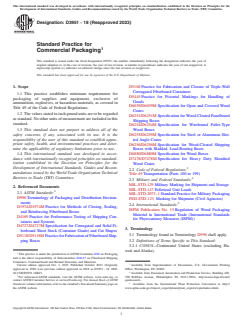
Designation: D3951 − 18 (Reapproved 2023)
Standard Practice for
Commercial Packaging
This standard is issued under the fixed designation D3951; the number immediately following the designation indicates the year of
original adoption or, in the case of revision, the year of last revision. A number in parentheses indicates the year of last reapproval. A
superscript epsilon (´) indicates an editorial change since the last revision or reapproval.
This standard has been approved for use by agencies of the U.S. Department of Defense.
1. Scope D5168 Practice for Fabrication and Closure of Triple-Wall
Corrugated Fiberboard Containers
1.1 This practice establishes minimum requirements for
D5445 Practice for Pictorial Markings for Handling of
packaging of supplies and equipment, exclusive of
Goods
ammunition, explosives, or hazardous materials, as covered in
D6039/D6039M Specification for Open and Covered Wood
Title 49 of the Code of Federal Regulations.
Crates
1.2 The values stated in inch-pound units are to be regarded
D6251/D6251M Specification for Wood-Cleated Panelboard
as standard. No other units of measurement are included in this
Shipping Boxes
standard.
D6254/D6254M Specification for Wirebound Pallet-Type
1.3 This standard does not purport to address all of the Wood Boxes
safety concerns, if any, associated with its use. It is the
D6255/D6255M Specification for Steel or Aluminum Slot-
responsibility of the user of this standard to establish appro- ted Angle Crates
priate safety, health, and environmental practices and deter-
D6256/D6256M Specification for Wood-Cleated Shipping
mine the applicability of regulatory limitations prior to use. Boxes with Skidded, Load-Bearing Bases
1.4 This international standard was developed in accor-
D6880/D6880M Specification for Wood Boxes
dance with internationally recognized principles on standard- D7478/D7478M Specification for Heavy Duty Sheathed
ization established in the Decision on Principles for the
Wood Crates
Development of International Standards, Guides and Recom-
2.2 Code of Federal Regulations:
mendations issued by the World Trade Organization Technical
Title 49 Transportation (Parts 100 to 199)
Barriers to Trade (TBT) Committee.
2.3 Military and Federal Standards:
MIL-STD-129 Military Marking for Shipment and Storage
2. Referenced Documents
MIL-STD-147 Palletized Unit Loads
2.1 ASTM Standards:
MIL-STD-2073–1 Standard Practice for Military Packaging
D996 Terminology of Packaging and Distribution Environ-
FED-STD-123 Marking for Shipment (Civil Agencies)
ments
2.4 International Standards:
D1974/D1974M Practice for Methods of Closing, Sealing,
ISPM Publication No. 15 Regulation of Wood Packaging
and Reinforcing Fiberboard Boxes
Material in International Trade (International Standards
D4169 Practice for Performance Testing of Shipping Con-
for Phytosanitary Measures (ISPM))
tainers and Systems
D4727/D4727M Specification for Corrugated and Solid Fi-
3. Terminology
berboard Sheet Stock (Container Grade) and Cut Shapes
3.1 Terminology found in Terminology D996 shall apply.
D5118/D5118M Practice for Fabrication of Fiberboard Ship-
ping Boxes
3.2 Definitions of Terms Specific to This Standard:
3.2.1 CONUS—Continental United States (excluding Ha-
waii and Alaska).
This practice is under the jurisdiction of ASTM Committee D10 on Packaging
and is the direct responsibility of Subcommittee D10.27 on Fiberboard Shipping
Containers, Containerboard and Related Structures and Materials.
Current edition approved Oct. 1, 2023. Published October 2023. Originally Available from Superintendent of Documents, U.S. Government Printing
approved in 1980. Last previous edition approved in 2018 as D3951 – 18. DOI: Office, Washington, DC 20402.
10.1520/D3951-18R23. Available from Document Automation and Production Service, Building 4/D,
For referenced ASTM standards, visit the ASTM website, www.astm.org, or 700 Robbins Avenue, Philadelphia, PA 19111-5094,. http://assist.daps.dla.mil/
contact ASTM Customer Service at service@astm.org. For Annual Book of ASTM quicksearch.
Standards volume information, refer to the standard’s Document Summary page on Available from the International Plant Protection Convention at http://
the ASTM website. www.aphis.usda.gov/import_export/plants/plant_exports/wpm/index.shtml.
Copyright © ASTM International, 100 Barr Harbor Drive, PO Box C700, West Conshohocken, PA 19428-2959. United States
D3951 − 18 (2023)
3.2.2 immediate use—used or consumed within seven days coatings, barrier protection, volatile corrosion inhibitors, or
of receipt. desiccated unit packs.
5.1.1.3 Cushioning—Items requiring protection from physi-
3.2.3 safe delivery—in packaging—delivery of a shipment
cal and mechanical damage or which are fragile shall be
to its destination with minimal damage to the package and no
protected by wrapping, cushioning, pack compartmentization,
damage to the contents.
cartonizing, or other means to mitigate shock and vibration to
prevent damage during handling and shipment.
4. Significance and Use
5.1.1.4 Loose-fill Cushioning/Dunnage —Loose-fill mate-
4.1 This practice covers the requirements for the commer-
rial shall be prohibited for all Department of Defense (DoD)
cial preservation, packaging, packing (exterior container),
and/or General Services Administration (GSA) shipments and
unitization, and marking for supplies and equipment. It pro-
shipments to aerospace facilities.
vides for multiple handling and shipment by any mode, and
5.1.2 Unit Package:
storage periods of a minimum of one year in enclosed facilities
5.1.2.1 Unit Package— A unit package shall be so designed
without degradation or damage to the product within the
and constructed that it will contain the contents with no
container. It also provides for package quantities suitable for
damage to them, and with minimal damage to the unit pack
redistribution without additional repackaging or marking.
during shipment and storage in the shipping container
Planned storage that exceeds one year requires more than
configuration, and shall allow subsequent handling.
minimum requirements for physical and mechanical protec-
5.1.2.2 Unit Package Quantity—Unless otherwise specified
tion.
in the contract or purchase order, the unit package quantity
4.2 This practice is applicable to Department of Defense
shall be one each part, set, or assembly, except for small
shipments for:
lightweight items, for example, industrial hardware, which will
4.2.1 Items intended for immediate use;
be unit packaged in quantities that are standard in the trade and
4.2.2 Items for not-mission-capable supply;
suitable for retail sales. Single items weighing over 5 lb shall
4.2.3 Items intended for depot operational consumption;
be individually packaged.
4.2.4 Small parcel shipments (CONUS), not-for-stock; and
5.1.2.3 Bulk packaging shall be specifically excluded unless
4.2.5 Direct vendor deliveries (CONUS ONLY).
specified in the contract or purchase order.
4.3 All other Department of Defense shipments shall be in
5.1.3 Intermediate Package:
accordance with MIL-STD-2073–1.
5.1.3.1 The use of intermediate packaging is encouraged
particularly when such use enhances handling and storage.
5. Requirements
5.1.4 Packing:
5.1 General—The following requirements, unless specifi- 5.1.4.1 Unit packages and intermediate packages not meet-
ing the requirements for a shipping container shall be packed in
cally changed by the contract or order, shall apply. Suppliers
are encouraged to use advanced packaging technology. shipping containers.
5.1.1 Packaging—Preservation, packaging, packing, and 5.1.4.2 Shipping Containers—The shipping container (in-
marking furnished by the suppliers shall meet or exceed the cluding any necessary blocking, bracing, cushioning, or water
following minimum requirements: resistance) shall comply with the regulations of the carrier used
5.1.1.1 Cleanliness—Items shall be free of dirt and other and shall provide safe delivery to the destination. The shipping
contaminants which would contribute to deterioration of the container shall be capable of multiple handling and storage
item or which would require cleaning by the customer prior to periods at a minimum of one year in enclosed facilities without
use. Coatings and preservatives applied to the item for protec- degradation or damage to the product. Table 1 provides
tion are not considered contaminants. suggested size and weight limits for shipping containers and
5.1.1.2 Preservation—Items susceptible to corrosion or de- may be used for unit and intermediate packages when speci-
terioration shall be provided protection such as preservative fying a fiberboard container, wood box, or crate.
TABLE 1 Weight and Size Limits of Shipping Containers
Container Standard Maximum Outside Dimensions, Maximum Weight of
length + width + depth Boxes and Contents (lb)
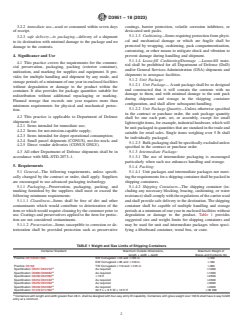
Practice D5118/D5118M SW Corrugated $40 and #105 in. #120
DW Corrugated $85 and #120 in. #180
Practice D5168 TW Corrugated $110 and #125 in. #300
A
Specification D6251/D6251M As required #1000
A
Specification D6880/D6880M As required #1000
A
Specification D6256/D6256M #16 ft #2500
A
Specification D6254/D6254M As required #2500
A
Specification D6255/D6255M As required #3000
A
Specification D6039/D6039M As required #4000
A
Specification D7478/D7478M 30 ft L × 9 ft W × 10 ft H #30 000
A
Containers with length and width greater than 48 in. shall be designed with four-way entry lift capability. Containers with gross weight over 100 lb shall have 2-way forklift
entry at a minimum.
D3951 − 18 (2023)
5.1.4.3 All containers shall be tested to meet Practice D4169 5.1.6.5 Unit, Intermediate, and Shipping Container Mark-
test standards when specified in the contract or purchase order. ings for DoD—For all shipments to the Department of Defense,
5.1.5 Unitization—Shipments should be considered for unit- the marking shall be in accordance with MIL-STD-129. Any
ization where appropriate or as specified in the contract or additional marking requirements shall be specified in the
purchase order. Unitization encompasses, but is not limited to, contract or purchase order.
bundling, consolidation in a container, or placement on a pallet. 5.1.6.6 Container Markings for Government Civil
Palletized unit loads shipped to the Department of Defense Agencies—For all shipments to government civil agencies,
shall be in accordance with MIL-STD-147 and contractual such as the General Services Administration (GSA), the
requirements. marking shall be in accordance with FED-STD-123. Any
5.1.6 Marking: additional marking requirements shall be specified in the
5.1.6.1 Unit and Intermediate Marking—Marking for the contract or purchase order.
unit and intermediate container shall mean those used in the 5.1.6.7 Items without Adequate Surface for Labels—Items
commercial distribution or over-the-counter retail sales. The without adequate surface for labels shall be marked in accor-
markings shall be sufficient to clearly and visibly identify the dance with 5.1.6.1 by means of a tag securely affixed to the
contents of the package. When the unit or intermediate item.
container is also the shipping container the requirements of
5.1.6.2 shall apply. Unless otherwise specified in the contract/
6. Options
purchase order, the following are the minimum requirements:
6.1 Export Shipments—When permitted by the contract or
(1) Part number and/or UPC barcode part number,
purchase order, this practice may be used for export shipments
(2) Product name or nomenclature,
when favorable conditions are provided, such as containeriza-
(3) Quantity and unit of issue,
tion media and enclosed areas of receiving. Additional preser-
(4) Manufacture retail markings,
vation methods and the use of weather-resistant grades may be
(5) Shelf-life markings (expiration date/inspection date/
required to ensure the packaging successfully protects the item
date of manufacture), if applicable,
in the export shipping environment. Ensure u
...