

ASTM F3203-19(2023)
(Test Method)Standard Test Method for Determination of Gel Content of Crosslinked Polyethylene (PEX) Pipes and Tubing
General Information
- Abstract
SIGNIFICANCE AND USE
5.1 Many important properties of crosslinked ethylene plastics vary with the gel content. Hence, determination of the gel content provides a basis for controlling production processes and a means of establishing the quality of finished products.
5.2 Extraction tests permit verification of the proper gel content of any given crosslinked ethylene plastic and they also permit comparison between different crosslinked ethylene plastics, including those containing fillers, provided that, for the latter, the following conditions are met:
5.2.1 The filler is not soluble in the solvent used in this method at the extraction temperature.
5.2.2 The amount of filler present in the compound either is known or can be determined.
5.2.3 Sufficient crosslinking has been achieved to prevent migration of filler during the extraction. It has been found that, at gel content above 30 %, the solvent remains clear and free of filler.
5.3 Since some oxidative degradation of the material and solvent may occur at the reflux temperature of the solvents, a suitable antioxidant is added to the solvent to inhibit such degradation.
5.4 This test method is normally used for specimens consisting of an equal representation of the entire cross section of the product, but may also be used to examine specific portions of a product for differences in extent of cross-linking when compared to either a product standard or another sample.
5.5 This test method is intended for testing crosslinked polyethylene compounds that are not hygroscopic. If compounds that are hygroscopic are tested using this method, specimen conditioning before and after extraction is required.
5.6 This test method differs from Test Methods D2765, ISO 10147 and Test Method D7567 which also describe procedures for determining the gel content of crosslinked polyethylene. It allows for the use of naphthenic hydrocarbon blend, isoparaffin solvent, or light aromatic solvent naptha as alternatives to xylenes. Xylenes a...
SCOPE
1.1 The gel content of pipe and tubing produced from crosslinked polyethylene plastics as described in Specification F876 and other pipe or tubing standards is determined by extracting with solvents such as xylenes. A test method for quantitative determination of gel content is described herein. The method is applicable to PEX pipe and tubing of all densities, including those containing fillers, and provides correction for the inert fillers present in some of those compounds.
1.2 Continuous extraction (see definition in Section 3) is used in this method to test the gel content of crosslinked polyethylene specimens. Continuous extraction when used for testing gel content has the advantages of decreased cost of testing, increased accuracy and consistency of results, and decreased test time. This is because extraction with a pure solvent is more efficient than extraction with a partially saturated solvent.
1.3 While extraction tests may be made on articles of any shape, this test method is applicable for determining the gel content of crosslinked polyethylene pipes and tubing.
1.4 This test method makes use of xylenes or alternative solvents. Alternative solvents either have lower toxicity than xylenes or allow decreased extraction times. The alternative solvents are also potentially beneficial from an economic and environmental viewpoint. Xylenes are used for referee tests.
1.5 The values stated in SI units are to be regarded as standard. The inch-pound units in brackets are for information only.
1.6 This standard does not purport to address all of the safety concerns, if any, associated with its use. It is the responsibility of the user of this standard to establish appropriate safety, health, and environmental practices and determine the applicability of regulatory limitations prior to use.
1.7 This international standard was developed in accordance with internationally recognized principles on standard...
- Status
- Published
- Publication Date
- 30-Jun-2023
- Technical Committee
- F17 - Plastic Piping Systems
- Drafting Committee
- F17.40 - Test Methods
Overview
ASTM F3203-19(2023), titled Standard Test Method for Determination of Gel Content of Crosslinked Polyethylene (PEX) Pipes and Tubing, is a critical international standard developed by ASTM International. This standard describes a method for quantitatively determining the gel content-the fraction of insoluble polymer-in crosslinked polyethylene (PEX) pipes and tubing. Gel content is a fundamental property that reflects the level of crosslinking in PEX and is directly related to the material’s quality, durability, and performance in various piping applications.
The method specified in ASTM F3203-19(2023) uses solvent extraction, typically with xylenes or alternative solvents, and employs a continuous extraction apparatus to ensure accurate and repeatable results.
Key Topics
Significance of Gel Content
The gel content of PEX pipes and tubing influences many important properties, including mechanical strength, chemical resistance, and long-term durability. Determining gel content helps manufacturers control production processes and certify the quality of finished products.Continuous Extraction Method
ASTM F3203-19(2023) specifies the use of continuous extraction apparatus (such as Soxhlet, Knöfler-Bohm, or Kumagawa extractors), offering higher efficiency, improved repeatability, and reduced test time compared to non-continuous methods.Applicability
- Suitable for all densities and compositions of PEX pipes and tubing, including those with inert fillers.
- Correction for inert filler content is provided, ensuring accurate results for filled compounds.
- The method can be applied to whole product cross sections or targeted areas to diagnose crosslinking variations.
Alternative Solvents
While xylenes is the referee solvent, alternative solvents-such as naphthenic hydrocarbon blends, isoparaffin, or light aromatic solvent naphtha-may be used for routine quality control. These alternatives may offer lower toxicity or faster extraction times, benefiting both safety and efficiency.Testing Considerations
- Routine use requires sample preparation to consistent thickness, careful handling of solvents, and adherence to safety protocols.
- The method includes steps for handling compounds with fillers, antioxidant use to inhibit oxidative degradation, and proper conditioning for hygroscopic materials.
Applications
ASTM F3203-19(2023) is essential for:
PEX Pipe and Tubing Manufacturers
Ensuring that production meets industry requirements for gel content and thereby delivers products with reliable performance in plumbing, radiant heating, and similar applications.Quality Control Laboratories
Providing a repeatable, precise method for routine verification of material properties across production batches or between different PEX formulations.Material Comparisons and Product Development
Allowing for direct comparison between different crosslinked polyethylene compounds, whether unfilled or filled, and assessment of process or formulation changes.Certification and Compliance
Meeting the requirements of relevant product standards (such as ASTM F876) and ensuring compliance with international best practices in polymer piping systems.
Related Standards
- ASTM D2765: Test Methods for Determination of Gel Content and Swell Ratio of Crosslinked Ethylene Plastics
- ASTM D7567: Test Method for Determining Gel Content in Crosslinked Ethylene Plastics Using Pressurized Liquid Extraction
- ISO 10147: Pipes and Fittings Made of Crosslinked Polyethylene (PE-X) – Estimation of the Degree of Crosslinking by Determination of the Gel Content
- ASTM F876: Specification for Crosslinked Polyethylene (PEX) Tubing
Conclusion
ASTM F3203-19(2023) provides an authoritative, precise, and practical method for determining the gel content in PEX pipes and tubing. Its robust procedures ensure the reliable control and verification of material quality, supporting manufacturers, laboratories, and end users in producing and selecting high-performance crosslinked polyethylene piping systems. By adopting ASTM F3203-19(2023), organizations align with internationally recognized best practices for PEX product testing and quality assurance.
Relations
- Effective Date
- 01-Feb-2024
- Effective Date
- 01-Feb-2024
- Effective Date
- 01-Feb-2024
- Effective Date
- 01-Dec-2023
- Effective Date
- 01-Nov-2023
- Effective Date
- 01-Feb-2020
- Effective Date
- 01-Jan-2020
- Effective Date
- 01-Aug-2019
- Effective Date
- 15-Apr-2019
- Effective Date
- 01-Feb-2019
- Effective Date
- 01-Dec-2018
- Effective Date
- 01-Nov-2018
- Effective Date
- 15-Aug-2017
- Effective Date
- 01-Sep-2016
- Effective Date
- 01-May-2014
Get Certified
Connect with accredited certification bodies for this standard

Institut za varilstvo d.o.o. (Welding Institute)
Slovenia's leading welding institute since 1952. ISO 3834, EN 1090, pressure equipment certification, NDT personnel, welder qualification. Only IIW Au
Sponsored listings
Frequently Asked Questions
ASTM F3203-19(2023) is a standard published by ASTM International. Its full title is "Standard Test Method for Determination of Gel Content of Crosslinked Polyethylene (PEX) Pipes and Tubing". This standard covers: SIGNIFICANCE AND USE 5.1 Many important properties of crosslinked ethylene plastics vary with the gel content. Hence, determination of the gel content provides a basis for controlling production processes and a means of establishing the quality of finished products. 5.2 Extraction tests permit verification of the proper gel content of any given crosslinked ethylene plastic and they also permit comparison between different crosslinked ethylene plastics, including those containing fillers, provided that, for the latter, the following conditions are met: 5.2.1 The filler is not soluble in the solvent used in this method at the extraction temperature. 5.2.2 The amount of filler present in the compound either is known or can be determined. 5.2.3 Sufficient crosslinking has been achieved to prevent migration of filler during the extraction. It has been found that, at gel content above 30 %, the solvent remains clear and free of filler. 5.3 Since some oxidative degradation of the material and solvent may occur at the reflux temperature of the solvents, a suitable antioxidant is added to the solvent to inhibit such degradation. 5.4 This test method is normally used for specimens consisting of an equal representation of the entire cross section of the product, but may also be used to examine specific portions of a product for differences in extent of cross-linking when compared to either a product standard or another sample. 5.5 This test method is intended for testing crosslinked polyethylene compounds that are not hygroscopic. If compounds that are hygroscopic are tested using this method, specimen conditioning before and after extraction is required. 5.6 This test method differs from Test Methods D2765, ISO 10147 and Test Method D7567 which also describe procedures for determining the gel content of crosslinked polyethylene. It allows for the use of naphthenic hydrocarbon blend, isoparaffin solvent, or light aromatic solvent naptha as alternatives to xylenes. Xylenes a... SCOPE 1.1 The gel content of pipe and tubing produced from crosslinked polyethylene plastics as described in Specification F876 and other pipe or tubing standards is determined by extracting with solvents such as xylenes. A test method for quantitative determination of gel content is described herein. The method is applicable to PEX pipe and tubing of all densities, including those containing fillers, and provides correction for the inert fillers present in some of those compounds. 1.2 Continuous extraction (see definition in Section 3) is used in this method to test the gel content of crosslinked polyethylene specimens. Continuous extraction when used for testing gel content has the advantages of decreased cost of testing, increased accuracy and consistency of results, and decreased test time. This is because extraction with a pure solvent is more efficient than extraction with a partially saturated solvent. 1.3 While extraction tests may be made on articles of any shape, this test method is applicable for determining the gel content of crosslinked polyethylene pipes and tubing. 1.4 This test method makes use of xylenes or alternative solvents. Alternative solvents either have lower toxicity than xylenes or allow decreased extraction times. The alternative solvents are also potentially beneficial from an economic and environmental viewpoint. Xylenes are used for referee tests. 1.5 The values stated in SI units are to be regarded as standard. The inch-pound units in brackets are for information only. 1.6 This standard does not purport to address all of the safety concerns, if any, associated with its use. It is the responsibility of the user of this standard to establish appropriate safety, health, and environmental practices and determine the applicability of regulatory limitations prior to use. 1.7 This international standard was developed in accordance with internationally recognized principles on standard...
SIGNIFICANCE AND USE 5.1 Many important properties of crosslinked ethylene plastics vary with the gel content. Hence, determination of the gel content provides a basis for controlling production processes and a means of establishing the quality of finished products. 5.2 Extraction tests permit verification of the proper gel content of any given crosslinked ethylene plastic and they also permit comparison between different crosslinked ethylene plastics, including those containing fillers, provided that, for the latter, the following conditions are met: 5.2.1 The filler is not soluble in the solvent used in this method at the extraction temperature. 5.2.2 The amount of filler present in the compound either is known or can be determined. 5.2.3 Sufficient crosslinking has been achieved to prevent migration of filler during the extraction. It has been found that, at gel content above 30 %, the solvent remains clear and free of filler. 5.3 Since some oxidative degradation of the material and solvent may occur at the reflux temperature of the solvents, a suitable antioxidant is added to the solvent to inhibit such degradation. 5.4 This test method is normally used for specimens consisting of an equal representation of the entire cross section of the product, but may also be used to examine specific portions of a product for differences in extent of cross-linking when compared to either a product standard or another sample. 5.5 This test method is intended for testing crosslinked polyethylene compounds that are not hygroscopic. If compounds that are hygroscopic are tested using this method, specimen conditioning before and after extraction is required. 5.6 This test method differs from Test Methods D2765, ISO 10147 and Test Method D7567 which also describe procedures for determining the gel content of crosslinked polyethylene. It allows for the use of naphthenic hydrocarbon blend, isoparaffin solvent, or light aromatic solvent naptha as alternatives to xylenes. Xylenes a... SCOPE 1.1 The gel content of pipe and tubing produced from crosslinked polyethylene plastics as described in Specification F876 and other pipe or tubing standards is determined by extracting with solvents such as xylenes. A test method for quantitative determination of gel content is described herein. The method is applicable to PEX pipe and tubing of all densities, including those containing fillers, and provides correction for the inert fillers present in some of those compounds. 1.2 Continuous extraction (see definition in Section 3) is used in this method to test the gel content of crosslinked polyethylene specimens. Continuous extraction when used for testing gel content has the advantages of decreased cost of testing, increased accuracy and consistency of results, and decreased test time. This is because extraction with a pure solvent is more efficient than extraction with a partially saturated solvent. 1.3 While extraction tests may be made on articles of any shape, this test method is applicable for determining the gel content of crosslinked polyethylene pipes and tubing. 1.4 This test method makes use of xylenes or alternative solvents. Alternative solvents either have lower toxicity than xylenes or allow decreased extraction times. The alternative solvents are also potentially beneficial from an economic and environmental viewpoint. Xylenes are used for referee tests. 1.5 The values stated in SI units are to be regarded as standard. The inch-pound units in brackets are for information only. 1.6 This standard does not purport to address all of the safety concerns, if any, associated with its use. It is the responsibility of the user of this standard to establish appropriate safety, health, and environmental practices and determine the applicability of regulatory limitations prior to use. 1.7 This international standard was developed in accordance with internationally recognized principles on standard...
ASTM F3203-19(2023) is classified under the following ICS (International Classification for Standards) categories: 23.040.20 - Plastics pipes. The ICS classification helps identify the subject area and facilitates finding related standards.
ASTM F3203-19(2023) has the following relationships with other standards: It is inter standard links to ASTM F876-24, ASTM D2765-16(2024), ASTM D883-24, ASTM F876-23a, ASTM D883-23, ASTM D1603-20, ASTM D883-20, ASTM D883-19c, ASTM D883-19a, ASTM D883-19, ASTM D883-18a, ASTM D883-18, ASTM D883-17, ASTM D2765-16, ASTM E177-14. Understanding these relationships helps ensure you are using the most current and applicable version of the standard.
ASTM F3203-19(2023) is available in PDF format for immediate download after purchase. The document can be added to your cart and obtained through the secure checkout process. Digital delivery ensures instant access to the complete standard document.
Standards Content (Sample)
This international standard was developed in accordance with internationally recognized principles on standardization established in the Decision on Principles for the
Development of International Standards, Guides and Recommendations issued by the World Trade Organization Technical Barriers to Trade (TBT) Committee.
Designation: F3203 − 19 (Reapproved 2023)
Standard Test Method for
Determination of Gel Content of Crosslinked Polyethylene
(PEX) Pipes and Tubing
This standard is issued under the fixed designation F3203; the number immediately following the designation indicates the year of
original adoption or, in the case of revision, the year of last revision. A number in parentheses indicates the year of last reapproval. A
superscript epsilon (´) indicates an editorial change since the last revision or reapproval.
1. Scope* 1.7 This international standard was developed in accor-
dance with internationally recognized principles on standard-
1.1 The gel content of pipe and tubing produced from
ization established in the Decision on Principles for the
crosslinked polyethylene plastics as described in Specification
Development of International Standards, Guides and Recom-
F876 and other pipe or tubing standards is determined by
mendations issued by the World Trade Organization Technical
extracting with solvents such as xylenes. A test method for
Barriers to Trade (TBT) Committee.
quantitative determination of gel content is described herein.
The method is applicable to PEX pipe and tubing of all
2. Referenced Documents
densities, including those containing fillers, and provides
correction for the inert fillers present in some of those 2.1 ASTM Standards:
compounds. D883 Terminology Relating to Plastics
D1603 Test Method for Carbon Black Content in Olefin
1.2 Continuous extraction (see definition in Section 3) is
Plastics
used in this method to test the gel content of crosslinked
D2765 Test Methods for Determination of Gel Content and
polyethylene specimens. Continuous extraction when used for
Swell Ratio of Crosslinked Ethylene Plastics
testing gel content has the advantages of decreased cost of
D7567 Test Method for Determining Gel Content in Cross-
testing, increased accuracy and consistency of results, and
linked Ethylene Plastics Using Pressurized Liquid Extrac-
decreased test time. This is because extraction with a pure
tion (Withdrawn 2015)
solvent is more efficient than extraction with a partially
E177 Practice for Use of the Terms Precision and Bias in
saturated solvent.
ASTM Test Methods
1.3 While extraction tests may be made on articles of any
E691 Practice for Conducting an Interlaboratory Study to
shape, this test method is applicable for determining the gel
Determine the Precision of a Test Method
content of crosslinked polyethylene pipes and tubing.
F876 Specification for Crosslinked Polyethylene (PEX) Tub-
1.4 This test method makes use of xylenes or alternative ing
solvents. Alternative solvents either have lower toxicity than
2.2 ISO Standard:
xylenes or allow decreased extraction times. The alternative
ISO 10147 Pipes and Fittings Made of Crosslinked Polyeth-
solvents are also potentially beneficial from an economic and
ylene (Pe-X) – Estimation of the Degree of Crosslinking
environmental viewpoint. Xylenes are used for referee tests.
by Determination of the Gel Content
1.5 The values stated in SI units are to be regarded as
3. Terminology
standard. The inch-pound units in brackets are for information
only.
3.1 Terms as shown in Terminology D883 are applicable to
1.6 This standard does not purport to address all of the this test method.
safety concerns, if any, associated with its use. It is the
3.2 Definitions of Terms Specific to This Standard:
responsibility of the user of this standard to establish appro-
priate safety, health, and environmental practices and deter-
mine the applicability of regulatory limitations prior to use.
For referenced ASTM standards, visit the ASTM website, www.astm.org, or
contact ASTM Customer Service at service@astm.org. For Annual Book of ASTM
Standards volume information, refer to the standard’s Document Summary page on
This test method is under the jurisdiction of ASTM Committee F17 on Plastic the ASTM website.
Piping Systems and is the direct responsibility of Subcommittee F17.40 on Test The last approved version of this historical standard is referenced on
Methods. www.astm.org.
Current edition approved July 1, 2023. Published July 2023. Originally approved Available from International Organization for Standardization (ISO), ISO
in 2018. Last previous edition approved in 2019 as F3202–19. DOI: 10.1520/ Central Secretariat, BIBC II, Chemin de Blandonnet 8, CP 401, 1214 Vernier,
F3203–19R23 Geneva, Switzerland, http://www.iso.org.
*A Summary of Changes section appears at the end of this standard
Copyright © ASTM International, 100 Barr Harbor Drive, PO Box C700, West Conshohocken, PA 19428-2959. United States
F3203 − 19 (2023)
3.2.1 continuous extractor, n—test apparatus for performing 5.2.3 Sufficient crosslinking has been achieved to prevent
a continuous extraction. migration of filler during the extraction. It has been found that,
at gel content above 30 %, the solvent remains clear and free of
3.2.1.1 Discussion—Soxhlet, Knofler-Bohm, and Kum-
filler.
agawa extractors are examples of continuous extractors. A
continuous extractor has three main components which are a
5.3 Since some oxidative degradation of the material and
boiling flask or vessel for the solvent, a condenser, and a
solvent may occur at the reflux temperature of the solvents, a
siphon cup. There are various designs for the siphon cup; the
suitable antioxidant is added to the solvent to inhibit such
Soxhlet, Knofler-Bohm, and Kumagawa designs are the most
degradation.
common.
5.4 This test method is normally used for specimens con-
3.2.2 continuous extraction, n—an extraction performed in a
sisting of an equal representation of the entire cross section of
continuous extractor where a solvent (normally xylenes) is
the product, but may also be used to examine specific portions
heated in a vessel and boils forming vapors, the vapors rise and
of a product for differences in extent of cross-linking when
condense on a condenser to form droplets, the droplets fall into
compared to either a product standard or another sample.
a cup where one or more specimens are placed, there the
5.5 This test method is intended for testing crosslinked
solvent in the cup dissolves some of the un-crosslinked
polyethylene compounds that are not hygroscopic. If com-
polyethylene in the specimens, and when the cup holding the
pounds that are hygroscopic are tested using this method,
specimens is filled with solvent, the solvent now containing
specimen conditioning before and after extraction is required.
some of the un-crosslinked polyethylene drains out through a
5.6 This test method differs from Test Methods D2765, ISO
siphon tube back into the vessel where it started. The solvent
10147 and Test Method D7567 which also describe procedures
and the sample specimens in the cup are kept warm by solvent
for determining the gel content of crosslinked polyethylene. It
vapor rising toward the condenser. The extraction steps repeat
allows for the use of naphthenic hydrocarbon blend, isoparaffin
automatically and continuously as long as heat is applied to the
solvent, or light aromatic solvent naptha as alternatives to
vessel holding the solvent. Because only the solvent evaporates
xylenes. Xylenes are the only solvent allowed to be used for
and not the material dissolved in it, the concentration of
referee tests. The preferred method of sample preparation in
un-crosslinked polyethylene in the boiling solvent increases,
this test method is to use a lathe to create thin ribbons of PEX
while the concentration of un-crosslinked polyethylene in the
material. This standard requires the use of a continuous
specimens continually decreases.
extractor in order to provide consistent results and to allow for
3.2.3 gel content, n—the percentage by mass of polymer
reliable solvent re-use. Specialized specimen holders are used
insoluble in a specified solvent after extraction under the
to minimize variability resulting from loss of specimen par-
specified conditions.
ticles.
NOTE 1—Pressurized extraction techniques have been found to yield
4. Summary of Test Method
useful results in a shorter time frame, however not all grades of PEX
tolerate the elevated extraction temperatures without substantial degrada-
4.1 Specimens of the crosslinked ethylene plastic are
tion. For this reason pressurized extraction techniques are recommended
prepared, weighed and then extracted using a heated extraction
for control tests only if it is possible to determine that the crosslinked
solvent in a continuous extractor for the time designated by the
matrix of the PEX does not break down at the temperature of extraction
procedure. After extraction, the specimens are removed from
the continuous extractor, dried, and weighed as directed. The
6. Conditioning
gel content is calculated using the final and initial specimen
6.1 Conditioning—Conditioning of the test specimens is not
weights as directed in the calculations section of this test
required, unless specified by the manufacturer of the material
method.
being sampled.
5. Significance and Use 6.2 Test Conditions—Test conditions do not affect results,
with the exception of atmospheric pressure. Conduct tests in a
5.1 Many important properties of crosslinked ethylene plas-
laboratory with atmospheric pressure greater than 80 kPa (less
tics vary with the gel content. Hence, determination of the gel
than 6000 ft above average sea level).
content provides a basis for controlling production processes
NOTE 2—The altitude above sea level of the lab will influence the
and a means of establishing the quality of finished products.
atmospheric pressure, which in turn will affect the boiling temperature of
5.2 Extraction tests permit verification of the proper gel the solvent used and the rate at which it will be able to extract
un-crosslinked polyethylene from the matrix.
content of any given crosslinked ethylene plastic and they also
permit comparison between different crosslinked ethylene
7. Apparatus
plastics, including those containing fillers, provided that, for
the latter, the following conditions are met:
7.1 Continuous Extractor, of the following general type, as
5.2.1 The filler is not soluble in the solvent used in this
illustrated in Fig. 1. Further information regarding possible
method at the extraction temperature.
sources of components is included in the Appendix X3.
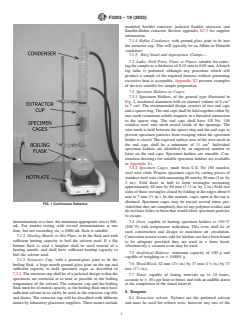
5.2.2 The amount of filler present in the compound either is 7.1.1 Boiling Flask, with a ground-glass joint. The flask
known or can be determined. may be either flat bottom or round bottom. For one or two
F3203 − 19 (2023)
modified Soxhlet extractor, jacketed Soxhlet extractor, and
Knofler-Bohm extractor. Review appendix X3.3 for supplier
information.
7.1.4 Reflux Condenser, with ground-glass joint to fit into
the extractor cup. This will typically be an Allihn or Dimroth
condenser.
7.1.5 Ring Stand and Appropriate Clamps—
7.2 Lathe, Drill Press, Plane or Planer, suitable for reduc-
ing the sample to a thickness of 0.15 mm to 0.05 mm. A bench
top lathe is preferred, although any procedure which will
produce a sample of the required fineness without generating
excessive heat is acceptable. Appendix X2 presents examples
of devices suitable for sample preparation.
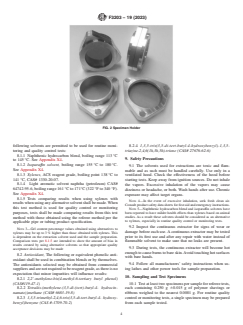
7.3 Specimen Holders or Cages:
7.3.1 Specimen Holders, of the general type illustrated in
Fig. 2, machined aluminum with an internal volume of 6 cm
to 7 cm . The recommended design consists of two end caps
and a spacer ring. The end caps shall be held together either by
rare earth (samarium cobalt) magnets or a threaded connection
to the spacer ring. The end caps shall have US No. 150
stainless steel wire mesh nested inside of the openings. The
wire mesh is held between the spacer ring and the end caps to
prevent specimen particles from escaping when the specimen
holder is closed. The exposed surface area of the wire mesh in
the end caps shall be a minimum of 11 cm . Individual
specimen holders are identified by an engraved number or
letter on the end caps. Specimen holders are reusable. Con-
struction drawings for suitable specimen holders are available
in Appendix X1.
7.3.2 Specimen Cages, made from U.S. No 150 stainless
steel wire cloth. Prepare specimen cages by cutting pieces of
stainless steel wire cloth measuring 80 mm by 50 mm (3 in. by
2 in.). Fold these in half to form rectangles measuring
approximately 40 mm by 50 mm (1 ⁄2 in. by 2 in.) Fold two
sides of these rectangles closed by folding at the edges about 6
mm to 7 mm ( ⁄4 in.). In this manner, cages open at the top is
obtained. Specimen cages may be reused several times pro-
FIG. 1 Continuous Extractor
vided that they are completely free of any polymer residue and
do not have holes in them that would allow specimen particles
to escape.
determinations at a time, the minimum appropriate size is 500-
7.4 Oven, capable of heating specimen holders to 150 °C
mL. For routine testing with several determinations at one
(300 °F) with temperature indication. This oven shall be of
time, but not exceeding six, a 2000-mL flask is suitable.
such construction and design to maximize air circulation.
7.1.2 Heating Mantle or Hot Plate, to fit the flask and with
Convection toaster ovens sold for kitchen use have been found
sufficient heating capacity to boil the solvent used. If a flat
to be adequate provided they are used in a fume hood.
bottom flask is used a hotplate shall be used instead of a
Alternatively a vacuum oven may be used.
heating mantle, and shall have sufficient heating capacity to
7.5 Analytical Balance, minimum capacity of 100 g and
boil the solvent used.
capable of weighing to 6 0.0001 g.
7.1.3 Extractor Cup, with a ground-glass joint to fit the
1 1
7.6 Wood Block, 62 mm (2 ⁄2 in.) by 37 mm (1 ⁄2 in.) by 37
boiling flask, a large mouth ground-glass joint on the top and
mm (1 ⁄2 in.).
sufficient capacity to hold specimen cages as described in
7.3.2. The extractor cup shall be of a jacketed design so that the
7.7 Timer, capable of timing intervals up to 10 hours,
specimens are extracted at as near as possible to the boiling
accurate to 6 30 s per hour or better, and with an audible alarm
temperature of the solvent. The extractor cup and the boiling
at the completion of the timed interval.
flask must be of mated capacity, as the boiling flask must have
8. Reagents
sufficient solvent in to safely be used as the extractor cup fills
and drains. The extractor cup will be described with different 8.1 Extraction solvent, Xylenes are the preferred solvent
names by laboratory glassware suppliers. These names include and must be used for referee tests; however any one of the
F3203 − 19 (2023)
FIG. 2 Specimen Holder
following solvents are permitted to be used for routine moni- 8.2.4 1,3,5-tris(3,5-di-tert-butyl-4-hydroxybenzyl)-1,3,5-
toring and quality control tests: triazine-2,4,6(1h,3h,5h)-trione (CAS# 27676-62-6)
8.1.1 Naphthenic hydrocarbon blend, boiling range 113 °C
9. Safety Precautions
to 145 °C. See Appendix X4.
8.1.2 Isoparaffın solvent, boiling range 155 °C to 180 °C.
9.1 The solvents used for extractions are toxic and flam-
See Appendix X4.
mable and as such must be handled carefully. Use only in a
8.1.3 Xylenes, ACS reagent grade, boiling point 138 °C to
ventilated hood. Check the effectiveness of the hood before
141 °C, CAS# 1330-20-07.
starting tests. Keep away from ignition sources. Do not inhale
8.1.4 Light aromatic solvent naphtha (petroleum) CAS#
the vapors. Excessive inhalation of the vapors may cause
64742-95-6, boiling range 161 °C to 171°C (322 °F to 340 °F).
dizziness or headache, or both. Wash hands after use. Chronic
See Appendix X4.
exposure may affect target organs.
8.1.5 Tests comparing results when using xylenes with
NOTE 4—In the event of excessive inhalation, seek fresh clean air.
results when using any alternative solvent shall be made. When
Consult product safety data sheets for first aid and emergency instructions.
this test method is used for quality control or monitoring
NOTE 5—Naphthenic hydrocarbon blend and isoparaffin solvents have
purposes, tests shall be made comparing results from this test
been reported to have milder health effects than xylenes based on animal
studies. As a result these solvents should be considered as an alternative
method with those obtained using the referee method per the
to xylenes, especially in routine quality control or monitoring tests.
applicable pipe or tubing product specification.
9.2 Inspect the continuous extractor for signs of wear or
NOTE 3—Gel content percentage values obtained using alternatives to
damage before each use. A continuous extractor may be tested
xylenes may be up to 3 % higher than those obtained with xylenes. This
prior to its first use and after any repair with water instead of
is dependent on the extraction solvent used and the sample preparation.
Comparison tests per 8.1.5 are intended to show the amount of bias in
flammable solvent to make sure that no leaks are present.
results created by using alternative solvents so that appropriate quality
9.3 During tests, the continuous extractor will become hot
acceptance decisions may be made
enough to cause burns to bare skin. Avoid touching hot surfaces
8.2 Antioxidant, The following or equivalent phenolic anti-
with bare hands.
oxidant shall be used in combination blends or by themselves.
9.4 Follow all manufacturers’ safety instructions when us-
The antioxidants selected may be obtained from commercial
ing lathes and other power tools for sample preparation.
suppliers and are not required to be reagent grade, as there is no
expectation that minor impurities will influence results:
10. Sampling and Test Specimens
8.2.1 2,2’-methylene-bis(4-methyl-6-tertiary butyl phenol)
(CAS#119-47-1) 10.1 Test at least two specimens per sample for referee tests,
8.2.2 Tetrakis-(methylene-(3,5-di-(tert)-butyl-4- hydrocin- each containing 0.250 g 60.015 g of polymer shavings or
namate))methane (CAS# 6683-19-8) ribbons weighed to the nearest 0.0001 g. For routine quality
8.2.3 1,3,5-trimethyl-2,4,6-tris(3,5-di-tert-butyl-4- hydroxy- control or monitoring tests, a single specimen may be prepared
benzyl)benzene (CAS #:1709-70-2) from each sample tested.
F3203 − 19 (2023)
10.2 From sampled products make shavings or ribbons of 11.1.2.2 Record the weight of the closed cage and the
0.17 mm to 0.08 mm (0.007 in. to 0.003 in.) thickness for test specimen (W ) to the nearest 0.0001 g. Identify the specimen
specimens. Do not allow any fine particles that would pass cages by marking them with an ink that is insoluble to xylenes,
through a 60-mesh sieve among the shavings. Refer to Appen- or by attaching a metal tag to the cage.
dix X2 for information on suitable devices for sample prepa-
NOTE 9—Specimen cages have the advantage of being inexpensive and
ration.
simple to make. If the specimen consists of long continuous ribbons, the
risk of particles escaping is very low and if the specimen cages are
NOTE 6—The use of a lathe to produce shavings or ribbons from pipe
prepared carefully the risk of specimen compaction can be mitigated.
or tubing is the optimal method of sample preparation. When small
diameter or thin wall pipe or tubing is being converted into shavings, it
11.2 Set-up the continuous extractor (see Fig. 1) and add
may be helpful to insert a rigid mandrel pin into the pipe or tubing for
solvent (8.1) into the extraction vessel as required:
support while turning it on the lathe.
11.2.1 If the continuous extraction apparatus is set-up from
NOTE 7—The thickness of the shavings should be as consistent as
previous tests, confirm that there is adequate solvent remaining
possible, because thinner shavings will oxidize more rapidly during
in it and that the solvent is not overly saturated with extracted
testing while thicker shavings will take
...