

ASTM D1835-22
(Specification)Standard Specification for Liquefied Petroleum (LP) Gases
General Information
- Abstract
ABSTRACT
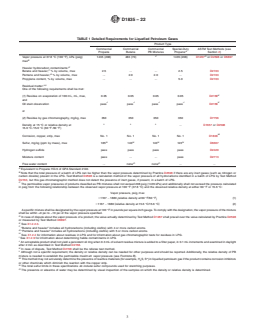
This specification covers liquefied petroleum gases consisting of propane, propene (propylene), butane, and mixtures of these materials. The products are intended for use as domestic, commercial and industrial heating, and engine fuels. Care must be taken to in sampling of the liquefied gases for test results to be significant. All four types of liquefied petroleum gases covered by this specification should conform to the specified requirements for vapor pressure, volatile residue, residue matter, relative density, and corrosion.
SCOPE
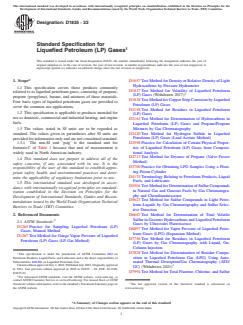
1.1 This specification covers those products commonly referred to as liquefied petroleum gases, consisting of propane, propene (propylene), butane, and mixtures of these materials. Four basic types of liquefied petroleum gases are provided to cover the common use applications.
1.2 This specification is applicable to products intended for use as domestic, commercial and industrial heating, and engine fuels.
1.3 The values stated in SI units are to be regarded as standard. The values given in parentheses after SI units are provided for information only and are not considered standard.
1.3.1 The non-SI unit ‘psig’ is the standard unit for footnote C of Table 1 because that unit of measurement is widely used in North American industry.
1.4 This standard does not purport to address all of the safety concerns, if any, associated with its use. It is the responsibility of the user of this standard to establish appropriate safety, health, and environmental practices and determine the applicability of regulatory limitations prior to use.
1.5 This international standard was developed in accordance with internationally recognized principles on standardization established in the Decision on Principles for the Development of International Standards, Guides and Recommendations issued by the World Trade Organization Technical Barriers to Trade (TBT) Committee.
- Status
- Published
- Publication Date
- 30-Jun-2022
- Technical Committee
- D02 - Petroleum Products, Liquid Fuels, and Lubricants
- Drafting Committee
- D02.H0 - Liquefied Petroleum Gas
Overview
ASTM D1835-22: Standard Specification for Liquefied Petroleum (LP) Gases establishes the requirements for liquefied petroleum gases, commonly known as LPG, which consist primarily of propane, propene (propylene), butane, and their mixtures. LPG is widely used as a fuel for domestic, commercial, and industrial heating, as well as for internal combustion engines.
The standard defines four basic types of LPG products to align with common applications and sets consistent benchmarks for quality, safety, and performance. Compliance with ASTM D1835-22 ensures LPG products meet industry requirements for vapor pressure, volatile residue, density, and corrosion resistance, supporting both efficiency and regulatory adherence in the LPG supply chain.
Key Topics
Product Composition: Specifies commercial propane, commercial butane, commercial propane-butane mixtures, and special-duty propane. Each type addresses different volatility and performance needs for fuel applications.
Critical Quality Requirements:
- Vapor pressure: Determines fuel usability at varying temperatures and prevents hazardous over-pressurization.
- Residue limits: Controls the amount of less volatile hydrocarbons to safeguard fuel system performance and cleanliness.
- Corrosion resistance: Ensures LPG does not degrade copper or copper alloy fittings commonly used in storage and distribution.
- Sulfur content: Sets maximum sulfur levels to minimize emissions and equipment corrosion.
- Moisture and free water: Regulates water content to prevent equipment freeze-up and operational issues.
Testing and Sampling: Adopts standardized sampling and test methods (e.g., vapor pressure, density, residue, corrosion, and sulfur analysis) to ensure consistent results and product quality.
Safety and Regulatory Compliance: While the standard outlines product requirements, it advises that users must implement proper safety, environmental, and health practices and consider applicable regulations.
Applications
ASTM D1835-22 is vital for industries and operations involving:
- Domestic Use: Residential heating, cooking, and water heating where reliable and safe fuel performance is essential.
- Commercial and Industrial Heating: Applications demand uniform vaporization, clean burning, and compliance to minimize system maintenance and environmental impact.
- Engine Fuels: Special-duty propane is tailored for internal combustion engines, especially in vehicles and equipment operated under stringent performance conditions.
- Material Processing: Used as a carbon source or refining raw material in certain manufacturing and petrochemical processes where product consistency is crucial.
By establishing precise criteria for LPG products, the standard supports safe distribution, storage, and end-use, reducing risk of system failures, engine issues, or regulatory non-compliance.
Related Standards
- ASTM D1265: Practice for Sampling Liquefied Petroleum Gases
- ASTM D1267: Test Method for Gauge Vapor Pressure of LPG
- ASTM D1657: Test Method for Density or Relative Density of Light Hydrocarbons
- ASTM D2158: Test Method for Residues in Liquefied Petroleum Gases
- ASTM D2163: Determination of Hydrocarbons in Liquefied Petroleum Gases by Gas Chromatography
- ASTM D2420: Hydrogen Sulfide Determination in LPG
- ASTM D6667: Total Volatile Sulfur in LPG by Ultraviolet Fluorescence
- GPA 2140: Liquefied Petroleum Gas Specifications and Test Methods
Summary
Adhering to ASTM D1835-22 ensures liquefied petroleum gases used across residential, commercial, industrial, and automotive sectors meet defined quality, performance, and safety criteria. By following this specification, producers, distributors, and end-users can achieve reliable fuel performance, comply with regulatory requirements, and maintain safe handling practices throughout the LPG value chain.
Relations
- Effective Date
- 01-Mar-2024
- Refers
ASTM D4175-23a - Standard Terminology Relating to Petroleum Products, Liquid Fuels, and Lubricants - Effective Date
- 15-Dec-2023
- Effective Date
- 01-Dec-2023
- Refers
ASTM D4175-23e1 - Standard Terminology Relating to Petroleum Products, Liquid Fuels, and Lubricants - Effective Date
- 01-Jul-2023
- Effective Date
- 01-Jan-2017
- Effective Date
- 01-Dec-2016
- Effective Date
- 01-Jun-2014
- Effective Date
- 15-Jan-2014
- Effective Date
- 01-Jan-2014
- Effective Date
- 01-Oct-2013
- Effective Date
- 15-Jun-2013
- Refers
ASTM D1838-12a - Standard Test Method for Copper Strip Corrosion by Liquefied Petroleum (LP) Gases - Effective Date
- 01-Dec-2012
- Effective Date
- 01-Nov-2012
- Refers
ASTM D1838-12 - Standard Test Method for Copper Strip Corrosion by Liquefied Petroleum (LP) Gases - Effective Date
- 01-Nov-2012
- Effective Date
- 01-Nov-2012
Get Certified
Connect with accredited certification bodies for this standard

Element Materials Technology
Materials testing and product certification.

ABS Group Brazil
ABS Group certification services in Brazil.

ABS Quality Evaluations Inc.
American Bureau of Shipping quality certification.
Sponsored listings
Frequently Asked Questions
ASTM D1835-22 is a technical specification published by ASTM International. Its full title is "Standard Specification for Liquefied Petroleum (LP) Gases". This standard covers: ABSTRACT This specification covers liquefied petroleum gases consisting of propane, propene (propylene), butane, and mixtures of these materials. The products are intended for use as domestic, commercial and industrial heating, and engine fuels. Care must be taken to in sampling of the liquefied gases for test results to be significant. All four types of liquefied petroleum gases covered by this specification should conform to the specified requirements for vapor pressure, volatile residue, residue matter, relative density, and corrosion. SCOPE 1.1 This specification covers those products commonly referred to as liquefied petroleum gases, consisting of propane, propene (propylene), butane, and mixtures of these materials. Four basic types of liquefied petroleum gases are provided to cover the common use applications. 1.2 This specification is applicable to products intended for use as domestic, commercial and industrial heating, and engine fuels. 1.3 The values stated in SI units are to be regarded as standard. The values given in parentheses after SI units are provided for information only and are not considered standard. 1.3.1 The non-SI unit ‘psig’ is the standard unit for footnote C of Table 1 because that unit of measurement is widely used in North American industry. 1.4 This standard does not purport to address all of the safety concerns, if any, associated with its use. It is the responsibility of the user of this standard to establish appropriate safety, health, and environmental practices and determine the applicability of regulatory limitations prior to use. 1.5 This international standard was developed in accordance with internationally recognized principles on standardization established in the Decision on Principles for the Development of International Standards, Guides and Recommendations issued by the World Trade Organization Technical Barriers to Trade (TBT) Committee.
ABSTRACT This specification covers liquefied petroleum gases consisting of propane, propene (propylene), butane, and mixtures of these materials. The products are intended for use as domestic, commercial and industrial heating, and engine fuels. Care must be taken to in sampling of the liquefied gases for test results to be significant. All four types of liquefied petroleum gases covered by this specification should conform to the specified requirements for vapor pressure, volatile residue, residue matter, relative density, and corrosion. SCOPE 1.1 This specification covers those products commonly referred to as liquefied petroleum gases, consisting of propane, propene (propylene), butane, and mixtures of these materials. Four basic types of liquefied petroleum gases are provided to cover the common use applications. 1.2 This specification is applicable to products intended for use as domestic, commercial and industrial heating, and engine fuels. 1.3 The values stated in SI units are to be regarded as standard. The values given in parentheses after SI units are provided for information only and are not considered standard. 1.3.1 The non-SI unit ‘psig’ is the standard unit for footnote C of Table 1 because that unit of measurement is widely used in North American industry. 1.4 This standard does not purport to address all of the safety concerns, if any, associated with its use. It is the responsibility of the user of this standard to establish appropriate safety, health, and environmental practices and determine the applicability of regulatory limitations prior to use. 1.5 This international standard was developed in accordance with internationally recognized principles on standardization established in the Decision on Principles for the Development of International Standards, Guides and Recommendations issued by the World Trade Organization Technical Barriers to Trade (TBT) Committee.
ASTM D1835-22 is classified under the following ICS (International Classification for Standards) categories: 75.160.30 - Gaseous fuels. The ICS classification helps identify the subject area and facilitates finding related standards.
ASTM D1835-22 has the following relationships with other standards: It is inter standard links to ASTM D5623-24, ASTM D4175-23a, ASTM D1265-23a, ASTM D4175-23e1, ASTM D7994-17, ASTM D2158-16, ASTM D1838-14, ASTM D5623-94(2014), ASTM D2163-14, ASTM D2713-13, ASTM D2420-13, ASTM D1838-12a, ASTM D3700-12, ASTM D1838-12, ASTM D1267-12. Understanding these relationships helps ensure you are using the most current and applicable version of the standard.
ASTM D1835-22 is available in PDF format for immediate download after purchase. The document can be added to your cart and obtained through the secure checkout process. Digital delivery ensures instant access to the complete standard document.
Standards Content (Sample)
This international standard was developed in accordance with internationally recognized principles on standardization established in the Decision on Principles for the
Development of International Standards, Guides and Recommendations issued by the World Trade Organization Technical Barriers to Trade (TBT) Committee.
Designation:D1835 −22
Standard Specification for
Liquefied Petroleum (LP) Gases
This standard is issued under the fixed designation D1835; the number immediately following the designation indicates the year of
original adoption or, in the case of revision, the year of last revision. A number in parentheses indicates the year of last reapproval. A
superscript epsilon (´) indicates an editorial change since the last revision or reapproval.
1. Scope* D1657 Test Method for Density or Relative Density of Light
Hydrocarbons by Pressure Hydrometer
1.1 This specification covers those products commonly
D1837 Test Method for Volatility of Liquefied Petroleum
referred to as liquefied petroleum gases, consisting of propane,
(LP) Gases (Withdrawn 2017)
propene (propylene), butane, and mixtures of these materials.
D1838 TestMethodforCopperStripCorrosionbyLiquefied
Four basic types of liquefied petroleum gases are provided to
Petroleum (LP) Gases
cover the common use applications.
D2158 Test Method for Residues in Liquefied Petroleum
1.2 This specification is applicable to products intended for
(LP) Gases
use as domestic, commercial and industrial heating, and engine
D2163 Test Method for Determination of Hydrocarbons in
fuels.
Liquefied Petroleum (LP) Gases and Propane/Propene
1.3 The values stated in SI units are to be regarded as Mixtures by Gas Chromatography
D2420 Test Method for Hydrogen Sulfide in Liquefied
standard. The values given in parentheses after SI units are
provided for information only and are not considered standard. Petroleum (LP) Gases (Lead Acetate Method)
D2598 Practice for Calculation of Certain Physical Proper-
1.3.1 The non-SI unit ‘psig’ is the standard unit for
footnote C of Table 1 because that unit of measurement is ties of Liquefied Petroleum (LP) Gases from Composi-
tional Analysis
widely used in North American industry.
D2713 Test Method for Dryness of Propane (Valve Freeze
1.4 This standard does not purport to address all of the
Method)
safety concerns, if any, associated with its use. It is the
D3700 Practice for Obtaining LPG Samples Using a Float-
responsibility of the user of this standard to establish appro-
ing Piston Cylinder
priate safety, health, and environmental practices and deter-
D4175 Terminology Relating to Petroleum Products, Liquid
mine the applicability of regulatory limitations prior to use.
Fuels, and Lubricants
1.5 This international standard was developed in accor-
D5504 TestMethodforDeterminationofSulfurCompounds
dance with internationally recognized principles on standard-
in Natural Gas and Gaseous Fuels by Gas Chromatogra-
ization established in the Decision on Principles for the
phy and Chemiluminescence
Development of International Standards, Guides and Recom-
D5623 Test Method for Sulfur Compounds in Light Petro-
mendations issued by the World Trade Organization Technical
leum Liquids by Gas Chromatography and Sulfur Selec-
Barriers to Trade (TBT) Committee.
tive Detection
D6667 Test Method for Determination of Total Volatile
2. Referenced Documents
Sulfur in Gaseous Hydrocarbons and Liquefied Petroleum
2.1 ASTM Standards:
Gases by Ultraviolet Fluorescence
D1265 Practice for Sampling Liquefied Petroleum (LP)
D6897 Test Method for Vapor Pressure of Liquefied Petro-
Gases, Manual Method
leum Gases (LPG) (Expansion Method)
D1267 Test Method for Gauge Vapor Pressure of Liquefied
D7756 Test Method for Residues in Liquefied Petroleum
Petroleum (LP) Gases (LP-Gas Method)
(LP) Gases by Gas Chromatography with Liquid, On-
Column Injection
D7828 Test Method for Determination of Residue Compo-
This specification is under the jurisdiction of ASTM Committee D02 on
Petroleum Products, Liquid Fuels, and Lubricants and is the direct responsibility of sition in Liquefied Petroleum Gas (LPG) Using Auto-
Subcommittee D02.H0 on Liquefied Petroleum Gas.
mated Thermal Desorption/Gas Chromatography (ATD/
Current edition approved July 1, 2022. Published July 2022. Originally approved 3
GC) (Withdrawn 2021)
in 1961. Last previous edition approved in 2020 as D1835 – 20. DOI: 10.1520/
D7994 Test Method for Total Fluorine, Chlorine, and Sulfur
D1835-22.
For referenced ASTM standards, visit the ASTM website, www.astm.org, or
contact ASTM Customer Service at service@astm.org. For Annual Book of ASTM
Standards volume information, refer to the standard’s Document Summary page on The last approved version of this historical standard is referenced on
the ASTM website. www.astm.org.
*A Summary of Changes section appears at the end of this standard
Copyright © ASTM International, 100 Barr Harbor Drive, PO Box C700, West Conshohocken, PA 19428-2959. United States
D1835−22
in Liquid Petroleum Gas (LPG) by Oxidative Pyrohydro- 3.1.5.1 Discussion—LPG is typically maintained in a liquid
lytic Combustion Followed by Ion Chromatography De- state by containing it within a closed container or storage tank
tection (Combustion Ion Chromatography-CIC) that can withstand the vapor pressure of the LPG at ambient
2.2 GPA Midstream Association Standard: temperature, or at a low temperature in refrigerated storage.
GPA Standard 2140 Liquefied Petroleum Gas Specifications
3.1.5.2 Discussion—In many jurisdictions, LPG for fuel
and Test Methods
purposes is required to be odorized with a stenching agent such
as ethyl mercaptan.
3. Terminology
3.1.6 special-duty propane, n—a product composed chiefly
3.1 Definitions:
of propane which exhibits superior antiknock characteristics
3.1.1 Fordefinitionsoftermsusedinthisspecification,refer
and was specifically developed for use as fuel in spark-ignition
to Terminology D4175.
internal combustion engines.
3.1.2 commercial butane, n—a hydrocarbon product for use
where low volatility is required.
4. Sampling
3.1.3 commercial PB mixtures, n—mixtures of propane and
4.1 Proper sampling of liquefied gases is extremely impor-
butane for use where intermediate volatility is required.
tant if the test results are to be significant. Obtain representa-
3.1.4 commercial propane, n—a hydrocarbon product for
tive samples in accordance with Practice D1265 or Practice
use where high volatility is required. Commercial propane is
D3700. In the event of a dispute involving sample integrity
suitable for certain low severity internal combustion engine
when sampling for testing against D1835 requirements, Prac-
applications.
tice D3700 shall be used as the referee sampling procedure.
3.1.5 liquefied petroleum gas (LP Gas, LPG), n—a narrow
boiling range mixture of hydrocarbons consisting of propane,
5. Detailed Requirements
propylene, butanes and butylenes, individually or in specified
5.1 The four types of liquefied petroleum gases shall con-
combinations, with limited amounts of other hydrocarbons
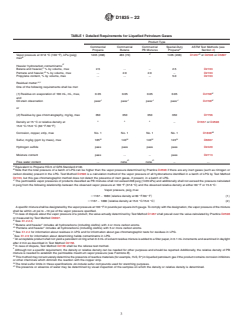
form to the requirements prescribed in Table 1.
(such as ethane) and may contain naturally occurring,
petroleum-derived, non-hydrocarbons.
6. Keywords
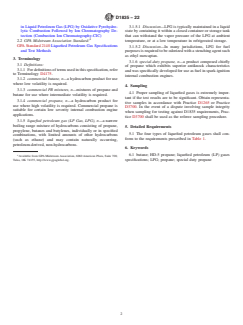
4 6.1 butane; HD-5 propane; liquefied petroleum (LP) gases
Available from GPA Midstream Association, 6060 American Plaza, Suite 700,
Tulsa, OK 74135, http://www.gpaglobal.org. specifications; LPG; propane; special duty propane
D1835−22
TABLE 1 Detailed Requirements for Liquefied Petroleum Gases
Product Type
Commercial Commercial Commercial Special-Duty ASTM Test Methods (see
A
Propane Butane PB Mixtures Propane Section 2)
C D
Vapor pressure at 37.8 °C (100 °F), kPa (psig) 1435 (208) 483 (70) 1435 (208) D1267 or D2598 or D6897
B
max
E
Heavier hydrocarbon contaminants:
F
Butane and heavier, % by volume, max 2.5 . . 2.5 D2163
G
Pentane and heavier, % by volume, max . 2.0 2.0 . D2163
Propylene content, % by volume, max . . . 5.0 D2163
H,I
Residual matter:
One of the following requirements shall be met:
K
(1) Residue on evaporation of 100 mL, mL, max, 0.05 0.05 0.05 0.05 D2158
and
J J J J K
Oil stain observation pass pass pass pass D2158
or
(2) Residue by gas chromatography, mg/kg, max 350 350 350 350 D7756
LL L
Density at 15 °C or relative density at . D1657 or D2598
15.6 °C ⁄15.6 °C (60 °F ⁄60 °F)
M
Corrosion, copper, strip, max No. 1 No. 1 No. 1 No. 1 D1838
N N N N
Sulfur, mg/kg (ppm by mass), max 185 140 140 123 D6667
Hydrogen sulfide pass pass pass pass D2420
Moisture content pass . . pass D2713
O O
Free water content . none none . .
A
Equivalent to Propane HD-5 of GPA Standard 2140.
B
Note that the total pressure of a batch of LPG can be higher than the vapor pressure determined by Practice D2598 if there are any inert gases (such as nitrogen or
carbon dioxide) present in the LPG. Test Method D2598 is a calculation method of the vapor pressure of all hydrocarbons identified in a batch of LPG by Test Method
D2163, but this gas chromatographic method does not detect the presence of inert gases, if present, in a batch of LPG.
C
The permissible vapor pressures of products classified as PB mixtures shall not exceed 208 psig (1435 kPa) and additionally shall not exceed the pressure calculated
in psig from the following relationship between the observed vapor pressure at 100 °F (37.8 °C) and the observed relative density at either 60 °F or 15.6 °C:
Vapor pressure, psig, max
511672 1880 srelative density at 60 °F/60 °Fd (1)
511672 1880 srelative density at 15.6 °C/15.6 °Cd (2)
A specific mixture shall be designated by the vapor pressure at 100 °F in pounds per square inch gauge. To comply with the designation, the vapor pressure of the mixture
shall be within +0 psi to −10 psi of the vapor pressure specified.
D
In case of dispute about the vapor pressure of a product, the value actually determined by Test Method D1267 shall prevail over the value calculated by Practice D2598
or measured by Test Method D6897.
E
See X1.2.2.3.
F
“Butane and heavier” includes all hydrocarbons (including olefins) with 4 or more carbon atoms.
G
“Pentane and heavier” includes all hydrocarbons (including olefins) with 5 or more carbon atoms.
H
See X1.2.4 for information about residues in LPG and for information about gas chromatographic tests for residues in LPG.
I
See X1.2.9 for information about determining halide contaminants in LPG.
J
An acceptable product shall not yield a persistent oil ring when 0.3 mL of solvent residue mixture is added to a filter paper, in 0.1 mL increments and examined in daylight
after 2 min as described in Test Method D2158.
K
In case of dispute, Test Method D2158 shall be the referee test method.
L
Although not a specific requirement, the density or relative density can be needed for other purposes and should be reported. Additionally, the relative density of PB
mixture is needed to establish the permissible maximum vapor pressure (see Footnote B).
M o
This method may not accurately determine the presence of reactive materials (for example, H S, S ) in liquefied petroleum gas if the product contains corrosion inhibitors
or other chemicals which diminish the reaction with the copper strip.
N
The total sulfur limits in these specifications do include sulfur compounds used for stenching purposes.
O
The presence or absence of water may be determined by visual inspection of the samples on which the density or relative density is determined.
D1835−22
APPENDIX
(Nonmandatory Information)
X1. SIGNIFICANCE OF ASTM SPECIFICATIONS FOR LIQUEFIED PETROLEUM (LP) GASES
X1.1 General X1.2 Significance and Use
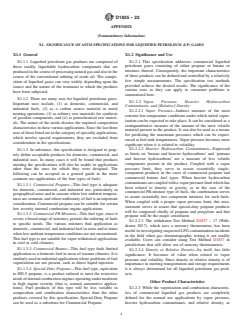
X1.2.1 This specification addresses commercial liquefied
X1.1.1 Liquefied petroleum gas products are composed of
petroleum gases consisting of either propane or butane or
those readily liquefiable hydrocarbon compounds that are
mixtures thereof. Consequently, the important characteristics
produced in the course of processing natural gas and also in the
of these products can be defined and controlled by a relatively
course of the conventional refining of crude oil. The compo-
few simple measurements. The specification test methods
sition of liquefied gases can vary widely depending upon the
provided achieve the desired results. The significance of the
source and the nature of the treatment to which the products
various tests as they can apply to consumer problems is
have been subjected.
summarized here.
X1.1.2 There are many uses for liquefied petroleum gases.
X1.2.2 Vapor Pressure, Heavier Hydrocarbon
Important uses include, (1) as domestic, commercial, and
Contaminants, and [Relative] Density:
industrial fuels, (2) as a carbon source material in metal
X1.2.2.1 Vapor Pressure—Indirect measure of the most
treating operations, (3) as refinery raw materials for synthesis
extreme low-temperature conditions under which initial vapor-
of gasoline components, and (4) as petrochemical raw materi-
ization can be expected to take place. It can be considered as a
als. The nature of the needs dictates the required composition
semiquantitative measure of the amount of the most volatile
characteristicsinthesevariousapplications.Sincethelastthree
material present in the product. It can also be used as a means
usesofthoselistedareinthecategoryofspecialtyapplications,
for predicting the maximum pressures which can be experi-
which involve special requirements, they are excluded from
enced at fuel tank temperatures. Vapor pressure becomes more
consideration in the specifications.
significant when it is related to volatility.
X1.2.2.2 Heavier Hydrocarbon Con
...
This document is not an ASTM standard and is intended only to provide the user of an ASTM standard an indication of what changes have been made to the previous version. Because
it may not be technically possible to adequately depict all changes accurately, ASTM recommends that users consult prior editions as appropriate. In all cases only the current version
of the standard as published by ASTM is to be considered the official document.
Designation: D1835 − 20 D1835 − 22
Standard Specification for
Liquefied Petroleum (LP) Gases
This standard is issued under the fixed designation D1835; the number immediately following the designation indicates the year of
original adoption or, in the case of revision, the year of last revision. A number in parentheses indicates the year of last reapproval. A
superscript epsilon (´) indicates an editorial change since the last revision or reapproval.
1. Scope*
1.1 This specification covers those products commonly referred to as liquefied petroleum gases, consisting of propane, propene
(propylene), butane, and mixtures of these materials. Four basic types of liquefied petroleum gases are provided to cover the
common use applications.
1.2 This specification is applicable to products intended for use as domestic, commercial and industrial heating, and engine fuels.
1.3 The values stated in SI units are to be regarded as standard. The values given in parentheses after SI units are provided for
information only and are not considered standard.
1.3.1 The non-SI unit ‘psig’ is the standard unit for footnote C of Table 1 because that unit of measurement is widely used in North
American industry.
1.4 This standard does not purport to address all of the safety concerns, if any, associated with its use. It is the responsibility
of the user of this standard to establish appropriate safety, health, and environmental practices and determine the applicability of
regulatory limitations prior to use.
1.5 This international standard was developed in accordance with internationally recognized principles on standardization
established in the Decision on Principles for the Development of International Standards, Guides and Recommendations issued
by the World Trade Organization Technical Barriers to Trade (TBT) Committee.
2. Referenced Documents
2.1 ASTM Standards:
D1265 Practice for Sampling Liquefied Petroleum (LP) Gases, Manual Method
D1267 Test Method for Gauge Vapor Pressure of Liquefied Petroleum (LP) Gases (LP-Gas Method)
D1657 Test Method for Density or Relative Density of Light Hydrocarbons by Pressure Hydrometer
D1837 Test Method for Volatility of Liquefied Petroleum (LP) Gases (Withdrawn 2017)
D1838 Test Method for Copper Strip Corrosion by Liquefied Petroleum (LP) Gases
D2158 Test Method for Residues in Liquefied Petroleum (LP) Gases
D2163 Test Method for Determination of Hydrocarbons in Liquefied Petroleum (LP) Gases and Propane/Propene Mixtures by
Gas Chromatography
D2420 Test Method for Hydrogen Sulfide in Liquefied Petroleum (LP) Gases (Lead Acetate Method)
This specification is under the jurisdiction of ASTM Committee D02 on Petroleum Products, Liquid Fuels, and Lubricants and is the direct responsibility of Subcommittee
D02.H0 on Liquefied Petroleum Gas.
Current edition approved May 1, 2020July 1, 2022. Published May 2020July 2022. Originally approved in 1961. Last previous edition approved in 20182020 as D1835
– 18a.20. DOI: 10.1520/D1835-20.10.1520/D1835-22.
For referenced ASTM standards, visit the ASTM website, www.astm.org, or contact ASTM Customer Service at service@astm.org. For Annual Book of ASTM Standards
volume information, refer to the standard’s Document Summary page on the ASTM website.
The last approved version of this historical standard is referenced on www.astm.org.
*A Summary of Changes section appears at the end of this standard
Copyright © ASTM International, 100 Barr Harbor Drive, PO Box C700, West Conshohocken, PA 19428-2959. United States
D1835 − 22
D2598 Practice for Calculation of Certain Physical Properties of Liquefied Petroleum (LP) Gases from Compositional Analysis
D2713 Test Method for Dryness of Propane (Valve Freeze Method)
D3700 Practice for Obtaining LPG Samples Using a Floating Piston Cylinder
D4175 Terminology Relating to Petroleum Products, Liquid Fuels, and Lubricants
D5504 Test Method for Determination of Sulfur Compounds in Natural Gas and Gaseous Fuels by Gas Chromatography and
Chemiluminescence
D5623 Test Method for Sulfur Compounds in Light Petroleum Liquids by Gas Chromatography and Sulfur Selective Detection
D6667 Test Method for Determination of Total Volatile Sulfur in Gaseous Hydrocarbons and Liquefied Petroleum Gases by
Ultraviolet Fluorescence
D6897 Test Method for Vapor Pressure of Liquefied Petroleum Gases (LPG) (Expansion Method)
D7756 Test Method for Residues in Liquefied Petroleum (LP) Gases by Gas Chromatography with Liquid, On-Column Injection
D7828 Test Method for Determination of Residue Composition in Liquefied Petroleum Gas (LPG) Using Automated Thermal
Desorption/Gas Chromatography (ATD/GC) (Withdrawn 2021)
D7994 Test Method for Total Fluorine, Chlorine, and Sulfur in Liquid Petroleum Gas (LPG) by Oxidative Pyrohydrolytic
Combustion Followed by Ion Chromatography Detection (Combustion Ion Chromatography-CIC)
2.2 GPA Midstream Association Standard:
GPA Standard 2140 Liquefied Petroleum Gas Specifications and Test Methods
3. Terminology
3.1 Definitions:
3.1.1 For definitions of terms used in this specification, refer to Terminology D4175.
3.1.2 commercial butane, n—a hydrocarbon product for use where low volatility is required.
3.1.3 commercial PB mixtures, n—mixtures of propane and butane for use where intermediate volatility is required.
3.1.4 commercial propane, n—a hydrocarbon product for use where high volatility is required. Commercial propane is suitable for
certain low severity internal combustion engine applications.
3.1.5 liquefied petroleum gas (LP Gas, LPG), n—a narrow boiling range mixture of hydrocarbons consisting of propane,
propylene, butanes and butylenes, individually or in specified combinations, with limited amounts of other hydrocarbons (such as
ethane) and may contain naturally occurring, petroleum-derived, non-hydrocarbons.
3.1.5.1 Discussion—
LPG is typically maintained in a liquid state by containing it within a closed container or storage tank that can withstand the vapor
pressure of the LPG at ambient temperature, or at a low temperature in refrigerated storage.
3.1.5.2 Discussion—
In many jurisdictions, LPG for fuel purposes is required to be odorized with a stenching agent such as ethyl mercaptan.
3.1.6 special-duty propane, n—a product composed chiefly of propane which exhibits superior antiknock characteristics and was
specifically developed for use as fuel in spark-ignition internal combustion engines.
4. Sampling
4.1 Proper sampling of liquefied gases is extremely important if the test results are to be significant. Obtain representative samples
in accordance with Practice D1265 or Practice D3700. In the event of a dispute involving sample integrity when sampling for
testing against D1835 requirements, Practice D3700 shall be used as the referee sampling procedure.
5. Detailed Requirements
5.1 The four types of liquefied petroleum gases shall conform to the requirements prescribed in Table 1.
6. Keywords
6.1 butane; HD-5 propane; liquefied petroleum (LP) gases specifications; LPG; propane; special duty propane
Available from GPA Midstream Association, 6060 American Plaza, Suite 700, Tulsa, OK 74135, http://www.gpaglobal.org.
D1835 − 22
TABLE 1 Detailed Requirements for Liquefied Petroleum Gases
Product Type
Commercial Commercial Commercial Special-Duty ASTM Test Methods (see
A
Propane Butane PB Mixtures Propane Section 2)
C D
Vapor pressure at 37.8 °C (100 °F), kPa (psig) 1435 (208) 483 (70) 1435 (208) D1267 or D2598 or D6897
B
max
E
Heavier hydrocarbon contaminants:
F
Butane and heavier, % by volume, max 2.5 . . 2.5 D2163
G
Pentane and heavier, % by volume, max . 2.0 2.0 . D2163
Propylene content, % by volume, max . . . 5.0 D2163
H,I
Residual matter:
One of the following requirements shall be met:
K
(1) Residue on evaporation of 100 mL, mL, max, 0.05 0.05 0.05 0.05 D2158
and
J J J J K
Oil stain observation pass pass pass pass D2158
or
(2) Residue by gas chromatography, mg/kg, max 350 350 350 350 D7756
L L L
Density at 15 °C or relative density at . D1657 or D2598
15.6 °C ⁄15.6 °C (60 °F ⁄60 °F)
M
Corrosion, copper, strip, max No. 1 No. 1 No. 1 No. 1 D1838
N N N N
Sulfur, mg/kg (ppm by mass), max 185 140 140 123 D6667
Hydrogen sulfide pass pass pass pass D2420
Moisture content pass . . pass D2713
O O
Free water content . none none . .
A
Equivalent to Propane HD-5 of GPA Standard 2140.
B
Note that the total pressure of a batch of LPG can be higher than the vapor pressure determined by Practice D2598 if there are any inert gases (such as nitrogen or
carbon dioxide) present in the LPG. Test Method D2598 is a calculation method of the vapor pressure of all hydrocarbons identified in a batch of LPG by Test Method
D2163, but this gas chromatographic method does not detect the presence of inert gases, if present, in a batch of LPG.
C
The permissible vapor pressures of products classified as PB mixtures shall not exceed 208 psig (1435 kPa) and additionally shall not exceed the pressure calculated
in psig from the following relationship between the observed vapor pressure at 100 °F (37.8 °C) and the observed relative density at either 60 °F or 15.6 °C:
Vapor pressure, psig, max
51167 21880 srelative density at 60 °F/60 °Fd (1)
51167 21880 relative density at 15.6 °C/15.6 °C (2)
s d
A specific mixture shall be designated by the vapor pressure at 100 °F in pounds per square inch gauge. To comply with the designation, the vapor pressure of the mixture
shall be within +0 psi to −10 psi of the vapor pressure specified.
D
In case of dispute about the vapor pressure of a product, the value actually determined by Test Method D1267 shall prevail over the value calculated by Practice D2598
or measured by Test Method D6897.
E
See X1.2.2.3.
F
“Butane and heavier” includes all hydrocarbons (including olefins) with 4 or more carbon atoms.
G
“Pentane and heavier” includes all hydrocarbons (including olefins) with 5 or more carbon atoms.
H
See X1.2.4 for information about residues in LPG and for information about gas chromatographic tests for residues in LPG.
I
See X1.2.9 for information about determining halide contaminants in LPG.
J
An acceptable product shall not yield a persistent oil ring when 0.3 mL of solvent residue mixture is added to a filter paper, in 0.1 mL increments and examined in daylight
after 2 min as described in Test Method D2158.
K
In case of dispute, Test Method D2158 shall be the referee test method.
L
Although not a specific requirement, the density or relative density can be needed for other purposes and should be reported. Additionally, the relative density of PB
mixture is needed to establish the permissible maximum vapor pressure (see Footnote B).
M o
This method may not accurately determine the presence of reactive materials (for example, H S, S ) in liquefied petroleum gas if the product contains corrosion inhibitors
or other chemicals which diminish the reaction with the copper strip.
N
The total sulfur limits in these specifications do include sulfur compounds used for stenching purposes.
O
The presence or absence of water may be determined by visual inspection of the samples on which the density or relative density is determined.
D1835 − 22
APPENDIX
(Nonmandatory Information)
X1. SIGNIFICANCE OF ASTM SPECIFICATIONS FOR LIQUEFIED PETROLEUM (LP) GASES
X1.1 General
X1.1.1 Liquefied petroleum gas products are composed of those readily liquefiable hydrocarbon compounds that are produced in
the course of processing natural gas and also in the course of the conventional refining of crude oil. The composition of liquefied
gases can vary widely depending upon the source and the nature of the treatment to which the products have been subjected.
X1.1.2 There are many uses for liquefied petroleum gases. Important uses include, (1) as domestic, commercial, and industrial
fuels, (2) as a carbon source material in metal treating operations, (3) as refinery raw materials for synthesis of gasoline
components, and (4) as petrochemical raw materials. The nature of the needs dictates the required composition characteristics in
these various applications. Since the last three uses of those listed are in the category of specialty applications, which involve
special requirements, they are excluded from consideration in the specifications.
X1.1.3 In substance, this specification is designed to properly define acceptable products for domestic, commercial, and industrial
uses. In many cases it will be found that products meeting the specifications will also be usable in applications other than the ones
for which they were designed. The following can be accepted as a general guide in the more common use applications of the four
types of fuels:
X1.1.3.1 Commercial Propane—This fuel type is adequate for domestic, commercial, and industrial use, particularly in
geographical areas and in seasons where low ambient temperatures are common, and where uniformity of fuel is an important
consideration. Commercial propane can be suitable for certain low severity internal combustion engine applications.
X1.1.3.2 Commercial PB Mixtures—This fuel type, since it covers a broad range of mixtures, permits the tailoring of fuels to
specific needs. The various mixtures find application as domestic, commercial, and industrial fuel in areas and at times when low
ambient temperature conditions are not encountered. This fuel type is not suitable for vapor withdrawal applications in cool or cold
climates.
X1.1.3.3 Commercial Butane—This fuel type finds limited application as a domestic fuel in areas of warmer climates. It is
similarly
...