


ASTM D2812-07(2021)
(Test Method)Standard Test Method for Non-Lint Content of Cotton
Standard Test Method for Non-Lint Content of Cotton
SIGNIFICANCE AND USE
5.1 This test method for testing cotton for non-lint content is considered satisfactory for acceptance testing of commercial shipments since it is the best available procedure for obtaining objective data.
5.1.1 If there are differences of practical significance between reported test results for two laboratories (or more), comparative tests should be performed to determine if there is a statistical bias between them, using competent statistical assistance. As a minimum, ensure the test samples to be used are as homogeneous as possible, are drawn from the material from which the disparate test results were obtained, and are randomly assigned in equal numbers to each laboratory for testing. The test results from the two laboratories should be compared using a statistical test for unpaired data, at a probability level chosen prior to the testing series. If a bias is found, either its cause must be found and corrected, or future test results for that material must be adjusted in consideration of the known bias.
5.2 This test method gives data on the non-lint content of raw cotton which can be used as a basis for: (1) estimating the net amount of manufactured textile product obtainable from raw cotton; (2) predicting the quality of cotton textile products, particularly their aesthetic properties; (3) assembling and blending bales in a mix on a non-lint content basis; (4) adjusting ginning and textile processing machines for maximum efficiency in cleaning lint; and (5) relating non-lint content of cotton to end-product quality and processing efficiency.
SCOPE
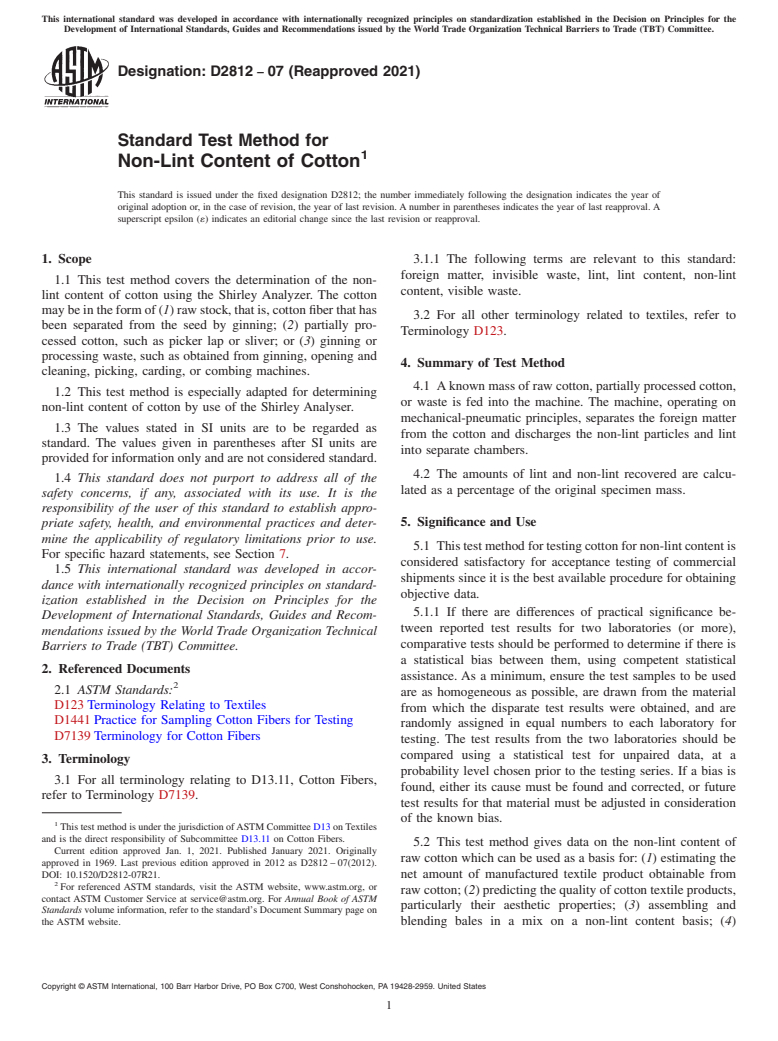
1.1 This test method covers the determination of the non-lint content of cotton using the Shirley Analyzer. The cotton may be in the form of (1) raw stock, that is, cotton fiber that has been separated from the seed by ginning; (2) partially processed cotton, such as picker lap or sliver; or (3) ginning or processing waste, such as obtained from ginning, opening and cleaning, picking, carding, or combing machines.
1.2 This test method is especially adapted for determining non-lint content of cotton by use of the Shirley Analyser.
1.3 The values stated in SI units are to be regarded as standard. The values given in parentheses after SI units are provided for information only and are not considered standard.
1.4 This standard does not purport to address all of the safety concerns, if any, associated with its use. It is the responsibility of the user of this standard to establish appropriate safety, health, and environmental practices and determine the applicability of regulatory limitations prior to use. For specific hazard statements, see Section 7.
1.5 This international standard was developed in accordance with internationally recognized principles on standardization established in the Decision on Principles for the Development of International Standards, Guides and Recommendations issued by the World Trade Organization Technical Barriers to Trade (TBT) Committee.
General Information
Relations
Standards Content (Sample)
This international standard was developed in accordance with internationally recognized principles on standardization established in the Decision on Principles for the
Development of International Standards, Guides and Recommendations issued by the World Trade Organization Technical Barriers to Trade (TBT) Committee.
Designation: D2812 − 07 (Reapproved 2021)
Standard Test Method for
1
Non-Lint Content of Cotton
This standard is issued under the fixed designation D2812; the number immediately following the designation indicates the year of
original adoption or, in the case of revision, the year of last revision. A number in parentheses indicates the year of last reapproval. A
superscript epsilon (´) indicates an editorial change since the last revision or reapproval.
1. Scope 3.1.1 The following terms are relevant to this standard:
foreign matter, invisible waste, lint, lint content, non-lint
1.1 This test method covers the determination of the non-
content, visible waste.
lint content of cotton using the Shirley Analyzer. The cotton
maybeintheformof(1)rawstock,thatis,cottonfiberthathas
3.2 For all other terminology related to textiles, refer to
been separated from the seed by ginning; (2) partially pro-
Terminology D123.
cessed cotton, such as picker lap or sliver; or (3) ginning or
processing waste, such as obtained from ginning, opening and
4. Summary of Test Method
cleaning, picking, carding, or combing machines.
4.1 Aknown mass of raw cotton, partially processed cotton,
1.2 This test method is especially adapted for determining
or waste is fed into the machine. The machine, operating on
non-lint content of cotton by use of the Shirley Analyser.
mechanical-pneumatic principles, separates the foreign matter
1.3 The values stated in SI units are to be regarded as
from the cotton and discharges the non-lint particles and lint
standard. The values given in parentheses after SI units are
into separate chambers.
provided for information only and are not considered standard.
4.2 The amounts of lint and non-lint recovered are calcu-
1.4 This standard does not purport to address all of the
lated as a percentage of the original specimen mass.
safety concerns, if any, associated with its use. It is the
responsibility of the user of this standard to establish appro-
5. Significance and Use
priate safety, health, and environmental practices and deter-
mine the applicability of regulatory limitations prior to use.
5.1 Thistestmethodfortestingcottonfornon-lintcontentis
For specific hazard statements, see Section 7.
considered satisfactory for acceptance testing of commercial
1.5 This international standard was developed in accor-
shipments since it is the best available procedure for obtaining
dance with internationally recognized principles on standard-
objective data.
ization established in the Decision on Principles for the
5.1.1 If there are differences of practical significance be-
Development of International Standards, Guides and Recom-
tween reported test results for two laboratories (or more),
mendations issued by the World Trade Organization Technical
comparative tests should be performed to determine if there is
Barriers to Trade (TBT) Committee.
a statistical bias between them, using competent statistical
2. Referenced Documents
assistance. As a minimum, ensure the test samples to be used
2
2.1 ASTM Standards:
are as homogeneous as possible, are drawn from the material
D123 Terminology Relating to Textiles
from which the disparate test results were obtained, and are
D1441 Practice for Sampling Cotton Fibers for Testing
randomly assigned in equal numbers to each laboratory for
D7139 Terminology for Cotton Fibers
testing. The test results from the two laboratories should be
compared using a statistical test for unpaired data, at a
3. Terminology
probability level chosen prior to the testing series. If a bias is
3.1 For all terminology relating to D13.11, Cotton Fibers,
found, either its cause must be found and corrected, or future
refer to Terminology D7139.
test results for that material must be adjusted in consideration
of the known bias.
1
This test method is under the jurisdiction ofASTM Committee D13 on Textiles
and is the direct responsibility of Subcommittee D13.11 on Cotton Fibers.
5.2 This test method gives data on the non-lint content of
Current edition approved Jan. 1, 2021. Published January 2021. Originally
raw cotton which can be used as a basis for: (1) estimating the
approved in 1969. Last previous edition approved in 2012 as D2812 – 07(2012).
DOI: 10.1520/D2812-07R21.
net amount of manufactured textile product obtainable from
2
For referenced ASTM standards, visit the ASTM website, www.astm.org, or
raw cotton; (2) predicting the quality of cotton textile products,
contact ASTM Customer Service at service@astm.org. For Annual Book of ASTM
particularly their aesthetic properties; (3) assembling and
Standards volume information, refer to the standard’s Document Summary page on
the ASTM website. blen
...
Questions, Comments and Discussion
Ask us and Technical Secretary will try to provide an answer. You can facilitate discussion about the standard in here.