


ASTM E2041-13(2018)
(Test Method)Standard Test Method for Estimating Kinetic Parameters by Differential Scanning Calorimeter Using the Borchardt and Daniels Method
Standard Test Method for Estimating Kinetic Parameters by Differential Scanning Calorimeter Using the Borchardt and Daniels Method
SIGNIFICANCE AND USE
6.1 This test method is useful in research and development.
6.2 The determination of the appropriate model for a chemical reaction or transformation and the values associated with its kinetic parameters may be used in the estimation of reaction performance at temperatures or time conditions not easily tested. This use, however, is not described in this test method.
SCOPE
1.1 This test method describes the determination of the kinetic parameters of activation energy, Arrhenius pre-exponential factor, and reaction order using the Borchardt and Daniels2 treatment of data obtained by differential scanning calorimetry. This test method is applicable to the temperature range from 170 to 870 K (−100 to 600°C).
1.2 This treatment is applicable only to smooth exothermic reactions with no shoulders, discontinuous changes, or shifts in baseline. It is applicable only to reactions with reaction order n ≤ 2. It is not applicable to acceleratory reactions and, therefore, is not applicable to the determination of kinetic parameters for most thermoset curing reactions or to crystallization reactions.
1.3 The values stated in SI units are to be regarded as standard. No other units of measurement are included in this standard.
1.4 This test method is similar, but not equivalent to, ISO 11357, Part 5, that contains provisions for additional information not supplied by this test method.
1.5 This standard does not purport to address all of the safety concerns, if any, associated with its use. It is the responsibility of the user of this standard to establish appropriate safety, health, and environmental practices and determine the applicability of regulatory limitations prior to use.
1.6 This international standard was developed in accordance with internationally recognized principles on standardization established in the Decision on Principles for the Development of International Standards, Guides and Recommendations issued by the World Trade Organization Technical Barriers to Trade (TBT) Committee.
General Information
Buy Standard
Standards Content (Sample)
NOTICE: This standard has either been superseded and replaced by a new version or withdrawn.
Contact ASTM International (www.astm.org) for the latest information
Designation: E2041 − 13 (Reapproved 2018)
Standard Test Method for
Estimating Kinetic Parameters by Differential Scanning
Calorimeter Using the Borchardt and Daniels Method
This standard is issued under the fixed designation E2041; the number immediately following the designation indicates the year of
original adoption or, in the case of revision, the year of last revision. A number in parentheses indicates the year of last reapproval. A
superscript epsilon (´) indicates an editorial change since the last revision or reapproval.
1. Scope 2. Referenced Documents
2.1 ASTM Standards:
1.1 This test method describes the determination of the
E473 Terminology Relating to Thermal Analysis and Rhe-
kinetic parameters of activation energy, Arrhenius pre-
ology
exponential factor, and reaction order using the Borchardt and
E537 Test Method for The Thermal Stability of Chemicals
Daniels treatment of data obtained by differential scanning
by Differential Scanning Calorimetry
calorimetry. This test method is applicable to the temperature
E698 Test Method for Kinetic Parameters for Thermally
range from 170 to 870 K (−100 to 600°C).
Unstable Materials Using Differential Scanning Calorim-
1.2 This treatment is applicable only to smooth exothermic
etry and the Flynn/Wall/Ozawa Method
reactions with no shoulders, discontinuous changes, or shifts in
E967 Test Method for Temperature Calibration of Differen-
baseline. It is applicable only to reactions with reaction order
tial Scanning Calorimeters and Differential Thermal Ana-
n ≤ 2. It is not applicable to acceleratory reactions and,
lyzers
therefore, is not applicable to the determination of kinetic
E968 Practice for Heat Flow Calibration of Differential
parameters for most thermoset curing reactions or to crystalli-
Scanning Calorimeters
zation reactions.
E1142 Terminology Relating to Thermophysical Properties
E1445 Terminology Relating to Hazard Potential of Chemi-
1.3 The values stated in SI units are to be regarded as
cals
standard. No other units of measurement are included in this
E1641 Test Method for Decomposition Kinetics by Thermo-
standard.
gravimetry Using the Ozawa/Flynn/Wall Method
1.4 This test method is similar, but not equivalent to, E1970 Practice for Statistical Treatment of Thermoanalytical
ISO 11357, Part 5, that contains provisions for additional Data
information not supplied by this test method. 2.2 ISO Standards:
ISO 11357 Part 5: Determination of Temperature and/or
1.5 This standard does not purport to address all of the
Time of Reaction and Reaction Kinetics
safety concerns, if any, associated with its use. It is the
responsibility of the user of this standard to establish appro-
3. Terminology
priate safety, health, and environmental practices and deter-
3.1 Definitions—Specific technical terms used in this test
mine the applicability of regulatory limitations prior to use.
method are defined in Terminologies E473, E1142, and E1445,
1.6 This international standard was developed in accor-
including calibration, calorimeter, differential scanning
dance with internationally recognized principles on standard-
calorimetry, enthalpy, peak, reaction, repeatability,
ization established in the Decision on Principles for the
reproducibility, and slope.
Development of International Standards, Guides and Recom-
mendations issued by the World Trade Organization Technical
4. Summary of Test Method
Barriers to Trade (TBT) Committee.
4.1 A test specimen is heated at a linear rate in a differential
scanning calorimeter or other suitable calorimeter through a
region of exothermic reaction behavior. The rate of heat
This test method is under the jurisdiction of ASTM Committee E37 on Thermal
Measurements and the direct responsibility of Subcommittee E37.01 on Calorimetry
and Mass Loss. For referenced ASTM standards, visit the ASTM website, www.astm.org, or
Current edition approved April 1, 2018. Published May 2018. Originally contact ASTM Customer Service at service@astm.org. For Annual Book of ASTM
ε1
approved in 1999. Last previous edition approved in 2013 as E2041 – 13 . DOI: Standards volume information, refer to the standard’s Document Summary page on
10.1520/E2041-13R18. the ASTM website.
2 4
Borchardt, H.J., Daniels, F., Journal of the American Chemical Society, Vol 79, Available from American National Standards Institute (ANSI), 25 W. 43rd St.,
1957, pp. 41–46. 4th Floor, New York, NY 10036, http://www.ansi.org.
Copyright © ASTM International, 100 Barr Harbor Drive, PO Box C700, West Conshohocken, PA 19428-2959. United States
E2041 − 13 (2018)
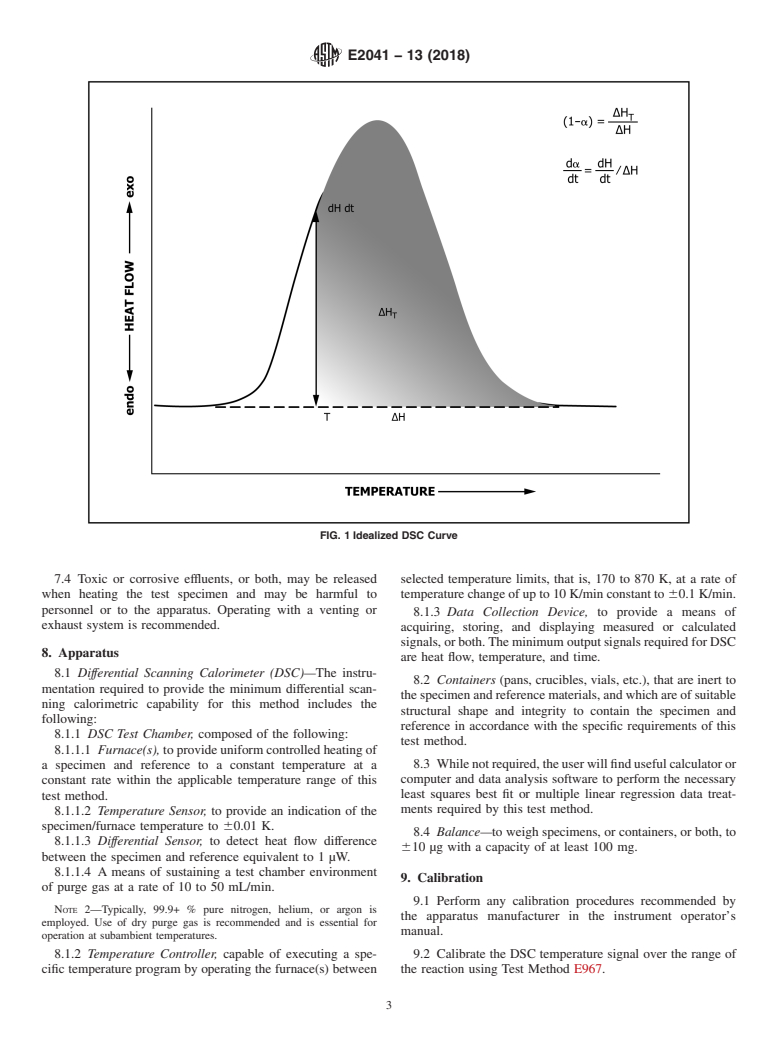
evolution, developed by a chemical reaction, is proportional to 5.6 The values for dα/dt, (1 − α) and T needed to solve Eq
the rate of reaction. Integration of the heat flow as a function of 2, Eq 4 and Eq 5, are experimental parameters obtained from
time yields the total heat of a reaction. a single linear heating rate DSC experiment scanning through
2 the temperature region of the reaction exotherm as shown in
4.2 The Borchardt and Daniels data treatment is used to
Fig. 1.
derive the kinetic parameters of activation energy, Arrhenius
pre-exponential factor, and reaction order from the heat flow 5.7 Kinetic results obtained by this test method may be
and total heat of reaction information obtained in 4.1 (see compared with those obtained by Test Method E698.
Section 5).
6. Significance and Use
5. Basis of Methodology
6.1 This test method is useful in research and development.
5.1 Kinetic reactions may be modeled with a number of
2 6.2 The determination of the appropriate model for a chemi-
suitable equations. The Borchardt and Daniels method makes
cal reaction or transformation and the values associated with its
use of the rate equation to describe the dependence of the rate
kinetic parameters may be used in the estimation of reaction
of reaction on the amount of material present.
performance at temperatures or time conditions not easily
n
dα/dt5 k T 1 2 α (1)
~ ! ~ !
tested. This use, however, is not described in this test method.
where:
−1
7. Interferences
dα/dt = reaction rate (min )
α = fraction reacted (dimensionless),
7.1 Because of its simplicity and ease of use, the Borchardt
−1
k(T) = rate constant at temperature T (min ), and
and Daniels method is often the method of choice for
n = reaction order (dimensionless).
characterization of the kinetic parameters of a reaction system.
5.2 For a reaction conducted at temperature (T), the rate The Borchardt and Daniels method, like all tools used to
evaluate kinetic parameters, is not applicable to all cases. The
equation of Eq 1, may be cast in its logarithmic form:
user of this test method is expressly advised to use this test
ln dα/dt 5 ln k T 1nln 1 2 α (2)
@ # @ ~ !# @ #
method and its results with caution.
This equation has the form of a straight line, y = mx + b,
7.2 Tabulated below are some guidelines for the use of the
where a plot of the logarithm of the reaction rate (ln[dα/dt])
Borchardt and Daniels method.
versus the logarithm of the fraction remaining ln[1 − α] yields
7.2.1 The approach is applicable only to exothermic reac-
a straight line, the slope of which is equal to n and the intercept
tions.
is equal to ln[k(T)].
2 NOTE 1—Endothermic reactions are controlled by the kinetics of the
5.3 The Borchardt and Daniels model also makes use of the
heat transfer of the apparatus and not by the kinetics of the reaction.
Arrhenius equation to describe how the reaction rate changes
7.2.2 The reaction under investigation must have a constant
as a function of temperature:
mechanism throughout the whole reaction process. In practice,
·E/RT
k~T! 5 Z e (3)
this means that the reaction exotherm upon heating must be
smooth, well shaped (as in Fig. 1) with no shoulders, multiple
where:
−1
peaks or discontinuous steps.
Z = Arrhenius pre-exponential factor (min ),
−1
7.2.3 The reaction must be nth order. Confirmation of an nth
E = Activation energy (J mol ),
order reaction may be made by an isothermal experiment such
T = Absolute temperature (K), and
−1 −1
as that described in Appendix X1.
R = Gas constant (= 8.314 J mol K ).
7.2.4 Typical reactions which are not nth order and to which
5.4 The Arrhenius equation Eq 3 also may be cast in its
Borchardt and Daniels kinetic may not be applied for predic-
logarithmic form:
tive purposes include many thermoset curing reactions and
ln@k~T!# 5 ln@Z# 2 E/RT (4)
crystallization transformations.
7.2.5 The nth order kinetic reactions anticipate that the
The equation has the form of a straight line, y = mx + b,
value of n will be small, non-zero integers, such as 1 or 2.
(where y ≡ ln[k(T)], m ≡ E/R, x ≡1/T and b ≡ ln[Z]) where a plot
Values of n greater than 2 or that are not simple fractions, such
of the logarithm of the reaction rate constant (ln[k(T)]) versus
as ⁄2 = 0.5, are highly unlikely and shall be viewed with
the reciprocal of absolute temperature (l/T) produces a straight
caution.
line, the slope of which is equal to −E/R and the intercept of
7.2.6 The Borchardt and Daniels method assumes tempera-
which is ln[Z].
ture equilibrium throughout the whole test specimen. This
5.5 As an alternate to Eq 2 and 4, the rate and Arrhenius
means that low heating rates, (that is, <10 K/min), small
equations may be combined and cast in its logarithmic form:
specimen sizes (<5 mg) and highly conductive sealed specimen
ln dα/dt 5 ln Z 1nln 1 2 α 2 E/RT (5)
@ # @ # @ #
containers, for example, aluminum, gold, platinum, etc., should
be used.
The resultant equation has the form z = a + bx + cy (where
z ≡ ln[dα/dt], ln[Z] ≡ a, b ≡ n, x ≡ ln[1 − α], c ≡ E/R, and y ≡ 7.3 Since milligram quantities of specimen are used, it is
l/T) and may be solved using multiple linear regression data essential that the specimen be homogeneous and representative
treatment. of the test sample from which they are taken.
E2041 − 13 (2018)
FIG. 1 Idealized DSC Curve
7.4 Toxic or corrosive effluents, or both, may be released selected temperature limits, that is, 170 to 870 K, at a rate of
when heating the test specimen and may be harmful to temperature change of up to 10 K/min constant to 60.1 K/min.
personnel or to the apparatus. Operating with a venting or
8.1.3 Data Collection Device, to provide a means of
exhaust system is recommended.
acquiring, storing, and displaying measured or calculated
signals, or both. The minimum output signals required for DSC
8. Apparatus
are heat flow, temperature, and time.
8.1 Differential Scanning Calorimeter (DSC)—The instru-
8.2 Containers (pans, crucibles, vials, etc.), that are inert to
mentation required to provide the minimum differential scan-
the specimen and reference materials, and which are of suitable
ning calorimetric capability for this method includes the
structural shape and integrity to contain the specimen and
following:
reference in accordance with the specific requirements of this
8.1.1 DSC Test Chamber, composed of the following:
test method.
8.1.1.1 Furnace(s), to provide uniform controlled heating of
8.3 While not required, the user will find useful calculator or
a specimen and reference to a constant temperature at a
computer and data analysis software to perform the necessary
constant rate within the applicable temperature range of this
least squares best fit or multiple linear regression data treat-
test method.
ments required by this test method.
8.1.1.2 Temperature Sensor, to provide an indication of the
specimen/furnace temperature to 60.01 K.
8.4 Balance—to weigh specimens, or containers, or both, to
8.1.1.3 Differential Sensor, to detect heat flow difference
610 µg with a capacity of at least 100 mg.
between the specimen and reference equivalent to 1 µW.
8.1.1.4 A means of sustaining a test chamber environment
9. Calibration
of purge gas at a rate of 10 to 50 mL/min.
9.1 Perform any calibration procedures recommended by
NOTE 2—Typically, 99.9+ % pure nitrogen, helium, or argon is
the apparatus manufacturer in the instrument operator’s
employed. Use of dry purge gas is recommended and is essential for
manual.
operation at subambient temperatures.
8.1.2 Temperature Controller, capable of executing a spe- 9.2 Calibrate the DSC temperature signal over the range of
cific temperature program by operating the furnace(s) between the reaction using Test Method E967.
E2041 − 13 (2018)
NOTE 6—It is convenient to prepare a table of these values.
9.3 Calibrate the DSC heat flow signal using Practice E968.
11.7 For each of the fractional areas obtained in 11.6,
10. Procedure
determine the fraction remaining (1 − α) and the fractional rate
of reaction (dα/dt) using the following equation:
10.1 Weigh 1 to 10 mg of test specimen to a precision of
610 µg into a sample container and hermetically seal the
~1 2 α! 5 ΔH /ΔH (6)
T
container. Weigh the specimen and container to 610 µg. Load
dα/dt5 dH/dt /ΔH (7)
~ !
the test specimen into the apparatus using an equivalent empty
NOTE 7—In this and all subsequent calculations, retain all available
specimen container as the reference. Close the DSC sample
significant figures rounding only the final result to the number of
chamber and prepare the apparatus for an experimental run. significant figures described in Section 13.
NOTE 8—The values for (1 − α) should range between 0.9 and 0.1
NOTE 3—This test method is based upon a “non-self heating” assump-
depending upon the values selected in 11.4 and 11.5
tion. Combinations of specimen size and reaction kinetics that produce
11.8 Calculate the reciprocal of absolute temperature for
heat flow greater than 8 mW fail this assumption and produce erroneous
results. Small specimen sizes may be used to obtain this critical non-self each value determined in 11.6 and 11.7 (see Note 7).
heating assumption.
NOTE 9—Often, it is convenient to report the value of reciprocal
−1
10.2 Equilibrate the specimen at a temperature 40 K below
temperature in units of kK .
the first exothermic behavior.
11.9 Calculate the natural logarithm of the rate of reaction
NOTE 4—This temperature may be determined from a previously
(ln[dα/dt ]) for each of the values determined in 11.6 and 11.7
recorded exploratory run using Test Method E537.
(see Note 7).
10.3 Heat the test specimen at a rate of 5 K/min to a
11.10 Determine the values for n, s , E, s , ln , and s
n E [Z] ln[Z]
temperature 10 K higher than the completion of the exothermic
by either Method A or Method B below.
reaction as indicated by the return to baseline. Record the heat
11.11 Method A:
flow and sample temperature throughout this region.
11.11.1 Assume a value for n = 1.0.
NOTE 5—Other heating rates (<10 K/min) may be used but shall be
11.11.2
...
This document is not an ASTM standard and is intended only to provide the user of an ASTM standard an indication of what changes have been made to the previous version. Because
it may not be technically possible to adequately depict all changes accurately, ASTM recommends that users consult prior editions as appropriate. In all cases only the current version
of the standard as published by ASTM is to be considered the official document.
´1
Designation: E2041 − 13 E2041 − 13 (Reapproved 2018)
Standard Test Method for
Estimating Kinetic Parameters by Differential Scanning
Calorimeter Using the Borchardt and Daniels Method
This standard is issued under the fixed designation E2041; the number immediately following the designation indicates the year of
original adoption or, in the case of revision, the year of last revision. A number in parentheses indicates the year of last reapproval. A
superscript epsilon (´) indicates an editorial change since the last revision or reapproval.
ε NOTE—Warning statements were editorially corrected throughout in September 2013.
1. Scope
1.1 This test method describes the determination of the kinetic parameters of activation energy, Arrhenius pre-exponential
factor, and reaction order using the Borchardt and Daniels treatment of data obtained by differential scanning calorimetry. This
test method is applicable to the temperature range from 170 to 870 K (−100 to 600°C).
1.2 This treatment is applicable only to smooth exothermic reactions with no shoulders, discontinuous changes, or shifts in
baseline. It is applicable only to reactions with reaction order
n ≤ 2. It is not applicable to acceleratory reactions and, therefore, is not applicable to the determination of kinetic parameters for
most thermoset curing reactions or to crystallization reactions.
1.3 The values stated in SI units are to be regarded as standard. No other units of measurement are included in this standard.
1.4 This test method is similar, but not equivalent to, ISO 11357, Part 5, that contains provisions for additional information not
supplied by this test method.
1.5 This standard does not purport to address all of the safety concerns, if any, associated with its use. It is the responsibility
of the user of this standard to establish appropriate safety safety, health, and healthenvironmental practices and determine the
applicability of regulatory limitations prior to use.
1.6 This international standard was developed in accordance with internationally recognized principles on standardization
established in the Decision on Principles for the Development of International Standards, Guides and Recommendations issued
by the World Trade Organization Technical Barriers to Trade (TBT) Committee.
2. Referenced Documents
2.1 ASTM Standards:
E473 Terminology Relating to Thermal Analysis and Rheology
E537 Test Method for The Thermal Stability of Chemicals by Differential Scanning Calorimetry
E698 Test Method for Kinetic Parameters for Thermally Unstable Materials Using Differential Scanning Calorimetry and the
Flynn/Wall/Ozawa Method
E967 Test Method for Temperature Calibration of Differential Scanning Calorimeters and Differential Thermal Analyzers
E968 Practice for Heat Flow Calibration of Differential Scanning Calorimeters
E1142 Terminology Relating to Thermophysical Properties
E1445 Terminology Relating to Hazard Potential of Chemicals
E1641 Test Method for Decomposition Kinetics by Thermogravimetry Using the Ozawa/Flynn/Wall Method
E1970 Practice for Statistical Treatment of Thermoanalytical Data
2.2 ISO Standards:
ISO 11357 Part 5: Determination of Temperature and/or Time of Reaction and Reaction Kinetics
This test method is under the jurisdiction of ASTM Committee E37 on Thermal Measurements and the direct responsibility of Subcommittee E37.01 on Calorimetry and
Mass Loss.
Current edition approved Sept. 15, 2013April 1, 2018. Published September 2013May 2018. Originally approved in 1999. Last previous edition approved in 20082013
ε1
as E2041 – 08E2041 – 13 . DOI: 10.1520/E2041-13E01.10.1520/E2041-13R18.
Borchardt, H.J., Daniels, F., Journal of the American Chemical Society, Vol 79, 1957, pp. 41–46.
For referenced ASTM standards, visit the ASTM website, www.astm.org, or contact ASTM Customer Service at service@astm.org. For Annual Book of ASTM Standards
volume information, refer to the standard’s Document Summary page on the ASTM website.
Available from American National Standards Institute (ANSI), 25 W. 43rd St., 4th Floor, New York, NY 10036, http://www.ansi.org.
Copyright © ASTM International, 100 Barr Harbor Drive, PO Box C700, West Conshohocken, PA 19428-2959. United States
E2041 − 13 (2018)
3. Terminology
3.1 Definitions—Specific technical terms used in this test method are defined in Terminologies E473, E1142, and E1445,
including calibration, calorimeter, differential scanning calorimetry, enthalpy, peak, reaction, repeatability, reproducibility, and
slope.
4. Summary of Test Method
4.1 A test specimen is heated at a linear rate in a differential scanning calorimeter or other suitable calorimeter through a region
of exothermic reaction behavior. The rate of heat evolution, developed by a chemical reaction, is proportional to the rate of
reaction. Integration of the heat flow as a function of time yields the total heat of a reaction.
4.2 The Borchardt and Daniels data treatment is used to derive the kinetic parameters of activation energy, Arrhenius
pre-exponential factor, and reaction order from the heat flow and total heat of reaction information obtained in 4.1 (see Section
5).
5. Basis of Methodology
5.1 Kinetic reactions may be modeled with a number of suitable equations. The Borchardt and Daniels method makes use of
the rate equation to describe the dependence of the rate of reaction on the amount of material present.
n
dα/dt 5 k T 12 α (1)
~ ! ~ !
where:
−1
dα/dt = reaction rate (min )
α = fraction reacted (dimensionless),
−1
k(T) = rate constant at temperature T (min ), and
n = reaction order (dimensionless).
5.2 For a reaction conducted at temperature (T), the rate equation of Eq 1, may be cast in its logarithmic form:
ln@dα/dt# 5 ln@k~T!#1nln@12α# (2)
This equation has the form of a straight line, y = mx + b, where a plot of the logarithm of the reaction rate (ln[dα/dt]) versus
the logarithm of the fraction remaining ln[1 − α] yields a straight line, the slope of which is equal to n and the intercept is equal
to ln[k(T)].
5.3 The Borchardt and Daniels model also makes use of the Arrhenius equation to describe how the reaction rate changes as
a function of temperature:
·E/RT
k T 5 Z e (3)
~ !
where:
−1
Z = Arrhenius pre-exponential factor (min ),
−1
E = Activation energy (J mol ),
T = Absolute temperature (K), and
−1 −1
R = Gas constant (= 8.314 J mol K ).
5.4 The Arrhenius equation Eq 3 also may be cast in its logarithmic form:
ln k T 5 ln Z 2E/RT (4)
@ ~ !# @ #
The equation has the form of a straight line, y = mx + b, (where y ≡ ln[k(T)], m ≡ E/R,x ≡1/T and b ≡ ln[Z]) where a plot of
the logarithm of the reaction rate constant (ln[k(T)]) versus the reciprocal of absolute temperature (l/T) produces a straight line,
the slope of which is equal to −E/R and the intercept of which is ln[Z].
5.5 As an alternate to Eq 2 and 4, the rate and Arrhenius equations may be combined and cast in its logarithmic form:
ln@dα/dt# 5 ln@Z#1nln@12α#2E/RT (5)
The resultant equation has the form z = a + bx + cy (where z ≡ ln[dα/dt], ln[Z] ≡ a, b ≡ n, x ≡ ln[1 − α], c ≡ E/R, and y ≡ l/T)
and may be solved using multiple linear regression data treatment.
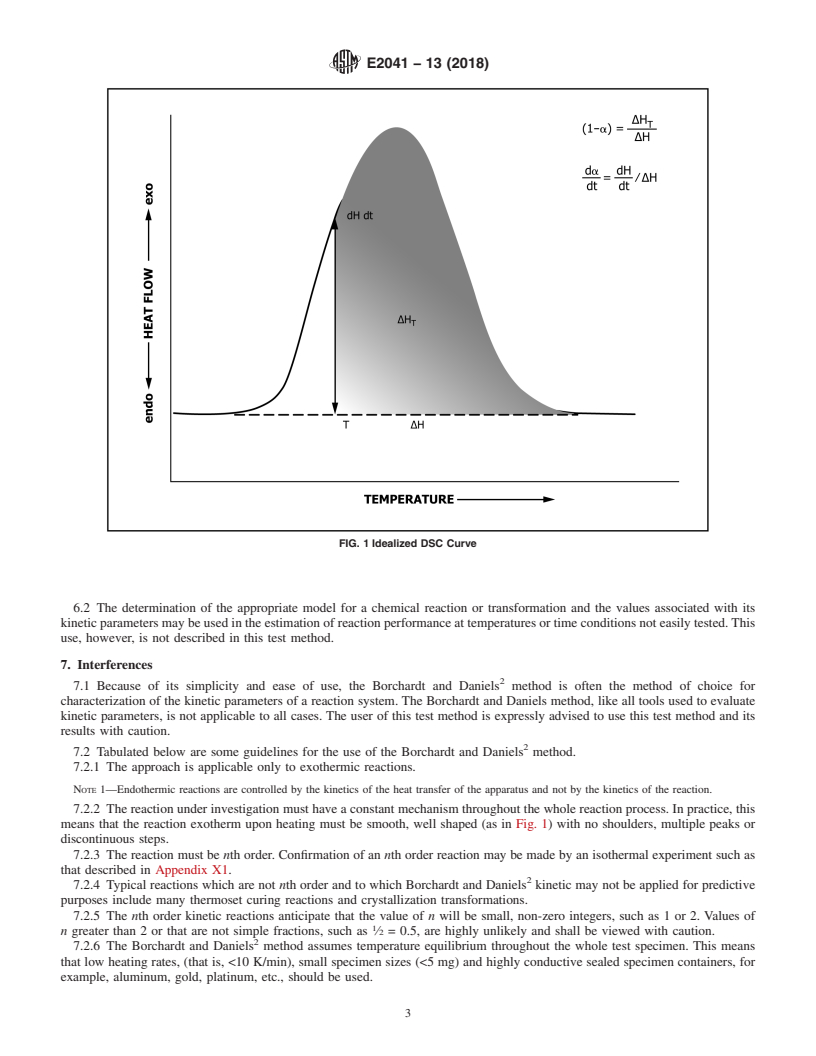
5.6 The values for dα/dt, (1 − α) and T needed to solve Eq 2, Eq 4 and Eq 5, are experimental parameters obtained from a single
linear heating rate DSC experiment scanning through the temperature region of the reaction exotherm as shown in Fig. 1.
5.7 Kinetic results obtained by this test method may be compared with those obtained by Test Method E698.
6. Significance and Use
6.1 This test method is useful in research and development.
E2041 − 13 (2018)
FIG. 1 Idealized DSC Curve
6.2 The determination of the appropriate model for a chemical reaction or transformation and the values associated with its
kinetic parameters may be used in the estimation of reaction performance at temperatures or time conditions not easily tested. This
use, however, is not described in this test method.
7. Interferences
7.1 Because of its simplicity and ease of use, the Borchardt and Daniels method is often the method of choice for
characterization of the kinetic parameters of a reaction system. The Borchardt and Daniels method, like all tools used to evaluate
kinetic parameters, is not applicable to all cases. The user of this test method is expressly advised to use this test method and its
results with caution.
7.2 Tabulated below are some guidelines for the use of the Borchardt and Daniels method.
7.2.1 The approach is applicable only to exothermic reactions.
NOTE 1—Endothermic reactions are controlled by the kinetics of the heat transfer of the apparatus and not by the kinetics of the reaction.
7.2.2 The reaction under investigation must have a constant mechanism throughout the whole reaction process. In practice, this
means that the reaction exotherm upon heating must be smooth, well shaped (as in Fig. 1) with no shoulders, multiple peaks or
discontinuous steps.
7.2.3 The reaction must be nth order. Confirmation of an nth order reaction may be made by an isothermal experiment such as
that described in Appendix X1.
7.2.4 Typical reactions which are not nth order and to which Borchardt and Daniels kinetic may not be applied for predictive
purposes include many thermoset curing reactions and crystallization transformations.
7.2.5 The nth order kinetic reactions anticipate that the value of n will be small, non-zero integers, such as 1 or 2. Values of
n greater than 2 or that are not simple fractions, such as ⁄2 = 0.5, are highly unlikely and shall be viewed with caution.
7.2.6 The Borchardt and Daniels method assumes temperature equilibrium throughout the whole test specimen. This means
that low heating rates, (that is, <10 K/min), small specimen sizes (<5 mg) and highly conductive sealed specimen containers, for
example, aluminum, gold, platinum, etc., should be used.
E2041 − 13 (2018)
7.3 Since milligram quantities of specimen are used, it is essential that the specimen be homogeneous and representative of the
test sample from which they are taken.
7.4 Toxic or corrosive effluents, or both, may be released when heating the test specimen and may be harmful to personnel or
to the apparatus. Operating with a venting or exhaust system is recommended.
8. Apparatus
8.1 Differential Scanning Calorimeter (DSC)—The instrumentation required to provide the minimum differential scanning
calorimetric capability for this method includes the following:
8.1.1 DSC Test Chamber, composed of the following:
8.1.1.1 Furnace(s), to provide uniform controlled heating of a specimen and reference to a constant temperature at a constant
rate within the applicable temperature range of this test method.
8.1.1.2 Temperature Sensor, to provide an indication of the specimen/furnace temperature to 60.01 K.
8.1.1.3 Differential Sensor, to detect heat flow difference between the specimen and reference equivalent to 1 μW.
8.1.1.4 A means of sustaining a test chamber environment of purge gas at a rate of 10 to 50 mL/min.
NOTE 2—Typically, 99.9+ % pure nitrogen, helium, or argon is employed. Use of dry purge gas is recommended and is essential for operation at
subambient temperatures.
8.1.2 Temperature Controller, capable of executing a specific temperature program by operating the furnace(s) between selected
temperature limits, that is, 170 to 870 K, at a rate of temperature change of up to 10 K/min constant to 60.1 K/min.
8.1.3 Data Collection Device, to provide a means of acquiring, storing, and displaying measured or calculated signals, or both.
The minimum output signals required for DSC are heat flow, temperature, and time.
8.2 Containers (pans, crucibles, vials, etc.), that are inert to the specimen and reference materials, and which are of suitable
structural shape and integrity to contain the specimen and reference in accordance with the specific requirements of this test
method.
8.3 While not required, the user will find useful calculator or computer and data analysis software to perform the necessary least
squares best fit or multiple linear regression data treatments required by this test method.
8.4 Balance—to weigh specimens, or containers, or both, to 610 μg with a capacity of at least 100 mg.
9. Calibration
9.1 Perform any calibration procedures recommended by the apparatus manufacturer in the instrument operator’s manual.
9.2 Calibrate the DSC temperature signal over the range of the reaction using Test Method E967.
9.3 Calibrate the DSC heat flow signal using Practice E968.
10. Procedure
10.1 Weigh 1 to 10 mg of test specimen to a precision of
610 μg into a sample container and hermetically seal the container. Weigh the specimen and container to 610 μg. Load the test
specimen into the apparatus using an equivalent empty specimen container as the reference. Close the DSC sample chamber and
prepare the apparatus for an experimental run.
NOTE 3—This test method is based upon a “non-self heating” assumption. Combinations of specimen size and reaction kinetics that produce heat flow
greater than 8 mW fail this assumption and produce erroneous results. Small specimen sizes may be used to obtain this critical non-self heating
assumption.
10.2 Equilibrate the specimen at a temperature 40 K below the first exothermic behavior.
NOTE 4—This temperature may be determined from a previously recorded exploratory run using Test Method E537.
10.3 Heat the test specimen at a rate of 5 K/min to a temperature 10 K higher than the completion of the exothermic reaction
as indicated by the return to baseline. Record the heat flow and sample temperature throughout this region.
NOTE 5—Other heating rates (<10 K/min) may be used but shall be indicated in the report. Agreement of results undertaken at several heating rates
will provide confidence in the method and efficacy of the results.
10.4 Cool the specimen container to ambient temperature and reweigh. Record and report any change in mass from that
observed in 10.1 prior to the test.
10.5 Calculate reaction order (n), activation energy (E), and Arrhenius pre-exponential factor (Z) according to the procedures
in Section 11.
11. Calculation
11.1 Construct a linear baseline from a point on the baseline before the reaction exotherm to a point on the baseline after the
reaction.
E2041 − 13 (2018)
11.2 Construct a perpendicular line from the
...
Questions, Comments and Discussion
Ask us and Technical Secretary will try to provide an answer. You can facilitate discussion about the standard in here.