

ASTM E1157-87(2018)e1
(Specification)Standard Specification for Sampling and Testing of Reusable Laboratory Glassware
General Information
- Abstract
ABSTRACT
This specification covers sampling and testing of laboratory glassware items for use until they are no longer considered functional for the intended purpose, and does not include disposable (single use) items. Four types of reusable laboratory glassware are covered, namely: blown and pressed glassware, nongraduated; blown and pressed glassware, graduated; tubular glassware, nongraduated; and tubular glassware, graduated. The product shall be designed to meet the specified test performance requirements. Alternate testing methods, inspection levels, and sample sizes may be implemented. Sampling shall be conducted in accordance with the specified inspection and examination levels and acceptance quality levels for major defects, minor defects, and dimensional examination. Where applicable, distilled water and reagent grade chemicals shall be used throughout the tests. Inspection shall be conducted in accordance with applicable section and individual specifications. The basic testing criteria for the following tests are detailed: (1) leakage test, (2) permanency of marking by alkali and acid tests, (3) capacity fill test, (4) autoclaving, (5) pour test, and (6) centrifugal test.
SCOPE
1.1 This specification covers laboratory items for use until they are no longer considered functional for the intended purpose. It is written specifically for reusable items and is not to be confused with disposable (single use) items that are described in other standards.
1.2 This specification covers the sampling inspection and basic testing criteria for the following four types of laboratory glassware: blown and pressed glassware, nongraduated;2 blown and pressed glassware, graduated;2 tubular glassware, nongraduated; and tubular glassware, graduated.
1.3 This specification is intended to be used in conjunction with a standard specification for a specific laboratory glassware product.
1.4 The following precautionary statement pertains only to the test method portion, Section 6, of this specification. This standard does not purport to address all of the safety concerns, if any, associated with its use. It is the responsibility of the user of this standard to establish appropriate safety, health, and environmental practices and determine the applicability of regulatory limitations prior to use.
1.5 This international standard was developed in accordance with internationally recognized principles on standardization established in the Decision on Principles for the Development of International Standards, Guides and Recommendations issued by the World Trade Organization Technical Barriers to Trade (TBT) Committee.
- Status
- Published
- Publication Date
- 30-Nov-2011
- Technical Committee
- E41 - Laboratory Apparatus
- Drafting Committee
- E41.01 - Laboratory Ware and Supplies
Overview
ASTM E1157-87(2018)e1: Standard Specification for Sampling and Testing of Reusable Laboratory Glassware is an internationally recognized standard developed by ASTM International. This specification outlines the minimum requirements and procedures for sampling, inspecting, and testing reusable laboratory glassware used in scientific, medical, or industrial laboratories. It is strictly applicable to reusable items, not to be confused with disposable, single-use glassware.
The standard addresses four classifications of laboratory glassware:
- Blown and pressed glassware (nongraduated)
- Blown and pressed glassware (graduated)
- Tubular glassware (nongraduated)
- Tubular glassware (graduated)
ASTM E1157 supports laboratories and manufacturers by providing a consistent framework for evaluating glassware quality, ensuring functionality, durability, and safety throughout the lifecycle of each item.
Key Topics
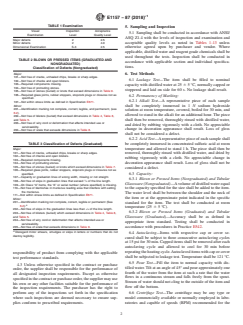
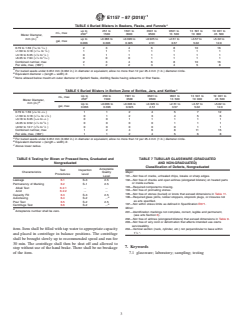
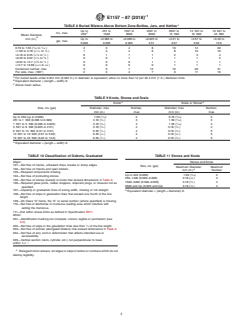
- Sampling and Inspection: The standard specifies how to conduct sampling of product lots using established quality assurance methodologies, notably referencing ANSI/ASQ Z1.4. Inspection and examination focus on major and minor defects as well as dimensional accuracy.
- Testing Requirements: Several core tests are required to assure glassware performance, including:
- Leakage testing
- Permanency of markings (via alkali and acid resistance tests)
- Capacity (fill) verification
- Autoclaving for thermal resistance
- Pour test to assess pouring performance
- Centrifuge test for mechanical strength
- Types of Defects: The standard categorizes defects in glassware, such as cracks, chips, blisters, and incorrect markings, providing clear criteria for acceptance or rejection.
- Performance Criteria: Emphasis is placed on conformity with specified test methods, with alternatives allowed if they achieve the same level of compliance and are agreed upon between purchaser and vendor.
- Quality Control: Recommendations are included for inspection levels, sample sizes, and acceptable quality levels (AQLs), supporting both purchaser and manufacturer.
- Safety and Environmental Considerations: Users are responsible for implementing appropriate safety, health, and environmental practices, as the standard does not address all protective measures.
Applications
ASTM E1157 is widely used in laboratory quality assurance and procurement processes across industries, including:
- Scientific and Research Laboratories: Ensures sampling and testing of glassware used in experiments, reducing the risk of contamination or erroneous results.
- Healthcare and Medical Facilities: Guides the validation of glass equipment for clinical testing, promoting safety and accuracy.
- Industrial and Pharmaceutical Labs: Assists QA/QC departments in selecting reliable reusable glassware for critical processes and compliance with audit requirements.
- Manufacturers: Offers a benchmarking tool for production quality, helping glassware producers meet industry expectations and international trade standards.
- Auditors and Inspectors: Provides a transparent basis for evaluating laboratory glassware, supporting regulatory compliance and certification.
Related Standards
Organizations relying on ASTM E1157 often use the following related standards and practices:
- ASTM C162 - Terminology of Glass and Glass Products
- ASTM E542 - Practice for Calibration of Laboratory Volumetric Apparatus
- ASTM E671 - Specification for Maximum Permissible Thermal Residual Stress in Annealed Glass Laboratory Apparatus
- ANSI/ASQ Z1.4 - Sampling Procedures and Tables for Inspection by Attributes
By adhering to ASTM E1157-87(2018)e1, laboratories and manufacturers can ensure that reusable laboratory glassware meets rigorous standards for durability, performance, and safety, contributing to the reliability of laboratory operations worldwide.
Keywords: reusable laboratory glassware, ASTM E1157, glassware testing, laboratory glassware standard, sampling and inspection, laboratory equipment quality, laboratory compliance standards
Relations
- Effective Date
- 01-Dec-2011
- Effective Date
- 01-Oct-2023
- Effective Date
- 01-Nov-2015
- Effective Date
- 01-Apr-2010
- Effective Date
- 01-Nov-2007
- Effective Date
- 01-Oct-2005
- Effective Date
- 01-Oct-2005
- Effective Date
- 01-Jun-2004
- Effective Date
- 01-May-2004
- Effective Date
- 10-Jul-2003
- Effective Date
- 10-Oct-2001
- Effective Date
- 10-Oct-2001
- Effective Date
- 10-May-1999
- Effective Date
- 10-Apr-1998
- Effective Date
- 01-Dec-2011
Get Certified
Connect with accredited certification bodies for this standard

ECOCERT
Organic and sustainability certification.

Eurofins Food Testing Global
Global leader in food, environment, and pharmaceutical product testing.

Intertek Bangladesh
Intertek certification and testing services in Bangladesh.
Sponsored listings
Frequently Asked Questions
ASTM E1157-87(2018)e1 is a technical specification published by ASTM International. Its full title is "Standard Specification for Sampling and Testing of Reusable Laboratory Glassware". This standard covers: ABSTRACT This specification covers sampling and testing of laboratory glassware items for use until they are no longer considered functional for the intended purpose, and does not include disposable (single use) items. Four types of reusable laboratory glassware are covered, namely: blown and pressed glassware, nongraduated; blown and pressed glassware, graduated; tubular glassware, nongraduated; and tubular glassware, graduated. The product shall be designed to meet the specified test performance requirements. Alternate testing methods, inspection levels, and sample sizes may be implemented. Sampling shall be conducted in accordance with the specified inspection and examination levels and acceptance quality levels for major defects, minor defects, and dimensional examination. Where applicable, distilled water and reagent grade chemicals shall be used throughout the tests. Inspection shall be conducted in accordance with applicable section and individual specifications. The basic testing criteria for the following tests are detailed: (1) leakage test, (2) permanency of marking by alkali and acid tests, (3) capacity fill test, (4) autoclaving, (5) pour test, and (6) centrifugal test. SCOPE 1.1 This specification covers laboratory items for use until they are no longer considered functional for the intended purpose. It is written specifically for reusable items and is not to be confused with disposable (single use) items that are described in other standards. 1.2 This specification covers the sampling inspection and basic testing criteria for the following four types of laboratory glassware: blown and pressed glassware, nongraduated;2 blown and pressed glassware, graduated;2 tubular glassware, nongraduated; and tubular glassware, graduated. 1.3 This specification is intended to be used in conjunction with a standard specification for a specific laboratory glassware product. 1.4 The following precautionary statement pertains only to the test method portion, Section 6, of this specification. This standard does not purport to address all of the safety concerns, if any, associated with its use. It is the responsibility of the user of this standard to establish appropriate safety, health, and environmental practices and determine the applicability of regulatory limitations prior to use. 1.5 This international standard was developed in accordance with internationally recognized principles on standardization established in the Decision on Principles for the Development of International Standards, Guides and Recommendations issued by the World Trade Organization Technical Barriers to Trade (TBT) Committee.
ABSTRACT This specification covers sampling and testing of laboratory glassware items for use until they are no longer considered functional for the intended purpose, and does not include disposable (single use) items. Four types of reusable laboratory glassware are covered, namely: blown and pressed glassware, nongraduated; blown and pressed glassware, graduated; tubular glassware, nongraduated; and tubular glassware, graduated. The product shall be designed to meet the specified test performance requirements. Alternate testing methods, inspection levels, and sample sizes may be implemented. Sampling shall be conducted in accordance with the specified inspection and examination levels and acceptance quality levels for major defects, minor defects, and dimensional examination. Where applicable, distilled water and reagent grade chemicals shall be used throughout the tests. Inspection shall be conducted in accordance with applicable section and individual specifications. The basic testing criteria for the following tests are detailed: (1) leakage test, (2) permanency of marking by alkali and acid tests, (3) capacity fill test, (4) autoclaving, (5) pour test, and (6) centrifugal test. SCOPE 1.1 This specification covers laboratory items for use until they are no longer considered functional for the intended purpose. It is written specifically for reusable items and is not to be confused with disposable (single use) items that are described in other standards. 1.2 This specification covers the sampling inspection and basic testing criteria for the following four types of laboratory glassware: blown and pressed glassware, nongraduated;2 blown and pressed glassware, graduated;2 tubular glassware, nongraduated; and tubular glassware, graduated. 1.3 This specification is intended to be used in conjunction with a standard specification for a specific laboratory glassware product. 1.4 The following precautionary statement pertains only to the test method portion, Section 6, of this specification. This standard does not purport to address all of the safety concerns, if any, associated with its use. It is the responsibility of the user of this standard to establish appropriate safety, health, and environmental practices and determine the applicability of regulatory limitations prior to use. 1.5 This international standard was developed in accordance with internationally recognized principles on standardization established in the Decision on Principles for the Development of International Standards, Guides and Recommendations issued by the World Trade Organization Technical Barriers to Trade (TBT) Committee.
ASTM E1157-87(2018)e1 is classified under the following ICS (International Classification for Standards) categories: 71.040.20 - Laboratory ware and related apparatus. The ICS classification helps identify the subject area and facilitates finding related standards.
ASTM E1157-87(2018)e1 has the following relationships with other standards: It is inter standard links to ASTM E1157-87(2011), ASTM C162-23, ASTM C162-05(2015), ASTM E671-98(2010), ASTM E542-01(2007), ASTM C162-05, ASTM C162-05(2010), ASTM C162-04, ASTM E671-98(2004), ASTM C162-03, ASTM E542-00, ASTM E542-01, ASTM C162-99, ASTM E671-98, ASTM E237-02(2019). Understanding these relationships helps ensure you are using the most current and applicable version of the standard.
ASTM E1157-87(2018)e1 is available in PDF format for immediate download after purchase. The document can be added to your cart and obtained through the secure checkout process. Digital delivery ensures instant access to the complete standard document.
Standards Content (Sample)
This international standard was developed in accordance with internationally recognized principles on standardization established in the Decision on Principles for the
Development of International Standards, Guides and Recommendations issued by the World Trade Organization Technical Barriers to Trade (TBT) Committee.
ϵ1
Designation:E1157 −87(Reapproved 2018)
Standard Specification for
Sampling and Testing of Reusable Laboratory Glassware
This standard is issued under the fixed designation E1157; the number immediately following the designation indicates the year of
original adoption or, in the case of revision, the year of last revision. A number in parentheses indicates the year of last reapproval. A
superscript epsilon (´) indicates an editorial change since the last revision or reapproval.
This standard has been approved for use by agencies of the U.S. Department of Defense.
ε NOTE—Editorially updated the name of the document listed in 2.2 in January 2019.
1. Scope 2. Referenced Documents
2.1 ASTM Standards:
1.1 This specification covers laboratory items for use until
C162 Terminology of Glass and Glass Products
they are no longer considered functional for the intended
E542 Practice for Calibration of Laboratory Volumetric
purpose. It is written specifically for reusable items and is not
Apparatus
to be confused with disposable (single use) items that are
E671 Specification for Maximum Permissible Thermal Re-
described in other standards.
sidual Stress in Annealed Glass Laboratory Apparatus
1.2 This specification covers the sampling inspection and
2.2 ANSI/ASQ Standard:
basic testing criteria for the following four types of laboratory
ANSI/ASQ Z1.4 Sampling Procedures And Tables For In-
glassware: blown and pressed glassware, nongraduated;
spection By Attributes
blown and pressed glassware, graduated; tubular glassware,
nongraduated; and tubular glassware, graduated.
3. Terminology
1.3 This specification is intended to be used in conjunction
3.1 Definitions of Terms Specific to This Standard:
withastandardspecificationforaspecificlaboratoryglassware
3.1.1 lot—items of the same respective type, class, style,
product.
and size offered for acceptance at one time that have been
produced by one manufacturer under essentially the same
1.4 The following precautionary statement pertains only to
manufacturing conditions.
the test method portion, Section 6, of this specification. This
3.1.2 inspection—as both “examination” (such as visual
standard does not purport to address all of the safety concerns,
investigation without the use of special laboratory appliances
if any, associated with its use. It is the responsibility of the user
or procedure) and “testing” (determination by technical means
of this standard to establish appropriate safety, health, and
of physical and chemical properties) of the item.
environmental practices and determine the applicability of
regulatory limitations prior to use.
4. Performance Requirements
1.5 This international standard was developed in accor-
4.1 The product shall be designed to meet test performance
dance with internationally recognized principles on standard-
requirements specified in Section 6. Testing of individual lots
ization established in the Decision on Principles for the
may be obviated when process controls are employed and
Development of International Standards, Guides and Recom-
monitored. Deviation from or changes to established manufac-
mendations issued by the World Trade Organization Technical
turing procedures that could adversely affect performance of a
Barriers to Trade (TBT) Committee.
product shall be cause for performing applicable testing
requirements on a specific lot to verify quality acceptance.
4.2 Alternate testing methods, inspection levels, and sample
sizes may also be implemented.Any deviation shall not negate
This specification is under the jurisdiction of ASTM Committee E41 on
Laboratory Apparatus and is the direct responsibility of Subcommittee E41.01 on For referenced ASTM standards, visit the ASTM website, www.astm.org, or
Laboratory Ware and Supplies. contact ASTM Customer Service at service@astm.org. For Annual Book of ASTM
Current edition approved Dec. 1, 2018. Published January 2019. Originally Standards volume information, refer to the standard’s Document Summary page on
approved in 1987. Last previous edition approved in 2011 as E1157 – 87(2011). the ASTM website.
DOI: 10.1520/E1157-87R18E01. Available from American National Standards Institute (ANSI), 25 W. 43rd St.,
As defined in Terminology C162. 4th Floor, New York, NY 10036, http://www.ansi.org.
Copyright © ASTM International, 100 Barr Harbor Drive, PO Box C700, West Conshohocken, PA 19428-2959. United States
ϵ1
E1157−87(2018)
TABLE 1 Examination
5. Sampling and Inspection
Visual Inspection Acceptance
5.1 Sampling shall be conducted in accordance with ANSI/
Examination Level Quality Level
ASQ Z1.4 with the levels of inspection and examination and
Major defects 2 2.5
acceptable quality levels as noted in Tables 1-13 unless
Minor defects 2 4.0
Dimensional Examination S-3 2.5
otherwise agreed upon by purchaser and vendor. Where
applicable, distilled water and reagent grade chemicals shall be
used throughout the tests. Inspection shall be conducted in
TABLE 2 BLOWN OR PRESSED ITEMS (GRADUATED AND
accordance with applicable section and individual specifica-
NONGRADUATED)
tions.
Classification of Defects (Nongraduated)
Major:
6. Test Methods
101—Not free of cracks, unhealed chips, breaks or sharp edges.
6.1 Leakage Test—The item shall be filled to nominal
102—Not free of checks and open blisters.
103—Required components missing.
capacity with distilled water at 25 6 5 °C, normally capped or
104—Not free of protruding stones.
stoppered and laid on side for 60 s. No leakage shall result.
105—Not free of stones (buried) or knots that exceed dimensions in Table 9.
106—Required glass joints, rubber stoppers, stopcock plugs or closures not as
6.2 Permanency of Marking:
specified.
6.2.1 Alkali Test—A representative piece of each sample
107—Not within stress limits as defined in Specification E671.
Minor: shall be completely immersed in 1 N sodium hydroxide
201—Identification marking not complete, correct, legible, and permanent, (see
solution at room temperature, covered, boiled for 30 min, and
6.2).
allowed to stand in the alkali for an additional hour. The piece
202—Not free of blisters (buried) that exceed dimensions in Table 4, Table 8,
and Table 5. shall then be removed, thoroughly rinsed with distilled water,
203—Not free of wiry cord or deformation that affects intended use or
and dried by rubbing vigorously with a cloth. No appreciable
serviceability.
change in decoration appearance shall result. Loss of gloss
204—Not free of scale that exceeds dimensions in Table 8.
shall not be considered a defect.
6.2.2 Acid Test—Arepresentative piece of each sample shall
TABLE 3 Classification of Defects (Graduated)
be completely immersed in concentrated sulfuric acid at room
temperature and allowed to stand 1 h. The piece shall then be
Major:
101—Not free of cracks, unhealed chips, breaks or sharp edges.
removed, thoroughly rinsed with distilled water, and dried by
102—Not free of checks and open blisters.
rubbing vigorously with a cloth. No appreciable change in
103—Required components missing.
decoration appearance shall result. Loss of gloss shall not be
104—Not free of protruding stones.
105—Not free of stones (buried) or knots which exceed dimensions in Table 7.
considered a defect.
106—Required glass joints, rubber stoppers, stopcock plugs or closures not as
specified. 6.3 Capacity:
107—Capacity or graduation lines of wrong width, missing or not straight.
6.3.1 Blown or Pressed Items (Nongraduated) and Tubular
108—Not free of skips in graduation lines that exceed ⁄4 of the line length.
Glassware (Nongraduated)—Avolume of distilled water equal
109—On Class “A” items, the “A” or serial number (where specified) is missing.
110—Not free of blemishes in meniscus reading area that interfere with setting
to the capacity specified for the size shall be added to the item.
the meniscus.
The water level shall be between the shoulder and the neck of
111—Not within stress limits as defined in Specification E671.
the item or at the approximate point indicated in the specific
Minor:
201—Identification marking not complete, correct, legible or permanent (See standard for the item. The test shall be conducted at room
A
6.2).
temperature (25 6 5 °C).
202—Not free of skips in the graduation lines less than ⁄4 of the line length.
6.3.2 Blown or Pressed Items (Graduated) and Tubular
203—Not free of blisters (buried) which exceed dimensions in Table 4, Table 8,
and Table 5.
Glassware (Graduated)—Accuracy shall be as defined in
204—Not free of wiry cord or deformation that affects intended use or
appropriate item standard. Testing shall be conducted in
serviceability.
accordance with procedures in Practice E542.
205—Not free of scale that exceeds dimensions in Table 9.
A
Disregard minor smears, smudges or skips in letters or numbers that do not
6.4 Autoclaving—Items with respective cap or cover se-
destroy legibility.
cured shall be subject to three consecutive autoclaving cycles
at 15 psi for 30 min. Capped items shall be removed after each
autoclaving cycle and allowed to cool for 30 min before
repeatingtheheatingcycle.Autoclaveditemswithcaporcover
responsibility of product from complying with the applicable
shall be subjected to leakage test.Temperature shall be 121 °C.
test performance standards.
6.5 Pour Test—Fill the item to normal capacity with dis-
4.3 Unless otherwise specified in the contract or purchase
tilled water.Tilt at an angle of 45° and pour approximately one
order, the supplier shall be responsible for the performance of
fourth of the water from the item at such a rate that the water
all designated inspection requirements. Except as otherwise
...