

ASTM D5206-24
(Test Method)Standard Test Method for Windload Resistance of Rigid Plastic Siding
General Information
- Abstract
SIGNIFICANCE AND USE
5.1 This test method is a standard procedure for determining windload resistance of rigid plastic siding under specified uniform static pressure difference. This typically is intended to represent the effects of wind loads on exterior building surfaces. The actual loading on building surfaces is quite complex, varying with wind direction, time, height above ground, building shape, terrain, surrounding structures, and other factors.
5.2 Design wind pressure is derived for specific geographical locations from wind velocity maps prepared by various agencies and found in references such as ASCE 7, the International Residential Code, International Building Code or other sources. For additional detailed information relating to the use of this test method for evaluation of wind load resistance, refer to Annex A1 of the standard specification appropriate for the type of polymeric siding.
Note 2: In applying the results of this test method, note that the performance of rigid PVC siding is a function of installation, and the specimen may or may not truly represent the actual application. In service, performance will also depend on the rigidity of supporting construction, and on the resistance of other components to deterioration by various causes, to thermal expansion and contraction, etc.
SCOPE
1.1 This test method describes methods for testing and evaluating windload resistance of rigid plastic siding when fastened in accordance with specific product standard specifications, or in accordance with the manufacturer’s installation instructions.
1.2 The proper use of this test method requires a knowledge of the principles of pressure measurement.
1.3 This test method describes the apparatus and the procedures to be used to determine an average maximum sustained static test pressure, or ultimate test pressure values, or both, with static pressure applied uniformly to a specimen.
Note 1: There is no known ISO equivalent to this test method.
1.4 The values expressed in inch-pound units are to be regarded as the standard. The SI equivalents in parentheses are for information only.
1.5 This standard does not purport to address all of the safety concerns, if any, associated with its use. It is the responsibility of the user of this standard to establish appropriate safety, health, and environmental practices and determine the applicability of regulatory limitations prior to use. For specific precautionary statements, see Section 7.
1.6 This international standard was developed in accordance with internationally recognized principles on standardization established in the Decision on Principles for the Development of International Standards, Guides and Recommendations issued by the World Trade Organization Technical Barriers to Trade (TBT) Committee.
- Status
- Published
- Publication Date
- 31-Mar-2024
- Technical Committee
- D20 - Plastics
- Drafting Committee
- D20.24 - Plastic Building Products

Overview
ASTM D5206-24: Standard Test Method for Windload Resistance of Rigid Plastic Siding establishes a uniform procedure for determining the windload resistance of rigid plastic siding, such as PVC siding, when installed according to specific product standard specifications or manufacturer’s instructions. Developed by ASTM International, this standard provides a recognized methodology to evaluate siding performance under static pressure conditions representative of wind forces experienced on exterior building surfaces.
Windload resistance is a critical factor in assessing the suitability of plastic siding products for use in various geographical and climatic conditions. By simulating uniform pressure differences, the method helps manufacturers, builders, and code officials verify compliance with building codes and quality standards.
Key Topics
- Test Scope: Addresses procedures for testing windload resistance of rigid plastic siding, requiring knowledge of pressure measurement principles.
- Test Apparatus: Specifies the use of a test chamber, air system for applying pressure, and pressure measuring devices with strict tolerances.
- Test Procedure:
- Preparation of test specimens on frames simulating actual installation.
- Sealing the specimen to a chamber and incrementally applying static pressure.
- Measurement and documentation of ultimate test pressure (failure point) and maximum sustained static test pressure.
- Performance Criteria: Defines failure as torn nail tabs, permanent buckling, fastener withdrawal, or disengaged locks. Requires repeat testing for verification.
- Reporting Requirements: Details the information needed for comprehensive test reports, including product identification, test parameters, observed failure modes, and ambient test conditions.
- Safety Measures: Stresses the need for precaution due to risks associated with static pressure testing.
Applications
ASTM D5206-24 is employed by:
- Manufacturers of rigid plastic and PVC siding to demonstrate product performance and consistency.
- Building product testing laboratories for code compliance and certification.
- Architects, engineers, and specifiers to validate siding suitability for specific wind zones as defined by codes like the International Building Code (IBC) and International Residential Code (IRC).
- Code officials and inspectors to ensure proper installation and exterior cladding performance in new construction and renovation projects.
- Quality assurance teams in siding production and installation to monitor ongoing conformity with windload resistance requirements.
The standard is particularly relevant in hurricane-prone regions, high-wind areas, and where building envelope integrity is essential for occupant safety and property protection.
Related Standards
- ASCE 7 - Minimum Design Loads for Buildings and Other Structures: Provides the methodology for determining design wind pressures for specific locations.
- ASTM D4756 - Practice for Installation of Rigid Poly(Vinyl Chloride) (PVC) Siding and Soffit (Withdrawn): Referenced for installation guidance but has been withdrawn.
- ASTM D883 - Terminology Relating to Plastics: Establishes definitions relevant to test procedures.
- E631 - Terminology of Building Constructions: Provides additional terminology used in building envelope testing.
- International Building Code (IBC) and International Residential Code (IRC): Code references for establishing wind design requirements.
Keywords: windload resistance, rigid plastic siding, PVC siding, ASTM D5206-24, test method, building code compliance, siding failure modes, exterior cladding, static pressure test, siding installation.
Relations
- Effective Date
- 01-Apr-2024
- Effective Date
- 01-Apr-2024
- Effective Date
- 01-Apr-2024
- Effective Date
- 01-Apr-2024
- Effective Date
- 01-Apr-2024
- Effective Date
- 01-Apr-2024
Get Certified
Connect with accredited certification bodies for this standard

DIBt (Deutsches Institut für Bautechnik)
German Institute for Building Technology.
DIN CERTCO
DIN Group product certification.

Aboma Certification B.V.
Specialized in construction, metal, and transport sectors.
Sponsored listings
Frequently Asked Questions
ASTM D5206-24 is a standard published by ASTM International. Its full title is "Standard Test Method for Windload Resistance of Rigid Plastic Siding". This standard covers: SIGNIFICANCE AND USE 5.1 This test method is a standard procedure for determining windload resistance of rigid plastic siding under specified uniform static pressure difference. This typically is intended to represent the effects of wind loads on exterior building surfaces. The actual loading on building surfaces is quite complex, varying with wind direction, time, height above ground, building shape, terrain, surrounding structures, and other factors. 5.2 Design wind pressure is derived for specific geographical locations from wind velocity maps prepared by various agencies and found in references such as ASCE 7, the International Residential Code, International Building Code or other sources. For additional detailed information relating to the use of this test method for evaluation of wind load resistance, refer to Annex A1 of the standard specification appropriate for the type of polymeric siding. Note 2: In applying the results of this test method, note that the performance of rigid PVC siding is a function of installation, and the specimen may or may not truly represent the actual application. In service, performance will also depend on the rigidity of supporting construction, and on the resistance of other components to deterioration by various causes, to thermal expansion and contraction, etc. SCOPE 1.1 This test method describes methods for testing and evaluating windload resistance of rigid plastic siding when fastened in accordance with specific product standard specifications, or in accordance with the manufacturer’s installation instructions. 1.2 The proper use of this test method requires a knowledge of the principles of pressure measurement. 1.3 This test method describes the apparatus and the procedures to be used to determine an average maximum sustained static test pressure, or ultimate test pressure values, or both, with static pressure applied uniformly to a specimen. Note 1: There is no known ISO equivalent to this test method. 1.4 The values expressed in inch-pound units are to be regarded as the standard. The SI equivalents in parentheses are for information only. 1.5 This standard does not purport to address all of the safety concerns, if any, associated with its use. It is the responsibility of the user of this standard to establish appropriate safety, health, and environmental practices and determine the applicability of regulatory limitations prior to use. For specific precautionary statements, see Section 7. 1.6 This international standard was developed in accordance with internationally recognized principles on standardization established in the Decision on Principles for the Development of International Standards, Guides and Recommendations issued by the World Trade Organization Technical Barriers to Trade (TBT) Committee.
SIGNIFICANCE AND USE 5.1 This test method is a standard procedure for determining windload resistance of rigid plastic siding under specified uniform static pressure difference. This typically is intended to represent the effects of wind loads on exterior building surfaces. The actual loading on building surfaces is quite complex, varying with wind direction, time, height above ground, building shape, terrain, surrounding structures, and other factors. 5.2 Design wind pressure is derived for specific geographical locations from wind velocity maps prepared by various agencies and found in references such as ASCE 7, the International Residential Code, International Building Code or other sources. For additional detailed information relating to the use of this test method for evaluation of wind load resistance, refer to Annex A1 of the standard specification appropriate for the type of polymeric siding. Note 2: In applying the results of this test method, note that the performance of rigid PVC siding is a function of installation, and the specimen may or may not truly represent the actual application. In service, performance will also depend on the rigidity of supporting construction, and on the resistance of other components to deterioration by various causes, to thermal expansion and contraction, etc. SCOPE 1.1 This test method describes methods for testing and evaluating windload resistance of rigid plastic siding when fastened in accordance with specific product standard specifications, or in accordance with the manufacturer’s installation instructions. 1.2 The proper use of this test method requires a knowledge of the principles of pressure measurement. 1.3 This test method describes the apparatus and the procedures to be used to determine an average maximum sustained static test pressure, or ultimate test pressure values, or both, with static pressure applied uniformly to a specimen. Note 1: There is no known ISO equivalent to this test method. 1.4 The values expressed in inch-pound units are to be regarded as the standard. The SI equivalents in parentheses are for information only. 1.5 This standard does not purport to address all of the safety concerns, if any, associated with its use. It is the responsibility of the user of this standard to establish appropriate safety, health, and environmental practices and determine the applicability of regulatory limitations prior to use. For specific precautionary statements, see Section 7. 1.6 This international standard was developed in accordance with internationally recognized principles on standardization established in the Decision on Principles for the Development of International Standards, Guides and Recommendations issued by the World Trade Organization Technical Barriers to Trade (TBT) Committee.
ASTM D5206-24 is classified under the following ICS (International Classification for Standards) categories: 91.060.10 - Walls. Partitions. Facades. The ICS classification helps identify the subject area and facilitates finding related standards.
ASTM D5206-24 has the following relationships with other standards: It is inter standard links to ASTM D5206-19, ASTM D7445-18, ASTM D3679-24, ASTM D7254-21, ASTM D8484-23, ASTM D7793-24. Understanding these relationships helps ensure you are using the most current and applicable version of the standard.
ASTM D5206-24 is available in PDF format for immediate download after purchase. The document can be added to your cart and obtained through the secure checkout process. Digital delivery ensures instant access to the complete standard document.
Standards Content (Sample)
This international standard was developed in accordance with internationally recognized principles on standardization established in the Decision on Principles for the
Development of International Standards, Guides and Recommendations issued by the World Trade Organization Technical Barriers to Trade (TBT) Committee.
Designation: D5206 − 24 An American National Standard
Standard Test Method for
Windload Resistance of Rigid Plastic Siding
This standard is issued under the fixed designation D5206; the number immediately following the designation indicates the year of
original adoption or, in the case of revision, the year of last revision. A number in parentheses indicates the year of last reapproval. A
superscript epsilon (´) indicates an editorial change since the last revision or reapproval.
1. Scope* D1600 Terminology for Abbreviated Terms Relating to Plas-
tics (Withdrawn 2024)
1.1 This test method describes methods for testing and
D4756 Practice for Installation of Rigid Poly(Vinyl Chlo-
evaluating windload resistance of rigid plastic siding when
ride) (PVC) Siding and Soffit (Withdrawn 2023)
fastened in accordance with specific product standard
E631 Terminology of Building Constructions
specifications, or in accordance with the manufacturer’s instal-
2.2 ASCE Standard:
lation instructions.
ASCE 7-10 Minimum Design Loads for Buildings and Other
1.2 The proper use of this test method requires a knowledge
Structures
of the principles of pressure measurement.
2.3 International Code Council:
1.3 This test method describes the apparatus and the proce-
International Building Code
dures to be used to determine an average maximum sustained
International Residential Code
static test pressure, or ultimate test pressure values, or both,
with static pressure applied uniformly to a specimen. 3. Terminology
3.1 General—Definitions are in accordance with Terminolo-
NOTE 1—There is no known ISO equivalent to this test method.
gies D883 and E631 and abbreviations are in accordance with
1.4 The values expressed in inch-pound units are to be
Terminology D1600 unless otherwise indicated.
regarded as the standard. The SI equivalents in parentheses are
3.2 Definitions of Terms Specific to This Standard:
for information only.
3.2.1 maximum sustained static test pressure, n—the great-
1.5 This standard does not purport to address all of the
est difference in static air pressure (negative or positive) that a
safety concerns, if any, associated with its use. It is the
test specimen withstands without failure, expressed as force
responsibility of the user of this standard to establish appro-
per square foot (or pascals).
priate safety, health, and environmental practices and deter-
mine the applicability of regulatory limitations prior to use. 3.2.2 nail hem thickness, n—the average thickness of the
nail hem as measured between the nail slots.
For specific precautionary statements, see Section 7.
1.6 This international standard was developed in accor-
3.2.3 specimen, n—the entire assembled siding panel as
dance with internationally recognized principles on standard-
described in Section 8.
ization established in the Decision on Principles for the
3.2.4 static test pressure, n—the specific difference in static
Development of International Standards, Guides and Recom-
air pressure (positive or negative) for which the specimen is to
mendations issued by the World Trade Organization Technical
be tested expressed as force per square foot (or pascals).
Barriers to Trade (TBT) Committee.
3.2.5 ultimate test pressure, n—the difference in static air
pressure (positive or negative) at which failure occurs ex-
2. Referenced Documents
pressed as force per square foot (or pascals).
2.1 ASTM Standards:
D883 Terminology Relating to Plastics
4. Summary of Test Method
4.1 This method can be used to determine either the
maximum sustained static test pressure or the ultimate
This test method is under the jurisdiction of ASTM Committee D20 on Plastics
pressure, or both, for the siding specimen. The procedure
and is the direct responsibility of Subcommittee D20.24 on Plastic Building
Products.
Current edition approved April 1, 2024. Published April 2024. Originally
approved in 1991. Last previous edition approved in 2019 as D5602 – 19. DOI: The last approved version of this historical standard is referenced on
10.1520/D5206-24. www.astm.org.
2 4
For referenced ASTM standards, visit the ASTM website, www.astm.org, or Available from American Society of Civil Engineers (ASCE), 1801 Alexander
contact ASTM Customer Service at service@astm.org. For Annual Book of ASTM Bell Dr., Reston, VA 20191, http://www.asce.org.
Standards volume information, refer to the standard’s Document Summary page on Available from International Code Council (ICC), 500 New Jersey Ave., NW,
the ASTM website. 6th Floor, Washington, DC 20001, http://www.iccsafe.org.
*A Summary of Changes section appears at the end of this standard
Copyright © ASTM International, 100 Barr Harbor Drive, PO Box C700, West Conshohocken, PA 19428-2959. United States
D5206 − 24
performance will also depend on the rigidity of supporting construction,
consists of sealing the test specimen with or against one face of
and on the resistance of other components to deterioration by various
a test chamber, supplying air to or exhausting air from the
causes, to thermal expansion and contraction, etc.
chamber at a rate required to maintain a specific static air
pressure across the specimen for a specific time period.
6. Apparatus
Pressure is applied in increments and the sample observed for
6.1 The description of theapparatus is general in nature; any
failure at each stage, to determine the maximum sustained
equipment capable of performing the test procedure within the
static test pressure, the ultimate test pressure, or both.
allowable tolerances is permitted.
5. Significance and Use
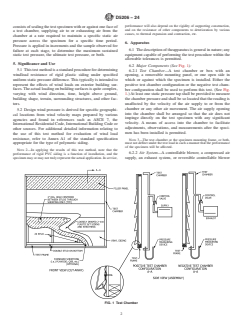
6.2 Major Components (See Fig. 1):
5.1 This test method is a standard procedure for determining
6.2.1 Test Chamber—A test chamber or box with an
windload resistance of rigid plastic siding under specified
opening, a removable mounting panel, or one open side in
uniform static pressure difference. This typically is intended to
which or against which the specimen is installed. Either the
represent the effects of wind loads on exterior building sur-
positive test chamber configuration or the negative test cham-
faces. The actual loading on building surfaces is quite complex,
ber configuration shall be used to perform this test. (See Fig.
varying with wind direction, time, height above ground,
1.) At least one static pressure tap shall be provided to measure
building shape, terrain, surrounding structures, and other fac-
the chamber pressure and shall be so located that the reading is
tors.
unaffected by the velocity of the air supply to or from the
chamber or any other air movement. The air supply opening
5.2 Design wind pressure is derived for specific geographi-
into the chamber shall be arranged so that the air does not
cal locations from wind velocity maps prepared by various
impinge directly on the test specimen with any significant
agencies and found in references such as ASCE 7, the
velocity. A means of access into the chamber to facilitate
International Residential Code, International Building Code or
adjustments, observations, and measurements after the speci-
other sources. For additional detailed information relating to
men has been installed is permitted.
the use of this test method for evaluation of wind load
resistance, refer to Annex A1 of the standard specification
NOTE 3—The test chamber or the specimen mounting frame, or both,
appropriate for the type of polymeric siding. must not deflect under the test load in such a manner that the performance
of the specimen will be affected.
NOTE 2—In applying the results of this test method, note that the
6.2.2 Air System—A controllable blower, a compressed air
performance of rigid PVC siding is a function of installation, and the
specimen may or may not truly represent the actual application. In service, supply, an exhaust system, or reversible controllable blower
FIG. 1 Test Chamber
D5206 − 24
designed to provide the required maximum air pressure differ- 9. Procedure
ence across the specimen. The system shall provide an essen-
9.1 Position a test specimen frame vertically or horizontally
tially constant air pressure difference for the required test
over the opening in the test chamber (box) so as to subject the
period.
entire test specimen to the pressure load. The orientation of the
6.2.3 Pressure Measuring Apparatus—A device to measure
siding face will depend upon whether a positive or negative
the test pressure difference within a tolerance of 62 %.
chamber configuration is used. The test configuration shall
create a load on the siding in the direction that would tend to
7. Safety Precautions
pull the siding off the wall.
7.1 Take proper precautions to protect the observers in the
9.2 Install a filler panel in the test chamber of box opening
event of any failure. At the pressures used in this test method,
not covered by the specimen frame.
considerable energy and hazard are involved. In cases of
9.3 Seal all seams in the equipment and test chamber which
failure, the hazard to personnel is less with a negative pressure
could permit pressure leakage during the test.
...
This document is not an ASTM standard and is intended only to provide the user of an ASTM standard an indication of what changes have been made to the previous version. Because
it may not be technically possible to adequately depict all changes accurately, ASTM recommends that users consult prior editions as appropriate. In all cases only the current version
of the standard as published by ASTM is to be considered the official document.
Designation: D5206 − 19 D5206 − 24 An American National Standard
Standard Test Method for
Windload Resistance of Rigid Plastic Siding
This standard is issued under the fixed designation D5206; the number immediately following the designation indicates the year of
original adoption or, in the case of revision, the year of last revision. A number in parentheses indicates the year of last reapproval. A
superscript epsilon (´) indicates an editorial change since the last revision or reapproval.
1. Scope Scope*
1.1 This test method describes methods for testing and evaluating windload resistance of rigid plastic siding when fastened in
accordance with Practice D4756, specific product standard specifications, or in accordance with the manufacturer’s installation
instructions.
1.2 The proper use of this test method requires a knowledge of the principles of pressure measurement.
1.3 This test method describes the apparatus and the procedures to be used to determine an average maximum sustained static test
pressure, or ultimate test pressure values, or both, with static pressure applied uniformly to a specimen.
NOTE 1—There is no known ISO equivalent to this test method.
1.4 The values expressed in inch-pound units are to be regarded as the standard. The SI equivalents in parentheses are for
information only.
1.5 This standard does not purport to address all of the safety concerns, if any, associated with its use. It is the responsibility
of the user of this standard to establish appropriate safety, health, and environmental practices and determine the applicability of
regulatory limitations prior to use. For specific precautionary statements, see Section 7.
1.6 This international standard was developed in accordance with internationally recognized principles on standardization
established in the Decision on Principles for the Development of International Standards, Guides and Recommendations issued
by the World Trade Organization Technical Barriers to Trade (TBT) Committee.
2. Referenced Documents
2.1 ASTM Standards:
D883 Terminology Relating to Plastics
D1600 Terminology for Abbreviated Terms Relating to Plastics (Withdrawn 2024)
D4756 Practice for Installation of Rigid Poly(Vinyl Chloride) (PVC) Siding and Soffit (Withdrawn 2023)
E631 Terminology of Building Constructions
2.2 ASCE Standard:
ASCE 7-10 Minimum Design Loads for Buildings and Other Structures
This test method is under the jurisdiction of ASTM Committee D20 on Plastics and is the direct responsibility of Subcommittee D20.24 on Plastic Building Products.
Current edition approved Nov. 15, 2019April 1, 2024. Published January 2020April 2024. Originally approved in 1991. Last previous edition approved in 20132019 as
D5602 – 13.D5602 – 19. DOI: 10.1520/D5206-19.10.1520/D5206-24.
For referenced ASTM standards, visit the ASTM website, www.astm.org, or contact ASTM Customer Service at service@astm.org. For Annual Book of ASTM Standards
volume information, refer to the standard’s Document Summary page on the ASTM website.
The last approved version of this historical standard is referenced on www.astm.org.
Available from American Society of Civil Engineers (ASCE), 1801 Alexander Bell Dr., Reston, VA 20191, http://www.asce.org.
*A Summary of Changes section appears at the end of this standard
Copyright © ASTM International, 100 Barr Harbor Drive, PO Box C700, West Conshohocken, PA 19428-2959. United States
D5206 − 24
2.3 International Code Council:
International Building Code
International Residential Code
3. Terminology
3.1 General—Definitions are in accordance with Terminologies D883 and E631 and abbreviations are in accordance with
Terminology D1600 unless otherwise indicated.
3.2 Definitions of Terms Specific to This Standard:
3.2.1 maximum sustained static test pressure—pressure, n—the greatest difference in static air pressure (negative or positive) that
a test specimen withstands without failure, expressed as force per square foot (or pascals).
3.2.2 nail hem thickness—thickness, n—the average thickness of the nail hem as measured between the nail slots.
3.2.3 specimen—specimen, n—the entire assembled siding panel as described in Section 8.
3.2.4 static test pressure—pressure, n—the specific difference in static air pressure (positive or negative) for which the specimen
is to be tested expressed as force per square foot (or pascals).
3.2.5 ultimate test pressure—pressure, n—the difference in static air pressure (positive or negative) at which failure occurs
expressed as force per square foot (or pascals).
4. Summary of Test Method
4.1 This method can be used to determine either the maximum sustained static test pressure or the ultimate pressure, or both, for
the siding specimen. The procedure consists of sealing the test specimen with or against one face of a test chamber, supplying air
to or exhausting air from the chamber at a rate required to maintain a specific static air pressure across the specimen for a specific
time period. Pressure is applied in increments and the sample observed for failure at each stage, to determine the maximum
sustained static test pressure, the ultimate test pressure, or both.
5. Significance and Use
5.1 This test method is a standard procedure for determining windload resistance of rigid plastic siding under specified uniform
static pressure difference. This typically is intended to represent the effects of wind loads on exterior building surfaces. The actual
loading on building surfaces is quite complex, varying with wind direction, time, height above ground, building shape, terrain,
surrounding structures, and other factors.
5.2 Design wind pressure is derived for specific geographical locations from wind velocity maps prepared by various agencies and
found in references such as ASCE 7, the International Residential Code, International Building Code or other sources. For
additional detailed information relating to the use of this test method for evaluation of wind load resistance, refer to Annex A1 of
the standard specification appropriate for the type of polymeric siding.
NOTE 2—In applying the results of this test method, note that the performance of rigid PVC siding is a function of installation, and the specimen may
or may not truly represent the actual application. In service, performance will also depend on the rigidity of supporting construction, and on the resistance
of other components to deterioration by various causes, to thermal expansion and contraction, etc.
6. Apparatus
6.1 The description of theapparatus is general in nature; any equipment capable of performing the test procedure within the
allowable tolerances is permitted.
6.2 Major Components (See Fig. 1):
Available from International Code Council (ICC), 500 New Jersey Ave., NW, 6th Floor, Washington, DC 20001, http://www.iccsafe.org.
D5206 − 24
FIG. 1 Test Chamber
6.2.1 Test Chamber—A test chamber or box with an opening, a removable mounting panel, or one open side in which or against
which the specimen is installed. Either the positive test chamber configuration or the negative test chamber configuration shall be
used to perform this test. (See Fig. 1.) At least one static pressure tap shall be provided to measure the chamber pressure and shall
be so located that the reading is unaffected by the velocity of the air supply to or from the chamber or any other air movement.
The air supply opening into the chamber shall be arranged so that the air does not impinge directly on the test specimen with any
significant velocity. A means of access into the chamber to facilitate adjustments, observations, and measurements after the
specimen has been installed is permitted.
NOTE 3—The test chamber or the specimen mounting frame, or both, must not deflect under the test load in such a manner that the performance of the
specimen will be affected.
6.2.2 Air System—A controllable blower, a compressed air supply, an exhaust system, or reversible controllable blower designed
to provide the required maximum air pressure difference across the specimen. The system shall provide an essentially constant air
pressure difference for the required test period.
6.2.3 Pressure Measuring Apparatus—A device to measure the test pressure difference within a tolerance of 62 %.
7. Safety Precautions
7.1 Take proper precautions to protect the observers in the event of any failure. At the pressures used in this test method,
considerable energy and hazard are involved. In cases of failure, the hazard to personnel is less with a negative pressure
configuration, as the specimen will tend to blow into the test chamber rather than out. Do not permit personnel in such chambers
during tests and lock out chambers during tests.
8. Test Specimens
8.1 Sampling—Siding samples for test specimens shall be selected at random from production stock.
D5206 − 24
8.2 Prepare a test specimen frame to simulate construction methods that will be expected in the field. The frame shall be sized
to accommodate a minimum of three stud spaces wide and a minimum of four siding p
...