

ASTM E84-23d
(Test Method)Standard Test Method for Surface Burning Characteristics of Building Materials
General Information
- Abstract
SIGNIFICANCE AND USE
4.1 This test method is intended to provide only comparative measurements of surface flame spread and smoke density measurements with that of select grade red oak and fiber-cement board surfaces under the specific fire exposure conditions described herein.
4.2 This test method exposes a nominal 24-ft (7.32 m) long by 20-in. (508 mm) wide specimen to a controlled air flow and flaming fire exposure adjusted to spread the flame along the entire length of the select grade red oak specimen in 5 1/2 min.
4.3 This test method does not provide for the following:
4.3.1 Measurement of heat transmission through the tested surface.
4.3.2 The effect of aggravated flame spread behavior of an assembly resulting from the proximity of combustible walls and ceilings.
4.3.3 Classifying or defining a material as noncombustible, by means of a flame spread index by itself.
SCOPE
1.1 This fire-test-response standard for the comparative surface burning behavior of building materials is applicable to exposed surfaces such as walls and ceilings. The test is conducted with the specimen in the ceiling position with the surface to be evaluated exposed face down to the ignition source. The material, product, or assembly shall be capable of being mounted in the test position during the test. Thus, the specimen shall either be self-supporting by its own structural quality, held in place by added supports along the test surface, or secured from the back side.
1.2 Test Method E84 is a 10-min fire-test response method. The following standards address testing of materials in accordance with test methods that are applications or variations of the test method or apparatus used for Test Method E84:
1.2.1 Materials required by the user to meet an extended 30-min duration tunnel test shall be tested in accordance with Test Method E2768.
1.2.2 Wires and cables for use in air-handling spaces shall be tested in accordance with NFPA 262.
1.2.3 Pneumatic tubing for control systems shall be tested in accordance with UL 1820.
1.2.4 Combustible sprinkler piping shall be tested in accordance with UL 1887.
1.2.5 Optical fiber and communications raceways for use in air handling spaces shall be tested in accordance with UL 2024.
Note 1: Annex A13 includes additional information describing a standard other than those listed in this section that also utilizes a modification of the apparatus used for Test Method E84.
1.3 The purpose of this test method is to determine the relative burning behavior of the material by observing the flame spread along the specimen. Flame spread and smoke developed index are reported. However, there is not necessarily a relationship between these two measurements.
1.4 The use of supporting materials on the underside of the test specimen has the ability to lower the flame spread index from those which might be obtained if the specimen could be tested without such support. These test results do not necessarily relate to indices obtained by testing materials without such support.
1.5 Testing of materials that melt, drip, or delaminate to such a degree that the continuity of the flame front is destroyed, results in low flame spread indices that do not relate directly to indices obtained by testing materials that remain in place.
1.6 Units—The values stated in inch-pound units are to be regarded as standard. The values given in parentheses are mathematical conversions to SI units that are provided for information only and are not considered standard.
1.7 The text of this standard references notes and footnotes that provide explanatory information. These notes and footnotes, excluding those in tables and figures, shall not be considered as requirements of the standard.
1.8 This standard is used to measure and describe the response of materials, products, or assemblies to heat and flame under controlled conditions, but does not by itself incorporate all factors required f...
- Status
- Published
- Publication Date
- 30-Nov-2023
- Technical Committee
- E05 - Fire Standards
- Drafting Committee
- E05.22 - Surface Burning
Buy Documents
ASTM E84-23d - Standard Test Method for Surface Burning Characteristics of Building Materials
REDLINE ASTM E84-23d - Standard Test Method for Surface Burning Characteristics of Building Materials
Overview
ASTM E84-23d: Standard Test Method for Surface Burning Characteristics of Building Materials specifies a fire-test-response standard designed to assess the comparative surface burning behavior of building materials. Developed by ASTM International, this standard is widely recognized for evaluating flame spread and smoke developed indexes for exposed surfaces, primarily used in architectural and construction projects. The test is essential for comparing new or existing construction materials’ reaction to flame and smoke development under controlled conditions, aiding compliance with building code fire safety requirements.
Key Topics
Purpose and Limitations
- Measures relative flame spread and smoke generation of building materials.
- Results are comparative, using select grade red oak and fiber-cement board as reference materials.
- The test does not determine heat transmission, noncombustibility, or address the effects of installation proximity to other surfaces.
Test Procedure Overview
- Exposes a long, flat specimen (nominally 24 ft by 20 in.) to controlled airflow and fire.
- The sample is mounted in a ceiling position with its evaluated surface facing the ignition source.
- The method reports flame spread index and smoke developed index; these parameters are not directly correlated.
Applicability
- Intended for exposed walls and ceilings but not for evaluating embedded or concealed applications.
- The test method is applicable to materials capable of being installed in the test position, either self-supporting or mounted with additional supports.
Cautions and Considerations
- Testing materials that melt, drip, or delaminate and disrupt the flame front may result in low flame spread indices not comparable to rigid materials.
- Test conditions do not replicate actual fire scenarios and are not sole indicators for fire-hazard or fire-risk assessment.
Applications
ASTM E84-23d is widely used to support material selection and certification in:
Building Design and Construction
- Specifies minimum fire performance for interior finishes in commercial, institutional, and residential projects.
- Required by building codes to assess materials like wall panels, ceiling tiles, insulation, and surface finishes.
Product Certification and Regulations
- Used as a standard reference by manufacturers to demonstrate fire-safety compliance.
- Supports required testing for categories such as air-handling wires and cables (NFPA 262), pneumatic tubing (UL 1820), combustible sprinkler piping (UL 1887), and certain raceways (UL 2024).
Material Research and Development
- Facilitates comparative analysis in developing innovative or eco-friendly construction materials, ensuring safety and code compliance prior to market adoption.
Related Standards
ASTM E84-23d is referenced across numerous industry standards and codes:
ASTM Standards
- E2768: Extended 30-minute fire test for surface burning.
- E2231, E2404, E2573, E2579, E2599, E2688, E2690, E2988, E3202, E3287: Practices for specimen preparation and mounting for various materials.
- E160, E162: Surface flammability test methods.
- E176: Fire standards terminology.
UL and NFPA Standards
- UL 723: Test for surface burning characteristics.
- UL 1820: Pneumatic tubing fire testing.
- UL 1887: Fire test for plastic sprinkler pipe.
- UL 2024: Testing of optical fiber and communications raceways.
- NFPA 262: Flame and smoke testing for wires and cables.
- NFPA 90A: Installation of air-conditioning and ventilating systems.
Codes and Regulations
- International Mechanical Code (IMC)
- U.S. Department of Defense standards and approvals
Conclusion
ASTM E84-23d underpins fire safety assurance in the building materials industry by providing clear, comparative data on flame spread and smoke development. The method supports regulatory compliance, informed material selection, and product development aligned with building and fire code requirements, making it a critical reference for architects, engineers, manufacturers, and safety professionals. For optimal fire safety in buildings, ASTM E84-23d should be considered alongside related standards and tailored to the specific application and installation environment.
Relations
- Replaces
ASTM E84-23c - Standard Test Method for Surface Burning Characteristics of Building Materials - Effective Date
- 01-Dec-2023
- Effective Date
- 01-Dec-2023
- Effective Date
- 01-Dec-2023
- Effective Date
- 01-Dec-2023
- Referred By
ASTM D5319-22 - Standard Specification for Glass-Fiber Reinforced Polyester Wall and Ceiling Panels - Effective Date
- 01-Dec-2023
- Effective Date
- 01-Dec-2023
- Effective Date
- 01-Dec-2023
- Effective Date
- 01-Dec-2023
- Effective Date
- 01-Dec-2023
- Effective Date
- 01-Dec-2023
- Effective Date
- 01-Dec-2023
- Effective Date
- 01-Dec-2023
- Effective Date
- 01-Dec-2023
- Effective Date
- 01-Dec-2023
- Effective Date
- 01-Dec-2023
Buy Documents
ASTM E84-23d - Standard Test Method for Surface Burning Characteristics of Building Materials
REDLINE ASTM E84-23d - Standard Test Method for Surface Burning Characteristics of Building Materials
Get Certified
Connect with accredited certification bodies for this standard

DIBt (Deutsches Institut für Bautechnik)
German Institute for Building Technology.
DIN CERTCO
DIN Group product certification.

Kiwa BDA Testing
Building and construction product certification.
Sponsored listings
Frequently Asked Questions
ASTM E84-23d is a standard published by ASTM International. Its full title is "Standard Test Method for Surface Burning Characteristics of Building Materials". This standard covers: SIGNIFICANCE AND USE 4.1 This test method is intended to provide only comparative measurements of surface flame spread and smoke density measurements with that of select grade red oak and fiber-cement board surfaces under the specific fire exposure conditions described herein. 4.2 This test method exposes a nominal 24-ft (7.32 m) long by 20-in. (508 mm) wide specimen to a controlled air flow and flaming fire exposure adjusted to spread the flame along the entire length of the select grade red oak specimen in 5 1/2 min. 4.3 This test method does not provide for the following: 4.3.1 Measurement of heat transmission through the tested surface. 4.3.2 The effect of aggravated flame spread behavior of an assembly resulting from the proximity of combustible walls and ceilings. 4.3.3 Classifying or defining a material as noncombustible, by means of a flame spread index by itself. SCOPE 1.1 This fire-test-response standard for the comparative surface burning behavior of building materials is applicable to exposed surfaces such as walls and ceilings. The test is conducted with the specimen in the ceiling position with the surface to be evaluated exposed face down to the ignition source. The material, product, or assembly shall be capable of being mounted in the test position during the test. Thus, the specimen shall either be self-supporting by its own structural quality, held in place by added supports along the test surface, or secured from the back side. 1.2 Test Method E84 is a 10-min fire-test response method. The following standards address testing of materials in accordance with test methods that are applications or variations of the test method or apparatus used for Test Method E84: 1.2.1 Materials required by the user to meet an extended 30-min duration tunnel test shall be tested in accordance with Test Method E2768. 1.2.2 Wires and cables for use in air-handling spaces shall be tested in accordance with NFPA 262. 1.2.3 Pneumatic tubing for control systems shall be tested in accordance with UL 1820. 1.2.4 Combustible sprinkler piping shall be tested in accordance with UL 1887. 1.2.5 Optical fiber and communications raceways for use in air handling spaces shall be tested in accordance with UL 2024. Note 1: Annex A13 includes additional information describing a standard other than those listed in this section that also utilizes a modification of the apparatus used for Test Method E84. 1.3 The purpose of this test method is to determine the relative burning behavior of the material by observing the flame spread along the specimen. Flame spread and smoke developed index are reported. However, there is not necessarily a relationship between these two measurements. 1.4 The use of supporting materials on the underside of the test specimen has the ability to lower the flame spread index from those which might be obtained if the specimen could be tested without such support. These test results do not necessarily relate to indices obtained by testing materials without such support. 1.5 Testing of materials that melt, drip, or delaminate to such a degree that the continuity of the flame front is destroyed, results in low flame spread indices that do not relate directly to indices obtained by testing materials that remain in place. 1.6 Units—The values stated in inch-pound units are to be regarded as standard. The values given in parentheses are mathematical conversions to SI units that are provided for information only and are not considered standard. 1.7 The text of this standard references notes and footnotes that provide explanatory information. These notes and footnotes, excluding those in tables and figures, shall not be considered as requirements of the standard. 1.8 This standard is used to measure and describe the response of materials, products, or assemblies to heat and flame under controlled conditions, but does not by itself incorporate all factors required f...
SIGNIFICANCE AND USE 4.1 This test method is intended to provide only comparative measurements of surface flame spread and smoke density measurements with that of select grade red oak and fiber-cement board surfaces under the specific fire exposure conditions described herein. 4.2 This test method exposes a nominal 24-ft (7.32 m) long by 20-in. (508 mm) wide specimen to a controlled air flow and flaming fire exposure adjusted to spread the flame along the entire length of the select grade red oak specimen in 5 1/2 min. 4.3 This test method does not provide for the following: 4.3.1 Measurement of heat transmission through the tested surface. 4.3.2 The effect of aggravated flame spread behavior of an assembly resulting from the proximity of combustible walls and ceilings. 4.3.3 Classifying or defining a material as noncombustible, by means of a flame spread index by itself. SCOPE 1.1 This fire-test-response standard for the comparative surface burning behavior of building materials is applicable to exposed surfaces such as walls and ceilings. The test is conducted with the specimen in the ceiling position with the surface to be evaluated exposed face down to the ignition source. The material, product, or assembly shall be capable of being mounted in the test position during the test. Thus, the specimen shall either be self-supporting by its own structural quality, held in place by added supports along the test surface, or secured from the back side. 1.2 Test Method E84 is a 10-min fire-test response method. The following standards address testing of materials in accordance with test methods that are applications or variations of the test method or apparatus used for Test Method E84: 1.2.1 Materials required by the user to meet an extended 30-min duration tunnel test shall be tested in accordance with Test Method E2768. 1.2.2 Wires and cables for use in air-handling spaces shall be tested in accordance with NFPA 262. 1.2.3 Pneumatic tubing for control systems shall be tested in accordance with UL 1820. 1.2.4 Combustible sprinkler piping shall be tested in accordance with UL 1887. 1.2.5 Optical fiber and communications raceways for use in air handling spaces shall be tested in accordance with UL 2024. Note 1: Annex A13 includes additional information describing a standard other than those listed in this section that also utilizes a modification of the apparatus used for Test Method E84. 1.3 The purpose of this test method is to determine the relative burning behavior of the material by observing the flame spread along the specimen. Flame spread and smoke developed index are reported. However, there is not necessarily a relationship between these two measurements. 1.4 The use of supporting materials on the underside of the test specimen has the ability to lower the flame spread index from those which might be obtained if the specimen could be tested without such support. These test results do not necessarily relate to indices obtained by testing materials without such support. 1.5 Testing of materials that melt, drip, or delaminate to such a degree that the continuity of the flame front is destroyed, results in low flame spread indices that do not relate directly to indices obtained by testing materials that remain in place. 1.6 Units—The values stated in inch-pound units are to be regarded as standard. The values given in parentheses are mathematical conversions to SI units that are provided for information only and are not considered standard. 1.7 The text of this standard references notes and footnotes that provide explanatory information. These notes and footnotes, excluding those in tables and figures, shall not be considered as requirements of the standard. 1.8 This standard is used to measure and describe the response of materials, products, or assemblies to heat and flame under controlled conditions, but does not by itself incorporate all factors required f...
ASTM E84-23d is classified under the following ICS (International Classification for Standards) categories: 13.220.50 - Fire-resistance of building materials and elements; 91.100.01 - Construction materials in general. The ICS classification helps identify the subject area and facilitates finding related standards.
ASTM E84-23d has the following relationships with other standards: It is inter standard links to ASTM E84-23c, ASTM C1767-21, ASTM D6577-15(2019), ASTM D7745-19, ASTM D5319-22, ASTM C1149-23, ASTM D7032-21, ASTM C1852-20, ASTM D3806-19a, ASTM D7793-21, ASTM C1029-20, ASTM C1320-20, ASTM C516-19, ASTM C1676/C1676M-23, ASTM C126-22. Understanding these relationships helps ensure you are using the most current and applicable version of the standard.
ASTM E84-23d is available in PDF format for immediate download after purchase. The document can be added to your cart and obtained through the secure checkout process. Digital delivery ensures instant access to the complete standard document.
Standards Content (Sample)
This international standard was developed in accordance with internationally recognized principles on standardization established in the Decision on Principles for the
Development of International Standards, Guides and Recommendations issued by the World Trade Organization Technical Barriers to Trade (TBT) Committee.
Designation: E84 − 23d An American National Standard
Standard Test Method for
Surface Burning Characteristics of Building Materials
This standard is issued under the fixed designation E84; the number immediately following the designation indicates the year of original
adoption or, in the case of revision, the year of last revision. A number in parentheses indicates the year of last reapproval. A superscript
epsilon (´) indicates an editorial change since the last revision or reapproval.
This standard has been approved for use by agencies of the U.S. Department of Defense.
1. Scope* developed index are reported. However, there is not necessarily
a relationship between these two measurements.
1.1 This fire-test-response standard for the comparative
surface burning behavior of building materials is applicable to
1.4 The use of supporting materials on the underside of the
exposed surfaces such as walls and ceilings. The test is
test specimen has the ability to lower the flame spread index
conducted with the specimen in the ceiling position with the
from those which might be obtained if the specimen could be
surface to be evaluated exposed face down to the ignition
tested without such support. These test results do not neces-
source. The material, product, or assembly shall be capable of
sarily relate to indices obtained by testing materials without
being mounted in the test position during the test. Thus, the
such support.
specimen shall either be self-supporting by its own structural
1.5 Testing of materials that melt, drip, or delaminate to
quality, held in place by added supports along the test surface,
such a degree that the continuity of the flame front is destroyed,
or secured from the back side.
results in low flame spread indices that do not relate directly to
1.2 Test Method E84 is a 10-min fire-test response method.
indices obtained by testing materials that remain in place.
The following standards address testing of materials in accor-
1.6 Units—The values stated in inch-pound units are to be
dance with test methods that are applications or variations of
regarded as standard. The values given in parentheses are
the test method or apparatus used for Test Method E84:
mathematical conversions to SI units that are provided for
1.2.1 Materials required by the user to meet an extended
information only and are not considered standard.
30-min duration tunnel test shall be tested in accordance with
Test Method E2768. 1.7 The text of this standard references notes and footnotes
1.2.2 Wires and cables for use in air-handling spaces shall
that provide explanatory information. These notes and
be tested in accordance with NFPA 262. footnotes, excluding those in tables and figures, shall not be
1.2.3 Pneumatic tubing for control systems shall be tested in
considered as requirements of the standard.
accordance with UL 1820.
1.8 This standard is used to measure and describe the
1.2.4 Combustible sprinkler piping shall be tested in accor-
response of materials, products, or assemblies to heat and
dance with UL 1887.
flame under controlled conditions, but does not by itself
1.2.5 Optical fiber and communications raceways for use in
incorporate all factors required for fire-hazard or fire-risk
air handling spaces shall be tested in accordance with UL 2024.
assessment of the materials, products, or assemblies under
actual fire conditions.
NOTE 1—Annex A13 includes additional information describing a
standard other than those listed in this section that also utilizes a
1.9 This standard does not purport to address all of the
modification of the apparatus used for Test Method E84.
safety concerns, if any, associated with its use. It is the
1.3 The purpose of this test method is to determine the
responsibility of the user of this standard to establish appro-
relative burning behavior of the material by observing the
priate safety, health, and environmental practices and deter-
flame spread along the specimen. Flame spread and smoke
mine the applicability of regulatory limitations prior to use.
1.10 Fire testing is inherently hazardous. Adequate safe-
guards for personnel and property shall be employed in
This test method is under the jurisdiction of ASTM Committee E05 on Fire
Standards and is the direct responsibility of Subcommittee E05.22 on Surface conducting these tests.
Burning.
1.11 This international standard was developed in accor-
Current edition approved Dec. 1, 2023. Published January 2024. Originally
dance with internationally recognized principles on standard-
approved in 1950. Last previous edition approved in 2023 as E84 – 23c. DOI:
ization established in the Decision on Principles for the
10.1520/E0084-23D.
*A Summary of Changes section appears at the end of this standard
Copyright © ASTM International, 100 Barr Harbor Drive, PO Box C700, West Conshohocken, PA 19428-2959. United States
E84 − 23d
Development of International Standards, Guides and Recom- Flexible Fibrous Glass Insulation for Metal Buildings to
mendations issued by the World Trade Organization Technical Assess Surface Burning Characteristics
Barriers to Trade (TBT) Committee. E3202 Practice for Specimen Preparation and Mounting of
Plastic Composites for Use as Deck Boards, Stair Treads,
2. Referenced Documents
Guards or Handrails to Assess Surface Burning Charac-
teristics
2.1 ASTM Standards:
E3287 Practice for Specimen Preparation of Fenestration
A390 Specification for Zinc-Coated (Galvanized) Steel
Profiles Intended to Support Non-Combustible In-Fill
Poultry Fence Fabric (Hexagonal and Straight Line)
Materials to Assess Surface Burning Characteristics
C1186 Specification for Flat Fiber-Cement Sheets
2.2 NFPA Standards:
C1288 Specification for Fiber-Cement Interior Substrate
NFPA 90A Standard for the Installation of Air-Conditioning
Sheets
and Ventilating Systems (2021)
C1396/C1396M Specification for Gypsum Board
NFPA 262 Standard Method of Test for Flame Travel and
D4442 Test Methods for Direct Moisture Content Measure-
Smoke of Wires and Cables for Use in Air-Handling
ment of Wood and Wood-Based Materials
Spaces (2019)
D4444 Test Method for Laboratory Standardization and
2.3 UL Standards:
Calibration of Hand-Held Moisture Meters
UL 723 Standard for Test for Surface Burning Characteris-
E69 Test Method for Combustible Properties of Treated
tics of Building Materials (2023)
Wood by the Fire-Tube Apparatus
UL 1820 Standard for Safety for Fire Test of Pneumatic
E160 Test Method for Combustible Properties of Treated
Tubing for Flame and Smoke Characteristics (2021)
Wood by the Crib Test
UL 1887 Standard for Fire Test of Plastic Sprinkler Pipe for
E162 Test Method for Surface Flammability of Materials
Visible Flame and Smoke Characteristics (2021)
Using a Radiant Heat Energy Source
UL 2024 Standard for Safety for Optical Fiber and Commu-
E176 Terminology of Fire Standards
nication Cable Raceway (2021)
E286 Test Method for Surface Flammability of Building
UL 2846 Standard for Fire Test of Plastic Water Distribution
Materials Using an 8-ft (2.44-m) Tunnel Furnace (With-
Plumbing Pipe for Visible Flame and Smoke Characteris-
drawn 1991)
tics (2021)
E691 Practice for Conducting an Interlaboratory Study to
2.4 ICC Codes:
Determine the Precision of a Test Method
IMC International Mechanical Code (2021)
E2231 Practice for Specimen Preparation and Mounting of
Pipe and Duct Insulation Materials to Assess Surface
3. Terminology
Burning Characteristics
E2404 Practice for Specimen Preparation and Mounting of 3.1 Definitions:
3.1.1 For definitions of terms used in this test method refer
Textile, Paper or Polymeric (Including Vinyl) and Wood
Wall or Ceiling Coverings, Facings and Veneers, to Assess to Terminology E176. The term flame spread index from
Surface Burning Characteristics Terminology E176 is of particular interest to this standard and
E2573 Practice for Specimen Preparation and Mounting of is defined in 3.1.2.
Site-Fabricated Stretch Systems to Assess Surface Burn- 3.1.2 flame spread index, n—a number or classification
ing Characteristics indicating a comparative measure derived from observations
E2579 Practice for Specimen Preparation and Mounting of made during the progress of the boundary of a zone of flame
Wood Products to Assess Surface Burning Characteristics under defined test conditions.
E2599 Practice for Specimen Preparation and Mounting of
3.2 Definitions of Terms Specific to This Standard:
Reflective Insulation, Radiant Barrier and Vinyl Stretch
3.2.1 self-supporting (as related to fire testing of
Ceiling Materials for Building Applications to Assess
specimens), adj—having the ability to remain on the ceiling of
Surface Burning Characteristics
the test apparatus without the use of additional supporting
E2688 Practice for Specimen Preparation and Mounting of
elements and without exhibiting behavior, such as sagging and
Tapes to Assess Surface Burning Characteristics
falling debris, that interferes with the burner flame and pro-
E2690 Practice for Specimen Preparation and Mounting of
gression of the flame front over the surface of the specimen
Caulks and Sealants to Assess Surface Burning Charac-
before the application of the burner flame and at any time
teristics
during the test.
E2768 Test Method for Extended Duration Surface Burning
3.2.1.1 Discussion—Self-supporting specimens, after being
Characteristics of Building Materials (30 min Tunnel Test)
mounted on the ledges of the test furnace, are structurally
E2988 Practice for Specimen Preparation and Mounting of
capable of supporting their own weight prior to the test and
2 4
For referenced ASTM standards, visit the ASTM website, www.astm.org, or Available from National Fire Protection Association, 1 Battery March Park,
contact ASTM Customer Service at service@astm.org. For Annual Book of ASTM Quincy, MA 02169.
Standards volume information, refer to the standard’s Document Summary page on Available from Underwriters Laboratories, 333 Pfingsten Road, Northbrook, IL
the ASTM website. 60062.
3 6
The last approved version of this historical standard is referenced on Available from International Code Council (ICC), 500 New Jersey Avenue, NW
www.astm.org. 6th Floor, Washington, DC 20001.
E84 − 23d
during the test without the use of additional supports. Ex- 4.3 This test method does not provide for the following:
amples of self-supporting specimen behavior include the abil- 4.3.1 Measurement of heat transmission through the tested
ity to do the following without the use of additional supporting surface.
elements: 4.3.2 The effect of aggravated flame spread behavior of an
(1) Prior to and during the test, the specimen stays in its assembly resulting from the proximity of combustible walls
position to such an extent that it does not interfere with the and ceilings.
effect of the burner flame. 4.3.3 Classifying or defining a material as noncombustible,
(2) During the test, the specimen does not interrupt the by means of a flame spread index by itself.
progression of the flame front along the specimen. A specimen
5. Apparatus
may still be considered self-supporting if it sags during the test
or if debris falls from the specimen as long as this behavior
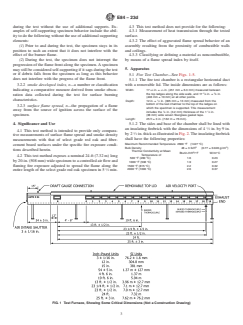
5.1 Fire Test Chamber—See Figs. 1-5.
does not interfere with the progress of the flame front.
5.1.1 The fire test chamber is a rectangular horizontal duct
with a removable lid. The inside dimensions are as follows:
3.2.2 smoke developed index, n—a number or classification
3 1
indicating a comparative measure derived from smoke obscu- Width: 17 ⁄4 in. ± ⁄4 in. (451 mm ± 6.3 mm) measured between
5 3
the top ledges along the side walls, and 17 ⁄8 in. ± ⁄8 in.
ration data collected during the test for surface burning
(448 mm ± 10 mm) at all other points.
characteristics.
Depth: 12 in. ± ⁄2 in. (305 mm ± 13 mm) measured from the
bottom of the test chamber to the top of the ledges on
3.2.3 surface flame spread, n—the propagation of a flame
which the specimen is supported. This measurement
away from the source of ignition across the surface of the
1 1
includes the ⁄8 in. (3.2 mm) thickness of the 1 ⁄2 in.
specimen. (38 mm) wide woven fiberglass gasket tape.
Length: 25 ft ± 3 in. (7.62 m ± 76 mm).
4. Significance and Use 5.1.2 The sides and base of the chamber shall be lined with
an insulating firebrick with the dimensions of 4 ⁄2 in. by 9 in.
4.1 This test method is intended to provide only compara-
by 2 ⁄2 in. thick as illustrated in Fig. 2. The insulating firebrick
tive measurements of surface flame spread and smoke density
shall have the following properties:
measurements with that of select grade red oak and fiber-
Maximum Recommended Temperature 2600 °F (1427 °C)
cement board surfaces under the specific fire exposure condi-
3 3
Bulk Density 48 ± 3 lb/ft (0.77 ± 0.046 g/cm )
tions described herein.
Thermal Conductivity at Mean
Btu•in./h•ft •°F W/m•°C
Temperature of
4.2 This test method exposes a nominal 24-ft (7.32 m) long
500 °F (260 °C) 1.6 0.23
by 20-in. (508 mm) wide specimen to a controlled air flow and
1000 °F (538 °C) 1.9 0.27
flaming fire exposure adjusted to spread the flame along the 1500 °F (815 °C) 2.2 0.32
1 2000 °F (1093 °C) 2.6 0.37
entire length of the select grade red oak specimen in 5 ⁄2 min.
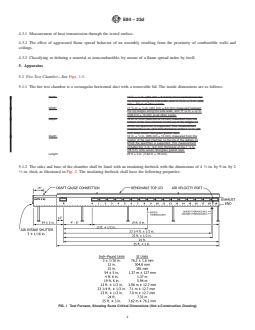
FIG. 1 Test Furnace, Showing Some Critical Dimensions (Not a Construction Drawing)
E84 − 23d
FIG. 2 Test Furnace Showing Critical Dimensions (Not a Construction Drawing)
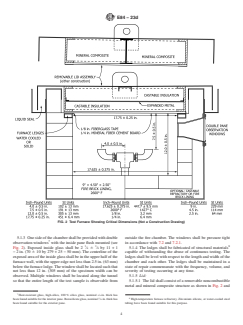
5.1.3 One side of the chamber shall be provided with double outside the fire chamber. The windows shall be pressure tight
observation windows with the inside pane flush mounted (see in accordance with 7.2 and 7.2.1.
3 3
Fig. 2). Exposed inside glass shall be 2 ⁄4 6 ⁄8 by 11 + 1 5.1.4 The ledges shall be fabricated of structural materials
− 2 in. (70 6 10 by 279 + 25 − 50 mm). The centerline of the capable of withstanding the abuse of continuous testing. The
exposed area of the inside glass shall be in the upper half of the ledges shall be level with respect to the length and width of the
furnace wall, with the upper edge not less than 2.5 in. (63 mm) chamber and each other. The ledges shall be maintained in a
below the furnace ledge. The window shall be located such that state of repair commensurate with the frequency, volume, and
not less than 12 in. (305 mm) of the specimen width can be severity of testing occurring at any time.
observed. Multiple windows shall be located along the tunnel 5.1.5 Lid:
so that the entire length of the test sample is observable from 5.1.5.1 The lid shall consist of a removable noncombustible
metal and mineral composite structure as shown in Fig. 2 and
Heat-resistant glass, high-silica, 100 % silica glass, nominal ⁄4-in. thick has
been found suitable for the interior pane. Borosilicate glass, nominal ⁄4-in. thick has High-temperature furnace refractory. Zirconium silicate, or water-cooled steel
been found suitable for the exterior pane. tubing have been found suitable for this purpose.
E84 − 23d
FIG. 3 Typical Exhaust End Transition (Not a Construction Drawing)
of a size necessary to cover completely the fire test chamber 5.1.6.1 One end of the test chamber shall be designated as
and the test samples. The lid shall be maintained in an the “fire end”. This fire end shall be provided with two gas
unwarped and flat condition. When in place, the lid shall be burners delivering flames upward against the surface of the test
completely sealed to prevent air leakage into the fire test sample (see Fig. 2). The burners shall be spaced 12 in.
chamber during the test. (305 mm) from the fire end of the test chamber, and 7 ⁄2 in. 6
5.1.5.2 The lid shall be insulated with a minimal thickness ⁄2 in. (190 mm 6 13 mm) below the under surface of the test
of 2 in. (51 mm) castable insulation or mineral composite sample. Gas to the burners shall be provided through a single
material having physical characteristics comparable to the inlet pipe, distributed to each port burner through a tee-section.
following: The outlet shall be a ⁄4 in. NPT elbow. The plane of the port
shall be parallel to the furnace floor, such that the gas is
Maximum effective use temperature of
at least: 1200 °F (650 °C)
directed upward toward the specimen. Each port shall be
3 3
Bulk density 21 lb/ft (336 kg ⁄m )
positioned with its centerline 4 in. 6 ⁄2 in. (102 mm 6 13 mm)
Thermal conductivity at 300 °F to 0.50 to 0.71 Btu·in./h·ft ·°F (0.072 to
on each side of the centerline of the furnace so that the flame
700 °F 0.102 W/m·K)
(149 °C to 371 °C)
is distributed evenly over the width of the exposed specimen
surface (see Fig. 2).
5.1.5.3 The entire lid assembly shall be protected with flat
sections of nominal ⁄4-in. (6.3 mm) fiber-cement board meet- 5.1.6.2 The controls used to assure constant flow of gas to
ing the properties of Annex A3. This protective board shall be the burners during period of use shall consist of a pressure
maintained in sound condition through continued replacement. regulator, a gas meter constructed to read in increments of not
The protective board is to be secured to the furnace lid or place more than 0.1 ft (2.8 L), a manometer to indicate gas pressure
on the back side of the test specimen. in inches of water, a quick-acting gas shut-off valve, and a gas
5.1.6 Gas Burners: metering valve.
E84 − 23d
from the burner centerline to the outside surface of the shutter
(see Fig. 1). The air intake is to be fitted with a vertically
sliding shutter extending the entire width of the test chamber.
The shutter shall be positioned so as to provide an air inlet port
3 in. 6 ⁄16 in. (76 mm 6 2 mm) high measured from the floor
level of the test chamber at the air intake point.
5.1.7.2 To provide air turbulence for proper combustion,
turbulence baffling shall be provided by positioning six refrac-
tory firebricks (as defined in 5.1.2) along the side walls of the
chamber. With the long dimension vertical, 4 ⁄2 in. (114 mm)
dimension along the wall, place the bricks as follows from the
centerline of the burner ports:
On the window side at 7, 12, and 20 ± ⁄2 ft (2.1, 3.7, and 6.1 ± 0.2 m)
1 1 1
On the opposite side at 4 ⁄2, 9 ⁄2, and 16 ± ⁄2 ft (1.3, 2.9, and 4.9 ± 0.2 m)
5.1.7.3 The movement of air shall be by an induced draft
system having a total draft capacity of at least 0.15 in.
(3.8 mm) water column with the sample in place, the shutter at
the fire end open the normal 3 in. 6 ⁄16 in. (76 mm 6 2 mm),
and the damper in the wide open position. A draft gauge tap to
indicate static pressure shall be inserted through the top at the
midwidth of the tunnel, 1 in. 6 0.5 in. (25 mm 6 12 mm)
below the ceiling, 15 in. 6 0.5 in. (381 mm 6 12 mm)
downstream from the inlet shutter (see Fig. 1).
5.1.8 Exhaust End:
5.1.8.1 The other end of the test chamber is designated as
the exhaust end. The exhaust end shall be fitted with a gradual
rectangular-to-round transition piece, not less than 20 in.
(508 mm) in length, with a cross-sectional area of not less than
2 2
200 in. (1290 cm ) at any point (see Fig. 3).
5.1.8.2 The transition piece shall in turn be fitted to a 16 in.
(406 mm) diameter duct pipe. A typical duct system shown in
Fig. 4 contains two 90° elbows (see Fig. 5) with the exhaust
duct running beside the fire test chamber. In order to comply
with this typical design, the vertical centerline of the exhaust
duct system is identical to that of the fire test chamber.
5.1.8.3 The exhaust duct is to be insulated with at least 2 in.
(51 mm) of high temperature mineral composition material
from the exhaust end of the fire chamber to the photometer
location.
5.1.8.4 An exhaust fan shall be installed at the end of the
exhaust duct. The air flow shall be controlled as specified in
5.1.10.
5.1.8.5 An alternative exhaust duct layout design shall
demonstrate equivalency by meeting the requirements speci-
fied in Section 7.
5.1.9 Photometer System:
5.1.9.1 A photometer system consisting of a white light
source and photocell shall be mounted on a horizontal section
of the 16 in. (406 mm) diameter vent pipe at a point where it
will be preceded by a straight run of pipe (at least 12 diameters
or 16 ft (4.88 m) and not more than 30 diameters or 40 ft
(12.19 m) from the vent end of the chamber, and with the light
beam directed upward along the vertical axis of the vent pipe.
FIG. 4 Plan View—Typical Duct System (Not a Construction
Drawing)
The sole source of supply of the apparatus known to the committee at this time
is a model No. 856RRV from Huygen Corp., Crystal Lake, IL. If you are aware of
5.1.7 Air Intake:
alternative suppliers, please provide this information to ASTM Headquarters. Your
5.1.7.1 An air intake shutter shall be located 54 in. 6 5 in.
comments will receive careful consideration at a meeting of the responsible
(1372 mm 6 127 mm) upstream of the burner, as measured technical committee, which you may attend.
E84 − 23d
FIG. 5 Typical Duct Elbow (Not a Construction Drawing)
The vent pipe shall be insulated with at least 2 in. (51 mm) of 5.1.11.2 Two No. 18 Awg (1.02 mm) thermocouples are
high-temperature mineral composition material, from the vent
embedded below the floor surface of the test chamber. These
end of the chamber to the photometer location. The output of thermocouples shall be mounted at distances of 13 ft 6 ⁄2 in.
1 1
the photoelectric cell is proportional to the smoke, particulate,
(3.96 m 6 13 mm) and 23 ⁄4 ft 6 ⁄2 in. (7.09 m 6 13 mm)
and other effluent passing between the light source and
measured from the centerline of the burner ports. The thermo-
photocell. The distance between the light source lens and the
couples shall be inserted from below the fire test chamber
photocell lens shall be 36 in. 6 4 in. (914 mm 6 102 mm). The
through the firebrick until the tip of the thermocouple is ⁄8 in.
cylindrical light beam shall pass through 3 in. (76 mm)
6 ⁄32 in. (3.2 mm 6 0.8 mm) below the floor surface. The tip
diameter openings at the top and bottom of the 16-in. diameter
of the thermocouples shall be covered with refractory or
duct, with the resultant light beam centered on the photocell.
portland cement, carefully dried to avoid cracking.
5.1.9.2 Linearity of the photometer system shall be verified
periodically by interrupting the light beam with calibrated
6. Test Specimens
neutral density filters. The filters shall cover the full range of
6.1 Specimens shall be representative of the materials which
the recording instrument. Transmittance values measured by
the test is intended to examine. The report shall include
the photometer, using neutral density filters, shall be within
information on the composition needed for identification of the
63 % of the calibrated value for each filter.
test specimen as described in 11.1.1.
5.1.10 Draft Regulating Device:
5.1.10.1 An automatically controlled damper to regulate the
6.2 The specimen shall be provided in one of two ways: (1)
draft pressure shall be installed in the vent pipe down-stream of
a continuous, unbroken length; (2) sections that will be joined
the smoke-indicating attachment. The damper shall be pro-
or butted end-to-end.
vided with a manual override.
6.3 The size of the test specimen shall be:
5.1.10.2 Other manual or automatic draft regulation
devices, or both, are allowed to be incorporated to help
Width: between 20 in. and 24 in. (508 mm and 610 mm),
maintain fan characterization and air-flow control throughout
Length: 24 ft + 12 in. – 6 in., and
the test.
Thickness: maximum 4 in. (101 mm).
5.1.11 Thermocouples:
5.1.11.1 A No. 18 Awg (1.02 mm) thermocouple, with ⁄8 in.
NOTE 2—The test apparatus is not designed for testing at thicknesses
greater than 4 in. (101 mm), but has the ability to be modified if required.
6 ⁄8 in. (9.5 mm 6 3.2 mm) of the junction exposed in the air,
This is accomplished through (a) modifications to the test apparatus lid to
shall be inserted through the floor of the test chamber so that
maintain an airtight seal, and (b) the introduction, usually of additional
the tip is 1 in. 6 ⁄32 in. (25.4 mm 6 0.8 mm) below the top
sample/lid supports above the test apparatus ledges. Due to the composi-
surface of the gasketing tape and 23 ft 6 ⁄2 in. (7.0 m 6
tion of some materials, test results obtained at a thickness greater than
13 mm) from the centerline of the burner ports at the center of
4 in. (101 mm) will potentially vary from results of a test on the same
its width. material tested at a thickness of 4 in. (101 mm) or less.
E84 − 23d
6.3.1 The test specimen shall be required to conform to the E3202 for plastic composites for use as deck boards, stair
test specimen length and width described in 6.3 unless the treads, guards or handrails.
material complies with any one of the requirements in 6.3.1.1 E3287 for fenestration profiles intended to support non-
– 6.3.1.3. combustible in-fill materials.
6.8.1 Section 11.1.3.3 requires the reporting of the mounting
NOTE 3—When tests are conducted with materials installed at less than
method employed, including additional information required to
full width, representing the end-use width, any resulting flame spread and
be reported by the applicable specimen preparation and mount-
smoke developed indices will not relate to indices obtained with the
calibration material, which is tested using the specimen width described in ing practice referenced in this section.
6.3.
6.9 Annexes address the optional use of fiber cement and of
6.3.1.1 Materials for which there is a standard practice to
metal support pieces in this test method. They also address
address specimen preparation and mounting with this test
mounting methods for some specific materials or products. Test
method shall be tested as described in the appropriate standard
specimens that sag and interfere with the progression of the
practice (see 6.8).
flame front are to use metal supports in accordance with Annex
6.3.1.2 Adhesives, tapes, and trim shall be permitted to be A4.
tested in the width or length, or both, specified in their listings,
6.10 Appendix X1 provides guidance on mounting methods
or as part of their conditions for being labeled, by a nationally
for materials or products not covered by the standard practices
recognized testing laboratory.
in 6.8 or any of the annexes.
6.3.1.3 Materials and products for which there is a specific
test method or application standard requiring the use of the
7. Calibration
apparatus described in Section 5 shall be permitted to be tested
7.1 Place a nominal ⁄4 in. (6.3 mm) fiber-cement board
in accordance with that specific test method or application
meeting the properties of Annex A3 on the ledge of the furnace
standard (see 1.2 – 1.2.5).
chamber. Place the removable lid of the test chamber in
6.4 The test specimen shall be conditioned to a constant
position.
weight at a temperature of 73.4 °F 6 5 °F (23 °C 6 2.8 °C)
7.2 With the ⁄4 in. (6.3 mm) fiber-cement board in position
and at a relative humidity of 50 % 6 5 %.
on top of the ledge of the furnace chamber and with the
6.5 The upstream end of the fire test chamber shall be filled removable lid in place, establish a draft to produce a 0.15 in.
with a 14 in. 6 ⁄8 in. (356 mm 6 3 mm) length of uncoated 16
(3.8 mm) water-column reading on the draft manometer, with
gauge (0.053 in. to 0.060 in.) steel plate positioned on the
the fire-end shutter open 3 in. 6 ⁄16 in. (76 mm 6 1.6 mm), by
specimen mounting ledge in front of and under the leading
manually setting the damper as a characterization of fan
edge of the specimen.
performance. Then close and seal the fire-end shutter, without
changing the damper position. The manometer reading shall
6.6 When the overall length of the test specimen exceeds
increase to at least 0.375 in. (9.53 mm), indicating that no
24 ft (7.32 m), butt one end of the test specimen against the
excessive air leakage exists.
exhaust end of the fire test chamber and continue the installa-
7.2.1 In addition, conduct a supplemental leakage test peri-
tion of the specimen toward the gas burner.
odically with the tunnel sealed from the inlet end to beyond the
6.7 When the overall length of the test specimen is 24 ft
photometer system, by placing a smoke bomb in the chamber.
(7.32 m) or less, provide a 1 in. (25 mm) overlap of the steel
Ignite the bomb and pressurize the chamber to 0.375 in. 6
plate at the upstream end with one end of the test specimen and
0.125 in. (9.53 mm 6 3.18 mm) water column. Seal all points
continue the installation of the specimen toward the exhaust
of leakage observed in the form of escaping smoke particles.
end.
7.3 Establish a draft reading within the range 0.055 in. to
0.100 in. (1.40 mm to 2.54 mm) water column. The required
6.8 In addition to the above provisions, the standard prac-
tices listed below shall be used for specimen preparation and draft gauge reading will be maintained throughout the test by
mounting of the relevant test materials. the automatically controlled damper. Record the air velocity at
E2231 for pipe and duct insulation materials. seven points, 23 ft from the centerline of the burner ports, 6 in.
E2404 for paper, polymeric (including vinyl and expanded 6 ⁄4 in. (168 mm 6 7 mm) below the plane of the specimen
vinyl) and textile wall and ceiling covering materials, facings mounting ledge. Determine these seven points by dividing the
or wood veneers intended to be applied on site over a wood width of the tunnel into seven equal sections and recording the
substrate. velocity at the geometrical center of each section. During the
E2573 for site-fabricated stretch systems. measurement of velocity, remove the turbulence bricks (see
E2579 for wood products as well as for laminated products 4.3) and the exposed 23-ft thermocouple and place 24 in.
factory-produced with a wood substrate. (670 mm) long straightening vanes between 16 ft and 18 ft
E2599 for reflective insulation, radiant barrier and vinyl (4.88 m and 5.49 m) from the burner. The straightening vanes
stretch ceiling materials for building applications. shall divide the furnace cross section into nine uniform
E2688 for tapes. sections. Determine the velocity with furnace air temperature
E2690 for caulks or sealants. at 73.4 °F 6 5 °F (23 °C 6 2.8 °C), using a velocity transducer.
E2988 for flexible fibrous glass insulation for metal build- The velocity, determined as the arithmetic average of the seven
ings. readings, shall be 240 ft 6 5 ft (73.2 m 6 1.4 m)/min.
E84 − 23d
7.3.1 The following alternative to the velocity transducer
equipment and method of determining the tunnel air velocity
has been found suitable: A 4-in. diameter low-speed rotary
vane anemometer, having a resolution of 1 ft/min. with an
accuracy of 62 %, is attached to the steel stand and placed in
the tunnel 22.5 ft downstream of the burners. Three trials shall
be conducted and their values averaged. The average is
rounded to the nearest unit. The centerline of the vane
anemometer shall be aligned with the vertical centerline of the
tunnel by placing it on the steel stand. Trial 1 is run with the
vane edge 1 in. from the non-window wall; Trial 2 is with the
center axis at the tunnel center point; and Trial 3 is run with the
vane edge 1 in. from the window wall.
FIG. 6 Representative Time-Temperature Curve for Preheat Tem-
peratures
7.4 The room in which the test chamber is located shall have
provision for a free inflow of air during test to maintain the
room at atmospheric pressure during the entire test run.
7.8.1 The red oak decks are to be constructed and condi-
Maintain the air supply at a temperature of 65 °F to 80 °F
tioned as specified in Annex A1 and Annex A2. Make
(18.3 °C to 26.7 °C) and a relative humidity of 45 % to 60 %.
observations at distance intervals not in excess of 2 ft (0.6 m)
7.5 Supply the fire test chamber with natural (city) or
and time intervals not in excess of 30 s, and record the time
methane (bottled) gas fuel of uniform quality with a heating when the flame reaches the end of the specimen 19 ⁄2 ft
3 3
value of nominally 1000 Btu/ft (37.3 MJ/m ). Adjust the gas
(5.94 m) from the end of the ignition fire. The end of the
supply initially at approximately 5000 Btu (5.3 MJ)/min. ignition fire shall be considered as being 4 ⁄2 ft (1.4 m) from
Record the gas pressure, the pressure differential across the
the burners. The flame shall reach the end point in 5 ⁄2 min 6
orifice plate, and the volume of gas used in each test. If a 15 s. Automatically record the temperature measured by the
temperature- and pressure-compensating mass flowmeter is
exposed thermocouple at 23 ft (7.0 m) at least every 15 s.
utilized, record only the volume of gas used. Unless otherwise Automatically record the photoelectric cell output immediately
corrected for, when bottled methane is employed, insert a
prior to the test and at least every 15 s during the test.
length of coiled copper tubing into the gas line between the 7.8.2 Another means of judging when the flame has reached
supply and metering connection to compensate for possible
the end point is when the exposed thermocouple at 23 ft
errors in the flow indicated due to reductions in gas tempera-
(7.0 m) registers a temperature of 980 °F (527 °C).
ture associated with the pressure drop and expansion across the
7.9 Plot the flame spread distance and temperature, for the
regulator. With the draft and gas supply adjusted as indicated in
duration of the test. Fig. 7 and Fig. 8 are representative curves
7.3 and 7.4, the test flame shall extend downstream to a
for red oak flame spread distance and time-temperature
distance of 4 ⁄2 ft (1.37 m) over the specimen surface, with
development, respectively. Flame spread distance shall be
negligible upstream coverage.
determined as the observed distance minus 4 ⁄2 ft (1.37 m).
7.6 Preheat the test chamber with the ⁄4 in. (6.3 mm)
7.10 Conduct a similar test or tests on samples of ⁄4 in.
fiber-cement board and the removable lid in place and with the
(6 mm) fiber-cement board. These results shall be considered
fuel supply adjusted to the required flow. Continue the preheat-
as representing an index of 0. Plot the temperature readings for
ing until the temperature indicated by the floor thermocouple at
23 ⁄4 ft (7.09 m) reaches 150 °F 6 5 °F (66 °C 6 2.8 °C).
During the preheat test, record the temperatures indicated by
the thermocouple at the vent end of the test chamber at
intervals not longer than 15 s.
7.6.1 Compare the temperature readings during the preheat
test in 7.6 with those in the time-temperature curve in Fig. 6. If
they are different investigate the differences and make adjust-
ments as necessary, while maintaining calibration require-
ments.
7.7 Allow the furnace to cool after each test. When the floor
thermocouple at 13 ft (3.96 m) shows a temperature of 105 °F
6 5 °F (40.5 °C 6 2.8 °C), place the next specimen in position
for test.
7.8 With the test equipment adjusted and conditioned as
described in 7.2, 7.3, 7.4, and 7.6, make a test or series of tests,
using nominal ⁄32-in. (18 mm) select-grade red oak flooring
samples and samples of ⁄4-in. (6 mm) fiber-cement board.
FIG. 7 Representative Time-Distance Curve for Flame Spread of
Conduct these tests in either order. Red Oak
E84 − 23d
7.14.1.2 Use a round, stainless steel pan, inside diameter
7 1 5
8 ⁄8 in. 6 ⁄8 in. (225 mm 6 3 mm) by inside height, 1 ⁄8 in.
6 ⁄8 in. (41 mm 6 3 mm).
7.14.1.3 Use 24 in. by 24 in. (610 mm by 610 mm), clear
plastic cling wrap (food grade), nominally 0.001 in. 6
0.0005 in. (0.03 mm 6 0.015 mm) in thickness.
7.14.1.4 Use ordinary tap water as a flotation base for the
liquid heptane.
7.14.2 Procedure—Conduct the smoke calibration as indi-
cated below:
7.14.2.1 Preheat and cool the furnace as described in 7.6 and
FIG. 8 Representative Time-Temperature Curve for Red Oak 7.7.
7.14.2.2 Pour 200 mL 6 10 mL (200 g 6 10 g) of water
into the stainless steel pan. All deformities in the pan bottom
the duration of the test. Fig. 9 is a representative curve for
shall be covered, creating a level water surface. If 200 mL is
time-temperature development for fiber-cement board.
insufficient to eliminate pan deformities, then replace or repair
7.11 The calibrations described in Section 7 shall be per-
the pan. Change the water between trials.
formed after major repairs, such as re-bricking, have been
7.14.2.3 Measure and pour 295 g 6 2 g of heptane onto the
made. If there have been no major repairs, new calibrations
water in the pan.
shall be conducted after 200 tests, or every 12 months,
7.14.2.4 To minimize evaporation, cover the heptane pan
whichever comes first.
with a section of cling wrap, by wrapping around and under the
7.12 The red oak flame spread calibration data shall be used pan bottom as appropriate until taut, to adequately seal the top
to confirm performance indicated in 7.8, that the flame reaches
rim of the pan, without floating the cling wrap on the surface
the end of the specimen at a time no less than 5 min 15 s and of the heptane. The use of an elastic band around the
no more than 5 min 45 s from the start of the test. In the event
circumference of the pan has been found to be effective in
that the flame reaches the end of the specimen outside these
securing the cling wrap in position.
time limits, make adjustments and recalibrate until the correct
7.14.2.5 Center the pan on the apparatus floor, 24 in. 6
time is achieved. Do not use red oak calibration data (if
0.5 in. (610 mm 6 13 mm) downstream from the centerline of
recorded) for smoke calibration. See 7.13 for smoke calibration
the burners.
using heptane.
7.14.2.6 Place fiber-cement boards on the tunnel ledges as
7.13 After achieving a successful red oak flame spread described in 7.1.
calibration, use the procedure described in 7.14 and complete
7.14.2.7 Place the furnace lid in position and allow the draft
a minimum of three trials using 295 g 6 2 g of laboratory grade
to stabilize as described in 8.2.
liquid heptane.
7.14.2.8 Initiate the calibration test by simultaneously ignit-
7.14 Smoke Calibration using Heptane: ing the heptane via either a remote spark igniter (or similar), or
7.14.1 Materials: an open flame ignition source, and starting the smoke data
7.14.1.1 Use liquid heptane, high-performance liquid chro- recording in the same manner as that for standard tests. Allow
matography (HPLC) Grade, submicron filtered. the heptane to be totally consumed.
FIG. 9 Representative Time-Temperature Curve for Fuel Contribution of Fiber-Cement Board
E84 − 23d
NOTE 4—It has been found that igniting the cling wrap will also cause
8.5 Record the gas pressure, the pressure differential across
ignition of the heptane.
the orifice plate, and the volume of gas used in each test. If a
7.14.2.9 Record the time to heptane flame-out. temperature- and pressure-compensating mass flowmeter de-
7.14.2.10 Terminate the test at 10 min. vice is used to monitor the gas flow, record only the volume of
7.14.2.11 Record and plot the change in photoelectric cell
gas.
readings for the duration of the test.
8.6 When the test is ended, shut off the gas supply, observe
7.14.2.12 Allow the tunnel to cool, remove the pan, and
smoldering and other conditions within the test duct, and
repeat as necessary.
remove the specimen for further examination.
7.14.2.13 Calculate the average smoke area for all trials
recorded.
8.7 Plot the flame spread distance, temperature, and change
in photoelectric cell readings for the duration of the test for use
7.15 Add the data from the new heptane smoke calibration
in determining the flame-spread and smoke-developed indexes
to previous heptane calibration data in order to maintain a
as outlined in Section 9. Flame front advancement shall be
running average of at least 15 individual heptane calibration
recorded at the time of occurrence or at least every 30 s if no
trials. If necessary, run additional calibration runs in order to
advancement is noted. Flame spread distance shall be deter-
achieve the minimum number of 15 calibrations. This average
mined as the observed distance minus 4 ⁄2 ft (1.37 m).
of the recorded smoke areas for heptane shall provide the
calibration data to be used to establish the area for calculation
9. Interpretation of Results
of the smoke-developed index (SDI).
7.15.1 Fig. 10 is a representative curve of smoke area for
9.1 The flame spread index (FSI) shall be the value,
heptane.
determined as follows, rounded to the nearest multiple of five.
9.1.1 Appendix X2 describes the derivation of the formulas
8. Procedure
for the flame spread area values needed for the FSI.
8.1 With the furnace draft operating, place the test specimen
9.1.2 In plotting the flame spread distance-time relationship,
on the test chamber ledges that have been completely covered
all progressive flaming as previously recorded shall be in-
1 1
with nominal ⁄8 in. (3.2 mm) thick by 1 ⁄2 in. (38 mm) wide
cluded at the time of occurrence. A straight line shall be used
woven gasketing tape. Place the specimen as quickly as is
to connect successive points. The total area (A ) under the
T
practical. Place the removable top in position over the speci-
flame spread distance-time plot shall be determined by ignor-
men.
ing any flame front recession. For example, in Fig. 11 the flame
8.2 Keep the completely mounted specimen in position in
spreads 10 ft (3.05 m) in 2 ⁄2 min and then recedes. The area
the chamber with the furnace draft operating for 120 s 6 15 s
is calculated as if the flame had spread to 10 ft in 2 ⁄2 min and
prior to the application of the test flame.
then remained at 10 ft for the remainder of the test or until the
8.3 Ignite the burner gas. Observe and record the distance flame front again passed 10 ft. This is shown by the dashed line
and time of maximum flame front travel with the room in Fig. 11. The area (A ) used for calculating the flame spread
T
darkened. Continue the test for a 10-min period. Termination of index is the sum of areas A and A in Fig. 11.
1 2
the test prior to 10 min is permitted if the specimen is
9.1.3 If this total area (A ) is less than or equal to
T
completely consumed in the fire area and no further progres-
97.5 ft·min, the flame spread index shall be 0.515 times the
sive burning is evident and the photoelectric cell reading has
total area (FSI = 0.515 A ).
T
returned to the baseline.
9.1.4 If the total area (A ) is greater than 97.5 ft·min, the
T
8.4 Record the photoelectric cell output immediately prior flame spread index shall be 4900, divided by the difference of
to the test and at least every 2 s during the test. 195 minus the total area (A ). (FSI = 4900 ⁄(195 − A )).
T T
FIG. 10 Representative Time-Absorption Curve for Smoke Density of Heptane
E84 − 23d
FIG. 11 Example of Time-Distance Relationship with Flame Front Recession
(Total Area, A = A + A )
T 1 2
9.2 The test results for smoke shall be plotted and the area 11.1.3.5 The method of placement of the cement board
under the curve shall be divided by the area under the curve for protecting the furnace lid assembly.
heptane, multiplied by 100, and rounded to the nearest multiple 11.1.4 Observations of the burning characteristics of the
of five to establish a numerical smoke-developed index (SDI). specimen during test exposure, such as delamination, sagging,
The performance of the material is compared with that of shrinkage, fallout, etc., and
fiber-cement board and heptane, which have been arbitrarily 11.1.5 Graphical plots of flame spread and smoke developed
established as 0 and 100, respectively. For smoke-developed data.
indexes 200 or more, the calculated value shall be rounded to
12. Precision and Bias
the nearest 50 points.
9.2.1 There are no formulas to derive SDI, which is calcu-
12.1 Precision—A series of interlaboratory tests for this test
lated as indicated above.
method was run using eleven laboratories and six materials.
Four replicates of each material were tested. The complete
10. Analysis of Products of Combustion
results have been placed on file at ASTM Headquarters as a
10.1 Samples for combustion product analysis, when analy-
Research Project entitled “Interlaboratory Test Study on ASTM
sis is re
...
This document is not an ASTM standard and is intended only to provide the user of an ASTM standard an indication of what changes have been made to the previous version. Because
it may not be technically possible to adequately depict all changes accurately, ASTM recommends that users consult prior editions as appropriate. In all cases only the current version
of the standard as published by ASTM is to be considered the official document.
Designation: E84 − 23c E84 − 23d An American National Standard
Standard Test Method for
Surface Burning Characteristics of Building Materials
This standard is issued under the fixed designation E84; the number immediately following the designation indicates the year of original
adoption or, in the case of revision, the year of last revision. A number in parentheses indicates the year of last reapproval. A superscript
epsilon (´) indicates an editorial change since the last revision or reapproval.
This standard has been approved for use by agencies of the U.S. Department of Defense.
1. Scope*
1.1 This fire-test-response standard for the comparative surface burning behavior of building materials is applicable to exposed
surfaces such as walls and ceilings. The test is conducted with the specimen in the ceiling position with the surface to be evaluated
exposed face down to the ignition source. The material, product, or assembly shall be capable of being mounted in the test position
during the test. Thus, the specimen shall either be self-supporting by its own structural quality, held in place by added supports
along the test surface, or secured from the back side.
1.2 Test Method E84 is a 10-min fire-test response method. The following standards address testing of materials in accordance
with test methods that are applications or variations of the test method or apparatus used for Test Method E84:
1.2.1 Materials required by the user to meet an extended 30-min duration tunnel test shall be tested in accordance with Test
Method E2768.
1.2.2 Wires and cables for use in air-handling spaces shall be tested in accordance with NFPA 262.
1.2.3 Pneumatic tubing for control systems shall be tested in accordance with UL 1820.
1.2.4 Combustible sprinkler piping shall be tested in accordance with UL 1887.
1.2.5 Optical fiber and communications raceways for use in air handling spaces shall be tested in accordance with UL 2024.
NOTE 1—Annex A13 includes additional information describing a standard other than those listed in this section that also utilizes a modification of the
apparatus used for Test Method E84.
1.3 The purpose of this test method is to determine the relative burning behavior of the material by observing the flame spread
along the specimen. Flame spread and smoke developed index are reported. However, there is not necessarily a relationship
between these two measurements.
1.4 The use of supporting materials on the underside of the test specimen has the ability to lower the flame spread index from those
which might be obtained if the specimen could be tested without such support. These test results do not necessarily relate to indices
obtained by testing materials without such support.
This test method is under the jurisdiction of ASTM Committee E05 on Fire Standards and is the direct responsibility of Subcommittee E05.22 on Surface Burning.
Current edition approved Sept. 1, 2023Dec. 1, 2023. Published September 2023January 2024. Originally approved in 1950. Last previous edition approved in 2023 as
E84 – 23b.E84 – 23c. DOI: 10.1520/E0084-23C.10.1520/E0084-23D.
*A Summary of Changes section appears at the end of this standard
Copyright © ASTM International, 100 Barr Harbor Drive, PO Box C700, West Conshohocken, PA 19428-2959. United States
E84 − 23d
1.5 Testing of materials that melt, drip, or delaminate to such a degree that the continuity of the flame front is destroyed, results
in low flame spread indices that do not relate directly to indices obtained by testing materials that remain in place.
1.6 Units—The values stated in inch-pound units are to be regarded as standard. The values given in parentheses are mathematical
conversions to SI units that are provided for information only and are not considered standard.
1.7 The text of this standard references notes and footnotes that provide explanatory information. These notes and footnotes,
excluding those in tables and figures, shall not be considered as requirements of the standard.
1.8 This standard is used to measure and describe the response of materials, products, or assemblies to heat and flame under
controlled conditions, but does not by itself incorporate all factors required for fire-hazard or fire-risk assessment of the materials,
products, or assemblies under actual fire conditions.
1.9 This standard does not purport to address all of the safety concerns, if any, associated with its use. It is the responsibility
of the user of this standard to establish appropriate safety, health, and environmental practices and determine the applicability of
regulatory limitations prior to use.
1.10 Fire testing is inherently hazardous. Adequate safeguards for personnel and property shall be employed in conducting
these tests.
1.11 This international standard was developed in accordance with internationally recognized principles on standardization
established in the Decision on Principles for the Development of International Standards, Guides and Recommendations issued
by the World Trade Organization Technical Barriers to Trade (TBT) Committee.
2. Referenced Documents
2.1 ASTM Standards:
A390 Specification for Zinc-Coated (Galvanized) Steel Poultry Fence Fabric (Hexagonal and Straight Line)
C1186 Specification for Flat Fiber-Cement Sheets
C1288 Specification for Fiber-Cement Interior Substrate Sheets
C1396/C1396M Specification for Gypsum Board
D4442 Test Methods for Direct Moisture Content Measurement of Wood and Wood-Based Materials
D4444 Test Method for Laboratory Standardization and Calibration of Hand-Held Moisture Meters
E69 Test Method for Combustible Properties of Treated Wood by the Fire-Tube Apparatus
E160 Test Method for Combustible Properties of Treated Wood by the Crib Test
E162 Test Method for Surface Flammability of Materials Using a Radiant Heat Energy Source
E176 Terminology of Fire Standards
E286 Test Method for Surface Flammability of Building Materials Using an 8-ft (2.44-m) Tunnel Furnace (Withdrawn 1991)
E691 Practice for Conducting an Interlaboratory Study to Determine the Precision of a Test Method
E2231 Practice for Specimen Preparation and Mounting of Pipe and Duct Insulation Materials to Assess Surface Burning
Characteristics
E2404 Practice for Specimen Preparation and Mounting of Textile, Paper or Polymeric (Including Vinyl) and Wood Wall or
Ceiling Coverings, Facings and Veneers, to Assess Surface Burning Characteristics
E2573 Practice for Specimen Preparation and Mounting of Site-Fabricated Stretch Systems to Assess Surface Burning
Characteristics
E2579 Practice for Specimen Preparation and Mounting of Wood Products to Assess Surface Burning Characteristics
E2599 Practice for Specimen Preparation and Mounting of Reflective Insulation, Radiant Barrier and Vinyl Stretch Ceiling
Materials for Building Applications to Assess Surface Burning Characteristics
E2688 Practice for Specimen Preparation and Mounting of Tapes to Assess Surface Burning Characteristics
E2690 Practice for Specimen Preparation and Mounting of Caulks and Sealants to Assess Surface Burning Characteristics
E2768 Test Method for Extended Duration Surface Burning Characteristics of Building Materials (30 min Tunnel Test)
E2988 Practice for Specimen Preparation and Mounting of Flexible Fibrous Glass Insulation for Metal Buildings to Assess
Surface Burning Characteristics
E3202 Practice for Specimen Preparation and Mounting of Plastic Composites for Use as Deck Boards, Stair Treads, Guards or
Handrails to Assess Surface Burning Characteristics
E3287 Practice for Specimen Preparation of Fenestration Profiles Intended to Support Non-Combustible In-Fill Materials to
Assess Surface Burning Characteristics
For referenced ASTM standards, visit the ASTM website, www.astm.org, or contact ASTM Customer Service at service@astm.org. For Annual Book of ASTM Standards
volume information, refer to the standard’s Document Summary page on the ASTM website.
The last approved version of this historical standard is referenced on www.astm.org.
E84 − 23d
2.2 NFPA Standards:
NFPA 90A Standard for the Installation of Air-Conditioning and Ventilating Systems (2021)
NFPA 262 Standard Method of Test for Flame Travel and Smoke of Wires and Cables for Use in Air-Handling Spaces
(2007)(2019)
2.3 UL StandardsStandards:
UL 723 Standard for Test for Surface Burning Characteristics of Building Materials (2023)
UL 1820 Standard for Safety for Fire Test of Pneumatic Tubing for Flame and Smoke Characteristics (2004)(2021)
UL 1887 Standard for Fire Test of Plastic Sprinkler Pipe for Visible Flame and Smoke Characteristics (2004)(2021)
UL 2024 Standard for Safety for Optical Fiber and Communication Cable Raceway (2004)(2021)
UL 2846 Standard for Fire Test of Plastic Water Distribution Plumbing Pipe for Visible Flame and Smoke Characteristics (2021)
2.4 ICC Codes:
IMC International Mechanical Code (2021)
3. Terminology
3.1 Definitions:
3.1.1 For definitions of terms used in this test method refer to Terminology E176. The term flame spread index from Terminology
E176 is of particular interest to this standard and is defined in 3.1.2.
3.1.2 flame spread index, n—a number or classification indicating a comparative measure derived from observations made during
the progress of the boundary of a zone of flame under defined test conditions.
3.2 Definitions of Terms Specific to This Standard:
3.2.1 self-supporting (as related to fire testing of specimens), adj—having the ability to remain on the ceiling of the test apparatus
without the use of additional supporting elements and without exhibiting behavior, such as sagging and falling debris, that
interferes with the burner flame and progression of the flame front over the surface of the specimen before the application of the
burner flame and at any time during the test.
3.2.1.1 Discussion—
Self-supporting specimens, after being mounted on the ledges of the test furnace, are structurally capable of supporting their own
weight prior to the test and during the test without the use of additional supports. Examples of self-supporting specimen behavior
include the ability to do the following without the use of additional supporting elements:
(1) Prior to and during the test, the specimen stays in its position to such an extent that it does not interfere with the effect of
the burner flame.
(2) During the test, the specimen does not interrupt the progression of the flame front along the specimen. A specimen may
still be considered self-supporting if it sags during the test or if debris falls from the specimen as long as this behavior does not
interfere with the progress of the flame front.
3.2.2 smoke developed index, n—a number or classification indicating a comparative measure derived from smoke obscuration
data collected during the test for surface burning characteristics.
3.2.3 surface flame spread, n—the propagation of a flame away from the source of ignition across the surface of the specimen.
4. Significance and Use
4.1 This test method is intended to provide only comparative measurements of surface flame spread and smoke density
measurements with that of select grade red oak and fiber-cement board surfaces under the specific fire exposure conditions
described herein.
4.2 This test method exposes a nominal 24-ft (7.32 m) long by 20-in. (508 mm) wide specimen to a controlled air flow and flaming
fire exposure adjusted to spread the flame along the entire length of the select grade red oak specimen in 55 ⁄2 min. min.
4.3 This test method does not provide for the following:
Available from National Fire Protection Association, 1 Battery March Park, Quincy, MA 02169.
Available from Underwriters Laboratories, 333 Pfingsten Road, Northbrook, IL 60062.
Available from International Code Council (ICC), 500 New Jersey Avenue, NW 6th Floor, Washington, DC 20001.
E84 − 23d
4.3.1 Measurement of heat transmission through the tested surface.
4.3.2 The effect of aggravated flame spread behavior of an assembly resulting from the proximity of combustible walls and
ceilings.
4.3.3 Classifying or defining a material as noncombustible, by means of a flame spread index by itself.
5. Apparatus
5.1 Fire Test Chamber—See Figs. 1-5.
5.1.1 The fire test chamber is a rectangular horizontal duct with a removable lid. The inside dimensions are as follows:
3 1
Width: 17 ⁄4 ± ⁄4 in. (451 mm ± 6.3 mm) measured between the
5 3
top ledges along the side walls, and 17 ⁄8 in. ± ⁄8 in. (448
mm ± 10) at all other points.
3 1
Width: 17 ⁄4 in. ± ⁄4 in. (451 mm ± 6.3 mm) measured between
5 3
the top ledges along the side walls, and 17 ⁄8 in. ± ⁄8 in.
(448 mm ± 10 mm) at all other points.
Depth: 12 in. ± ⁄2 in. (305 mm ± 13 mm) measured from the
bottom of the test chamber to the top of the ledges on
which the specimen is supported. This measurement
1 1
includes the ⁄8 in. (3.2 mm) thickness of the 1 ⁄2 in. (38
mm) wide woven fiberglass gasket tape.
Depth: 12 in. ± ⁄2 in. (305 mm ± 13 mm) measured from the
bottom of the test chamber to the top of the ledges on
which the specimen is supported. This measurement
1 1
includes the ⁄8 in. (3.2 mm) thickness of the 1 ⁄2 in.
(38 mm) wide woven fiberglass gasket tape.
Length: 25 ft ± 3 in. (7.62 m ± 76 mm).
5.1.2 The sides and base of the chamber shall be lined with an insulating firebrick with the dimensions of 4 ⁄2 in. by 9 in. by 2
⁄2 in. thick as illustrated in Fig. 2. The insulating firebrick shall have the following properties:
FIG. 1 Test Furnace, Showing Some Critical Dimensions (Not a Construction Drawing)
E84 − 23d
FIG. 2 Test Furnace Showing Critical Dimensions (Not a Construction Drawing)
Maximum Recommended Temperature 2600 °F (1427 °C)
3 3
Bulk Density 48 ± 3 lb/ft (0.77 ± 0.046 g/cm )
Thermal Conductivity at Mean
Btu•in./h•ft •°F W/m•°C
Temperature of
500 °F (260 °C) 1.6 0.23
1000 °F (538 °C) 1.9 0.27
1500 °F (815 °C) 2.2 0.32
2000 °F (1093 °C) 2.6 0.37
5.1.3 One side of the chamber shall be provided with double observation windows with the inside pane flush mounted (see Fig.
3 3
2). Exposed inside glass shall be 2 ⁄4 6 ⁄8 by 11 + 1, −2 in. + 1 − 2 in. (70 6 10 by 279 + 25 − 50 + 25 − 50 mm). The centerline
of the exposed area of the inside glass shall be in the upper half of the furnace wall, with the upper edge not less than 2.5 in. (63
mm) below the furnace ledge. The window shall be located such that not less than 12 in. (305 mm) of the specimen width can be
7 1 1
Heat-resistant glass, high-silica, 100 % silica glass, nominal ⁄4-in. thick has been found suitable for the interior pane. Borosilicate glass, nominal ⁄4-in. thick has been
found suitable for the exterior pane.
E84 − 23d
FIG. 3 Typical Exhaust End Transition (Not a Construction Drawing)
observed. Multiple windows shall be located along the tunnel so that the entire length of the test sample is observable from outside
the fire chamber. The windows shall be pressure tight in accordance with 7.2 and 7.2.1.
5.1.4 The ledges shall be fabricated of structural materials capable of withstanding the abuse of continuous testing. The ledges
shall be level with respect to the length and width of the chamber and each other. The ledges shall be maintained in a state of repair
commensurate with the frequency, volume, and severity of testing occurring at any time.
5.1.5 Lid:
5.1.5.1 The lid shall consist of a removable noncombustible metal and mineral composite structure as shown in Fig. 2 and of a
size necessary to cover completely the fire test chamber and the test samples. The lid shall be maintained in an unwarped and flat
condition. When in place, the lid shall be completely sealed to prevent air leakage into the fire test chamber during the test.
5.1.5.2 The lid shall be insulated with a minimal thickness of 2 in. (51 mm) castable insulation or mineral composite material
having physical characteristics comparable to the following:
High-temperature furnace refractory. Zirconium silicate, or water-cooled steel tubing have been found suitable for this purpose.
E84 − 23d
FIG. 4 Plan View—Typical Duct System (Not a Construction Drawing)
E84 − 23d
FIG. 5 Typical Duct Elbow (Not a Construction Drawing)
Maximum effective use temperature of
at least: 1200 °F (650 °C)
3 3
Bulk density 21 lb/ft (336 kg ⁄m )
Thermal conductivity at 300 °F to 0.50 to 0.71 Btu·in./h·ft ·°F (0.072 to
700 °F 0.102 W/m·K)
(149 °C to 371 °C)
5.1.5.3 The entire lid assembly shall be protected with flat sections of nominal ⁄4-in. (6.3 mm) fiber-cement board meeting the
properties of Annex A3. This protective board shall be maintained in sound condition through continued replacement. The
protective board is to be secured to the furnace lid or place on the back side of the test specimen.
5.1.6 Gas Burners:
5.1.6.1 One end of the test chamber shall be designated as the “fire end”. This fire end shall be provided with two gas burners
delivering flames upward against the surface of the test sample (see Fig. 2). The burners shall be spaced 12 in. (305 mm) (305 mm)
1 1
from the fire end of the test chamber, and 7 ⁄2 in. 6 ⁄2 in. (190 mm 6 13 mm) below the under surface of the test sample. Gas
to the burners shall be provided through a single inlet pipe, distributed to each port burner through a tee-section. The outlet shall
be a ⁄4 in. NPT elbow. The plane of the port shall be parallel to the furnace floor, such that the gas is directed upward toward
the specimen. Each port shall be positioned with its centerline 44 in. 6 ⁄2 in. (102 mm 6 13 mm) on each side of the centerline
of the furnace so that the flame is distributed evenly over the width of the exposed specimen surface (see Fig. 2).
5.1.6.2 The controls used to assure constant flow of gas to the burners during period of use shall consist of a pressure regulator,
a gas meter constructed to read in increments of not more than 0.1 ft (2.8 L), a manometer to indicate gas pressure in inches of
water, a quick-acting gas shut-off valve, and a gas metering valve.
5.1.7 Air Intake:
5.1.7.1 An air intake shutter shall be located 54 in. 6 5 in. (1372 mm 6 127 mm) upstream of the burner, as measured from the
burner centerline to the outside surface of the shutter (see Fig. 1). The air intake is to be fitted with a vertically sliding shutter
extending the entire width of the test chamber. The shutter shall be positioned so as to provide an air inlet port 33 in. 6 ⁄16 in.
(76 mm 6 2 mm) high measured from the floor level of the test chamber at the air intake point.
5.1.7.2 To provide air turbulanceturbulence for proper combustion, turbulanceturbulence baffling shall be provided by positioning
E84 − 23d
six refractory firebricks (as defined in 5.1.2) along the side walls of the chamber. With the long dimension vertical, 4 ⁄2 in. in.
(114 mm) dimension along the wall, place the bricks as follows from the centerline of the burner ports:
On the window side at 7, 12, and 20 ± ⁄2 ft (2.1, 3.7, and 6.1 ± 0.2 m)
1 1 1
On the opposite side at 4 ⁄2, 9 ⁄2, and 16 ± ⁄2 ft (1.3, 2.9, and 4.9 ± 0.2 m)
5.1.7.3 The movement of air shall be by an induced draft system having a total draft capacity of at least 0.15 in. (3.8 mm) (3.8 mm)
water column with the sample in place, the shutter at the fire end open the normal 33 in. 6 ⁄16 in. (76(76 mm 6 2 mm), and the
damper in the wide open position. A draft gauge tap to indicate static pressure shall be inserted through the top at the midwidth
of the tunnel, 1 in. 6 0.5 in. (25 mm 6 12 mm) below the ceiling, 15 in. 6 0.5 in. (381 mm 6 12 mm) downstream from the
inlet shutter (see Fig. 1).
5.1.8 Exhaust End:
5.1.8.1 The other end of the test chamber is designated as the exhaust end. The exhaust end shall be fitted with a gradual
rectangular-to-round transition piece, not less than 20 in. (508 mm) (508 mm) in length, with a cross-sectional area of not less than
2 2
200 in.200 in. (1290 cm ) at any point (see Fig. 3).
5.1.8.2 The transition piece shall in turn be fitted to a 16 in. (406 mm) diameter duct pipe. A typical duct system shown in Fig.
4 contains two 90° elbows (see Fig. 5) with the exhaust duct running beside the fire test chamber. In order to comply with this
typical design, the vertical centerline of the exhaust duct system is identical to that of the fire test chamber.
5.1.8.3 The exhaust duct is to be insulated with at least 2 in. (51 mm) of high temperature mineral composition material from the
exhaust end of the fire chamber to the photometer location.
5.1.8.4 An exhaust fan shall be installed at the end of the exhaust duct. The air flow shall be controlled as specified in 5.1.10.
5.1.8.5 An alternative exhaust duct layout design shall demonstrate equivalency by meeting the requirements specified in Section
7.
5.1.9 Photometer System:
5.1.9.1 A photometer system consisting of a white light source and photocell shall be mounted on a horizontal section of the 16
in. (406 mm) diameter vent pipe at a point where it will be preceded by a straight run of pipe (at least 12 diameters or 16 ft (4.88
m) and not more than 30 diameters or 40 ft (12.19 m) (12.19 m) from the vent end of the chamber, and with the light beam directed
upward along the vertical axis of the vent pipe. The vent pipe shall be insulated with at least 2 in. (51 mm) of high-temperature
mineral composition material, from the vent end of the chamber to the photometer location. The output of the photoelectric cell
is proportional to the smoke, particulate, and other effluent passing between the light source and photocell. The distance between
the light source lens and the photocell lens shall be 36 in. 6 4 in. (914 mm 6 102 mm). The cylindrical light beam shall pass
through 3 in. (76 mm) diameter openings at the top and bottom of the 16-in. diameter duct, with the resultant light beam centered
on the photocell.
5.1.9.2 Linearity of the photometer system shall be verified periodically by interrupting the light beam with calibrated neutral
density filters. The filters shall cover the full range of the recording instrument. Transmittance values measured by the photometer,
using neutral density filters, shall be within 63 % of the calibrated value for each filter.
5.1.10 Draft Regulating Device:
5.1.10.1 An automatically controlled damper to regulate the draft pressure shall be installed in the vent pipe down-stream of the
smoke-indicating attachment. The damper shall be provided with a manual override.
5.1.10.2 Other manual or automatic draft regulation devices, or both, are allowed to be incorporated to help maintain fan
characterization and air-flow control throughout the test.
The sole source of supply of the apparatus known to the committee at this time is a model No. 856RRV from Huygen Corp., Crystal Lake, IL. If you are aware of
alternative suppliers, please provide this information to ASTM Headquarters. Your comments will receive careful consideration at a meeting of the responsible technical
committee, which you may attend.
E84 − 23d
5.1.11 Thermocouples:
3 1
5.1.11.1 A No. 18 Awg (1.02 mm) thermocouple, with ⁄8 in. 6 ⁄8 in. (9.5 mm 6 3.2 mm) of the junction exposed in the air, shall
be inserted through the floor of the test chamber so that the tip is 1 in. 6 ⁄32 in. (25.4 mm 6 0.8 mm) below the top surface of
the gasketing tape and 23 ft 6 ⁄2 in. (7.0 m 6 13 mm) 13 mm) from the centerline of the burner ports at the center of its width.
5.1.11.2 Two No. 18 Awg (1.02 mm) thermocouples are embedded below the floor surface of the test chamber. These
1 1 1
thermocouples shall be mounted at distances of 13 ft 6 ⁄2 in. (3.96 m 6 13 mm) and 23 ⁄4 ft 6 ⁄2 in. (7.09 m 6 13 mm) measured
from the centerline of the burner ports. The thermocouples shall be inserted from below the fire test chamber through the firebrick
1 1
until the tip of the thermocouple is ⁄8 in. 6 ⁄32 in. (3.2 mm 6 0.8 mm) below the floor surface. The tip of the thermocouples shall
be covered with refractory or portland cement, carefully dried to avoid cracking.
6. Test Specimens
6.1 Specimens shall be representative of the materials which the test is intended to examine. The report shall include information
on the composition needed for identification of the test specimen as described in 11.1.1.
6.2 The specimen shall be provided in one of two ways: ((1)1) a continuous, unbroken length; ((2)2) sections that will be joined
or butted end-to-end.
6.3 The size of the test specimen shall be:
Width: between 20 in. and 24 in. (508 mm and 610 mm)mm),
Length: 24 ft + 12 in. – 6 in.in., and
Thickness: maximum 4 in. (101 mm).
NOTE 2—The test apparatus is not designed for testing at thicknesses greater than 4 in. (101 mm), but has the ability to be modified if required. This is
accomplished through (a) modifications to the test apparatus lid to maintain an airtight seal, and (b) the introduction, usually of additional sample/lid
supports above the test apparatus ledges. Due to the composition of some materials, test results obtained at a thickness greater than 4 in. 4 in. (101 mm)
will potentially vary from results of a test on the same material tested at a thickness of 4 in. (101 mm) or less.
6.3.1 The test specimen shall be required to conform to the test specimen length and width described in 6.3 unless the material
complies with any one of the requirements in 6.3.1.1 – 6.3.1.3.
NOTE 3—When tests are conducted with materials installed at less than full width, representing the end-use width, any resulting flame spread and smoke
developed indices will not relate to indices obtained with the calibration material, which is tested using the specimen width described in 6.3.
6.3.1.1 Materials for which there is a standard practice to address specimen preparation and mounting with this test method shall
be tested as described in the appropriate standard practice (see 6.8).
6.3.1.2 Adhesives, tapes, and trim shall be permitted to be tested in the width or length, or both, specified in their listings, or as
part of their conditions for being labeled, by a nationally recognized testing laboratory.
6.3.1.3 Materials and products for which there is a specific test method or application standard requiring the use of the apparatus
described in Section 5 shall be permitted to be tested in accordance with that specific test method or application standard (see 1.2
– 1.2.5).
6.4 The test specimen shall be conditioned to a constant weight at a temperature of 73.4 °F 6 5 °F (23 °C 6 2.8 °C) and at a
relative humidity of 50 6 5%.50 % 6 5 %.
6.5 The upstream end of the fire test chamber shall be filled with a 14 in. 6 ⁄8 in. (356 mm 6 3 mm) length of uncoated 16 gauge
(0.053 in. to 0.060 in.) steel plate positioned on the specimen mounting ledge in front of and under the leading edge of the
specimen.
6.6 When the overall length of the test specimen exceeds 24 ft 24 ft (7.32 m), butt one end of the test specimen against the exhaust
end of the fire test chamber and continue the installation of the specimen toward the gas burner.
E84 − 23d
6.7 When the overall length of the test specimen is 24 ft (7.32 m) or less, provide a 1 in. (25 mm) overlap of the steel plate at
the upstream end with one end of the test specimen and continue the installation of the specimen toward the exhaust end.
6.8 In addition to the above provisions, the standard practices listed below shall be used for specimen preparation and mounting
of the relevant test materials.
E2231 for pipe and duct insulation materials.
E2404 for paper, polymeric (including vinyl and expanded vinyl) and textile wall and ceiling covering materials, facings or
wood veneers intended to be applied on site over a wood substrate.
E2573 for site-fabricated stretch systems.
E2579 for wood products as well as for laminated products factory-produced with a wood substrate.
E2599 for reflective insulation, radiant barrier and vinyl stretch ceiling materials for building applications.
E2688 for tapes.
E2690 for caulks or sealants.
E2988 for flexible fibrous glass insulation for metal buildings.
E3202 for plastic composites for use as deck boards, stair treads, guards or handrails.
E3287 for fenestration profiles intended to support non-combustible in-fill materials.
6.8.1 Section 11.1.3.3 requires the reporting of the mounting method employed, including additional information required to be
reported by the applicable specimen preparation and mounting practice referenced in this section.
6.9 Annexes address the optional use of fiber cement and of metal support pieces in this test method. They also address mounting
methods for some specific materials or products. Test specimens that sag and interfere with the progression of the flame front are
to use metal supports in accordance with Annex A4.
6.10 Appendix X1 provides guidance on mounting methods for materials or products not covered by the standard practices in 6.8
or any of the annexes.
7. Calibration
7.1 Place a nominal ⁄4 in. (6.3 mm) fiber-cement board meeting the properties of Annex A3 on the ledge of the furnace chamber.
Place the removable lid of the test chamber in position.
7.2 With the ⁄4 in. (6.3 mm) fiber-cement board in position on top of the ledge of the furnace chamber and with the removable
lid in place, establish a draft to produce a 0.15 in. (3.8 mm) water-column reading on the draft manometer, with the fire-end shutter
open 33 in. 6 ⁄16 in. (76(76 mm 6 1.6 mm), by manually setting the damper as a characterization of fan performance. Then close
and seal the fire-end shutter, without changing the damper position. The manometer reading shall increase to at least 0.375 in. (9.53
mm), indicating that no excessive air leakage exists.
7.2.1 In addition, conduct a supplemental leakage test periodically with the tunnel sealed from the inlet end to beyond the
photometer system, by placing a smoke bomb in the chamber. Ignite the bomb and pressurize the chamber to 0.375 in. 6 0.125
in. (9.53 mm 6 3.18 mm) water column. Seal all points of leakage observed in the form of escaping smoke particles.
7.3 Establish a draft reading within the range 0.055 in. to 0.100 in. (1.40 mm to 2.54 mm) water column. The required draft gauge
reading will be maintained throughout the test by the automatically controlled damper. Record the air velocity at seven points, 23
ft from the centerline of the burner ports, 6 in. 6 ⁄4 in. (168 mm 6 7 mm) below the plane of the specimen mounting ledge.
Determine these seven points by dividing the width of the tunnel into seven equal sections and recording the velocity at the
geometrical center of each section. During the measurement of velocity, remove the turbulence bricks (see 4.3) and the exposed
23-ft thermocouple and place 24 in. (670 mm) (670 mm) long straightening vanes between 16 ft and 18 ft (4.88 m and 5.49 m)
from the burner. The straightening vanes shall divide the furnace cross section into nine uniform sections. Determine the velocity
with furnace air temperature at 73.4 °F 6 5 °F (23 °C 6 2.8 °C), using a velocity transducer. The velocity, determined as the
arithmetic average of the seven readings, shall be 240 ft 6 5 ft (73.2 m 6 1.4 m)/min.
7.3.1 The following alternative to the velocity transducer equipment and method of determining the tunnel air velocity has been
found suitable: A 4-in. diameter low-speed rotary vane anemometer, having a resolution of 1 ft/min. with an accuracy of 62 %,
is attached to the steel stand and placed in the tunnel 22.5 ft downstream of the burners. Three trials shall be conducted and their
E84 − 23d
values averaged. The average is rounded to the nearest unit. The centerline of the vane anemometer shall be aligned with the
vertical centerline of the tunnel by placing it on the steel stand. Trial 1 is run with the vane edge 1 in. from the non-window wall;
Trial 2 is with the center axis at the tunnel center point; and Trial 3 is run with the vane edge 1 in. from the window wall.
7.4 The room in which the test chamber is located shall have provision for a free inflow of air during test to maintain the room
at atmospheric pressure during the entire test run. Maintain the air supply at a temperature of 65 °F to 80 °F (18.3 °C to 26.7 °C)
and a relative humidity of 45 % to 60 %.
7.5 Supply the fire test chamber with natural (city) or methane (bottled) gas fuel of uniform quality with a heating value of
3 3
nominally 1000 Btu/ft (37.3 MJ/m ). Adjust the gas supply initially at approximately 5000 Btu (5.3 MJ)/min. Record the gas
pressure, the pressure differential across the orifice plate, and the volume of gas used in each test. If a temperature- and
pressure-compensating mass flowmeter is utilized, record only the volume of gas used. Unless otherwise corrected for, when
bottled methane is employed, insert a length of coiled copper tubing into the gas line between the supply and metering connection
to compensate for possible errors in the flow indicated due to reductions in gas temperature associated with the pressure drop and
expansion across the regulator. With the draft and gas supply adjusted as indicated in 7.3 and 7.4, the test flame shall extend
downstream to a distance of 44 ⁄2 ft (1.37 m) over the specimen surface, with negligible upstream coverage.
7.6 Preheat the test chamber with the ⁄4 in. (6.3 mm) fiber-cement board and the removable lid in place and with the fuel supply
adjusted to the required flow. Continue the preheating until the temperature indicated by the floor thermocouple at 2323 ⁄4 ft (7.09
m) reaches 150 °F 6 5 °F (66 °C 6 2.8 °C). During the preheat test, record the temperatures indicated by the thermocouple at the
vent end of the test chamber at intervals not longer than 15 s.
7.6.1 Compare the temperature readings during the preheat test in 7.6 with those in the time-temperature curve in Fig. 6. If they
are different investigate the differences and make adjustments as necessary, while maintaining calibration requirements.
7.7 Allow the furnace to cool after each test. When the floor thermocouple at 13 ft (3.96 m) shows a temperature of 105 °F 6 5 °F
(40.5 °C 6 2.8 °C), place the next specimen in position for test.
7.8 With the test equipment adjusted and conditioned as described in 7.2, 7.3, 7.4, and 7.6, make a test or series of tests, using
23 1
nominal ⁄32-in. (18 mm) select-grade red oak flooring samples and samples of ⁄4-in. (6 mm) fiber-cement board. Conduct these
tests in either order.
7.8.1 The red oak decks are to be constructed and conditioned as specified in AnnexAnnex A1 A1 and Annex A2Annex A2. . Make
observations at distance intervals not in excess of 2 ft (0.6 m) and time intervals not in excess of 30 s, and record the time when
the flame reaches the end of the specimen 1919 ⁄2 ft (5.94 m) (5.94 m) from the end of the ignition fire. The end of the ignition
1 1
fire shall be considered as being 44 ⁄2 ft (1.4 m) from the burners. The flame shall reach the end point in 55 ⁄2 min 6 15 s.
Automatically record the temperature measured by the exposed thermocouple at 23 ft (7.0 m) at least every 15 s. Automatically
record the photoelectric cell output immediately prior to the test and at least every 15 s during the test.
7.8.2 Another means of judging when the flame has reached the end point is when the exposed thermocouple at 23 ft (7.0 m)
(7.0 m) registers a temperature of 980 °F (527 °C).
FIG. 6 Representative Time-Temperature Curve for Preheat Temperatures
E84 − 23d
7.9 Plot the flame spread distance and temperature, for the duration of the test. Fig. 7 and Fig. 8 are representative curves for red
oak flame spread distance and time-temperature development, respectively. Flame spread distance shall be determined as the
observed distance minus 44 ⁄2 ft (1.37 m).
7.10 Conduct a similar test or tests on samples of ⁄4 in. (6 mm) (6 mm) fiber-cement board. These results shall be considered as
representing an index of 0. Plot the temperature readings for the duration of the test. Fig. 9 is a representative curve for
time-temperature development for fiber-cement board.
7.11 The calibrations described in Section 7 shall be performed after major repairs, such as re-bricking, have been made. If there
have been no major repairs, new calibrations shall be conducted after 200 tests, or every 12 months, whichever comes first.
7.12 The red oak flame spread calibration data shall be used to confirm performance indicated in 7.8, that the flame reaches the
end of the specimen at a time no less than 5 min 15 s and no more than 5 min 45 s from the start of the test. In the event that the
flame reaches the end of the specimen outside these time limits, make adjustments and recalibrate until the correct time is achieved.
Do not use red oak calibration data (if recorded) for smoke calibration. See 7.13 for smoke calibration using heptane.
7.13 After achieving a successful red oak flame spread calibration, use the procedure described in 7.14 and complete a minimum
of three trials using 295 g 6 2 g of laboratory grade liquid heptane.
7.14 Smoke Calibration using Heptane:
7.14.1 Materials:
7.14.1.1 Use liquid heptane, high-performance liquid chromatography (HPLC) Grade, submicron filtered.
7 1 5 1
7.14.1.2 Use a round, stainless steel pan, inside diameter 88 ⁄8 in. 6 ⁄8 in. (225 mm 6 3 mm) by inside height, 11 ⁄8 in. 6 ⁄8
in. in. (41 mm 6 3 mm).
7.14.1.3 Use 24 in. by 24 in. (610 mm by 610 mm), clear plastic cling wrap (food grade), nominally 0.001 in. 6 0.0005 in.
0.0005 in. (0.03 mm 6 0.015 mm) in thickness.
7.14.1.4 Use ordinary tap water as a flotation base for the liquid heptane.
7.14.2 Procedure—Conduct the smoke calibration as indicated below:
7.6 and 7.7.
7.14.2.1 Preheat and cool the furnace as described in
FIG. 7 Representative Time-Distance Curve for Flame Spread of Red Oak
E84 − 23d
FIG. 8 Representative Time-Temperature Curve for Red Oak
7.14.2.2 Pour 200 mL 6 10 mL (200 g 6 10 g) of water into the stainless steel pan. All deformities in the pan bottom shall be
covered, creating a level water surface. If 200 mL is insufficient to eliminate pan deformities, then replace or repair the pan. Change
the water between trials.
7.14.2.3 Measure and pour 295 g 6 2 g of heptane onto the water in the pan.
7.14.2.4 To minimize evaporation, cover the heptane pan with a section of cling wrap, by wrapping around and under the pan
bottom as appropriate until taut, to adequately seal the top rim of the pan, without floating the cling wrap on the surface of the
heptane. The use of an elastic band around the circumference of the pan has been found to be effective in securing the cling wrap
in position.
7.14.2.5 Center the pan on the apparatus floor, 24 in. 6 0.5 in. 0.5 in. (610 mm 6 13 mm) downstream from the centerline of the
burners.
7.14.2.6 Place fiber-cement boards on the tunnel ledges as described in 7.1.
7.14.2.7 Place the furnace lid in position and allow the draft to stabilize as described in 8.2.
7.14.2.8 Initiate the calibration test by simultaneously igniting the heptane via either a remote spark igniter (or similar), or an open
flame ignition source, and starting the smoke data recording in the same manner as that for standard tests. Allow the heptane to
be totally consumed.
NOTE 4—It has been found that igniting the cling wrap will also cause ignition of the heptane.
7.14.2.9 Record the time to heptane flame-out.
7.14.2.10 Terminate the test at 10 min.
7.14.2.11 Record and plot the change in photoelectric cell readings for the duration of the test.
7.14.2.12 Allow the tunnel to cool, remove the pan, and repeat as necessary.
7.14.2.13 Calculate the average smoke area for all trials recorded.
7.15 Add the data from the new heptane smoke calibration to previous heptane calibration data in order to maintain a running
average of at least 15 individual heptane calibration trials. If necessary, run additional calibration runs in order to achieve the
minimum number of 15 calibrations. This average of the recorded smoke areas for heptane shall provide the calibration data to
be used to establish the area for calculation of the smoke-developed index (SDI).
7.15.1 Fig. 10 is a representative curve of smoke area for heptane.
E84 − 23d
FIG. 9 Representative Time-Temperature Curve for Fuel Contribution of Fiber-Cement Board
FIG. 10 Representative Time-Absorption Curve for Smoke Density of Heptane
8. Procedure
8.1 With the furnace draft operating, place the test specimen on the test chamber ledges that have been completely covered with
1 1
nominal ⁄8 in. (3.2 mm) thick by 11 ⁄2 in. (38 mm) wide woven gasketing tape. Place the specimen as quickly as is practical. Place
the removable top in position over the specimen.
8.2 Keep the completely mounted specimen in position in the chamber with the furnace draft operating for 120 s 6 15 s prior to
the application of the test flame.
8.3 Ignite the burner gas. Observe and record the distance and time of maximum flame front travel with the room darkened.
Continue the test for a 10-min period. Termination of the test prior to 10 min is permitted if the specimen is completely consumed
in the fire area and no further progressive burning is evident and the photoelectric cell reading has returned to the baseline.
8.4 Record the photoelectric cell output immediately prior to the test and at least every 2 s during the test.
8.5 Record the gas pressure, the pressure differential across the orifice plate, and the volume of gas used in each test. If a
temperature- and pressure-compensating mass flowmeter device is used to monitor the gas flow, record only the volume of gas.
8.6 When the test is ended, shut off the gas supply, observe smoldering and other conditions within the test duct, and remove the
specimen for further examination.
E84 − 23d
8.7 Plot the flame spread distance, temperature, and change in photoelectric cell readings for the duration of the test for use in
determining the flame-spread and smoke-developed indexes as outlined in Section 9. Flame front advancement shall be recorded
at the time of occurrence or at least every 30 s if no advancement is noted. Flame spread distance shall be determined as the
observed distance minus 44 ⁄2 ft (1.37 m).
9. Interpretation of Results
9.1 The flame spread index (FSI) shall be the value, determined as follows, rounded to the nearest multiple of five.
9.1.1 Appendix X2 describes the derivation of the formulas for the flame spread area values needed for the FSI.
9.1.2 In plotting the flame spread distance-time relationship, all progressive flaming as previously recorded shall be included at
the time of occurrence. A straight line shall be used to connect successive points. The total area (A ) under the flame spread
T
distance-time plot shall be determined by ignoring any flame front recession. For example, in Fig. 11 the flame spreads 10 ft (3.05
1 1
m) in 22 ⁄2 min and then recedes. The area is calculated as if the flame had spread to 10 ft in 22 ⁄2 min and then remained at 10
ft for the remainder of the test or until the flame front again passed 10 ft. This is shown by the dashed line in Fig. 11. The area
(A ) used for calculating the flame spread index is the sum of areas A and A in Fig. 11.
T 1 2
9.1.3 If this total area (A ) is less than or equal to 97.5 ft·min, 97.5 ft·min, the flame spread index shall be 0.515 times the total
T
area (FSI = 0.515 A ).
T
9.1.4 If the total area (A ) is greater than 97.5 ft·min, the flame spread index shall be 4900, divided by the difference of 195 minus
T
the total area (A ). (FSI = 4900 ⁄(195 − A )).
T T
9.2 The test results for smoke shall be plotted and the area under the curve shall be divided by the area under the curve for heptane,
multiplied by 100, and rounded to the nearest multiple of five to establish a numerical smoke-developed index (SDI). The
performance of the material is compared with that of fiber-cement board and heptane, which have been arbit
...