

ASTM F145-72(2023)
(Practice)Standard Practice for Evaluating Flat-Faced Gasketed Joint Assemblies
General Information
- Abstract
SIGNIFICANCE AND USE
4.1 Gasket compressions produced by bolt loads in a flanged joint are important in the application engineering of a joint assembly. They are related to the ability of a gasket to seal, to maintain tightness on assembly bolts, and to a variety of other gasket properties that determine the service behavior of a joint assembly. Thus, being able to determine the degree of compression in a gasket under the bolt loading will permit one to make qualitative predictions of the behavior of a joint assembly when it comes in contact with the application or service environment. With the plug test, bending of a flange facing between bolt centers can be measured; however, in a few highly distortable flanges the maximum bending between bolt centers may not be detected.
4.2 The variation in gasket compressions at selected points in a flat-face joint assembly reveals the degree of flange distortion or the ability of the flange to distribute satisfactorily the compressive forces from bolt loads throughout the gasket.
SCOPE
1.1 This practice permits measurement of gasket compression resulting from bolt loading on a flat-face joint assembly at ambient conditions.
1.2 The values stated in SI units are to be regarded as the standard. The values given in parentheses are for information only.
1.3 This standard does not purport to address all of the safety concerns, if any, associated with its use. It is the responsibility of the user of this standard to establish appropriate safety, health, and environmental practices and determine the applicability of regulatory limitations prior to use.
1.4 This international standard was developed in accordance with internationally recognized principles on standardization established in the Decision on Principles for the Development of International Standards, Guides and Recommendations issued by the World Trade Organization Technical Barriers to Trade (TBT) Committee.
- Status
- Published
- Publication Date
- 31-Mar-2023
- Technical Committee
- F03 - Gaskets
- Drafting Committee
- F03.20 - Mechanical Test Methods


Overview
ASTM F145-72(2023): Standard Practice for Evaluating Flat-Faced Gasketed Joint Assemblies provides a consistent methodology for evaluating gasket compression in flat-faced flange joint assemblies under bolt loading. This ASTM standard is essential for understanding the sealing capability, joint tightness, and distribution of compressive loads in gasketed assemblies operating at ambient conditions. By measuring the compression of gaskets between flanges, users can predict the assembly’s behavior and performance in various environments, ensuring reliable sealing and maintenance of industrial equipment.
Key Topics
- Gasket Compression Measurement: Details the procedures for measuring gasket thickness before and after compression using solder-plug test methods to determine performance under bolt loads.
- Flange Distortion Assessment: Evaluates the extent to which flanges distribute compressive forces across the gasket, detecting any distortion that may affect sealing integrity.
- Test Apparatus and Materials: Specifies the equipment required, such as flat-faced flanges, torque indicating devices, dial gauge indicators, and solder plugs, to standardize the evaluation method.
- Environmental Conditioning: Addresses the need for ensuring that assemblies and gaskets reach equilibrium with ambient temperature and humidity before testing, improving the reliability of results.
- Reporting and Documentation: Outlines comprehensive reporting requirements to ensure transparency and reproducibility, including gasket identification, flange details, bolt specifications, and the exact method of assembly and testing.
Applications
This standard practice is valuable for a wide range of industries including:
- Petrochemical and Chemical Processing: Ensures safe, leak-tight assembly of flanged joints in piping systems, reactors, and containment vessels.
- Power Generation and Utilities: Helps maintain system integrity in boilers, steam lines, and coolant systems where seal reliability is critical.
- Water Treatment and Distribution: Used to validate gasket performance in potable water systems, wastewater treatment plants, and industrial water supply networks.
- Manufacturing and Equipment Maintenance: Assists maintenance teams in evaluating the condition and fit of new or replacement gaskets, reducing downtime and preventing leaks.
- Quality Control in Gasket Production: Supports manufacturers in testing and qualifying gaskets for end-use scenarios, ensuring compliance with industry standards and customer requirements.
By applying ASTM F145-72(2023), organizations can optimize joint assembly design, troubleshoot persistent leaks, monitor flange alignment, and improve overall plant safety and efficiency.
Related Standards
- ASTM E171: Standard Practice for Conditioning and Testing Flexible Barrier Packaging, referenced for specimen conditioning before compression testing.
- Other ASTM Gasket Standards: Complementary documents such as standards issued by ASTM Committee F03 on Gaskets offer additional guidelines for material specification, mechanical test methods, and assembly procedures.
- International Alignment: Developed in accordance with international standardization principles, including those recognized by the World Trade Organization (WTO) Technical Barriers to Trade (TBT) Committee, ensuring global applicability and acceptance.
Keywords: ASTM F145-72, flat-faced gasketed joint, flange assembly, gasket compression, solder plug test, flange distortion, bolt loading, joint tightness, industrial sealing standards, ASTM gasket standards.
By adhering to ASTM F145-72(2023), engineers and quality professionals can bolster the reliability of gasketed joint assemblies, meet compliance requirements, and ensure long-term system performance.
Relations
- Effective Date
- 01-Apr-2007
- Effective Date
- 15-Nov-1994
Frequently Asked Questions
ASTM F145-72(2023) is a standard published by ASTM International. Its full title is "Standard Practice for Evaluating Flat-Faced Gasketed Joint Assemblies". This standard covers: SIGNIFICANCE AND USE 4.1 Gasket compressions produced by bolt loads in a flanged joint are important in the application engineering of a joint assembly. They are related to the ability of a gasket to seal, to maintain tightness on assembly bolts, and to a variety of other gasket properties that determine the service behavior of a joint assembly. Thus, being able to determine the degree of compression in a gasket under the bolt loading will permit one to make qualitative predictions of the behavior of a joint assembly when it comes in contact with the application or service environment. With the plug test, bending of a flange facing between bolt centers can be measured; however, in a few highly distortable flanges the maximum bending between bolt centers may not be detected. 4.2 The variation in gasket compressions at selected points in a flat-face joint assembly reveals the degree of flange distortion or the ability of the flange to distribute satisfactorily the compressive forces from bolt loads throughout the gasket. SCOPE 1.1 This practice permits measurement of gasket compression resulting from bolt loading on a flat-face joint assembly at ambient conditions. 1.2 The values stated in SI units are to be regarded as the standard. The values given in parentheses are for information only. 1.3 This standard does not purport to address all of the safety concerns, if any, associated with its use. It is the responsibility of the user of this standard to establish appropriate safety, health, and environmental practices and determine the applicability of regulatory limitations prior to use. 1.4 This international standard was developed in accordance with internationally recognized principles on standardization established in the Decision on Principles for the Development of International Standards, Guides and Recommendations issued by the World Trade Organization Technical Barriers to Trade (TBT) Committee.
SIGNIFICANCE AND USE 4.1 Gasket compressions produced by bolt loads in a flanged joint are important in the application engineering of a joint assembly. They are related to the ability of a gasket to seal, to maintain tightness on assembly bolts, and to a variety of other gasket properties that determine the service behavior of a joint assembly. Thus, being able to determine the degree of compression in a gasket under the bolt loading will permit one to make qualitative predictions of the behavior of a joint assembly when it comes in contact with the application or service environment. With the plug test, bending of a flange facing between bolt centers can be measured; however, in a few highly distortable flanges the maximum bending between bolt centers may not be detected. 4.2 The variation in gasket compressions at selected points in a flat-face joint assembly reveals the degree of flange distortion or the ability of the flange to distribute satisfactorily the compressive forces from bolt loads throughout the gasket. SCOPE 1.1 This practice permits measurement of gasket compression resulting from bolt loading on a flat-face joint assembly at ambient conditions. 1.2 The values stated in SI units are to be regarded as the standard. The values given in parentheses are for information only. 1.3 This standard does not purport to address all of the safety concerns, if any, associated with its use. It is the responsibility of the user of this standard to establish appropriate safety, health, and environmental practices and determine the applicability of regulatory limitations prior to use. 1.4 This international standard was developed in accordance with internationally recognized principles on standardization established in the Decision on Principles for the Development of International Standards, Guides and Recommendations issued by the World Trade Organization Technical Barriers to Trade (TBT) Committee.
ASTM F145-72(2023) is classified under the following ICS (International Classification for Standards) categories: 21.140 - Seals, glands. The ICS classification helps identify the subject area and facilitates finding related standards.
ASTM F145-72(2023) has the following relationships with other standards: It is inter standard links to ASTM E171-94(2007), ASTM E171-94(2002). Understanding these relationships helps ensure you are using the most current and applicable version of the standard.
ASTM F145-72(2023) is available in PDF format for immediate download after purchase. The document can be added to your cart and obtained through the secure checkout process. Digital delivery ensures instant access to the complete standard document.
Standards Content (Sample)
This international standard was developed in accordance with internationally recognized principles on standardization established in the Decision on Principles for the
Development of International Standards, Guides and Recommendations issued by the World Trade Organization Technical Barriers to Trade (TBT) Committee.
Designation: F145 − 72 (Reapproved 2023)
Standard Practice for
Evaluating Flat-Faced Gasketed Joint Assemblies
This standard is issued under the fixed designation F145; the number immediately following the designation indicates the year of original
adoption or, in the case of revision, the year of last revision. A number in parentheses indicates the year of last reapproval. A superscript
epsilon (´) indicates an editorial change since the last revision or reapproval.
1. Scope 4. Significance and Use
1.1 This practice permits measurement of gasket compres- 4.1 Gasket compressions produced by bolt loads in a
sion resulting from bolt loading on a flat-face joint assembly at flanged joint are important in the application engineering of a
ambient conditions. joint assembly. They are related to the ability of a gasket to
seal, to maintain tightness on assembly bolts, and to a variety
1.2 The values stated in SI units are to be regarded as the
of other gasket properties that determine the service behavior
standard. The values given in parentheses are for information
of a joint assembly. Thus, being able to determine the degree of
only.
compression in a gasket under the bolt loading will permit one
1.3 This standard does not purport to address all of the
to make qualitative predictions of the behavior of a joint
safety concerns, if any, associated with its use. It is the
assembly when it comes in contact with the application or
responsibility of the user of this standard to establish appro-
service environment. With the plug test, bending of a flange
priate safety, health, and environmental practices and deter-
facing between bolt centers can be measured; however, in a
mine the applicability of regulatory limitations prior to use.
few highly distortable flanges the maximum bending between
1.4 This international standard was developed in accor-
bolt centers may not be detected.
dance with internationally recognized principles on standard-
4.2 The variation in gasket compressions at selected points
ization established in the Decision on Principles for the
in a flat-face joint assembly reveals the degree of flange
Development of International Standards, Guides and Recom-
distortion or the ability of the flange to distribute satisfactorily
mendations issued by the World Trade Organization Technical
the compressive forces from bolt loads throughout the gasket.
Barriers to Trade (TBT) Committee.
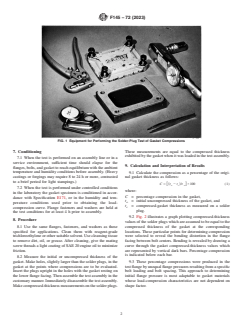
5. Apparatus (see Fig. 1)
2. Referenced Documents
5.1 Test Assembly, any flat-face flange design.
2.1 ASTM Standards:
5.2 Torque Indicating Device, for bolt loading.
E171 Practice for Conditioning and Testing Flexible Barrier
Packaging
5.3 Dial Gage Indicator, graduated in 0.00254 mm (0.0001
in.) to measure thickness of the solder plugs and the uncom-
3. Summary of Practice
pressed gasket.
3.1 The gasket compression and flange distortion are ob-
5.4 Leather Punch, for punching holes in the gasket and
tained from compressed-thickness measurements on cylindri-
fabricating the solder plugs.
cally shaped soft-solder plugs (50-50 lead-tin by weight)
5.5 Tweezers, to conveniently handle the solder plugs.
inserted into holes, drilled or punched through the gasket in the
thickness direction. Initial compression is accomplished in the
5.6 Solder Plugs—The solder must be made into a flat strip.
flanged-joint assembly when the bolts are loaded at ambient
This can be done by compressing wire in a vise, a pair of
temperature. Solder, being inelastic, will remain at the com-
flanges, pliers, or passing it between two calender rolls. The
pressed thickness of the gasket after the joint is subsequently
solder plugs are punched from the strip by means of the leather
disassembled.
punch. Recommended plug diameter is 0.8 mm ( ⁄32 in.) and
the height need only be such that the plug is compressed by the
flanges when the gasket is also compressed. The initial
This practice is under the jurisdiction of ASTM Committee F03 on Gaskets and
thickness of the plug and gasket before compression need not
is the direct responsibility of Subcommittee F03.20 on Mechanical Test Methods.
be equal.
Current edition approved April 1, 2023. Published April 2023. Originally
approved in 1972. Last previous edition approved in 2016 as F145 – 72 (2016).
6. Test Specimens
DOI: 10.1520/F0145-72R23.
For referenced ASTM standards, visit the ASTM website, www.astm.org, or
6.1 Three gasket specimens shall be tested. The size and
contact ASTM Customer Service at service@astm.org. For Annual Book of ASTM
shape of the specimens must be such as to fit the particular
Standards volume information, refer to the standard’s Document Summary page on
the ASTM website. flange design.
Copyright © ASTM International, 100 Barr Harbor Drive, PO Box C700, West Conshohocken, PA 19428-2959. United States
F145 − 72 (2023)
FIG. 1 Equipment for Performing the Solder-Plug Test of Gasket Compressions
7. Conditioning These measurements are equal to the compressed thickness
exhibited by the gasket when it was loaded in the test assembly.
7.1 When th
...