

ASTM D3967-23
(Test Method)Standard Test Method for Splitting Tensile Strength of Intact Rock Core Specimens with Flat Loading Platens
General Information
- Abstract
SIGNIFICANCE AND USE
5.1 By definition, the tensile strength is obtained by the direct tensile test. However, the direct tensile test is difficult and expensive for routine application. The splitting tensile test appears to offer a desirable alternative because it is much simpler and inexpensive. Furthermore, engineers involved in rock mechanics design usually deal with complex stress fields, including various combinations of compressive and tensile stress fields. Under such conditions, the tensile strength should be obtained with the presence of compressive stresses to be representative of the field conditions.
5.2 The splitting tensile strength test is one of the simplest tests in which such stress fields occur. Also, by testing across different diametral directions, any variations in tensile strength for anisotropic rocks can be determined. Since it is widely used in practice, a uniform test method is needed for data to be comparable. A uniform test is also needed to make sure that the disk specimens break diametrically due to tensile stresses perpendicular to the loading axis.
Note 2: The quality of the results produced by this standard is dependent on the competence of the personnel performing it, and the suitability of the equipment and facilities used. Agencies that meet the criteria of Practice D3740 are generally considered capable of competent and objective testing/sampling/inspection/etc. Users of this standard are cautioned that compliance with Practice D3740 does not in itself assure reliable results. Reliable results depend on many factors; Practice D3740 provides a means of evaluating some of those factors.
SCOPE
1.1 This test method covers testing apparatus, specimen preparation, and testing procedures for determining the splitting tensile strength of rock by diametral line compression of disk shaped specimens.
Note 1: The tensile strength of rock determined by tests other than the straight pull test is designated as the “indirect” tensile strength and, specifically, the value obtained in Section 9 of this test is termed the “splitting” tensile strength. This test method is also sometimes referred to as the Brazilian test method.
1.2 Units—The values stated in SI units are to be regarded as standard. The values given in parentheses are mathematical conversions to inch-pound units, which are provided for information only and are not considered standard. Reporting of test results in units other than SI shall not be regarded as nonconformance with this test method.
1.3 All observed and calculated values shall conform to the guidelines for significant digits and rounding established in Practice D6026.
1.3.1 The procedures used to specify how data are collected/recorded or calculated, in this standard are regarded as the industry standard. In addition, they are representative of the significant digits that generally should be retained. The procedures used do not consider material variation, the purpose for obtaining the data, special purpose studies, or any considerations for the user's objectives; and it is common practice to increase or reduce significant digits of reported data to be commensurate with these considerations. It is beyond the scope of this standard to consider significant digits used in analysis methods for engineering design.
1.4 This standard does not purport to address all of the safety concerns, if any, associated with its use. It is the responsibility of the user of this standard to establish appropriate safety, health, and environmental practices and determine the applicability of regulatory limitations prior to use.
1.5 This international standard was developed in accordance with internationally recognized principles on standardization established in the Decision on Principles for the Development of International Standards, Guides and Recommendations issued by the World Trade Organization Technical Barriers to Trade (TBT) Committee.
- Status
- Published
- Publication Date
- 14-May-2023
- Technical Committee
- D18 - Soil and Rock
- Drafting Committee
- D18.12 - Rock Mechanics
Buy Documents
ASTM D3967-23 - Standard Test Method for Splitting Tensile Strength of Intact Rock Core Specimens with Flat Loading Platens
REDLINE ASTM D3967-23 - Standard Test Method for Splitting Tensile Strength of Intact Rock Core Specimens with Flat Loading Platens
Overview
ASTM D3967-23: Standard Test Method for Splitting Tensile Strength of Intact Rock Core Specimens with Flat Loading Platens is a globally recognized standard issued by ASTM International. This widely used standard provides a uniform, reliable method to determine the splitting tensile strength - also called indirect tensile strength - of intact rock specimens. By using the diametral line compression (commonly known as the Brazilian Test), practitioners can efficiently evaluate the tensile properties of rock, vital for geotechnical engineering, mining, tunneling, and civil infrastructure projects.
The splitting tensile test is preferred over direct tensile testing due to its practicality, cost-effectiveness, and ability to simulate complex stress conditions similar to those encountered in field environments. ASTM D3967-23 outlines precise procedures for specimen selection, preparation, testing, and data reporting, ensuring comparability and repeatability of results.
Key Topics
- Purpose and Significance: The standard provides an indirect method to measure the tensile strength of rock cores, offering a feasible option for routine laboratory assessment.
- Test Methodology:
- Preparation and selection of disk-shaped specimens with specific thickness-to-diameter ratios.
- Clear guidance for marking, orientation, and moisture conditioning.
- Application of compressive loads using calibrated platens until specimen failure.
- Uniformity and Comparability: Ensures test data is consistent across laboratories by standardizing dimensions, loading rates, and reporting formats.
- Quality Assurance: Emphasizes the importance of skilled personnel and suitable equipment. Refers to ASTM Practice D3740 for evaluating testing agencies.
Applications
The splitting tensile strength determined by ASTM D3967-23 is critical in:
- Geotechnical Engineering: Used for stability analysis of rock slopes, foundations, and underground excavations. Essential for design in environments with combined compressive and tensile forces.
- Mining and Tunneling: Informs support system design and assesses potential for rock spalling or fracturing.
- Civil Engineering: Supports structural design of dams, bridges, and large infrastructure projects that interact with rock masses.
- Rock Anisotropy Assessment: By testing in different diametral directions, variations due to rock fabric or bedding planes can be identified, aiding in comprehensive material characterization.
- Research and Development: Commonly used in laboratory studies for material comparison, method validation, and performance evaluation.
Related Standards
ASTM D3967-23 references several important ASTM standards that enhance its scope and application, including:
- ASTM D653: Terminology Relating to Soil, Rock, and Contained Fluids
- ASTM D2216: Water (Moisture) Content Determination
- ASTM D3740: Minimum Requirements for Agencies Engaged in Testing and/or Inspection of Soil and Rock
- ASTM D6026: Significant Digits and Data Records in Geotechnical Data
- ASTM E4: Force Calibration and Verification of Testing Machines
- ASTM E691: Precision Determination of Test Methods by Interlaboratory Study
- ASTM E2586: Calculation and Use of Basic Statistics
These referenced standards provide a framework for testing reliability, accuracy, and uniformity across various laboratory and field contexts.
Keywords: ASTM D3967-23, splitting tensile strength, Brazilian test, rock core specimen, indirect tensile strength, geotechnical engineering, laboratory testing, rock mechanics, standard test method, rock anisotropy, compressive load, ASTM standard.
Relations
- Effective Date
- 01-Nov-2023
- Effective Date
- 01-Oct-2019
- Effective Date
- 01-Apr-2019
- Effective Date
- 01-Mar-2019
- Effective Date
- 01-Aug-2014
- Effective Date
- 01-Jun-2014
- Effective Date
- 01-Jun-2014
- Effective Date
- 01-Oct-2013
- Effective Date
- 01-May-2013
- Effective Date
- 01-Oct-2012
- Effective Date
- 01-May-2012
- Effective Date
- 01-Mar-2012
- Effective Date
- 15-Feb-2012
- Effective Date
- 01-Jan-2012
- Effective Date
- 01-Nov-2011
Buy Documents
ASTM D3967-23 - Standard Test Method for Splitting Tensile Strength of Intact Rock Core Specimens with Flat Loading Platens
REDLINE ASTM D3967-23 - Standard Test Method for Splitting Tensile Strength of Intact Rock Core Specimens with Flat Loading Platens
Get Certified
Connect with accredited certification bodies for this standard

Zavod za gradbeništvo Slovenije (ZAG) - Inšpekcija
ZAG inspection body for construction products, structures, and materials.
Sponsored listings
Frequently Asked Questions
ASTM D3967-23 is a standard published by ASTM International. Its full title is "Standard Test Method for Splitting Tensile Strength of Intact Rock Core Specimens with Flat Loading Platens". This standard covers: SIGNIFICANCE AND USE 5.1 By definition, the tensile strength is obtained by the direct tensile test. However, the direct tensile test is difficult and expensive for routine application. The splitting tensile test appears to offer a desirable alternative because it is much simpler and inexpensive. Furthermore, engineers involved in rock mechanics design usually deal with complex stress fields, including various combinations of compressive and tensile stress fields. Under such conditions, the tensile strength should be obtained with the presence of compressive stresses to be representative of the field conditions. 5.2 The splitting tensile strength test is one of the simplest tests in which such stress fields occur. Also, by testing across different diametral directions, any variations in tensile strength for anisotropic rocks can be determined. Since it is widely used in practice, a uniform test method is needed for data to be comparable. A uniform test is also needed to make sure that the disk specimens break diametrically due to tensile stresses perpendicular to the loading axis. Note 2: The quality of the results produced by this standard is dependent on the competence of the personnel performing it, and the suitability of the equipment and facilities used. Agencies that meet the criteria of Practice D3740 are generally considered capable of competent and objective testing/sampling/inspection/etc. Users of this standard are cautioned that compliance with Practice D3740 does not in itself assure reliable results. Reliable results depend on many factors; Practice D3740 provides a means of evaluating some of those factors. SCOPE 1.1 This test method covers testing apparatus, specimen preparation, and testing procedures for determining the splitting tensile strength of rock by diametral line compression of disk shaped specimens. Note 1: The tensile strength of rock determined by tests other than the straight pull test is designated as the “indirect” tensile strength and, specifically, the value obtained in Section 9 of this test is termed the “splitting” tensile strength. This test method is also sometimes referred to as the Brazilian test method. 1.2 Units—The values stated in SI units are to be regarded as standard. The values given in parentheses are mathematical conversions to inch-pound units, which are provided for information only and are not considered standard. Reporting of test results in units other than SI shall not be regarded as nonconformance with this test method. 1.3 All observed and calculated values shall conform to the guidelines for significant digits and rounding established in Practice D6026. 1.3.1 The procedures used to specify how data are collected/recorded or calculated, in this standard are regarded as the industry standard. In addition, they are representative of the significant digits that generally should be retained. The procedures used do not consider material variation, the purpose for obtaining the data, special purpose studies, or any considerations for the user's objectives; and it is common practice to increase or reduce significant digits of reported data to be commensurate with these considerations. It is beyond the scope of this standard to consider significant digits used in analysis methods for engineering design. 1.4 This standard does not purport to address all of the safety concerns, if any, associated with its use. It is the responsibility of the user of this standard to establish appropriate safety, health, and environmental practices and determine the applicability of regulatory limitations prior to use. 1.5 This international standard was developed in accordance with internationally recognized principles on standardization established in the Decision on Principles for the Development of International Standards, Guides and Recommendations issued by the World Trade Organization Technical Barriers to Trade (TBT) Committee.
SIGNIFICANCE AND USE 5.1 By definition, the tensile strength is obtained by the direct tensile test. However, the direct tensile test is difficult and expensive for routine application. The splitting tensile test appears to offer a desirable alternative because it is much simpler and inexpensive. Furthermore, engineers involved in rock mechanics design usually deal with complex stress fields, including various combinations of compressive and tensile stress fields. Under such conditions, the tensile strength should be obtained with the presence of compressive stresses to be representative of the field conditions. 5.2 The splitting tensile strength test is one of the simplest tests in which such stress fields occur. Also, by testing across different diametral directions, any variations in tensile strength for anisotropic rocks can be determined. Since it is widely used in practice, a uniform test method is needed for data to be comparable. A uniform test is also needed to make sure that the disk specimens break diametrically due to tensile stresses perpendicular to the loading axis. Note 2: The quality of the results produced by this standard is dependent on the competence of the personnel performing it, and the suitability of the equipment and facilities used. Agencies that meet the criteria of Practice D3740 are generally considered capable of competent and objective testing/sampling/inspection/etc. Users of this standard are cautioned that compliance with Practice D3740 does not in itself assure reliable results. Reliable results depend on many factors; Practice D3740 provides a means of evaluating some of those factors. SCOPE 1.1 This test method covers testing apparatus, specimen preparation, and testing procedures for determining the splitting tensile strength of rock by diametral line compression of disk shaped specimens. Note 1: The tensile strength of rock determined by tests other than the straight pull test is designated as the “indirect” tensile strength and, specifically, the value obtained in Section 9 of this test is termed the “splitting” tensile strength. This test method is also sometimes referred to as the Brazilian test method. 1.2 Units—The values stated in SI units are to be regarded as standard. The values given in parentheses are mathematical conversions to inch-pound units, which are provided for information only and are not considered standard. Reporting of test results in units other than SI shall not be regarded as nonconformance with this test method. 1.3 All observed and calculated values shall conform to the guidelines for significant digits and rounding established in Practice D6026. 1.3.1 The procedures used to specify how data are collected/recorded or calculated, in this standard are regarded as the industry standard. In addition, they are representative of the significant digits that generally should be retained. The procedures used do not consider material variation, the purpose for obtaining the data, special purpose studies, or any considerations for the user's objectives; and it is common practice to increase or reduce significant digits of reported data to be commensurate with these considerations. It is beyond the scope of this standard to consider significant digits used in analysis methods for engineering design. 1.4 This standard does not purport to address all of the safety concerns, if any, associated with its use. It is the responsibility of the user of this standard to establish appropriate safety, health, and environmental practices and determine the applicability of regulatory limitations prior to use. 1.5 This international standard was developed in accordance with internationally recognized principles on standardization established in the Decision on Principles for the Development of International Standards, Guides and Recommendations issued by the World Trade Organization Technical Barriers to Trade (TBT) Committee.
ASTM D3967-23 is classified under the following ICS (International Classification for Standards) categories: 93.020 - Earthworks. Excavations. Foundation construction. Underground works. The ICS classification helps identify the subject area and facilitates finding related standards.
ASTM D3967-23 has the following relationships with other standards: It is inter standard links to ASTM D3740-23, ASTM D3740-19, ASTM E2586-19e1, ASTM D2216-19, ASTM D653-14, ASTM E4-14, ASTM E2586-14, ASTM E2586-13, ASTM E691-13, ASTM E2586-12b, ASTM D3740-12a, ASTM D3740-12, ASTM E2586-12a, ASTM E2586-12, ASTM E691-11. Understanding these relationships helps ensure you are using the most current and applicable version of the standard.
ASTM D3967-23 is available in PDF format for immediate download after purchase. The document can be added to your cart and obtained through the secure checkout process. Digital delivery ensures instant access to the complete standard document.
Standards Content (Sample)
This international standard was developed in accordance with internationally recognized principles on standardization established in the Decision on Principles for the
Development of International Standards, Guides and Recommendations issued by the World Trade Organization Technical Barriers to Trade (TBT) Committee.
Designation: D3967 − 23
Standard Test Method for
Splitting Tensile Strength of Intact Rock Core Specimens
with Flat Loading Platens
This standard is issued under the fixed designation D3967; the number immediately following the designation indicates the year of
original adoption or, in the case of revision, the year of last revision. A number in parentheses indicates the year of last reapproval. A
superscript epsilon (´) indicates an editorial change since the last revision or reapproval.
1. Scope* ization established in the Decision on Principles for the
Development of International Standards, Guides and Recom-
1.1 This test method covers testing apparatus, specimen
mendations issued by the World Trade Organization Technical
preparation, and testing procedures for determining the split-
Barriers to Trade (TBT) Committee.
ting tensile strength of rock by diametral line compression of
disk shaped specimens.
2. Referenced Documents
NOTE 1—The tensile strength of rock determined by tests other than the
straight pull test is designated as the “indirect” tensile strength and, 2.1 ASTM Standards:
specifically, the value obtained in Section 9 of this test is termed the
D653 Terminology Relating to Soil, Rock, and Contained
“splitting” tensile strength. This test method is also sometimes referred to
Fluids
as the Brazilian test method.
D2216 Test Methods for Laboratory Determination of Water
1.2 Units—The values stated in SI units are to be regarded
(Moisture) Content of Soil and Rock by Mass
as standard. The values given in parentheses are mathematical
D3740 Practice for Minimum Requirements for Agencies
conversions to inch-pound units, which are provided for
Engaged in Testing and/or Inspection of Soil and Rock as
information only and are not considered standard. Reporting of
Used in Engineering Design and Construction
test results in units other than SI shall not be regarded as
D6026 Practice for Using Significant Digits and Data Re-
nonconformance with this test method.
cords in Geotechnical Data
E4 Practices for Force Calibration and Verification of Test-
1.3 All observed and calculated values shall conform to the
ing Machines
guidelines for significant digits and rounding established in
E691 Practice for Conducting an Interlaboratory Study to
Practice D6026.
Determine the Precision of a Test Method
1.3.1 The procedures used to specify how data are collected/
E2586 Practice for Calculating and Using Basic Statistics
recorded or calculated, in this standard are regarded as the
industry standard. In addition, they are representative of the
3. Terminology
significant digits that generally should be retained. The proce-
3.1 Definitions:
dures used do not consider material variation, the purpose for
obtaining the data, special purpose studies, or any consider- 3.1.1 For definitions of common technical terms used in this
standard, refer to Terminology D653.
ations for the user’s objectives; and it is common practice to
increase or reduce significant digits of reported data to be
4. Summary of Test Method
commensurate with these considerations. It is beyond the scope
of this standard to consider significant digits used in analysis 4.1 Samples are selected from rock cores or cored from
methods for engineering design. platen samples for testing as described. A section of rock core
sample is cut perpendicular to the core axis to produce disk
1.4 This standard does not purport to address all of the
shape specimens until the required number of specimens are
safety concerns, if any, associated with its use. It is the
obtained. Each specimen is then marked to indicate the desired
responsibility of the user of this standard to establish appro-
orientation of the applied loading on the specimen by drawing
priate safety, health, and environmental practices and deter-
a diametral line on each end surface of the specimen. Each
mine the applicability of regulatory limitations prior to use.
specimen is positioned inside the testing machine in such a way
1.5 This international standard was developed in accor-
that the diametral line is coincidental with the loading axis of
dance with internationally recognized principles on standard-
the testing machine fitted with flat loading platens. Each
This test method is under the jurisdiction of ASTM Committee D18 on Soil and
Rock and is the direct responsibility of Subcommittee D18.12 on Rock Mechanics. For referenced ASTM standards, visit the ASTM website, www.astm.org, or
Current edition approved May 15, 2023. Published June 2023. Originally contact ASTM Customer Service at service@astm.org. For Annual Book of ASTM
approved in 1981. Last previous edition approved in 2016 as D3967 – 16. DOI: Standardsvolume information, refer to the standard’s Document Summary page on
10.1520/D3967-23. the ASTM website.
*A Summary of Changes section appears at the end of this standard
Copyright © ASTM International, 100 Barr Harbor Drive, PO Box C700, West Conshohocken, PA 19428-2959. United States
D3967 − 23
specimen is then tested by applying a continuously increasing locked position with the faces of the bearing platens meeting
compressive load until it fails within 1 to 10 minutes of the the requirements of 6.1.1.
start of loading. 6.1.3 Rigid Seating—If a spherical seat is not used, then the
opposing faces of the loading device bearing platens shall be
parallel to 0.0005 mm/mm of the platen diameter. This crite-
5. Significance and Use
rion shall be met when the platens are in the loading device and
5.1 By definition, the tensile strength is obtained by the
separated approximately by the diameter of the test specimen.
direct tensile test. However, the direct tensile test is difficult
and expensive for routine application. The splitting tensile test 6.2 False, Flat Bearing Platens—During testing, the speci-
men can be placed in direct contact with the loading device
appears to offer a desirable alternative because it is much
simpler and inexpensive. Furthermore, engineers involved in bearing platens or false platens with bearing faces conforming
to the requirements of this standard, may be used (see Fig. 1 for
rock mechanics design usually deal with complex stress fields,
including various combinations of compressive and tensile false flat platens). These shall be oil hardened to more than 58
HRC, and surface ground.
stress fields. Under such conditions, the tensile strength should
be obtained with the presence of compressive stresses to be 6.2.1 False Flat Bearing Platens—The bearing faces of
false flat bearing platens shall not depart from a plane by more
representative of the field conditions.
than 0.0125 mm (0.0005 in.) when the platens are new and
5.2 The splitting tensile strength test is one of the simplest
shall be maintained within a permissible variation of 0.025
tests in which such stress fields occur. Also, by testing across
mm. The bearing platen’s diameter shall be at least as great as
different diametral directions, any variations in tensile strength
the specimen thickness.
for anisotropic rocks can be determined. Since it is widely used
in practice, a uniform test method is needed for data to be NOTE 3—The apparatus bearing or false platens, due to the contact with
abrasive rocks, these platens tend to roughen after a number of specimens
comparable. A uniform test is also needed to make sure that the
have been tested, and hence need to be surfaced from time to time.
disk specimens break diametrically due to tensile stresses
Bearing platens can be round or rectangular.
perpendicular to the loading axis.
6.3 Bearing Strips (optional)—The load bearing strips shall
NOTE 2—The quality of the results produced by this standard is
dependent on the competence of the personnel performing it, and the be made of plywood, free of imperfections, 3 mm thick, width
suitability of the equipment and facilities used. Agencies that meet the
less than 8 % of the specimen diameter and equal in length to
criteria of Practice D3740 are generally considered capable of competent
the specimen thickness or slightly longer (Fig. 2). The use of
and objective testing/sampling/inspection/etc. Users of this standard are
cautioned that compliance with Practice D3740 does not in itself assure
reliable results. Reliable results depend on many factors; Practice D3740
provides a means of evaluating some of those factors.
6. Apparatus
6.1 Loading Device—A device of sufficient capacity to
apply and measure the load at a rate conforming to the
requirements in 8.5. It shall be verified at suitable time
intervals in accordance with Practices E4 and shall comply
with the requirements prescribed therein.
6.1.1 Bearing Platens—The loading device shall be
equipped with two opposing steel bearing platens having a
Rockwell hardness of not less than 58 HRC through which
loading is transmitted. The bearing faces shall not depart from
a plane by more than 0.0125 mm (0.0005 in.) when the platens
are new and shall be maintained within a permissible variation
of 0.025 mm. The bearing platens’ diameter shall be at least as
great as the specimen’s thickness (see Note 3).
6.1.2 Spherical Seating—One of the bearing surfaces on the
loading device should be spherically seated, and the other one
a plain rigid platen. The diameter of the spherical seat shall be
at least as large as the test specimen, but the diameter of the
spherical seat shall not exceed twice the diameter of the
specimen. Center of the sphere in the spherical seat coincides
with the center of the loaded side of the specimen. The
spherical seat shall be lubricated to ensure its free movement.
The movable part of the platen shall be held closely in the
spherical seat, but the design shall be such that the bearing face
can be rotated and tilted through small angles in any direction.
If the spherical seat’s diameter exceeds twice the diameter of
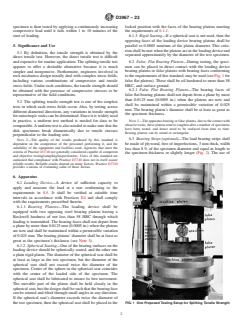
the test specimen, then the spherical seat shall be placed in the FIG. 1 One Proposed Testing Setup for Splitting Tensile Strength
D3967 − 23
7.2.1 Dimensions—The test specimen shall be a circular
disk with a thickness-to-diameter ratio (t/D) between 0.2 and
0.75. The diameter of the specimen shall be at least 10 times
greater than the largest mineral grain constituent. A diameter of
54 mm (NX core) will generally satisfy this criterion.
NOTE 6—When cores smaller than the specified minimum must be
tested because of the unavailability of material, make notation of the fact
in the test report.
NOTE 7—If the specimen shows apparent anisotropic features such as
bedding or schistosity, the user of this standard may be required to
exercise care in preparing the specimen so that the test orientation of the
cross sectional area subject to the load relative to anisotropic features can
be determined separately.
7.2.2 Number of Specimens—It is suggested that at least ten
tests be performed on the same stratigraphy and isotropic. If
the reproducibility of the test results is good (coefficient of
variation less than 5 %), a smaller number of specimens is
acceptable. More than ten specimens may be required for more
complex rock specimens where anisotropy may affect the
results and such data is essential to the user. Unless specified
by the client, professional judgment shall be exercised to
determine the number of specimens necessary to estimate the
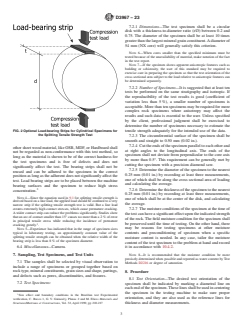
FIG. 2 Optional Load-bearing Strips for Cylindrical Specimens for tensile strength adequately for the intended use of the data.
the Splitting Tensile Strength Test
7.2.3 The circumferential surface of the specimen shall be
smooth and straight to 0.50 mm (0.02 in.).
7.2.4 Cut the ends of the specimen parallel to each other and
other sheet wood material, like OSB, MDF, or Hardboard shall
at right angles to the longitudinal axis. The ends of the
not be regarded as non-conformance with this test method, so
specimen shall not deviate from perpendicular to the core axis
long as the material is shown to be of the correct hardness for
by more than 0.5°. This requirement can be generally met by
the test specimens and is free of defects and does not
cutting the specimen with a precision diamond saw.
significantly affect the test. The bearing strips shall not be
7.2.5 Determine the diameter of the specimen to the nearest
reused and can be adhered to the specimen in the correct
0.25 mm (0.01 in.) by recording at least three measurements,
position as long as the adherent does not significantly affect the
one of which shall be along the cross sectional area of loading
test. Load bearing strips are to be placed between the machine
and calculating the average.
bearing surfaces and the specimen to reduce high stress
7.2.6 Determine the thickness of the specimen to the nearest
concent
...
This document is not an ASTM standard and is intended only to provide the user of an ASTM standard an indication of what changes have been made to the previous version. Because
it may not be technically possible to adequately depict all changes accurately, ASTM recommends that users consult prior editions as appropriate. In all cases only the current version
of the standard as published by ASTM is to be considered the official document.
Designation: D3967 − 16 D3967 − 23
Standard Test Method for
Splitting Tensile Strength of Intact Rock Core Specimens
with Flat Loading Platens
This standard is issued under the fixed designation D3967; the number immediately following the designation indicates the year of
original adoption or, in the case of revision, the year of last revision. A number in parentheses indicates the year of last reapproval. A
superscript epsilon (´) indicates an editorial change since the last revision or reapproval.
1. Scope*
1.1 This test method covers testing apparatus, specimen preparation, and testing procedures for determining the splitting tensile
strength of rock by diametral line compression of disk shapeshaped specimens.
NOTE 1—The tensile strength of rock determined by tests other than the straight pull test is designated as the “indirect” tensile strength and, specifically,
the value obtained in Section 9 of this test is termed the “splitting” tensile strength. This test method is also sometimes referred to as the Brazilian test
method.
1.2 Units—The values stated in SI units are to be regarded as standard. The values given in parentheses are mathematical
conversions to inch-pound units, which are provided for information only and are not considered standard. Reporting of test results
in units other than SI shall not be regarded as nonconformance with this test method.
1.3 All observed and calculated values shall conform to the guidelines for significant digits and rounding established in Practice
D6026.
1.3.1 The procedures used to specify how data are collected/recorded or calculated, in this standard are regarded as the industry
standard. In addition, they are representative of the significant digits that generally should be retained. The procedures used do not
consider material variation, the purpose for obtaining the data, special purpose studies, or any considerations for the user’s
objectives; and it is common practice to increase or reduce significant digits of reported data to be commensurate with these
considerations. It is beyond the scope of this standard to consider significant digits used in analysis methods for engineering
designdesign.
1.4 This standard does not purport to address all of the safety concerns, if any, associated with its use. It is the responsibility
of the user of this standard to establish appropriate safety and healthsafety, health, and environmental practices and determine
the applicability of regulatory limitations prior to use.
1.5 This international standard was developed in accordance with internationally recognized principles on standardization
established in the Decision on Principles for the Development of International Standards, Guides and Recommendations issued
by the World Trade Organization Technical Barriers to Trade (TBT) Committee.
2. Referenced Documents
2.1 ASTM Standards:
D653 Terminology Relating to Soil, Rock, and Contained Fluids
This test method is under the jurisdiction of ASTM Committee D18 on Soil and Rock and is the direct responsibility of Subcommittee D18.12 on Rock Mechanics.
Current edition approved Nov. 1, 2016May 15, 2023. Published November 2016June 2023. Originally approved in 1981. Last previous edition approved in 20082016 as
D3967 – 08.D3967 – 16. DOI: 10.1520/D3967-16.10.1520/D3967-23.
For referenced ASTM standards, visit the ASTM website, www.astm.org, or contact ASTM Customer Service at service@astm.org. For Annual Book of ASTM
Standardsvolume information, refer to the standard’s Document Summary page on the ASTM website.
*A Summary of Changes section appears at the end of this standard
Copyright © ASTM International, 100 Barr Harbor Drive, PO Box C700, West Conshohocken, PA 19428-2959. United States
D3967 − 23
D2216 Test Methods for Laboratory Determination of Water (Moisture) Content of Soil and Rock by Mass
D3740 Practice for Minimum Requirements for Agencies Engaged in Testing and/or Inspection of Soil and Rock as Used in
Engineering Design and Construction
D6026 Practice for Using Significant Digits and Data Records in Geotechnical Data
E4 Practices for Force Calibration and Verification of Testing Machines
E691 Practice for Conducting an Interlaboratory Study to Determine the Precision of a Test Method
E2586 Practice for Calculating and Using Basic Statistics
3. Terminology
3.1 Definitions:
3.1.1 For common definitions of common technical terms used in this standard, refer to Terminology D653.
4. Summary of Test Method
4.1 Samples are selected from rock cores or cored from platen samples for testing as described. A section of rock core sample is
cut perpendicular to the core axis to produce disk shape specimens until the required number of specimens are obtained. Each
specimen is then marked to indicate the desired orientation of the applied loading on the specimen by drawing a diametral line
on each end surface onof the specimen. Each specimen is positioned inside the testing machine in such a way that diametrical the
diametral line is coincidental with the loading axis of the testing machine either curved or flat fitted with flat loading platens. Each
specimen is then tested by applying a continuously increasing compressive load until it fails within 1 to 10 minutes of the start
of loading.
5. Significance and Use
5.1 By definition, the tensile strength is obtained by the direct tensile test. However, the direct tensile test is difficult and expensive
for routine application. The splitting tensile test appears to offer a desirable alternative,alternative because it is much simpler and
inexpensive. Furthermore, engineers involved in rock mechanics design usually deal with complicatedcomplex stress fields,
including various combinations of compressive and tensile stress fields. Under such conditions, the tensile strength should be
obtained with the presence of compressive stresses to be representative of the field conditions.
5.2 The splitting tensile strength test is one of the simplest tests in which such stress fields occur. Also, by testing across different
diametrical directions, possiblediametral directions, any variations in tensile strength for anisotropic rocks can be determined.
Since it is widely used in practice, a uniform test method is needed for data to be comparable. A uniform test is also needed to
make sure that the disk specimens break diametrically due to tensile stresses perpendicular to the loading diameter.axis.
NOTE 2—The quality of the results produced by this standard is dependent on the competence of the personnel performing it, and the suitability of the
equipment and facilities used. Agencies that meet the criteria of Practice D3740 are generally considered capable of competent and objective
testing/sampling/inspection/etc. Users of this standard are cautioned that compliance with Practice D3740 does not in itself assure reliable results. Reliable
results depend on many factors; Practice D3740 provides a means of evaluating some of those factors.
6. Apparatus
6.1 Loading Device—A device of sufficient capacity to apply and measure the load at a rate conforming to the requirements in
8.38.5. It shall be verified at suitable time intervals in accordance with Practices E4 and shall comply with the requirements
prescribed therein.
6.1.1 Bearing Platens—The loading device shall be equipped with two opposing steel bearing platens having a Rockwell hardness
of not less than 58 HRC through which loading is transmitted. The bearing faces shall not depart from a plane by more than 0.0125
mm (0.0005 in.) when the platens are new and shall be maintained within a permissible variation of 0.025 mm. The bearing
platensplatens’ diameter shall be at least as great as the specimen’s thickness (see Note 3Note 3).).
6.1.2 Spherical Seating—One of the bearing surfaces on the loading device should be spherically seated, and the other one a plain
rigid platen. The diameter of the spherical seat shall be at least as large as the test specimen, but the diameter of the
spericalspherical seat shall not exceed from twice the diameter of the specimen. Center of the sphere in the spherical seat coincides
with the center of the loaded side of the specimen. The spherical seat shall be lubricated to assureensure its free movement. The
movable part of the platen shall be held closely in the spherical seat, but the design shall be such that the bearing face can be rotated
D3967 − 23
and tilted through small angles in any direction. If the spherical seat’s diameter exceeds twice the diameter of the test specimen,
then the spherical seat shall be placed in the locked position with the faces of the bearing platens meeting the requirements of 6.1.1.
6.1.3 Rigid Seating—If a spherical seat is not used, then the opposing faces of the loading device bearing platens shall be parallel
to 0.0005 mm/mm of the platen diameter. This criterion shall be met when the platens are in the loading device and separated
approximately by the diameter of the test specimen.
NOTE 3—False platens, due to the contact with abrasive rocks, these platens tend to roughen after a number of specimens have been tested, and hence
need to be surfaced from time to time.
6.2 False, Flat or Curved Bearing Platens—During testing, the specimen can be placed in direct contact with the loading device
bearing platens or false platens with bearing faces conforming to the requirements of this standard, may be used (see Fig. 1 for
false flat platens). These shall be oil hardened to more than 58 HRC, and surface ground. With contact by abrasive rocks, these
platens tend to roughen after a number of specimens have been tested, and hence need to be re-surfaced from time to time.
6.2.1 False Flat Bearing—Bearing Platens—The bearing faces of false flat bearing platens shall not depart from a plane by more
than 0.0125 mm (0.0005 in.) when the platens are new and shall be maintained within a permissible variation of 0.025 mm. The
bearing platen’s diameter shall be at least as great as the specimen thickness.
NOTE 3—The apparatus bearing or false platens, due to the contact with abrasive rocks, these platens tend to roughen after a number of specimens have
been tested, and hence need to be surfaced from time to time. Bearing platens can be round or rectangular.
6.2.2 Curved Supplementary Bearing Platens—These may be used to reduce the contact stresses on the test specimen. The radius
of curvature of the supplementary bearing platens shall be so designed that their arc of contact with the specimen will in no case
exceed 15° or that the width of contact is less than D/6, where D is the diameter of the specimen.
FIG. 1 One Proposed Testing Setup for Splitting Tensile Strength
D3967 − 23
NOTE 4—Since the equation used in 9.1 for splitting tensile strength is derived based on a line load, the applied load should be confined to a very narrow
strip if the splitting tensile strength test is to be valid. But a line load creates extremely high contact stresses which cause premature cracking. A wider
contact strip can reduce the problems significantly. Studies show that an arc of contact smaller than 15° causes no more than 2 % of error in principal
tensile stress while reducing the incidence of premature cracking greatly.
6.3 Bearing Strips (optional)—0.01The Dload thick cardboard cushions, wherebearing strips shall be Dmade of plywood, free of
imperfections, 3 mm thick, width less than 8 % of the specimen diameter and equal in length to the specimen thickness or slightly
longer (Fig. 2is the specimen’s diameter; or up to 6.4 mm (0.25 in.) thick plywood cushions are recommended ). The use of other
sheet wood material, like OSB, MDF, or Hardboard shall not be regarded as non-conformance with this test method, so long as
the material is shown to be of the correct hardness for the test specimens and is free of defects and does not significantly affect
the test. The bearing strips shall not be reused and can be adhered to the specimen in the correct position as long as the adherent
does not significantly affect the test. Load bearing strips are to be placed between the machine bearing surfaces (or
supplementary-bearing plates; if used) and the specimen to reduce high stress concentration.
NOTE 4—Since the equation used in 9.1 for splitting tensile strength is derived based on a line load, the applied load should be confined to a very narrow
strip if the splitting tensile strength test is valid. But a line load creates extremely high contact stresses, which cause premature cracking. A wider contact
strip can reduce the problems significantly. Studies show that an arc of contact smaller than 15° causes no more than a 2 % of error in principal tensile
stress while reducing the incidence of premature cracking greatly. .
NOTE 5—Experience has indicated that test results using the curved supplementary bearing plates and bearing strips, as specified in the range of specimen
sizes typical in 6.2.2 andlaboratory testing, 6.3, respectively, do not significantly differ from each other, but there may be some consistent difference from
the results of tests in which direct contact between the specimen and the machine platen is used.an approximately constant value of the splitting tensile
strength can be obtained when the relative width of the bearing strip is less than 8 % of the specimen diameter.
6.4 Miscellaneous—Camera.
7. Sampling, Test Specimens, and Test Units
7.1 The samples shall be selected by visual observation to include a range of specimens or grouped together based on rock type,
mineral constituents, grain sizes and shape, partings, and defects such as pores pores, discontinuities, and fissures.
7.2 Test Specimens:
FIG. 2 Optional Load-bearing Strips for Cylindrical Specimens for the Splitting Tensile Strength Test
Size effect and boundary conditions in the Brazilian test Experimental verification, C. Rocco 1, G. V. Guinea2,j. Planas 2 and M. Elices Materials and Structures/Matriaux
et Constructions, Vol. 32, April 1999, pp 210-217
D3967 − 23
7.2.1 Dimensions—The test specimen shall be a circular disk with a thickness-to-diameter ratio (t/D) between 0.2 and 0.75. The
diameter of the specimen shall be at least 10 times greater than the largest mineral grain constituent. A diameter of 54 mm (NX
core) will generally satisfy this criterion.
NOTE 6—When cores smaller than the specified minimum must be tested because of the unavailability of material, make nota
...