

ASTM D4452/D4452M-22
(Practice)Standard Practice for X-Ray Radiography of Soil Samples
General Information
- Abstract
SIGNIFICANCE AND USE
5.1 Many geotechnical tests require the utilization of intact, representative samples of soil. The quality of these samples depends on many factors. Many of the samples obtained by intact sampling methods have inherent anomalies. Sampling procedures cause disturbances of varying types and intensities. These anomalies and disturbances, however, are not always readily detectable by visual inspection of the intact samples before or after testing. Often test results would be enhanced if the presence and the extent of these anomalies and disturbances are known before testing or before destruction of the sample by testing. Such determinations assist the user in detecting flaws in sampling methods, the presence of natural or induced shear planes, and the presence of natural intrusions, such as gravels or shells at critical regions in the samples, the presence of sand and silt seams, and the intensity of disturbances caused by sampling.
5.2 X-ray radiography provides the user with a picture of the internal massive structure of the soil sample, regardless of whether the soil is X-rayed within or without the sampling tube. X-ray radiography assists the user in identifying the following:
5.2.1 Appropriateness of sampling methods used.
5.2.2 Effects of sampling in terms of the disturbances caused by the turning of the edges of various thin layers in varved soils, large disturbances caused in soft soils, shear planes induced by sampling, or extrusion, or both, effects of overdriving of samplers, the presence of cuttings in sampling tubes, or the effects of using bent, corroded, or nonstandard tubes for sampling.
5.2.3 Naturally occurring fissures, shear planes, etc.
5.2.4 The presence of intrusions within the sample, such as calcareous nodules, gravel, or shells.
5.2.5 Sand and silt seams, organic matter, large voids, and channels developed by natural or artificial leaching of soil components.
Note 1: The quality of the results produced by this standard is de...
SCOPE
1.1 This practice covers the determination of the quality of soil samples in thin wall tubes or of extruded soil cores by X-ray radiography.
1.2 This practice enables the user to determine the effects of sampling and natural variations within samples as identified by the extent of the relative penetration of X-rays through soil samples.
1.3 This practice can be used to X-ray soil cores (or observe their features on a fluoroscope) in thin wall tubes or liners ranging from approximately 50 to 150 mm [2 to 6 in.] in diameter. X-rays of samples in the larger diameter tubes provide a radiograph of major features of soils and disturbances, such as large scale bending of edges of varved clays, shear planes, the presence of large concretions, silt and sand seams thicker than 6 mm [1/4 in.], large lumps of organic matter, and voids or other types of intrusions. X-rays of the smaller diameter cores provide higher resolution of soil features and disturbances, such as small concretions (3 mm [1/8 in.] diameter or larger), solution channels, slight bending of edges of varved clays, thin silt or sand seams, narrow solution channels, plant root structures, and organic matter. The X-raying of samples in thin wall tubes or liners requires minimal preparation.
1.4 Greater detail and resolution of various features of the soil can be obtained by X-raying extruded soil cores, as compared to samples in metal tubes. The method used for X-raying soil cores is the same as that for tubes and liners, except that extruded cores have to be handled with extreme care and have to be placed in sample troughs (similar to Fig. 2) before X-raying. This practice should be used only when natural water content or other intact soil characteristics are irrelevant to the end use of the sample.
1.4.1 Often it is necessary to obtain greater resolution of features to determine the propriety of sampling methods, the representative nature of soil samples,...
- Status
- Published
- Publication Date
- 30-Sep-2022
- Technical Committee
- D18 - Soil and Rock
- Drafting Committee
- D18.07 - Identification and Classification of Soils
Overview
ASTM D4452/D4452M-22, "Standard Practice for X-Ray Radiography of Soil Samples," establishes procedures for evaluating the internal quality of soil samples using X-ray radiography. Developed by ASTM International, this standard enables geotechnical professionals to assess both natural features and disturbances in soil cores-whether retained in thin-wall tubes or prepared as extruded samples. By providing a non-destructive means to visualize soil structure and anomalies, this practice supports improved decision-making in soil sampling, classification, and testing.
Key Topics
- Non-Destructive Imaging: X-ray radiography offers detailed internal views of soil samples with minimal preparation, preserving sample integrity until further testing.
- Assessment of Sampling Quality: The standard helps users determine the effects of sampling methods, such as induced shear planes, overdriving effects, and sample disturbances that are not apparent by visual inspection.
- Feature Identification: X-ray images reveal structural details, including:
- Natural fissures and shear planes
- Varved (layered) soil bending or disturbance
- Intrusions like calcareous nodules, gravel, and shells
- Sand and silt seams, organic matter, solution channels, and voids
- Resolution and Applicability: The standard covers X-raying soil cores in tubes or liners of 50–150 mm diameter and extruded cores, enabling differentiation between major features (in larger cores) and finer details (in smaller cores or careful extruded slices).
Applications
ASTM D4452/D4452M-22 is crucial in geotechnical investigations, soil mechanics, and foundation engineering. Key applications include:
- Geotechnical Laboratory Testing: Evaluating sample quality before conducting tests that may destroy the sample, ensuring only representative, undisturbed sections are used.
- Construction and Design Analysis: Identifying potential variability or anomalies that could affect soil performance under load, supporting safer and more efficient foundation designs.
- Forensic and Quality Control: Detecting flaws in sampling procedures, such as extruded sample disturbance, overdriving, or using damaged sampling tubes.
- Research and Soil Characterization: Supporting scientific studies that require understanding of soil formation, structure, or the presence of features like roots or shells in undisturbed contexts.
Related Standards
Several ASTM standards are directly referenced or complement the use of ASTM D4452/D4452M-22:
- ASTM D653: Terminology Relating to Soil, Rock, and Contained Fluids – provides definitions relevant to soil sampling and radiography.
- ASTM D3740: Minimum Requirements for Agencies Engaged in Testing and/or Inspection of Soil and Rock – addresses competence of testing agencies.
- ASTM D6026: Using Significant Digits and Data Records in Geotechnical Data – ensures consistency in reporting radiographic results.
- ASTM E7: Terminology Relating to Metallography – includes terms applicable to X-ray technology.
Practical Value
Using X-ray radiography according to ASTM D4452/D4452M-22 allows practitioners to:
- Rapidly screen for major and minor defects, disturbances, or inclusions without damaging samples
- Improve sample selection for laboratory testing, reducing the risk of misleading geotechnical data
- Gain insight into complex soils by revealing hidden structures, supporting both construction planning and research objectives
- Document and report findings in standardized, reproducible formats, complying with recognized industry practices
By incorporating this standard, geotechnical professionals enhance the reliability, safety, and effectiveness of soil investigations-helping ensure project success in civil engineering, environmental studies, and soil research.
Keywords: X-ray radiography, soil samples, ASTM D4452, soil core analysis, geotechnical testing, sample quality, non-destructive testing, soil structure, sample disturbances, foundation engineering.
Relations
- Effective Date
- 01-Nov-2023
- Effective Date
- 01-Oct-2019
- Effective Date
- 01-Jun-2015
- Effective Date
- 01-Nov-2014
- Effective Date
- 01-Aug-2014
- Effective Date
- 01-May-2012
- Effective Date
- 01-Mar-2012
- Effective Date
- 01-Sep-2011
- Effective Date
- 01-Sep-2011
- Effective Date
- 01-Mar-2010
- Effective Date
- 01-Oct-2009
- Effective Date
- 01-Jan-2009
- Effective Date
- 01-Dec-2008
- Effective Date
- 01-Nov-2008
- Effective Date
- 01-Mar-2008
Get Certified
Connect with accredited certification bodies for this standard

Zavod za gradbeništvo Slovenije (ZAG) - Inšpekcija
ZAG inspection body for construction products, structures, and materials.
Sponsored listings
Frequently Asked Questions
ASTM D4452/D4452M-22 is a standard published by ASTM International. Its full title is "Standard Practice for X-Ray Radiography of Soil Samples". This standard covers: SIGNIFICANCE AND USE 5.1 Many geotechnical tests require the utilization of intact, representative samples of soil. The quality of these samples depends on many factors. Many of the samples obtained by intact sampling methods have inherent anomalies. Sampling procedures cause disturbances of varying types and intensities. These anomalies and disturbances, however, are not always readily detectable by visual inspection of the intact samples before or after testing. Often test results would be enhanced if the presence and the extent of these anomalies and disturbances are known before testing or before destruction of the sample by testing. Such determinations assist the user in detecting flaws in sampling methods, the presence of natural or induced shear planes, and the presence of natural intrusions, such as gravels or shells at critical regions in the samples, the presence of sand and silt seams, and the intensity of disturbances caused by sampling. 5.2 X-ray radiography provides the user with a picture of the internal massive structure of the soil sample, regardless of whether the soil is X-rayed within or without the sampling tube. X-ray radiography assists the user in identifying the following: 5.2.1 Appropriateness of sampling methods used. 5.2.2 Effects of sampling in terms of the disturbances caused by the turning of the edges of various thin layers in varved soils, large disturbances caused in soft soils, shear planes induced by sampling, or extrusion, or both, effects of overdriving of samplers, the presence of cuttings in sampling tubes, or the effects of using bent, corroded, or nonstandard tubes for sampling. 5.2.3 Naturally occurring fissures, shear planes, etc. 5.2.4 The presence of intrusions within the sample, such as calcareous nodules, gravel, or shells. 5.2.5 Sand and silt seams, organic matter, large voids, and channels developed by natural or artificial leaching of soil components. Note 1: The quality of the results produced by this standard is de... SCOPE 1.1 This practice covers the determination of the quality of soil samples in thin wall tubes or of extruded soil cores by X-ray radiography. 1.2 This practice enables the user to determine the effects of sampling and natural variations within samples as identified by the extent of the relative penetration of X-rays through soil samples. 1.3 This practice can be used to X-ray soil cores (or observe their features on a fluoroscope) in thin wall tubes or liners ranging from approximately 50 to 150 mm [2 to 6 in.] in diameter. X-rays of samples in the larger diameter tubes provide a radiograph of major features of soils and disturbances, such as large scale bending of edges of varved clays, shear planes, the presence of large concretions, silt and sand seams thicker than 6 mm [1/4 in.], large lumps of organic matter, and voids or other types of intrusions. X-rays of the smaller diameter cores provide higher resolution of soil features and disturbances, such as small concretions (3 mm [1/8 in.] diameter or larger), solution channels, slight bending of edges of varved clays, thin silt or sand seams, narrow solution channels, plant root structures, and organic matter. The X-raying of samples in thin wall tubes or liners requires minimal preparation. 1.4 Greater detail and resolution of various features of the soil can be obtained by X-raying extruded soil cores, as compared to samples in metal tubes. The method used for X-raying soil cores is the same as that for tubes and liners, except that extruded cores have to be handled with extreme care and have to be placed in sample troughs (similar to Fig. 2) before X-raying. This practice should be used only when natural water content or other intact soil characteristics are irrelevant to the end use of the sample. 1.4.1 Often it is necessary to obtain greater resolution of features to determine the propriety of sampling methods, the representative nature of soil samples,...
SIGNIFICANCE AND USE 5.1 Many geotechnical tests require the utilization of intact, representative samples of soil. The quality of these samples depends on many factors. Many of the samples obtained by intact sampling methods have inherent anomalies. Sampling procedures cause disturbances of varying types and intensities. These anomalies and disturbances, however, are not always readily detectable by visual inspection of the intact samples before or after testing. Often test results would be enhanced if the presence and the extent of these anomalies and disturbances are known before testing or before destruction of the sample by testing. Such determinations assist the user in detecting flaws in sampling methods, the presence of natural or induced shear planes, and the presence of natural intrusions, such as gravels or shells at critical regions in the samples, the presence of sand and silt seams, and the intensity of disturbances caused by sampling. 5.2 X-ray radiography provides the user with a picture of the internal massive structure of the soil sample, regardless of whether the soil is X-rayed within or without the sampling tube. X-ray radiography assists the user in identifying the following: 5.2.1 Appropriateness of sampling methods used. 5.2.2 Effects of sampling in terms of the disturbances caused by the turning of the edges of various thin layers in varved soils, large disturbances caused in soft soils, shear planes induced by sampling, or extrusion, or both, effects of overdriving of samplers, the presence of cuttings in sampling tubes, or the effects of using bent, corroded, or nonstandard tubes for sampling. 5.2.3 Naturally occurring fissures, shear planes, etc. 5.2.4 The presence of intrusions within the sample, such as calcareous nodules, gravel, or shells. 5.2.5 Sand and silt seams, organic matter, large voids, and channels developed by natural or artificial leaching of soil components. Note 1: The quality of the results produced by this standard is de... SCOPE 1.1 This practice covers the determination of the quality of soil samples in thin wall tubes or of extruded soil cores by X-ray radiography. 1.2 This practice enables the user to determine the effects of sampling and natural variations within samples as identified by the extent of the relative penetration of X-rays through soil samples. 1.3 This practice can be used to X-ray soil cores (or observe their features on a fluoroscope) in thin wall tubes or liners ranging from approximately 50 to 150 mm [2 to 6 in.] in diameter. X-rays of samples in the larger diameter tubes provide a radiograph of major features of soils and disturbances, such as large scale bending of edges of varved clays, shear planes, the presence of large concretions, silt and sand seams thicker than 6 mm [1/4 in.], large lumps of organic matter, and voids or other types of intrusions. X-rays of the smaller diameter cores provide higher resolution of soil features and disturbances, such as small concretions (3 mm [1/8 in.] diameter or larger), solution channels, slight bending of edges of varved clays, thin silt or sand seams, narrow solution channels, plant root structures, and organic matter. The X-raying of samples in thin wall tubes or liners requires minimal preparation. 1.4 Greater detail and resolution of various features of the soil can be obtained by X-raying extruded soil cores, as compared to samples in metal tubes. The method used for X-raying soil cores is the same as that for tubes and liners, except that extruded cores have to be handled with extreme care and have to be placed in sample troughs (similar to Fig. 2) before X-raying. This practice should be used only when natural water content or other intact soil characteristics are irrelevant to the end use of the sample. 1.4.1 Often it is necessary to obtain greater resolution of features to determine the propriety of sampling methods, the representative nature of soil samples,...
ASTM D4452/D4452M-22 is classified under the following ICS (International Classification for Standards) categories: 93.020 - Earthworks. Excavations. Foundation construction. Underground works. The ICS classification helps identify the subject area and facilitates finding related standards.
ASTM D4452/D4452M-22 has the following relationships with other standards: It is inter standard links to ASTM D3740-23, ASTM D3740-19, ASTM E7-15, ASTM E7-14, ASTM D653-14, ASTM D3740-12a, ASTM D3740-12, ASTM D653-11, ASTM D3740-11, ASTM D3740-10, ASTM E7-03(2009), ASTM D653-09, ASTM D653-08a, ASTM D653-08, ASTM D3740-08. Understanding these relationships helps ensure you are using the most current and applicable version of the standard.
ASTM D4452/D4452M-22 is available in PDF format for immediate download after purchase. The document can be added to your cart and obtained through the secure checkout process. Digital delivery ensures instant access to the complete standard document.
Standards Content (Sample)
This international standard was developed in accordance with internationally recognized principles on standardization established in the Decision on Principles for the
Development of International Standards, Guides and Recommendations issued by the World Trade Organization Technical Barriers to Trade (TBT) Committee.
Designation: D4452/D4452M − 22
Standard Practice for
X-Ray Radiography of Soil Samples
This standard is issued under the fixed designation D4452/D4452M; the number immediately following the designation indicates the
year of original adoption or, in the case of revision, the year of last revision. A number in parentheses indicates the year of last
reapproval. A superscript epsilon (´) indicates an editorial change since the last revision or reapproval.
1. Scope* This practice requires that either duplicate samples be obtained
or already tested specimens be X-rayed.
1.1 This practice covers the determination of the quality of
soil samples in thin wall tubes or of extruded soil cores by
1.5 This practice can only be used to its fullest extent after
X-ray radiography.
considerable experience is obtained through many detailed
comparisonsbetweentheX-rayimageandthesampleX-rayed.
1.2 This practice enables the user to determine the effects of
sampling and natural variations within samples as identified by
1.6 Units—The values stated in either SI units or inch-
the extent of the relative penetration of X-rays through soil
pound units [presented in brackets] are to be regarded sepa-
samples.
rately as standard.The values stated in each system may not be
exact equivalents; therefore, each system shall be used inde-
1.3 This practice can be used to X-ray soil cores (or observe
pendentlyoftheother.Combiningvaluesfromthetwosystems
their features on a fluoroscope) in thin wall tubes or liners
may result in nonconformance with standard.
ranging from approximately 50 to 150 mm [2 to 6 in.] in
diameter. X-rays of samples in the larger diameter tubes
1.7 This practice offers a set of instructions for performing
provide a radiograph of major features of soils and
one or more specific operations. This document cannot replace
disturbances, such as large scale bending of edges of varved
educationorexperienceandshouldbeusedinconjunctionwith
clays, shear planes, the presence of large concretions, silt and
professional judgment. Not all aspects of this practice may be
sand seams thicker than 6 mm [ ⁄4 in.], large lumps of organic
applicable in all circumstances. This ASTM standard is not
matter, and voids or other types of intrusions. X-rays of the
intended to represent or replace the standard of care by which
smaller diameter cores provide higher resolution of soil fea-
the adequacy of a given professional service must be judged,
tures and disturbances, such as small concretions (3 mm [ ⁄8
nor should this document be applied without consideration of
in.] diameter or larger), solution channels, slight bending of
a project’s many unique aspects. The word “Standard” in the
edges of varved clays, thin silt or sand seams, narrow solution
title of this document means only that the document has been
channels, plant root structures, and organic matter. The
approved through the ASTM consensus process.
X-raying of samples in thin wall tubes or liners requires
1.8 All observed and calculated values shall conform to the
minimal preparation.
guidelines for significant digits and rounding established in
1.4 Greater detail and resolution of various features of the
Practice D6026.
soil can be obtained by X-raying extruded soil cores, as
1.8.1 For purposes of comparing, a measured or calculated
compared to samples in metal tubes. The method used for
value(s) with specified limits, the measured or calculated
X-raying soil cores is the same as that for tubes and liners,
value(s) shall be rounded to the nearest decimal or significant
except that extruded cores have to be handled with extreme
digits in the specified limits.
care and have to be placed in sample troughs (similar to Fig. 2)
1.8.2 Theproceduresusedtospecifyhowdataarecollected/
before X-raying. This practice should be used only when
recorded or calculated, in this standard are regarded as the
natural water content or other intact soil characteristics are
industry standard. In addition, they are representative of the
irrelevant to the end use of the sample.
signification digits that generally should be retained. The
1.4.1 Often it is necessary to obtain greater resolution of
procedures used do not consider material variation, purpose for
features to determine the propriety of sampling methods, the
obtaining the data, special purpose studies, or any consider-
representative nature of soil samples, or anomalies in soils.
ations for the user’s objectives; and it is common practice to
increase or reduce significant digits of reported data to be
commensuratewiththeseconsiderations.Itisbeyondthescope
This practice is under the jurisdiction of ASTM Committee D18 on Soil and
of this standard to consider significant digits used in analysis
RockandarethedirectresponsibilityofSubcommitteeD18.07onIdentificationand
Classification of Soils. methods for engineering design.
Current edition approved Oct. 1, 2022. Published October 2022. Originally
1.9 This standard does not purport to address all of the
approved in 1985. Last previous edition approved in 2014 as D4452 – 14. DOI:
10.1520/D4452_D4452M-22. safety concerns, if any, associated with its use. It is the
*A Summary of Changes section appears at the end of this standard
Copyright © ASTM International, 100 Barr Harbor Drive, PO Box C700, West Conshohocken, PA 19428-2959. United States
D4452/D4452M − 22
responsibility of the user of this standard to establish appro- or shells at critical regions in the samples, the presence of sand
priate safety, health, and environmental practices and deter- and silt seams, and the intensity of disturbances caused by
mine the applicability of regulatory limitations prior to use.
sampling.
For specific precaution statements, see Section 7.
5.2 X-ray radiography provides the user with a picture of
1.10 This international standard was developed in accor-
the internal massive structure of the soil sample, regardless of
dance with internationally recognized principles on standard-
whether the soil is X-rayed within or without the sampling
ization established in the Decision on Principles for the
tube. X-ray radiography assists the user in identifying the
Development of International Standards, Guides and Recom-
following:
mendations issued by the World Trade Organization Technical
5.2.1 Appropriateness of sampling methods used.
Barriers to Trade (TBT) Committee.
5.2.2 Effects of sampling in terms of the disturbances
2. Referenced Documents
caused by the turning of the edges of various thin layers in
varved soils, large disturbances caused in soft soils, shear
2.1 ASTM Standards:
planes induced by sampling, or extrusion, or both, effects of
D653 Terminology Relating to Soil, Rock, and Contained
overdriving of samplers, the presence of cuttings in sampling
Fluids
tubes, or the effects of using bent, corroded, or nonstandard
D3740 Practice for Minimum Requirements for Agencies
tubes for sampling.
Engaged in Testing and/or Inspection of Soil and Rock as
5.2.3 Naturally occurring fissures, shear planes, etc.
Used in Engineering Design and Construction
D6026 Practice for Using Significant Digits and Data Re-
5.2.4 The presence of intrusions within the sample, such as
cords in Geotechnical Data
calcareous nodules, gravel, or shells.
E7 Terminology Relating to Metallography
5.2.5 Sand and silt seams, organic matter, large voids, and
channels developed by natural or artificial leaching of soil
3. Terminology
components.
3.1 Definitions:
NOTE 1—The quality of the results produced by this standard is
3.1.1 For definitions of common technical terms used in this
dependent on the competence of the personnel performing it, and the
standard relating to soil samples, refer to Terminology D653.
suitability of the equipment and facilities used. Agencies that meet the
3.1.2 For definitions of common technical terms used in this
criteria of Practice D3740 are generally considered capable of competent
and objective testing/sampling/inspection/etc. Users of this standard are
standardrelatingtoX-rayRadiography,refertoDefinitionsE7.
cautioned that compliance with Practice D3740 does not in itself ensure
reliable testing. Reliable testing depends on many factors; Practice D3740
4. Summary of Practice
provides a means of evaluating some of those factors.
4.1 This standard practice involves the preparation of soil
coresamplesanduseofX-raytechnologytoproduceimagesof
6. Apparatus
soil core samples often contained in metallic tubes or extruded.
6.1 X-Ray Radiography Equipment—Equipment with a
Theseimagesprovideinsightintothequalityofthesample,the
peak current of approximately 15 mA is needed for a wide
type of material contained in the sample and can help guide
range of applications capable of accommodating commercially
decision making process when selecting samples or sections of
availablefilmordetectorplates,suitableforthesamplesizesto
a sample for laboratory test specimens.
beX-rayed,andsuitableforthesampleholders.Theequipment
may be equipped with a fluoroscope.
5. Significance and Use
6.1.1 Use of equipment that produces digital images is
5.1 Many geotechnical tests require the utilization of intact,
permitted. Typical digital image pixel resolutions range from
representative samples of soil. The quality of these samples
30 to 350 µm [0.001 to 0.014 in.]. Image resolution shall be
depends on many factors. Many of the samples obtained by
minimized and adjusted based on the diameter of the soil core
intact sampling methods have inherent anomalies. Sampling
to maximize the clarity of the image.
procedures cause disturbances of varying types and intensities.
These anomalies and disturbances, however, are not always
6.2 Although equipment with a voltage output of 100 kV is
readily detectable by visual inspection of the intact samples
often used, certain types of samples may require equipment
before or after testing. Often test results would be enhanced if
capable of performing at lower voltages (for example, 40 kV).
thepresenceandtheextentoftheseanomaliesanddisturbances
For maximum resolution in certain types of applications a fine
areknownbeforetestingorbeforedestructionofthesampleby
focus X-ray tube may be necessary. Persons inexperienced
testing. Such determinations assist the user in detecting flaws
withX-rayradiographyshoulddiscusstheirspecificequipment
in sampling methods, the presence of natural or induced shear
needs and the requirements of these methods with equipment
planes, and the presence of natural intrusions, such as gravels
manufacturers prior to purchasing.
NOTE 2—Equipment with beryllium window X-ray tubes may be
necessary to perform radiography at low voltages.
For referenced ASTM standards, visit the ASTM website, www.astm.org, or
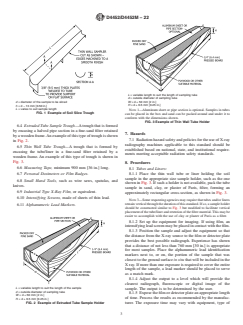
6.3 Soil Slice Trough—A trough that is formed by cutting
contact ASTM Customer Service at service@astm.org. For Annual Book of ASTM
the sample tube/liner along its vertical axis through the soil
Standards volume information, refer to the standard’s Document Summary page on
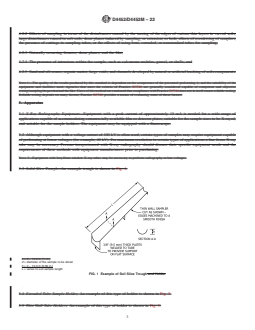
the ASTM website. sample. An example trough is shown in Fig. 1.
D4452/D4452M − 22
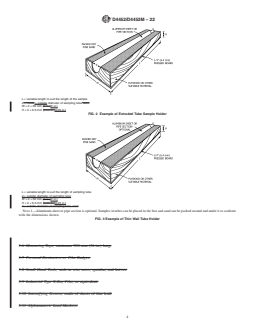
L = variable length to suit the length of sampling tube
d = outside diameter of sampling tube
d = diameter of the sample to be sliced W =d+50 mm [2 in.]
H =d+6.5 mm [0.25 in.]
h =d−13 mm [0.50 in.]
L = varies to suit sample length
NOTE 1—Aluminum sheet or pipe section is optional. Samples in tubes
FIG. 1 Example of Soil Slice Trough
can be placed in the box and sand can be packed around and under it to
conform with the dimensions shown.
FIG. 3 Example of Thin Wall Tube Holder
6.4 Extruded Tube Sample Trough—Atrough that is formed
by encasing a halved pipe section in a fine-sand filter retained
7. Hazards
byawoodenframe.Anexampleofthistypeoftroughisshown
7.1 Radiation hazard safety and policies for the use of X-ray
in Fig. 2.
radiography machines applicable to this standard should be
6.5 Thin Wall Tube Trough—A trough that is formed by
established based on national, state, and institutional require-
encasing the tube/liner in a fine-sand filter retained by a
ments meeting acceptable radiation safety standards.
wooden frame. An example of this type of trough is shown in
Fig. 3.
8. Procedures
6.6 Measuring Tape, minimum 900
...
This document is not an ASTM standard and is intended only to provide the user of an ASTM standard an indication of what changes have been made to the previous version. Because
it may not be technically possible to adequately depict all changes accurately, ASTM recommends that users consult prior editions as appropriate. In all cases only the current version
of the standard as published by ASTM is to be considered the official document.
Designation: D4452 − 14 D4452/D4452M − 22
Standard Practice for
X-Ray Radiography of Soil Samples
This standard is issued under the fixed designation D4452;D4452/D4452M; the number immediately following the designation indicates
the year of original adoption or, in the case of revision, the year of last revision. A number in parentheses indicates the year of last
reapproval. A superscript epsilon (´) indicates an editorial change since the last revision or reapproval.
1. Scope*
1.1 This practice covers the determination of the quality of soil samples in thin wall tubes or of extruded cores by X-ray
radiography.
1.2 This practice enables the user to determine the effects of sampling and natural variations within samples as identified by the
extent of the relative penetration of X-rays through soil samples.
1.3 This practice can be used to X-ray cores (or observe their features on a fluoroscope) in thin wall tubes or liners ranging from
approximately 50 to 150 mm (2 to 6 in.) in diameter. X-rays of samples in the larger diameter tubes provide a radiograph of major
features of soils and disturbances, such as large scale bending of edges of varved clays, shear planes, the presence of large
concretions, silt and sand seams thicker than 6 mm ( ⁄4 in.), large lumps of organic matter, and voids or other types of intrusions.
X-rays of the smaller diameter cores provide higher resolution of soil features and disturbances, such as small concretions (3 mm
( ⁄8 in.) diameter or larger), solution channels, slight bending of edges of varved clays, thin silt or sand seams, narrow solution
channels, plant root structures, and organic matter. The X-raying of samples in thin wall tubes or liners requires minimal
preparation.
1.4 Greater detail and resolution of various features of the soil can be obtained by X-raying of extruded cores, as compared to
samples in metal tubes. The method used for X-raying cores is the same as that for tubes and liners, except that extruded cores
have to be handled with extreme care and have to be placed in sample holders (similar to Fig. 2) before X-raying. This practice
should be used only when natural water content or other intact soil characteristics are irrelevant to the end use of the sample.
1.4.1 Often it is necessary to obtain greater resolution of features to determine the propriety of sampling methods, the
representative nature of soil samples, or anomalies in soils. This practice requires that either duplicate samples be obtained or
already tested specimens be X-rayed.
1.5 This practice can only be used to their fullest extent after considerable experience is obtained through many detailed
comparisons between the X-ray image and the sample X-rayed.
1.6 Units—The values stated in SI units are to be regarded as standard. The values given in parentheses are mathematical
conversions to inch-pound units, which are provided for information only and are not considered standard.
1.6.1 Reporting of test results in units other than SI shall not be regarded as nonconformance with this test method.
This practice is under the jurisdiction of ASTM Committee D18 on Soil and Rock and are the direct responsibility of Subcommittee D18.07 on Identification and
Classification of Soils.
Current edition approved July 1, 2014Oct. 1, 2022. Published August 2014October 2022. Originally approved in 1985. Last previous edition approved in 20062014 as
D4452 – 06.14. DOI: 10.1520/D4452-14.10.1520/D4452_D4452M-22.
*A Summary of Changes section appears at the end of this standard
Copyright © ASTM International, 100 Barr Harbor Drive, PO Box C700, West Conshohocken, PA 19428-2959. United States
D4452/D4452M − 22
1.7 This practice offers a set of instructions for performing one or more specific operations. This document cannot replace
education or experience and should be used in conjunction with professional judgment. Not all aspects of this practice may be
applicable in all circumstances. This ASTM standard is not intended to represent or replace the standard of care by which the
adequacy of a given professional service must be judged, nor should this document be applied without consideration of a project’s
many unique aspects. The word “Standard” in the title of this document means only that the document has been approved through
the ASTM consensus process.
1.8 All observed and calculated values shall conform to the guidelines for significant digits and rounding established in Practice
D6026.
1.8.1 For purposes of comparing, a measured or calculated value(s) with specified limits, the measured or calculated value(s) shall
be rounded to the nearest decimal or significant digits in the specified limits.
1.8.2 The procedures used to specify how data are collected/recorded or calculated, in this standard are regarded as the industry
standard. In addition, they are representative of the signification digits that generally should be retained. The procedures used do
not consider material variation, purpose for obtaining the data, special purpose studies, or any considerations for the user’s
objectives; and it is common practice to increase or reduce significant digits of reported data to be commensurate with these
considerations. It is beyond the scope of this standard to consider significant digits used in analysis methods for engineering design.
1.9 This standard does not purport to address all of the safety concerns, if any, associated with its use. It is the responsibility
of the user of this standard to establish appropriate safety and health practices and determine the applicability of regulatory
limitations prior to use. For specific precaution statements, see Section 6.
2. Referenced Documents
2.1 ASTM Standards:
D653 Terminology Relating to Soil, Rock, and Contained Fluids
D3740 Practice for Minimum Requirements for Agencies Engaged in Testing and/or Inspection of Soil and Rock as Used in
Engineering Design and Construction
D6026 Practice for Using Significant Digits and Data Records in Geotechnical Data
E7 Terminology Relating to Metallography
3. Terminology
3.1 Definitions:
3.1.1 For definitions of terms relating to soil samples, refer to Terminology D653.
3.1.2 For definitions of terms relating to X rays, refer to Definitions E7.
4. Significance and Use
4.1 Many geotechnical tests require the utilization of intact, representative samples of soil deposits. The quality of these samples
depends on many factors. Many of the samples obtained by intact sampling methods have inherent anomalies. Sampling
procedures cause disturbances of varying types and intensities. These anomalies and disturbances, however, are not always readily
detectable by visual inspection of the intact samples before or after testing. Often test results would be enhanced if the presence
and the extent of these anomalies and disturbances are known before testing or before destruction of the sample by testing. Such
determinations assist the user in detecting flaws in sampling methods, the presence of natural or induced shear planes, and the
presence of natural intrusions, such as gravels or shells at critical regions in the samples, the presence of sand and silt seams, and
the intensity of some of the unavoidable disturbances caused by sampling.
4.2 X-ray radiography provides the user with a picture of the internal massive structure of the soil sample, regardless of whether
the soil is X-rayed within or without the sampling tube. X-ray radiography assists the user in identifying the following:
4.2.1 Appropriateness of sampling methods used,
For referenced ASTM standards, visit the ASTM website, www.astm.org, or contact ASTM Customer Service at service@astm.org. For Annual Book of ASTM Standards
volume information, refer to the standard’s Document Summary page on the ASTM website.
D4452/D4452M − 22
4.2.2 Effects of sampling in terms of the disturbances caused by the turning of the edges of various thin layers in varved soils,
large disturbances caused in soft soils, shear planes induced by sampling, or extrusion, or both, effects of overdriving of samplers,
the presence of cuttings in sampling tubes, or the effects of using bent, corroded, or nonstandard tubes for sampling,
4.2.3 Naturally occurring fissures, shear planes, and the like,
4.2.4 The presence of intrusions within the sample, such as calcareous nodules, gravel, or shells, and
4.2.5 Sand and silt seams, organic matter, large voids, and channels developed by natural or artificial leaching of soils components.
NOTE 1—The quality of the results produced by this standard is dependent on the competence of the personnel performing it, and the suitability of the
equipment and facilities used. Agencies that meet the criteria of Practice D3740 are generally considered capable of competent and objective
testing/sampling/inspection/and the like. Users of this method are cautioned that compliance with Practice D3740 does not in itself ensure reliable testing.
Reliable testing depends on many factors; Practice D3740 provides a means of evaluating some of those factors.
5. Apparatus
5.1 X-Ray Radiography Equipment—Equipment with a peak current of approximately 15 mA is needed for a wide range of
applications capable of accommodating commercially available film or detector plates, suitable for the sample sizes to be X-rayed,
and suitable for the sample holders. The equipment may be equipped with a fluoroscope.
5.2 Although equipment with a voltage outout of 100 kV is often used, certain types of samples may require equipment capable
of performing at lower voltages (for example, 40 kV). For maximum resolution in certain types of applications a fine focus X-ray
tube may be necessary. Persons inexperienced with X-ray radiography should discuss their specific equipment needs and the
requirements of these methods with equipment manufacturers prior to purchasing.
NOTE 2—Equipment with beryllium window X-ray tubes may be necessary to perform radiography at low voltages.
5.3 Solid Slice Trough—An example trough is shown in Fig. 1.
h = d − 13 mm ( ⁄2 in.)
d = diameter of the sample to be sliced
h = d − 13 mm [0.50 in.]
L = varies to suit sample length
FIG. 1 Example of Soil Slice Trough and Holder
5.4 Extruded Tube Sample Holder, An example of this type of holder is shown in Fig. 2.
5.5 Thin Wall Tube Holders, An example of this type of holder is shown in Fig. 3.
D4452/D4452M − 22
L = variable length to suit the length of the sample
d = inside = outside diameter of sampling tube used
W = d + 50 mm (2 in.)[2 in.]
H = d + 6.5 mm (0.25 in.)[0.25 in.]
FIG. 2 Example of Extruded Tube Sample Holder
L = variable length to suit the length of sampling tube
d = outside diameter of sampling tube
W = d + 50 mm (2 in.)[2 in.]
H = d + 6.5 mm (0.25 in.)[0.25 in.]
d = outside diameter of sampling tube used
NOTE 1—Aluminum sheet or pipe section is optional. Samples in tubes can be placed in the box and sand can be packed around and under it to conform
with the dimensions shown.
FIG. 3 Example of Thin Wall Tube Holder
5.6 Measuring Tape, minimum 900 mm (36 in.) long.
5.7 Personal Dosimeters or Film Badges.
5.8 Small Hand Tools, such as wire saws, spatulas, and knives.
5.9 Industrial Type X-Ray Film, or equivalent.
5.10 Intensifying Screens, made of sheets of thin lead.
5.11 Alphanumeric Lead Markers.
D4452/D4452M − 22
6. Safety Precautions
6.1 Radiation safety and policies for the use of X-ray radiography machines applicable to these methods should be established
based on national, state, and institutional requirements meeting acceptable radiation safety standards.
7. Procedures
7.1 Tubes and Liners:
7.1.1 Place the thin wall tube or liner holding the soil sample in the appropriate size sample holder, such as the one shown in Fig.
3. If such a holder is not available, pack the tube sample in sand, clay, or plaster of Paris, forming an approximately rectangular
cross-section, as shown in Fig. 3.
7.1.2 Set up the equipment for imaging. If using film, an intensifying lead screen may be placed in contact with the film.
7.1.3 Position the sample and adjust the equipment so that the distance from the X-ray source to the film or detector plate provides
the best possible radiograph. Experience has shown that a distance of not less than 760 mm (30 in.) is appropriate for most samples.
Place the alphanumeric lead identification markers next to, or on, the portion of the sample that was closest to the ground surface
in situ that will be included in the X ray. If more than one exposure is required to cover the entire length of the sample, a lead
marker should be placed to serve as a match mark.
7.1.4 Adjust the output to a level which will provide the clearest radiograph or fluoroscopic image of the sample. The output is
to be determined by the user.
7.1.5 Expose the film or detector plate an appropriate length of time. Process the results as recommended by the manufacturer.
The exposure time may vary with equipment, type of soil, or type of tubing material used. It is advisable to experiment with the
exposure time, keeping the distance of the specimen from film or detector plate constant until well-defined, clear, X-ray
radiographs are obtained. Adjustments also can be made by keeping the exposure time constant and by varying the distance of the
X-ray source from the film or detector plate.
7.1.6 Rotate the sample 90° about its longitudinal axis and repeat the procedure. Identify the 0° and 90° exposures with lead
markers.
7.1.7 For some applications it may be sufficient to prepare samples as in 7.1.1 – 7.1.3 and simply observe various features on the
fluoroscope; in such cases, eliminate 7.1.5.
7.2 Extruded Samples:
7.2.1 Specimen Preparation:
7.2.1.1 Place the specimen horizontally on the soil slicing trough.
7.2.1.2 Slice the specimen using a clean wire saw or other acceptable cutting device.
7.2.1.3 Remove the top portion of the specimen by placing a 180° segment of appropriate diameter thin wall tube over the
specimen. Turn the thin wall tube segment, the specimen, and the slicing trough upside down in unison, so that the sliced specimen
rests in the thin wall tube segment.
7.2.1.4 Remove the slicing trough and the portion of the specimen contained within. Discard the portion of the specimen removed
from the slicing trough.
7.2.1.5 Wipe the slicing trough clean.
7.2.1.6 Place the portion of the specimen held in the thin wall tube segment in the trough with the sliced plane facing up.
7.2.1.7 Repeat 7.2.1.2.
7.2.1.8 Place a 6-mm ( ⁄4-in.) thick window glass or clear acrylic plate over the exposed face of the sample.
D4452/D4452M − 22
7.2.1.9 Holding the glass plate with one hand and the specimen trough with the other, turn the glass plate, the specimen, and the
trough over.
7.2.1.10 Remove the trough and the portion of the specimen remaining within. This should leave a 10-mm ( ⁄8-in. ) thick soil slice
specimen on the glass plate.
7.2.2 Procedure:
7.2.2.1 Set up the equipment for imaging. If using film, an intensifying lead screen may be placed in contact with the film.
7.2.2.2 Position the specimen and glass plate and adjust the distance from the X-ray source to the film to provide the clearest
radiograph. Place the alphanumeric lead identification markers on the glass plate next to the specimen.
7.2.2.3 Repeat 7.1.3 and 7.1.4.
7.2.2.4 If a permanent radiography image is not required, see 7.1.7.
8. Interpretation of Test Results
8.1 The interpretation of X-ray radiographs must be done by personnel experienced in analyzing X-ray radiographs of soils.
8.2 X-ray radiographs show variations in the ability of X-rays to penetrate matter. These variations are exhibited as varying shades
of gray color burned on the X-ray image.
8.3 The following factors can be discerned from the radiograph:
8.3.1 Voids—Open void spaces will show as dark dots, or spaces, or channels, depending on the shape of the void (Fig. 4).
8.3.2 Bedding—Horizontal, inclined, or distorted bedding will show as layers of various shades of gray easily identifiable as
bedding (Fig. 4).
8.3.3 Turning of Edges—Turning or bending of edges of various thin layers show as curved down edges on the sides of the
specimen (Fig. 5). In extreme cases this turning down is accompanied by a symmetrical curving of the distorted layers. This may
be an indication of improper sampling or extrusion methods (Fig. 6).
8.3.4 Peat, Organic Matter, Roots—Peat and organic matter will appear as dark or black spots (Fig. 7), while roots will appear
as black, irregular, often interconnected lines (Fig. 8).
8.3.5 Shells and Invertebrates—They will appear as light colored shapes, generally easily identified from their profile (Fig. 9).
8.3.6 Calcareous Concretions—These will appear as light gray irregular spots (Fig. 10). Natural fissures will appear as thin dark
lines. Where bedding of various layers are apparent in the radiograph, bedding will be continuous across fissures (Fig. 11).
8.3.7 Shear Fractures—Shear fractures will appear as either dark lines (open fractures) or as lines identifiable only by the abrupt
displacement and discontinuance of a number of bedding planes across the shear zone (Fig. 12).
9. Report: Test Data Sheet(s)/Form(s)
9.1 The methodology used to specify how data are recorded on the data sheet(s)/form(s), as given below, is covered in 1.8.
9.2 Record as a minimum the following general information (see Appendix X1, Sample Report Form):
9.2.1 Original radiograph, or digital copy, a negative print, or a contact print of the radiograph,
NOTE 3—When contact prints are used instead of negative prints the photographic process reverses the colors of the X ray.
D4452/D4452M − 22
FIG. 4 Open Void Spaces and Bedding (contact prints)
9.2.2 Description of the soil specimen,
9.2.3 Location and depth from which the sample was obtained,
9.2.4 Type and size of sample or specimen used for radiography, (for example, 127 mm (5 in.) diameter sample in thin wall tube),
9.2.5 Type of radiographic equipment used, voltage, amperage, and exposure time,
D4452/D4452M − 22
FIG. 56 Turning of Edges (contact prints)
9.2.6 Distance from the X-ray source to the film surface or detection plate, and
9.2.7 Descriptive interpretation of the radiograph and its meaning in terms of the quality of the sample.
D4452/D4452M − 22
FIG. 67 Extreme Distortion of Bedding in Soft Soil (contact prints)Distortion/Tension Cracking
D4452/D4452M − 22
FIG. 78 Appearance of Peat (contact print)
10. Precision and Bias
10.1 This practice provide qualitative and general information, therefore, a precision and bias statement is not applicable. The
reliability of X-ray interpretation of soil samples is commensurate with the training and experience of the personnel.
11. Keywords
11.1 intact samples; sample disturbance; samples; soil investigations; X-rays
D4452/D4452M − 22
FIG. 89 Appearance of Roots (contact prints)
D4452/D4452M − 22
FIG. 910 Shells and Invertebrates (contact prints)
D4452/D4452M − 22
FIG. 1011 Calcareous Concretions (contact print)Shear Fractures
APPENDIX
(Nonmandatory Information)
X1. SAMPLE REPORT FORM
X1.1 See Fig. X1.1.
D4452/D4452M − 22
Radiograph Report for Soil Specimen
Date
Project Number
Project Name
Project Location
Technician
Sample Number
Depth Range (m)
Sampling Method
Sample Diameter (mm)
Sample Length (m)
Sample Extruded h Yes h No If Yes: h entire sample, h half sample, h slice
If No: Tube Type
Purpose for X ray hAnomalies h Quality h Other
Sample Description
Type of Equipment
Radiation Period (min) Voltage (kV) Amperage (mA)
Radiation Period (min) Voltage (kV) Amperage (mA) Resolution (μm)
Source to Detector Distance (m)
Interpretation of Images
Attachments h x-ray h copy of x-ray h print
h cd with images h negative h other
FIG. X1.1 Sample Report Format
SUMMARY OF CHANGES
In accordance with Committee D18 policy, this section identifies the location of changes to this standard since
the 2006 edition that may impact the use of this standard.
(1) Changed standard to SI system.
(2) Included digital form of X-ray images.
(3) Included D6026 Practice for Using Significant Digits in Geotechnical Data.
(4) General updating and format changes.
ASTM International takes no position respecting the validity of any patent rights asserted in connection with any item mentioned
in this standard. Users of this standard are expressly advised that determination of the validity of any such patent rights, and the risk
of infringement of such rights, are entirely their own responsibility.
This standard is subject to revision at any time by the responsible technical committee and must be reviewed every five years and
if not revised, either reapproved or withdrawn. Your comments are invited either for revision of this standard or for additional standards
and should be addressed to ASTM International Headquarters. Your comments will receive careful consideration at a meeting of the
responsible technical committee, which you may attend. If you feel that your comments have not received a fair hearing you should
make your views known to the ASTM Committee on Standards, at the address shown below.
This standard is copyrighted by ASTM International, 100 Barr Harbor Drive, PO Box C700, West Conshohocken, PA 19428-2959,
United States. Individual reprints (single or multiple co
...