


ASTM D1173-23
(Test Method)Standard Test Method for Foaming Properties of Surface-Active Agents
Standard Test Method for Foaming Properties of Surface-Active Agents
ABSTRACT
This test method covers the determination of foaming properties of surface-active agents. Glass tubing apparatus for this test method shall include pipet and a receiver. Apparatus requirements like dimensions, shape, calibration marks, rubber stoppers, etc., shall conform to the specifications as indicated in this standard method. Test solution preparation shall include water preheating, adding the surface-active agent while stirring, and solution aging. Test procedure for foaming properties determination shall be done while surface-active solution is aging as indicated in this standard test method. Report shall include test solution concentration, temperature, water hardness, and foam height.
SCOPE
1.1 This test method covers the determination of the foaming properties of surface-active agents as defined in Terminology D459. This test method is applicable under limited and controlled conditions, but does not necessarily yield information correlating with specific end uses. This method is subjected to the operator of the method as the foam heights are not always level and an average height is determined by the user so it is more of a qualitative measurement in these instances. However, for foam measurements results taken on more flat uniform samples this method has more of a quantitative quality.
1.2 This standard does not purport to address all of the safety concerns, if any, associated with its use. It is the responsibility of the user of this standard to establish appropriate safety, health, and environmental practices and determine the applicability of regulatory limitations prior to use.
1.3 This international standard was developed in accordance with internationally recognized principles on standardization established in the Decision on Principles for the Development of International Standards, Guides and Recommendations issued by the World Trade Organization Technical Barriers to Trade (TBT) Committee.
General Information
- Status
- Published
- Publication Date
- 30-Jun-2023
- Technical Committee
- D12 - Soaps and Other Detergents
- Drafting Committee
- D12.15 - Physical Testing
Relations
- Effective Date
- 01-Jul-2016
- Refers
ASTM D459-09 - Standard Terminology Relating to Soaps and Other Detergents <a href="#fn00002"></a> - Effective Date
- 01-Oct-2009
- Refers
ASTM D459-08a - Standard Terminology Relating to Soaps and Other Detergents <a href="#fn00002"></a> - Effective Date
- 15-Oct-2008
- Refers
ASTM D459-08 - Standard Terminology Relating to Soaps and Other Detergents <a href="#fn00002"></a> - Effective Date
- 15-Jul-2008
- Effective Date
- 01-Oct-2007
- Effective Date
- 10-Jun-2000
Overview
ASTM D1173-23: Standard Test Method for Foaming Properties of Surface-Active Agents provides a reliable laboratory technique to evaluate the foaming characteristics of surfactants and related surface-active agents. Developed by ASTM International, this standard outlines apparatus requirements, sample preparation, and procedural steps to consistently measure foam production under controlled laboratory conditions. While this method captures both qualitative and semi-quantitative data on foam height, it is primarily designed for comparative assessments rather than predicting real-world product performance.
Key Topics
Testing Apparatus
- Utilizes chemically resistant glass pipets and receivers, calibrated accurately to ensure reproducible measurements.
- Includes devices such as stopcocks, water jackets with thermostatic controls, and leveling platforms for precise alignment.
Sample Preparation
- Test solutions require preheated water and carefully measured addition of surface-active agents, followed by a defined aging period for solution stability.
Foaming Measurement Procedure
- The process involves transferring the test solution into the apparatus, generating foam, and recording foam height at specific time intervals (0, 1, 3, and 5 minutes).
- All results factor in solution concentration, temperature, water hardness, and average foam height as observed by the operator.
Reporting Requirements
- The standard mandates comprehensive documentation of test conditions and measurements, facilitating meaningful comparison across samples and laboratories.
Qualitative and Quantitative Limitations
- Foam heights may vary depending on operator technique and sample surface characteristics; as such, results are best suited for comparative rather than absolute analysis.
Applications
The ASTM D1173-23 test method serves multiple industries and research fields where foaming characteristics are critical, such as:
Detergent and Cleaning Product Development
- Provides an objective means for formulators to compare surfactant foaming tendencies, an important factor in consumer cleaning efficacy and satisfaction.
Cosmetic and Personal Care Products
- Assists in quality control and new product development for items like shampoos, hand soaps, and bubble baths, where foam properties influence user experience.
Industrial and Institutional Cleaners
- Enables assessment of foam behavior in products designed for commercial dishwashing, laundering, and various surface cleaning applications.
Surfactant Research and Quality Assurance
- Laboratory and manufacturing environments use this method for incoming material inspection, batch control, and ensuring consistency in production.
While results from ASTM D1173-23 allow stakeholders to objectively compare foaming properties under defined conditions, correlation to end-use or in-field performance may be limited.
Related Standards
Key related ASTM and international standards include:
- ASTM D459 - Terminology Relating to Soaps and Other Detergents: Provides essential definitions for understanding and applying ASTM D1173-23.
- ASTM E284 - Terminology of Appearance: Useful for broader studies in product aesthetics where foam is a significant attribute.
- ISO 696 - International standard for assessment of detergents, complementary to ASTM methods.
- ASTM D4007 - Separation of Water from Petroleum Oils and Synthetic Fluids, involving surface-active agent assessment.
For specific apparatus calibration, safety guidance, and advanced surfactant characterization, consulting related ASTM guidelines and ISO standards is recommended.
By following ASTM D1173-23, laboratories and product developers can ensure standardized, repeatable measurement of foaming properties in surface-active agents, improving product formulation, quality control, and research consistency within the detergents, personal care, and related industries.
Buy Documents


ASTM D1173-23 - Standard Test Method for Foaming Properties of Surface-Active Agents

REDLINE ASTM D1173-23 - Standard Test Method for Foaming Properties of Surface-Active Agents
Get Certified
Connect with accredited certification bodies for this standard

ECOCERT
Organic and sustainability certification.

Eurofins Food Testing Global
Global leader in food, environment, and pharmaceutical product testing.

Intertek Bangladesh
Intertek certification and testing services in Bangladesh.
Sponsored listings
Frequently Asked Questions
ASTM D1173-23 is a standard published by ASTM International. Its full title is "Standard Test Method for Foaming Properties of Surface-Active Agents". This standard covers: ABSTRACT This test method covers the determination of foaming properties of surface-active agents. Glass tubing apparatus for this test method shall include pipet and a receiver. Apparatus requirements like dimensions, shape, calibration marks, rubber stoppers, etc., shall conform to the specifications as indicated in this standard method. Test solution preparation shall include water preheating, adding the surface-active agent while stirring, and solution aging. Test procedure for foaming properties determination shall be done while surface-active solution is aging as indicated in this standard test method. Report shall include test solution concentration, temperature, water hardness, and foam height. SCOPE 1.1 This test method covers the determination of the foaming properties of surface-active agents as defined in Terminology D459. This test method is applicable under limited and controlled conditions, but does not necessarily yield information correlating with specific end uses. This method is subjected to the operator of the method as the foam heights are not always level and an average height is determined by the user so it is more of a qualitative measurement in these instances. However, for foam measurements results taken on more flat uniform samples this method has more of a quantitative quality. 1.2 This standard does not purport to address all of the safety concerns, if any, associated with its use. It is the responsibility of the user of this standard to establish appropriate safety, health, and environmental practices and determine the applicability of regulatory limitations prior to use. 1.3 This international standard was developed in accordance with internationally recognized principles on standardization established in the Decision on Principles for the Development of International Standards, Guides and Recommendations issued by the World Trade Organization Technical Barriers to Trade (TBT) Committee.
ABSTRACT This test method covers the determination of foaming properties of surface-active agents. Glass tubing apparatus for this test method shall include pipet and a receiver. Apparatus requirements like dimensions, shape, calibration marks, rubber stoppers, etc., shall conform to the specifications as indicated in this standard method. Test solution preparation shall include water preheating, adding the surface-active agent while stirring, and solution aging. Test procedure for foaming properties determination shall be done while surface-active solution is aging as indicated in this standard test method. Report shall include test solution concentration, temperature, water hardness, and foam height. SCOPE 1.1 This test method covers the determination of the foaming properties of surface-active agents as defined in Terminology D459. This test method is applicable under limited and controlled conditions, but does not necessarily yield information correlating with specific end uses. This method is subjected to the operator of the method as the foam heights are not always level and an average height is determined by the user so it is more of a qualitative measurement in these instances. However, for foam measurements results taken on more flat uniform samples this method has more of a quantitative quality. 1.2 This standard does not purport to address all of the safety concerns, if any, associated with its use. It is the responsibility of the user of this standard to establish appropriate safety, health, and environmental practices and determine the applicability of regulatory limitations prior to use. 1.3 This international standard was developed in accordance with internationally recognized principles on standardization established in the Decision on Principles for the Development of International Standards, Guides and Recommendations issued by the World Trade Organization Technical Barriers to Trade (TBT) Committee.
ASTM D1173-23 is classified under the following ICS (International Classification for Standards) categories: 71.100.40 - Surface active agents. The ICS classification helps identify the subject area and facilitates finding related standards.
ASTM D1173-23 has the following relationships with other standards: It is inter standard links to ASTM D459-16, ASTM D459-09, ASTM D459-08a, ASTM D459-08, ASTM D459-00(2007), ASTM D459-00. Understanding these relationships helps ensure you are using the most current and applicable version of the standard.
ASTM D1173-23 is available in PDF format for immediate download after purchase. The document can be added to your cart and obtained through the secure checkout process. Digital delivery ensures instant access to the complete standard document.
Standards Content (Sample)
This international standard was developed in accordance with internationally recognized principles on standardization established in the Decision on Principles for the
Development of International Standards, Guides and Recommendations issued by the World Trade Organization Technical Barriers to Trade (TBT) Committee.
Designation: D1173 − 23
Standard Test Method for
Foaming Properties of Surface-Active Agents
This standard is issued under the fixed designation D1173; the number immediately following the designation indicates the year of
original adoption or, in the case of revision, the year of last revision. A number in parentheses indicates the year of last reapproval. A
superscript epsilon (´) indicates an editorial change since the last revision or reapproval.
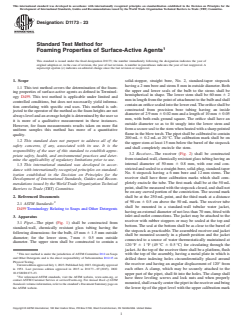
1. Scope solid-stopper, straight bore, No. 2, standard-taper stopcock
having a 2 mm bore and stems 8 mm in outside diameter. Both
1.1 This test method covers the determination of the foam-
the upper and lower seals of the bulb to the stems shall be
ing properties of surface-active agents as defined in Terminol-
hemispherical in shape. The lower stem shall be 60 mm 6 2
ogy D459. This test method is applicable under limited and
mm in length from the point of attachment to the bulb and shall
controlled conditions, but does not necessarily yield informa-
contain an orifice sealed into the lower end. The orifice shall be
tion correlating with specific end uses. This method is sub-
constructed from precision bore tubing having an inside
jected to the operator of the method as the foam heights are not
diameter of 2.9 mm 6 0.02 mm and a length of 10 mm 6 0.05
always level and an average height is determined by the user so
mm, with both ends ground square. The orifice shall have an
it is more of a qualitative measurement in these instances.
outside diameter so as to fit snugly into the lower stem and
However, for foam measurements results taken on more flat
form a secure seal to the stem when heated with a sharp pointed
uniform samples this method has more of a quantitative
flame in the blow torch. The pipet shall be calibrated to contain
quality.
200 mL 6 0.2 mL at 20 °C. The calibration mark shall be on
1.2 This standard does not purport to address all of the
the upper stem at least 15 mm below the barrel of the stopcock
safety concerns, if any, associated with its use. It is the
and shall completely encircle the stem.
responsibility of the user of this standard to establish appro-
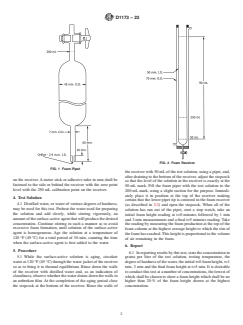
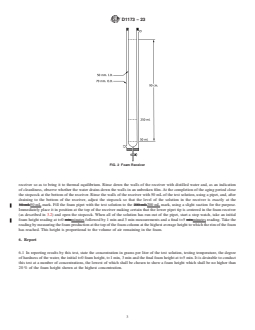
3.2 Receiver—The receiver (Fig. 2) shall be constructed
priate safety, health, and environmental practices and deter-
from standard-wall, chemically resistant glass tubing having an
mine the applicability of regulatory limitations prior to use.
internal diameter of 50 mm 6 0.8 mm, with one end con-
1.3 This international standard was developed in accor-
stricted and sealed to a straight-bore, solid-plug, standard-taper
dance with internationally recognized principles on standard-
No. 6 stopcock having a 6 mm bore and 12 mm stems. The
ization established in the Decision on Principles for the
receiver shall have three calibration marks which shall com-
Development of International Standards, Guides and Recom-
pletely encircle the tube. The first mark shall be at the 50 mL
mendations issued by the World Trade Organization Technical
point, shall be measured with the stopcock closed, and shall not
Barriers to Trade (TBT) Committee.
be on any curved portion of the constriction. The second mark
2. Referenced Documents shall be at the 250 mL point, and the third mark at a distance
2 of 90 cm 6 0.5 cm above the 50 mL mark. The receiver tube
2.1 ASTM Standards:
shall be mounted in a standard-wall tubular water jacket,
D459 Terminology Relating to Soaps and Other Detergents
having an external diameter of not less than 70 mm, fitted with
inlet and outlet connections. The jacket may be attached to the
3. Apparatus
receiver with rubber stoppers or may be sealed at the top and
3.1 Pipet—The pipet (Fig. 1) shall be constructed from
bottom. The seal at the bottom shall be as close to the barrel of
standard-wall, chemically resistant glass tubing having the
the stopcock as practicable. The assembled receiver and jacket
following dimensions: for the bulb, 45 mm 6 1.5 mm outside
shall be mounted securely in a plumb position and the jacket
diameter; for the lower stem, 7 mm 6 0.5 mm outside
connected to a source of water thermostatically maintained at
diameter. The upper stem shall be constructed to contain a
120 °F 6 1 °F (49 °C 6 0.5 °C) for circulating through the
jacket. At the top of the receiver there shall be a platform, flush
This test method is under the jurisdiction of ASTM Committee D12 on Soaps
with the top of the assembly, having a metal plate in which is
and Other Detergents and is the direct responsibility of Subcommittee D12.15 on
drilled three indexing holes circumferentially placed around
Physical Testing.
the receiver and having an angular displacement of 120° from
Current edition approved July 1, 2023. Published July 2023. Originally approved
each other. A clamp, which ma
...
This document is not an ASTM standard and is intended only to provide the user of an ASTM standard an indication of what changes have been made to the previous version. Because
it may not be technically possible to adequately depict all changes accurately, ASTM recommends that users consult prior editions as appropriate. In all cases only the current version
of the standard as published by ASTM is to be considered the official document.
Designation: D1173 − 07 (Reapproved 2015) D1173 − 23
Standard Test Method for
Foaming Properties of Surface-Active Agents
This standard is issued under the fixed designation D1173; the number immediately following the designation indicates the year of
original adoption or, in the case of revision, the year of last revision. A number in parentheses indicates the year of last reapproval. A
superscript epsilon (´) indicates an editorial change since the last revision or reapproval.
1. Scope
1.1 This test method covers the determination of the foaming properties of surface-active agents as defined in Terminology D459.
This test method is applicable under limited and controlled conditions, but does not necessarily yield information correlating with
specific end uses. This method is subjected to the operator of the method as the foam heights are not always level and an average
height is determined by the user so it is more of a qualitative measurement in these instances. However, for foam measurements
results taken on more flat uniform samples this method has more of a quantitative quality.
1.2 This standard does not purport to address all of the safety concerns, if any, associated with its use. It is the responsibility
of the user of this standard to establish appropriate safety, health, and environmental practices and determine the applicability of
regulatory limitations prior to use.
1.3 This international standard was developed in accordance with internationally recognized principles on standardization
established in the Decision on Principles for the Development of International Standards, Guides and Recommendations issued
by the World Trade Organization Technical Barriers to Trade (TBT) Committee.
2. Referenced Documents
2.1 ASTM Standards:
D459 Terminology Relating to Soaps and Other Detergents
3. Apparatus
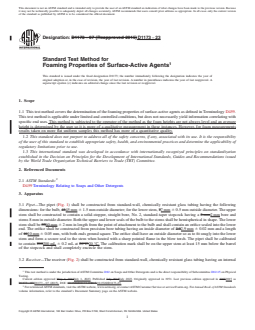
3.1 Pipet—The pipet (Fig. 1) shall be constructed from standard-wall, chemically resistant glass tubing having the following
dimensions: for the bulb, 4545 mm 6 1.5 mm outside diameter; for the lower stem, 77 mm 6 0.5 mm outside diameter. The upper
stem shall be constructed to contain a solid-stopper, straight bore, No. 2, standard-taper stopcock having a 2-mm2 mm bore and
stems 8 mm in outside diameter. Both the upper and lower seals of the bulb to the stems shall be hemispherical in shape. The lower
stem shall be 6060 mm 6 2 mm in length from the point of attachment to the bulb and shall contain an orifice sealed into the lower
end. The orifice shall be constructed from precision bore tubing having an inside diameter of 2.92.9 mm 6 0.02 mm and a length
of 1010 mm 6 0.05 mm, with both ends ground square. The orifice shall have an outside diameter so as to fit snugly into the lower
stem and form a secure seal to the stem when heated with a sharp pointed flame in the blow torch. The pipet shall be calibrated
to contain 200200 mL 6 0.2 mL at 20°C.20 °C. The calibration mark shall be on the upper stem at least 15 mm below the barrel
of the stopcock and shall completely encircle the stem.
3.2 Receiver—The receiver (Fig. 2) shall be constructed from standard-wall, chemically resistant glass tubing having an internal
This test method is under the jurisdiction of ASTM Committee D12 on Soaps and Other Detergents and is the direct responsibility of Subcommittee D12.15 on Physical
Testing.
Current edition approved May 1, 2015July 1, 2023. Published July 2015July 2023. Originally approved in 1951. Last previous edition approved in 20072015 as
D1173 – 07.D1173 – 07 (2015). DOI: 10.1520/D1173-07R15.10.1520/D1173-23.
For referenced ASTM standards, visit the ASTM website, www.astm.org, or contact ASTM Customer Service at service@astm.org. For Annual Book of ASTM Standards
volume information, refer to the standard’s Document Summary page on the ASTM website.
Copyright © ASTM International, 100 Barr Harbor Drive, PO Box C700, West Conshohocken, PA 19428-2959. United States
D1173 − 23
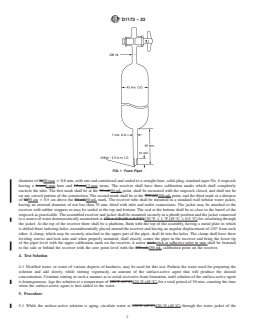
FIG. 1 Foam Pipet
diameter of 5050 mm 6 0.8 mm, with one end constricted and sealed to a straight-bore, solid-plug, standard-taper No. 6 stopcock
having a 6-mm6 mm bore and 12-mm12 mm stems. The receiver shall have three calibration marks which shall completely
encircle the tube. The first mark shall be at the 50-mL50 mL point, shall be measured with the stopcock closed, and shall not be
on any curved portion of the constriction. The second mark shall be at the 250-mL250 mL point, and the third mark at a distance
of 9090 cm 6 0.5 cm above the 50-mL50 mL mark. The receiver tube shall be mounted in a standard-wall tubular water jacket,
having an external diameter of not less than 70 mm, fitted with inlet and outlet connections. The jacket may be attached to the
receiver with rubber stoppers or may be sealed at the top and bo
...
Questions, Comments and Discussion
Ask us and Technical Secretary will try to provide an answer. You can facilitate discussion about the standard in here.
Loading comments...