


ASTM C1153-23
(Practice)Standard Practice for Location of Wet Insulation in Roofing Systems Using Infrared Imaging
Standard Practice for Location of Wet Insulation in Roofing Systems Using Infrared Imaging
SIGNIFICANCE AND USE
4.1 This practice is used to outline the minimum necessary elements and conditions to obtain an accurate determination of the location of wet insulation in roofing systems using infrared imaging.
4.2 This practice is not meant to be an instructional document or to provide all the knowledge and background necessary to provide an accurate analysis. For further information, see ANSI-ASHRAE Standard 101 and ISO/DP 6781.3E.
4.3 This practice does not provide methods to determine the cause of moisture or its point of entry. It does not address the suitability of any particular system to function capably as waterproofing.
SCOPE
1.1 This practice applies to techniques that employ infrared imaging at night to determine the location of wet insulation in roofing systems that have insulation above the deck in contact with the waterproofing. This practice includes ground-based and aerial inspections. (Warning—Extreme caution shall be taken when accessing or walking on roof surfaces and when operating aircraft at low altitudes, especially at night.) (Warning—It is a good safety practice for at least two people to be present on the roof surface at all times when ground-based inspections are being conducted.)
1.2 This practice addresses criteria for infrared equipment such as minimum resolvable temperature difference, spectral range, instantaneous field of view, and field of view.
1.3 This practice addresses meteorological conditions under which infrared inspections shall be performed.
1.4 This practice addresses the effect of roof construction, material differences, and roof conditions on infrared inspections.
1.5 This practice addresses operating procedures, operator qualifications, and operating practices.
1.6 This practice also addresses verification of infrared data using invasive test methods.
1.7 The values stated in SI units are to be regarded as standard. No other units of measurement are included in this standard.
1.8 This standard does not purport to address all of the safety concerns, if any, associated with its use. It is the responsibility of the user of this standard to establish appropriate safety, health, and environmental practices and determine the applicability of regulatory limitations prior to use. Specific precautionary statements are given in 1.1.
1.9 This international standard was developed in accordance with internationally recognized principles on standardization established in the Decision on Principles for the Development of International Standards, Guides and Recommendations issued by the World Trade Organization Technical Barriers to Trade (TBT) Committee.
General Information
- Status
- Published
- Publication Date
- 31-Aug-2023
- Technical Committee
- C16 - Thermal Insulation
- Drafting Committee
- C16.30 - Thermal Measurement
Relations
- Effective Date
- 01-Sep-2023
- Effective Date
- 15-Apr-2024
- Effective Date
- 01-May-2022
- Effective Date
- 01-Sep-2023
- Effective Date
- 01-Sep-2023
- Effective Date
- 01-Sep-2023
- Effective Date
- 01-Sep-2023
Overview
ASTM C1153-23 is the Standard Practice for Location of Wet Insulation in Roofing Systems Using Infrared Imaging, developed by ASTM International. This standard establishes the minimum requirements and conditions necessary to accurately identify the location of wet insulation within roofing assemblies by employing infrared (IR) imaging techniques. It applies specifically to insulation installed above the deck in contact with the waterproofing layer and covers both ground-based and aerial inspection methods performed at night.
The proper identification of wet insulation is critical for building maintenance, energy efficiency, and preventing further roof deterioration. By standardizing the IR survey process, ASTM C1153-23 helps building professionals, inspectors, and contractors achieve consistent, reliable results in roof moisture detection.
Key Topics
- Infrared Imaging Techniques: The standard outlines methods for using night-time IR imaging to detect thermal anomalies indicative of wet insulation in roofing systems.
- Equipment Requirements: It addresses specifications for IR equipment, including minimum resolvable temperature difference (MRTD), spectral range, field of view (FOV), and instantaneous field of view (IFOV).
- Inspection Procedures: Guidance is provided for both ground-based walk-over, elevated vantage-point, and aerial IR surveys, including recommended safety practices.
- Operating Conditions: ASTM C1153-23 details suitable meteorological and environmental conditions for accurate inspections, such as temperature differentials, wind limits, and avoidance of surveys after precipitation.
- Verification Methods: The practice requires the use of invasive techniques (cores, moisture probes) to confirm IR survey findings, ensuring reliability.
- Data Interpretation: The standard highlights the importance of distinguishing between thermal anomalies caused by wet insulation versus those due to other factors like construction variations or damage.
- Reporting: Clear guidance is provided for documentation, including survey method, environmental conditions, findings, and verification data.
Applications
ASTM C1153-23 is employed by:
- Roofing Contractors: To evaluate moisture damage and plan repairs or replacements.
- Building Owners and Facility Managers: For asset management, preventive maintenance, and energy audit purposes.
- Infrared Thermographers and Inspectors: To ensure standardized, repeatable methodologies for moisture detection.
- Insurance Adjusters and Consultants: To assess the extent of damage for claims and restoration purposes.
Roof assemblies best suited for this practice include those with rigid insulation boards (such as perlite, fiberboard, cork, cellular glass, polystyrene, polyurethane, isocyanurate, and phenolic) above the deck. However, it is less effective for assemblies with reflective surfaces or heavy ballast, and certain insulation types may require additional considerations or limitations.
Related Standards
ASTM C1153-23 references and aligns with several related documents and international standards, including:
- ASTM C168: Terminology Relating to Thermal Insulation
- ASTM D1079: Terminology Relating to Roofing and Waterproofing
- ASTM E1213: Practice for Minimum Resolvable Temperature Difference for Thermal Imaging Systems
- ANSI-ASHRAE Standard 101: Application of Infrared Sensing Devices to the Assessment of Building Heat Loss Characteristics
- ISO/DP 6781.3E: Thermal Insulation - Qualitative Detection of Thermal Irregularities in Building Envelopes - Infrared Method
Practical Value
Implementing ASTM C1153-23 improves the accuracy and reliability of identifying wet insulation in roofing systems, supporting timely repairs, reducing energy loss, and extending the lifespan of building envelopes. The standard’s structured approach to infrared surveys and data verification ensures consistency and trust in moisture assessment, protecting building investments and occupant safety.
Keywords: ASTM C1153, infrared imaging, wet insulation, roofing systems, thermal anomalies, moisture detection, building envelope, IR survey, ASTM standards, building maintenance.
Buy Documents
ASTM C1153-23 - Standard Practice for Location of Wet Insulation in Roofing Systems Using Infrared Imaging
REDLINE ASTM C1153-23 - Standard Practice for Location of Wet Insulation in Roofing Systems Using Infrared Imaging
Get Certified
Connect with accredited certification bodies for this standard

ICC Evaluation Service
Building products evaluation and certification.

QAI Laboratories
Building and construction product testing and certification.

Aboma Certification B.V.
Specialized in construction, metal, and transport sectors.
Sponsored listings
Frequently Asked Questions
ASTM C1153-23 is a standard published by ASTM International. Its full title is "Standard Practice for Location of Wet Insulation in Roofing Systems Using Infrared Imaging". This standard covers: SIGNIFICANCE AND USE 4.1 This practice is used to outline the minimum necessary elements and conditions to obtain an accurate determination of the location of wet insulation in roofing systems using infrared imaging. 4.2 This practice is not meant to be an instructional document or to provide all the knowledge and background necessary to provide an accurate analysis. For further information, see ANSI-ASHRAE Standard 101 and ISO/DP 6781.3E. 4.3 This practice does not provide methods to determine the cause of moisture or its point of entry. It does not address the suitability of any particular system to function capably as waterproofing. SCOPE 1.1 This practice applies to techniques that employ infrared imaging at night to determine the location of wet insulation in roofing systems that have insulation above the deck in contact with the waterproofing. This practice includes ground-based and aerial inspections. (Warning—Extreme caution shall be taken when accessing or walking on roof surfaces and when operating aircraft at low altitudes, especially at night.) (Warning—It is a good safety practice for at least two people to be present on the roof surface at all times when ground-based inspections are being conducted.) 1.2 This practice addresses criteria for infrared equipment such as minimum resolvable temperature difference, spectral range, instantaneous field of view, and field of view. 1.3 This practice addresses meteorological conditions under which infrared inspections shall be performed. 1.4 This practice addresses the effect of roof construction, material differences, and roof conditions on infrared inspections. 1.5 This practice addresses operating procedures, operator qualifications, and operating practices. 1.6 This practice also addresses verification of infrared data using invasive test methods. 1.7 The values stated in SI units are to be regarded as standard. No other units of measurement are included in this standard. 1.8 This standard does not purport to address all of the safety concerns, if any, associated with its use. It is the responsibility of the user of this standard to establish appropriate safety, health, and environmental practices and determine the applicability of regulatory limitations prior to use. Specific precautionary statements are given in 1.1. 1.9 This international standard was developed in accordance with internationally recognized principles on standardization established in the Decision on Principles for the Development of International Standards, Guides and Recommendations issued by the World Trade Organization Technical Barriers to Trade (TBT) Committee.
SIGNIFICANCE AND USE 4.1 This practice is used to outline the minimum necessary elements and conditions to obtain an accurate determination of the location of wet insulation in roofing systems using infrared imaging. 4.2 This practice is not meant to be an instructional document or to provide all the knowledge and background necessary to provide an accurate analysis. For further information, see ANSI-ASHRAE Standard 101 and ISO/DP 6781.3E. 4.3 This practice does not provide methods to determine the cause of moisture or its point of entry. It does not address the suitability of any particular system to function capably as waterproofing. SCOPE 1.1 This practice applies to techniques that employ infrared imaging at night to determine the location of wet insulation in roofing systems that have insulation above the deck in contact with the waterproofing. This practice includes ground-based and aerial inspections. (Warning—Extreme caution shall be taken when accessing or walking on roof surfaces and when operating aircraft at low altitudes, especially at night.) (Warning—It is a good safety practice for at least two people to be present on the roof surface at all times when ground-based inspections are being conducted.) 1.2 This practice addresses criteria for infrared equipment such as minimum resolvable temperature difference, spectral range, instantaneous field of view, and field of view. 1.3 This practice addresses meteorological conditions under which infrared inspections shall be performed. 1.4 This practice addresses the effect of roof construction, material differences, and roof conditions on infrared inspections. 1.5 This practice addresses operating procedures, operator qualifications, and operating practices. 1.6 This practice also addresses verification of infrared data using invasive test methods. 1.7 The values stated in SI units are to be regarded as standard. No other units of measurement are included in this standard. 1.8 This standard does not purport to address all of the safety concerns, if any, associated with its use. It is the responsibility of the user of this standard to establish appropriate safety, health, and environmental practices and determine the applicability of regulatory limitations prior to use. Specific precautionary statements are given in 1.1. 1.9 This international standard was developed in accordance with internationally recognized principles on standardization established in the Decision on Principles for the Development of International Standards, Guides and Recommendations issued by the World Trade Organization Technical Barriers to Trade (TBT) Committee.
ASTM C1153-23 is classified under the following ICS (International Classification for Standards) categories: 91.060.20 - Roofs. The ICS classification helps identify the subject area and facilitates finding related standards.
ASTM C1153-23 has the following relationships with other standards: It is inter standard links to ASTM C1153-10(2015), ASTM C168-24, ASTM C168-22, ASTM D7053/D7053M-17, ASTM C1155-95(2021), ASTM C1046-95(2021), ASTM E2813-18. Understanding these relationships helps ensure you are using the most current and applicable version of the standard.
ASTM C1153-23 is available in PDF format for immediate download after purchase. The document can be added to your cart and obtained through the secure checkout process. Digital delivery ensures instant access to the complete standard document.
Standards Content (Sample)
This international standard was developed in accordance with internationally recognized principles on standardization established in the Decision on Principles for the
Development of International Standards, Guides and Recommendations issued by the World Trade Organization Technical Barriers to Trade (TBT) Committee.
Designation: C1153 − 23
Standard Practice for
Location of Wet Insulation in Roofing Systems Using
Infrared Imaging
This standard is issued under the fixed designation C1153; the number immediately following the designation indicates the year of
original adoption or, in the case of revision, the year of last revision. A number in parentheses indicates the year of last reapproval. A
superscript epsilon (´) indicates an editorial change since the last revision or reapproval.
1. Scope ization established in the Decision on Principles for the
Development of International Standards, Guides and Recom-
1.1 This practice applies to techniques that employ infrared
mendations issued by the World Trade Organization Technical
imaging at night to determine the location of wet insulation in
Barriers to Trade (TBT) Committee.
roofing systems that have insulation above the deck in contact
with the waterproofing. This practice includes ground-based
2. Referenced Documents
and aerial inspections. (Warning—Extreme caution shall be
2.1 ASTM Standards:
taken when accessing or walking on roof surfaces and when
operating aircraft at low altitudes, especially at night.) C168 Terminology Relating to Thermal Insulation
D1079 Terminology Relating to Roofing and Waterproofing
(Warning—It is a good safety practice for at least two people
to be present on the roof surface at all times when ground- E1149 Definitions of Terms Relating to Ndt by Infrared
Thermography (Withdrawn 1991)
based inspections are being conducted.)
E1213 Practice for Minimum Resolvable Temperature Dif-
1.2 This practice addresses criteria for infrared equipment
ference for Thermal Imaging Systems
such as minimum resolvable temperature difference, spectral
2.2 ANSI-ASHRAE Standard:
range, instantaneous field of view, and field of view.
ANSI-ASHRAE Standard 101—Application of Infrared
1.3 This practice addresses meteorological conditions under
Sensing Devices to the Assessment of Building Heat Loss
which infrared inspections shall be performed.
Characteristics
1.4 This practice addresses the effect of roof construction,
2.3 ISO Standard:
material differences, and roof conditions on infrared inspec-
ISO/DP 6781.3E—Thermal Insulation—Qualitative Detec-
tions.
tion of Thermal Irregularities in Building Envelopes—
1.5 This practice addresses operating procedures, operator
Infrared Method
qualifications, and operating practices.
3. Terminology
1.6 This practice also addresses verification of infrared data
using invasive test methods. 3.1 Definitions:
3.1.1 blackbody, n—the ideal, perfect emitter and absorber
1.7 The values stated in SI units are to be regarded as
of thermal radiation. It emits radiant energy at each wavelength
standard. No other units of measurement are included in this
at the maximum rate possible as a consequence of its
standard.
temperature, and absorbs all incident radiance. (See Terminol-
1.8 This standard does not purport to address all of the
ogy C168.)
safety concerns, if any, associated with its use. It is the
3.1.2 core, n, n—a small sample encompassing at least 13
responsibility of the user of this standard to establish appro-
cm of the roof surface area taken by cutting through the roof
priate safety, health, and environmental practices and deter-
membrane and insulation and removing the insulation to
mine the applicability of regulatory limitations prior to use.
determine its composition, condition, and moisture content.
Specific precautionary statements are given in 1.1.
1.9 This international standard was developed in accor-
dance with internationally recognized principles on standard-
For referenced ASTM standards, visit the ASTM website, www.astm.org, or
contact ASTM Customer Service at service@astm.org. For Annual Book of ASTM
This practice is under the jurisdiction of ASTM Committee C16 on Thermal Standards volume information, refer to the standard’s Document Summary page on
Insulation and is the direct responsibility of Subcommittee C16.30 on Thermal the ASTM website.
Measurement. The last approved version of this historical standard is referenced on
Current edition approved Sept. 1, 2023. Published October 2023. Originally www.astm.org.
approved in 1990. Last previous edition approved in 2015 as C1153 – 10 (2015). Available from American National Standards Institute (ANSI), 25 W. 43rd St.,
DOI: 10.1520/C1153-23. 4th Floor, New York, NY 10036, http://www.ansi.org.
Copyright © ASTM International, 100 Barr Harbor Drive, PO Box C700, West Conshohocken, PA 19428-2959. United States
C1153 − 23
3.1.3 detection, n—the condition at which there is a consis- 3.1.15 roofing system, n—an assembly of interacting com-
tent indication that a thermal difference is present on the ponents designed to weatherproof, and normally to insulate, a
surface of the roof. Detection of thermal anomalies can be building’s top surface. (See Terminology D1079.)
accomplished when they are large enough and close enough to
3.1.16 survey window, n—the time period during which roof
be within the spatial resolution capabilities of the imaging
moisture surveys are successfully conducted according to the
system; that is, when their width is at least two times the
requirements of Section 10.
product of the instantaneous field of view (IFOV) (see 3.1.8) of
3.1.17 thermal anomaly, n—a thermal pattern of a surface
the system and the distance from the system to the surface of
that varies from a uniform color or tone when viewed with an
the roof divided by 1000.
infrared imaging system. Wet insulation is capable of causing
3.1.4 emittance, ε, n—the ratio of the radiant flux emitted by
thermal anomalies.
a specimen to that emitted by a blackbody at the same
3.1.18 thermogram, n—a recorded visual image that maps
temperature and under the same conditions. (See Terminology
the apparent temperature pattern of an object or scene into a
C168.)
corresponding contrast or color pattern. (See Terminology
3.1.5 expansion joint, n—a structural separation or flexible
E1149 with the word “recorded” added.)
connection between two building elements that allows free
movement between the elements without damage to the roofing
4. Significance and Use
or waterproofing system. (See Terminology D1079.)
4.1 This practice is used to outline the minimum necessary
3.1.6 field-of-view, (FOV), n—the total angular dimensions,
elements and conditions to obtain an accurate determination of
expressed in radians, within which objects are imaged, dis-
the location of wet insulation in roofing systems using infrared
played and recorded by a stationary imaging device.
imaging.
3.1.7 infrared imaging system, n—an apparatus that con-
4.2 This practice is not meant to be an instructional docu-
verts the spatial variations in infrared radiance from a surface
ment or to provide all the knowledge and background neces-
into a two-dimensional image, in which variations in radiance
sary to provide an accurate analysis. For further information,
are displayed as a range of colors or tones.
see ANSI-ASHRAE Standard 101 and ISO/DP 6781.3E.
3.1.8 instantaneous field of view, (IFOV), n—the smallest
4.3 This practice does not provide methods to determine the
angle, in milliradians, that will be instantaneously resolved by
cause of moisture or its point of entry. It does not address the
a particular infrared imaging system.
suitability of any particular system to function capably as
3.1.9 membrane, n—a flexible or semiflexible roof covering
waterproofing.
or waterproofing whose primary function is the exclusion of
water. (See Terminology D1079.)
5. Infrared Survey Techniques
3.1.10 minimum resolvable temperature difference (MRTD),
5.1 Ground-Based:
n—a measure of the ability of operators of an infrared imaging
5.1.1 Walk-Over—Walking on a roof using an infrared
system to discern temperature differences with that system. The
imaging system. Imaging systems are hand-carried or mounted
MRTD is the minimum temperature difference between a four
on a cart, is required. Thermograms are taken of areas of
slot test pattern of defined shape and size and its blackbody
interest. Areas that appear to contain wet insulation are
background at which an average observer is capable of
identified and marked for verification.
discerning the pattern with that infrared imaging system at a
5.1.2 Elevated Vantage Point—Use of an infrared imaging
defined distance.
system from an elevated vantage point provides an improved
3.1.11 moisture meter probe, n—an invasive (electrical re-
view of the roof.
sistance or galvanometric type) test that entails the insertion of
a meter probe(s) through the roof membrane to indicate the
5.2 Aerial:
presence of moisture within the roofing system.
5.2.1 Real-Time Imaging—Use of an infrared imaging sys-
tem from an aircraft. Thermograms are obtained for the entire
3.1.12 radiance, n—the rate of radiant emission per unit
roof.
solid angle and per unit projected area of a source in a stated
angular direction from the surface (usually the normal). (See
6. Instrument Requirements
Terminology C168.)
3.1.13 recognition, n—the ability to differentiate between
6.1 General:
different types of thermal patterns such as board-stock, picture-
6.1.1 Objective—Instrument requirements have been estab-
framed and amorphous. Recognition of thermal anomalies is
lished in order to permit location of insulation that has lost as
accomplished when their width is at least eight times the
little as 20 % of its insulating ability because it contains
product of the IFOV of the infrared imaging system and the
moisture.
distance from the system to the surface of the roof divided by
6.1.2 Spectral Range—The infrared imaging system shall
1000.
operate within a spectral range from 2 to 14 μm. A spot
radiometer or nonimaging line scanner is not sufficient.
3.1.14 roof section, n—a portion of a roof that is separated
from adjacent portions by walls or expansion joints and in 6.1.3 Minimum Resolvable Temperature Difference
which there are no major changes in the components. (MRTD)—The MRTD at 20°C shall be 0.3°C.
C1153 − 23
6.1.3.1 The survey shall be conducted with the thermal 6.3 Elevated Vantage Point Surveys:
imaging system only on sensitivity settings that meet this 6.3.1 Anomaly Size—Instrument requirements have been
requirement. established to permit recognition of areas of wet insulation as
6.1.4 Test for Minimum Resolvable Temperature Difference: small as 0.15 m on a side.
6.1.4.1 Instrument Setting—The thermal imaging system 6.3.2 Recognition Distance, FOV and IFOV—Since recog-
shall be tested at each sensitivity that the system will be used. nition must be possible at distances greater than 5 m, the
6.1.4.2 Test Target Pattern—The test target shall consist of maximum allowable IFOV in milliradians is related to
two plates with known temperatures, located in front of the distance, (d), in metres from the infrared imaging system to the
imaging system. The near plate shall have four equally spaced place on the roof being scanned as follows:
slots each having 7:1 height-to-width ratio (see Fig. 1).
IFOV 5 18.8/d
6.1.4.3 Test Geometry—Refer to Fig. 1. The ratio of the
The minimum horizontal FOV shall be 1.0/d and the
width, (w), on the test pattern to the distance, (d), to the
minimum vertical FOV shall be 0.5/d, both expressed in rad.
imaging system shall be established, using the maximum IFOV
allowed for the type of survey being conducted, as follows:
6.4 Aerial Surveys:
6.4.1 Anomaly Size—Aerial surveys shall be conducted with
w/d,0.002 ~IFOV!
infrared imaging systems that have the ability to detect areas of
where:
wet insulation as small as 0.3 m on a side directly below the
w and d are in the same units and IFOV is in milliradians.
system.
Maximum allowable values of IFOV are defined in 6.2.2, 6.3.2,
6.4.2 Detection Distance, FOV and IFOV—Detection is
and 6.4.2.
accomplished when the width of a thermal anomaly, in metres,
6.1.4.4 Test Procedure—In accordance with Test Method
is at least 0.002 times the product of the IFOV of the system
E1213, the temperature difference between the two plates of
and the distance, in metres, from the system to the anomaly.
the target is slowly increased without communicating with the
The maximum allowable IFOV is related to the vertical
observer. The observer announces when the test pattern comes
distance (d), in metres, above the roof, as follows:
into view on the display. The temperature at this point is
IFOV 5 150/d
recorded.
6.1.4.5 Test Replicates—Because of differences in visual
The FOV along the line of flight and across the line of flight
acuity, more than one observer shall perform the procedure in
shall be at least 0.05 rad by 0.10 rad, respectively. The usable
6.1.4.4. The average temperature difference is the MRTD for
field of view shall be within 0.35 rad of a point directly below
that test condition.
the infrared imaging system.
6.2 Walk-Over Surveys:
7. Level of Knowledge
6.2.1 Anomaly Size—Instrument requirements have been
established to permit recognition of areas of wet insulation as
7.1 The proper conduct of a roof moisture survey using an
small as 0.15 m on a side.
infrared imaging system requires knowledge of how and under
6.2.2 Recognition Distance, FOV and IFOV—Recognition
what circumstances the system is used and a general under-
is accomplished when the width of a thermal anomaly, in
standing of roof construction.
metres, is at least 0.008 times the product of the IFOV of the
7.2 Proper interpretation of infrared data requires knowl-
system and the distance, in metres, from the system to the
edge of infrared theory, moisture migration, heat transfer,
anomaly. Since the walkover survey shall be accomplished at a
environmental effects, and roof construction as they apply to
maximum distance of 5 m, the IFOV of the apparatus shall be
roof moisture analysis.
3.8 milliradians, or less. The horizontal and vertical FOVs shall
be at least 0.21 rad by 0.10 rad, respectively.
8. Limitations (Applicability of Constructions)
8.1 Applicable constructions include membrane systems
containing any of the commercially available rigid insulation
boards. This includes boards made of organic fibers, perlite,
cork, fibrous glass, cellular glass, polystyrene, polyurethane,
isocyanurate, and phenolic. Composite boards, tapered systems
made from these materials and roofs insulated with foamed in
place polyurethane are able
...
This document is not an ASTM standard and is intended only to provide the user of an ASTM standard an indication of what changes have been made to the previous version. Because
it may not be technically possible to adequately depict all changes accurately, ASTM recommends that users consult prior editions as appropriate. In all cases only the current version
of the standard as published by ASTM is to be considered the official document.
Designation: C1153 − 10 (Reapproved 2015) C1153 − 23
Standard Practice for
Location of Wet Insulation in Roofing Systems Using
Infrared Imaging
This standard is issued under the fixed designation C1153; the number immediately following the designation indicates the year of
original adoption or, in the case of revision, the year of last revision. A number in parentheses indicates the year of last reapproval. A
superscript epsilon (´) indicates an editorial change since the last revision or reapproval.
1. Scope
1.1 This practice applies to techniques that employ infrared imaging at night to determine the location of wet insulation in roofing
systems that have insulation above the deck in contact with the waterproofing. This practice includes ground-based and aerial
inspections. (Warning—Extreme caution shall be taken when accessing or walking on roof surfaces and when operating aircraft
at low altitudes, especially at night.) (Warning—It is a good safety practice for at least two people to be present on the roof surface
at all times when ground-based inspections are being conducted.)
1.2 This practice addresses criteria for infrared equipment such as minimum resolvable temperature difference, spectral range,
instantaneous field of view, and field of view.
1.3 This practice addresses meteorological conditions under which infrared inspections shall be performed.
1.4 This practice addresses the effect of roof construction, material differences, and roof conditions on infrared inspections.
1.5 This practice addresses operating procedures, operator qualifications, and operating practices.
1.6 This practice also addresses verification of infrared data using invasive test methods.
1.7 The values stated in SI units are to be regarded as standard. No other units of measurement are included in this standard.
1.8 This standard does not purport to address all of the safety concerns, if any, associated with its use. It is the responsibility
of the user of this standard to establish appropriate safety and healthsafety, health, and environmental practices and determine
the applicability of regulatory limitations prior to use. Specific precautionary statements are given in 1.1.
1.9 This international standard was developed in accordance with internationally recognized principles on standardization
established in the Decision on Principles for the Development of International Standards, Guides and Recommendations issued
by the World Trade Organization Technical Barriers to Trade (TBT) Committee.
2. Referenced Documents
2.1 ASTM Standards:
C168 Terminology Relating to Thermal Insulation
This practice is under the jurisdiction of ASTM Committee C16 on Thermal Insulation and is the direct responsibility of Subcommittee C16.30 on Thermal Measurement.
Current edition approved Sept. 1, 2015Sept. 1, 2023. Published October 2015October 2023. Originally approved in 1990. Last previous edition approved in 20102015 as
C1153 – 10.C1153 – 10 (2015). DOI: 10.1520/C1153-10R15.10.1520/C1153-23.
For referenced ASTM standards, visit the ASTM website, www.astm.org, or contact ASTM Customer Service at service@astm.org. For Annual Book of ASTM Standards
volume information, refer to the standard’s Document Summary page on the ASTM website.
Copyright © ASTM International, 100 Barr Harbor Drive, PO Box C700, West Conshohocken, PA 19428-2959. United States
C1153 − 23
D1079 Terminology Relating to Roofing and Waterproofing
E1149 Definitions of Terms Relating to Ndt by Infrared Thermography (Withdrawn 1991)
E1213 Practice for Minimum Resolvable Temperature Difference for Thermal Imaging Systems
2.2 ANSI-ASHRAE Standard:
ANSI-ASHRAE Standard 101—Application of Infrared Sensing Devices to the Assessment of Building Heat Loss Character-
istics
2.3 ISO Standard:
ISO/DP 6781.3E—Thermal Insulation—Qualitative Detection of Thermal Irregularities in Building Envelopes—Infrared
Method
3. Terminology
3.1 Definitions:
3.1.1 blackbody, n—the ideal, perfect emitter and absorber of thermal radiation. It emits radiant energy at each wavelength at the
maximum rate possible as a consequence of its temperature, and absorbs all incident radiance. (See Terminology C168.)
3.1.2 core, n, n—a small sample encompassing at least 13 cm of the roof surface area taken by cutting through the roof membrane
and insulation and removing the insulation to determine its composition, condition, and moisture content.
3.1.3 detection, n—the condition at which there is a consistent indication that a thermal difference is present on the surface of the
roof. Detection of thermal anomalies can be accomplished when they are large enough and close enough to be within the spatial
resolution capabilities of the imaging system; that is, when their width is at least two times the product of the instantaneous field
of view (IFOV) (see 3.1.8) of the system and the distance from the system to the surface of the roof divided by 1000.
3.1.4 emittance, ε, n—the ratio of the radiant flux emitted by a specimen to that emitted by a blackbody at the same temperature
and under the same conditions. (See Terminology C168.)
3.1.5 expansion joint, n—a structural separation or flexible connection between two building elements that allows free movement
between the elements without damage to the roofing or waterproofing system. (See Terminology D1079.)
3.1.6 field-of-view, (FOV), n—the total angular dimensions, expressed in radians, within which objects are imaged, displayed and
recorded by a stationary imaging device.
3.1.7 infrared imaging system, n—an apparatus that converts the spatial variations in infrared radiance from a surface into a
two-dimensional image, in which variations in radiance are displayed as a range of colors or tones.
3.1.8 instantaneous field of view, (IFOV), n—the smallest angle, in milliradians, that will be instantaneously resolved by a
particular infrared imaging system.
3.1.9 membrane, n—a flexible or semiflexible roof covering or waterproofing whose primary function is the exclusion of water.
(See Terminology D1079.)
3.1.10 minimum resolvable temperature difference (MRTD), n—a measure of the ability of operators of an infrared imaging system
to discern temperature differences with that system. The MRTD is the minimum temperature difference between a four slot test
pattern of defined shape and size and its blackbody background at which an average observer is capable of discerning the pattern
with that infrared imaging system at a defined distance.
3.1.11 moisture meter probe, n—an invasive (electrical resistance or galvanometric type) test that entails the insertion of a meter
probe(s) through the roof membrane to indicate the presence of moisture within the roofing system.
3.1.12 radiance, n—the rate of radiant emission per unit solid angle and per unit projected area of a source in a stated angular
direction from the surface (usually the normal). (See Terminology C168.)
The last approved version of this historical standard is referenced on www.astm.org.
Available from American National Standards Institute (ANSI), 25 W. 43rd St., 4th Floor, New York, NY 10036, http://www.ansi.org.
C1153 − 23
3.1.13 recognition, n—the ability to differentiate between different types of thermal patterns such as board-stock, picture-framed
and amorphous. Recognition of thermal anomalies is accomplished when their width is at least eight times the product of the IFOV
of the infrared imaging system and the distance from the system to the surface of the roof divided by 1000.
3.1.14 roof section, n—a portion of a roof that is separated from adjacent portions by walls or expansion joints and in which there
are no major changes in the components.
3.1.15 roofing system, n—an assembly of interacting components designed to weatherproof, and normally to insulate, a building’s
top surface. (See Terminology D1079.)
3.1.16 survey window, n—the time period during which roof moisture surveys are successfully conducted according to the
requirements of Section 10.
3.1.17 thermal anomaly, n—a thermal pattern of a surface that varies from a uniform color or tone when viewed with an infrared
imaging system. Wet insulation is capable of causing thermal anomalies.
3.1.18 thermogram, n—a recorded visual image that maps the apparent temperature pattern of an object or scene into a
corresponding contrast or color pattern. (See Terminology E1149 with the word “recorded” added.)
4. Significance and Use
4.1 This practice is used to outline the minimum necessary elements and conditions to obtain an accurate determination of the
location of wet insulation in roofing systems using infrared imaging.
4.2 This practice is not meant to be an instructional document or to provide all the knowledge and background necessary to
provide an accurate analysis. For further information, see ANSI-ASHRAE Standard 101 and ISO/DP 6781.3E.
4.3 This practice does not provide methods to determine the cause of moisture or its point of entry. It does not address the
suitability of any particular system to function capably as waterproofing.
5. Infrared Survey Techniques
5.1 Ground-Based:
5.1.1 Walk-Over—Walking on a roof using an infrared imaging system. Imaging systems are hand-carried or mounted on a cart,
is required. Thermograms are taken of areas of interest. Areas that appear to contain wet insulation are identified and marked for
verification.
5.1.2 Elevated Vantage Point—Use of an infrared imaging system from an elevated vantage point provides an improved view of
the roof.
5.2 Aerial:
5.2.1 Real-Time Imaging—Use of an infrared imaging system from an aircraft. Thermograms are obtained for the entire roof.
6. Instrument Requirements
6.1 General:
6.1.1 Objective—Instrument requirements have been established in order to permit location of insulation that has lost as little as
20 % of its insulating ability because it contains moisture.
6.1.2 Spectral Range—The infrared imaging system shall operate within a spectral range from 2 to 14 μm. A spot radiometer or
nonimaging line scanner is not sufficient.
C1153 − 23
6.1.3 Minimum Resolvable Temperature Difference (MRTD)—The MRTD at 20°C shall be 0.3°C.
6.1.3.1 The survey shall be conducted with the thermal imaging system only on sensitivity settings that meet this requirement.
6.1.4 Test for Minimum Resolvable Temperature Difference:
6.1.4.1 Instrument Setting—The thermal imaging system shall be tested at each sensitivity that the system will be used.
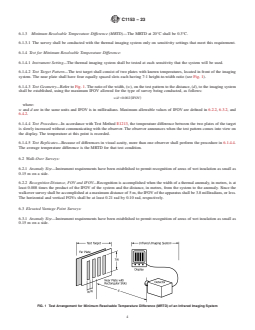
6.1.4.2 Test Target Pattern—The test target shall consist of two plates with known temperatures, located in front of the imaging
system. The near plate shall have four equally spaced slots each having 7:1 height-to-width ratio (see Fig. 1).
6.1.4.3 Test Geometry—Refer to Fig. 1. The ratio of the width, (w), on the test pattern to the distance, (d), to the imaging system
shall be established, using the maximum IFOV allowed for the type of survey being conducted, as follows:
w/d,0.002 IFOV
~ !
where:
w and d are in the same units and IFOV is in milliradians. Maximum allowable values of IFOV are defined in 6.2.2, 6.3.2, and
6.4.2.
6.1.4.4 Test Procedure—In accordance with Test Method E1213, the temperature difference between the two plates of the target
is slowly increased without communicating with the observer. The observer announces when the test pattern comes into view on
the display. The temperature at this point is recorded.
6.1.4.5 Test Replicates—Because of differences in visual acuity, more than one observer shall perform the procedure in 6.1.4.4.
The average temperature difference is the MRTD for that test condition.
6.2 Walk-Over Surveys:
6.2.1 Anomaly Size—Instrument requirements have been established to permit recognition of areas of wet insulation as small as
0.15 m on a side.
6.2.2 Recognition Distance, FOV and IFOV—Recognition is accomplished when the width of a thermal anomaly, in metres, is at
least 0.008 times the product of the IFOV of the system and the distance, in metres, from the system to the anomaly. Since the
walkover survey shall be accomplished at a maximum distance of 5 m, the IFOV of the apparatus shall be 3.8 milliradians, or less.
The horizontal and vertical FOVs shall be at least 0.21 rad by 0.10 rad, respectively.
6.3 Elevated Vantage Point Surveys:
6.3.1 Anomaly Size—Instrument requirements have been established to permit recognition of areas of wet insulation as small as
0.15 m on a side.
FIG. 1 Test Arrangement for Minimum Resolvable Temperature Difference (MRTD) of an Infrared Imaging System
C1153 − 23
6.3.2 Recognition Distance, FOV and IFOV—Since recognition must be possible at distances greater than 5 m, the maximum
allowable IFOV in milliradians is related to distance, (d), in metres from the infrared imaging system to the place on the roof being
scanned as follows:
IFOV 5 18.8/d
The minimum horizontal FOV shall be 1.0/d and the minimum vertical FOV shall be 0.5/d, both expressed in rad.
6.4 Aerial Surveys:
6.4.1 Anomaly Size—Aerial surveys shall be conducted with infrared imaging systems that have the ability to detect areas of wet
insulation as small as 0.3 m on a side directly below the system.
6.4.2 Detection Distance, FOV and IFOV—Detection is accomplished when the width of a thermal anomaly, in metres, is at least
0.002 times the product of the IFOV of the system and the distance, in metres, from the system to the anomaly. The maximum
allowable IFOV is related to the vertical distance (d), in metres, above the roof, as follows:
IFOV 5 150/d
The FOV along the line of flight and across the line of flight shall be at least 0.05 rad by 0.10 rad, respectively. The usable field
of view shall be within 0.35 rad of a point directly below the infrared imaging system.
7. Level of Knowledge
7.1 The proper conduct of a roof moisture survey using an infrared imaging system requires knowledge of how and under what
circumstances the system is used and a general understanding of roof construction.
7.2 Proper interpretation of infrared data requires knowledge of infrared theory, moisture migration, heat transfer, environmental
effects, and roof construction as they apply to roof moisture analysis.
8. Limitations (Applicability of Constructions)
8.1 Applicable constructions include membrane systems containing any of the commercially available rigid insulation boards.
This includes boa
...
Questions, Comments and Discussion
Ask us and Technical Secretary will try to provide an answer. You can facilitate discussion about the standard in here.
Loading comments...