


ASTM E1965-98(2016)
(Specification)Standard Specification for Infrared Thermometers for Intermittent Determination of Patient Temperature
Standard Specification for Infrared Thermometers for Intermittent Determination of Patient Temperature
ABSTRACT
This specification covers infrared thermometers, which are electronic instruments intended for the intermittent measurement and monitoring of patient temperatures by means of detecting the intensity of thermal radiation between the subject of measurement and the sensor. The specification addresses the assessment of the subject's internal body temperature through measurement of thermal emission from the ear canal. Though, performance requirements for noncontact temperature measurement of skin are also provided. Limits are set for laboratory accuracy, and determination and disclosure of clinical accuracy of the covered instruments are required. Performance and storage limits under various environmental conditions, requirements for labeling, and test procedures are all established herein.
SCOPE
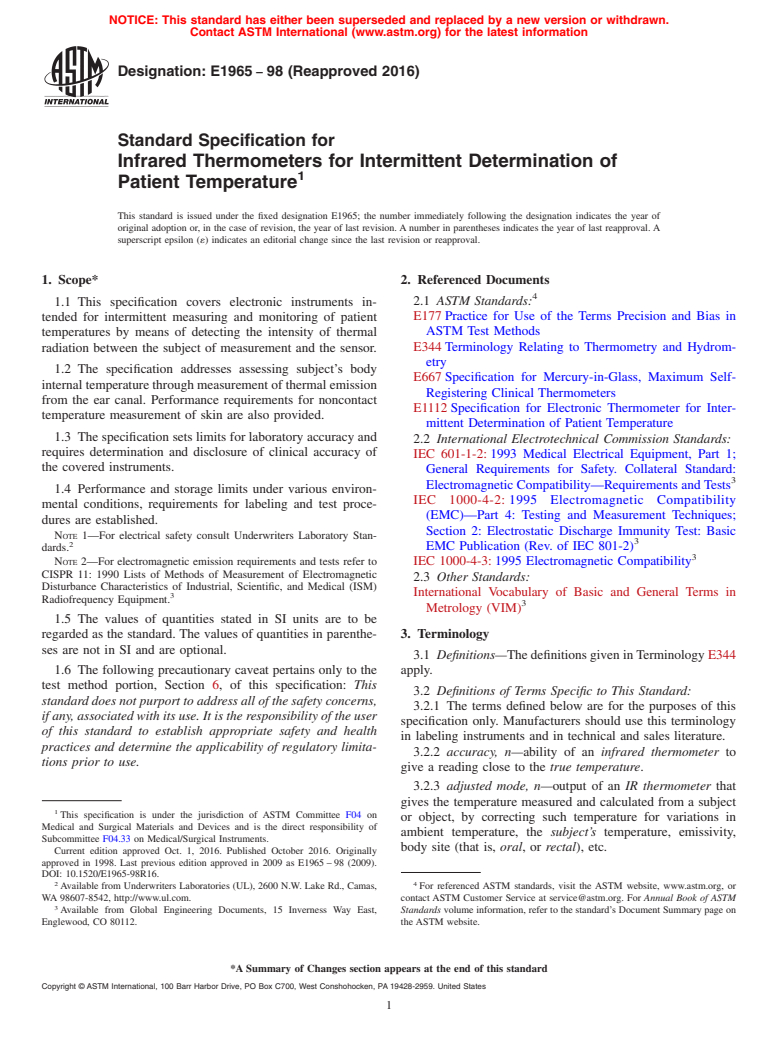
1.1 This specification covers electronic instruments intended for intermittent measuring and monitoring of patient temperatures by means of detecting the intensity of thermal radiation between the subject of measurement and the sensor.
1.2 The specification addresses assessing subject’s body internal temperature through measurement of thermal emission from the ear canal. Performance requirements for noncontact temperature measurement of skin are also provided.
1.3 The specification sets limits for laboratory accuracy and requires determination and disclosure of clinical accuracy of the covered instruments.
1.4 Performance and storage limits under various environmental conditions, requirements for labeling and test procedures are established.
Note 1: For electrical safety consult Underwriters Laboratory Standards.2
Note 2: For electromagnetic emission requirements and tests refer to CISPR 11: 1990 Lists of Methods of Measurement of Electromagnetic Disturbance Characteristics of Industrial, Scientific, and Medical (ISM) Radiofrequency Equipment.3
1.5 The values of quantities stated in SI units are to be regarded as the standard. The values of quantities in parentheses are not in SI and are optional.
1.6 The following precautionary caveat pertains only to the test method portion, Section 6, of this specification: This standard does not purport to address all of the safety concerns, if any, associated with its use. It is the responsibility of the user of this standard to establish appropriate safety and health practices and determine the applicability of regulatory limitations prior to use.
General Information
Buy Standard

Standards Content (Sample)
NOTICE: This standard has either been superseded and replaced by a new version or withdrawn.
Contact ASTM International (www.astm.org) for the latest information
Designation: E1965 − 98 (Reapproved 2016)
Standard Specification for
Infrared Thermometers for Intermittent Determination of
Patient Temperature
This standard is issued under the fixed designation E1965; the number immediately following the designation indicates the year of
original adoption or, in the case of revision, the year of last revision. A number in parentheses indicates the year of last reapproval. A
superscript epsilon (´) indicates an editorial change since the last revision or reapproval.
1. Scope* 2. Referenced Documents
2.1 ASTM Standards:
1.1 This specification covers electronic instruments in-
E177 Practice for Use of the Terms Precision and Bias in
tended for intermittent measuring and monitoring of patient
ASTM Test Methods
temperatures by means of detecting the intensity of thermal
E344 Terminology Relating to Thermometry and Hydrom-
radiation between the subject of measurement and the sensor.
etry
1.2 The specification addresses assessing subject’s body
E667 Specification for Mercury-in-Glass, Maximum Self-
internal temperature through measurement of thermal emission
Registering Clinical Thermometers
from the ear canal. Performance requirements for noncontact
E1112 Specification for Electronic Thermometer for Inter-
temperature measurement of skin are also provided.
mittent Determination of Patient Temperature
1.3 The specification sets limits for laboratory accuracy and
2.2 International Electrotechnical Commission Standards:
requires determination and disclosure of clinical accuracy of
IEC 601-1-2: 1993 Medical Electrical Equipment, Part 1;
the covered instruments.
General Requirements for Safety. Collateral Standard:
Electromagnetic Compatibility—Requirements and Tests
1.4 Performance and storage limits under various environ-
IEC 1000-4-2: 1995 Electromagnetic Compatibility
mental conditions, requirements for labeling and test proce-
(EMC)—Part 4: Testing and Measurement Techniques;
dures are established.
Section 2: Electrostatic Discharge Immunity Test: Basic
NOTE 1—For electrical safety consult Underwriters Laboratory Stan-
EMC Publication (Rev. of IEC 801-2)
dards.
NOTE 2—For electromagnetic emission requirements and tests refer to IEC 1000-4-3: 1995 Electromagnetic Compatibility
CISPR 11: 1990 Lists of Methods of Measurement of Electromagnetic
2.3 Other Standards:
Disturbance Characteristics of Industrial, Scientific, and Medical (ISM)
International Vocabulary of Basic and General Terms in
Radiofrequency Equipment.
Metrology (VIM)
1.5 The values of quantities stated in SI units are to be
regarded as the standard. The values of quantities in parenthe- 3. Terminology
ses are not in SI and are optional.
3.1 Definitions—The definitions given in Terminology E344
1.6 The following precautionary caveat pertains only to the apply.
test method portion, Section 6, of this specification: This
3.2 Definitions of Terms Specific to This Standard:
standard does not purport to address all of the safety concerns,
3.2.1 The terms defined below are for the purposes of this
if any, associated with its use. It is the responsibility of the user
specification only. Manufacturers should use this terminology
of this standard to establish appropriate safety and health
in labeling instruments and in technical and sales literature.
practices and determine the applicability of regulatory limita-
3.2.2 accuracy, n—ability of an infrared thermometer to
tions prior to use.
give a reading close to the true temperature.
3.2.3 adjusted mode, n—output of an IR thermometer that
gives the temperature measured and calculated from a subject
This specification is under the jurisdiction of ASTM Committee F04 on
or object, by correcting such temperature for variations in
Medical and Surgical Materials and Devices and is the direct responsibility of
ambient temperature, the subject’s temperature, emissivity,
Subcommittee F04.33 on Medical/Surgical Instruments.
body site (that is, oral, or rectal), etc.
Current edition approved Oct. 1, 2016. Published October 2016. Originally
approved in 1998. Last previous edition approved in 2009 as E1965 – 98 (2009).
DOI: 10.1520/E1965-98R16.
2 4
Available from Underwriters Laboratories (UL), 2600 N.W. Lake Rd., Camas, For referenced ASTM standards, visit the ASTM website, www.astm.org, or
WA 98607-8542, http://www.ul.com. contact ASTM Customer Service at service@astm.org. For Annual Book of ASTM
Available from Global Engineering Documents, 15 Inverness Way East, Standards volume information, refer to the standard’s Document Summary page on
Englewood, CO 80112. the ASTM website.
*A Summary of Changes section appears at the end of this standard
Copyright © ASTM International, 100 Barr Harbor Drive, PO Box C700, West Conshohocken, PA 19428-2959. United States
E1965 − 98 (2016)
3.2.4 axillary temperature [t ], n—temperature at the apex eter whose probe is placed into the auditory canal of a subject
ba
of either axilla (armpit) as measured by a contact thermometer. according to the manufacturer’s recommendations.
3.2.19 field of view, n—area of a subject’s surface that
3.2.5 blackbody, n—a reference source of infrared radiation
exchanges thermal radiation with the sensor.
made in the shape of a cavity and characterized by precisely
known temperature of the cavity walls and having effective
3.2.20 infrared (IR), adj—of the electromagnetic radiation
emissivity at the cavity opening arbitrarily considered equal to
within the mid- and far infrared spectral ranges (approximately
unity.
from 3 to 30 µm wavelength).
3.2.6 blackbody temperature [t ], n—temperature of 3.2.21 infrared (IR) thermometer, n—optoelectronic instru-
BB
blackbody cavity walls as measured by an imbedded or ment adapted for noncontact measurement of the temperature
immersed contact thermometer. of a subject by utilizing infrared radiation exchange between
the subject and the sensor.
3.2.7 bladder temperature, n—temperature of the interior of
3.2.22 instrumentational offset [µ ], n—calculated differ-
the urinary bladder as measured by a contact thermometer. d
ence in degrees of measured temperature between core tem-
3.2.8 body temperature, n—temperature measured from the
perature and ear canal temperature, derived from the popula-
interior of a human body cavity, such as pulmonary artery,
tion of representative study samples.
distal esophagus, urinary bladder, ear canal, oral, or rectal.
3.2.23 internal, adj—of the interior of subject’s body or
3.2.9 clinical accuracy, n—ability of an infrared ear canal
body cavity, such as pulmonary artery, urinary bladder, oral,
thermometer to give a reading close to true temperature of the
rectal, etc.
site that it purports to represent.
3.2.24 laboratory error [δ], n—difference between unad-
3.2.10 clinical bias [x¯¯ ], n—mean difference between IR
d
justed temperature as measured by an IR thermometer and
thermometer output and an internal body site temperature from
temperature of a blackbody, over specified operating condi-
subjects at specified conditions of ambient temperature and
tions of ambient temperature and humidity and blackbody
humidity and averaged over a selected group of subjects.
temperature ranges.
3.2.11 clinical repeatability [s ], n—pooled standard devia-
3.2.25 operating temperature, n—ambient temperature that
r
tion of changes in multiple ear canal temperature readings as
allows operation of an IR thermometer within specified labo-
taken from the same subject from the same ear with the same
ratory error range.
infrared thermometer by the same operator within a relatively
3.2.26 operating humidity, n—relative humidity of ambient
short time.
air which allows operation of an IR thermometer within a
3.2.12 combined site offset [µ ], n—calculated difference in specified laboratory error range.
s
degrees of measured temperature between a selected reference
3.2.27 oral temperature [t ], n—posterior sublingual tem-
bm
body site and ear canal temperature and averaged over the
perature as measured by a contact thermometer.
population of representative study samples.
3.2.28 physiological site offset, [µ ], n—difference in de-
p
3.2.13 contact thermometer, n—an instrument that is
grees of measured temperature between two body sites derived
adapted for measuring temperature by means of thermal from the representative study samples.
conductivity by determining temperature at the moment when
3.2.29 probe, n—part of an IR thermometer that channels
negligible thermal energy flows between the thermometer and
net infrared radiation between the subject and the sensor and is
the object of measurement.
intended to be positioned near or inside the subject.
3.2.14 core temperature [t ], n—temperature at a subject’s
3.2.30 probe cover, n—disposable or reusable sanitary bar-
c
body site, such as the pulmonary artery, distal esophagus,
rier enveloping that part of the probe which otherwise would
urinary bladder, or tympanic membrane, recognized as indica-
come in contact with a subject.
tive of internal body temperature and obtained with a contact
3.2.31 professional use, n—intended or implied use of an
thermometer.
instrument by individuals that are licensed or certified for
3.2.15 mode, n—an output of an IR thermometer that gives collecting information for medical diagnosing purposes.
a representation of a temperature using a disclosed calculation
3.2.32 rectal temperature [t ], n—temperature in the anal
br
technique with respect to selected reference (for example,
canal as measured by a contact thermometer.
blackbody, oral, rectal, etc.).
3.2.33 resolution, n—minimum temperature increment dis-
3.2.16 displayed temperature range, n—temperature range
played by an IR thermometer in degrees Celsius or Fahrenheit.
in degrees Celsius or Fahrenheit that can be shown by an IR
3.2.34 scale, n—graduation of temperature display in de-
thermometer.
grees Celsius or Fahrenheit.
3.2.17 IR thermometer type, n—an optoelectronic instru-
3.2.35 sensor, n—device designed to respond to net IR
ment that is capable of noncontact infrared temperature mea-
radiation and convert that response into electrical signals.
surement when placed into the auditory canal of a subject (ear
3.2.36 skin temperature, n—average temperature of a flat
canal type) or from the subject’s body surface (skin type).
skin surface as measured from the field of view of an IR skin
3.2.18 ear canal temperature [t ], n—displayed unadjusted type thermometer, with an appropriate adjustments for skin
ec
temperature measured from the field of view of an IR thermom- emissivity.
E1965 − 98 (2016)
3.2.37 system, n—combination of an IR thermometer and an each adjusted display mode, and for every age group of febrile
installed probe cover. and afebrile subjects on which the IR thermometer is intended
to be used.
3.2.38 subject, n—a human whose temperature is measured.
5.5.1.3 Any disclosure of clinical accuracy claims shall be
3.2.39 true temperature, n—temperature attributed to a
accompanied by disclosure of methodology and procedures.
particular site of a subject or object of measurement and
Such information shall be made available on request.
accepted as having a specified uncertainty.
5.5.1.4 Clinical accuracy should be determined in the form
3.2.40 tympanic temperature [t ], n—temperature of either
ty
of two characteristics—clinical bias with stated uncertainty and
tympanic membrane as measured by a contact thermometer.
clinical repeatability, as defined in 3.2.9.
3.2.41 unadjusted mode, n—an output of IR thermometer
5.6 Ambient Conditions:
that displays temperature measured and calculated from a
5.6.1 Operating Temperature Range:
subject or object, without any corrections for variations in
5.6.1.1 The system shall meet laboratory error requirements
operating temperature, subject temperature, emissivity, etc.
as specified in 5.3 or 5.4, or both, when operating in an
4. Classification
environment from 16 to 40 °C (60.8 to 104.0 °F).
5.6.1.2 If the operating temperature range is narrower than
4.1 IR thermometers may be classified into two types: “ear
specified in 5.6.1.1, the device shall be clearly labeled with a
canal IR thermometers” and “skin IR thermometers.”
cautionary statement of the maximum or minimum operating
4.1.1 The ear canal IR thermometer is intended for assessing
temperatures, or both.
the internal temperature of a subject.
4.1.2 The skin IR thermometer is intended for assessing the 5.6.1.3 Under no circumstances may the upper limit of
outer surface temperature of a subject. operating temperature range be less than 35 °C (95 °F).
5.6.2 Operating Humidity Range—The relative humidity
5. Requirements
range for the operating temperature range as specified in 5.6.1
is up to 95 %, noncondensing.
5.1 The following requirements shall apply to any IR
thermometer that is labeled to meet these specifications.
5.6.3 Shock:
5.6.3.1 The instrument with batteries installed (if appli-
5.2 Displayed Temperature Range:
cable) without a carrying (storage) casing shall withstand drops
5.2.1 In any display mode, an ear canal IR thermometer
with controlled orientation of the device without degradation of
shall display a subject’s temperature over a minimum range of
accuracy as specified in 5.3 or 5.4, or both, for a blackbody
34.4 to 42.2 °C (94.0 to 108.0 °F).
temperature of or near 37 °C (98.6 °F), when tested according
5.2.2 A skin IR thermometer shall display a subject’s
to 6.3.
temperature over a minimum range of 22 to 40.0 °C (71.6 to
104.0 °F). 5.6.3.2 If an IR thermometer does not meet the requirement
of 5.6.3.1, a means of detecting and informing the user of its
5.3 Maximum Permissible Laboratory Error (for an Ear
inoperable state, after being subjected to shock, shall be
Canal IR Thermometer):
provided.
5.3.1 Within the manufacturer’s specified operating ambient
5.6.4 Storage Conditions—The instrument shall meet the
conditions (see 5.6), laboratory error δ as measured according
accuracy requirements of 5.3 or 5.4, or both, after having been
to 6.1.4 shall be no greater than values specified below:
stored or transported, or both, at any point in an environment
5.3.1.1 For blackbody temperature range from 36 to 39 °C
of – 20 to + 50 °C (– 4 to + 122 °F) and relative humidity up
(96.8 to 102.2 °F)
to 95 %, noncondensing, for a period of one month. The test
0.2 °C (0.4 °F).
procedure is specified in 6.1.6.
5.3.1.2 For blackbody temperatures less than 36 °C (96.8
°F) or greater than 39 °C (102.2 °F) 5.6.5 Cleaning and Disinfection—Instrument performance
shall not be degraded by using the manufacturer’s recom-
0.3 °C (0.5 ° F).
mended procedures for cleaning and disinfection provided in
5.4 Maximum Permissible Laboratory Error (for a Skin IR
the instruction ma
...
This document is not an ASTM standard and is intended only to provide the user of an ASTM standard an indication of what changes have been made to the previous version. Because
it may not be technically possible to adequately depict all changes accurately, ASTM recommends that users consult prior editions as appropriate. In all cases only the current version
of the standard as published by ASTM is to be considered the official document.
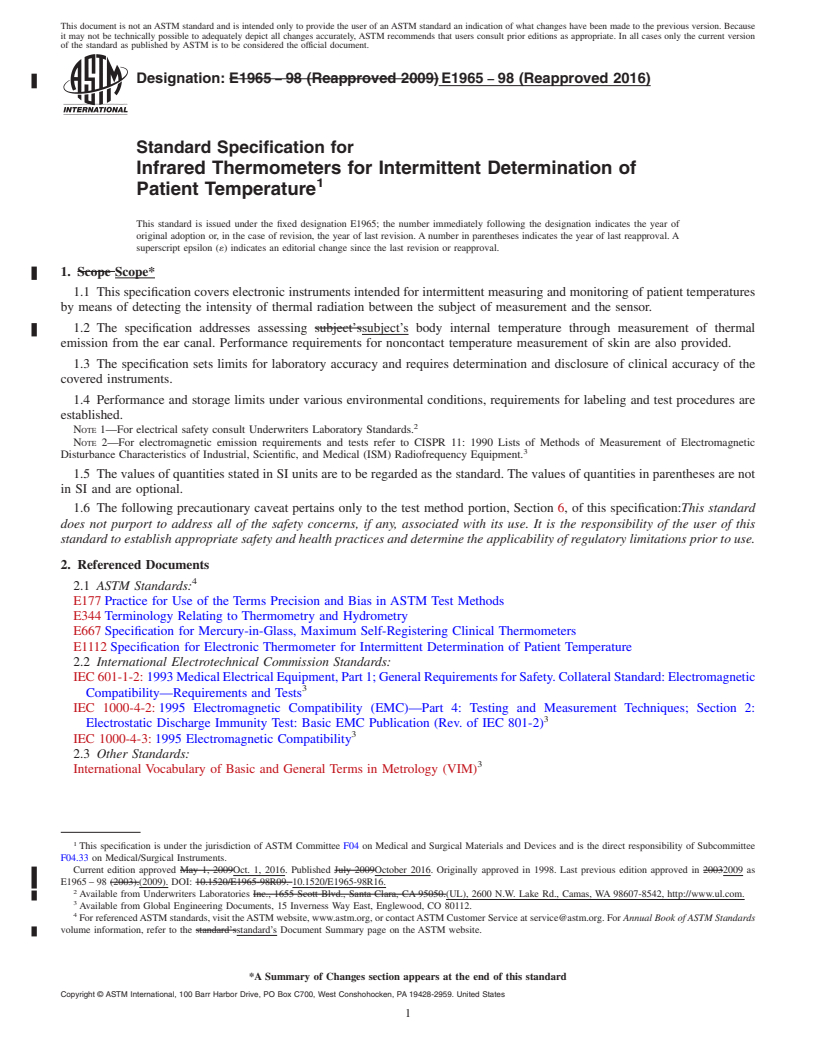
Designation: E1965 − 98 (Reapproved 2009) E1965 − 98 (Reapproved 2016)
Standard Specification for
Infrared Thermometers for Intermittent Determination of
Patient Temperature
This standard is issued under the fixed designation E1965; the number immediately following the designation indicates the year of
original adoption or, in the case of revision, the year of last revision. A number in parentheses indicates the year of last reapproval. A
superscript epsilon (´) indicates an editorial change since the last revision or reapproval.
1. Scope Scope*
1.1 This specification covers electronic instruments intended for intermittent measuring and monitoring of patient temperatures
by means of detecting the intensity of thermal radiation between the subject of measurement and the sensor.
1.2 The specification addresses assessing subject’ssubject’s body internal temperature through measurement of thermal
emission from the ear canal. Performance requirements for noncontact temperature measurement of skin are also provided.
1.3 The specification sets limits for laboratory accuracy and requires determination and disclosure of clinical accuracy of the
covered instruments.
1.4 Performance and storage limits under various environmental conditions, requirements for labeling and test procedures are
established.
NOTE 1—For electrical safety consult Underwriters Laboratory Standards.
NOTE 2—For electromagnetic emission requirements and tests refer to CISPR 11: 1990 Lists of Methods of Measurement of Electromagnetic
Disturbance Characteristics of Industrial, Scientific, and Medical (ISM) Radiofrequency Equipment.
1.5 The values of quantities stated in SI units are to be regarded as the standard. The values of quantities in parentheses are not
in SI and are optional.
1.6 The following precautionary caveat pertains only to the test method portion, Section 6, of this specification:This standard
does not purport to address all of the safety concerns, if any, associated with its use. It is the responsibility of the user of this
standard to establish appropriate safety and health practices and determine the applicability of regulatory limitations prior to use.
2. Referenced Documents
2.1 ASTM Standards:
E177 Practice for Use of the Terms Precision and Bias in ASTM Test Methods
E344 Terminology Relating to Thermometry and Hydrometry
E667 Specification for Mercury-in-Glass, Maximum Self-Registering Clinical Thermometers
E1112 Specification for Electronic Thermometer for Intermittent Determination of Patient Temperature
2.2 International Electrotechnical Commission Standards:
IEC 601-1-2: 1993 Medical Electrical Equipment, Part 1; General Requirements for Safety. Collateral Standard: Electromagnetic
Compatibility—Requirements and Tests
IEC 1000-4-2: 1995 Electromagnetic Compatibility (EMC)—Part 4: Testing and Measurement Techniques; Section 2:
Electrostatic Discharge Immunity Test: Basic EMC Publication (Rev. of IEC 801-2)
IEC 1000-4-3: 1995 Electromagnetic Compatibility
2.3 Other Standards:
International Vocabulary of Basic and General Terms in Metrology (VIM)
This specification is under the jurisdiction of ASTM Committee F04 on Medical and Surgical Materials and Devices and is the direct responsibility of Subcommittee
F04.33 on Medical/Surgical Instruments.
Current edition approved May 1, 2009Oct. 1, 2016. Published July 2009October 2016. Originally approved in 1998. Last previous edition approved in 20032009 as
E1965 – 98 (2003).(2009). DOI: 10.1520/E1965-98R09. 10.1520/E1965-98R16.
Available from Underwriters Laboratories Inc., 1655 Scott Blvd., Santa Clara, CA 95050.(UL), 2600 N.W. Lake Rd., Camas, WA 98607-8542, http://www.ul.com.
Available from Global Engineering Documents, 15 Inverness Way East, Englewood, CO 80112.
For referenced ASTM standards, visit the ASTM website, www.astm.org, or contact ASTM Customer Service at service@astm.org. For Annual Book of ASTM Standards
volume information, refer to the standard’sstandard’s Document Summary page on the ASTM website.
*A Summary of Changes section appears at the end of this standard
Copyright © ASTM International, 100 Barr Harbor Drive, PO Box C700, West Conshohocken, PA 19428-2959. United States
E1965 − 98 (2016)
3. Terminology
3.1 Definitions—The definitions given in Terminology E344 apply.
3.2 Definitions of Terms Specific to This Standard:
3.2.1 The terms defined below are for the purposes of this specification only. Manufacturers should use this terminology in
labeling instruments and in technical and sales literature.
3.2.2 accuracy, n—ability of an infrared thermometer to give a reading close to the true temperature.
3.2.3 adjusted mode, n—output of an IR thermometer that gives the temperature measured and calculated from a subject or
object, by correcting such temperature for variations in ambient temperature, the subject’ssubject’s temperature, emissivity, body
site (that is, oral, or rectal), etc.
3.2.4 axillary temperature [t ], n—temperature at the apex of either axilla (armpit) as measured by a contact thermometer.
ba
3.2.5 blackbody, n—a reference source of infrared radiation made in the shape of a cavity and characterized by precisely known
temperature of the cavity walls and having effective emissivity at the cavity opening arbitrarily considered equal to unity.
3.2.6 blackbody temperature [t ], n—temperature of blackbody cavity walls as measured by an imbedded or immersed contact
BB
thermometer.
3.2.7 bladder temperature, n—temperature of the interior of the urinary bladder as measured by a contact thermometer.
3.2.8 body temperature, n—temperature measured from the interior of a human body cavity, such as pulmonary artery, distal
esophagus, urinary bladder, ear canal, oral, or rectal.
3.2.9 clinical accuracy, n—ability of an infrared ear canal thermometer to give a reading close to true temperature of the site
that it purports to represent.
3.2.10 clinical bias [x¯¯ ], n—mean difference between IR thermometer output and an internal body site temperature from
d
subjects at specified conditions of ambient temperature and humidity and averaged over a selected group of subjects.
3.2.11 clinical repeatability [s ], n—pooled standard deviation of changes in multiple ear canal temperature readings as taken
r
from the same subject from the same ear with the same infrared thermometer by the same operator within a relatively short time.
3.2.12 combined site offset [μ ], n—calculated difference in degrees of measured temperature between a selected reference body
s
site and ear canal temperature and averaged over the population of representative study samples.
3.2.13 contact thermometer, n—an instrument that is adapted for measuring temperature by means of thermal conductivity by
determining temperature at the moment when negligible thermal energy flows between the thermometer and the object of
measurement.
3.2.14 core temperature [t ], n—temperature at a subject’ssubject’s body site, such as the pulmonary artery, distal esophagus,
c
urinary bladder, or tympanic membrane, recognized as indicative of internal body temperature and obtained with a contact
thermometer.
3.2.15 mode, n—an output of an IR thermometer that gives a representation of a temperature using a disclosed calculation
technique with respect to selected reference (for example, blackbody, oral, rectal, etc.).
3.2.16 displayed temperature range, n—temperature range in degrees Celsius or Fahrenheit that can be shown by an IR
thermometer.
3.2.17 IR thermometer type, n—an optoelectronic instrument that is capable of noncontact infrared temperature measurement
when placed into the auditory canal of a subject (ear canal type) or from the subject’ssubject’s body surface (skin type).
3.2.18 ear canal temperature [t ], n—displayed unadjusted temperature measured from the field of view of an IR thermometer
ec
whose probe is placed into the auditory canal of a subject according to the manufacturer’smanufacturer’s recommendations.
3.2.19 field of view, n—area of a subject’ssubject’s surface that exchanges thermal radiation with the sensor.
3.2.20 infrared (IR), adj—of the electromagnetic radiation within the mid- and far infrared spectral ranges (approximately from
3 to 30 μm wavelength).
3.2.21 infrared (IR) thermometer, n—optoelectronic instrument adapted for noncontact measurement of the temperature of a
subject by utilizing infrared radiation exchange between the subject and the sensor.
3.2.22 instrumentational offset [μ ], n—calculated difference in degrees of measured temperature between core temperature and
d
ear canal temperature, derived from the population of representative study samples.
3.2.23 internal, adj—of the interior of subject’ssubject’s body or body cavity, such as pulmonary artery, urinary bladder, oral,
rectal, etc.
3.2.24 laboratory error [δ], n—difference between unadjusted temperature as measured by an IR thermometer and temperature
of a blackbody, over specified operating conditions of ambient temperature and humidity and blackbody temperature ranges.
3.2.25 operating temperature, n—ambient temperature that allows operation of an IR thermometer within specified laboratory
error range.
E1965 − 98 (2016)
3.2.26 operating humidity, n—relative humidity of ambient air which allows operation of an IR thermometer within a specified
laboratory error range.
3.2.27 oral temperature [t ], n—posterior sublingual temperature as measured by a contact thermometer.
bm
3.2.28 physiological site offset, [μ ], n—difference in degrees of measured temperature between two body sites derived from the
p
representative study samples.
3.2.29 probe, n—part of an IR thermometer that channels net infrared radiation between the subject and the sensor and is
intended to be positioned near or inside the subject.
3.2.30 probe cover, n—disposable or reusable sanitary barrier enveloping that part of the probe which otherwise would come
in contact with a subject.
3.2.31 professional use, n—intended or implied use of an instrument by individuals that are licensed or certified for collecting
information for medical diagnosing purposes.
3.2.32 rectal temperature [t ], n—temperature in the anal canal as measured by a contact thermometer.
br
3.2.33 resolution, n—minimum temperature increment displayed by an IR thermometer in degrees Celsius or Fahrenheit.
3.2.34 scale, n—graduation of temperature display in degrees Celsius or Fahrenheit.
3.2.35 sensor, n—device designed to respond to net IR radiation and convert that response into electrical signals.
3.2.36 skin temperature, n—average temperature of a flat skin surface as measured from the field of view of an IR skin type
thermometer, with an appropriate adjustments for skin emissivity.
3.2.37 system, n—combination of an IR thermometer and an installed probe cover.
3.2.38 subject, n—a human whose temperature is measured.
3.2.39 true temperature, n—temperature attributed to a particular site of a subject or object of measurement and accepted as
having a specified uncertainty.
3.2.40 tympanic temperature [t ], n—temperature of either tympanic membrane as measured by a contact thermometer.
ty
3.2.41 unadjusted mode, n—an output of IR thermometer that displays temperature measured and calculated from a subject or
object, without any corrections for variations in operating temperature, subject temperature, emissivity, etc.
4. Classification
4.1 IR thermometers may be classified into two types: “ear canal IR thermometers” and “skin IR thermometers.”
4.1.1 The ear canal IR thermometer is intended for assessing the internal temperature of a subject.
4.1.2 The skin IR thermometer is intended for assessing the outer surface temperature of a subject.
5. Requirements
5.1 The following requirements shall apply to any IR thermometer that is labeled to meet these specifications.
5.2 Displayed Temperature Range:
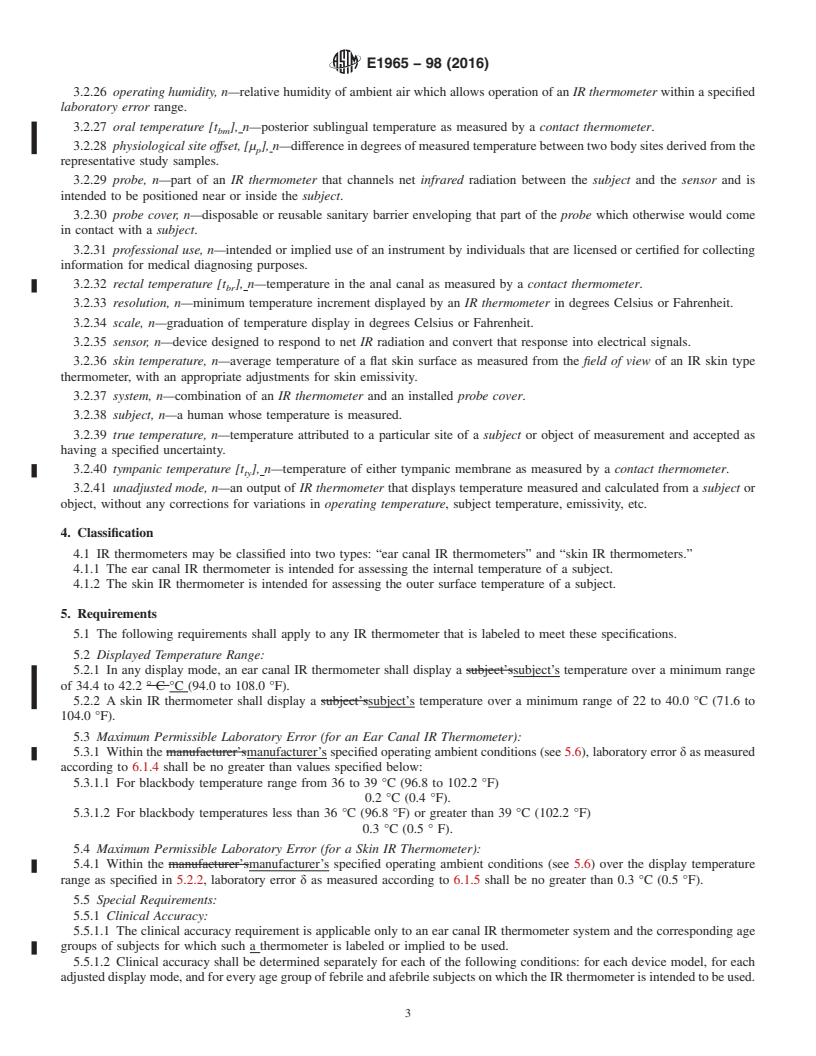
5.2.1 In any display mode, an ear canal IR thermometer shall display a subject’ssubject’s temperature over a minimum range
of 34.4 to 42.2 ° C °C (94.0 to 108.0 °F).
5.2.2 A skin IR thermometer shall display a subject’ssubject’s temperature over a minimum range of 22 to 40.0 °C (71.6 to
104.0 °F).
5.3 Maximum Permissible Laboratory Error (for an Ear Canal IR Thermometer):
5.3.1 Within the manufacturer’smanufacturer’s specified operating ambient conditions (see 5.6), laboratory error δ as measured
according to 6.1.4 shall be no greater than values specified below:
5.3.1.1 For blackbody temperature range from 36 to 39 °C (96.8 to 102.2 °F)
0.2 °C (0.4 °F).
5.3.1.2 For blackbody temperatures less than 36 °C (96.8 °F) or greater than 39 °C (102.2 °F)
0.3 °C (0.5 ° F).
5.4 Maximum Permissible Laboratory Error (for a Skin IR Thermometer):
5.4.1 Within the manufacturer’smanufacturer’s specified operating ambient conditions (see 5.6) over the display temperature
range as specified in 5.2.2, laboratory error δ as measured according to 6.1.5 shall be no greater than 0.3 °C (0.5 °F).
5.5 Special Requirements:
5.5.1 Clinical Accuracy:
5.5.1.1 The clinical accuracy requirement is applicable only to an ear canal IR thermometer system and the corresponding age
groups of subjects for which such a thermometer is labeled or implied to be used.
5.5.1.2 Clinical accuracy shall be determined separately for each of the following conditions: for each device model, for each
adjusted display mode, and for every age group of febrile and afebrile subjects on which the IR thermometer is intended to be used.
E1965 − 98 (2016)
5.5.1.3 Any disclosure of clinical accuracy claims shall be accompanied by disclosure of methodology and procedures. Such
information shall be made available on request.
5.5.1.4 Clinical accuracy should be determined in the form of two characteristics—clinical bias with stated uncertainty and
clinical repeatability, as defined in 3.2.9.
5.6 Ambient Conditions:
5.6.1 Operating Temperature Range:
5.6.1.1 The system shall meet laboratory error requirements as specified in 5.3 or 5.4, or both, when operating in an environment
from 16 to 40 °C (60.8 to 104.0 °F).
5.6.1.2 If the operating temperature range is narrower than specified in 5.6.1.1, the device shall be clearly labeled with a
cautionary statement of the maximum or minimum operating temperatures, or both.
5.6.1.3 Under no circumstances may the upper limit of operating temperature range be less than 35 °C (95 °F).
5.6.2 Operating Humidity Range—The relative h
...
Questions, Comments and Discussion
Ask us and Technical Secretary will try to provide an answer. You can facilitate discussion about the standard in here.