

ASTM D8047-23
(Test Method)Standard Test Method for Evaluation of Engine Oil Aeration Resistance in a Caterpillar C13 Direct-Injected Turbocharged Automotive Diesel Engine
General Information
- Abstract
SIGNIFICANCE AND USE
5.1 Background—Prior to this test method, the ability of an engine lubricant to resist aeration was measured by the engine oil aeration test (EOAT) described in Test Method D6894. The continued availability of engine parts coupled with field service aeration problems led to concerns about the relevance of this test method to newer oil and engine technologies. These concerns prompted the development of this new engine oil aeration test method, based on the Caterpillar C13 engine and termed COAT. This test method aims to provide a more reliable measurement of the ability of a lubricant to resist aeration during engine operation in field service. The engine used is of current technology and the aeration measurement is operator independent.
5.2 Test Method—This test method evaluates aeration performance under high-engine-speed, zero-load operation in a turbocharged, heavy-duty, four-stroke diesel engine.
5.3 Use:
5.3.1 The tendency of engine oils to aerate in direct-injection, turbocharged diesel engines is influenced by a variety of factors, including engine oil formulation, oil temperature, sump design and capacity, residence time of the oil in the sump, and the design of the pressurized oil systems. In some engine oil-activated systems, the residence time of the oil in the sump is insufficient to allow dissipation of aeration from the oil. As a consequence, aerated oil can be circulated to hydraulically activated components, adversely affecting the engine timing characteristics and engine operation.
5.3.2 The results from this test method may be compared against specification requirements such as Specification D4485 to ascertain acceptance.
5.3.3 The design of the test engine used in this test method is representative of many, but not all, diesel engines. This factor, along with the unique operating conditions, needs to be considered when comparing the test results against specification requirements.
SCOPE
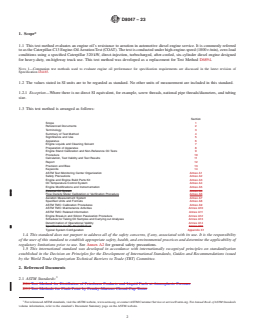
1.1 This test method evaluates an engine oil's resistance to aeration in automotive diesel engine service. It is commonly referred to as the Caterpillar-C13 Engine-Oil Aeration Test (COAT). The test is conducted under high-engine-speed (1800 r/min), zero-load conditions using a specified Caterpillar 320 kW, direct-injection, turbocharged, after-cooled, six-cylinder diesel engine designed for heavy-duty, on-highway truck use. This test method was developed as a replacement for Test Method D6894.
Note 1: Companion test methods used to evaluate engine oil performance for specification requirements are discussed in the latest revision of Specification D4485.
1.2 The values stated in SI units are to be regarded as standard. No other units of measurement are included in this standard.
1.2.1 Exception—Where there is no direct SI equivalent, for example, screw threads, national pipe threads/diameters, and tubing size.
1.3 This test method is arranged as follows:
Section
Scope
1
Referenced Documents
2
Terminology
3
Summary of Test Method
4
Significance and Use
5
Apparatus
6
Engine Liquids and Cleaning Solvent
7
Preparation of Apparatus
8
Engine Stand Calibration and Non-Reference Oil Tests
9
Procedure
10
Calculation, Test Validity and Test Results
11
Report
12
Precision and Bias
13
Keywords
14
ASTM Test Monitoring Center Organization
Annex A1
Safety Precautions
Annex A2
Engine and Engine Build Parts Kit
Annex A3
Oil Temperature Control System
Annex A4
Engine Modifications and Instrumentation
Annex A5
Flow Density Meter Calibration or Verification Procedure
Annex A6
Aeration Measurement System
Annex A7
Specified Units and Formats
Annex A8
ASTM TMC: Calibration Procedures
Annex A9
ASTM TMC: Maintenance Activities
Annex A10
ASTM TMC: Related Information
Annex A11
Engine Break-in and Silicon...
- Status
- Published
- Publication Date
- 28-Feb-2023
- Technical Committee
- D02 - Petroleum Products, Liquid Fuels, and Lubricants
- Drafting Committee
- D02.B0 - Automotive Lubricants
Buy Documents
ASTM D8047-23 - Standard Test Method for Evaluation of Engine Oil Aeration Resistance in a Caterpillar C13 Direct-Injected Turbocharged Automotive Diesel Engine
REDLINE ASTM D8047-23 - Standard Test Method for Evaluation of Engine Oil Aeration Resistance in a Caterpillar C13 Direct-Injected Turbocharged Automotive Diesel Engine
Overview
ASTM D8047-23: Standard Test Method for Evaluation of Engine Oil Aeration Resistance in a Caterpillar C13 Direct-Injected Turbocharged Automotive Diesel Engine is a critical international standard developed by ASTM International. This test method, known as the Caterpillar-C13 Engine-Oil Aeration Test (COAT), provides a modern and reliable approach to assessing the resistance of engine oils to aeration in heavy-duty diesel engine service. Aeration resistance is essential for maintaining engine performance and minimizing operational issues such as poor engine timing or malfunction of hydraulic components.
This standard supersedes the previous ASTM D6894 method and utilizes current Caterpillar C13 engine technology. The test focuses on real-world operational conditions, making the results representative of actual field use in contemporary on-highway trucks equipped with direct-injection, turbocharged diesel engines.
Key Topics
- Engine Oil Aeration: The standard specifically evaluates the tendency of engine oils to entrain air (aeration) during high-speed, zero-load diesel engine operation.
- Modern Engine Technology: Utilizes a Caterpillar 320 kW C13 direct-injection, turbocharged, after-cooled diesel engine with advanced electronic controls (ACERT technology).
- Test Relevance: Developed in response to evolving engine designs and oil formulations to address field concerns regarding engine oil aeration.
- Operator-Independent Measurement: Aeration is measured using a flow and density meter (FDM), ensuring consistent, repeatable, and operator-independent results.
- Specification Compliance: Results can be used as part of compliance with established industry specifications, such as ASTM D4485.
- Calibration and Validity: Reference oils and calibration procedures are integral, ensuring test reliability across laboratories participating in ASTM Test Monitoring Center (TMC) programs.
Applications
The ASTM D8047-23 test method has significant practical applications for:
- Engine Oil Formulators: Enables the development and validation of engine oils with improved aeration resistance suitable for modern diesel engines.
- Automotive and Truck Manufacturers: Assists in specifying and approving lubricants that ensure optimal engine operation, longevity, and reliability.
- Oil and Lubricant Testing Laboratories: Provides a standardized, reproducible test approach for assessing oil aeration performance in heavy-duty diesel engines.
- Specification Bodies: Supports qualification and acceptance testing for lubricants required to meet industry and manufacturer specifications.
- Fleet Operators and Maintenance Managers: Helps in selecting engine oils that minimize aeration-related issues, reducing maintenance costs and maximizing engine uptime.
The test is especially relevant for heavy-duty, on-highway truck engines operating in challenging service environments, where oil aeration can have direct impacts on hydraulic systems and engine timing.
Related Standards
Several ASTM test methods and standards complement or relate to ASTM D8047-23, including:
- ASTM D6894: Superseded method for evaluation of engine oil aeration resistance in older engine designs.
- ASTM D4485: Specification for Performance of Active API Service Category Engine Oils, used for comparison of test results and oil qualification.
- ASTM D445: Test method for kinematic viscosity of petroleum oils, relevant for oil formulation.
- ASTM D4052: Method for density determination, integral for calculating oil aeration in this test.
- ASTM D975: Specification for diesel fuel, specifies the fuel characteristics for testing.
- ASTM D130, D482, D613: Other related methods covering petroleum product characteristics that may influence test outcomes.
Refer to the latest standards from ASTM International for a comprehensive understanding of related testing and specification requirements.
Keywords: ASTM D8047-23, engine oil aeration, Caterpillar C13, COAT, diesel engine oil testing, lubricant performance, heavy-duty engine, ASTM standard, aeration resistance.
Relations
- Effective Date
- 01-Apr-2024
- Refers
ASTM D4175-23a - Standard Terminology Relating to Petroleum Products, Liquid Fuels, and Lubricants - Effective Date
- 15-Dec-2023
- Effective Date
- 01-Nov-2023
- Refers
ASTM D4175-23e1 - Standard Terminology Relating to Petroleum Products, Liquid Fuels, and Lubricants - Effective Date
- 01-Jul-2023
- Effective Date
- 15-Dec-2018
- Refers
ASTM D4485-18 - Standard Specification for Performance of Active API Service Category Engine Oils - Effective Date
- 01-Jul-2018
- Effective Date
- 01-Apr-2018
- Effective Date
- 01-May-2017
- Effective Date
- 15-Dec-2016
- Refers
ASTM D4485-16 - Standard Specification for Performance of Active API Service Category Engine Oils - Effective Date
- 15-Dec-2016
- Effective Date
- 01-Apr-2016
- Effective Date
- 01-Oct-2015
- Refers
ASTM D4485-15a - Standard Specification for Performance of Active API Service Category Engine Oils - Effective Date
- 15-Apr-2015
- Effective Date
- 01-Apr-2015
- Refers
ASTM D4485-15 - Standard Specification for Performance of Active API Service Category Engine Oils - Effective Date
- 01-Apr-2015
Buy Documents
ASTM D8047-23 - Standard Test Method for Evaluation of Engine Oil Aeration Resistance in a Caterpillar C13 Direct-Injected Turbocharged Automotive Diesel Engine
REDLINE ASTM D8047-23 - Standard Test Method for Evaluation of Engine Oil Aeration Resistance in a Caterpillar C13 Direct-Injected Turbocharged Automotive Diesel Engine
Get Certified
Connect with accredited certification bodies for this standard

Element Materials Technology
Materials testing and product certification.

ABS Group Brazil
ABS Group certification services in Brazil.

ABS Quality Evaluations Inc.
American Bureau of Shipping quality certification.
Sponsored listings
Frequently Asked Questions
ASTM D8047-23 is a standard published by ASTM International. Its full title is "Standard Test Method for Evaluation of Engine Oil Aeration Resistance in a Caterpillar C13 Direct-Injected Turbocharged Automotive Diesel Engine". This standard covers: SIGNIFICANCE AND USE 5.1 Background—Prior to this test method, the ability of an engine lubricant to resist aeration was measured by the engine oil aeration test (EOAT) described in Test Method D6894. The continued availability of engine parts coupled with field service aeration problems led to concerns about the relevance of this test method to newer oil and engine technologies. These concerns prompted the development of this new engine oil aeration test method, based on the Caterpillar C13 engine and termed COAT. This test method aims to provide a more reliable measurement of the ability of a lubricant to resist aeration during engine operation in field service. The engine used is of current technology and the aeration measurement is operator independent. 5.2 Test Method—This test method evaluates aeration performance under high-engine-speed, zero-load operation in a turbocharged, heavy-duty, four-stroke diesel engine. 5.3 Use: 5.3.1 The tendency of engine oils to aerate in direct-injection, turbocharged diesel engines is influenced by a variety of factors, including engine oil formulation, oil temperature, sump design and capacity, residence time of the oil in the sump, and the design of the pressurized oil systems. In some engine oil-activated systems, the residence time of the oil in the sump is insufficient to allow dissipation of aeration from the oil. As a consequence, aerated oil can be circulated to hydraulically activated components, adversely affecting the engine timing characteristics and engine operation. 5.3.2 The results from this test method may be compared against specification requirements such as Specification D4485 to ascertain acceptance. 5.3.3 The design of the test engine used in this test method is representative of many, but not all, diesel engines. This factor, along with the unique operating conditions, needs to be considered when comparing the test results against specification requirements. SCOPE 1.1 This test method evaluates an engine oil's resistance to aeration in automotive diesel engine service. It is commonly referred to as the Caterpillar-C13 Engine-Oil Aeration Test (COAT). The test is conducted under high-engine-speed (1800 r/min), zero-load conditions using a specified Caterpillar 320 kW, direct-injection, turbocharged, after-cooled, six-cylinder diesel engine designed for heavy-duty, on-highway truck use. This test method was developed as a replacement for Test Method D6894. Note 1: Companion test methods used to evaluate engine oil performance for specification requirements are discussed in the latest revision of Specification D4485. 1.2 The values stated in SI units are to be regarded as standard. No other units of measurement are included in this standard. 1.2.1 Exception—Where there is no direct SI equivalent, for example, screw threads, national pipe threads/diameters, and tubing size. 1.3 This test method is arranged as follows: Section Scope 1 Referenced Documents 2 Terminology 3 Summary of Test Method 4 Significance and Use 5 Apparatus 6 Engine Liquids and Cleaning Solvent 7 Preparation of Apparatus 8 Engine Stand Calibration and Non-Reference Oil Tests 9 Procedure 10 Calculation, Test Validity and Test Results 11 Report 12 Precision and Bias 13 Keywords 14 ASTM Test Monitoring Center Organization Annex A1 Safety Precautions Annex A2 Engine and Engine Build Parts Kit Annex A3 Oil Temperature Control System Annex A4 Engine Modifications and Instrumentation Annex A5 Flow Density Meter Calibration or Verification Procedure Annex A6 Aeration Measurement System Annex A7 Specified Units and Formats Annex A8 ASTM TMC: Calibration Procedures Annex A9 ASTM TMC: Maintenance Activities Annex A10 ASTM TMC: Related Information Annex A11 Engine Break-in and Silicon...
SIGNIFICANCE AND USE 5.1 Background—Prior to this test method, the ability of an engine lubricant to resist aeration was measured by the engine oil aeration test (EOAT) described in Test Method D6894. The continued availability of engine parts coupled with field service aeration problems led to concerns about the relevance of this test method to newer oil and engine technologies. These concerns prompted the development of this new engine oil aeration test method, based on the Caterpillar C13 engine and termed COAT. This test method aims to provide a more reliable measurement of the ability of a lubricant to resist aeration during engine operation in field service. The engine used is of current technology and the aeration measurement is operator independent. 5.2 Test Method—This test method evaluates aeration performance under high-engine-speed, zero-load operation in a turbocharged, heavy-duty, four-stroke diesel engine. 5.3 Use: 5.3.1 The tendency of engine oils to aerate in direct-injection, turbocharged diesel engines is influenced by a variety of factors, including engine oil formulation, oil temperature, sump design and capacity, residence time of the oil in the sump, and the design of the pressurized oil systems. In some engine oil-activated systems, the residence time of the oil in the sump is insufficient to allow dissipation of aeration from the oil. As a consequence, aerated oil can be circulated to hydraulically activated components, adversely affecting the engine timing characteristics and engine operation. 5.3.2 The results from this test method may be compared against specification requirements such as Specification D4485 to ascertain acceptance. 5.3.3 The design of the test engine used in this test method is representative of many, but not all, diesel engines. This factor, along with the unique operating conditions, needs to be considered when comparing the test results against specification requirements. SCOPE 1.1 This test method evaluates an engine oil's resistance to aeration in automotive diesel engine service. It is commonly referred to as the Caterpillar-C13 Engine-Oil Aeration Test (COAT). The test is conducted under high-engine-speed (1800 r/min), zero-load conditions using a specified Caterpillar 320 kW, direct-injection, turbocharged, after-cooled, six-cylinder diesel engine designed for heavy-duty, on-highway truck use. This test method was developed as a replacement for Test Method D6894. Note 1: Companion test methods used to evaluate engine oil performance for specification requirements are discussed in the latest revision of Specification D4485. 1.2 The values stated in SI units are to be regarded as standard. No other units of measurement are included in this standard. 1.2.1 Exception—Where there is no direct SI equivalent, for example, screw threads, national pipe threads/diameters, and tubing size. 1.3 This test method is arranged as follows: Section Scope 1 Referenced Documents 2 Terminology 3 Summary of Test Method 4 Significance and Use 5 Apparatus 6 Engine Liquids and Cleaning Solvent 7 Preparation of Apparatus 8 Engine Stand Calibration and Non-Reference Oil Tests 9 Procedure 10 Calculation, Test Validity and Test Results 11 Report 12 Precision and Bias 13 Keywords 14 ASTM Test Monitoring Center Organization Annex A1 Safety Precautions Annex A2 Engine and Engine Build Parts Kit Annex A3 Oil Temperature Control System Annex A4 Engine Modifications and Instrumentation Annex A5 Flow Density Meter Calibration or Verification Procedure Annex A6 Aeration Measurement System Annex A7 Specified Units and Formats Annex A8 ASTM TMC: Calibration Procedures Annex A9 ASTM TMC: Maintenance Activities Annex A10 ASTM TMC: Related Information Annex A11 Engine Break-in and Silicon...
ASTM D8047-23 is classified under the following ICS (International Classification for Standards) categories: 75.100 - Lubricants, industrial oils and related products. The ICS classification helps identify the subject area and facilitates finding related standards.
ASTM D8047-23 has the following relationships with other standards: It is inter standard links to ASTM D445-24, ASTM D4175-23a, ASTM D445-23, ASTM D4175-23e1, ASTM D7549-18, ASTM D4485-18, ASTM D5185-18, ASTM D7549-17, ASTM D445-16, ASTM D4485-16, ASTM D7549-16, ASTM D7549-15a, ASTM D4485-15a, ASTM D7549-15, ASTM D4485-15. Understanding these relationships helps ensure you are using the most current and applicable version of the standard.
ASTM D8047-23 is available in PDF format for immediate download after purchase. The document can be added to your cart and obtained through the secure checkout process. Digital delivery ensures instant access to the complete standard document.
Standards Content (Sample)
This international standard was developed in accordance with internationally recognized principles on standardization established in the Decision on Principles for the
Development of International Standards, Guides and Recommendations issued by the World Trade Organization Technical Barriers to Trade (TBT) Committee.
Designation: D8047 − 23
Standard Test Method for
Evaluation of Engine Oil Aeration Resistance in a Caterpillar
C13 Direct-Injected Turbocharged Automotive Diesel
Engine
This standard is issued under the fixed designation D8047; the number immediately following the designation indicates the year of
original adoption or, in the case of revision, the year of last revision. A number in parentheses indicates the year of last reapproval. A
superscript epsilon (´) indicates an editorial change since the last revision or reapproval.
INTRODUCTION
Portions of this test method are written for use by laboratories that make use of ASTM Test
Monitoring Center (TMC) services (see Annex A1).
The TMC provides reference oils, and engineering and statistical services to laboratories that desire
to produce test results that are statistically similar to those produced by laboratories previously
calibrated by the TMC.
In general, the Test Purchaser decides if a calibrated test stand is to be used. Organizations such as
the American Chemistry Council require that a laboratory utilize the TMC services as part of their test
registration process. In addition, the American Petroleum Institute and the Gear Lubricant Review
Committee of the Lubricant Review Institute (SAE International) require that a laboratory use the
TMC services in seeking qualification of oils against their specifications.
The advantage of using the TMC services to calibrate test stands is that the test laboratory (and
hence the Test Purchaser) has an assurance that the test stand was operating at the proper level of test
severity. It should also be borne in mind that results obtained in a non-calibrated test stand may not
be the same as those obtained in a test stand participating in the ASTM TMC services process.
ASTM International policy is to encourage the development of test procedures based on generic
equipment. It is recognized that there are occasions where critical/sole-source equipment has been
approved by the technical committee (surveillance panel/task force) and is required by the test
procedure. The technical committee that oversees the test procedure is encouraged to clearly identify
if the part is considered critical in the test procedure. If a part is deemed to be critical, ASTM
encourages alternative suppliers to be given the opportunity for consideration of supplying the critical
part/component providing they meet the approval process set forth by the technical committee.
An alternative supplier can start the process by initiating contact with the technical committee
(current chairs shown on ASTM TMC website). The supplier should advise on the details of the part
that is intended to be supplied. The technical committee will review the request and determine
feasibility of an alternative supplier for the requested replacement critical part. In the event that a
replacement critical part has been identified and proven equivalent the sole-source supplier footnote
shall be removed from the test procedure.
1. Scope*
1 1.1 This test method evaluates an engine oil’s resistance to
This test method is under the jurisdiction of ASTM Committee D02 on
Petroleum Products, Liquid Fuels, and Lubricants and is the direct responsibility of aeration in automotive diesel engine service. It is commonly
Subcommittee D02.B0 on Automotive Lubricants.
referred to as the Caterpillar-C13 Engine-Oil Aeration Test
Current edition approved March 1, 2023. Published April 2023. Originally
(COAT). The test is conducted under high-engine-speed
ε1
approved in 2016. Last previous edition approved in 2019 as D8047 – 19 . DOI:
(1800 r ⁄min), zero-load conditions using a specified Caterpillar
10.1520/D8047-23.
Until the next revision of this test method, the ASTM Test Monitoring Center
320 kW, direct-injection, turbocharged, after-cooled, six-
will update changes in the test method by means of information letters. Information
cylinder diesel engine designed for heavy-duty, on-highway
letters may be obtained from the ASTM Test Monitoring Center, 203 Armstrong
truck use. This test method was developed as a replacement for
Drive, Freeport, PA 16229, Attention: Director. This edition incorporates revisions
in all information letters through No. 22-1. http://www.astmtmc.org. Test Method D6894.
*A Summary of Changes section appears at the end of this standard
Copyright © ASTM International, 100 Barr Harbor Drive, PO Box C700, West Conshohocken, PA 19428-2959. United States
D8047 − 23
NOTE 1—Companion test methods used to evaluate engine oil perfor-
D1319 Test Method for Hydrocarbon Types in Liquid Petro-
mance for specification requirements are discussed in the latest revision of
leum Products by Fluorescent Indicator Adsorption
Specification D4485.
D3524 Test Method for Diesel Fuel Diluent in Used Diesel
1.2 The values stated in SI units are to be regarded as
Engine Oils by Gas Chromatography
standard. No other units of measurement are included in this
D4052 Test Method for Density, Relative Density, and API
standard.
Gravity of Liquids by Digital Density Meter
1.2.1 Exception—Where there is no direct SI equivalent, for
D4175 Terminology Relating to Petroleum Products, Liquid
example, screw threads, national pipe threads/diameters, and
Fuels, and Lubricants
tubing size.
D4485 Specification for Performance of Active API Service
Category Engine Oils
1.3 This test method is arranged as follows:
D5185 Test Method for Multielement Determination of
Section
Used and Unused Lubricating Oils and Base Oils by
Scope 1
Referenced Documents 2
Inductively Coupled Plasma Atomic Emission Spectrom-
Terminology 3
etry (ICP-AES)
Summary of Test Method 4
D6894 Test Method for Evaluation of Aeration Resistance of
Significance and Use 5
Apparatus 6
Engine Oils in Direct-Injected Turbocharged Automotive
Engine Liquids and Cleaning Solvent 7
Diesel Engine (Withdrawn 2022)
Preparation of Apparatus 8
D7549 Test Method for Evaluation of Heavy-Duty Engine
Engine Stand Calibration and Non-Reference Oil Tests 9
Procedure 10
Oils under High Output Conditions—Caterpillar C13 Test
Calculation, Test Validity and Test Results 11
Procedure
Report 12
Precision and Bias 13 E29 Practice for Using Significant Digits in Test Data to
Keywords 14
Determine Conformance with Specifications
ASTM Test Monitoring Center Organization Annex A1
Safety Precautions Annex A2
3. Terminology
Engine and Engine Build Parts Kit Annex A3
Oil Temperature Control System Annex A4
3.1 Definitions:
Engine Modifications and Instrumentation Annex A5
Flow Density Meter Calibration or Verification Procedure Annex A6
3.1.1 automotive, adj—descriptive of equipment associated
Aeration Measurement System Annex A7
with self-propelled machinery, usually vehicles driven by
Specified Units and Formats Annex A8
internal combustion engines. D4175
ASTM TMC: Calibration Procedures Annex A9
ASTM TMC: Maintenance Activities Annex A10
3.1.2 blowby, n—in internal combustion engines, that por-
ASTM TMC: Related Information Annex A11
tion of the combustion products and unburned air/fuel mixture
Engine Break-in and Silicon Passivation Procedure Annex A12
Schedule for Taking Oil Samples and Carrying out Analyses Annex A13
that leaks past piston rings into the engine crankcase during
Determination of Operational Validity Annex A14
operation. D4175
Typical System Configuration Appendix X1
3.1.3 break-in, v—in internal combustion engines, the run-
1.4 This standard does not purport to address all of the
ning of a new engine under prescribed conditions to help
safety concerns, if any, associated with its use. It is the
stabilize engine response and help remove initial friction
responsibility of the user of this standard to establish appro-
characteristics associated with new engine parts. D4175
priate safety, health, and environmental practices and deter-
mine the applicability of regulatory limitations prior to use. 3.1.4 calibrate, v—to determine the indication or output of a
See Annex A2 for general safety precautions.
measuring device or a given engine with respect to a standard.
1.5 This international standard was developed in accor- D4175
dance with internationally recognized principles on standard-
3.1.5 calibrated test stand, n—a test stand on which the
ization established in the Decision on Principles for the
testing of reference material(s), conducted as specified in the
Development of International Standards, Guides and Recom-
standard, provided acceptable test results.
mendations issued by the World Trade Organization Technical
3.1.5.1 Discussion—In several automotive lubricant stan-
Barriers to Trade (TBT) Committee.
dard test methods, the ASTM Test Monitoring Center provides
testing guidance and determines acceptability. D4175
2. Referenced Documents
3.1.6 calibration oil, n—an oil that is used to determine the
2.1 ASTM Standards:
indication or output of a measuring device or a given engine
D235 Specification for Mineral Spirits (Petroleum Spirits)
with respect to a standard. D4175
(Hydrocarbon Dry Cleaning Solvent)
3.1.7 calibration test, n—an engine test conducted on a
D445 Test Method for Kinematic Viscosity of Transparent
reference oil under carefully prescribed conditions, the results
and Opaque Liquids (and Calculation of Dynamic Viscos-
of which are used to determine the suitability of the engine
ity)
stand/laboratory for such tests on non-reference oils.
3.1.7.1 Discussion—A calibration test also includes tests
For referenced ASTM standards, visit the ASTM website, www.astm.org, or
contact ASTM Customer Service at service@astm.org. For Annual Book of ASTM
Standards volume information, refer to the standard’s Document Summary page on The last approved version of this historical standard is referenced on
the ASTM website. www.astm.org.
D8047 − 23
conducted on parts to ensure their suitability for use in T = 40 °C, where T is used as the symbol for the quantity
fuel
reference and non-reference tests. D4175 temperature and T is the symbol for the specific quantity
fuel
fuel temperature).
3.1.8 candidate oil, n—an oil that is intended to have the
3.1.18 reference oil, n—an oil of known performance
performance characteristics necessary to satisfy a specification
characteristics, used as a basis for comparison.
and is to be tested against that specification.
3.1.18.1 Discussion—Reference oils are used to calibrate
3.1.8.1 Discussion—These oils are mainly submitted for
testing facilities, to compare the performance of other oils, or
testing as candidates to satisfy a specified performance; hence
to evaluate other materials (such as seals) that interact with
the designation of the term. D4175
oils. D4175
3.1.9 engine oil, n—a liquid that reduces friction or wear, or
3.1.19 test oil, n—any oil subjected to evaluation in an
both, between the moving parts within an engine; removes heat
established procedure.
particularly from the underside of pistons; and serves as
3.1.19.1 Discussion—It can be any oil selected by the
combustion gas sealant for the piston rings.
laboratory conducting the test. It could be an experimental
3.1.9.1 Discussion—It may contain additives to enhance
product or a commercially available oil. Often it is an oil that
certain properties. Inhibition of engine rusting, deposit
is a candidate for approval against engine oil specifications
formation, valve train wear, oil oxidation, and foaming are
(such as manufacturers’ or military specifications, and so
examples. D4175
forth). D4175
3.1.10 foam, n—in liquids, a collection of bubbles formed in
3.1.20 volume fraction of B, φ , n—volume of component B
B
the liquid or on (at) its surface in which the air (or gas) is the
divided by the total volume of the all the constituents of the
major component on a volumetric basis. D4175
mixture prior to mixing.
3.1.20.1 Discussion—Values are expressed as pure numbers
3.1.11 heavy-duty engine, n—in internal combustion engine
or the ratio of two units of volume (for example, φ = 0.012 =
types, one that is designed to allow operation continuous at or
B
1.2 % = 1.2 cL/L).
close to its peak output.
3.1.11.1 Discussion—This type of engine is typically in- 3.2 Definitions of Terms Specific to This Standard:
stalled in large trucks and buses as well as farm, industrial, and
3.2.1 aeration, n—in lubricants, the action of impregnating
construction equipment. D4175 with air that forms foam bubbles in or on the surface of a
lubricant or is entrained as a dispersion in that lubricant.
3.1.12 lubricant, n—any material interposed between two
3.2.2 flush, n—the action of cleaning out the engine oil
surfaces that reduces the friction or wear, or both, between
system using new test oil to remove any residues as well as to
them. D4175
minimize possible carryover effect from the previous test oil.
3.1.13 lubricant test monitoring system (LTMS), n—an ana-
3.3 Abbreviations and Acronyms:
lytical system in which ASTM calibration test data are used to
3.3.1 ACERT—Advanced Combustion Emission Reduction
manage lubricant test precision and severity (bias). D4175
Technology
3.1.14 mass fraction of B, w , n—mass of a component B in
B
3.3.2 ACM—Alkyl Acrylate Copolymer
a mixture divided by the total mass of all the constituents of the
3.3.3 BL—Baseline (refers to density of fresh, un-aerated oil
mixture.
at 90 °C)
3.1.14.1 Discussion—Values are expressed as pure numbers
3.3.4 BOT—Beginning of Test
or the ratio of two units of mass (for example, mass fraction of
3.3.5 CARB—California Air Resources Board
-6
lead is w = 1.3 × 10 = 1.3 mg/kg). 5
B
3.3.6 Cat —abbreviation for Caterpillar
3.1.15 non-reference oil, n—any oil other than a reference 3.3.7 COAT—Caterpillar-C13 Oil-Aeration Test
3.3.8 CPD—Central Parts Distributor
oil; such as a research formulation, commercial oil, or candi-
date oil. D4175 3.3.9 ELC —Extended-Life Coolant
3.3.10 EOAT—Engine-Oil Aeration Test
3.1.16 quality index (QI), n—a mathematical formula that
3.3.11 ET—Engine Technician
uses data from controlled properties to calculate a value
3.3.12 EOT—End of Test
indicative of control performance. D4175
3.3.13 FDM—Flow and Density Meter
3.1.17 quantity, n—in the SI, a measurable property of a
3.3.14 ICP-AES—Inductively Coupled Plasma Atomic
body or substance where the property has a magnitude ex-
Emission Spectrometry
pressed as the product of a number and a unit; there are seven,
3.3.15 ID—Internal Diameter
well-defined base quantities (length, time, mass, temperature,
3.3.16 LTMS—Lubricant Test Monitoring System
amount of substance, electric current, and luminous intensity)
3.3.17 NPT—National Pipe Thread
from which all other quantities are derived (for example,
3.3.18 OA—Oil Aeration
volume, whose SI unit is the cubic metre).
3.1.17.1 Discussion—Symbols for quantities must be care-
fully defined; they are written in italic font, can be upper or
Registered trademark of Caterpillar Inc., 100 North East Adams St., Peoria, IL
lower case, and can be qualified by adding further information
61629.
in subscripts, or superscripts, or in parentheses (for example, Trademark of Caterpillar Inc., 100 North East Adams St., Peoria, IL 61629.
D8047 − 23
3.3.19 P/N—Part Number (applies only to parts sourced oil aeration test (EOAT) described in Test Method D6894. The
from Caterpillar) continued availability of engine parts coupled with field service
3.3.20 QI—Quality Index aeration problems led to concerns about the relevance of this
3.3.21 RCV—Research Control Valve test method to newer oil and engine technologies. These
3.3.22 SLBOCLE—Scuffing Load Ball-on-Cylinder Lubric- concerns prompted the development of this new engine oil
ity Evaluator aeration test method, based on the Caterpillar C13 engine and
3.3.23 SS—Stainless Steel termed COAT. This test method aims to provide a more reliable
3.3.24 TMC—Test Monitoring Center of ASTM measurement of the ability of a lubricant to resist aeration
3.3.25 ULSD fuel—Ultra-Low-Sulfur Diesel fuel during engine operation in field service. The engine used is of
current technology and the aeration measurement is operator
3.4 Quantity Symbols:
independent.
3.4.1 OA—Oil Aeration, %, (see 11.2.1.3)
3.4.2 P —Pressure of the aerated oil sampled during 5.2 Test Method—This test method evaluates aeration per-
SAMPLE
the 50 h test determined as the average of the FDM inlet- and formance under high-engine-speed, zero-load operation in a
turbocharged, heavy-duty, four-stroke diesel engine.
outlet-pressures (see 10.5.6.3)
3.4.3 T—Temperature (see 10.4.2.3)
5.3 Use:
3.4.4 T —Temperature of the aerated oil sampled
SAMPLE
5.3.1 The tendency of engine oils to aerate in direct-
during the 50 h test determined as the average of the FDM
injection, turbocharged diesel engines is influenced by a
inlet- and outlet-temperatures (see 10.5.6.4)
variety of factors, including engine oil formulation, oil
3.4.5 ρ—density (see 10.4.2.3)
temperature, sump design and capacity, residence time of the
3.4.6 ρ —air density calculated at the temperature and
AIR
oil in the sump, and the design of the pressurized oil systems.
pressure of the aerated oil sample during the 50 h test (see
In some engine oil-activated systems, the residence time of the
11.2.1.2)
oil in the sump is insufficient to allow dissipation of aeration
3.4.7 ρ —baseline density of the un-aerated fresh oil at
BL, 90
from the oil. As a consequence, aerated oil can be circulated to
90 °C determined as the intercept of the D4052 density versus
hydraulically activated components, adversely affecting the
temperature regression (see 10.4.2.3)
engine timing characteristics and engine operation.
3.4.8 ρ —the measured FDM density of the aerated
SAMPLE
5.3.2 The results from this test method may be compared
oil sampled during the 50 h test at the temperature T
SAMPLE
against specification requirements such as Specification D4485
(see 10.5.6.4)
to ascertain acceptance.
3.4.9 ρ —the calculated FDM density of the aer-
SAMPLE, 90
5.3.3 The design of the test engine used in this test method
ated oil sampled during the 50 h test at 90 °C (see 11.2.1.1)
is representative of many, but not all, diesel engines. This
d
3.4.10 ρ —temperature dependence of the baseline den- factor, along with the unique operating conditions, needs to be
BL
dT
considered when comparing the test results against specifica-
sity of fresh, un-aerated oil determined as the slope of the
tion requirements.
density vs. temperature regression of fresh, un-aerated oil (see
10.4.2.3)
6. Apparatus
4. Summary of Test Method
6.1 Test Stand—The test stand consists of the test engine and
the aeration measurement system.
4.1 This test method uses a production Caterpillar C13
6.1.1 Test Engine—The test engine is a production 2004
diesel engine. It is installed on a stand equipped with appro-
7,8
Caterpillar 320 kW C13 engine, designed for heavy-duty,
priate instrumentation to record and control various operating
on-highway truck use. It is an electronically controlled,
quantities. This test is run on an engine that is built with new
turbocharged, after-cooled, direct-injected, six-cylinder diesel
components except where specified in this document and then
engine with an in-block camshaft and a four-valve per cylinder
used for oil evaluations until operational conditions or aeration
arrangement. The engine uses Caterpillar’s ACERT technology
performance are impacted by the engine condition.
featuring multiple injections per cycle and inlet-valve actuation
4.2 The test operation involves two test oil flushes of 40 min
control. It features a 2004 US EPA emissions configuration
duration for each test, a test warmup for 40 min, and then a test
with electronic control for metering of the fuel and timing the
length of 50 h at high-engine-speed (1800 r/min), zero-load
fuel injection and inlet-valve actuation. See Annex A3 for the
conditions.
source of the test engine and critical and non-critical parts.
4.3 The percent aeration of the engine oil is determined
6.1.2 Aeration Measurement System—The aeration mea-
using a flow and density meter to continuously monitor the
surement system uses the density measurement to calculate the
density of a small portion of diverted gallery oil flow that has
percent entrained air volume within the engine oil at a given
controlled pressure, temperature, and flow rate. The density of
pressure and temperature. The system shall utilize a Micro
this oil is used to calculate the percentage of total sample
volume that is entrained air.
The sole source of supply of the apparatus known to the committee at this time
5. Significance and Use is Caterpillar Inc., 100 North East Adams St., Peoria, IL 61629.
If you are aware of alternative suppliers, please provide this information to
5.1 Background—Prior to this test method, the ability of an
ASTM International Headquarters. Your comments will receive careful consider-
engine lubricant to resist aeration was measured by the engine ation at a meeting of the responsible technical committee, which you may attend.
D8047 − 23
Motion Elite, Model CMF 025 coriolis-based, flow and density 6.2.6 Turbocharger—Modify the turbocharger wastegate for
meter (FDM) with a remote core processor in a 5700R manual control by replacing the supplied pressure control with
9 3
transmitter, capable of measuring density to less than 1 kg ⁄m . a manual linkage. See Fig. A5.3.
The calculation of the percent aeration is based on the
6.3 Test-Stand Configuration:
difference in density between an un-aerated oil sample (mea-
6.3.1 For Full-Load Break-In—Configure the stand with a
sured by Test Method D4052) and the density of the aerated oil
drive-line and dynamometer capable of meeting the conditions
during the test measured by the FDM. The aeration measure-
described in the break-in and on-test subsections in Section 10,
ment system comprises a heated line, a pressure-control valve,
Procedure, of Test Method D7549. Remove all break-in spe-
the FDM, a variable-speed pump, and pressure transducers and
cific systems once break-in is complete. The modified oil pan
thermocouples. Assemble the system with the indicated line
may be used for the aeration test provided that all unused ports
lengths, fittings and components as shown in the schematic
are plugged. The location for the pump supply of the oil pan is
described in A7.1.
capped when this system is not in use.
6.3.2 Engine Mounting—Install the engine so that it is
6.2 Test Engine Configuration:
upright and the crankshaft is horizontal.
6.2.1 Oil-Heat Exchanger and Oil-Heat System—Replace
6.3.2.1 Configure the engine-mounting hardware to mini-
the standard Caterpillar oil-heat exchanger core with a stainless
7,8
mize block distortion when the engine is fastened to the
steel core, Caterpillar P/N 1Y-4026. Additionally, install a
mounts. Excessive block distortion may influence test results.
remotely mounted heat exchanger vertically with a drain valve
6.3.3 Intake Air System—With the exception of the air filter
on the outlet. See Figs. A4.1 and A4.2. Control the oil
and intake air tube, the intake air system is not specified. See
temperature with a dedicated cooling loop and control system
Fig. X1.1 for a typical configuration. Use a suitable air filter.
which is separate from the engine coolant (see Annex A4).
Install the intake air tube (Fig. A5.4) at the intake of the
Ensure that the oil-cooler bypass valve is blocked closed.
turbocharger compressor. The intake air tube is a minimum
NOTE 2—In subsequent text, P/N denotes the part number for parts
305 mm of straight, nominal 102 mm diameter tubing. The
sourced from Caterpillar. Footnotes 7 and 8 apply.
system configuration upstream of the air tube is not specified.
6.2.2 Oil Pan Modification—Modify the oil pan as shown in
NOTE 3—Difficulty in achieving or maintaining intake-manifold pres-
Figs. A4.1-A4.4 of Annex A4 of Test Method D7549. Install
sure or intake-manifold temperature, or both, may be indicative of
the oil pan jacket as shown in Fig. A5.1. insufficient or excessive restriction.
6.2.3 Engine Control Module (ECM)—The ECM defines the
6.3.4 Charge Air Cooler—In addition to the Caterpillar-
desired engine fuel timing and quantity. It also limits maximum
supplied, charge air cooler which is engine mounted, use
engine speed and power. Caterpillar electronic governors are
another cooler to simulate the air-to-air charge air cooler used
10,8
designed to maintain a speed indicated by the throttle position
in most field applications. A Modine cooler (part number
signal. Speed variation drives fuel demand (rack). Rack and
1A012865) has been found suitable for this use.
engine speed are input to the injection duration and timing
Alternatively, other charge air coolers may be used that provide
maps to determine duration and timing commands for the fuel
sufficient cooling capacity to control inlet-manifold tempera-
injectors. Obtain special oil-test, engine-control software
tures in the range specified elsewhere in this test method. Equip
(module P/N 250-6775-03) for correct maps. Contact the
all coolers with a drain system to remove condensate continu-
Caterpillar oil-test representative through TMC for installation
ously from the boost air cooler outlet side. Remove the coolant
of this software. Use the Caterpillar engine technician (ET)
diverter valve diaphragm for the Caterpillar-supplied, charge-
service software package, version 2004B or later, to monitor
air cooler.
engine parameters, flash software, and to change power and
6.3.5 Exhaust System—Install the exhaust tube, see Fig.
injector trim values. Use the full dealer version purchased from
A5.5, at the discharge flange of the turbocharger-turbine
a Caterpillar dealer with a yearly subscription.
housing. Downstream exhaust piping is required but is left to
the discretion of the laboratory to fabricate. Include a method
6.2.4 Crankshaft Position Sensor—Sense the crankshaft
position using a primary sensor at the crankshaft gear and a to control exhaust back pressure.
6.3.6 Fuel System—The fuel supply and filtration system is
secondary sensor at the camshaft gear. The secondary sensor
provides position information during cranking and in the event not specified. See Fig. X1.2 for a typical configuration.
Determine the fuel consumption rate by measuring the rate of
of a primary sensor position failure. Calibrate the engine
control software before starting the timed test operation. fresh fuel flowing into the day tank. Provide a method to
control fuel temperature. Return the excess fuel from the
6.2.5 Air Compressor—Do not use the engine-mounted air
engine into the day tank.
compressor for this test method. Remove the air compressor
and in its place install block-off plates. P/N 227-2574 (cover
group) and P/N 223-3873 (plug group) have been found
The sole source of supply of this cooler known to the committee at this time
satisfactory for this purpose.
is Modine Manufacturing Company. www.modine.com.
Obtain the Modine cooler from a Mack Truck dealer. Order the aftercooler
using part number 5424 03 928 031. This is a non-stocked part in the Mack Parts
Distribution System and appears as an invalid part number. Instruct the dealer to
The sole source of supply of the apparatus known to the Committee at this time expedite the aftercooler on a Ship Direct purchase order. The aftercooler will be
is Emerson Process Management Micro Motion Americas, 7070 Winchester Circle, shipped directly from Modine, bypassing the normal Mack Parts Distribution
Boulder, CO 80301. www.emersonprocess.com. System.
D8047 − 23
6.3.7 Coolant System—The system configuration is not time responses in accordance with the Data Acquisition and
13,14
specified. See Fig. X1.3 showing a typical configuration Control Automation II (DACA II) Task Force Report.
consisting of a non-ferrous core heat exchanger, a reservoir
6.5 Oil Sample Containers—Preferably use high-density
(expansion tank), and a temperature control valve. Pressurize
polyethylene containers for oil samples. (Warning—Avoid
the system by regulating air pressure at the top of the expansion
using glass containers which may break and cause injury or
tank. Ensure the system has a sight glass to detect air
exposure to hazardous materials.)
entrapment.
6.3.7.1 System volume is not specified. Avoid a very large
7. Engine Liquids and Cleaning Solvent
volume as it may increase the time required for the engine
7.1 Test Oil—Approximately 115 L of test oil is required to
coolant to reach operating temperatures.
complete the test.
6.3.8 Pressurized Oil-Fill System—The oil-fill system is not
7.2 Test Fuel—Approximately 490 L of Chevron Philips
specified. A typical system includes an electric pump, a 50 L
14,15,8
PC-10 ultra-low-sulfur diesel (ULSD) fuel is required to
reservoir, and a transfer hose.
complete the test. The fuel shall have the properties and
6.3.9 External Oil System for Full-Load Break-In:
tolerances shown in the “PC-10 Fuel Specification” section of
6.3.9.1 The locations for the pump supply and return port of
the “TMC-Monitored Test Fuel Specifications” document
the oil pan are capped when this system is not in use.
maintained on the TMC website at http://www.astmtmc.org/
6.3.9.2 Oil Sample Valve Location—Locate the oil sample
ftp/docs/fuel/tmc-
valve on the oil sump drain port. See Fig. A5.2.
monitored%20test%20fuel%20specifications.pdf.
6.3.9.3 Unacceptable Oil System Materials—Do not use
brass or copper fittings because they can adversely influence
7.3 Engine Coolant:
the analyses for oil-wear metals in the external oil system.
7.3.1 Use a mixture of equal parts by volume of mineral-
6.3.10 Crankcase Aspiration—Vent the blowby gas at the
free water and Caterpillar brand, coolant concentrate P/N
7,8
blowby filter housing located at the left-front side of the
238-86476.
cylinder head cover (Fig. A5.6). Use crankcase breather P/N
7.3.2 As an option, premixed coolant is available and may
9Y-4357. Use breather spacer P/N 221-3934 or equivalent plate
be used directly.
20 mm thick with a fully open center. Use gasket P/N 9Y-1758
7.3.2.1 Table 2 shows Caterpillar part numbers for several
on each side of the spacer.
6.3.11 Blowby Rate—See the general configuration of this
system in Fig. A5.6. The minimum internal volume of the
A B
TABLE 2 Part Numbers for Cat ELC Coolant Concentrate and
blowby canister is 26.5 L. The inside diameter of the pipe
Premixes
C
connecting the breather outlet to the blowby canister is 32 mm. Tote,
Container Size 3.8 L 19 L 208 L
275 g
Incline the pipe downward to the canister. The hose connecting
Concentrate P/N 238-8647 { . .
the blowby canister to the device for measuring the flow rate is
D
Premix P/N 238-8648 238-8649 238-8650 361-1024
not specified but it shall match closely to the inlet of the device.
A
Registered Trademark of Caterpillar Inc., 100 North East Adams St., Peoria, IL
The device for measurement of flow rate is not specified, but
61629.
B
shall be capable of measuring approximately 70 L/min. The Trademark of Caterpillar Inc., 100 North East Adams St., Peoria, IL 61629.
C
12,13,8
A small container.
J-TEC Associates, Inc. Model No. YF563A or YF563B
D
Equal parts by volume of mineral-free water and coolant concentrate.
have been found to give satisfactory results under the condi-
tions specified in this test method.
6.4 System Time Responses—The maximum allowable sys-
tem time responses are shown in Table 1. Determine system
container sizes for concentrate and premixed coolant.
7.3.3 Replace the coolant mixture after 5000 h. The mixture
shall remain at equal parts by volume of water and concentrate
during the course of the test. Keep the coolant mixture free
TABLE 1 Maximum Allowable System Time Responses
from contamination.
Quantity Time Response
Speed 2.0 s 7.4 Cleaning Solvent—Use a solvent meeting the require-
Temperature 3.0 s
ments of Specification D235, Type II, Class C for volume
Pressure 3.0 s
fraction of aromatics 0 % to 2 %, flash point (61 °C, min), and
Fuel Flow 40.0 s
Oil-Sample Flow 4.0 s color (not darker that +25 Saybolt or 25 Pt-Co). Obtain a
certificate of analysis for each batch of solvent from the
supplier. (Warning—Combustible. Health Hazard. Use ad-
equate safety precautions.)
The sole source of supply of the apparatus known to the committee at this time
is J-TEC Associates, Inc., 5005 Blairs Forest Lane NE, Suite L, Cedar Rapids, IA The sole source of supply of the fuel known to the committee at this time is
52402. www.j-tecassociates.co. Chevron Philips Chevron Phillips Chemical Company LP, 10001 Six Pines Drive,
Available at: http://ftp.astmtmc.org/docs/TechnicalGuidanceCommittee/ Suite 4036B, The Woodlands, TX 77387-4910, www.cpchem.com.
minutes/BestPractices/DACA_II_ Loctite is a registered trademark of Henkel Corp., 26235 First Street, Westlake,
Data%20Acquisition%20and%20Control%20Automation.pdf. OH 44145.
D8047 − 23
7.5 Sealant—Because leached silicon from engine gaskets 8.2.4 Coolant Thermostat—Lock the engine coolant ther-
and sealants can cause elevated aeration levels (see A12.1), use mostat open.
silicon-free sealants such as alkyl acrylate copolymer (ACM). 8.2.5 Fuel Injectors—Use P/N 239-4908 fuel injectors. If
15,16,8
Loctite 5810A (item 39210 or 39211) has been found fuel injectors are reused, exercise caution to avoid mechanical
suitable for this purpose. damage to or contamination of the nozzles. Dedicate the
injectors to a particular cylinder. Install the injectors according
8. Preparation of Apparatus
to the method described in Caterpillar Service Manual Form
16 17,18,8
8.1 Cleaning of Parts During Rebuild:
SENR9700. Use Mobil EF-411 engine oil as the
8.1.1 General—Preparation of test engine components spe-
build-up oil for the injector O-rings.
cific to the Caterpillar C13 engine rebuild are indicated in this
8.2.6 Piston-Cooling Tubes—Aim the piston-cooling tubes
section. Use the Caterpillar Service Manual Form SEN R
at the underside of the pistons according to the specifications
16,17
9700 for the preparation of other components (except for
on the TMC website. Contact the TMC for details.
the piston second ring—see 8.2.7.1). Take precautions to
8.2.7 New Parts:
prevent rusting of iron components. Use of an engine parts
8.2.7.1 General—The following new parts are included in
washer followed by a solvent wash is permitted.
the Engine Build Parts List. They are not reusable. Clean the
8.1.2 Engine Block—Disassemble the engine, including re-
parts prior to use. A full rebuild parts list is available from the
moval of the crankshaft, camshaft, piston cooling tubes, oil
TMC. For piston second rings, follow the Test Method D7549
pump, and oil gallery plugs. Thoroughly clean the surfaces and
Piston Second Ring Pre-Test Cleaning Procedure, available
oil passages (galleries). Use a nylon brush to clean the oil
from the TMC. During a test, a replacement of any of the new
passages. Removal of camshaft bearings is optional.
parts listed below will invalidate the test and terminate the
8.1.3 Cylinder Head, Intake System, and Duct—
current calibration period:
Disassemble and clean these components during engine re-
8.2.7.2 List of (Non-Reusable) New Parts:
build. Scrub with a nylon brush and solvent. Use of an engine
(1) Pistons,
parts washer followed by a solvent wash is permitted.
(2) Piston rings (top, second, and oil),
8.1.4 Rocker Cover and Oil Pan—Clean the rocker cover
(3) Cylinder liners,
and oil pan. Use a nylon brush, as necessary, to remove
(4) Valves (intake, exhaust),
deposits.
(5) Valve guides,
8.1.5 External Oil Mass System—Flush the internal surfaces
(6) Valve seats,
of the oil lines and the external reservoir with solvent. Repeat
(7) Connecting-rod bearings, main bearings, and
until the solvent drains cleanly. Flush the solvent through the
thrust plate,
oil pumps until the solvent drains cleanly, then air dry.
(8) Turbochargers,
8.1.6 High-Pressure Turbocharger—Carefully remove the
(9) Oil pump, and
turbine housing from the turbocharger and clean the wastegate
(10) Oil-pressure regulator springs located inside of the
valve with solvent and a soft-wire brush.
oil-filter block.
8.1.7 Cam-Follower Assembly—Take the cam follower as-
8.3 Operational Measurements:
sembly apart and inspect the bushings and pins. Replace the
8.3.1 Specified Units and Formats—See Annex A8.
parts as necessary.
8.3.1.1 Measurement of Fuel Consumption Rate—Calibrate
8.2 Engine Assembly:
the system for measuring the fuel consumption rate before each
8.2.1 General:
sequence of reference oil tests and within six months after
8.2.1.1 Perform an engine assembly at the laboratory’s
completion of the last successful calibration test. Compensate
discretion. Instances when an engine rebuild should be consid-
volumetric systems for temperature, and calibrate them against
ered include not meeting operational conditions, or when
a standard mass-flow device. The flow meter on the test stand
reference limits cannot be met.
shall agree within 0.2 % of the calibration standard, that
8.2.1.2 Except as noted in this section, use the procedures
standard itself being calibrated against a national standard.
described in the Caterpillar Service Manual Form SEN R
8.3.1.2 Calibration of Temperature-Measurement System—
9700. Assemble the engine with the components shown in the
Calibrate the temperature-measurement systems before each
Engine Build Parts List (Annex A3).
reference oil test sequence and within six months after comple-
8.2.2 Parts Reuse and Replacement—Reuse engine
tion of the last successful calibration test. Each temperature-
components, except as noted in 8.2.7, provided they meet
measurement system shall agree within 60.5 °C of the labo-
production tolerances as described in the Caterpillar Service
ratory calibration standard, that standard itself being calibrated
Manual.
against a national standard.
8.2.3 Build-Up Oils—For the head, main caps, and rod
8.3.1.3 Calibration of Pressure-Measurement System—
bolts, use CAT DEO-ULS engine oil as the build-up oil. If
Calibrate the pressure-measurement systems before each ref-
test oil is used, the engine build is valid only for the respective
erence oil test sequence and within six months after completion
test oil.
16 18
Available from a Caterpillar parts distributor. Supporting data have been filed at ASTM International Headquarters and may
The sole source of this oil known to the committee at this time is Exxon-Mobil be obtained by requesting Research Report RR:D02-1218. Contact ASTM Customer
Oil Corp., P.O. Box 66940, AMF O’Hare, IL 60666, Attention Illinois Order Board. Service at service@astm.org.
D8047 − 23
of the last successful calibration test. Confirm the calibration 8.3.2.10 Oil Sump Temperature—Insert a thermocouple to a
standard against a national standard. depth of 50 mm into the drain-plug port on the right-front pan
pictured in Fig. A5.2.
8.3.1.4 Calibration and Verification of FDM:
8.3.2.11 Additional Temperatures—It is permissible to mea-
(1) Calibration of FDM System is required for new instal-
lation of a COAT Aeration Measurement System or replace- sure any additional temperatures that may be useful for test
operation or engine diagnostics.
ment of Micro Motion Assembly components found in Annex
A7 Drawings_REV3_5_7_19. Calibrate the Newly Installed
NOTE 4—Additional exhaust sensor locations, at the exhaust ports and
Box and Micro Motion FDM System using n-Decane (99+ %)
pre-turbine (front and rear), are recommended. The detection of changes
and EF411 oil to determine potential gains and offsets for the
in exhaust temperatures is an important diagnostic feature.
FDM Density Data Acquisition (DAQ) measurement as com-
8.3.3 Locations for Pressure-Measurement Sensors:
pared with Test Method D4052 Density/Temperature sweeps of
8.3.3.1 General—The measurement equipment is not speci-
both fluids as outlined in Annex A6. Reference Two Fluid
fied. Follow the guidelines in ASTM Research Report
EF411 nDecane Calibration Summary.xlsx file available on the
RR:D02-1218 for the accuracy and resolution of the
TMC website to follow Gain and Slope determination.
pressure-measurement sensors and the complete measurement
SeeA6.2 for Set Up procedure and methodology.
system. If the laboratory has problems with condensation
(2) Verification of FDM System is required for each
forming in the pressure lines, install a condensation trap at the
subsequent Reference period of the stand (6 months or test
lowest elevation of the tubing between the pressure-
limit): Verify the Micro Motion FDM Apparatus using Refer-
measurement location and the final pressure sensor for crank-
ence Oils 832-1 or 833-1 along with the nDecane results from
case pressure, intake-air pressure, and exhaust pressure. Route
the original calibration to determine potential changes in gains
the tubing to avoid intermediate loops or low spots before and
and offsets for the FDM Density Data Acquisition (DAQ)
after the condensation trap.
measurement as compared with Test Method D4052 Density/
8.3.3.2 Oil Gallery Pressure—Measure the pressure from
Temperature sweeps of both fluids as outlined in Annex A6.
the upper vertical port of the ⁄8 in. 4-way cross fitting on the
Reference Two Fluid Reference Oil nDecane Verification
right rear of the engine (Fig. A5.11).
Summary.xlsx file available on the TMC website to follow Gain
and Slope determination. See A6.3 for setup procedure and
8.3.3.3 Oil Filter Inlet Pressure—Measure the pressure at
methodology. the plug located on the inlet side of the oil filter assembly (Fig.
A5.13).
8.3.2 Locations for Temperature Measurement Sensors:
8.3.3.4 Inlet Manifold Pressure—Measure the pressure at
8.3.2.1 General—The measurement equipment is not speci-
the ⁄4 in. NPT port on the outside radius of the inlet-manifold
fied. Install the sensors such that the tip is located midstream of
elbow (Fig. A5.12).
the flow unless otherwise indicated. The accuracy and mea-
surement of the temperature-measurement sensors and the 8.3.3.5 Crankcase Pressure—Measure the pressure by in-
complete measurement system shall follow the guidelines in
stalling a bulkhead fitting in the top of the valve cover. (Fig.
14,18
ASTM Research Report RR:D02-1218. A5.7).
8.3.2.2 Coolant-Out Temperature—Install the sensor in the 8.3.3.6 Intake Air Pressure—Measure the pressure at a wall
fitting on the thermostat housing (Fig. A5.8).
tap on the intake-air tube 153 mm upstream of the compressor
connection (Fig. A5.4).
8.3.2.3 Coolant-In Temperature—Install the sensor on the
right side of the coolant-pump intake housing at the 1 in. NPT 8.3.3.7 Exhaust Pressure—Measure the pressure on the
port (Fig. A5.9). exhaust tube (Fig. A5.5).
8.3.2.4 Fuel-In Temperature—Install the sensor in the fuel- 8.3.3.8 Fuel Pressure—Measure the pressure at the fuel-
filter head (Fig. A5.14).
pump inlet fitting (Fig. A5.10).
8.3.2.5 Oil Gallery Temperature—Install a ⁄8 in. thermo- 8.3.3.9 Coolant Pressure—Measure the pressure on top of
couple at the sensor at the ⁄8 in. NPT female boss on the the expansion tank (Fig. A5.16).
right-rear of the engine (Fig. A5.11) extending from the cross
8.3.3.10 Intake Valve Actuator Oil Pressure—Measure the
fitting described in A7.2.1 to the center of the oil gallery flow.
intake valve actuator rail pressure at the rear of the cylinder
head (refer to Fig. A5.17). Use an EL pressure snubber.
8.3.2.6 Intake Air Temperature—Install the sensor in the
inlet air tube 127 mm upstream of the compressor connection
8.3.3.11 External Oil Heat Exchanger Outlet Pressure—
(Fig. A5.4).
Measure the heat exchanger outlet pressure at the return port to
the oil filter block assembly. See Fig. A5.15.
8.3.2.7 Intake Manifold Temperature—Install the sensor at
the ⁄8 in. NPT female boss on the outside radius of the 8.3.3.12 Additional Pressures—It is permissible to measure
inlet-manifold elbow (Fig. A5.12).
any additional pressures that may be useful for test operation or
engine diagnostics.
8.3.2.8 Exhaust Temperature—Install the sensor in the ex-
haust tube (Fig. A5.5).
8.3.4 Locations for Flow-Rate Measurement:
8.3.2.9 Aeration System Enclosure Temperature—Insert the 8.3.4.1 General—The equipment for fuel-rate measure-
sensor 75 mm directly above the vertical centerline of the ments is not specified. Follow the guidelines in ASTM Re-
Micro Motion FDM and extending into the enclosure to the search Report RR:D02-12
...
This document is not an ASTM standard and is intended only to provide the user of an ASTM standard an indication of what changes have been made to the previous version. Because
it may not be technically possible to adequately depict all changes accurately, ASTM recommends that users consult prior editions as appropriate. In all cases only the current version
of the standard as published by ASTM is to be considered the official document.
´1
Designation: D8047 − 19 D8047 − 23
Standard Test Method for
Evaluation of Engine Oil Aeration Resistance in a Caterpillar
C13 Direct-Injected Turbocharged Automotive Diesel
Engine
This standard is issued under the fixed designation D8047; the number immediately following the designation indicates the year of
original adoption or, in the case of revision, the year of last revision. A number in parentheses indicates the year of last reapproval. A
superscript epsilon (´) indicates an editorial change since the last revision or reapproval.
ε NOTE—Editorially updated TMC governance information in June 2022.
INTRODUCTION
Portions of this test method are written for use by laboratories that make use of ASTM Test
Monitoring Center (TMC) services (see Annex A1).
The TMC provides reference oils, and engineering and statistical services to laboratories that desire
to produce test results that are statistically similar to those produced by laboratories previously
calibrated by the TMC.
In general, the Test Purchaser decides if a calibrated test stand is to be used. Organizations such as
the American Chemistry Council require that a laboratory utilize the TMC services as part of their test
registration process. In addition, the American Petroleum Institute and the Gear Lubricant Review
Committee of the Lubricant Review Institute (SAE International) require that a laboratory use the
TMC services in seeking qualification of oils against their specifications.
The advantage of using the TMC services to calibrate test stands is that the test laboratory (and
hence the Test Purchaser) has an assurance that the test stand was operating at the proper level of test
severity. It should also be borne in mind that results obtained in a non-calibrated test stand may not
be the same as those obtained in a test stand participating in the ASTM TMC services process.
ASTM International policy is to encourage the development of test procedures based on generic
equipment. It is recognized that there are occasions where critical/sole-source equipment has been
approved by the technical committee (surveillance panel/task force) and is required by the test
procedure. The technical committee that oversees the test procedure is encouraged to clearly identify
if the part is considered critical in the test procedure. If a part is deemed to be critical, ASTM
encourages alternative suppliers to be given the opportunity for consideration of supplying the critical
part/component providing they meet the approval process set forth by the technical committee.
An alternative supplier can start the process by initiating contact with the technical committee
(current chairs shown on ASTM TMC website). The supplier should advise on the details of the part
that is intended to be supplied. The technical committee will review the request and determine
feasibility of an alternative supplier for the requested replacement critical part. In the event that a
replacement critical part has been identified and proven equivalent the sole-source supplier footnote
shall be removed from the test procedure.
This test method is under the jurisdiction of ASTM Committee D02 on Petroleum Products, Liquid Fuels, and Lubricants and is the direct responsibility of Subcommittee
D02.B0 on Automotive Lubricants.
Current edition approved Dec. 1, 2019March 1, 2023. Published December 2019April 2023. Originally approved in 2016. Last previous edition approved in 20182019
ε1
as D8047 – 18.D8047 – 19 . DOI: 10.1520/D8047-19E01.10.1520/D8047-23.
Until the next revision of this test method, the ASTM Test Monitoring Center will update changes in the test method by means of information letters. Information letters
may be obtained from the ASTM Test Monitoring Center, 203 Armstrong Drive, Freeport, PA 16229, Attention: Director. This edition incorporates revisions in all information
letters through No. 19-1.22-1. http://www.astmtmc.org.
Copyright © ASTM International, 100 Barr Harbor Drive, PO Box C700, West Conshohocken, PA 19428-2959. United States
D8047 − 23
1. Scope*
1.1 This test method evaluates an engine oil’s resistance to aeration in automotive diesel engine service. It is commonly referred
to as the Caterpillar-C13 Engine-Oil Aeration Test (COAT). The test is conducted under high-engine-speed (1800 r ⁄min), zero-load
conditions using a specified Caterpillar 320 kW, direct-injection, turbocharged, after-cooled, six-cylinder diesel engine designed
for heavy-duty, on-highway truck use. This test method was developed as a replacement for Test Method D6894.
NOTE 1—Companion test methods used to evaluate engine oil performance for specification requirements are discussed in the latest revision of
Specification D4485.
1.2 The values stated in SI units are to be regarded as standard. No other units of measurement are included in this standard.
1.2.1 Exception—Where there is no direct SI equivalent, for example, screw threads, national pipe threads/diameters, and tubing
size.
1.3 This test method is arranged as follows:
Section
Scope 1
Referenced Documents 2
Terminology 3
Summary of Test Method 4
Significance and Use 5
Apparatus 6
Engine Liquids and Cleaning Solvent 7
Preparation of Apparatus 8
Engine Stand Calibration and Non-Reference Oil Tests 9
Procedure 10
Calculation, Test Validity and Test Results 11
Report 12
Precision and Bias 13
Keywords 14
ASTM Test Monitoring Center Organization Annex A1
Safety Precautions Annex A2
Engine and Engine Build Parts Kit Annex A3
Oil Temperature Control System Annex A4
Engine Modifications and Instrumentation Annex A5
External Oil System Annex A6
Flow Density Meter Calibration or Verification Procedure Annex A6
Aeration Measurement System Annex A7
Specified Units and Formats Annex A8
ASTM TMC: Calibration Procedures Annex A9
ASTM TMC: Maintenance Activities Annex A10
ASTM TMC: Related Information Annex A11
Engine Break-in and Silicon Passivation Procedure Annex A12
Schedule for Taking Oil Samples and Carrying out Analyses Annex A13
Determination of Operational Validity Annex A14
Specification for PC-10 ULSD Fuel Annex A15
Typical System Configuration Appendix X1
1.4 This standard does not purport to address all of the safety concerns, if any, associated with its use. It is the responsibility
of the user of this standard to establish appropriate safety, health, and environmental practices and determine the applicability of
regulatory limitations prior to use. See Annex A2 for general safety precautions.
1.5 This international standard was developed in accordance with internationally recognized principles on standardization
established in the Decision on Principles for the Development of International Standards, Guides and Recommendations issued
by the World Trade Organization Technical Barriers to Trade (TBT) Committee.
2. Referenced Documents
2.1 ASTM Standards:
D86 Test Method for Distillation of Petroleum Products and Liquid Fuels at Atmospheric Pressure
D93 Test Methods for Flash Point by Pensky-Martens Closed Cup Tester
For referenced ASTM standards, visit the ASTM website, www.astm.org, or contact ASTM Customer Service at service@astm.org. For Annual Book of ASTM Standards
volume information, refer to the standard’s Document Summary page on the ASTM website.
D8047 − 23
D97 Test Method for Pour Point of Petroleum Products
D130 Test Method for Corrosiveness to Copper from Petroleum Products by Copper Strip Test
D235 Specification for Mineral Spirits (Petroleum Spirits) (Hydrocarbon Dry Cleaning Solvent)
D445 Test Method for Kinematic Viscosity of Transparent and Opaque Liquids (and Calculation of Dynamic Viscosity)
D482 Test Method for Ash from Petroleum Products
D524 Test Method for Ramsbottom Carbon Residue of Petroleum Products
D613 Test Method for Cetane Number of Diesel Fuel Oil
D664 Test Method for Acid Number of Petroleum Products by Potentiometric Titration
D975 Specification for Diesel Fuel
D976 Test Method for Calculated Cetane Index of Distillate Fuels
D1319 Test Method for Hydrocarbon Types in Liquid Petroleum Products by Fluorescent Indicator Adsorption
D2274 Test Method for Oxidation Stability of Distillate Fuel Oil (Accelerated Method)
D2709 Test Method for Water and Sediment in Middle Distillate Fuels by Centrifuge
D3524 Test Method for Diesel Fuel Diluent in Used Diesel Engine Oils by Gas Chromatography
D4052 Test Method for Density, Relative Density, and API Gravity of Liquids by Digital Density Meter
D4175 Terminology Relating to Petroleum Products, Liquid Fuels, and Lubricants
D4485 Specification for Performance of Active API Service Category Engine Oils
D5185 Test Method for Multielement Determination of Used and Unused Lubricating Oils and Base Oils by Inductively
Coupled Plasma Atomic Emission Spectrometry (ICP-AES)
D5186 Test Method for Determination of the Aromatic Content and Polynuclear Aromatic Content of Diesel Fuels By
Supercritical Fluid Chromatography
D5453 Test Method for Determination of Total Sulfur in Light Hydrocarbons, Spark Ignition Engine Fuel, Diesel Engine Fuel,
and Engine Oil by Ultraviolet Fluorescence
D6078 Test Method for Evaluating Lubricity of Diesel Fuels by the Scuffing Load Ball-on-Cylinder Lubricity Evaluator
(SLBOCLE) (Withdrawn 2021)
D6894 Test Method for Evaluation of Aeration Resistance of Engine Oils in Direct-Injected Turbocharged Automotive Diesel
Engine (Withdrawn 2022)
D7549 Test Method for Evaluation of Heavy-Duty Engine Oils under High Output Conditions—Caterpillar C13 Test Procedure
E29 Practice for Using Significant Digits in Test Data to Determine Conformance with Specifications
3. Terminology
3.1 Definitions:
3.1.1 automotive, adj—descriptive of equipment associated with self-propelled machinery, usually vehicles driven by internal
combustion engines. D4175
3.1.2 blowby, n—in internal combustion engines, that portion of the combustion products and unburned air/fuel mixture that leaks
past piston rings into the engine crankcase during operation. D4175
3.1.3 break-in, v—in internal combustion engines, the running of a new engine under prescribed conditions to help stabilize engine
response and help remove initial friction characteristics associated with new engine parts. D4175
3.1.4 calibrate, v—to determine the indication or output of a measuring device or a given engine with respect to a standard. D4175
3.1.5 calibrated test stand, n—a test stand on which the testing of reference material(s), conducted as specified in the standard,
provided acceptable test results.
3.1.5.1 Discussion—
In several automotive lubricant standard test methods, the ASTM Test Monitoring Center provides testing guidance and determines
acceptability. D4175
3.1.6 calibration oil, n—an oil that is used to determine the indication or output of a measuring device or a given engine with
respect to a standard. D4175
3.1.7 calibration test, n—an engine test conducted on a reference oil under carefully prescribed conditions, the results of which
are used to determine the suitability of the engine stand/laboratory for such tests on non-reference oils.
The last approved version of this historical standard is referenced on www.astm.org.
D8047 − 23
3.1.7.1 Discussion—
A calibration test also includes tests conducted on parts to ensure their suitability for use in reference and non-reference tests.
D4175
3.1.8 candidate oil, n—an oil that is intended to have the performance characteristics necessary to satisfy a specification and is
to be tested against that specification.
3.1.8.1 Discussion—
These oils are mainly submitted for testing as candidates to satisfy a specified performance; hence the designation of the term.
D4175
3.1.9 engine oil, n—a liquid that reduces friction or wear, or both, between the moving parts within an engine; removes heat
particularly from the underside of pistons; and serves as combustion gas sealant for the piston rings.
3.1.9.1 Discussion—
It may contain additives to enhance certain properties. Inhibition of engine rusting, deposit formation, valve train wear, oil
oxidation, and foaming are examples. D4175
3.1.10 foam, n—in liquids, a collection of bubbles formed in the liquid or on (at) its surface in which the air (or gas) is the major
component on a volumetric basis. D4175
3.1.11 heavy-duty engine, n—in internal combustion engine types, one that is designed to allow operation continuous at or close
to its peak output.
3.1.11.1 Discussion—
This type of engine is typically installed in large trucks and buses as well as farm, industrial, and construction equipment. D4175
3.1.12 lubricant, n—any material interposed between two surfaces that reduces the friction or wear, or both, between them. D4175
3.1.13 lubricant test monitoring system (LTMS), n—an analytical system in which ASTM calibration test data are used to manage
lubricant test precision and severity (bias). D4175
3.1.14 mass fraction of B, w ,n—mass of a component B in a mixture divided by the total mass of all the constituents of the
B
mixture.
3.1.14.1 Discussion—
-6
Values are expressed as pure numbers or the ratio of two units of mass (for example, mass fraction of lead is w = 1.3 × 10 =
B
1.3 mg/kg).
3.1.15 non-reference oil, n—any oil other than a reference oil; such as a research formulation, commercial oil, or candidate oil.
D4175
3.1.16 quality index (QI), n—a mathematical formula that uses data from controlled properties to calculate a value indicative of
control performance. D4175
3.1.17 quantity, n—in the SI, a measurable property of a body or substance where the property has a magnitude expressed as the
product of a number and a unit; there are seven, well-defined base quantities (length, time, mass, temperature, amount of substance,
electric current, and luminous intensity) from which all other quantities are derived (for example, volume, whose SI unit is the
cubic metre).
3.1.17.1 Discussion—
Symbols for quantities must be carefully defined; they are written in italic font, can be upper or lower case, and can be qualified
by adding further information in subscripts, or superscripts, or in parentheses (for example, T = 40 °C, = 40 °C, where T is used
fuel
as the symbol for the quantity temperature and T is the symbol for the specific quantity fuel temperature).
fuel
3.1.18 reference oil, n—an oil of known performance characteristics, used as a basis for comparison.
3.1.18.1 Discussion—
Reference oils are used to calibrate testing facilities, to compare the performance of other oils, or to evaluate other materials (such
as seals) that interact with oils. D4175
D8047 − 23
3.1.19 test oil, n—any oil subjected to evaluation in an established procedure.
3.1.19.1 Discussion—
It can be any oil selected by the laboratory conducting the test. It could be an experimental product or a commercially available
oil. Often it is an oil that is a candidate for approval against engine oil specifications (such as manufacturers’ or military
specifications, and so forth). D4175
3.1.20 volume fraction of B, φ ,n—volume of component B divided by the total volume of the all the constituents of the mixture
B
prior to mixing.
3.1.20.1 Discussion—
Values are expressed as pure numbers or the ratio of two units of volume (for example, φ = 0.012 = 1.2 % = 1.2 cL/L).
B
3.2 Definitions of Terms Specific to This Standard:
3.2.1 aeration, n—in lubricants, the action of impregnating with air that forms foam bubbles in or on the surface of a lubricant
or is entrained as a dispersion in that lubricant.
3.2.2 flush, n—the action of cleaning out the engine oil system using new test oil to remove any residues as well as to minimize
possible carryover effect from the previous test oil.
3.3 Abbreviations and Acronyms:
3.3.1 ACERT—Advanced Combustion Emission Reduction Technology
3.3.2 ACM—Alkyl Acrylate Copolymer
3.3.3 BL—Baseline (refers to density of fresh, un-aerated oil at 90 °C)90 °C)
3.3.4 BOT—Beginning of Test
3.3.5 CARB—California Air Resources Board
3.3.6 Cat —abbreviation for Caterpillar
3.3.7 COAT—Caterpillar-C13 Oil-Aeration Test
3.3.8 CPD—Central Parts Distributor
3.3.9 ELC —Extended-Life Coolant
3.3.10 EOAT—Engine-Oil Aeration Test
3.3.11 ET—Engine Technician
3.3.12 EOT—End of Test
3.3.13 FDM—Flow and Density Meter
3.3.14 ICP-AES—Inductively Coupled Plasma Atomic Emission Spectrometry
3.3.15 ID—Internal Diameter
3.3.16 LTMS—Lubricant Test Monitoring System
3.3.17 NPT—National Pipe Thread
Registered trademark of Caterpillar Inc., 100 North East Adams St., Peoria, IL 61629.
Trademark of Caterpillar Inc., 100 North East Adams St., Peoria, IL 61629.
D8047 − 23
3.3.18 OA—Oil Aeration
3.3.19 P/N—Part Number (applies only to parts sourced from Caterpillar)
3.3.20 QI—Quality Index
3.3.21 RCV—Research Control Valve
3.3.22 SLBOCLE—Scuffing Load Ball-on-Cylinder Lubricity Evaluator
3.3.23 SS—Stainless Steel
3.3.24 TMC—Test Monitoring Center of ASTM
3.3.25 ULSD fuel—Ultra-Low-Sulfur Diesel fuel
3.4 Quantity Symbols:
3.4.1 OA—Oil Aeration, %, (see 11.1.1.311.2.1.3)
3.4.2 P —Pressure of the aerated oil sampled during the 50 h test determined as the average of the FDM inlet- and
SAMPLE
outlet-pressures (see 10.5.6.3)
3.4.3 T—Temperature (see 10.4.2.3)
3.4.4 T —Temperature of the aerated oil sampled during the 50 h test determined as the average of the FDM inlet- and
SAMPLE
outlet-temperatures (see 10.5.6.4)
3.4.5 ρ—density (see 10.4.2.3)
3.4.6 ρ —air density calculated at the temperature and pressure of the aerated oil sample during the 50 h test (see
AIR
11.1.1.211.2.1.2)
3.4.7 ρ —baseline density of the unaeratedun-aerated fresh oil at 90 °C determined as the intercept of the D4052 density
BL, 90
versus temperature regression (see 10.4.2.3)
3.4.8 ρ —the measured FDM density of the aerated oil sampled during the 50 h 50 h test at the temperature T (see
SAMPLE SAMPLE
10.5.6.4)
3.4.9 ρ —the calculated FDM density of the aerated oil sampled during the 50 h test at 90 °C (see 11.1.1.111.2.1.1)
SAMPLE, 90
d
3.4.10 ρ —temperature dependence of the baseline density of fresh, un-aerated oil determined as the slope of the density vs.
BL
dT
temperature regression of fresh, un-aerated oil (see 10.4.2.3)
4. Summary of Test Method
4.1 This test method uses a production Caterpillar C13 diesel engine. It is installed on a stand equipped with appropriate
instrumentation to record and control various operating quantities. This test is run on an engine that is built with new components
except where specified in this document and then used for multiple oil evaluations until operational conditions or aeration
performance are impacted by the engine condition.
4.2 The test operation involves two test oil flushes of 40 min duration for each test, a test warmup for 40 min, and then a test length
of 50 h 50 h at high-engine-speed (1800 r/min), zero-load conditions.
4.3 The percent aeration of the engine oil is determined using a flow and density meter to continuously monitor the density of a
D8047 − 23
small portion of diverted gallery oil flow that has controlled pressure, temperature, and flow rate. The density of this oil is used
to calculate the percentage of total sample volume that is entrained air.
5. Significance and Use
5.1 Background—Prior to this test method, the ability of an engine lubricant to resist aeration was measured by the engine oil
aeration test (EOAT) described in Test Method D6894. The continued availability of engine parts coupled with field service
aeration problems led to concerns about the relevance of this test method to newer oil and engine technologies. These concerns
prompted the development of this new engine oil aeration test method, based on the Caterpillar C13 engine and termed COAT. This
test method aims to provide a more reliable measurement of the ability of a lubricant to resist aeration during engine operation
in field service. The engine used is of current technology and the aeration measurement is operator independent.
5.2 Test Method—This test method evaluates aeration performance under high-engine-speed, zero-load operation in a
turbocharged, heavy-duty, four-stroke diesel engine.
5.3 Use:
5.3.1 The tendency of engine oils to aerate in direct-injection, turbocharged diesel engines is influenced by a variety of factors,
including engine oil formulation, oil temperature, sump design and capacity, residence time of the oil in the sump, and the design
of the pressurized oil systems. In some engine oil-activated systems, the residence time of the oil in the sump is insufficient to allow
dissipation of aeration from the oil. As a consequence, aerated oil can be circulated to hydraulically activated components,
adversely affecting the engine timing characteristics and engine operation.
5.3.2 The results from this test method may be compared against specification requirements such as Specification D4485 to
ascertain acceptance.
5.3.3 The design of the test engine used in this test method is representative of many, but not all, diesel engines. This factor, along
with the unique operating conditions, needs to be considered when comparing the test results against specification requirements.
6. Apparatus
6.1 Test Stand—The test stand consists of the test engine and the aeration measurement system.
7,8
6.1.1 Test Engine—The test engine is a production 2004 Caterpillar 320 kW C13 engine, designed for heavy-duty, on-highway
truck use. It is an electronically controlled, turbocharged, after-cooled, direct-injected, six-cylinder diesel engine with an in-block
camshaft and a four-valve per cylinder arrangement. The engine uses Caterpillar’s ACERT technology featuring multiple injections
per cycle and inlet-valve actuation control. It features a 2004 US EPA emissions configuration with electronic control for metering
of the fuel and timing the fuel injection and inlet-valve actuation. See Annex A3 for the source of the test engine and critical and
non-critical parts.
6.1.2 Aeration Measurement System—The aeration measurement system uses the density measurement to calculate the percent
entrained air volume within the engine oil at a given pressure and temperature. The system utilizes shall utilize a Micro Motion
, 9
Elite, Model CMF 025,025 coriolis-based, flow and density meter (FDM) with a remote core processor in a 5700R transmitter,
capable of measuring density to less than 1 kg ⁄m . The calculation of the percent aeration is based on the difference in density
between an un-aerated oil sample (measured by Test Method D4052) and the density of the aerated oil during the test measured
by the FDM. The aeration measurement system comprises a heated line, a pressure-control valve, the FDM, a variable-speed pump,
and pressure transducers and thermocouples. Assemble the system with the indicated line lengths, fittings and components as
shown in Annex A7. The aeration measurementthe schematic described in A7.1system is enclosed in a cabinet capable of
maintaining the internal temperature at 50 °C regardless of ambient temperatures. This temperature is typically maintained by an
internal heater and insulation within the cabinet. Include the FDM, FDM-inlet and -outlet thermocouples and pressure transducers
in the enclosure.
The sole source of supply of the apparatus known to the committee at this time is Caterpillar Inc., 100 North East Adams St., Peoria, IL 61629.
If you are aware of alternative suppliers, please provide this information to ASTM International Headquarters. Your comments will receive careful consideration at a
meeting of the responsible technical committee, which you may attend.
The sole source of supply of the apparatus known to the Committee at this time is Emerson Process Management Micro Motion Americas, 7070 Winchester Circle,
Boulder, CO 80301. www.emersonprocess.com.
D8047 − 23
6.2 Test Engine Configuration:
6.2.1 Oil-Heat Exchanger and Oil-Heat System—Replace the standard Caterpillar oil-heat exchanger core with a stainless steel
7,8
core, Caterpillar P/N 1Y-4026. Additionally, install a remotely mounted heat exchanger. exchanger vertically with a drain valve
on the outlet. See Figs. A4.1 and A4.2. Control the oil temperature with a dedicated cooling loop and control system which is
separate from the engine coolant (see Annex A4). Ensure that the oil-cooler bypass valve is blocked closed.
NOTE 2—In subsequent text, P/N denotes the part number for parts sourced from Caterpillar. Footnotes 6 and 77 and 8 apply.
6.2.2 Oil Pan Modification—Modify the oil pan as shown in Figs. A5.1-A5.4Figs. A4.1-A4.4 of Annex A4 of Test Method D7549.
Install the oil pan jacket as shown in Fig. A5.5A5.1.
6.2.3 Engine Control Module (ECM)—The ECM defines the desired engine fuel timing and quantity. It also limits maximum
engine speed and power. Caterpillar electronic governors are designed to maintain a speed indicated by the throttle position signal.
Speed variation drives fuel demand (rack). Rack and engine speed are input to the injection duration and timing maps to determine
duration and timing commands for the fuel injectors. Obtain special oil-test, engine-control software (module P/N 250-6775-03)
for correct maps. Contact the Caterpillar oil-test representative through TMC for installation of this software. Use the Caterpillar
engine technician (ET) service software package, version 2004B or later, to monitor engine parameters, flash software, and to
change power and injector trim values. Use the full dealer version purchased from a Caterpillar dealer with a yearly subscription.
6.2.4 Crankshaft Position Sensor—Sense the crankshaft position using a primary sensor at the crankshaft gear and a secondary
sensor at the camshaft gear. The secondary sensor provides position information during cranking and in the event of a primary
sensor position failure. Calibrate the engine control software before starting the timed test operation.
6.2.5 Air Compressor—Do not use the engine-mounted air compressor for this test method. Remove the air compressor and in its
place install block-off plates, as shown in plates. Fig. A5.6. P/N 227-2574 (cover group) and P/N 223-3873 (plug group) have been
found satisfactory for this purpose.
6.2.6 Turbocharger—Modify the turbocharger wastegate for manual control by replacing the supplied pressure control with a
manual linkage. See Figs. A5.21-A5.23Fig. A5.3.
6.3 Test-Stand Configuration:
6.3.1 For Full-Load Break-In—Configure the stand with a drive-line and dynamometer capable of meeting the conditions
described in the break-in and on-test subsections in Section 10, Procedure, of Test Method D7549. Remove all break-in specific
systems once break-in is complete. The modified oil pan may be used for the aeration test provided that all unused ports are
plugged. The location for the pump supply of the oil pan is capped when this system is not in use.
6.3.2 Engine Mounting—Install the engine so that it is upright and the crankshaft is horizontal.
6.3.2.1 Configure the engine-mounting hardware to minimize block distortion when the engine is fastened to the mounts.
Excessive block distortion may influence test results.
6.3.3 Intake Air System—With the exception of the air filter and intake air tube, the intake air system is not specified. See Fig. X1.1
for a typical configuration. Use a suitable air filter. Install the intake air tube (Fig. A5.7A5.4) at the intake of the turbocharger
compressor. The intake air tube is a minimum 305 mm of straight, nominal 102 mm diameter tubing. The system configuration
upstream of the air tube is not specified.
NOTE 3—Difficulty in achieving or maintaining intake-manifold pressure or intake-manifold temperature, or both, may be indicative of insufficient or
excessive restriction.
6.3.4 Charge Air Cooler—In addition to the Caterpillar-supplied, charge air cooler which is engine mounted, use another cooler
10,8
to simulate the air-to-air charge air cooler used in most field applications. A Modine cooler (part number 1A012865) has been
The sole source of supply of this cooler known to the committee at this time is Modine Manufacturing Company. www.modine.com.
D8047 − 23
found suitable for this use. Alternatively, other charge air coolers may be used that provide sufficient cooling capacity to control
inlet-manifold temperatures in the range specified elsewhere in this test method. Equip all coolers with a drain system to remove
condensate continuously from the boost air cooler outlet side. Remove the coolant diverter valve diaphragm for the
Caterpillar-supplied, charge-air cooler.
6.3.5 Exhaust System—Install the exhaust tube, see Fig. A5.8A5.5, at the discharge flange of the turbocharger-turbine housing.
Downstream exhaust piping is required but is left to the discretion of the laboratory to fabricate. Include a method to control
exhaust back pressure.
6.3.6 Fuel System—The fuel supply and filtration system is not specified. See Fig. X1.2 for a typical configuration. Determine the
fuel consumption rate by measuring the rate of fresh fuel flowing into the day tank. Provide a method to control fuel temperature.
Return the excess fuel from the engine into the day tank.
6.3.7 Coolant System—The system configuration is not specified. See Fig. X1.3 showing a typical configuration consisting of a
non-ferrous core heat exchanger, a reservoir (expansion tank), and a temperature control valve. Pressurize the system by regulating
air pressure at the top of the expansion tank. Ensure the system has a sight glass to detect air entrapment.
6.3.7.1 System volume is not specified. Avoid a very large volume as it may increase the time required for the engine coolant to
reach operating temperatures.
6.3.8 Pressurized Oil-Fill System—The oil-fill system is not specified. A typical system includes an electric pump, a 50 L reservoir,
and a transfer hose.Fig. A5.24 shows the location of the pressurized oil-fill system.
6.3.9 External Oil System for Full-Load Break-In:
6.3.9.1 Configure the oil system as shown in Fig. A6.1 for full-load break-in of new or rebuilt engines only. Do not use this system
during the oil aeration test cycle. The capacity of the oil reservoir is 10 L to 13 L. Ensure that the oil return is drawn from the
,
bottom of the oil reservoir—see The Fig. A5.10. Use Viking Pump Model No. SG053514. Locate the external oil pumps at a depth
that is below the pump supply fitting on the oil pan. The nominal speed for the oil-pump motor is 1725 r/min. Figs. A5.1-A5.5
show the pump supply and return port locations. This system is removed for testing after the break-in and during the aeration tests.
The locations for the pump supply and return port of the oil pan are capped when this system is not in use.
6.3.9.2 Oil Sample Valve Location—Locate the oil sample valve on the oil sump drain port. See Fig. A5.2.
6.3.9.3 Unacceptable Oil System Materials—Do not use brass or copper fittings because they can adversely influence the analyses
for oil-wear metals in the external oil system.
6.3.10 Crankcase Aspiration—Vent the blowby gas at the blowby filter housing located at the left-front side of the cylinder head
cover (Fig. A5.11A5.6). Use crankcase breather P/N 9Y-4357. Use breather spacer P/N 221-3934 or equivalent plate 20 mm thick
with a fully open center. Use gasket P/N 9Y-1758 on each side of the spacer.
6.3.11 Blowby Rate—See the general configuration of this system in Fig. A5.11A5.6. The minimum internal volume of the blowby
canister is 26.5 L. The inside diameter of the pipe connecting the breather outlet to the blowby canister is 32 mm. Incline the pipe
downward to the canister. The hose connecting the blowby canister to the device for measuring the flow rate is not specified but
it shall match closely to the inlet of the device. The device for measurement of flow rate is not specified, but shall be capable of
12,13,8
measuring approximately 70 L/min. The J-TEC Associates, Inc. Model No. YF563A or YF563B have been found to give
satisfactory results under the conditions specified in this test method.
Obtain the Modine cooler from a Mack Truck dealer. Order the aftercooler using part number 5424 03 928 031. This is a non-stocked part in the Mack Parts Distribution
System and appears as an invalid part number. Instruct the dealer to expedite the aftercooler on a Ship Direct purchase order. The aftercooler will be shipped directly from
Modine, bypassing the normal Mack Parts Distribution System.
The sole source of supply of the apparatus known to the committee at this time is Viking Pumps, Inc., 406 State Street, Cedar Falls, IA 50613. www.vikingpump.com.J-
TEC Associates, Inc., 5005 Blairs Forest Lane NE, Suite L, Cedar Rapids, IA 52402. www.j-tecassociates.co.
The sole source of supply of the apparatus known to the committee at this time is J-TEC Associates, Inc., 5005 Blairs Forest Lane NE, Suite L, Cedar Rapids, IA 52402.
www.j-tecassociates.co.
Available at: https://www.astmtmc.org/ftp/docs/misc/QualityIndex/Minutes/DACA_II_Data%20Acquisition%20and%20Contro
l%20Automation.pdf.http://ftp.astmtmc.org/docs/TechnicalGuidanceCommittee/minutes/BestPractices/DACA
_II_Data%20Acquisition%20and%20Control%20Automation.pdf.
D8047 − 23
6.4 System Time Responses—The maximum allowable system time responses are shown in Table 1. Determine system time
TABLE 1 Maximum Allowable System Time Responses
Quantity Time Response
Speed 2.0 s
Temperature 3.0 s
Pressure 3.0 s
Fuel Flow 40.0 s
Oil-Sample Flow 4.0 s
13,14
responses in accordance with the Data Acquisition and Control Automation II (DACA II) Task Force Report.
6.5 Oil Sample Containers—Preferably use high-density polyethylene containers for oil samples. (Warning—Avoid using glass
containers which may break and cause injury or exposure to hazardous materials.)
7. Engine Liquids and Cleaning Solvent
7.1 Test Oil—Approximately 115 L of test oil is required to complete the test.
14,15,8
7.2 Test Fuel—Approximately 490 L of Chevron Philips PC-10 ultra-low-sulfur diesel (ULSD) fuel,fuel is required to
complete the test. Fuel property tolerances are The fuel shall have the properties and tolerances shown in Annex A15.the “PC-10
Fuel Specification” section of the “TMC-Monitored Test Fuel Specifications” document maintained on the TMC website at
http://www.astmtmc.org/ftp/docs/fuel/tmc-monitored%20test%20fuel%20specifications.pdf.
7.3 Engine Coolant:
7,8
7.3.1 Use a mixture of equal parts by volume of mineral-free water and Caterpillar brand, coolant concentrate P/N 238-86476.
7.3.2 As an option, premixed coolant is available and may be used directly.
7.3.2.1 Table 2 shows Caterpillar part numbers for several container sizes for concentrate and premixed coolant.
7.3.3 Replace the coolant mixture after 5000 h. The mixture shall remain at equal parts by volume of water and concentrate during
the course of the test. Keep the coolant mixture free from contamination.
7.3.4 Maintain a correct additive concentration.
7.4 Cleaning Solvent—Use a solvent meeting the requirements of Specification D235, Type II, Class C for volume fraction of
aromatics 0 % to 2 %, flash point (61 °C, min), and color (not darker that +25 Saybolt or 25 Pt-Co). Obtain a certificate of analysis
for each batch of solvent from the supplier. (Warning—Combustible. Health Hazard. Use adequate safety precautions.)
A B
TABLE 2 Part Numbers for Cat ELC Coolant Concentrate and
Premixes
C
Tote,
Container Size 3.8 L 19 L 208 L
275 g
Concentrate P/N 238-8647 { . .
D
Premix P/N 238-8648 238-8649 238-8650 361-1024
A
Registered Trademark of Caterpillar Inc., 100 North East Adams St., Peoria, IL
61629.
B
Trademark of Caterpillar Inc., 100 North East Adams St., Peoria, IL 61629.
C
A small container.
D
Equal parts by volume of mineral-free water and coolant concentrate.
The sole source of supply of the fuel known to the committee at this time is Chevron Philips Chevron Phillips Chemical Company LP, 10001 Six Pines Drive, Suite
4036B, The Woodlands, TX 77387-4910, www.cpchem.com.
Loctite is a registered trademark of Henkel Corp., 26235 First Street, Westlake, OH 44145.
D8047 − 23
7.5 Sealant—Because leached silicon from engine gaskets and sealants can cause elevated aeration levels (see A12.1), use
15,16,8
silicon-free sealants such as alkyl acrylate copolymer (ACM). Loctite 5810A (item 39210 or 39211) has been found suitable
for this purpose.
8. Preparation of Apparatus
8.1 Cleaning of Parts During Rebuild:
8.1.1 General—Preparation of test engine components specific to the Caterpillar C13 engine rebuild are indicated in this section.
16,17
Use the Caterpillar Service Manual Form SEN R 9700 for the preparation of other components (except for the piston second
ring—see 8.2.7.1). Take precautions to prevent rusting of iron components. Use of an engine parts washer followed by a solvent
wash is permitted.
8.1.2 Engine Block—Disassemble the engine, including removal of the crankshaft, camshaft, piston cooling tubes, oil pump, and
oil gallery plugs. Thoroughly clean the surfaces and oil passages (galleries). Use a nylon brush to clean the oil passages. Removal
of camshaft bearings is optional.
8.1.3 Cylinder Head, Intake System, and Duct—Disassemble and clean these components during engine rebuild. Scrub with a
nylon brush and solvent. Use of an engine parts washer followed by a solvent wash is permitted.
8.1.4 Rocker Cover and Oil Pan—Clean the rocker cover and oil pan. Use a nylon brush, as necessary, to remove deposits.
8.1.5 External Oil Mass System—Flush the internal surfaces of the oil lines and the external reservoir with solvent. Repeat until
the solvent drains cleanly. Flush the solvent through the oil pumps until the solvent drains cleanly, then air dry.
8.1.6 High-Pressure Turbocharger—Carefully remove the turbine housing from the turbocharger and clean the wastegate valve
with solvent and a soft- wire soft-wire brush.
8.1.7 Cam-Follower Assembly—Take the cam follower assembly apart and inspect the bushings and pins. Replace the parts as
necessary.
8.2 Engine Assembly:
8.2.1 General:
8.2.1.1 Perform an engine assembly at the laboratory’s discretion. Instances when an engine rebuild should be considered include
not meeting operational conditions, or when reference limits cannot be met.
8.2.1.2 Except as noted in this section, use the procedures described in the Caterpillar Service Manual Form SEN R 9700.
Assemble the engine with the components shown in the Engine Build Parts List (Annex A3).
8.2.2 Parts Reuse and Replacement—Reuse engine components, except as noted in 8.2.7, provided they meet production
tolerances as described in the Caterpillar Service Manual.
8.2.3 Build-Up Oils—For the head, main caps, and rod bolts, use CAT DEO-ULS engine oil as the build-up oil. If test oil is used,
the engine build is valid only for the respective test oil.
8.2.4 Coolant Thermostat—Lock the engine coolant thermostat open.
Available from a Caterpillar parts distributor.
The sole source of this oil known to the committee at this time is Exxon-Mobil Oil Corp., P.O. Box 66940, AMF O’Hare, IL 60666, Attention Illinois Order Board.
D8047 − 23
8.2.5 Fuel Injectors—Use P/N 239-4908 fuel injectors. If fuel injectors are reused, exercise caution to avoid mechanical damage
to or contamination of the nozzles. Dedicate the injectors to a particular cylinder. Install the injectors according to the method
16 17,18,8
described in Caterpillar Service Manual Form SENR9700. Use Mobil EF-411 engine oil as the build-up oil for the injector
O-rings.
8.2.6 Piston-Cooling Tubes—Aim the piston-cooling tubes at the underside of the pistons according to the specifications on the
TMC website. Contact the TMC for details.
8.2.7 New Parts:
8.2.7.1 General—The following new parts are included in the Engine Build Parts List. They are not reusable. Clean the parts prior
to use. A full rebuild parts list is available from the TMC. For piston second rings, follow the Test Method D7549 Piston Second
Ring Pre-Test Cleaning Procedure, available from the TMC. During a test, a replacement of any of the new parts listed below will
invalidate the test:test and terminate the current calibration period:
8.2.7.2 List of (Non-Reusable) New Parts:
(1) Pistons,
(2) Piston rings (top, second, and oil),
(3) Cylinder liners,
(4) Valves (intake, exhaust),
(5) Valve guides,
(6) Valve seats,
(7) Connecting-rod bearings, main bearings, and
thrust plate,
(8) Turbochargers,
(9) Oil pump, and
(10) Oil-pressure regulator springs located inside of the oil-filter block.
8.3 Operational Measurements:
8.3.1 Specified Units and Formats—See Annex A8.
8.3.1.1 Measurement of Fuel Consumption Rate—Calibrate the system for measuring the fuel consumption rate before each
sequence of reference oil tests and within six months after completion of the last successful calibration test. Compensate volumetric
systems for temperature, and calibrate them against a standard mass-flow device. The flow meter on the test stand shall agree within
0.2 % of the calibration standard, that standard itself being calibrated against a national standard.
8.3.1.2 Calibration of Temperature-Measurement System—Calibrate the temperature-measurement systems before each reference
oil test sequence and within six months after completion of the last successful calibration test. Each temperature-measurement
system shall agree within 60.5 °C 60.5 °C of the laboratory calibration standard, that standard itself being calibrated against a
national standard.
8.3.1.3 Calibration of Pressure-Measurement System—Calibrate the pressure-measurement systems before each reference oil test
sequence and within six months after completion of the last successful calibration test. Confirm the calibration standard against
a national standard.
8.3.1.4 Calibration and Verification of FDM:
(1) Calibration of FDM System is required for new installation of a COAT Aeration Measurement System or replacement of
Micro Motion Assembly components found in Annex A7 Drawings_REV3_5_7_19. Calibrate the Newly Installed Box and Micro
Motion FDM at least once a year. Emerson’s Flow System using n-Decane (99+ %) and EF411 oil to determine potential gains
and offsets for the FDM Density Data Acquisition (DAQ) measurement as compared with Test Method D4052 Density/
Temperature sweeps of both fluids as outlined in Annex A6. Reference Calibration Two Fluid EF411 nDecane Calibration
Summary.xlsxand Service Centers file available on the TMC website to follow Gain and Slope determination. haveSeeA6.2 been
found satisfactory for this purpose.for Set Up procedure and methodology.
Supporting data have been filed at ASTM International Headquarters and may be obtained by requesting Research Report RR:D02-1218. Contact ASTM Customer
Service at service@astm.org.
D8047 − 23
(2) For all reference and non-reference oil tests to be considered valid, the FDM shall have a current calibration.Verification
of FDM System is required for each subsequent Reference period of the stand (6 months or test limit): Verify the Micro Motion
FDM Apparatus using Reference Oils 832-1 or 833-1 along with the nDecane results from the original calibration to determine
potential changes in gains and offsets for the FDM Density Data Acquisition (DAQ) measurement as compared with Test Method
D4052 Density/Temperature sweeps of both fluids as outlined in Annex A6. Reference Two Fluid Reference Oil nDecane
Verification Summary.xlsx file available on the TMC website to follow Gain and Slope determination. See A6.3 for setup procedure
and methodology.
(3) Calibrate the FDM if there are concerns with the accuracy of the density or flow measurements.
(4) A procedure for checking the accuracy of the FDM-determined densities is described in 10.4.
8.3.2 Locations for Temperature Measurement Sensors:
8.3.2.1 General—The measurement equipment is not specified. Install the sensors such that the tip is located midstream of the flow
unless otherwise indicated. The accuracy and measurement of the temperature-measurement sensors and the c
...