

ASTM D8112-24
(Guide)Standard Guide for Obtaining In-Service Samples of Turbine Operation Related Lubricating Fluid
General Information
- Abstract
SIGNIFICANCE AND USE
5.1 Fluid analysis is one of the pillars in determining fluid and equipment conditions. The results of fluid analysis are used for planning corrective maintenance activities, if required.
5.2 The objective of a proper fluid sampling process is to obtain a representative fluid sample from critical location(s) that can provide information on both the equipment and the condition of the lubricant or hydraulic fluid.
5.3 The additional objective is to reduce the probability of outside contamination of the system and the fluid sample during the sampling process.
5.4 The intent of this guide is to help users in obtaining representative and repeatable fluid samples in a safe manner while preventing system and fluid sample contamination.
SCOPE
1.1 This guide is applicable for collecting representative fluid samples for the effective condition monitoring of steam and gas turbine lubrication and generator cooling gas sealing systems in the power generation industry. In addition, this guide is also applicable for collecting representative samples from power generation auxiliary equipment including hydraulic systems.
1.2 The fluid may be used for lubrication of turbine-generator bearings and gears, for sealing generator cooling gas as well as a hydraulic fluid for the control system. The fluid is typically supplied by dedicated pumps to different points in the system from a common or separate reservoirs. Some large steam turbine lubrication systems may also have a separate high pressure pump to allow generation of a hydrostatic fluid film for the most heavily loaded bearings prior to rotation. For some components, the lubricating fluid may be provided in the form of splashing formed by the system components moving through fluid surfaces at atmospheric pressure.
1.3 Turbine lubrication and hydraulic systems are primarily lubricated with petroleum based fluids but occasionally also use synthetic fluids.
1.4 For large lubrication and hydraulic turbine systems, it may be beneficial to extract multiple samples from different locations for determining the condition of a specific component.
1.5 The values stated in SI units are regarded as standard.
1.5.1 The values given in parentheses are for information only.
1.6 This standard does not purport to address all of the safety concerns, if any, associated with its use. It is the responsibility of the user of this standard to establish appropriate safety, health, and environmental practices and determine the applicability of regulatory limitations prior to use.
1.7 This international standard was developed in accordance with internationally recognized principles on standardization established in the Decision on Principles for the Development of International Standards, Guides and Recommendations issued by the World Trade Organization Technical Barriers to Trade (TBT) Committee.
- Status
- Published
- Publication Date
- 29-Feb-2024
- Technical Committee
- D02 - Petroleum Products, Liquid Fuels, and Lubricants
- Drafting Committee
- D02.C0.01 - Turbine Oil Monitoring, Problems and Systems
Buy Documents
ASTM D8112-24 - Standard Guide for Obtaining In-Service Samples of Turbine Operation Related Lubricating Fluid
REDLINE ASTM D8112-24 - Standard Guide for Obtaining In-Service Samples of Turbine Operation Related Lubricating Fluid
Overview
ASTM D8112-24 is a comprehensive guide developed by ASTM International for obtaining in-service samples of turbine operation related lubricating fluid. This standard is essential for condition monitoring and maintenance planning in the power generation industry, including steam and gas turbines as well as auxiliary systems such as hydraulic equipment. Proper sampling, as outlined in ASTM D8112-24, ensures accurate fluid analysis, supports corrective maintenance, and minimizes the risk of contamination during the sampling process.
The guide provides best practices for collecting representative lubricating and hydraulic fluid samples, enabling the early detection of fluid degradation and equipment wear. These insights allow operators to maintain system reliability, extend equipment life, and achieve compliance with international maintenance standards.
Key Topics
- Significance of Fluid Analysis: Fluid analysis is a critical component in assessing the condition of lubricating and hydraulic fluids, as well as the associated turbine and auxiliary equipment. Reliable sampling supports informed maintenance strategies.
- Representative Sampling: The standard emphasizes obtaining samples from critical points in the system that accurately reflect the fluid’s current condition, ensuring meaningful results.
- Contamination Control: A core objective is to reduce the probability of external contamination during the sample collection process. This is vital for maintaining the integrity of the results and equipment health.
- Safe Sampling Procedures: Guidelines are included to enable users to obtain repeatable samples in a safe and efficient manner, while protecting both personnel and the system itself.
- Sample Point Selection: Recommendations are given for identifying both primary (routine) and secondary (troubleshooting) sampling locations to cover various system configurations.
- Apparatus and Equipment Requirements: The guide describes the use of proper sample bottles, valves, tubing, and vacuum devices appropriate for different types of fluids and systems.
Applications
The practical applications of ASTM D8112-24 are primarily within the power generation industry, but the methodologies are also relevant for any sector utilizing large-scale turbine or hydraulic systems. Specific applications include:
- Steam and Gas Turbine Lubrication Systems: Ensure lubricating oil and generator cooling gas sealants are monitored for contamination, degradation, and wear debris.
- Auxiliary Hydraulic Systems: Effectively monitor and maintain hydraulic control fluids to avoid system failure and unplanned downtime.
- Component-Specific Monitoring: For large or complex systems, extracting multiple samples from different locations helps diagnose condition issues at a granular level.
- Routine and Corrective Maintenance: Sampling supports oil analysis and trending, which inform maintenance schedules and corrective actions before failures occur.
- Contamination and Microbial Detection: Enables early identification of water ingress, solid particles, or microbial contamination that could compromise turbine performance.
- Regulatory Compliance: Adheres to internationally recognized best practices for safety, health, and environmental stewardship in industrial operations.
Related Standards
ASTM D8112-24 references and aligns with a variety of related international and industry standards to ensure broad compatibility and robust methodology:
- ASTM D4378: In-Service Monitoring of Mineral Turbine Oils for Steam, Gas, and Combined Cycle Turbines
- ASTM D4057: Manual Sampling of Petroleum and Petroleum Products
- ASTM D923: Sampling Electrical Insulating Liquids
- ASTM D6224: In-Service Monitoring of Lubricating Oil for Auxiliary Power Plant Equipment
- ASTM D8506: Microbial Contamination and Biodeterioration in Turbine Oils and Oil Systems
- SAE J517: Hydraulic Hose Requirements
- ISO 3165 & ISO 3170: Sampling of Chemical and Petroleum Liquids
- ISO 4406: Hydraulic Fluid Power - Method for Coding the Level of Contamination by Solid Particles
Practical Value
By implementing the procedures defined in ASTM D8112-24, organizations benefit from improved reliability, extended asset life, optimized maintenance costs, and minimized risk of catastrophic failure. This standard is an essential resource for maintenance professionals, reliability engineers, and plant operators responsible for turbine and hydraulic system health in the power generation industry. Following these guidelines ensures safe, consistent, and efficient fluid sampling, supporting a proactive approach to equipment condition monitoring and asset management.
Relations
- Effective Date
- 01-Mar-2024
- Effective Date
- 01-Apr-2024
- Effective Date
- 01-Mar-2024
- Effective Date
- 01-Jul-2022
- Effective Date
- 15-Dec-2017
- Effective Date
- 01-Mar-2024
- Effective Date
- 01-Mar-2024
- Effective Date
- 01-Mar-2024
- Effective Date
- 01-Mar-2024
- Effective Date
- 01-Mar-2024
- Effective Date
- 01-Mar-2024
Buy Documents
ASTM D8112-24 - Standard Guide for Obtaining In-Service Samples of Turbine Operation Related Lubricating Fluid
REDLINE ASTM D8112-24 - Standard Guide for Obtaining In-Service Samples of Turbine Operation Related Lubricating Fluid
Get Certified
Connect with accredited certification bodies for this standard

Element Materials Technology
Materials testing and product certification.

ABS Group Brazil
ABS Group certification services in Brazil.

ABS Quality Evaluations Inc.
American Bureau of Shipping quality certification.
Sponsored listings
Frequently Asked Questions
ASTM D8112-24 is a guide published by ASTM International. Its full title is "Standard Guide for Obtaining In-Service Samples of Turbine Operation Related Lubricating Fluid". This standard covers: SIGNIFICANCE AND USE 5.1 Fluid analysis is one of the pillars in determining fluid and equipment conditions. The results of fluid analysis are used for planning corrective maintenance activities, if required. 5.2 The objective of a proper fluid sampling process is to obtain a representative fluid sample from critical location(s) that can provide information on both the equipment and the condition of the lubricant or hydraulic fluid. 5.3 The additional objective is to reduce the probability of outside contamination of the system and the fluid sample during the sampling process. 5.4 The intent of this guide is to help users in obtaining representative and repeatable fluid samples in a safe manner while preventing system and fluid sample contamination. SCOPE 1.1 This guide is applicable for collecting representative fluid samples for the effective condition monitoring of steam and gas turbine lubrication and generator cooling gas sealing systems in the power generation industry. In addition, this guide is also applicable for collecting representative samples from power generation auxiliary equipment including hydraulic systems. 1.2 The fluid may be used for lubrication of turbine-generator bearings and gears, for sealing generator cooling gas as well as a hydraulic fluid for the control system. The fluid is typically supplied by dedicated pumps to different points in the system from a common or separate reservoirs. Some large steam turbine lubrication systems may also have a separate high pressure pump to allow generation of a hydrostatic fluid film for the most heavily loaded bearings prior to rotation. For some components, the lubricating fluid may be provided in the form of splashing formed by the system components moving through fluid surfaces at atmospheric pressure. 1.3 Turbine lubrication and hydraulic systems are primarily lubricated with petroleum based fluids but occasionally also use synthetic fluids. 1.4 For large lubrication and hydraulic turbine systems, it may be beneficial to extract multiple samples from different locations for determining the condition of a specific component. 1.5 The values stated in SI units are regarded as standard. 1.5.1 The values given in parentheses are for information only. 1.6 This standard does not purport to address all of the safety concerns, if any, associated with its use. It is the responsibility of the user of this standard to establish appropriate safety, health, and environmental practices and determine the applicability of regulatory limitations prior to use. 1.7 This international standard was developed in accordance with internationally recognized principles on standardization established in the Decision on Principles for the Development of International Standards, Guides and Recommendations issued by the World Trade Organization Technical Barriers to Trade (TBT) Committee.
SIGNIFICANCE AND USE 5.1 Fluid analysis is one of the pillars in determining fluid and equipment conditions. The results of fluid analysis are used for planning corrective maintenance activities, if required. 5.2 The objective of a proper fluid sampling process is to obtain a representative fluid sample from critical location(s) that can provide information on both the equipment and the condition of the lubricant or hydraulic fluid. 5.3 The additional objective is to reduce the probability of outside contamination of the system and the fluid sample during the sampling process. 5.4 The intent of this guide is to help users in obtaining representative and repeatable fluid samples in a safe manner while preventing system and fluid sample contamination. SCOPE 1.1 This guide is applicable for collecting representative fluid samples for the effective condition monitoring of steam and gas turbine lubrication and generator cooling gas sealing systems in the power generation industry. In addition, this guide is also applicable for collecting representative samples from power generation auxiliary equipment including hydraulic systems. 1.2 The fluid may be used for lubrication of turbine-generator bearings and gears, for sealing generator cooling gas as well as a hydraulic fluid for the control system. The fluid is typically supplied by dedicated pumps to different points in the system from a common or separate reservoirs. Some large steam turbine lubrication systems may also have a separate high pressure pump to allow generation of a hydrostatic fluid film for the most heavily loaded bearings prior to rotation. For some components, the lubricating fluid may be provided in the form of splashing formed by the system components moving through fluid surfaces at atmospheric pressure. 1.3 Turbine lubrication and hydraulic systems are primarily lubricated with petroleum based fluids but occasionally also use synthetic fluids. 1.4 For large lubrication and hydraulic turbine systems, it may be beneficial to extract multiple samples from different locations for determining the condition of a specific component. 1.5 The values stated in SI units are regarded as standard. 1.5.1 The values given in parentheses are for information only. 1.6 This standard does not purport to address all of the safety concerns, if any, associated with its use. It is the responsibility of the user of this standard to establish appropriate safety, health, and environmental practices and determine the applicability of regulatory limitations prior to use. 1.7 This international standard was developed in accordance with internationally recognized principles on standardization established in the Decision on Principles for the Development of International Standards, Guides and Recommendations issued by the World Trade Organization Technical Barriers to Trade (TBT) Committee.
ASTM D8112-24 is classified under the following ICS (International Classification for Standards) categories: 75.100 - Lubricants, industrial oils and related products. The ICS classification helps identify the subject area and facilitates finding related standards.
ASTM D8112-24 has the following relationships with other standards: It is inter standard links to ASTM D8112-22, ASTM D3326-07(2024), ASTM D4378-24, ASTM D4378-22, ASTM D3326-07(2017), ASTM D7669-20, ASTM D8323-20, ASTM D4293-22, ASTM D8506-23, ASTM D7973-19, ASTM D6439-23. Understanding these relationships helps ensure you are using the most current and applicable version of the standard.
ASTM D8112-24 is available in PDF format for immediate download after purchase. The document can be added to your cart and obtained through the secure checkout process. Digital delivery ensures instant access to the complete standard document.
Standards Content (Sample)
This international standard was developed in accordance with internationally recognized principles on standardization established in the Decision on Principles for the
Development of International Standards, Guides and Recommendations issued by the World Trade Organization Technical Barriers to Trade (TBT) Committee.
Designation: D8112 − 24
Standard Guide for
Obtaining In-Service Samples of Turbine Operation Related
Lubricating Fluid
This standard is issued under the fixed designation D8112; the number immediately following the designation indicates the year of
original adoption or, in the case of revision, the year of last revision. A number in parentheses indicates the year of last reapproval. A
superscript epsilon (´) indicates an editorial change since the last revision or reapproval.
INTRODUCTION
Oil analysis is one of widely accepted condition monitoring techniques by the modern industry. This
technology, however, depends on obtaining a representative sample of the fluid from the operating
system. Although some information on sampling procedure for condition monitoring is provided in a
number of different standards, there is a lack of a clear reference addressing all related issues in one
document. The intent of this standard is an attempt to provide all critical information related to fluid
sampling for condition monitoring from steam and gas turbines as well as from other auxiliary
equipment in power generating industry in one document.
1. Scope* 1.5 The values stated in SI units are regarded as standard.
1.5.1 The values given in parentheses are for information
1.1 This guide is applicable for collecting representative
only.
fluid samples for the effective condition monitoring of steam
1.6 This standard does not purport to address all of the
and gas turbine lubrication and generator cooling gas sealing
systems in the power generation industry. In addition, this safety concerns, if any, associated with its use. It is the
responsibility of the user of this standard to establish appro-
guide is also applicable for collecting representative samples
from power generation auxiliary equipment including hydrau- priate safety, health, and environmental practices and deter-
mine the applicability of regulatory limitations prior to use.
lic systems.
1.7 This international standard was developed in accor-
1.2 The fluid may be used for lubrication of turbine-
dance with internationally recognized principles on standard-
generator bearings and gears, for sealing generator cooling gas
ization established in the Decision on Principles for the
as well as a hydraulic fluid for the control system. The fluid is
Development of International Standards, Guides and Recom-
typically supplied by dedicated pumps to different points in the
mendations issued by the World Trade Organization Technical
system from a common or separate reservoirs. Some large
Barriers to Trade (TBT) Committee.
steam turbine lubrication systems may also have a separate
high pressure pump to allow generation of a hydrostatic fluid
2. Referenced Documents
film for the most heavily loaded bearings prior to rotation. For
some components, the lubricating fluid may be provided in the 2.1 ASTM Standards:
form of splashing formed by the system components moving B117 Practice for Operating Salt Spray (Fog) Apparatus
through fluid surfaces at atmospheric pressure. D923 Practices for Sampling Electrical Insulating Liquids
D3326 Practice for Preparation of Samples for Identification
1.3 Turbine lubrication and hydraulic systems are primarily
of Waterborne Oils
lubricated with petroleum based fluids but occasionally also
D4057 Practice for Manual Sampling of Petroleum and
use synthetic fluids.
Petroleum Products
1.4 For large lubrication and hydraulic turbine systems, it
D4175 Terminology Relating to Petroleum Products, Liquid
may be beneficial to extract multiple samples from different
Fuels, and Lubricants
locations for determining the condition of a specific compo-
D4289 Test Method for Elastomer Compatibility of Lubri-
nent.
cating Greases and Fluids
This guide is under the jurisdiction of ASTM Committee D02 on Petroleum
Products, Liquid Fuels, and Lubricants and is the direct responsibility of Subcom-
mittee D02.C0.01 on Turbine Oil Monitoring, Problems and Systems. For referenced ASTM standards, visit the ASTM website, www.astm.org, or
Current edition approved March 1, 2024. Published March 2024. Originally contact ASTM Customer Service at service@astm.org. For Annual Book of ASTM
approved in 2017. Last previous edition approved in 2022 as D8112 – 22. DOI: Standards volume information, refer to the standard’s Document Summary page on
10.1520/D8112-24. the ASTM website.
*A Summary of Changes section appears at the end of this standard
Copyright © ASTM International, 100 Barr Harbor Drive, PO Box C700, West Conshohocken, PA 19428-2959. United States
D8112 − 24
D4378 Practice for In-Service Monitoring of Mineral Tur- pleted by dropping an appropriate length of sampling tubing
bine Oils for Steam, Gas, and Combined Cycle Turbines into the reservoir and using a vacuum generating device to
D6224 Practice for In-Service Monitoring of Lubricating Oil extract the sample.
for Auxiliary Power Plant Equipment
3.2.6 permanent sample tube, n—any tubing installed in a
D7464 Practice for Manual Sampling of Liquid Fuels, As-
reservoir or pipe used to extract a sample from a specific
sociated Materials and Fuel System Components for
location within the system.
Microbiological Testing
3.2.7 purge, v—to remove the existing non-representative
D8506 Guide for Microbial Contamination and Biodeterio-
fluid and contaminants from the sample valve and tubing
ration in Turbine Oils and Turbine Oil Systems
during the sampling process.
2.2 American National Standard Institute Standards:
3.2.8 reservoir, n—any equipment-based container that
B93.19 Method for Extraction Fluid Samples from the Lines
holds a volume of fluid, usually under atmospheric condition,
of an Operating Hydraulic Fluid Power System (for
for use in the lubrication, sealing or control process.
Particulate Contamination Analysis)
3.2.9 remote access hose, n—any permanently installed
B93.44 Method for Extracting Fluid Samples from the
metallic or elastomeric tube or hose used to transfer fluid from
Reservoir of an Operating Hydraulic Fluid Power System
the system to a point outside the system to facilitate sampling.
2.3 ISO Standards:
ISO 3165 Sampling of chemical products for industrial 3.2.10 sample container, n—a clean, fresh plastic bottle
use—Safety in sampling used for system fluid analysis (see section 6.1).
ISO 3170 Petroleum Liquids—Manual Sampling
3.2.11 sample valve, n—a system consisting of a male and
ISO 4406 Hydraulic fluid power—Fluids—Method for cod-
female component used specifically for the extraction of a fluid
ing the level of contamination by solid particles
sample either by internal system pressure or by an externally
2.4 Society of Automotive Engineers Standards:
generated vacuum.
SAE J517 Hydraulic Hose
3.2.11.1 Discussion—The male component, referred to as a
SAE J1273 Recommended Practices for Hydraulic Hose
probe, may be for one time use or permanently attached to the
Assemblies
female component, referred to as a sample valve, is used by
either threading the probe onto the valve or pushing the probe
3. Terminology
into the valve for the purpose of opening the valve and
3.1 Definitions: allowing fluid to flow out.
3.1.1 For definitions of terms used in this guide, refer to
3.2.12 sample valve sampling, v—to obtain a sample from
Terminology D4175.
either pressurized or non pressurized lines or reservoirs.
3.2 Definitions of Terms Specific to This Standard:
3.2.12.1 Discussion—When sampling non-pressurized res-
3.2.1 bulk oil tote, n—any container for lubrication or
ervoirs this sampling method usually applies a vacuum gener-
control fluid with working volume of approximately 1000 L to
ating device and sampling tubing to extract a sample into a
1300 L designed for fluid storage at atmospheric pressure.
sampling container from a strategically located sampling valve.
When sampling pressurized reservoirs or lines, this sampling
3.2.2 continuous sampling loop, n—a limited flow of fluid
method is completed by using system pressure to force
from a point in a pressurized system to a point of lower
lubricating fluid into a sampling container through a sampling
pressure used to decrease required purge fluid and sample time
valve.
during the sampling process.
3.2.13 vacuum generating device, n—a pump used to create
3.2.3 disposable sample tubing, n—any single-use flexible
a low pressure in a sample container to cause fluid to move
plastic tubing used to transfer fluid during the sampling
from a non-pressurized reservoir to the container through
process.
disposable tubing.
3.2.4 drain sampling, n—a method of sampling used fluid
3.2.14 weighted drop tube device, n—a mass attached to a
for non-pressurized reservoirs or lines occurring when the
piece of steel or stainless steel tubing with a method to attach
lubricating fluid is being drained from the reservoir during a
disposable sampling tubing to the steel or stainless steel tubing.
fluid change.
3.2.14.1 Discussion—This device is used during drop tube
3.2.4.1 Discussion—As part of a fluid change, the drain plug
is removed to allow the fluid to drain into an appropriate sampling.
container under gravity. Mid way through the draining, a
4. Summary of Guide
sample bottle is filled by placing it in the fluid stream and once
filled immediately capped.
4.1 This guide assists users in extracting representative
in-service fluid samples from turbines and related lubrication
3.2.5 drop tube sampling, n—a method of sampling used
and control systems primarily found in the power generation
fluid for non-pressurized reservoirs when sampling is com-
industry. This guide deals both with location of these sampling
points and the method used to extract the sample.
Available from American National Standards Institute (ANSI), 25 W. 43rd St.,
4.2 There is great variation in the methods of sampling
4th Floor, New York, NY 10036, http://www.ansi.org.
lubricating and control fluids in power generation turbines;
Available from SAE International (SAE), 400 Commonwealth Dr., Warrendale,
PA 15096, http://www.sae.org. however, most practices are based on the same principles. The
D8112 − 24
same procedure should be used for each location on a piece of
equipment. This is to provide sample consistency and improve
sample repeatability, which is important for trending sample
results. This guide presents an example of a simplified lubri-
cation system of a power generation turbine with potential
primary and secondary sample locations for condition moni-
toring purposes.
4.3 Proper fluid sampling procedure must also focus on the
safety of the person taking the sample.
4.4 In addition, the system safety should be maintained
ensuring a minimum lubricant volume is maintained at all
times.
FIG. 1 Examples of Typical Sample Bottles
4.5 It is also essential to prevent potential contamination of
the sample by following the principles of this standard and
proper procedure.
4.6 The fluid sampling process should also include proper
sampling frequencies driven from failure mode and effect
analysis to allow timely scheduling of corrective maintenance
activities.
5. Significance and Use
5.1 Fluid analysis is one of the pillars in determining fluid
FIG. 2 Example of a Dissolved Gas Device
and equipment conditions. The results of fluid analysis are used
for planning corrective maintenance activities, if required.
5.2 The objective of a proper fluid sampling process is to
6.1.4 The sampling container should have a threaded upper
obtain a representative fluid sample from critical location(s)
portion. This is required for closing the cap and for attaching
that can provide information on both the equipment and the
the sample bottle to the vacuum generating device used to
condition of the lubricant or hydraulic fluid.
extract the fluid sample.
5.3 The additional objective is to reduce the probability of
6.1.5 The sampling container must hold a vacuum of
outside contamination of the system and the fluid sample
11.7 kPa absolute (1.7 psia) without collapsing and be appro-
during the sampling process.
priate for the fluid operating temperature.
5.4 The intent of this guide is to help users in obtaining
6.1.6 Sampling containers should be supplied with the cap
representative and repeatable fluid samples in a safe manner
fully tightened. Sampling containers should be supplied with
while preventing system and fluid sample contamination.
an average ISO cleanliness code of 9/7/4.
6.1.7 In dirty environments, the sampling bottle should be
6. Apparatus Requirements
supplied in a clean resealable plastic bag. This arrangement
allows the vacuum pump to be directly threaded to the bottle
6.1 Requirements for Sample Container:
through the plastic bag then permitting the tubing to puncture
6.1.1 Unless specified otherwise by a laboratory, the sam-
the plastic membrane. This minimizes the possibility of exter-
pling container should be a new and transparent container
nal contamination entering the sample bottle. See Fig. 3.
preferably constructed of clear polyethylene terephthalate. The
sampling container should preferably be 125 mL (4 fluid
ounces) or a multiple of this size. If large volumes are required,
new, clean, high density polyethylene (HDPE) or polypropyl-
ene (PP) may be used. See Fig. 1.
6.1.2 For sampling phosphate ester fluids, the preferable
sampling container should be one liter made from low density
polyethylene (LDPE) or polypropylene (PP). For determining
fluid cleanliness or for collecting high temperature samples, the
recommended sample container material is borosilicate glass.
6.1.3 In the occasional event that gases in the fluid are
required to be determined, the sampling container should be a
new glass syringe with a three-way valve as outlined in
Practice D923. This syringe or, alternatively, a vacuum charged
bottle and the three-way valve can be inserted as an interme-
diate device between the sampling valve and purge bottle as
indicated in Fig. 2. FIG. 3 Example of a Sampling Bottle in a Plastic Bag
D8112 − 24
6.1.8 Alternately in dirty environments, a vacuum charged
bottle can be used with a probe and tube to transfer the fluid
directly to the sample bottle. See Fig. 4.
6.1.9 Under no circumstance should sample containers be
reused.
6.2 Requirement for Purging Bottle:
6.2.1 Typical purging bottle should be constructed of high
density polyethylene (HDPE) or polypropylene (PP) of 500 mL
(16 oz) capacity or more.
6.2.2 The neck of the purge bottle should have the same
thread as the vacuum pump.
6.3 Requirement for Disposable Sample Tubing:
6.3.1 If tubing is required to move the fluid from the
reservoir to the sample bottle it should be constructed of high
density polyethylene (HDPE). Suggested sizes can be 4.7 mm
outside diameter, 6.4 mm outside diameter or 7.9 mm outside
FIG. 5 Example of a Weighted Drop Tube Device
diameter with a wall thickness of 1.5 mm. The sampling tubing
must hold a vacuum of 11.7 kPa absolute (1.7 psia) without
collapsing. Sampling tubing should be supplied in a fully
sealed container and be used only for one sampling process
after which it should be disposed of responsibly.
6.4 Requirements for Weighted Drop Tube Device:
6.4.1 Appropriate mass with an attached stainless steel tube
with appropriately sized openings and a secure method to
attach the disposable sample tubing. See Fig. 5.
6.5 Requirements for a Vacuum Generating Device:
6.5.1 The vacuum generating device is threaded to the
sampling containers described in 6.1 and must generate a
FIG. 6 Example of a Vacuum Generating Device
vacuum of 34 kPa absolute or greater in less than 30 s. The
method of attaching the sampling tubing to the vacuum device
must be in a way that does not allow the vacuum generating
device to come in contact with the sampling fluid so that it
remains clean and therefore can be used for multiple samples.
Vacuum generating devices should be supplied and stored in a
sealed container. The preferable material for the vacuum head
is clear plastic (for example, acrylic). See Fig. 6.
6.6 Requirements for a Sample Valve:
6.6.1 Identification:
FIG. 7 Example of a Valve Label
6.6.1.1 All sample valves must be identified with attached
label, clearly displayed on the valve location.
6.6.1.2 The sample label should contain a unique sample
6.6.2.1 The sample valve itself may have a length of tubing
valve identification number, and preferably sample type (pri-
permanently attached that sits inside the reservoir allowing
mary or secondary) as well as what pressure is observed at the
fluid to be repeatedly extracted from a specific point in the
sample valve. The sample label should be constructed out of
reservoir. Suggested sizes can be 4.7 mm outside diameter,
suitable permanent material, and permanently marked. See Fig.
6.4 mm outside diameter or 7.9 mm outside diameter with a
7.
0.71 mm minimum wall thickness. However, the exact dimen-
6.6.2 Permanent Sample Tube:
sion depends on the specific equipment design. The preferable
material of the tubing should be stainless steel. Under most
situations, stainless steel tubing should be selected to avoid any
possible oxidation in the presence of free water. The joint must
be mechanical in nature and fully compatible with the system
fluid. It must withstand similar vacuum, pressure and tempera-
ture requirements as the sample valve.
6.6.2.2 A mechanical method to allow the sample tube to
swivel is required to lock the sample tube into position without
rotating the tube.
FIG. 4 Example of a Vacuum Charged Bottle with Probe 6.6.3 Non Pressurized Reservoir Sampling Valves:
D8112 − 24
6.6.3.1 Non pressurized reservoir sampling valves consist of 6.6.4.2 Alternatively, a weighted drop tube sampling device
a valve portion that is installed into the reservoir and a probe can be attached to the sample valve using flexible sample
portion that attaches to the valve portion typically using a tubing and placed in the tote with the weight resting on the
thread connection that is used in conjunction with a vacuum bottom of the tote.
generating device. The valve may have a permanent sample
6.6.5 Sampling Valves on Non-Pressurized Lines (Partially
tube attached to it. The probe may have a length of disposable
Flooded):
sample tubing to move the vacuum generating device to a
6.6.5.1 These sampling valves are located on non-
location to facilitate sampling.
pressurized, partially flooded lines, such as return lines from
6.6.3.2 The sample valve must have a protective cap cov-
pressure lubricated bearings and are usually considered as
ering the area where fluid exits the valve. The cap must be
secondary sampling valves used mainly for trouble-shooting.
re-attached to the sample valve after sampling to assist in
6.6.5.2 In large turbine systems, these sampling valves may
maintaining a clean environment and safe equipment opera-
be located at return lines from critical bearings.
tions.
6.6.5.3 In addition to sampling valves located at each return
6.6.3.3 The valve and probe system must hold a vacuum of
line, some large turbine lubricating systems may contain
20 kPa absolute (3 psia) or greater over a 24 h period without
additional sampling valves at the common, main return line.
the cap installed.
Usually the fluid sample is collected from this valve unless
6.6.3.4 The purge volume for valve and tube system should
specific performance data such as temperature or vibration may
preferably be at least three times of total volume of sampling
indicate a problem at a specific bearing.
valve and tube. Care should be taken to avoid any critical
6.6.6 Sampling Valves on Pressurized Lines or Reservoirs:
depletion of lubricant in low volume applications.
6.6.6.1 For pressurized lines between 20 kPa and 5 MPa
6.6.3.5 The approximate flowrate for ISO 680 viscosity
(3 psi to 750 psi), sampling valves can consist of a valve
grade fluid at 40 °C when filling a 125 mL (4 oz) sample with
portion that has an integrated probe or a valve and probe
1200 mm of combined length of permanent and disposable
system.
sample tube would not exceed 4 minutes.
6.6.6.2 For pressurized lines above 5 MPa (750 psi), sam-
6.6.3.6 Upon disconnection of probe from sample valve no
pling valves must consist of a valve portion and a removable
more than 0.25 mL of residue fluid should be left on the face
probe system. A fully enclosed probe and tubing system is
of the valve, or within the non-sealed portion of the sample
required to direct fluid into the sample container. These
valve.
sampling valves may have a tube permanently mounted inside
6.6.3.7 Sample valves must draw 2000 samples without
the reservoir or line, allowing fluid to be repeatedly extracted
failure of the valve. Non-pressurized reservoir sample valves
from a specific point. The valve and probe system must
must be able to pass a fluid that contains particulate of 500 μm
withstand a pressure at least 4 times greater than the system
in size. See Fig. 8.
pressure. The valve must hold a vacuum of 20 kPa absolute
6.6.3.8 For lubricati
...
This document is not an ASTM standard and is intended only to provide the user of an ASTM standard an indication of what changes have been made to the previous version. Because
it may not be technically possible to adequately depict all changes accurately, ASTM recommends that users consult prior editions as appropriate. In all cases only the current version
of the standard as published by ASTM is to be considered the official document.
Designation: D8112 − 22 D8112 − 24
Standard Guide for
Obtaining In-Service Samples of Turbine Operation Related
Lubricating Fluid
This standard is issued under the fixed designation D8112; the number immediately following the designation indicates the year of
original adoption or, in the case of revision, the year of last revision. A number in parentheses indicates the year of last reapproval. A
superscript epsilon (´) indicates an editorial change since the last revision or reapproval.
INTRODUCTION
Oil analysis is one of widely accepted condition monitoring techniques by the modern industry. This
technology, however, depends on obtaining a representative sample of the fluid from the operating
system. Although some information on sampling procedure for condition monitoring is provided in a
number of different standards, there is a lack of a clear reference addressing all related issues in one
document. The intent of this standard is an attempt to provide all critical information related to fluid
sampling for condition monitoring from steam and gas turbines as well as from other auxiliary
equipment in power generating industry in one document.
1. Scope*
1.1 This guide is applicable for collecting representative fluid samples for the effective condition monitoring of steam and gas
turbine lubrication and generator cooling gas sealing systems in the power generation industry. In addition, this guide is also
applicable for collecting representative samples from power generation auxiliary equipment including hydraulic systems.
1.2 The fluid may be used for lubrication of turbine-generator bearings and gears, for sealing generator cooling gas as well as a
hydraulic fluid for the control system. The fluid is typically supplied by dedicated pumps to different points in the system from
a common or separate reservoirs. Some large steam turbine lubrication systems may also have a separate high pressure pump to
allow generation of a hydrostatic fluid film for the most heavily loaded bearings prior to rotation. For some components, the
lubricating fluid may be provided in the form of splashing formed by the system components moving through fluid surfaces at
atmospheric pressure.
1.3 Turbine lubrication and hydraulic systems are primarily lubricated with petroleum based fluids but occasionally also use
synthetic fluids.
1.4 For large lubrication and hydraulic turbine systems, it may be beneficial to extract multiple samples from different locations
for determining the condition of a specific component.
1.5 The values stated in SI units are regarded as standard.
1.5.1 The values given in parentheses are for information only.
This guide is under the jurisdiction of ASTM Committee D02 on Petroleum Products, Liquid Fuels, and Lubricants and is the direct responsibility of Subcommittee
D02.C0.01 on Turbine Oil Monitoring, Problems and Systems.
Current edition approved May 1, 2022March 1, 2024. Published May 2022March 2024. Originally approved in 2017. Last previous edition approved in 20172022 as
D8112 – 17.D8112 – 22. DOI: 10.1520/D8112-22.10.1520/D8112-24.
*A Summary of Changes section appears at the end of this standard
Copyright © ASTM International, 100 Barr Harbor Drive, PO Box C700, West Conshohocken, PA 19428-2959. United States
D8112 − 24
1.6 This standard does not purport to address all of the safety concerns, if any, associated with its use. It is the responsibility
of the user of this standard to establish appropriate safety, health, and environmental practices and determine the applicability of
regulatory limitations prior to use.
1.7 This international standard was developed in accordance with internationally recognized principles on standardization
established in the Decision on Principles for the Development of International Standards, Guides and Recommendations issued
by the World Trade Organization Technical Barriers to Trade (TBT) Committee.
2. Referenced Documents
2.1 ASTM Standards:
B117 Practice for Operating Salt Spray (Fog) Apparatus
D923 Practices for Sampling Electrical Insulating Liquids
D3326 Practice for Preparation of Samples for Identification of Waterborne Oils
D4057 Practice for Manual Sampling of Petroleum and Petroleum Products
D4175 Terminology Relating to Petroleum Products, Liquid Fuels, and Lubricants
D4289 Test Method for Elastomer Compatibility of Lubricating Greases and Fluids
D4378 Practice for In-Service Monitoring of Mineral Turbine Oils for Steam, Gas, and Combined Cycle Turbines
D6224 Practice for In-Service Monitoring of Lubricating Oil for Auxiliary Power Plant Equipment
D7464 Practice for Manual Sampling of Liquid Fuels, Associated Materials and Fuel System Components for Microbiological
Testing
D8506 Guide for Microbial Contamination and Biodeterioration in Turbine Oils and Turbine Oil Systems
2.2 American National Standard Institute Standards:
B93.19 Method for Extraction Fluid Samples from the Lines of an Operating Hydraulic Fluid Power System (for Particulate
Contamination Analysis)
B93.44 Method for Extracting Fluid Samples from the Reservoir of an Operating Hydraulic Fluid Power System
2.3 ISO Standards:
ISO 3165 Sampling of chemical products for industrial use—Safety in sampling
ISO 3170 Petroleum Liquids—Manual Sampling
ISO 4406 Hydraulic fluid power—Fluids—Method for coding the level of contamination by solid particles
2.4 Society of Automotive Engineers Standards:
SAE J517 Hydraulic Hose
SAE J1273 Recommended Practices for Hydraulic Hose Assemblies
3. Terminology
3.1 Definitions:
3.1.1 For definitions of terms used in this guide, refer to Terminology D4175.
3.2 Definitions of Terms Specific to This Standard:
3.2.1 bulk oil tote, n—any container for lubrication or control fluid with working volume of approximately 1000 L to 1300 L
designed for fluid storage at atmospheric pressure.
3.2.2 continuous sampling loop, n—a limited flow of fluid from a point in a pressurized system to a point of lower pressure used
to decrease required purge fluid and sample time during the sampling process.
3.2.3 disposable sample tubing, n—any single-use flexible plastic tubing used to transfer fluid during the sampling process.
3.2.4 drain sampling, n—a method of sampling used fluid for non-pressurized reservoirs or lines occurring when the lubricating
fluid is being drained from the reservoir during a fluid change.
3.2.4.1 Discussion—
As part of a fluid change, the drain plug is removed to allow the fluid to drain into an appropriate container under gravity. Mid
way through the draining, a sample bottle is filled by placing it in the fluid stream and once filled immediately capped.
For referenced ASTM standards, visit the ASTM website, www.astm.org, or contact ASTM Customer Service at service@astm.org. For Annual Book of ASTM Standards
volume information, refer to the standard’s Document Summary page on the ASTM website.
Available from American National Standards Institute (ANSI), 25 W. 43rd St., 4th Floor, New York, NY 10036, http://www.ansi.org.
Available from SAE International (SAE), 400 Commonwealth Dr., Warrendale, PA 15096, http://www.sae.org.
D8112 − 24
3.2.5 drop tube sampling, n—a method of sampling used fluid for non-pressurized reservoirs when sampling is completed by
dropping an appropriate length of sampling tubing into the reservoir and using a vacuum generating device to extract the sample.
3.2.6 permanent sample tube, n—any tubing installed in a reservoir or pipe used to extract a sample from a specific location within
the system.
3.2.7 purge, v—to remove the existing non-representative fluid and contaminants from the sample valve and tubing during the
sampling process.
3.2.8 reservoir, n—any equipment-based container that holds a volume of fluid, usually under atmospheric condition, for use in
the lubrication, sealing or control process.
3.2.9 remote access hose, n—any permanently installed metallic or elastomeric tube or hose used to transfer fluid from the system
to a point outside the system to facilitate sampling.
3.2.10 sample container, n—a clean, fresh plastic bottle used for system fluid analysis (see section 6.1).
3.2.11 sample valve, n—a system consisting of a male and female component used specifically for the extraction of a fluid sample
either by internal system pressure or by an externally generated vacuum.
3.2.11.1 Discussion—
The male component, referred to as a probe, may be for one time use or permanently attached to the female component, referred
to as a sample valve, is used by either threading the probe onto the valve or pushing the probe into the valve for the purpose of
opening the valve and allowing fluid to flow out.
3.2.12 sample valve sampling, v—to obtain a sample from either pressurized or non pressurized lines or reservoirs.
3.2.12.1 Discussion—
When sampling non-pressurized reservoirs this sampling method usually applies a vacuum generating device and sampling tubing
to extract a sample into a sampling container from a strategically located sampling valve. When sampling pressurized reservoirs
or lines, this sampling method is completed by using system pressure to force lubricating fluid into a sampling container through
a sampling valve.
3.2.13 vacuum generating device, n—a pump used to create a low pressure in a sample container to cause fluid to move from a
non-pressurized reservoir to the container through disposable tubing.
3.2.14 weighted drop tube device, n—a mass attached to a piece of steel or stainless steel tubing with a method to attach disposable
sampling tubing to the steel or stainless steel tubing.
3.2.14.1 Discussion—
This device is used during drop tube sampling.
4. Summary of Guide
4.1 This guide assists users in extracting representative in-service fluid samples from turbines and related lubrication and control
systems primarily found in the power generation industry. This guide deals both with location of these sampling points and the
method used to extract the sample.
4.2 There is great variation in the methods of sampling lubricating and control fluids in power generation turbines; however, most
practices are based on the same principles. The same procedure should be used for each location on a piece of equipment. This
is to provide sample consistency and improve sample repeatability, which is important for trending sample results. This guide
presents an example of a simplified lubrication system of a power generation turbine with potential primary and secondary sample
locations for condition monitoring purposes.
4.3 Proper fluid sampling procedure must also focus on the safety of the person taking the sample.
4.4 In addition, the system safety should be maintained ensuring a minimum lubricant volume is maintained at all times.
D8112 − 24
4.5 It is also essential to prevent potential contamination of the sample by following the principles of this standard and proper
procedure.
4.6 The fluid sampling process should also include proper sampling frequencies driven from failure mode and effect analysis to
allow timely scheduling of corrective maintenance activities.
5. Significance and Use
5.1 Fluid analysis is one of the pillars in determining fluid and equipment conditions. The results of fluid analysis are used for
planning corrective maintenance activities, if required.
5.2 The objective of a proper fluid sampling process is to obtain a representative fluid sample from critical location(s) that can
provide information on both the equipment and the condition of the lubricant or hydraulic fluid.
5.3 The additional objective is to reduce the probability of outside contamination of the system and the fluid sample during the
sampling process.
5.4 The intent of this guide is to help users in obtaining representative and repeatable fluid samples in a safe manner while
preventing system and fluid sample contamination.
6. Apparatus Requirements
6.1 Requirements for Sample Container:
6.1.1 Unless specified otherwise by a laboratory, the sampling container should be a new and transparent container preferably
constructed of clear polyethylene terephthalate. The sampling container should preferably be 125 mL (4 fluid ounces) or a multiple
of this size. If large volumes are required, new, clean, high density polyethylene (HDPE) or polypropylene (PP) may be used. See
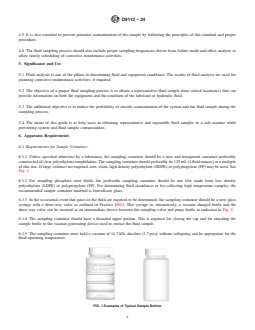
Fig. 1.
6.1.2 For sampling phosphate ester fluids, the preferable sampling container should be one liter made from low density
polyethylene (LDPE) or polypropylene (PP). For determining fluid cleanliness or for collecting high temperature samples, the
recommended sample container material is borosilicate glass.
6.1.3 In the occasional event that gases in the fluid are required to be determined, the sampling container should be a new glass
syringe with a three-way valve as outlined in Practice D923. This syringe or, alternatively, a vacuum charged bottle and the
three-way valve can be inserted as an intermediate device between the sampling valve and purge bottle as indicated in Fig. 2.
6.1.4 The sampling container should have a threaded upper portion. This is required for closing the cap and for attaching the
sample bottle to the vacuum generating device used to extract the fluid sample.
6.1.5 The sampling container must hold a vacuum of 11.7 kPa absolute (1.7 psia) without collapsing and be appropriate for the
fluid operating temperature.
FIG. 1 Examples of Typical Sample Bottles
D8112 − 24
FIG. 2 Example of a Dissolved Gas Device
6.1.6 Sampling containers should be supplied with the cap fully tightened. Sampling containers should be supplied with an average
ISO cleanliness code of 9/7/4.
6.1.7 In dirty environments, the sampling bottle should be supplied in a clean resealable plastic bag. This arrangement allows the
vacuum pump to be directly threaded to the bottle through the plastic bag then permitting the tubing to puncture the plastic
membrane. This minimizes the possibility of external contamination entering the sample bottle. See Fig. 3.
6.1.8 Alternately in dirty environments, a vacuum charged bottle can be used with a probe and tube to transfer the fluid directly
to the sample bottle. See Fig. 4.
6.1.9 Under no circumstance should sample containers be reused.
6.2 Requirement for Purging Bottle:
6.2.1 Typical purging bottle should be constructed of high density polyethylene (HDPE) or polypropylene (PP) of 500 mL (16 oz)
capacity or more.
6.2.2 The neck of the purge bottle should have the same thread as the vacuum pump.
6.3 Requirement for Disposable Sample Tubing:
6.3.1 If tubing is required to move the fluid from the reservoir to the sample bottle it should be constructed of high density
polyethylene (HDPE). Suggested sizes can be 4.7 mm outside diameter, 6.4 mm outside diameter or 7.9 mm outside diameter with
a wall thickness of 1.5 mm. The sampling tubing must hold a vacuum of 11.7 kPa absolute (1.7 psia) without collapsing. Sampling
tubing should be supplied in a fully sealed container and be used only for one sampling process after which it should be disposed
of responsibly.
6.4 Requirements for Weighted Drop Tube Device:
6.4.1 Appropriate mass with an attached stainless steel tube with appropriately sized openings and a secure method to attach the
disposable sample tubing. See Fig. 5.
FIG. 3 Example of a Sampling Bottle in a Plastic Bag
D8112 − 24
FIG. 4 Example of a Vacuum Charged Bottle with Probe
FIG. 5 Example of a Weighted Drop Tube Device
6.5 Requirements for a Vacuum Generating Device:
6.5.1 The vacuum generating device is threaded to the sampling containers described in 6.1 and must generate a vacuum of 34
kPa absolute or greater in less than 30 s. The method of attaching the sampling tubing to the vacuum device must be in a way that
does not allow the vacuum generating device to come in contact with the sampling fluid so that it remains clean and therefore can
be used for multiple samples. Vacuum generating devices should be supplied and stored in a sealed container. The preferable
material for the vacuum head is clear plastic (for example, acrylic). See Fig. 6.
6.6 Requirements for a Sample Valve:
6.6.1 Identification:
6.6.1.1 All sample valves must be identified with attached label, clearly displayed on the valve location.
FIG. 6 Example of a Vacuum Generating Device
D8112 − 24
6.6.1.2 The sample label should contain a unique sample valve identification number, and preferably sample type (primary or
secondary) as well as what pressure is observed at the sample valve. The sample label should be constructed out of suitable
permanent material, and permanently marked. See Fig. 7.
6.6.2 Permanent Sample Tube:
6.6.2.1 The sample valve itself may have a length of tubing permanently attached that sits inside the reservoir allowing fluid to
be repeatedly extracted from a specific point in the reservoir. Suggested sizes can be 4.7 mm outside diameter, 6.4 mm outside
diameter or 7.9 mm outside diameter with a 0.71 mm minimum wall thickness. However, the exact dimension depends on the
specific equipment design. The preferable material of the tubing should be stainless steel. Under most situations, stainless steel
tubing should be selected to avoid any possible oxidation in the presence of free water. The joint must be mechanical in nature
and fully compatible with the system fluid. It must withstand similar vacuum, pressure and temperature requirements as the sample
valve.
6.6.2.2 A mechanical method to allow the sample tube to swivel is required to lock the sample tube into position without rotating
the tube.
6.6.3 Non Pressurized Reservoir Sampling Valves:
6.6.3.1 Non pressurized reservoir sampling valves consist of a valve portion that is installed into the reservoir and a probe portion
that attaches to the valve portion typically using a thread connection that is used in conjunction with a vacuum generating device.
The valve may have a permanent sample tube attached to it. The probe may have a length of disposable sample tubing to move
the vacuum generating device to a location to facilitate sampling.
6.6.3.2 The sample valve must have a protective cap covering the area where fluid exits the valve. The cap must be re-attached
to the sample valve after sampling to assist in maintaining a clean environment and safe equipment operations.
6.6.3.3 The valve and probe system must hold a vacuum of 20 kPa absolute (3 psia) or greater over a 24 h period without the cap
installed.
6.6.3.4 The purge volume for valve and tube system should preferably be at least three times of total volume of sampling valve
and tube. Care should be taken to avoid any critical depletion of lubricant in low volume applications.
6.6.3.5 The approximate flowrate for ISO 680 viscosity grade fluid at 40 °C when filling a 125 mL (4 oz) sample with 1200 mm
of combined length of permanent and disposable sample tube would not exceed 4 minutes.
6.6.3.6 Upon disconnection of probe from sample valve no more than 0.25 mL of residue fluid should be left on the face of the
valve, or within the non-sealed portion of the sample valve.
6.6.3.7 Sample valves must draw 2000 samples without failure of the valve. Non-pressurized reservoir sample valves must be able
to pass a fluid that contains particulate of 500 μm in size. See Fig. 8.
6.6.3.8 For lubrication systems without original sampling ports, the user may consider modifying the existing drain or fluid level
ports by retrofitting new valves having combined functions of fluid sampling valve, fluid level indicator, and fluid drain or addition
capability. See Fig. 9.
6.6.4 Bulk Tote Sampling Valves:
FIG. 7 Example of a Valve Label
D8112 − 24
FIG. 8 Example of a Typical Fluid Sampling Valve with Stainless Steel Tub
6.6.4.1 This sampling valve consists of a valve and tube portion that is installed into the top of the bulk tote and a probe portion
that attaches to the valve portion using a threaded connection that is used in conjunction with a vacuum generating device.
6.6.4.2 Alternatively, a weighted drop tube sampling device can be attached to the sample valve using flexible sample tubing and
placed in the tote with the weight resting on the bottom of the tote.
6.6.5 Sampling Valves on Non-Pressurized Lines (Partially Flooded):
6.6.5.1 These sampling valves are located on non-pressurized, partially flooded lines, such as return lines from pressure lubricated
bearings and are usually considered as secondary sampling valves used mainly for trouble-shooting.
6.6.5.2 In large turbine systems, these sampling valves may be located at return lines from critical bearings.
6.6.5.3 In addition to sampling valves located at each return line, some large turbine lubricating systems may contain additional
sampling valves at the common, main return line. Usually the fluid sample is collected from this valve unless specific performance
data such as temperature or vibration may indicate a problem at a specific bearing.
6.6.6 Sampling Valves on Pressurized Lines or Reservoirs:
...