


ASTM D7612-10(2015)
(Practice)Standard Practice for Categorizing Wood and Wood-Based Products According to Their Fiber Sources
Standard Practice for Categorizing Wood and Wood-Based Products According to Their Fiber Sources
SIGNIFICANCE AND USE
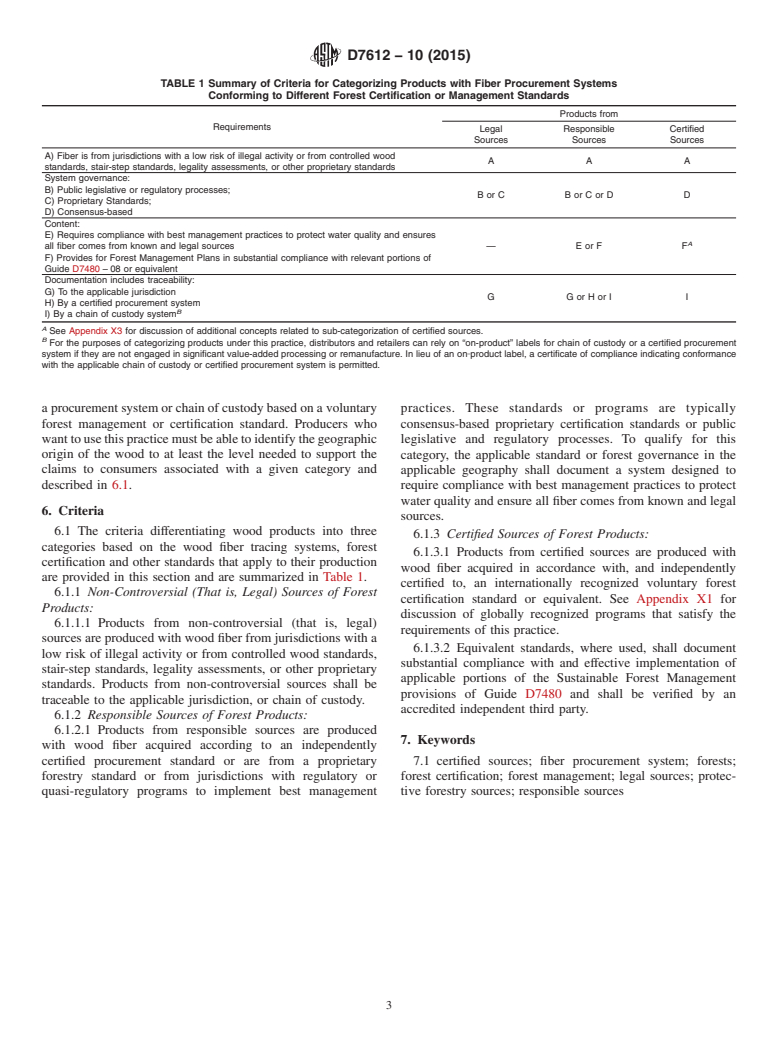
5.1 Voluntary forest certification systems have become an important factor in promoting sustainable forest management. The standards in use are highly variable, however. Even within a family of standards with a common label there is the potential for wide variations in practices. This prevents producers and consumers from using a certification label to characterize products according to a specific set of qualities or values. This practice creates a framework to differentiate products based on a set of qualities and values identified as important in the market for wood products. (A) See Appendix X3 for discussion of additional concepts related to sub-categorization of certified sources.(B) For the purposes of categorizing products under this practice, distributors and retailers can rely on “on-product” labels for chain of custody or a certified procurement system if they are not engaged in significant value-added processing or remanufacture. In lieu of an on‐product label, a certificate of compliance indicating conformance with the applicable chain of custody or certified procurement system is permitted.
5.2 This practice is intended to be used by producers, distributors, retailers, or consumers who wish to understand where a product fits within three categories. At a minimum, the user will need to know the geographic origin of the wood going into a product and whether it is labeled or otherwise certified to a procurement system or chain of custody based on a voluntary forest management or certification standard. Producers who want to use this practice must be able to identify the geographic origin of the wood to at least the level needed to support the claims to consumers associated with a given category and described in 6.1.
SCOPE
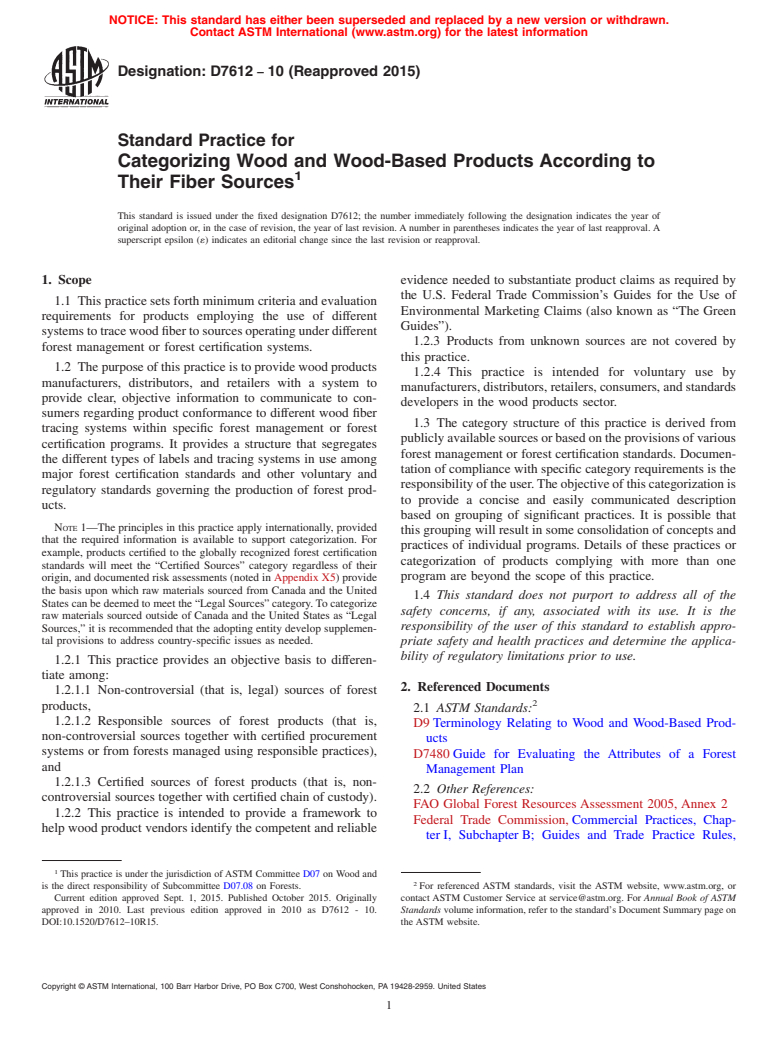
1.1 This practice sets forth minimum criteria and evaluation requirements for products employing the use of different systems to trace wood fiber to sources operating under different forest management or forest certification systems.
1.2 The purpose of this practice is to provide wood products manufacturers, distributors, and retailers with a system to provide clear, objective information to communicate to consumers regarding product conformance to different wood fiber tracing systems within specific forest management or forest certification programs. It provides a structure that segregates the different types of labels and tracing systems in use among major forest certification standards and other voluntary and regulatory standards governing the production of forest products.
Note 1: The principles in this practice apply internationally, provided that the required information is available to support categorization. For example, products certified to the globally recognized forest certification standards will meet the “Certified Sources” category regardless of their origin, and documented risk assessments (noted in Appendix X5) provide the basis upon which raw materials sourced from Canada and the United States can be deemed to meet the “Legal Sources” category. To categorize raw materials sourced outside of Canada and the United States as “Legal Sources,” it is recommended that the adopting entity develop supplemental provisions to address country-specific issues as needed.
1.2.1 This practice provides an objective basis to differentiate among:
1.2.1.1 Non-controversial (that is, legal) sources of forest products,
1.2.1.2 Responsible sources of forest products (that is, non-controversial sources together with certified procurement systems or from forests managed using responsible practices), and
1.2.1.3 Certified sources of forest products (that is, non-controversial sources together with certified chain of custody).
1.2.2 This practice is intended to provide a framework to help wood product vendors identify the competent and reliable evidence needed to substantiate product claims as required by the U.S. Federal Trade Commission’s Guides for ...
General Information
Buy Standard

Standards Content (Sample)
NOTICE: This standard has either been superseded and replaced by a new version or withdrawn.
Contact ASTM International (www.astm.org) for the latest information
Designation: D7612 − 10 (Reapproved 2015)
Standard Practice for
Categorizing Wood and Wood-Based Products According to
Their Fiber Sources
This standard is issued under the fixed designation D7612; the number immediately following the designation indicates the year of
original adoption or, in the case of revision, the year of last revision. A number in parentheses indicates the year of last reapproval. A
superscript epsilon (´) indicates an editorial change since the last revision or reapproval.
1. Scope evidence needed to substantiate product claims as required by
the U.S. Federal Trade Commission’s Guides for the Use of
1.1 This practice sets forth minimum criteria and evaluation
Environmental Marketing Claims (also known as “The Green
requirements for products employing the use of different
Guides”).
systemstotracewoodfibertosourcesoperatingunderdifferent
1.2.3 Products from unknown sources are not covered by
forest management or forest certification systems.
this practice.
1.2 The purpose of this practice is to provide wood products
1.2.4 This practice is intended for voluntary use by
manufacturers, distributors, and retailers with a system to
manufacturers, distributors, retailers, consumers, and standards
provide clear, objective information to communicate to con-
developers in the wood products sector.
sumers regarding product conformance to different wood fiber
1.3 The category structure of this practice is derived from
tracing systems within specific forest management or forest
publiclyavailablesourcesorbasedontheprovisionsofvarious
certification programs. It provides a structure that segregates
forest management or forest certification standards. Documen-
the different types of labels and tracing systems in use among
tation of compliance with specific category requirements is the
major forest certification standards and other voluntary and
responsibilityoftheuser.Theobjectiveofthiscategorizationis
regulatory standards governing the production of forest prod-
to provide a concise and easily communicated description
ucts.
based on grouping of significant practices. It is possible that
NOTE 1—The principles in this practice apply internationally, provided
this grouping will result in some consolidation of concepts and
that the required information is available to support categorization. For
practices of individual programs. Details of these practices or
example, products certified to the globally recognized forest certification
categorization of products complying with more than one
standards will meet the “Certified Sources” category regardless of their
program are beyond the scope of this practice.
origin, and documented risk assessments (noted in Appendix X5) provide
the basis upon which raw materials sourced from Canada and the United
1.4 This standard does not purport to address all of the
States can be deemed to meet the “Legal Sources” category.To categorize
safety concerns, if any, associated with its use. It is the
raw materials sourced outside of Canada and the United States as “Legal
responsibility of the user of this standard to establish appro-
Sources,” it is recommended that the adopting entity develop supplemen-
tal provisions to address country-specific issues as needed.
priate safety and health practices and determine the applica-
bility of regulatory limitations prior to use.
1.2.1 This practice provides an objective basis to differen-
tiate among:
2. Referenced Documents
1.2.1.1 Non-controversial (that is, legal) sources of forest
products,
2.1 ASTM Standards:
1.2.1.2 Responsible sources of forest products (that is,
D9 Terminology Relating to Wood and Wood-Based Prod-
non-controversial sources together with certified procurement
ucts
systems or from forests managed using responsible practices),
D7480 Guide for Evaluating the Attributes of a Forest
and
Management Plan
1.2.1.3 Certified sources of forest products (that is, non-
2.2 Other References:
controversial sources together with certified chain of custody).
FAO Global Forest Resources Assessment 2005, Annex 2
1.2.2 This practice is intended to provide a framework to
Federal Trade Commission, Commercial Practices, Chap-
help wood product vendors identify the competent and reliable
ter I, Subchapter B; Guides and Trade Practice Rules,
This practice is under the jurisdiction ofASTM Committee D07 on Wood and
is the direct responsibility of Subcommittee D07.08 on Forests. For referenced ASTM standards, visit the ASTM website, www.astm.org, or
Current edition approved Sept. 1, 2015. Published October 2015. Originally contact ASTM Customer Service at service@astm.org. For Annual Book of ASTM
approved in 2010. Last previous edition approved in 2010 as D7612 - 10. Standards volume information, refer to the standard’s Document Summary page on
DOI:10.1520/D7612–10R15. the ASTM website.
Copyright © ASTM International, 100 Barr Harbor Drive, PO Box C700, West Conshohocken, PA 19428-2959. United States
D7612 − 10 (2015)
Part 260—Guides for the Use of Environmental Market- 4. Summary of Practice
ing Claims
4.1 This practice describes a category-based method for
International Finance Corporation Indigenous Peoples,
evaluating broad differences between forest management stan-
Guidance Note 7
dards. The rationale underlying the categories is provided in
PEFC Technical Document: 2005
Appendix X2.
Standards Development Organization Advancement Act of
4.2 In providing rules for undertaking an evaluation of
2004, Pub. L. No. 108–237, Section 102(5) (2004)
different forest management standards, this practice (1) estab-
U.S. Customs and Border Patrol discussion of the Lacey
lishes three broad categories to distinguish between programs
Act (www.cbp.gov)
with different levels of tracing and documentation, and (2)
USDAForest Service, NRS-INF-06-08, “Who OwnsAmeri-
eliminates from consideration any products from unknown
ca’s Forests,” 2008
sources.
3. Terminology NOTE 2—The standard also provides a conceptual basis to describe the
category of protective forestry sources. Since this is conceptual and
3.1 Definitions—Fordefinitionsofgeneraltermsusedinthis
requires the development of an underlying database, it is included within
practice related to wood, refer to Terminology D9, and for Appendix X3 and Appendix X4 for information only.
terms related to forestry, forest certification, and traceability,
4.3 This practice is guided by the following principles:
refer to Guide D7480.
4.3.1 Its use is intended to promote the growth of respon-
sible forest management.
3.2 Definitions of Terms Specific to This Standard:
4.3.2 Any marketing claims based on or related to this
3.2.1 chain of custody (COC), n—a system of procedures
practice are accurate, verifiable, relevant and not misleading.
and documentation that tracks the custodianship of forestry
4.3.2.1 Any marketing claims based on or related to this
materials or wood-based products through one or more stages
practice are in compliance with the Federal Trade Commis-
of its life cycle from the forest to the end-use. See X1.7 for a
sion’s Guides for the Use of Environmental Marketing Claims
discussion of COC under forest certification standards.
and other U.S. consumer protection laws.
3.2.1.1 Discussion—Once a product receives a permanent
4.3.3 In the categories, differences in system governance
label (such as a gradestamp) and is not subsequently
that are legally relevant to federal and state or provincial
remanufactured, this practice accepts the on-product label as
government agencies are addressed specifically as to whether
proof of chain of custody.
they are governed through consensus-based processes.
3.2.2 consensus-based programs/standards, n—programs/
4.3.4 Decisions based on the categories avoid restraining
standards developed using the principles of openness, balance,
trade; that is, they enable consumer choice among products
transparency, consensus decision-making, and due process.
produced under comparable conditions.
3.2.3 non-controversial sources, n—sources that do not
4.4 It is possible that the differentiation between various
come from illegal or unauthorized harvesting.
forest practices, regulatory and certification-type systems will
3.2.3.1 Discussion—Examples of illegal or unauthorized
require in-depth examination beyond the scope of this practice.
harvesting include harvesting in forest areas protected by law
This practice does not rank, rate, or differentiate among the
as well as in forest areas officially published by government
efficacy of these systems for either forest practice or applica-
authorities (or the body with the legal authority to do so) as
tion to specific forest products. Such a differentiation requires
planned to become strictly protected by law, without the
detailed information specifically focused on the intended
government authorities (or the body with the legal authority to
end-use. See Appendix X5 for links to aid users who require
do so) giving permission to harvest.
more detailed differentiation.
3.2.3.2 Discussion—Source is Annex 4 PEFC Technical
Document: 2005, 1.3.4 controversial sources, modified by
5. Significance and Use
establishing the contradictory concept “non-controversial
5.1 Voluntary forest certification systems have become an
sources” with a negation of the essential characteristics of the
important factor in promoting sustainable forest management.
definition of controversial sources.
The standards in use are highly variable, however. Even within
3.2.4 procurement system, n—a system requiring organiza-
afamilyofstandardswithacommonlabelthereisthepotential
tions buying raw materials to have an auditable procurement
for wide variations in practices. This prevents producers and
process designed, at a minimum, to require compliance with
consumers from using a certification label to characterize
best management practices to protect water quality on all
products according to a specific set of qualities or values. This
suppliers’ lands and ensure all fiber comes from known and
practice creates a framework to differentiate products based on
legal sources.
a set of qualities and values identified as important in the
market for wood products.
5.2 This practice is intended to be used by producers,
Available from International Finance Corporation (IFC), 2121 Pennsylvania
distributors, retailers, or consumers who wish to understand
Avenue, NW Washington, DC 20433, http://www.ifc.org.
where a product fits within three categories.At a minimum, the
FromtheStandardsDevelopmentOrganizationAdvancementActof2004,Pub.
userwillneedtoknowthegeographicoriginofthewoodgoing
L. No. 108–237, Section 102(5) (2004). This definition is similar to those found in
various ASTM documents. intoaproductandwhetheritislabeledorotherwisecertifiedto
D7612 − 10 (2015)
TABLE 1 Summary of Criteria for Categorizing Products with Fiber Procurement Systems
Conforming to Different Forest Certification or Management Standards
Products from
Requirements
Legal Responsible Certified
Sources Sources Sources
A) Fiber is from jurisdictions with a low risk of illegal activity or from controlled wood
AAA
standards, stair-step standards, legality assessments, or other proprietary standards
System governance:
B) Public legislative or regulatory processes;
BorC BorCorD D
C) Proprietary Standards;
D) Consensus-based
Content:
E) Requires compliance with best management practices to protect water quality and ensures
A
all fiber comes from known and legal sources —EorF F
F) Provides for Forest Management Plans in substantial compliance with relevant portions of
Guide D7480 – 08 or equivalent
Documentation includes traceability:
G) To the applicable jurisdiction
GGorHorI I
H) By a certified procurement system
B
I) By a chain of custody system
A
See Appendix X3 for discussion of additional concepts related to sub-categorization of certified sources.
B
For the purposes of categorizing products under this practice, distributors and retailers can rely on “on-product” labels for chain of custody or a certified procurement
system if they are not engaged in significant value-added processing or remanufacture. In lieu of an on{product label, a certificate of compliance indicating conformance
with the applicable chain of custody or certified procurement system is permitted.
a procurement system or chain of custody based on a voluntary practices. These standards or programs are typically
forest management or certification standard. Producers who consensus-based proprietary certification standards or public
wanttousethispracticemustbeabletoidentifythegeographic legislative and regulatory processes. To qualify for this
origin of the wood to at least the level needed to support the category, the applicable standard or forest governance in the
claims to consumers associated with a given category and applicable geography shall document a system designed to
described in 6.1. require compliance with best management practices to protect
water quality and ensure all fiber comes from known and legal
6. Criteria
sources.
6.1 The criteria differentiating wood products into three
6.1.3 Certified Sources of Forest Products:
categories based on the wood fiber tracing systems, forest
6.1.3.1 Products from certified sources are produced with
certification and other standards that apply to their production
wood fiber acquired in accordance with, and independently
are provided in this section and are summarized in Table 1.
certified to, an internationally recognized voluntary forest
6.1.1 Non-Controversial (That is, Legal) Sources of Forest
certification standard or equivalent. See Appendix X1 for
Products:
discussion of globally recognized programs that satisfy the
6.1.1.1 Products from non-controversial (that is, legal)
requirements of this practice.
sources are produced with wood fiber from jurisdictions with a
6.1.3.2 Equivalent standards, where used, shall document
low risk of illegal activity or from controlled wood standards,
substantial compliance with and effective implementation of
stair-step standards, legality assessments, or other proprietary
applicable portions of the Sustainable Forest Management
standards. Products from non-controversial sources shall be
provisions of Guide D7480 and shall be verified by an
traceable to the applicable jurisdiction, or chain of custody.
accredited independent third party.
6.1.2 Responsible Sources of Forest Products:
6.1.2.1 Products from responsible sources are produced
7. Keywords
with wood fiber acquired according to an independently
certified procurement standard or are from a proprietary 7.1 certified sources; fiber procurement system; forests;
forestry standard or from jurisdictions with regulatory or forest certification; forest management; legal sources; protec
...
This document is not an ASTM standard and is intended only to provide the user of an ASTM standard an indication of what changes have been made to the previous version. Because
it may not be technically possible to adequately depict all changes accurately, ASTM recommends that users consult prior editions as appropriate. In all cases only the current version
of the standard as published by ASTM is to be considered the official document.
Designation: D7612 − 10 D7612 − 10 (Reapproved 2015)
Standard Practice for
Categorizing Wood and Wood-Based Products According to
Their Fiber Sources
This standard is issued under the fixed designation D7612; the number immediately following the designation indicates the year of
original adoption or, in the case of revision, the year of last revision. A number in parentheses indicates the year of last reapproval. A
superscript epsilon (´) indicates an editorial change since the last revision or reapproval.
1. Scope
1.1 This practice sets forth minimum criteria and evaluation requirements for products employing the use of different systems
to trace wood fiber to sources operating under different forest management or forest certification systems.
1.2 The purpose of this practice is to provide wood products manufacturers, distributors, and retailers with a system to provide
clear, objective information to communicate to consumers regarding product conformance to different wood fiber tracing systems
within specific forest management or forest certification programs. It provides a structure that segregates the different types of
labels and tracing systems in use among major forest certification standards and other voluntary and regulatory standards governing
the production of forest products.
NOTE 1—The principles in this practice apply internationally, provided that the required information is available to support categorization. For example,
products certified to the globally recognized forest certification standards will meet the “Certified Sources” category regardless of their origin, and
documented risk assessments (noted in Appendix X5) provide the basis upon which raw materials sourced from Canada and the United States can be
deemed to meet the “Legal Sources” category. To categorize raw materials sourced outside of Canada and the United States as “Legal Sources,” it is
recommended that the adopting entity develop supplemental provisions to address country-specific issues as needed.
1.2.1 This practice provides an objective basis to differentiate among:
1.2.1.1 Non-controversial (that is, legal) sources of forest products,
1.2.1.2 Responsible sources of forest products (that is, non-controversial sources together with certified procurement systems
or from forests managed using responsible practices), and
1.2.1.3 Certified sources of forest products (that is, non-controversial sources together with certified chain of custody).
1.2.2 This practice is intended to provide a framework to help wood product vendors identify the competent and reliable
evidence needed to substantiate product claims as required by the U.S. Federal Trade Commission’s Guides for the Use of
Environmental Marketing Claims (also known as “The Green Guides”).
1.2.3 Products from unknown sources are not covered by this practice.
1.2.4 This practice is intended for voluntary use by manufacturers, distributors, retailers, consumers, and standards developers
in the wood products sector.
1.3 The category structure of this practice is derived from publicly available sources or based on the provisions of various forest
management or forest certification standards. Documentation of compliance with specific category requirements is the
responsibility of the user. The objective of this categorization is to provide a concise and easily communicated description based
on grouping of significant practices. It is possible that this grouping will result in some consolidation of concepts and practices
of individual programs. Details of these practices or categorization of products complying with more than one program are beyond
the scope of this practice.
1.4 This standard does not purport to address all of the safety concerns, if any, associated with its use. It is the responsibility
of the user of this standard to establish appropriate safety and health practices and determine the applicability of regulatory
limitations prior to use.
2. Referenced Documents
2.1 ASTM Standards:
D9 Terminology Relating to Wood and Wood-Based Products
This practice is under the jurisdiction of ASTM Committee D07 on Wood and is the direct responsibility of Subcommittee D07.08 on Forests.
Current edition approved May 1, 2010Sept. 1, 2015. Published May 2010October 2015. DOI:10.1520/D7612–10.Originally approved in 2010. Last previous edition
approved in 2010 as D7612 - 10. DOI:10.1520/D7612–10R15.
For referenced ASTM standards, visit the ASTM website, www.astm.org, or contact ASTM Customer Service at service@astm.org. For Annual Book of ASTM Standards
volume information, refer to the standard’s Document Summary page on the ASTM website.
Copyright © ASTM International, 100 Barr Harbor Drive, PO Box C700, West Conshohocken, PA 19428-2959. United States
D7612 − 10 (2015)
D7480 Guide for Evaluating the Attributes of a Forest Management Plan
2.2 Other References:
FAO Global Forest Resources Assessment 2005, Annex 2
Federal Trade Commission, Commercial Practices, Chapter I, Subchapter B; Guides and Trade Practice Rules, Part 260—Guides
for the Use of Environmental Marketing Claims
D7612 − 10 (2015)
International Finance Corporation Indigenous Peoples, Guidance Note 7
PEFC Technical Document: 2005
Standards Development Organization Advancement Act of 2004, Pub. L. No. 108–237, Section 102(5) (2004)
U.S. Customs and Border Patrol discussion of the Lacey Act (www.cbp.gov)
USDA Forest Service, NRS-INF-06-08, “Who Owns America’s Forests,” 2008
3. Terminology
3.1 Definitions—For definitions of general terms used in this practice related to wood, refer to Terminology D9, and for terms
related to forestry, forest certification, and traceability, refer to Guide D7480.
3.2 Definitions of Terms Specific to This Standard:
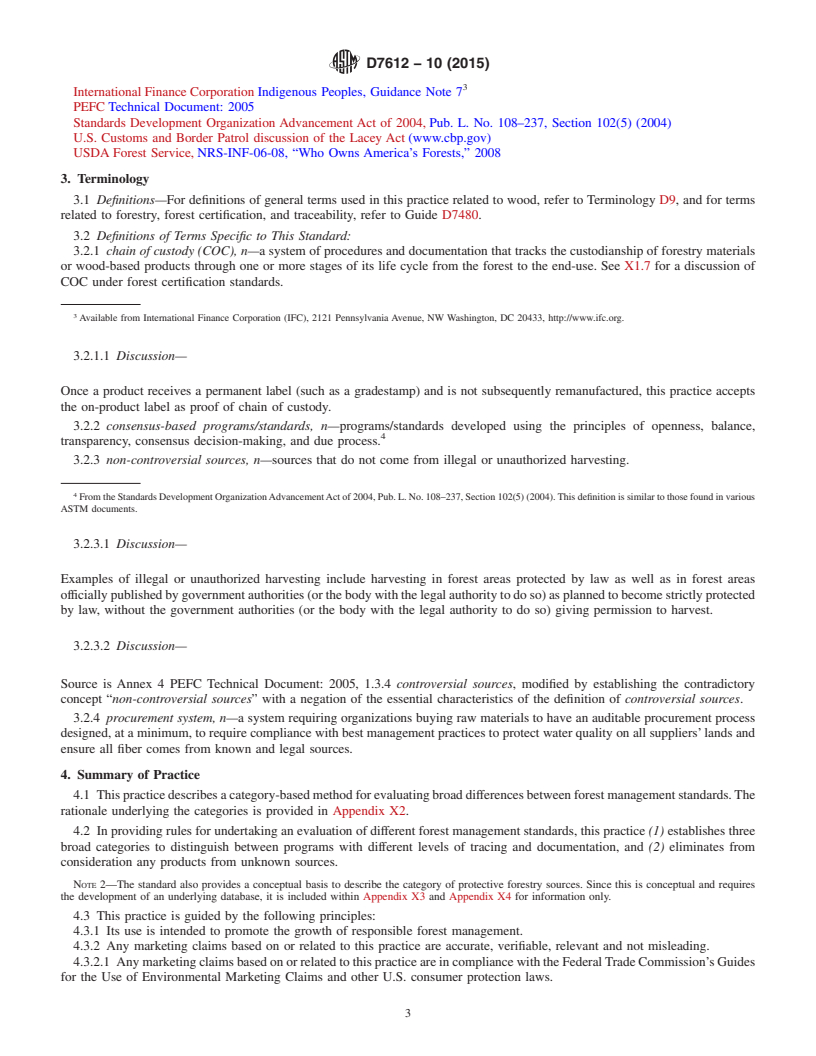
3.2.1 chain of custody (COC), n—a system of procedures and documentation that tracks the custodianship of forestry materials
or wood-based products through one or more stages of its life cycle from the forest to the end-use. See X1.7 for a discussion of
COC under forest certification standards.
Available from International Finance Corporation (IFC), 2121 Pennsylvania Avenue, NW Washington, DC 20433, http://www.ifc.org.
3.2.1.1 Discussion—
Once a product receives a permanent label (such as a gradestamp) and is not subsequently remanufactured, this practice accepts
the on-product label as proof of chain of custody.
3.2.2 consensus-based programs/standards, n—programs/standards developed using the principles of openness, balance,
transparency, consensus decision-making, and due process.
3.2.3 non-controversial sources, n—sources that do not come from illegal or unauthorized harvesting.
From the Standards Development Organization Advancement Act of 2004, Pub. L. No. 108–237, Section 102(5) (2004). This definition is similar to those found in various
ASTM documents.
3.2.3.1 Discussion—
Examples of illegal or unauthorized harvesting include harvesting in forest areas protected by law as well as in forest areas
officially published by government authorities (or the body with the legal authority to do so) as planned to become strictly protected
by law, without the government authorities (or the body with the legal authority to do so) giving permission to harvest.
3.2.3.2 Discussion—
Source is Annex 4 PEFC Technical Document: 2005, 1.3.4 controversial sources, modified by establishing the contradictory
concept “non-controversial sources” with a negation of the essential characteristics of the definition of controversial sources.
3.2.4 procurement system, n—a system requiring organizations buying raw materials to have an auditable procurement process
designed, at a minimum, to require compliance with best management practices to protect water quality on all suppliers’ lands and
ensure all fiber comes from known and legal sources.
4. Summary of Practice
4.1 This practice describes a category-based method for evaluating broad differences between forest management standards. The
rationale underlying the categories is provided in Appendix X2.
4.2 In providing rules for undertaking an evaluation of different forest management standards, this practice (1) establishes three
broad categories to distinguish between programs with different levels of tracing and documentation, and (2) eliminates from
consideration any products from unknown sources.
NOTE 2—The standard also provides a conceptual basis to describe the category of protective forestry sources. Since this is conceptual and requires
the development of an underlying database, it is included within Appendix X3 and Appendix X4 for information only.
4.3 This practice is guided by the following principles:
4.3.1 Its use is intended to promote the growth of responsible forest management.
4.3.2 Any marketing claims based on or related to this practice are accurate, verifiable, relevant and not misleading.
4.3.2.1 Any marketing claims based on or related to this practice are in compliance with the Federal Trade Commission’s Guides
for the Use of Environmental Marketing Claims and other U.S. consumer protection laws.
D7612 − 10 (2015)
4.3.3 In the categories, differences in system governance that are legally relevant to federal and state or provincial government
agencies are addressed specifically as to whether they are governed through consensus-based processes.
4.3.4 Decisions based on the categories avoid restraining trade; that is, they enable consumer choice among products produced
under comparable conditions.
4.4 It is possible that the differentiation between various forest practices, regulatory and certification-type systems will require
in-depth examination beyond the scope of this practice. This practice does not rank, rate, or differentiate among the efficacy of these
systems for either forest practice or application to specific forest products. Such a differentiation requires detailed information
specifically focused on the intended end-use. See Appendix X5 for links to aid users who require more detailed differentiation.
5. Significance and Use
5.1 Voluntary forest certification systems have become an important factor in promoting sustainable forest management. The
standards in use are highly variable, however. Even within a family of standards with a common label there is the potential for
wide variations in practices. This prevents producers and consumers from using a certification label to characterize products
according to a specific set of qualities or values. This practice creates a framework to differentiate products based on a set of
qualities and values identified as important in the market for wood products.
5.2 This practice is intended to be used by producers, distributors, retailers, or consumers who wish to understand where a
product fits within three categories. At a minimum, the user will need to know the geographic origin of the wood going into a
product and whether it is labeled or otherwise certified to a procurement system or chain of custody based on a voluntary forest
management or certification standard. Producers who want to use this practice must be able to identify the geographic origin of
the wood to at least the level needed to support the claims to consumers associated with a given category and described in 6.1.
6. Criteria
6.1 The criteria differentiating wood products into three categories based on the wood fiber tracing systems, forest certification
and other standards that apply to their production are provided in this section and are summarized in Table 1.
6.1.1 Non-Controversial (That is, Legal) Sources of Forest Products:
6.1.1.1 Products from non-controversial (that is, legal) sources are produced with wood fiber from jurisdictions with a low risk
of illegal activity or from controlled wood standards, stair-step standards, legality assessments, or other proprietary standards.
Products from non-controversial sources shall be traceable to the applicable jurisdiction, or chain of custody.
6.1.2 Responsible Sources of Forest Products:
6.1.2.1 Products from responsible sources are produced with wood fiber acquired according to an independently certified
procurement standard or are from a proprietary forestry standard or from jurisdictions with regulatory or quasi-regulatory programs
to implement best management practices. These standards or programs are typically consensus-based proprietary certification
standards or public legislative and regulatory processes. To qualify for this category, the applicable standard or forest governance
in the applicable geography shall document a system designed to require compliance with best management practices to protect
water quality and ensure all fiber comes from known and legal sources.
6.1.3 Certified Sources of Forest Products:
TABLE 1 Summary of Criteria for Categorizing Products with Fiber Procurement Systems
Conforming to Different Forest Certification or Management Standards
Products from
Requirements
Legal Responsible Certified
Sources Sources Sources
A) Fiber is from jurisdictions with a low risk of illegal activity or from controlled wood
A A A
standards, stair-step standards, legality assessments, or other proprietary standards
System governance:
B) Public legislative or regulatory processes;
B or C B or C or D D
C) Proprietary Standards;
D) Consensus-based
Content:
E) Requires compliance with best management practices to protect water quality and ensures
A
all fiber comes from known and legal sources — E or F F
F) Provides for Forest Management Plans in substantial compliance with relevant portions of
Guide D7480 – 08 or equivalent
Documentation includes traceability:
G) To the applicable jurisdiction
G G or H or I I
H) By a certified procurement system
B
I) By a chain of custody system
A
See Appendix X3 for discussion of additional concepts related to sub-categorization of certified sources.
B
For the purposes of categorizing products under this practice, distributors and retailers can rely on “on-product” labels for chain of custody or a certified procurement
system if they are not engaged in significant value-added processing or remanufacture. In lieu of an on{product label, a certificate of compliance indicating conformance
with the applicable chain of custody or certified procurement system is permitted.
D7612 − 10 (2015)
6.1.3.1 Products from certified sources are produced with wood fiber acquired in accordance with, an
...
Questions, Comments and Discussion
Ask us and Technical Secretary will try to provide an answer. You can facilitate discussion about the standard in here.