


ASTM D2843-22
(Test Method)Standard Test Method for Density of Smoke from the Burning or Decomposition of Plastics
Standard Test Method for Density of Smoke from the Burning or Decomposition of Plastics
SIGNIFICANCE AND USE
5.1 Tests made on a material under conditions herein prescribed are of considerable value in comparing the relative smoke obscuration characteristics of plastics.
5.2 This test method serves to determine the extent to which plastic materials are likely to smoke under conditions of active burning and decomposition in the presence of flame.
Note 2: One study5 suggested that visual and instrumental observations from this test compare well with the visual observations of the smoke generated by plastic materials when added to a freely burning large outdoor fire.
5.3 The usefulness of this test procedure is in its ability to measure the amount of smoke obscuration produced in a simple, direct, and meaningful manner under the specified conditions. The degree of obscuration of vision by smoke generated by combustibles is known to be affected by changes in quantity and form of material, humidity, draft, temperature, and oxygen supply.
5.4 Safety Precautions—Products of combustion are toxic. Care shall be taken to guard the operator from the effects of products of combustion.
SCOPE
1.1 This fire-test-response test method covers a laboratory procedure for measuring and observing the relative amounts of smoke obscuration produced by the burning or decomposition of plastics. It is intended to be used for measuring the smoke-producing characteristics of plastics under controlled conditions of combustion or decomposition. Correlation with other fire conditions is not implied. The measurements are made in terms of the loss of light transmission through a collected volume of smoke produced under controlled, standardized conditions. The apparatus is constructed so that the flame and smoke is observable during the test.2
1.2 During the course of combustion, gases or vapors, or both, are evolved that are potentially hazardous to personnel. Adequate precautions shall be taken to protect the operator.
1.3 The values stated in SI units are to be regarded as the standard. The values given in parentheses are for information purposes only.
1.4 This standard is used to measure and describe the response of materials, products, or assemblies to heat and flame under controlled conditions, but does not by itself incorporate all factors required for fire hazard or fire risk assessment of the materials, products, or assemblies under actual fire conditions.
1.5 Fire testing is inherently hazardous. Adequate safeguards for personnel and property shall be employed in conducting these tests. Specific safety warning statements are given in 1.2 and 9.13.
1.6 This standard does not purport to address all of the safety concerns, if any, associated with its use. It is the responsibility of the user of this standard to establish appropriate safety, health, and environmental practices and determine the applicability of regulatory limitations prior to use.
Note 1: There is no known ISO equivalent to this standard.
1.7 This international standard was developed in accordance with internationally recognized principles on standardization established in the Decision on Principles for the Development of International Standards, Guides and Recommendations issued by the World Trade Organization Technical Barriers to Trade (TBT) Committee.
General Information
- Status
- Published
- Publication Date
- 14-Mar-2022
- Technical Committee
- D20 - Plastics
- Drafting Committee
- D20.30 - Thermal Properties
Relations
- Effective Date
- 01-Feb-2024
- Effective Date
- 01-Jan-2024
- Effective Date
- 01-Dec-2023
- Effective Date
- 01-Nov-2023
- Effective Date
- 01-Sep-2023
- Effective Date
- 01-Apr-2022
- Effective Date
- 01-Jan-2020
- Effective Date
- 01-Aug-2019
- Effective Date
- 01-Jul-2019
- Effective Date
- 15-Apr-2019
- Effective Date
- 15-Apr-2019
- Effective Date
- 01-Mar-2019
- Effective Date
- 01-Feb-2019
- Effective Date
- 15-Dec-2018
- Effective Date
- 01-Dec-2018
Overview
ASTM D2843-22: Standard Test Method for Density of Smoke from the Burning or Decomposition of Plastics provides a laboratory procedure for measuring the relative smoke density generated when plastics are subjected to combustion or decomposition. Developed by ASTM International, this standard is essential for determining how much smoke plastic materials produce under controlled burning conditions, making it highly relevant for fire safety, construction, and product compliance assessments. While this method measures the optical density of smoke within a specific test chamber, it does not claim to simulate all real-world fire scenarios.
Key Topics
- Smoke Obscuration Measurement: Evaluates the loss of light transmission caused by smoke within a test chamber, offering a quantitative measure of smoke density attributable to plastic materials.
- Controlled Combustion Conditions: Ensures standardized conditions including chamber geometry, propane-fueled ignition, and specimen preparation to deliver reproducible results.
- Relative Material Rankings: Enables comparison of smoke-producing characteristics among different plastic types.
- Test Safety: Highlights the inherent hazards in fire testing and mandates strict safety precautions due to toxic combustion by-products.
- Reporting Requirements: Outlines comprehensive data reporting, including maximum smoke density, smoke density rating (SDR), test specimen identification, and any deviations from standard procedures.
Applications
The test method is vital for stakeholders in materials selection, fire safety, and regulatory compliance across several industries:
- Building and Construction: Commonly used to evaluate plastics for light-transmitting panels, wall coverings, or insulation. Model code organizations often reference ASTM D2843 for approving plastics in architectural applications where smoke production is a hazard.
- Product Development: Manufacturers use the test to screen plastic formulations for reduced smoke generation, aiding in safer product designs.
- Fire Safety Assessments: Provides data supporting risk management strategies by quantifying the extent to which plastics may obscure visibility during a fire, an important consideration for egress planning and occupant safety.
- Regulatory Compliance: Helps ensure that plastic products meet code requirements regarding smoke development-especially where alternatives to ASTM E84 are needed for thermoplastics that do not suit E84 apparatus.
Related Standards
ASTM D2843-22 operates in conjunction with, or as an alternative to, several other important fire testing and terminology standards:
- ASTM D618 – Practice for Conditioning Plastics for Testing
- ASTM D883 – Terminology Relating to Plastics
- ASTM D1600 – Terminology for Abbreviated Terms Relating to Plastics
- ASTM E84 – Test Method for Surface Burning Characteristics of Building Materials
- ASTM E176 – Terminology of Fire Standards
- ASTM E456 – Terminology Relating to Quality and Statistics
- ASTM E662 – Test Method for Specific Optical Density of Smoke Generated by Solid Materials
- ASTM E906/E906M & ASTM E1354 – Methods measuring heat and smoke release rates
- ISO 13943 – Fire Safety Vocabulary
Note: There is currently no ISO equivalent to ASTM D2843.
Practical Value
By providing a direct, reproducible, and meaningful measurement of smoke density under laboratory conditions, ASTM D2843-22 delivers practical value to engineers, specifiers, manufacturers, and regulators concerned with fire performance and smoke suppression in plastics. Its results support safer material choices, improved fire safety strategies, and informed compliance with building regulations and industry codes.
Keywords: ASTM D2843, smoke density, plastics fire testing, smoke obscuration, building materials, fire safety, laboratory test method, regulatory compliance.
Buy Documents
ASTM D2843-22 - Standard Test Method for Density of Smoke from the Burning or Decomposition of Plastics
REDLINE ASTM D2843-22 - Standard Test Method for Density of Smoke from the Burning or Decomposition of Plastics
Get Certified
Connect with accredited certification bodies for this standard

Smithers Quality Assessments
US management systems and product certification.

DIN CERTCO
DIN Group product certification.
Sponsored listings
Frequently Asked Questions
ASTM D2843-22 is a standard published by ASTM International. Its full title is "Standard Test Method for Density of Smoke from the Burning or Decomposition of Plastics". This standard covers: SIGNIFICANCE AND USE 5.1 Tests made on a material under conditions herein prescribed are of considerable value in comparing the relative smoke obscuration characteristics of plastics. 5.2 This test method serves to determine the extent to which plastic materials are likely to smoke under conditions of active burning and decomposition in the presence of flame. Note 2: One study5 suggested that visual and instrumental observations from this test compare well with the visual observations of the smoke generated by plastic materials when added to a freely burning large outdoor fire. 5.3 The usefulness of this test procedure is in its ability to measure the amount of smoke obscuration produced in a simple, direct, and meaningful manner under the specified conditions. The degree of obscuration of vision by smoke generated by combustibles is known to be affected by changes in quantity and form of material, humidity, draft, temperature, and oxygen supply. 5.4 Safety Precautions—Products of combustion are toxic. Care shall be taken to guard the operator from the effects of products of combustion. SCOPE 1.1 This fire-test-response test method covers a laboratory procedure for measuring and observing the relative amounts of smoke obscuration produced by the burning or decomposition of plastics. It is intended to be used for measuring the smoke-producing characteristics of plastics under controlled conditions of combustion or decomposition. Correlation with other fire conditions is not implied. The measurements are made in terms of the loss of light transmission through a collected volume of smoke produced under controlled, standardized conditions. The apparatus is constructed so that the flame and smoke is observable during the test.2 1.2 During the course of combustion, gases or vapors, or both, are evolved that are potentially hazardous to personnel. Adequate precautions shall be taken to protect the operator. 1.3 The values stated in SI units are to be regarded as the standard. The values given in parentheses are for information purposes only. 1.4 This standard is used to measure and describe the response of materials, products, or assemblies to heat and flame under controlled conditions, but does not by itself incorporate all factors required for fire hazard or fire risk assessment of the materials, products, or assemblies under actual fire conditions. 1.5 Fire testing is inherently hazardous. Adequate safeguards for personnel and property shall be employed in conducting these tests. Specific safety warning statements are given in 1.2 and 9.13. 1.6 This standard does not purport to address all of the safety concerns, if any, associated with its use. It is the responsibility of the user of this standard to establish appropriate safety, health, and environmental practices and determine the applicability of regulatory limitations prior to use. Note 1: There is no known ISO equivalent to this standard. 1.7 This international standard was developed in accordance with internationally recognized principles on standardization established in the Decision on Principles for the Development of International Standards, Guides and Recommendations issued by the World Trade Organization Technical Barriers to Trade (TBT) Committee.
SIGNIFICANCE AND USE 5.1 Tests made on a material under conditions herein prescribed are of considerable value in comparing the relative smoke obscuration characteristics of plastics. 5.2 This test method serves to determine the extent to which plastic materials are likely to smoke under conditions of active burning and decomposition in the presence of flame. Note 2: One study5 suggested that visual and instrumental observations from this test compare well with the visual observations of the smoke generated by plastic materials when added to a freely burning large outdoor fire. 5.3 The usefulness of this test procedure is in its ability to measure the amount of smoke obscuration produced in a simple, direct, and meaningful manner under the specified conditions. The degree of obscuration of vision by smoke generated by combustibles is known to be affected by changes in quantity and form of material, humidity, draft, temperature, and oxygen supply. 5.4 Safety Precautions—Products of combustion are toxic. Care shall be taken to guard the operator from the effects of products of combustion. SCOPE 1.1 This fire-test-response test method covers a laboratory procedure for measuring and observing the relative amounts of smoke obscuration produced by the burning or decomposition of plastics. It is intended to be used for measuring the smoke-producing characteristics of plastics under controlled conditions of combustion or decomposition. Correlation with other fire conditions is not implied. The measurements are made in terms of the loss of light transmission through a collected volume of smoke produced under controlled, standardized conditions. The apparatus is constructed so that the flame and smoke is observable during the test.2 1.2 During the course of combustion, gases or vapors, or both, are evolved that are potentially hazardous to personnel. Adequate precautions shall be taken to protect the operator. 1.3 The values stated in SI units are to be regarded as the standard. The values given in parentheses are for information purposes only. 1.4 This standard is used to measure and describe the response of materials, products, or assemblies to heat and flame under controlled conditions, but does not by itself incorporate all factors required for fire hazard or fire risk assessment of the materials, products, or assemblies under actual fire conditions. 1.5 Fire testing is inherently hazardous. Adequate safeguards for personnel and property shall be employed in conducting these tests. Specific safety warning statements are given in 1.2 and 9.13. 1.6 This standard does not purport to address all of the safety concerns, if any, associated with its use. It is the responsibility of the user of this standard to establish appropriate safety, health, and environmental practices and determine the applicability of regulatory limitations prior to use. Note 1: There is no known ISO equivalent to this standard. 1.7 This international standard was developed in accordance with internationally recognized principles on standardization established in the Decision on Principles for the Development of International Standards, Guides and Recommendations issued by the World Trade Organization Technical Barriers to Trade (TBT) Committee.
ASTM D2843-22 is classified under the following ICS (International Classification for Standards) categories: 83.080.01 - Plastics in general. The ICS classification helps identify the subject area and facilitates finding related standards.
ASTM D2843-22 has the following relationships with other standards: It is inter standard links to ASTM D883-24, ASTM E176-24, ASTM E84-23d, ASTM D883-23, ASTM E84-23c, ASTM E456-13a(2022)e1, ASTM D883-20, ASTM D883-19c, ASTM E84-19b, ASTM E84-19a, ASTM D883-19a, ASTM E84-19, ASTM D883-19, ASTM E176-18a, ASTM D883-18a. Understanding these relationships helps ensure you are using the most current and applicable version of the standard.
ASTM D2843-22 is available in PDF format for immediate download after purchase. The document can be added to your cart and obtained through the secure checkout process. Digital delivery ensures instant access to the complete standard document.
Standards Content (Sample)
This international standard was developed in accordance with internationally recognized principles on standardization established in the Decision on Principles for the
Development of International Standards, Guides and Recommendations issued by the World Trade Organization Technical Barriers to Trade (TBT) Committee.
Designation: D2843 − 22
Standard Test Method for
Density of Smoke from the Burning or Decomposition of
Plastics
This standard is issued under the fixed designation D2843; the number immediately following the designation indicates the year of
original adoption or, in the case of revision, the year of last revision. A number in parentheses indicates the year of last reapproval. A
superscript epsilon (´) indicates an editorial change since the last revision or reapproval.
This standard has been approved for use by agencies of the U.S. Department of Defense.
1. Scope* priate safety, health, and environmental practices and deter-
mine the applicability of regulatory limitations prior to use.
1.1 This fire-test-response test method covers a laboratory
procedure for measuring and observing the relative amounts of
NOTE 1—There is no known ISO equivalent to this standard.
smoke obscuration produced by the burning or decomposition
1.7 This international standard was developed in accor-
of plastics. It is intended to be used for measuring the
dance with internationally recognized principles on standard-
smoke-producing characteristics of plastics under controlled
ization established in the Decision on Principles for the
conditions of combustion or decomposition. Correlation with
Development of International Standards, Guides and Recom-
other fire conditions is not implied. The measurements are
mendations issued by the World Trade Organization Technical
made in terms of the loss of light transmission through a
Barriers to Trade (TBT) Committee.
collected volume of smoke produced under controlled, stan-
2. Referenced Documents
dardized conditions. The apparatus is constructed so that the
flame and smoke is observable during the test.
2.1 ASTM Standards:
D618 Practice for Conditioning Plastics for Testing
1.2 During the course of combustion, gases or vapors, or
D883 Terminology Relating to Plastics
both, are evolved that are potentially hazardous to personnel.
D1600 Terminology forAbbreviatedTerms Relating to Plas-
Adequate precautions shall be taken to protect the operator.
tics
1.3 The values stated in SI units are to be regarded as the
E84 Test Method for Surface Burning Characteristics of
standard. The values given in parentheses are for information
Building Materials
purposes only.
E176 Terminology of Fire Standards
1.4 This standard is used to measure and describe the
E456 Terminology Relating to Quality and Statistics
response of materials, products, or assemblies to heat and
E662 Test Method for Specific Optical Density of Smoke
flame under controlled conditions, but does not by itself
Generated by Solid Materials
incorporate all factors required for fire hazard or fire risk
E691 Practice for Conducting an Interlaboratory Study to
assessment of the materials, products, or assemblies under
Determine the Precision of a Test Method
actual fire conditions.
E906/E906M Test Method for Heat and Visible Smoke
Release Rates for Materials and Products Using a Ther-
1.5 Fire testing is inherently hazardous. Adequate safe-
mopile Method
guards for personnel and property shall be employed in
E1354 Test Method for Heat and Visible Smoke Release
conducting these tests. Specific safety warning statements are
Rates for Materials and Products Using an Oxygen Con-
given in 1.2 and 9.13.
sumption Calorimeter
1.6 This standard does not purport to address all of the
E2935 Practice for Evaluating Equivalence of Two Testing
safety concerns, if any, associated with its use. It is the
Processes
responsibility of the user of this standard to establish appro-
2.2 ISO Standards:
ISO 13943 Fire Safety—Vocabulary
This test method is under the jurisdiction ofASTM Committee D20 on Plastics
and is the direct responsibility of Subcommittee D20.30 on Thermal Properties-
(Section D20.30.03). For referenced ASTM standards, visit the ASTM website, www.astm.org, or
Current edition approved March 15, 2022. Published March 2022. Originally contact ASTM Customer Service at service@astm.org. For Annual Book of ASTM
approved in 1970. Last previous edition approved in 2019 as D2843 - 19. DOI: Standards volume information, refer to the standard’s Document Summary page on
10.1520/D2843-22. the ASTM website.
Anonymous, “A Method of Measuring Smoke Density,” NFPA Quarterly, Available from International Organization for Standardization (ISO), ISO
QNFPA,Vol 57, January 1964, p. 276. Reprint NFPAQ57-9.Available from NFPA, Central Secretariat, BIBC II, Chemin de Blandonnet 8, CP 401, 1214 Vernier,
60 Batterymarch St., Boston, MA 02110. Geneva, Switzerland, http://www.iso.org.
*A Summary of Changes section appears at the end of this standard
Copyright © ASTM International, 100 Barr Harbor Drive, PO Box C700, West Conshohocken, PA 19428-2959. United States
D2843 − 22
3. Terminology 6.1.1 Chamber:
6.1.1.1 The chamber shall consist of a 14-gage (B&Sor
3.1 Definitions—For definitions of terms relating to plastics,
AWG) 300 by 300 by 790-mm (12 by 12 by 31-in.) aluminum
the definitions in this test method are in accordance with
box to which is hinged a heat-resistant glass glazed door. This
Terminology D883 and D1600. For terms relating to fire, the
box shall be mounted on a 350 by 400 by 57-mm (14 by 16 by
definitions in this test method are in accordance with Termi-
2 ⁄4-in.) base which houses the controls. Dependent upon the
nology E176 and ISO 13943. In case of conflict, the definitions
materials tested, the metal will require protection from corro-
given in Terminology E176 shall prevail. For terms relating to
sion.
precision and bias and associated issues, the terms used in this
6.1.1.2 The chamber shall be sealed except for 25 by
test method are in accordance with the definitions in Termi-
230-mm (1 by 9-in.) openings on the four sides of the bottom
nology E456.
of the chamber. A 1700-L/min (60-ft /min) blower shall be
4. Summary of Test Method
mounted on one side of the chamber. The inlet duct to the
exhaust blower shall be equipped with a close-fitting hood
4.1 Thetestspecimenisexposedtoflameforthedurationof
damper. The outlet of the blower shall be connected through a
the test, and the smoke is substantially trapped in the chamber
duct to the laboratory exhaust system. If the chamber is in a
in which combustion occurs. A 25 by 25 by 6-mm (1 by 1 by
ventilated hood, no connection to the lab exhaust system
⁄4-in.) specimen is placed on supporting metal screen and
through a duct is needed.
burned in a laboratory test chamber (Fig. 1) under active flame
6.1.1.3 The two sides adjacent to the door shall be fitted
conditions using a propane burner operating at a pressure of
with 70-mm (2 ⁄4 in.) diameter smoke-tight glazed areas
276 kPa (40 psi). The 300 by 300 by 790-mm (12 by 12 by
centered 480 mm (19 ⁄4 in.) above the base. At these locations
31-in.) test chamber is instrumented with a light source,
and outside the chamber, boxes containing the optical equip-
photoelectric cell, and meter to measure light absorption
ment and additional controls shall be attached.
horizontally across the 300-mm (12-in.) light beam path. The
6.1.1.4 A removable white plastic plate shall be attached to
chamber is closed during the 4-min test period except for the
the back of the chamber. There shall be a 90 by 150-mm (3 ⁄2
25-mm (1-in.) high ventilation openings around the bottom.
by 6-in.) clear area centered 480 mm above the bottom of the
4.2 The light-absorption data are plotted versus time. A
chamber through which is seen an illuminated white-on-red
typical plot is shown in Fig. 2.Two indexes are used to rate the
exit sign. The white background permits observation of the
material:themaximumsmokeproducedandthesmoke-density
flame, smoke, and burning characteristics of the material. The
rating.
viewing of the exit sign helps to correlate visibility and
measured values.
5. Significance and Use
6.1.2 Specimen Holder:
5.1 Tests made on a material under conditions herein
6.1.2.1 The specimen shall be supported on a 64-mm
prescribed are of considerable value in comparing the relative
1 1 1
(2 ⁄2-in.) square of 6 by 6-mm, 0.9-mm gage ( ⁄4 by ⁄4-in.,
smoke obscuration characteristics of plastics.
0.035-in. gage) stainless steel wire cloth 220 mm (8 ⁄4 in.)
5.2 This test method serves to determine the extent to which
above the base and equidistant from all sides of the chamber.
plastic materials are likely to smoke under conditions of active
Thisscreenshalllieinastainlesssteelbezelsupportedbyarod
burning and decomposition in the presence of flame.
through the right side of the chamber. From the same rod, a
5 similar bezel shall be located 76 mm (3 in.) below, and it shall
NOTE 2—One study suggested that visual and instrumental observa-
support a square of ⁄4-in. thick calcium silicate to catch
tionsfromthistestcomparewellwiththevisualobservationsofthesmoke
generated by plastic materials when added to a freely burning large
particles that drip from the specimen during the test. At the
outdoor fire.
conclusion of the test, rotate the specimen holder rod and
5.3 The usefulness of this test procedure is in its ability to quench the burning specimen in a shallow pan of water
measure the amount of smoke obscuration produced in a positioned below the specimen holder.
simple, direct, and meaningful manner under the specified 6.1.3 Ignition System:
conditions. The degree of obscuration of vision by smoke 6.1.3.1 The specimen shall be ignited by a propane flame
generated by combustibles is known to be affected by changes from a burner operating at a pressure of 276 kPa (40 psi). The
in quantity and form of material, humidity, draft, temperature, fuel (Note 3) shall be mixed with air that has been propelled
and oxygen supply. through the burner by the Venturi effect of the propane as it
passes from a 0.13-mm (0.005-in.) diameter orifice (Note 4),
5.4 Safety Precautions—Products of combustion are toxic.
and the burner shall be assembled as shown in the exploded
Care shall be taken to guard the operator from the effects of
view of the burner in Fig. 3. The burner shall be designed to
products of combustion.
provide adequate outside air.
6. Apparatus
NOTE 3—Commercial grade 85.0 % minimum, gross heating value
23 000 cal/litre (2590 Btu/ft ) propane meets the requirements.
6.1 The smoke chamber shall be constructed essentially as
NOTE 4—Since the orifice provides the metering effect proportionate to
shown in Fig. 1.
the supply pressure, care must be taken that the orifice is the only means
of fuel egress.
Bartosic, A. J., and Rarig, F. J., “Evaluation of the XP2 Smoke Density
6.1.3.2 The burner shall be capable of being positioned
Chamber,” Symposium on Fire Test Methods—Restraint & Smoke, ASTM STP 422,
ASTM, Philadelphia, PA, 1966. quickly under the specimen so that the axis of the burner falls
D2843 − 22
1. Specimen Holder
A Stainless steel screen
B Calcium-silicate sheet
C Adjusting knob
D Quench pan
2. Ignition
A Burner 4. Photometer
B Propane tank A Visual system (exit sign)
C Gas shut-off valve B Measuring system
D Pressure regulator adjustment 1 Light source and adjusting transformer
E Pressure indicator 2 Photronic cell and grid (to block stray light)
F Burner-positioning knob 3 Meter (indicating percent of light absorbed)
3. Cabinet (shown without door) 4 Temperature compensation (if required)
A Hinges (door gasketed three sides) 5 Photocell temperature monitor (if required)
B Vents (25-mm (1-in.) high opening four sides) 6 Range change
C Blower (damper on mounting side) 5. Timer
D Control (blower on when damper is open) A Indicator, 0 to 5 min (friction reset)
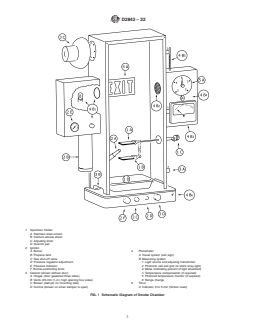
FIG. 1 Schematic Diagram of Smoke Chamber
D2843 − 22
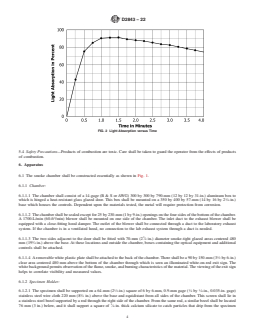
FIG. 2 Light Absorption versus Time
FIG. 3 Exploded View of Burner
3 1
on a line passing through a point 8 mm ( ⁄10 in.) above the base exit opening of the burner shall be 260 mm (10 ⁄4 in.) from the
at one back corner of the chamber extending diagonally across
reference point at the rear of the chamber.
the chamber and sloping upward at 45 deg with the base. The
D2843 − 22
T = Temperature-sensitive winding in or on meter case to increase in resistance in proportion to increase in meter resistance with temperature.
R = Potentiometer with calibrated scale to reduce resistance in proportion to decrease in photocell output with rise in temperature.
C = Potentiometer to calibrate total resistance of shunt to change meter sensitivity exactly by 10:1 ratio.
FIG. 4 Smoke Density Test Chamber Photometer
6.1.3.3 A duct having a minimum diameter of 150 mm (6 decreases as the temperature increases; compensations shall
in.) outside of the chamber shall provide the air piped to the therefore be made. The photocell shall not be operated at
burner. temperatures exceeding 50°C.
6.1.3.4 Propane pressure shall be adjustable and preferably 6.1.4.4 The meter shall have two ranges. The range change
automatically regulated. Propane pressure shall be indicated by shall be accomplished by shunting the meter to one tenth of its
means of a Bourdon tube gage. sensitivity. When smoke accumulates to absorb 90 percent of
6.1.4 Photometric System: the light beam, the meter shall be set to its basic sensitivity, by
6.1.4.1 Alight source, a barrier-layer photoelectric cell, and any appropriate manner (for example, pressing a momentary
a temperature compensated meter shall be used to measure the switch, turning a dia, or automatically controlled by software).
proportion of a light beam which penetrates a 300-mm (12-in.) By doing this, the scale in the meter will then read from 90 to
path through the smoke. The light path shall be arranged 100 % absorption instead of reading from 0 to 100 % absorp-
horizontally as shown in Fig. 4. tion.
6.1.4.2 The light source shall be mounted in a box (4B1 in 6.1.5 Timing Device—A timing device, such as a clock,
Fig. 1) extending from the left side of the chamber at the mean shall be used to indicate 15-s intervals. If the time intervals are
height of 480 mm (19 ⁄4 in.) above the base. The light source audibly marked it will be convenient for the operator to record
shall be a compact filament microscope lamp No. 1493 all observations. The timing device shall be reset at the start of
operated at 5.8Vand a spherical reflector, with power supplied a test. The timing device shall start measuring when the burner
byavoltage-regulatingtransformer.Alensoffocallength60to is swung into test position.
65 mm (2 ⁄2-in.) shall focus a spot of light on the photocell in 6.1.6 Planimeter—A planimeter or other suitable means
the right instrument panel. shall be used for measuring the area under the light-absorption
6.1.4.3 Another box containing the photometer (4B2 in Fig. curve.
1) shall be attached to the right side of the chamber. The
7. Test Specimen
barrier-laye
...
This document is not an ASTM standard and is intended only to provide the user of an ASTM standard an indication of what changes have been made to the previous version. Because
it may not be technically possible to adequately depict all changes accurately, ASTM recommends that users consult prior editions as appropriate. In all cases only the current version
of the standard as published by ASTM is to be considered the official document.
Designation: D2843 − 19 D2843 − 22
Standard Test Method for
Density of Smoke from the Burning or Decomposition of
Plastics
This standard is issued under the fixed designation D2843; the number immediately following the designation indicates the year of
original adoption or, in the case of revision, the year of last revision. A number in parentheses indicates the year of last reapproval. A
superscript epsilon (´) indicates an editorial change since the last revision or reapproval.
This standard has been approved for use by agencies of the U.S. Department of Defense.
1. Scope*
1.1 This fire-test-response test method covers a laboratory procedure for measuring and observing the relative amounts of smoke
obscuration produced by the burning or decomposition of plastics. It is intended to be used for measuring the smoke-producing
characteristics of plastics under controlled conditions of combustion or decomposition. Correlation with other fire conditions is not
implied. The measurements are made in terms of the loss of light transmission through a collected volume of smoke produced
under controlled, standardized conditions. The apparatus is constructed so that the flame and smoke is observable during the test.
1.2 During the course of combustion, gases or vapors, or both, are evolved that are potentially hazardous to personnel. Adequate
precautions shall be taken to protect the operator.
1.3 The values stated in SI units are to be regarded as the standard. The values given in parentheses are for information purposes
only.
1.4 This standard is used to measure and describe the response of materials, products, or assemblies to heat and flame under
controlled conditions, but does not by itself incorporate all factors required for fire hazard or fire risk assessment of the materials,
products, or assemblies under actual fire conditions.
1.5 Fire testing is inherently hazardous. Adequate safeguards for personnel and property shall be employed in conducting these
tests. Specific safety warning statements are given in 1.2 and 9.13.
1.6 This standard does not purport to address all of the safety concerns, if any, associated with its use. It is the responsibility
of the user of this standard to establish appropriate safety, health, and environmental practices and determine the applicability of
regulatory limitations prior to use.
NOTE 1—There is no known ISO equivalent to this standard.
1.7 This international standard was developed in accordance with internationally recognized principles on standardization
established in the Decision on Principles for the Development of International Standards, Guides and Recommendations issued
by the World Trade Organization Technical Barriers to Trade (TBT) Committee.
This test method is under the jurisdiction of ASTM Committee D20 on Plastics and is the direct responsibility of Subcommittee D20.30 on Thermal Properties(Section
D20.30.03).
Current edition approved Oct. 1, 2019March 15, 2022. Published October 2019March 2022. Originally approved in 1970. Last previous edition approved in 20162019
as D2843 - 16.D2843 - 19. DOI: 10.1520/D2843-19.10.1520/D2843-22.
Anonymous, “A Method of Measuring Smoke Density,” NFPA Quarterly, QNFPA, Vol 57, January 1964, p. 276. Reprint NFPA Q57-9. Available from NFPA, 60
Batterymarch St., Boston, MA 02110.
*A Summary of Changes section appears at the end of this standard
Copyright © ASTM International, 100 Barr Harbor Drive, PO Box C700, West Conshohocken, PA 19428-2959. United States
D2843 − 22
2. Referenced Documents
2.1 ASTM Standards:
D618 Practice for Conditioning Plastics for Testing
D883 Terminology Relating to Plastics
D1600 Terminology for Abbreviated Terms Relating to Plastics
E84 Test Method for Surface Burning Characteristics of Building Materials
E176 Terminology of Fire Standards
E456 Terminology Relating to Quality and Statistics
E662 Test Method for Specific Optical Density of Smoke Generated by Solid Materials
E691 Practice for Conducting an Interlaboratory Study to Determine the Precision of a Test Method
E906/E906M Test Method for Heat and Visible Smoke Release Rates for Materials and Products Using a Thermopile Method
E1354 Test Method for Heat and Visible Smoke Release Rates for Materials and Products Using an Oxygen Consumption
Calorimeter
E2935 Practice for Evaluating Equivalence of Two Testing Processes
2.2 ISO Standards:
ISO 13943 Fire Safety—Vocabulary
3. Terminology
3.1 Definitions—For definitions of terms relating to plastics, the definitions in this test method are in accordance with Terminology
D883 and D1600. For terms relating to fire, the definitions in this test method are in accordance with Terminology E176 and
ISO 13943. In case of conflict, the definitions given in Terminology E176 shall prevail. For terms relating to precision and bias
and associated issues, the terms used in this test method are in accordance with the definitions in Terminology E456.
4. Summary of Test Method
4.1 The test specimen is exposed to flame for the duration of the test, and the smoke is substantially trapped in the chamber in
which combustion occurs. A 25 by 25 by 6-mm (1 by 1 by ⁄4-in.) specimen is placed on supporting metal screen and burned in
a laboratory test chamber (Fig. 1) under active flame conditions using a propane burner operating at a pressure of 276 kPa (40 psi).
The 300 by 300 by 790-mm (12 by 12 by 31-in.) test chamber is instrumented with a light source, photoelectric cell, and meter
to measure light absorption horizontally across the 300-mm (12-in.) light beam path. The chamber is closed during the 4-min test
period except for the 25-mm (1-in.) high ventilation openings around the bottom.
4.2 The light-absorption data are plotted versus time. A typical plot is shown in Fig. 2. Two indexes are used to rate the material:
the maximum smoke produced and the smoke-density rating.
5. Significance and Use
5.1 Tests made on a material under conditions herein prescribed are of considerable value in comparing the relative smoke
obscuration characteristics of plastics.
5.2 This test method serves to determine the extent to which plastic materials are likely to smoke under conditions of active
burning and decomposition in the presence of flame.
NOTE 2—One study suggested that visual and instrumental observations from this test compare well with the visual observations of the smoke generated
by plastic materials when added to a freely burning large outdoor fire.
5.3 The usefulness of this test procedure is in its ability to measure the amount of smoke obscuration produced in a simple, direct,
and meaningful manner under the specified conditions. The degree of obscuration of vision by smoke generated by combustibles
is known to be affected by changes in quantity and form of material, humidity, draft, temperature, and oxygen supply.
For referenced ASTM standards, visit the ASTM website, www.astm.org, or contact ASTM Customer Service at service@astm.org. For Annual Book of ASTM Standards
volume information, refer to the standard’s Document Summary page on the ASTM website.
Available from International Organization for Standardization (ISO), ISO Central Secretariat, BIBC II, Chemin de Blandonnet 8, CP 401, 1214 Vernier, Geneva,
Switzerland, http://www.iso.org.
Bartosic, A. J., and Rarig, F. J., “Evaluation of the XP2 Smoke Density Chamber,” Symposium on Fire Test Methods—Restraint & Smoke, ASTM STP 422, ASTM,
Philadelphia, PA, 1966.
D2843 − 22
1. Specimen Holder
A Stainless steel screen
B Calcium-silicate sheet
C Adjusting knob
D Quench pan
2. Ignition
A Burner 4. Photometer
B Propane tank A Visual system (exit sign)
C Gas shut-off valve B Measuring system
D Pressure regulator adjustment 1 Light source and adjusting transformer
E Pressure indicator 2 Photronic cell and grid (to block stray light)
F Burner-positioning knob 3 Meter (indicating percent of light absorbed)
3. Cabinet (shown without door) 4 Temperature compensation (if required)
A Hinges (door gasketed three sides) 5 Photocell temperature monitor (if required)
B Vents (25-mm (1-in.) high opening four sides) 6 Range change
C Blower (damper on mounting side) 5. Timer
D Control (blower on when damper is open) A Indicator, 0 to 5 min (friction reset)
FIG. 1 Schematic Diagram of Smoke Chamber
D2843 − 22
FIG. 2 Light Absorption versus Time
5.4 Safety Precautions—Products of combustion are toxic. Care shall be taken to guard the operator from the effects of products
of combustion.
6. Apparatus
6.1 The smoke chamber shall be constructed essentially as shown in Fig. 1.
6.1.1 Chamber:
6.1.1.1 The chamber shall consist of a 14-gage (B & S or AWG) 300 by 300 by 790-mm (12 by 12 by 31-in.) aluminum box to
which is hinged a heat-resistant glass glazed door. This box shall be mounted on a 350 by 400 by 57-mm (14 by 16 by 2 ⁄4-in.)
base which houses the controls. Dependent upon the materials tested, the metal will require protection from corrosion.
6.1.1.2 The chamber shall be sealed except for 25 by 230-mm (1 by 9-in.) openings on the four sides of the bottom of the chamber.
A 1700-L/min (60-ft /min) blower shall be mounted on one side of the chamber. The inlet duct to the exhaust blower shall be
equipped with a close-fitting hood damper. The outlet of the blower shall be connected through a duct to the laboratory exhaust
system. If the chamber is in a ventilated hood, no connection to the lab exhaust system through a duct is needed.
6.1.1.3 The two sides adjacent to the door shall be fitted with 70-mm (2 ⁄4 in.) diameter smoke-tight glazed areas centered 480
mm (19 ⁄4 in.) above the base. At these locations and outside the chamber, boxes containing the optical equipment and additional
controls shall be attached.
6.1.1.4 A removable white plastic plate shall be attached to the back of the chamber. There shall be a 90 by 150-mm (3 ⁄2 by 6-in.)
clear area centered 480 mm above the bottom of the chamber through which is seen an illuminated white-on-red exit sign. The
white background permits observation of the flame, smoke, and burning characteristics of the material. The viewing of the exit sign
helps to correlate visibility and measured values.
6.1.2 Specimen Holder:
1 1 1
6.1.2.1 The specimen shall be supported on a 64-mm (2 ⁄2-in.) square of 6 by 6-mm, 0.9-mm gage ( ⁄4 by ⁄4-in., 0.035-in. gage)
stainless steel wire cloth 220 mm (8 ⁄4 in.) above the base and equidistant from all sides of the chamber. This screen shall lie in
a stainless steel bezel supported by a rod through the right side of the chamber. From the same rod, a similar bezel shall be located
76 mm (3 in.) below, and it shall support a square of ⁄4-in. thick calcium silicate to catch particles that drip from the specimen
D2843 − 22
FIG. 3 Exploded View of Burner
during the test. At the conclusion of the test, rotate the specimen holder rod and quench the burning specimen in a shallow pan
of water positioned below the specimen holder.
6.1.3 Ignition System:
6.1.3.1 The specimen shall be ignited by a propane flame from a burner operating at a pressure of 276 kPa (40 psi). The fuel (Note
3) shall be mixed with air that has been propelled through the burner by the Venturi effect of the propane as it passes from a
0.13-mm (0.005-in.) diameter orifice (Note 4), and the burner shall be assembled as shown in the exploded view of the burner in
Fig. 3. The burner shall be designed to provide adequate outside air.
NOTE 3—Commercial grade 85.0 % minimum, gross heating value 23 000 cal/litre (2590 Btu/ft ) propane meets the requirements.
NOTE 4—Since the orifice provides the metering effect proportionate to the supply pressure, care must be taken that the orifice is the only means of fuel
egress.
6.1.3.2 The burner shall be capable of being positioned quickly under the specimen so that the axis of the burner falls on a line
passing through a point 8 mm ( ⁄10 in.) above the base at one back corner of the chamber extending diagonally across the chamber
and sloping upward at 45 deg with the base. The exit opening of the burner shall be 260 mm (10 ⁄4 in.) from the reference point
at the rear of the chamber.
6.1.3.3 A duct having a minimum diameter of 150 mm (6 in.) outside of the chamber shall provide the air piped to the burner.
6.1.3.4 Propane pressure shall be adjustable and preferably automatically regulated. Propane pressure shall be indicated by means
of a Bourdon tube gage.
6.1.4 Photometric System:
D2843 − 22
T = Temperature-sensitive winding in or on meter case to increase in resistance in proportion to increase in meter resistance with temperature.
R = Potentiometer with calibrated scale to reduce resistance in proportion to decrease in photocell output with rise in temperature.
C = Potentiometer to calibrate total resistance of shunt to change meter sensitivity exactly by 10:1 ratio.
FIG. 4 Smoke Density Test Chamber Photometer
6.1.4.1 A light source, a barrier-layer photoelectric cell, and a temperature compensated meter shall be used to measure the
proportion of a light beam which penetrates a 300-mm (12-in.) path through the smoke. The light path shall be arranged
horizontally as shown in Fig. 4.
6.1.4.2 The light source shall be mounted in a box (4B1 in Fig. 1) extending from the left side of the chamber at the mean height
of 480 mm (19 ⁄4 in.) above the base. The light source shall be a compact filament microscope lamp No. 1493 operated at 5.8 V
and a spherical reflector, with power supplied by a voltage-regulating transformer. A lens of focal length 60 to 65 mm (2 ⁄2-in.)
shall focus a spot of light on the photocell in the right instrument panel.
6.1.4.3 Another box containing the photometer (4 B2 in Fig. 1) shall be attached to the right side of the chamber. The barrier-layer
photoelectric cell shall have standard observer spectral response. An egg-crate grid in front of the photocell shall be used to protect
the cell from stray light. The grid shall be finished in dull black and have openings at least twice as deep as they are wide. The
current produced by the photocell is indicated in terms of percent light absorption on a meter or on a computer display using
software. The photocell linearity decreases as the temperature increases; compensations shall therefore be made. The photocell
shall not be operated at temperatures exceeding 50°C.
6.1.4.4 The meter shall have two ranges. The range change shall be accomplished by shunting the meter to one tenth of its
sensitivity. When smoke accumulates to absorb 90 percent of the light beam, the meter shall be set to its basic sensitivity, by any
appropriate manner (for example, pressing a momentary switch, turning a dia, or automatically controlled by software). By doing
this, the scale in the meter will then read from 90 to 100 % absorption instead of reading from 0 to 100 % absorption.
6.1.5 Timing Device—A timing device, such as a clock, shall be used to indicate 15-s intervals. If the time intervals are audibly
marked it will be convenient for the operator to r
...
Questions, Comments and Discussion
Ask us and Technical Secretary will try to provide an answer. You can facilitate discussion about the standard in here.
Loading comments...