

ASTM D8159-19
(Test Method)Standard Test Method for Automated Extraction of Asphalt Binder from Asphalt Mixtures
General Information
- Abstract
SIGNIFICANCE AND USE
4.1 This test method is used for quantitative determination of asphalt binder in asphalt mixtures and asphalt pavement samples for specification acceptance, service evaluation, control, and research.
4.2 Aggregates obtained by this method may be used for sieve analysis using Test Method D5444. Extracted asphalt binder from this test method may be recovered using Test Method D1856 or Practice D5404/D5404M.
Note 1: The quality of results produced by this standard is dependent on the competence of the personnel performing the procedure and the capability, calibration, and maintenance of the equipment used. Agencies that meet the criteria of Specification D3666 are generally considered capable of competent and objective testing, sampling, inspection, etc. Users of this standard are cautioned that compliance with Specification D3666 alone does not completely ensure reliable results. Reliable results depend on many factors; following the suggestions of Specification D3666 or some similar acceptable guidance provides a means of evaluating and controlling some of those factors.
SCOPE
1.1 This test method covers the quantitative determination of asphalt binder content in asphalt mixtures and pavement specimens, using the automated computer controller or human-machine interface system (HMI), to perform a solvent extraction for specification acceptance, service evaluation, quality control, and research.
1.2 The values stated in SI units are to be regarded as standard. No other units of measurement are included in this standard.
1.3 The text of this standard references notes and footnotes which provide explanatory material. These notes and footnotes (excluding those in tables and figures) shall not be considered as requirements of the standard.
1.4 An ILS is being conducted according to Practice E691 and will be available on or before December 2018. Therefore, this standard should not be used for acceptance or rejection of a material for purchasing purposes.
1.5 This standard does not purport to address all of the safety concerns, if any, associated with its use. It is the responsibility of the user of this standard to establish appropriate safety, health, and environmental practices and determine the applicability of regulatory limitations prior to use.
1.6 This international standard was developed in accordance with internationally recognized principles on standardization established in the Decision on Principles for the Development of International Standards, Guides and Recommendations issued by the World Trade Organization Technical Barriers to Trade (TBT) Committee.
- Status
- Published
- Publication Date
- 30-Jun-2019
- Technical Committee
- D04 - Road and Paving Materials
- Drafting Committee
- D04.25 - Analysis of Asphalt Mixtures
Buy Documents
ASTM D8159-19 - Standard Test Method for Automated Extraction of Asphalt Binder from Asphalt Mixtures
REDLINE ASTM D8159-19 - Standard Test Method for Automated Extraction of Asphalt Binder from Asphalt Mixtures
Overview
ASTM D8159-19 is a widely recognized standard test method focused on the automated extraction of asphalt binder from asphalt mixtures and pavement samples. Developed by ASTM International, this method emphasizes the quantitative determination of asphalt binder content using automated equipment controlled by computer or human-machine interface (HMI). The process utilizes approved solvents, enabling reliable evaluation for specification acceptance, service performance analysis, quality control, and research in road construction and pavement engineering.
Key Topics
- Quantitative Asphalt Binder Determination: The method facilitates precise measurement of asphalt binder content, expressed as a mass percentage of the moisture-free mixture.
- Automated Extraction Equipment: Advanced computer-controlled or HMI-based systems streamline the extraction process, ensuring consistent results.
- Approved Solvents: The procedure allows for the use of tetrachloroethylene, trichloroethylene, or methylene chloride-each with defined handling, safety, and environmental requirements.
- Specimen Preparation and Handling: Guidelines specify the proper preparation of test specimens, including drying and splitting, as well as container and drum requirements to ensure sample integrity.
- Quality and Safety: The test method underlines the importance of personnel competence, equipment calibration, and adherence to safety and environmental regulations for solvents and byproducts.
Applications
The ASTM D8159-19 standard is essential for a variety of uses in the asphalt and pavement industry, including:
- Specification Acceptance: Provides a reliable approach for verifying asphalt binder content in mixtures for compliance with project or regulatory specifications.
- Quality Control: Enables laboratories, contractors, and agencies to routinely monitor asphalt binder content in both plant-produced and field-collected samples, helping to ensure consistent material properties.
- Service Evaluation: Facilitates the assessment of in-service pavement samples to support performance-based maintenance and rehabilitation decisions.
- Research and Development: The method supports material scientists and researchers in developing and evaluating new asphalt mixture designs.
A notable advantage of the automated extraction approach is improved efficiency and reduced operator variability, leading to higher confidence in test outcomes.
Aggregates recovered through the extraction process can be further tested using sieve analysis, while the extracted binder may undergo additional evaluation or recovery through referenced ASTM methods.
Related Standards
ASTM D8159-19 is part of a network of standards essential for comprehensive asphalt materials evaluation. Related standards include:
- ASTM D5444: Test Method for Mechanical Size Analysis of Extracted Aggregate, used for further analysis of aggregate obtained from the extraction process.
- ASTM D1856 and D5404/D5404M: Methods for recovery of asphalt binder from solution after extraction.
- ASTM D979/D979M: Practice for Sampling Bituminous Paving Mixtures, ensuring representative sample collection.
- ASTM D1461: Test Method for Moisture or Volatile Distillates in Asphalt Mixtures, which supports accurate binder calculation.
- ASTM D3666: Specification for Minimum Requirements for Agencies Testing Road and Paving Materials, referenced for laboratory competence and result reliability.
- AASHTO R 47: Practice for Reducing Samples of Hot Mix Asphalt (HMA) to Testing Size.
By adhering to ASTM D8159-19 and related standards, industry professionals can achieve higher quality control, improve pavement longevity, and comply with regulatory requirements in asphalt pavement construction and maintenance.
Keywords: ASTM D8159-19, automated asphalt binder extraction, asphalt mixture analysis, quality control, solvent extraction, pavement evaluation, asphalt standard test methods, laboratory testing, construction material standards.
Relations
- Effective Date
- 01-Jul-2019
- Effective Date
- 01-Feb-2024
- Effective Date
- 01-Oct-2016
- Effective Date
- 01-May-2015
- Effective Date
- 01-May-2014
- Effective Date
- 01-Dec-2013
- Effective Date
- 01-May-2013
- Effective Date
- 01-May-2013
- Effective Date
- 01-Aug-2012
- Effective Date
- 01-Aug-2012
- Effective Date
- 01-Jun-2012
- Effective Date
- 01-Feb-2012
- Effective Date
- 15-Dec-2011
- Effective Date
- 01-Dec-2011
- Effective Date
- 01-Nov-2011
Buy Documents
ASTM D8159-19 - Standard Test Method for Automated Extraction of Asphalt Binder from Asphalt Mixtures
REDLINE ASTM D8159-19 - Standard Test Method for Automated Extraction of Asphalt Binder from Asphalt Mixtures
Get Certified
Connect with accredited certification bodies for this standard

Zavod za gradbeništvo Slovenije (ZAG) - Inšpekcija
ZAG inspection body for construction products, structures, and materials.
Sponsored listings
Frequently Asked Questions
ASTM D8159-19 is a standard published by ASTM International. Its full title is "Standard Test Method for Automated Extraction of Asphalt Binder from Asphalt Mixtures". This standard covers: SIGNIFICANCE AND USE 4.1 This test method is used for quantitative determination of asphalt binder in asphalt mixtures and asphalt pavement samples for specification acceptance, service evaluation, control, and research. 4.2 Aggregates obtained by this method may be used for sieve analysis using Test Method D5444. Extracted asphalt binder from this test method may be recovered using Test Method D1856 or Practice D5404/D5404M. Note 1: The quality of results produced by this standard is dependent on the competence of the personnel performing the procedure and the capability, calibration, and maintenance of the equipment used. Agencies that meet the criteria of Specification D3666 are generally considered capable of competent and objective testing, sampling, inspection, etc. Users of this standard are cautioned that compliance with Specification D3666 alone does not completely ensure reliable results. Reliable results depend on many factors; following the suggestions of Specification D3666 or some similar acceptable guidance provides a means of evaluating and controlling some of those factors. SCOPE 1.1 This test method covers the quantitative determination of asphalt binder content in asphalt mixtures and pavement specimens, using the automated computer controller or human-machine interface system (HMI), to perform a solvent extraction for specification acceptance, service evaluation, quality control, and research. 1.2 The values stated in SI units are to be regarded as standard. No other units of measurement are included in this standard. 1.3 The text of this standard references notes and footnotes which provide explanatory material. These notes and footnotes (excluding those in tables and figures) shall not be considered as requirements of the standard. 1.4 An ILS is being conducted according to Practice E691 and will be available on or before December 2018. Therefore, this standard should not be used for acceptance or rejection of a material for purchasing purposes. 1.5 This standard does not purport to address all of the safety concerns, if any, associated with its use. It is the responsibility of the user of this standard to establish appropriate safety, health, and environmental practices and determine the applicability of regulatory limitations prior to use. 1.6 This international standard was developed in accordance with internationally recognized principles on standardization established in the Decision on Principles for the Development of International Standards, Guides and Recommendations issued by the World Trade Organization Technical Barriers to Trade (TBT) Committee.
SIGNIFICANCE AND USE 4.1 This test method is used for quantitative determination of asphalt binder in asphalt mixtures and asphalt pavement samples for specification acceptance, service evaluation, control, and research. 4.2 Aggregates obtained by this method may be used for sieve analysis using Test Method D5444. Extracted asphalt binder from this test method may be recovered using Test Method D1856 or Practice D5404/D5404M. Note 1: The quality of results produced by this standard is dependent on the competence of the personnel performing the procedure and the capability, calibration, and maintenance of the equipment used. Agencies that meet the criteria of Specification D3666 are generally considered capable of competent and objective testing, sampling, inspection, etc. Users of this standard are cautioned that compliance with Specification D3666 alone does not completely ensure reliable results. Reliable results depend on many factors; following the suggestions of Specification D3666 or some similar acceptable guidance provides a means of evaluating and controlling some of those factors. SCOPE 1.1 This test method covers the quantitative determination of asphalt binder content in asphalt mixtures and pavement specimens, using the automated computer controller or human-machine interface system (HMI), to perform a solvent extraction for specification acceptance, service evaluation, quality control, and research. 1.2 The values stated in SI units are to be regarded as standard. No other units of measurement are included in this standard. 1.3 The text of this standard references notes and footnotes which provide explanatory material. These notes and footnotes (excluding those in tables and figures) shall not be considered as requirements of the standard. 1.4 An ILS is being conducted according to Practice E691 and will be available on or before December 2018. Therefore, this standard should not be used for acceptance or rejection of a material for purchasing purposes. 1.5 This standard does not purport to address all of the safety concerns, if any, associated with its use. It is the responsibility of the user of this standard to establish appropriate safety, health, and environmental practices and determine the applicability of regulatory limitations prior to use. 1.6 This international standard was developed in accordance with internationally recognized principles on standardization established in the Decision on Principles for the Development of International Standards, Guides and Recommendations issued by the World Trade Organization Technical Barriers to Trade (TBT) Committee.
ASTM D8159-19 is classified under the following ICS (International Classification for Standards) categories: 93.080.20 - Road construction materials. The ICS classification helps identify the subject area and facilitates finding related standards.
ASTM D8159-19 has the following relationships with other standards: It is inter standard links to ASTM D8159-18, ASTM D4753-24, ASTM D3666-16, ASTM D4753-15, ASTM E177-14, ASTM D3666-13, ASTM E177-13, ASTM E691-13, ASTM D2872-12e1, ASTM D2872-12, ASTM D5404/D5404M-12, ASTM D979/D979M-12, ASTM D1461-11, ASTM D3666-11, ASTM E691-11. Understanding these relationships helps ensure you are using the most current and applicable version of the standard.
ASTM D8159-19 is available in PDF format for immediate download after purchase. The document can be added to your cart and obtained through the secure checkout process. Digital delivery ensures instant access to the complete standard document.
Standards Content (Sample)
This international standard was developed in accordance with internationally recognized principles on standardization established in the Decision on Principles for the
Development of International Standards, Guides and Recommendations issued by the World Trade Organization Technical Barriers to Trade (TBT) Committee.
Designation: D8159 − 19
Standard Test Method for
Automated Extraction of Asphalt Binder from Asphalt
Mixtures
This standard is issued under the fixed designation D8159; the number immediately following the designation indicates the year of
original adoption or, in the case of revision, the year of last revision. A number in parentheses indicates the year of last reapproval. A
superscript epsilon (´) indicates an editorial change since the last revision or reapproval.
1. Scope 2. Referenced Documents
2.1 ASTM Standards:
1.1 This test method covers the quantitative determination
D979/D979M Practice for Sampling Bituminous Paving
of asphalt binder content in asphalt mixtures and pavement
Mixtures
specimens, using the automated computer controller or human-
D1461 Test Method for Moisture or Volatile Distillates in
machine interface system (HMI), to perform a solvent extrac-
Asphalt Mixtures
tion for specification acceptance, service evaluation, quality
D1856 Test Method for Recovery of Asphalt From Solution
control, and research.
by Abson Method
1.2 The values stated in SI units are to be regarded as
D2042 Test Method for Solubility of Asphalt Materials in
standard. No other units of measurement are included in this Trichloroethylene
standard. D2872 Test Method for Effect of Heat and Air on a Moving
Film of Asphalt (Rolling Thin-Film Oven Test)
1.3 The text of this standard references notes and footnotes
D3666 Specification for Minimum Requirements for Agen-
which provide explanatory material. These notes and footnotes
cies Testing and Inspecting Road and Paving Materials
(excluding those in tables and figures) shall not be considered
D4753 Guide for Evaluating, Selecting, and Specifying Bal-
as requirements of the standard.
ances and Standard Masses for Use in Soil, Rock, and
Construction Materials Testing
1.4 An ILS is being conducted according to Practice E691
D5404/D5404M Practice for Recovery of Asphalt from So-
and will be available on or before December 2018. Therefore,
lution Using the Rotary Evaporator
this standard should not be used for acceptance or rejection of
D5444 Test Method for Mechanical Size Analysis of Ex-
a material for purchasing purposes.
tracted Aggregate
1.5 This standard does not purport to address all of the
D5546 Test Method for Solubility of Asphalt Binders in
safety concerns, if any, associated with its use. It is the
Toluene by Centrifuge (Withdrawn 2017)
responsibility of the user of this standard to establish appro-
E177 Practice for Use of the Terms Precision and Bias in
priate safety, health, and environmental practices and deter-
ASTM Test Methods
mine the applicability of regulatory limitations prior to use.
E691 Practice for Conducting an Interlaboratory Study to
Determine the Precision of a Test Method
1.6 This international standard was developed in accor-
dance with internationally recognized principles on standard- 2.2 AASHTO Standard:
R47 Standard Practice for Reducing Samples of Hot Mix
ization established in the Decision on Principles for the
Asphalt (HMA) to Testing Size
Development of International Standards, Guides and Recom-
mendations issued by the World Trade Organization Technical
3. Summary of Test Method
Barriers to Trade (TBT) Committee.
3.1 The asphalt paving mixture is extracted using the
automated extraction equipment, using only the following
For referenced ASTM standards, visit the ASTM website, www.astm.org, or
contact ASTM Customer Service at service@astm.org. For Annual Book of ASTM
Standards volume information, refer to the standard’s Document Summary page on
This test method is under the jurisdiction of ASTM Committee D04 on Road the ASTM website.
and Paving Materials and is the direct responsibility of Subcommittee D04.25 on The last approved version of this historical standard is referenced on
Analysis of Asphalt Mixtures. www.astm.org.
Current edition approved July 1, 2019. Published July 2019. Originally approved Available from American Association of State Highway and Transportation
in 2018. Last previous edition approved in 2018 as D8159 – 18. DOI: 10.1520/ Officials (AASHTO), 444 N. Capitol St., NW, Suite 249, Washington, DC 20001,
D8159-19. http://www.transportation.org.
Copyright © ASTM International, 100 Barr Harbor Drive, PO Box C700, West Conshohocken, PA 19428-2959. United States
D8159 − 19
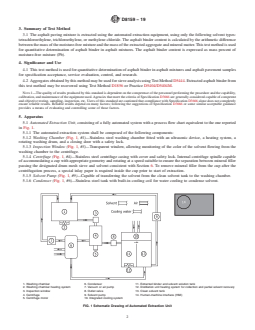
solvent types: tetrachloroethylene, trichloroethylene, or meth- 5.1.1 The automated extraction system shall be composed
ylene chloride. The asphalt binder content is calculated by the of the following components:
arithmetic difference between the mass of the moisture-free
5.1.2 Washing Chamber (Fig. 1, #1)—Stainless steel wash-
mixture and the mass of the extracted aggregate and mineral
ing chamber fitted with an ultrasonic device, a heating system,
matter. This test method is used for quantitative determination
a rotating washing drum, and a closing door with a safety lock.
of asphalt binder in asphalt mixtures. The asphalt binder
5.1.3 Inspection Window (Fig. 1, #3)—Transparent window,
content is expressed as mass percent of moisture-free mixture
allowing monitoring of the color of the solvent flowing from
(Pb).
the washing chamber to the centrifuge.
5.1.4 Centrifuge (Fig. 1, #4)—Stainless steel centrifuge
4. Significance and Use
casing with cover and safety lock. Internal centrifuge spindle
4.1 This test method is used for quantitative determination
capable of accommodating a cup with appropriate geometry
of asphalt binder in asphalt mixtures and asphalt pavement
and rotating at a speed suitable to ensure the separation
samples for specification acceptance, service evaluation,
between mineral filler passing the designated drum mesh sieve
control, and research.
and solvent consistent with Section 6. To remove mineral filler
4.2 Aggregates obtained by this method may be used for
from the cup after the centrifugation process, a special inlay
sieve analysis using Test Method D5444. Extracted asphalt
paper is required inside the cup prior to start of extraction.
binder from this test method may be recovered using Test
5.1.5 SolventPump(Fig.1,#9)—Capableoftransferringthe
Method D1856 or Practice D5404/D5404M.
solvent from the clean solvent tank to the washing chamber.
NOTE 1—The quality of results produced by this standard is dependent
5.1.6 Condenser (Fig. 1, #6)—Stainless steel tank with
on the competence of the personnel performing the procedure and the
built-in cooling coil for water cooling to condense solvent.
capability, calibration, and maintenance of the equipment used. Agencies
5.1.7 Pump, Air or Vacuum (Fig. 1, #7)—Solvent-resistant
that meet the criteria of Specification D3666 are generally considered
capable of competent and objective testing, sampling, inspection, etc. pump,abletocirculateairandsolventvaporsduringthedrying
Users of this standard are cautioned that compliance with Specification
cycle. The circulation of the air ensures that the solvent vapors
D3666 alone does not completely ensure reliable results. Reliable results
are extracted from the specimen and released in the condenser.
dependonmanyfactors;followingthesuggestionsofSpecificationD3666
5.1.8 Recovery Module—Composed of two chambers and
or some similar acceptable guidance provides a means of evaluating and
controlling some of those factors. integrated cooling system, capable of adequately recovering
solvent from an asphalt mixture. One chamber shall serve as a
5. Apparatus
binder and solvent solution storage chamber, and the other
5.1 Automated Extraction Unit, consisting of a fully auto- serving as a clean solvent storage and recovery chamber. All
mated system with a process flow chart equivalent to the one chambers shall have the capability to allow transfer of solvent
reported in Fig. 1. through the extraction process.
1. Washing chamber 6. Condenser 11. Extracted binder and solvent solution tank
2. Washing chamber heating system 7. Vacuum or air pump 12. Distillation unit heating system for collection and partial solvent recovery
3. Inspection window 8. Outlet valve 13. Clean solvent tank
4. Centrifuge 9. Solvent pump 14. Human-machine interface (HMI)
5. Centrifuge motor 10. Integrated cooling system
FIG. 1 Schematic Drawing of Automated Extraction Unit
D8159 − 19
5.1.8.1 Solvent Recovery and Binder Storage Chamber,
fitted with heating system to distill solvent, fill level indicators
to prevent heating when chamber is empty, and an outlet tap.
5.1.8.2 CleanSolventStorageandRecoveryChamber,fitted
with integrated cooling system, fill level indicator, outlet tap,
and mechanism to allow solvent distillate to flow or be
transferred back to washing chamber.
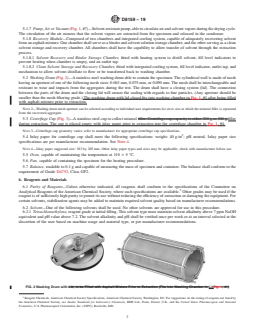
5.2 WashingDrum(Fig. 2)—Astainless steel washing drum
able to contain the specimen. The cylindrical wall is made of
mesh having an aperture of one of the following mesh sizes:
0.063 mm, 0.075 mm, or 0.090 mm. The mesh shall be inter-
changeable and resistant to wear and impacts from the aggre-
gates during the test. The drum shall have a closing system
(lid). The connection between the parts of the drum and the
closing lid will ensure the sealing with regards to fine particles.
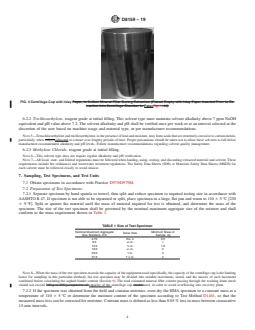
FIG. 3 Centrifuge Cup with Inlay Paper
(Any aperture should be smaller than the mesh filtering grade.)
The washing drum with lid closed fits into washing chamber in
Fig. 1, #1 after being filled with asphalt mixture prior to
6. Reagents and Materials
extraction.
6.1 Purity of Reagents—Unless otherwise indicated, all
NOTE 2—Washing drum mesh aperture can be selected according to reagents shall conform to the specifications of the Committee
individual user requirements for sieve size at which the mineral filler is
on Analytical Reagents of the American Chemical Society,
separated from the recovered aggregate. 5
where such specifications are available. Other grades may be
5.3 Centrifuge Cup (Fig. 3)—Astainless steel cup to collect
usedifthereagentisofsufficientlyhighpuritytopermititsuse
mineral filler during extraction. The cup is placed empty with
without reducing the efficiency of extraction or damaging the
inlay paper prior to extraction into the centrifuge chamber in
equipment. For certain solvents, stabilization agents may be
Fig. 1, #4.
added to maintain required solvent quality based on manufac-
turer recommendations.
NOTE 3—Centrifuge cup geometry varies; refer to manufacturer for
appropriate centrifuge cup specifications.
6.2 Solvent—One of the following solvents shall be used.
No other solvents are approved for use in this procedure.
5.4 Inlay paper for centrifuge cup shall meet the following
6.2.1 Tetrachloroethylene, reagent grade at initial filling.
specifications: weight: 40 g⁄m ; pH neutral. Inlay paper size
Thissolventtypemustmaintainsolventalkalinityabove7ppm
specifications are per manufacturer recommendation. See Note
NaOH equivalent and pH value above 7.2. The solvent
4.
alkalinity and pH shall be verified once per week or at an
NOTE 4—Inlay paper suggested size: 383 by 205 mm. Other inlay paper
interval selected at the discretion of the user based on machine
types and sizes may be applicable; check with manufacturer before use.
usage and material type, or per manufacturer recommenda-
5.5 Oven, capable of maintaining the temperature at 110 6
tions.
5 °C.
5.6 Pan, capable of containing the specimen for the heating
Reagent Chemicals, American Chemical Society Specifications, American
procedure.
Chemical Society, Washington, DC. For suggestions on the testing of reagents not
listed by the American Chemical Society, see Analar Standards for Laboratory
5.7 Balance, readable to 0.1 g and capable of measuring the
Chemicals, BDH Ltd., Poole, Dorset, U.K., and the United States Pharmacopeia
mass of specimen and container. The balance shall conform to
and National Formulary, U.S. Pharmacopeial Convention, Inc. (USPC), Rockville,
the requirement of Guide D4753, Class GP2. MD.
FIG. 2 Washing Drum with Lid
D8159 − 19
6.2.2 Trichloroethylene, reagent grade at initial filling. This Constant mass is defined as less than 0.05 % loss in mass
solvent type must maintain solvent alkalinity above 7 ppm between consecutive 15-min intervals.
NaOH equivalent and pH value above 7.2. The solvent
alkalinity and pH shall be verified once per week or at an 8. Procedure
interval selected at the discretion of the user based on machine
8.1 All necessary unit connections must be made in accor-
usage and material type, or per manufacturer recommenda-
dance with manufacturer’s instructions. The operating instruc-
tions.
tions of the machine supplier must be followed for calibrating,
checking, and operating the unit.
NOTE 5—Tetrachloroethylene and trichloroethylene, in the presence of
heat and moisture, may form acids that are extremely corrosive to certain
8.2 Preliminary Operations:
metals, particularly when subjected to contact over lengthy periods of
time. Proper precautions should be taken not to allow these solvents to fall
8.3 Carefully clean the centrifuge cup (Fig. 3) to be sure
below manufacturer-recommended alkalinity and pH levels. Follow
there is no residue on the bottom and under the rim. Line the
manufacturer recommendations regarding solvent quality management.
inside latera
...
This document is not an ASTM standard and is intended only to provide the user of an ASTM standard an indication of what changes have been made to the previous version. Because
it may not be technically possible to adequately depict all changes accurately, ASTM recommends that users consult prior editions as appropriate. In all cases only the current version
of the standard as published by ASTM is to be considered the official document.
Designation: D8159 − 18 D8159 − 19
Standard Test Method for
Automated Extraction of Asphalt Binder from Asphalt
Mixtures
This standard is issued under the fixed designation D8159; the number immediately following the designation indicates the year of
original adoption or, in the case of revision, the year of last revision. A number in parentheses indicates the year of last reapproval. A
superscript epsilon (´) indicates an editorial change since the last revision or reapproval.
1. Scope
1.1 This test method covers the quantitative determination of asphalt binder content in asphalt mixtures and pavement
specimens, using the automated computer controller or human-machine interface system (HMI), to perform a solvent extraction
for specification acceptance, service evaluation, quality control, and research.
1.2 The values stated in SI units are to be regarded as standard. No other units of measurement are included in this standard.
1.3 The text of this standard references notes and footnotes which provide explanatory material. These notes and footnotes
(excluding those in tables and figures) shall not be considered as requirements of the standard.
1.4 An ILS is being conducted according to Practice E691 and will be available on or before December 2018. Therefore, this
standard should not be used for acceptance or rejection of a material for purchasing purposes.
1.5 This standard does not purport to address all of the safety concerns, if any, associated with its use. It is the responsibility
of the user of this standard to establish appropriate safety, health, and environmental practices and determine the applicability of
regulatory limitations prior to use.
1.6 This international standard was developed in accordance with internationally recognized principles on standardization
established in the Decision on Principles for the Development of International Standards, Guides and Recommendations issued
by the World Trade Organization Technical Barriers to Trade (TBT) Committee.
2. Referenced Documents
2.1 ASTM Standards:
D979/D979M Practice for Sampling Bituminous Paving Mixtures
D1461 Test Method for Moisture or Volatile Distillates in Asphalt Mixtures
D1856 Test Method for Recovery of Asphalt From Solution by Abson Method
D2042 Test Method for Solubility of Asphalt Materials in Trichloroethylene
D2872 Test Method for Effect of Heat and Air on a Moving Film of Asphalt (Rolling Thin-Film Oven Test)
D3666 Specification for Minimum Requirements for Agencies Testing and Inspecting Road and Paving Materials
D4753 Guide for Evaluating, Selecting, and Specifying Balances and Standard Masses for Use in Soil, Rock, and Construction
Materials Testing
D5404/D5404M Practice for Recovery of Asphalt from Solution Using the Rotary Evaporator
D5444 Test Method for Mechanical Size Analysis of Extracted Aggregate
D5546 Test Method for Solubility of Asphalt Binders in Toluene by Centrifuge (Withdrawn 2017)
E177 Practice for Use of the Terms Precision and Bias in ASTM Test Methods
E691 Practice for Conducting an Interlaboratory Study to Determine the Precision of a Test Method
2.2 AASHTO Standard:
R 47 Standard Practice for Reducing Samples of Hot Mix Asphalt (HMA) to Testing Size
This test method is under the jurisdiction of ASTM Committee D04 on Road and Paving Materials and is the direct responsibility of Subcommittee D04.25 on Analysis
of Asphalt Mixtures.
Current edition approved July 1, 2018July 1, 2019. Published August 2018July 2019. Originally approved in 2018. Last previous edition approved in 2018 as D8159 – 18.
DOI: 10.1520/D8159-18.10.1520/D8159-19.
For referenced ASTM standards, visit the ASTM website, www.astm.org, or contact ASTM Customer Service at service@astm.org. For Annual Book of ASTM Standards
volume information, refer to the standard’s Document Summary page on the ASTM website.
The last approved version of this historical standard is referenced on www.astm.org.
Available from American Association of State Highway and Transportation Officials (AASHTO), 444 N. Capitol St., NW, Suite 249, Washington, DC 20001,
http://www.transportation.org.
Copyright © ASTM International, 100 Barr Harbor Drive, PO Box C700, West Conshohocken, PA 19428-2959. United States
D8159 − 19
3. Summary of Test Method
3.1 The asphalt paving mixture is extracted using the automated extraction equipment, using only the following solvent types:
tetrachloroethylene, trichloroethylene, or methylene chloride. The asphalt binder content is calculated by the arithmetic difference
between the mass of the moisture-free mixture and the mass of the extracted aggregate and mineral matter. This test method is used
for quantitative determination of asphalt binder in asphalt mixtures. The asphalt binder content is expressed as mass percent of
moisture-free mixture (Pb).
4. Significance and Use
4.1 This test method is used for quantitative determination of asphalt binder in asphalt mixtures and asphalt pavement samples
for specification acceptance, service evaluation, control, and research.
4.2 Aggregates obtained by this method may be used for sieve analysis using Test Method D5444. Extracted asphalt binder from
this test method may be recovered using Test Method D1856 or Practice D5404/D5404M.
NOTE 1—The quality of results produced by this standard is dependent on the competence of the personnel performing the procedure and the capability,
calibration, and maintenance of the equipment used. Agencies that meet the criteria of Specification D3666 are generally considered capable of competent
and objective testing, sampling, inspection, etc. Users of this standard are cautioned that compliance with Specification D3666 alone does not completely
ensure reliable results. Reliable results depend on many factors; following the suggestions of Specification D3666 or some similar acceptable guidance
provides a means of evaluating and controlling some of those factors.
5. Apparatus
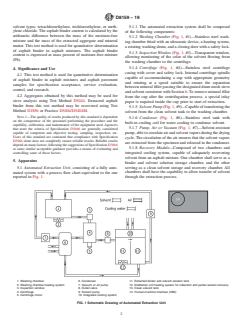
5.1 Automated Extraction Unit, consisting of a fully automated system with a process flow chart equivalent to the one reported
in Fig. 1.
5.1.1 The automated extraction system shall be composed of the following components:
5.1.2 Washing Chamber (Fig. 1, #1)—Stainless steel washing chamber fitted with an ultrasonic device, a heating system, a
rotating washing drum, and a closing door with a safety lock.
5.1.3 Inspection Window (Fig. 1, #3)—Transparent window, allowing monitoring of the color of the solvent flowing from the
washing chamber to the centrifuge.
5.1.4 Centrifuge (Fig. 1, #4)—Stainless steel centrifuge casing with cover and safety lock. Internal centrifuge spindle capable
of accommodating a cup with appropriate geometry and rotating at a speed suitable to ensure the separation between mineral filler
passing the designated drum mesh sieve and solvent consistent with Section 6. To remove mineral filler from the cup after the
centrifugation process, a special inlay paper is required inside the cup prior to start of extraction.
5.1.5 Solvent Pump (Fig. 1, #9)—Capable of transferring the solvent from the clean solvent tank to the washing chamber.
5.1.6 Condenser (Fig. 1, #6)—Stainless steel tank with built-in cooling coil for water cooling to condense solvent.
1. Washing chamber 6. Condenser 11. Extracted binder and solvent solution tank
2. Washing chamber heating system 7. Vacuum or air pump 12. Distillation unit heating system for collection and partial solvent recovery
3. Inspection window 8. Outlet valve 13. Clean solvent tank
4. Centrifuge 9. Solvent pump 14. Human-machine interface (HMI)
5. Centrifuge motor 10. Integrated cooling system
FIG. 1 Schematic Drawing of Automated Extraction Unit
D8159 − 19
5.1.7 Pump, Air or Vacuum (Fig. 1, #7)—Solvent-resistant pump, able to circulate air and solvent vapors during the drying cycle.
The circulation of the air ensures that the solvent vapors are extracted from the specimen and released in the condenser.
5.1.8 Recovery Module—Composed of two chambers and integrated cooling system, capable of adequately recovering solvent
from an asphalt mixture. One chamber shall serve as a binder and solvent solution storage chamber, and the other serving as a clean
solvent storage and recovery chamber. All chambers shall have the capability to allow transfer of solvent through the extraction
process.
5.1.8.1 Solvent Recovery and Binder Storage Chamber, fitted with heating system to distill solvent, fill level indicators to
prevent heating when chamber is empty, and an outlet tap.
5.1.8.2 Clean Solvent Storage and Recovery Chamber, fitted with integrated cooling system, fill level indicator, outlet tap, and
mechanism to allow solvent distillate to flow or be transferred back to washing chamber.
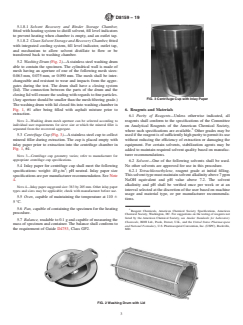
5.2 Washing Drum (Fig. 2)—A stainless steel washing drum able to contain the specimen. The cylindrical wall is made of mesh
having an aperture of one of the following mesh sizes: 0.063 mm, 0.075 mm, or 0.090 mm. The mesh shall be interchangeable and
resistant to wear and impacts from the aggregates during the test. The drum shall have a closing system (lid). The connection
between the parts of the drum and the closing lid will ensure the sealing with regards to fine particles. (Any aperture should be
smaller than the mesh filtering grade.) The washing drum with lid closed fits into washing chamber in Fig. 1, #1 after being filled
with asphalt mixture prior to extraction.
NOTE 2—Washing drum mesh aperture can be selected according to individual user requirements for sieve size at which the mineral filler is separated
from the recovered aggregate.
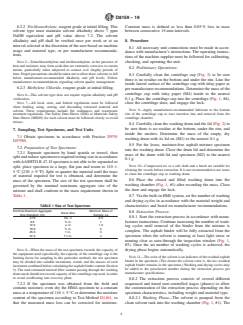
5.3 Centrifuge Cup (Fig. 3)—A stainless steel cup to collect mineral filler. Centrifuge cup capacity is either 200 g or 300 g.filler
during extraction. The cup is placed empty with inlay paper prior to extraction into the centrifuge chamber in Fig. 1, #4.
NOTE 3—Centrifuge cup geometry varies; refer to manufacturer for appropriate centrifuge cup specifications.
5.4 Inlay paper for centrifuge cup shall meet the following specifications: weight: 40 g ⁄m ; pH neutral. Inlay paper size
specifications are per manufacturer recommendation. See Note 4.
NOTE 4—Inlay paper suggested size: 383 by 205 mm. Other inlay paper types and sizes may be applicable; check with manufacturer before use.
5.5 Oven, capable of maintaining the temperature at 110 6 5 °C.
5.6 Pan, capable of containing the specimen for the heating procedure.
5.7 Balance, readable to 0.1 g and capable of measuring the mass of specimen and container. The balance shall conform to the
requirement of Guide D4753, Class GP2.
6. Reagents and Materials
6.1 Purity of Reagents—Unless otherwise indicated, all reagents shall conform to the specifications of the Committee on
Analytical Reagents of the American Chemical Society, where such specifications are available. Other grades may be used if the
reagent is of sufficiently high purity to permit its use without reducing the efficiency of extraction or damaging the equipment. For
certain solvents, stabilization agents may be added to maintain required solvent quality based on manufacturer recommendations.
6.2 Solvent—One of the following solvents shall be used. No other solvents are approved for use in this procedure.
6.2.1 Tetrachloroethylene, reagent grade at initial filling. This solvent type must maintain solvent alkalinity above 7 ppm NaOH
equivalent and pH value above 7.2. The solvent alkalinity and pH shall be verified once per week or at an interval selected at the
discretion of the user based on machine usage and material type, or per manufacturer recommendations.
FIG. 2 Washing Drum with Lid, to be Filled with Asphalt Mixture Prior to Extraction (Fits into Washing Chamber in LidFig. 1, #1)
Reagent Chemicals, American Chemical Society Specifications, American Chemical Society, Washington, DC. For suggestions on the testing of reagents not listed by
the American Chemical Society, see Analar Standards for Laboratory Chemicals, BDH Ltd., Poole, Dorset, U.K., and the United States Pharmacopeia and National
Formulary, U.S. Pharmacopeial Convention, Inc. (USPC), Rockville, MD.
D8159 − 19
FIG. 3 Centrifuge Cup with Inlay Paper, to Collect Mineral Filler During Extraction (Placed Empty with Inlay Paper Inserted Prior to Ex-
traction into Centrifuge Chamber in PaperFig. 1, #4)
6.2.2 Trichloroethylene, reagent grade at initial filling. This solvent type must maintain solvent alkalinity above 7 ppm NaOH
equivalent and pH value above 7.2. The solvent alkalinity and pH shall be verified once per week or at an interval selected at the
discretion of the user based on machine usage and material type, or per manufacturer recommendations.
NOTE 5—Tetrachloroethylene and trichloroethylene, in the presence of heat and moisture, may form acids that are extremely corrosive to certain metals,
particularly when subjectsubjected to contact over lengthy periods of time. Proper precautions should be taken not to allow these solvents to fall below
manufacturer-recommended alkalinity and pH levels. Follow manufacturer recommendations regarding solvent quality management.
6.2.3 Methylene Chloride, reagent grade at initial filling.
NOTE 6—This solvent type does not require regular alkalinity and pH verification.
NOTE 7—All local, state, and federal regulations must be followed when hauling, using, storing, and discarding extracted material and solvent. These
requirements include fire ordinances and wastewater treatment regulations. The Safety Data Sheets (SDS) or Materi
...