


ASTM B370-22
(Specification)Standard Specification for Copper Sheet and Strip for Building Construction
Standard Specification for Copper Sheet and Strip for Building Construction
ABSTRACT
This specification establishes the requirements for rolled copper sheets and strips in flat lengths or coils of ounce-weight thicknesses for roofing, flashing, gutters, downspouts, and general sheet metal work in building construction. Products produced to this specification are not intended for electrical applications. Materials are available in the following tempers: O60 (soft), H00 (cold-rolled), H01 (cold-rolled, high yield), H02 (half hard), H03 (three-quarter hard), and H04 (hard). Products shall be sampled and prepared, then tested accordingly to examine their conformance to dimensional (mass, thickness, length, width, weight, and straightness), mechanical (tensile and yield strength, and Rockwell hardness), chemical composition, and grain recrystallization requirements.
SCOPE
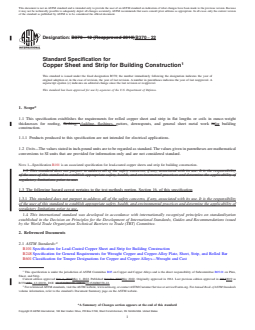
1.1 This specification establishes the requirements for rolled copper sheet and strip in flat lengths or coils in ounce-weight thicknesses for roofing, cladding, flashings, gutters, downspouts, and general sheet metal work for building construction.
1.1.1 Products produced to this specification are not intended for electrical applications.
1.2 Units—The values stated in inch-pound units are to be regarded as standard. The values given in parentheses are mathematical conversions to SI units that are provided for information only and are not considered standard.
Note 1: Specification B101 is an associated specification for lead-coated copper sheets and strip for building construction.
1.3 The following hazard caveat pertains to the test methods portion, Section 16, of this specification
1.3.1 This standard does not purport to address all of the safety concerns, if any, associated with its use. It is the responsibility of the user of this standard to establish appropriate safety, health, and environmental practices and determine the applicability of regulatory limitations prior to use.
1.4 This international standard was developed in accordance with internationally recognized principles on standardization established in the Decision on Principles for the Development of International Standards, Guides and Recommendations issued by the World Trade Organization Technical Barriers to Trade (TBT) Committee.
General Information
- Status
- Published
- Publication Date
- 30-Apr-2022
- Technical Committee
- B05 - Copper and Copper Alloys
- Drafting Committee
- B05.01 - Plate, Sheet, and Strip
Relations
- Effective Date
- 01-Jan-2024
- Effective Date
- 01-Aug-2019
- Effective Date
- 01-Jan-2019
- Effective Date
- 01-Oct-2018
- Effective Date
- 01-Mar-2018
- Effective Date
- 01-Oct-2016
- Effective Date
- 15-Jul-2016
- Effective Date
- 01-Feb-2015
- Effective Date
- 01-Jun-2013
- Effective Date
- 15-Nov-2012
- Effective Date
- 01-Oct-2012
- Effective Date
- 01-Apr-2012
- Effective Date
- 01-Apr-2012
- Effective Date
- 01-Dec-2011
- Effective Date
- 01-Jun-2011
Overview
ASTM B370-22: Standard Specification for Copper Sheet and Strip for Building Construction establishes the requirements for rolled copper sheet and strip, supplied in flat lengths or coils, and expressed in ounce-weight thicknesses. These copper products are widely used for roofing, cladding, flashing, gutters, downspouts, and general sheet metal work in building construction applications. This standard ensures the copper sheet and strip produced meet consistent quality specifications, focusing on dimensional, mechanical, chemical, and grain structure characteristics.
ASTM B370-22 is not intended for copper products used in electrical applications. The document specifies different tempers, such as O60 (soft annealed), H00 (cold-rolled), H01 (cold-rolled, high yield), H02 (half hard), H03 (three-quarter hard), and H04 (hard), to accommodate various construction uses.
Key Topics
Essential requirements covered by ASTM B370-22 include:
- Material and Manufacture: The copper must have a minimum content of 99.5% copper (including silver). Manufacturing processes ensure a uniform, wrought structure suitable for construction applications.
- Product Forms: Copper sheet (over 24 in./610 mm width) and strip (up to 24 in./610 mm width) are available in standard ounce-weights ranging typically from 48 oz to 88 oz.
- Dimensional and Mechanical Properties:
- Standard tolerances are defined for thickness, width, length, and straightness, ensuring precise fit and performance consistency.
- Mechanical properties such as tensile and yield strength, as well as Rockwell hardness, are specified for each temper.
- Requirements for minimum grain size in annealed tempers are included for product consistency.
- Sampling and Testing: Methods and criteria are provided for sampling, preparation, and testing for conformance to chemical composition, mechanical properties, and grain size.
- Terminology: The standard defines essential terms such as 'coil,' 'flashing,' 'sheet,' and 'strip' to promote clear understanding and usage among manufacturers and construction professionals.
- Ordering Information: Guidance on the information that should be specified when placing an order under this specification.
Applications
Copper sheet and strip conforming to ASTM B370-22 are extensively used in the construction industry due to their durability, workability, corrosion resistance, and aesthetic appeal. Key applications include:
- Roofing: Provides long-lasting, weather-resistant roofing solutions for various building types.
- Flashing: Used to create impervious barriers around windows, doors, chimneys, and changes in building planes to prevent water infiltration.
- Gutters and Downspouts: Ensures efficient water management and enhanced longevity of drainage systems.
- Cladding: Offers architectural cladding options with both functional and decorative roles.
- General Sheet Metal Work: Suitable for custom fabrications and structural applications in building envelopes.
By adhering to ASTM B370-22, architects, contractors, and fabricators can specify, source, and use copper products with confidence, knowing they meet rigorous, internationally-recognized quality standards.
Related Standards
For comprehensive guidance and compatibility, the following related standards are frequently referenced alongside ASTM B370-22:
- ASTM B101 – Standard Specification for Lead-Coated Copper Sheet and Strip for Building Construction
- ASTM B248 – Specification for General Requirements for Wrought Copper and Copper Alloy Plate, Sheet, Strip, and Rolled Bar
- ASTM B601 – Classification for Temper Designations for Copper and Copper Alloys-Wrought and Cast
- ASTM B846 – Terminology for Copper and Copper Alloys
- ASTM E8/E8M – Test Methods for Tension Testing of Metallic Materials
- ASTM E112 – Test Methods for Determining Average Grain Size
- ASTM E255 – Practice for Sampling Copper and Copper Alloys for the Determination of Chemical Composition
- ASTM E478 – Test Methods for Chemical Analysis of Copper Alloys
Keywords: copper sheet, copper strip, building construction, ASTM B370-22, roofing copper, flashing, gutters, downspouts, sheet metal, construction standards.
Buy Documents
ASTM B370-22 - Standard Specification for Copper Sheet and Strip for Building Construction
REDLINE ASTM B370-22 - Standard Specification for Copper Sheet and Strip for Building Construction
Get Certified
Connect with accredited certification bodies for this standard

Element Materials Technology
Materials testing and product certification.

Inštitut za kovinske materiale in tehnologije
Institute of Metals and Technology. Materials testing, metallurgical analysis, NDT.
Sponsored listings
Frequently Asked Questions
ASTM B370-22 is a technical specification published by ASTM International. Its full title is "Standard Specification for Copper Sheet and Strip for Building Construction". This standard covers: ABSTRACT This specification establishes the requirements for rolled copper sheets and strips in flat lengths or coils of ounce-weight thicknesses for roofing, flashing, gutters, downspouts, and general sheet metal work in building construction. Products produced to this specification are not intended for electrical applications. Materials are available in the following tempers: O60 (soft), H00 (cold-rolled), H01 (cold-rolled, high yield), H02 (half hard), H03 (three-quarter hard), and H04 (hard). Products shall be sampled and prepared, then tested accordingly to examine their conformance to dimensional (mass, thickness, length, width, weight, and straightness), mechanical (tensile and yield strength, and Rockwell hardness), chemical composition, and grain recrystallization requirements. SCOPE 1.1 This specification establishes the requirements for rolled copper sheet and strip in flat lengths or coils in ounce-weight thicknesses for roofing, cladding, flashings, gutters, downspouts, and general sheet metal work for building construction. 1.1.1 Products produced to this specification are not intended for electrical applications. 1.2 Units—The values stated in inch-pound units are to be regarded as standard. The values given in parentheses are mathematical conversions to SI units that are provided for information only and are not considered standard. Note 1: Specification B101 is an associated specification for lead-coated copper sheets and strip for building construction. 1.3 The following hazard caveat pertains to the test methods portion, Section 16, of this specification 1.3.1 This standard does not purport to address all of the safety concerns, if any, associated with its use. It is the responsibility of the user of this standard to establish appropriate safety, health, and environmental practices and determine the applicability of regulatory limitations prior to use. 1.4 This international standard was developed in accordance with internationally recognized principles on standardization established in the Decision on Principles for the Development of International Standards, Guides and Recommendations issued by the World Trade Organization Technical Barriers to Trade (TBT) Committee.
ABSTRACT This specification establishes the requirements for rolled copper sheets and strips in flat lengths or coils of ounce-weight thicknesses for roofing, flashing, gutters, downspouts, and general sheet metal work in building construction. Products produced to this specification are not intended for electrical applications. Materials are available in the following tempers: O60 (soft), H00 (cold-rolled), H01 (cold-rolled, high yield), H02 (half hard), H03 (three-quarter hard), and H04 (hard). Products shall be sampled and prepared, then tested accordingly to examine their conformance to dimensional (mass, thickness, length, width, weight, and straightness), mechanical (tensile and yield strength, and Rockwell hardness), chemical composition, and grain recrystallization requirements. SCOPE 1.1 This specification establishes the requirements for rolled copper sheet and strip in flat lengths or coils in ounce-weight thicknesses for roofing, cladding, flashings, gutters, downspouts, and general sheet metal work for building construction. 1.1.1 Products produced to this specification are not intended for electrical applications. 1.2 Units—The values stated in inch-pound units are to be regarded as standard. The values given in parentheses are mathematical conversions to SI units that are provided for information only and are not considered standard. Note 1: Specification B101 is an associated specification for lead-coated copper sheets and strip for building construction. 1.3 The following hazard caveat pertains to the test methods portion, Section 16, of this specification 1.3.1 This standard does not purport to address all of the safety concerns, if any, associated with its use. It is the responsibility of the user of this standard to establish appropriate safety, health, and environmental practices and determine the applicability of regulatory limitations prior to use. 1.4 This international standard was developed in accordance with internationally recognized principles on standardization established in the Decision on Principles for the Development of International Standards, Guides and Recommendations issued by the World Trade Organization Technical Barriers to Trade (TBT) Committee.
ASTM B370-22 is classified under the following ICS (International Classification for Standards) categories: 77.150.30 - Copper products. The ICS classification helps identify the subject area and facilitates finding related standards.
ASTM B370-22 has the following relationships with other standards: It is inter standard links to ASTM E8/E8M-24, ASTM B846-19a, ASTM B846-19, ASTM B601-18a, ASTM B601-18, ASTM B601-16, ASTM E8/E8M-16, ASTM E8/E8M-15, ASTM E8/E8M-13, ASTM E112-12, ASTM B601-12, ASTM B248-12, ASTM B101-12, ASTM E8/E8M-11, ASTM B846-11a. Understanding these relationships helps ensure you are using the most current and applicable version of the standard.
ASTM B370-22 is available in PDF format for immediate download after purchase. The document can be added to your cart and obtained through the secure checkout process. Digital delivery ensures instant access to the complete standard document.
Standards Content (Sample)
This international standard was developed in accordance with internationally recognized principles on standardization established in the Decision on Principles for the
Development of International Standards, Guides and Recommendations issued by the World Trade Organization Technical Barriers to Trade (TBT) Committee.
Designation:B370 −22
Standard Specification for
Copper Sheet and Strip for Building Construction
This standard is issued under the fixed designation B370; the number immediately following the designation indicates the year of
original adoption or, in the case of revision, the year of last revision. A number in parentheses indicates the year of last reapproval. A
superscript epsilon (´) indicates an editorial change since the last revision or reapproval.
This standard has been approved for use by agencies of the U.S. Department of Defense.
1. Scope* B248 Specification for General Requirements for Wrought
Copper and Copper-Alloy Plate, Sheet, Strip, and Rolled
1.1 Thisspecificationestablishestherequirementsforrolled
Bar
copper sheet and strip in flat lengths or coils in ounce-weight
B601 ClassificationforTemperDesignationsforCopperand
thicknesses for roofing, cladding, flashings, gutters,
Copper Alloys—Wrought and Cast
downspouts, and general sheet metal work for building con-
B846 Terminology for Copper and Copper Alloys
struction.
E8/E8M Test Methods for Tension Testing of Metallic Ma-
1.1.1 Products produced to this specification are not in-
terials
tended for electrical applications.
E112 Test Methods for Determining Average Grain Size
1.2 Units—The values stated in inch-pound units are to be
E255 Practice for Sampling Copper and Copper Alloys for
regarded as standard. The values given in parentheses are
the Determination of Chemical Composition
mathematical conversions to SI units that are provided for
information only and are not considered standard.
3. General Requirements
NOTE 1—Specification B101 is an associated specification for lead-
3.1 The following sections of Specification B248 constitute
coated copper sheets and strip for building construction.
a part of this specification:
1.3 Thefollowinghazardcaveatpertainstothetestmethods
3.1.1 Terminology;
portion, Section 16, of this specification
3.1.2 Materials and Manufacture;
1.3.1 This standard does not purport to address all of the
3.1.3 Workmanship, Finish, and Appearance;
safety concerns, if any, associated with its use. It is the
3.1.4 Specimen Preparation;
responsibility of the user of this standard to establish appro-
3.1.5 Test Methods;
priate safety, health, and environmental practices and deter-
3.1.6 Significance of Numerical Limits;
mine the applicability of regulatory limitations prior to use.
3.1.7 Inspection;
3.1.8 Certification;
1.4 This international standard was developed in accor-
3.1.9 Test Report;
dance with internationally recognized principles on standard-
3.1.10 Packaging and Package Marking; and
ization established in the Decision on Principles for the
3.1.11 Supplementary Requirements.
Development of International Standards, Guides and Recom-
mendations issued by the World Trade Organization Technical
3.2 In addition, when a section with a title identical to that
Barriers to Trade (TBT) Committee.
referenced in 3.1, above, appears in this specification, it
contains additional requirements, which supplement those
2. Referenced Documents
appearing in Specification B248.
2.1 ASTM Standards:
B101 Specification for Lead-Coated Copper Sheet and Strip
4. Terminology
for Building Construction
4.1 Definitions:
4.1.1 For definitions of terms related to copper and copper
ThisspecificationisunderthejurisdictionofASTMCommitteeB05onCopper
alloys, refer to Terminology B846.
andCopperAlloysandisthedirectresponsibilityofSubcommitteeB05.01onPlate,
4.2 Definitions of Terms Specific to This Standard:
Sheet, and Strip.
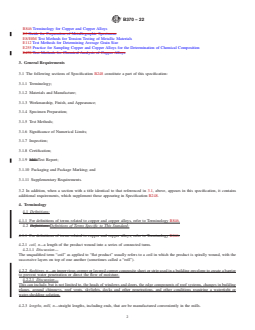
4.2.1 coil, n—a length of the product wound into a series of
Current edition approved May 1, 2022. Published May 2022. Originally
connected turns.
approved in 1961. Last previous edition approved in 2019 as B370–12 (2019). DOI:
10.1520/B0370-22.
4.2.1.1 Discussion—The unqualified term “coil” as applied
For referenced ASTM standards, visit the ASTM website, www.astm.org, or
to “flat product” usually refers to a coil in which the product is
contact ASTM Customer Service at service@astm.org. For Annual Book of ASTM
spirally wound, with the successive layers on top of one
Standards volume information, refer to the standard’s Document Summary page on
the ASTM website. another (sometimes called a “roll”).
*A Summary of Changes section appears at the end of this standard
Copyright © ASTM International, 100 Barr Harbor Drive, PO Box C700, West Conshohocken, PA 19428-2959. United States
B370−22
4.2.2 flashings, n—an impervious copper or layered copper 5.2 The following are options available under this specifi-
composite sheet or strip used in a building envelope to create cation and should be specified in the contract or purchase order
a barrier to prevent water penetration or direct the flow of when required:
moisture. 5.2.1 Heat identification or traceability details,
4.2.2.1 Discussion—This can include, but is not limited to, 5.2.2 Certification, and
the heads of windows and doors, the edge components of roof 5.2.3 Test Report.
systems, changes in building planes, around chimneys, roof
vents, skylights, decks and other penetrations, and other 6. Materials and Manufacture
conditions requiring a watertight or water-shedding solution.
6.1 Materials—The material of manufacture shall be a cast
4.2.3 lengths, mill, n—straight lengths, including ends, that bar, cake, or slab of any copper conforming with the chemical
are be manufactured conveniently in the mills.
composition requirements (Section 7) that is suitable for
4.2.3.1 Discussion—Full length pieces usually are 8 ft or processing into products listed in 1.1.
10 ft (2.4 m or 3.0 m) and subject to established length
6.2 Manufacture:
tolerances.
6.2.1 The product shall be manufactured by such hot
4.2.4 length, stock, n—straight lengths that are mill cut and
working, cold working, and annealing processes as to produce
stored in advance of orders.
a uniform wrought structure in the finished product.
4.2.4.1 Discussion—They usually are 8 ft or 10 ft (2.4 m or
6.2.2 Theproductshallbehotorcoldworkedtothefinished
3.0 m) and subject to established length tolerances.
size, and subsequently annealed when required, to meet the
temper properties specified in Table 3.
4.2.5 ounce-weight, n—the weight of copper sheet or strip
6.2.3 Sheet—The product shall be manufactured in flat
expressed in ounces per square foot.
sheets.
4.2.6 sheet, for building construction, n—a rolled flat prod-
6.2.4 Strip—The product shall be manufactured in flat
uct over 24 in. (610 mm) in width and of ounce-weight
lengths or in coils (rolls) of one single continuous length not
thickness from 8 oz to 48 oz.
less than 25 ft (7.5 m) wound into a cylindrical spiral.
4.2.7 strip, for building construction, n—a rolled flat prod-
uct up to 24 in. (610 mm), inclusive, in width and of
7. Chemical Composition
ounce-weight thickness from 8 oz to 48 oz.
7.1 The material shall be any copper with a minimum
NOTE 2—In 4.2.6 and 4.2.7, the 8 oz to 48 oz refers to the names
copper content, including silver, of 99.5 %.
commonly used in the building industry for the sizes used. The respective
7.1.1 Limits shall be established and analysis required for
sizes that correspond to these names are listed in Table 2.
unnamed elements by agreement between the manufacturer
and the purchaser.
5. Ordering Information
5.1 Include the following information when placing orders
8. Temper
for product under this specification, as applicable:
8.1 The standard tempers for products described in this
5.1.1 ASTM designation and year of issue (for example,
specification are given in Table 1.
B370–XX);
8.1.1 Annealed temper as defined in Classification B601:
5.1.2 Temper (Section 8);
O60 (soft).
5.1.3 Dimensions: tolerances (Section 12);
8.1.2 Cold Rolled tempers as defined in Classification
5.1.4 How furnished: flat lengths or coils (4.2.1 – 4.2.3);
B601: H00 (cold-rolled), H01 (cold-rolled, high yield), H02
5.1.5 Quantity: total weight or number of pieces of each
(half hard), H03 (three-quarter hard), and H04 (hard).
form and size; and
5.1.6 When product is purchased for agencies of the U.S.
NOTE 3—The purchaser should confer with the manufacturer or
Government (Section 11). supplier concerning the availability of a specific temper and form.
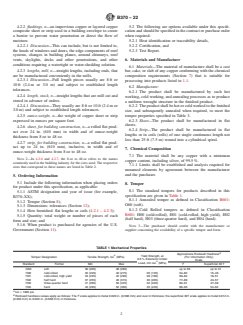
TABLE 1 Mechanical Properties
B
Approximate Rockwell Hardness
A Yield Strength, at
Temper Designation Tensile Strength, ksi (MPa) (For Information Only)
0.5 % Extension Under
Scale
A
Load, min ksi (MPa)
Standard Former Min Max F Superficial 30 T
O60 soft 30 (205) 38 (260) . . . up to 65 up to 31
H00 cold-rolled 32 (220) 40 (275) 20 (135) 54–82 15–49
H01 cold-rolled, high yield 34 (235) 42 (290) 28 (190) 60–84 18–51
H02 half hard 37 (255) 46 (315) 30 (205) 77–89 43–57
H03 three-quarter hard 41 (285) 50 (345) 32 (220) 82–91 47–59
H04 hard 43 (295) 52 (360) 35 (240) 86–93 54–62
A
ksi = 1000 psi.
B
Rockwell hardness values apply as follows: The F scale applies to metal 0.020 in. (0.508 mm) and over in thickness; the superficial 30T scale applies to metal 0.012 in.
(0.305 mm) to 0.020 in. (0.508 mm) in thickness.
B370−22
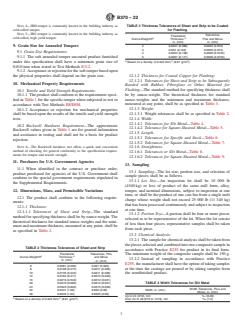
NOTE 4—H00 temper is commonly known in the building industry as TABLE 3 Thickness Tolerances of Sheet and Strip to be Coated
for Flashing
cold-rolled temper.
NOTE 5—H01 temper is commonly known in the building industry as
Tolerances,
Theoretical
cold-rolled, high yield temper. A
Ounce-Weight/ft Plus and Minus
Thickness,
in. (mm) in. (mm)
9. Grain Size for Annealed Tempers
2 0.0027 (0.068) 0.0004 (0.010)
3 0.004 (0.103) 0.0005 (0.013)
9.1 Grain Size Requirements:
4 0.0054 (0.138) 0.0006 (0.0152)
5 0.0067 (0.171) 0.0006 (0.0152)
9.1.1 The soft annealed temper uncoated product furnished
A 3 3
under this specification shall have a minimum grain size of Based on a density of 0.322 lb/in. (8.91 g/cm ).
0.010 mm when tested to Test Methods E112.
9.1.2 Acceptanceorrejectionforthesofttemperbasedupon
12.1.2 Thickness for Coated Copper for Flashing:
the physical properties shall depend on the grain size.
12.1.2.1 Tolerances for Sheet and Strip to be Subsequently
10. Mechanical Property Requirements
Bonded with Rubber, Fibreglass or Other Material for
Flashing—The standard method for specifying thickness shall
10.1 Tensile and Yield Strength Requirements:
be by ounce-weight. The theoretical thickness for standard
10.1.1 The product shall conform to the requirements speci-
ounce-weights and the minimum and maximum thickness,
fied in Table 1 for the specific temper when subjected to test in
measured at any point, shall be as specified in Table 3.
accordance with Test Methods E8/E8M.
12.1.3 Weight:
10.1.2 Acceptance or rejection for mechanical properties
12.1.3.1 Weight tolerances shall be as specified in Table 2.
shall be based upon the results of the tensile and yield strength
12.1.4 Width:
tests.
12.1.4.1 Tolerances for Slit Metal—Table 4.
10.2 Rockwell Hardness Requirement—The approximate
12.1.4.2 Tolerance for Square-Sheared Metal—Table 5.
Rockwell values given in Table 1 are for general information
12.1.5 Length.
and assistance in testing and shall not be a basis for product
12.1.5.1 Tolerances for Specific and Stock—Table 6.
rejection.
12.1.5.2 Tolerances fo
...
This document is not an ASTM standard and is intended only to provide the user of an ASTM standard an indication of what changes have been made to the previous version. Because
it may not be technically possible to adequately depict all changes accurately, ASTM recommends that users consult prior editions as appropriate. In all cases only the current version
of the standard as published by ASTM is to be considered the official document.
Designation: B370 − 12 (Reapproved 2019) B370 − 22
Standard Specification for
Copper Sheet and Strip for Building Construction
This standard is issued under the fixed designation B370; the number immediately following the designation indicates the year of
original adoption or, in the case of revision, the year of last revision. A number in parentheses indicates the year of last reapproval. A
superscript epsilon (´) indicates an editorial change since the last revision or reapproval.
This standard has been approved for use by agencies of the U.S. Department of Defense.
1. Scope*
1.1 This specification establishes the requirements for rolled copper sheet and strip in flat lengths or coils in ounce-weight
thicknesses for roofing, flashing, cladding, flashings, gutters, downspouts, and general sheet metal work infor building
construction.
1.1.1 Products produced to this specification are not intended for electrical applications.
1.2 Units—The values stated in inch-pound units are to be regarded as standard. The values given in parentheses are mathematical
conversions to SI units that are provided for information only and are not considered standard.
NOTE 1—Specification B101 is an associated specification for lead-coated copper sheets and strip for building construction.
1.3 This standard does not purport to address all of the safety concerns, if any, associated with its use. It is the responsibility
of the user of this standard to establish appropriate safety, health, and environmental practices and determine the applicability of
regulatory limitations prior to use.
1.3 The following hazard caveat pertains to the test methods portion, Section 16, of this specification
1.3.1 This standard does not purport to address all of the safety concerns, if any, associated with its use. It is the responsibility
of the user of this standard to establish appropriate safety, health, and environmental practices and determine the applicability of
regulatory limitations prior to use.
1.4 This international standard was developed in accordance with internationally recognized principles on standardization
established in the Decision on Principles for the Development of International Standards, Guides and Recommendations issued
by the World Trade Organization Technical Barriers to Trade (TBT) Committee.
2. Referenced Documents
2.1 ASTM Standards:
B101 Specification for Lead-Coated Copper Sheet and Strip for Building Construction
B248 Specification for General Requirements for Wrought Copper and Copper-Alloy Plate, Sheet, Strip, and Rolled Bar
B601 Classification for Temper Designations for Copper and Copper Alloys—Wrought and Cast
This specification is under the jurisdiction of ASTM Committee B05 on Copper and Copper Alloys and is the direct responsibility of Subcommittee B05.01 on Plate,
Sheet, and Strip.
Current edition approved Oct. 1, 2019May 1, 2022. Published October 2019May 2022. Originally approved in 1961. Last previous edition approved in 20122019 as
B370–12. –12 (2019). DOI: 10.1520/B0370–12R19.10.1520/B0370-22.
For referenced ASTM standards, visit the ASTM website, www.astm.org, or contact ASTM Customer Service at service@astm.org. For Annual Book of ASTM Standards
volume information, refer to the standard’s Document Summary page on the ASTM website.
*A Summary of Changes section appears at the end of this standard
Copyright © ASTM International, 100 Barr Harbor Drive, PO Box C700, West Conshohocken, PA 19428-2959. United States
B370 − 22
B846 Terminology for Copper and Copper Alloys
E3 Guide for Preparation of Metallographic Specimens
E8/E8M Test Methods for Tension Testing of Metallic Materials
E112 Test Methods for Determining Average Grain Size
E255 Practice for Sampling Copper and Copper Alloys for the Determination of Chemical Composition
E478 Test Methods for Chemical Analysis of Copper Alloys
3. General Requirements
3.1 The following sections of Specification B248 constitute a part of this specification:
3.1.1 Terminology;
3.1.2 Materials and Manufacture;
3.1.3 Workmanship, Finish, and Appearance;
3.1.4 Specimen Preparation;
3.1.5 Test Methods;
3.1.6 Significance of Numerical Limits;
3.1.7 Inspection;
3.1.8 Certification;
3.1.9 Mill Test Report;
3.1.10 Packaging and Package Marking; and
3.1.11 Supplementary Requirements.
3.2 In addition, when a section with a title identical to that referenced in 3.1, above, appears in this specification, it contains
additional requirements, which supplement those appearing in Specification B248.
4. Terminology
4.1 Definitions:
4.1.1 For definitions of terms related to copper and copper alloys, refer to Terminology B846.
4.2 Definitions:Definitions of Terms Specific to This Standard:
4.1.1 For definitions of terms related to copper and copper alloys, refer to Terminology B846.
4.2.1 coil, n—a length of the product wound into a series of connected turns.
4.2.1.1 Discussion—
The unqualified term “coil” as applied to “flat product” usually refers to a coil in which the product is spirally wound, with the
successive layers on top of one another (sometimes called a “roll”).
4.2.2 flashings, n—an impervious copper or layered copper composite sheet or strip used in a building envelope to create a barrier
to prevent water penetration or direct the flow of moisture.
4.2.2.1 Discussion—
This can include, but is not limited to, the heads of windows and doors, the edge components of roof systems, changes in building
planes, around chimneys, roof vents, skylights, decks and other penetrations, and other conditions requiring a watertight or
water-shedding solution.
4.2.3 lengths, mill, n—straight lengths, including ends, that are be manufactured conveniently in the mills.
B370 − 22
4.2.3.1 Discussion—
Full length pieces usually are 8 or 10 ft (2.4 8 ft or 10 ft (2.4 m or 3.0 m) and subject to established length tolerances.
4.2.4 length, stock, n—straight lengths that are mill cut and stored in advance of orders.
4.2.4.1 Discussion—
They usually are 8 or 10 ft (2.4 or 3.0 m) 8 ft or 10 ft (2.4 m or 3.0 m) and subject to established length tolerances.
4.2.5 ounce-weight, n—the weight of copper sheet or strip expressed in ounces per square foot.
4.2.6 sheet, for building construction, n—a rolled flat product over 24 in. (610 mm) in width and of ounce-weight thickness from
88 oz to 48 oz.
4.2.7 strip, for building construction, n—a rolled flat product up to 24 in. (610 mm), inclusive, in width and of ounce-weight
thickness from 88 oz to 48 oz.
NOTE 2—In 4.1.64.2.6 and 4.1.74.2.7, the 88 oz to 48 oz 48 oz refers to the names commonly used in the building industry for the sizes used. The
respective sizes that correspond to these names are listed in Table 1.Table 2.
5. Ordering Information
5.1 Include the following information when placing orders for product under this specification, as applicable:
5.1.1 ASTM designation and year of issue (for example, B370–XX);
5.1.2 Temper (Section 8);
5.1.3 Dimensions: tolerances (Section 12);
5.1.4 How furnished: flat lengths or coils (4.1.24.2.1 – 4.1.44.2.3);
5.1.5 Quantity: total weight or number of pieces of each form and size; and
5.1.6 When product is purchased for agencies of the U.S. Government (Section 11).
5.2 The following are options available under this specification and should be specified in the contract or purchase order when
required:
5.2.1 Heat identification or traceability details,
5.2.2 Certification, and
5.2.3 Mill test report.Test Report.
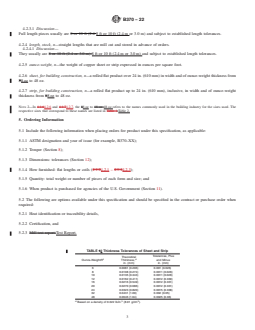
TABLE 12 Thickness Tolerances of Sheet and Strip
Tolerances, Plus
Theoretical
A
Ounce-Weight/ft Thickness, and Minus
in. (mm)
in. (mm)
6 0.0081 (0.206) 0.001 (0.026)
8 0.0108 (0.274) 0.0011 (0.028)
10 0.0135 (0.343) 0.0011 (0.028)
12 0.0162 (0.411) 0.0012 (0.030)
16 0.0216 (0.549) 0.0012 (0.031)
20 0.0270 (0.686) 0.0012 (0.031)
24 0.0323 (0.820) 0.0015 (0.038)
32 0.0431 (1.09) 0.002 (0.05)
48 0.0646 (1.64) 0.0025 (0.06)
A 3 3
Based on a density of 0.322 lb/in. (8.91 g/cm ).
B370 − 22
6. Materials and Manufacture
6.1 Materials—The material shall be of manufacture shall be a cast bar, cake, or slab of any copper conforming with the chemical
composition requirements (Section 7).) that is suitable for processing into products listed in 1.1.
6.2 Manufacture:
6.2.1 The product shall be manufactured by such hot working, cold working, and annealing processes as to produce a uniform
wrought structure in the finished product.
6.2.2 The product shall be hot or cold worked to the finished size, and subsequently annealed when required, to meet the temper
properties specified in Table 3.
6.2.3 Sheet—The product shall be manufactured in flat sheets.
6.2.4 Strip—The product shall be manufactured in flat lengths or in coils (rolls) of one single continuous length not less than 25
ft (7.5 m) wound into a cylindrical spiral.
7. Chemical Composition
7.1 The material shall be any copper with a minimum copper content, including silver, of 99.5 %.
7.1.1 Limits shall be established and analysis required for unnamed elements by agreement between the manufacturer and the
purchaser.
8. Temper
8.1 The standard tempers for products described in this specification are given in Table 3.
8.2 Cold Rolled tempers as defined in Classification B601: H00 (cold-rolled), H01 (cold-rolled, high yield), H02 (half hard), H03
(three-quarter hard), and H04 (hard).
8.1 Annealed temper as defined in ClassificationThe standard tempers for products described in this B601: O60 (soft)specification
are given in Table 1.
NOTE 3—The purchaser should confer with the manufacturer or supplier concerning the availability of a specific temper and form.
8.1.1 Annealed temper as defined in Classification B601: O60 (soft).
NOTE 4—H00 temper is commonly known in the building industry as cold-rolled temper.
8.1.2 Cold Rolled tempers as defined in Classification B601: H00 (cold-rolled), H01 (cold-rolled, high yield), H02 (half hard),
H03 (three-quarter hard), and H04 (hard).
NOTE 3—The purchaser should confer with the manufacturer or supplier concerning the availability of a specific temper and form.
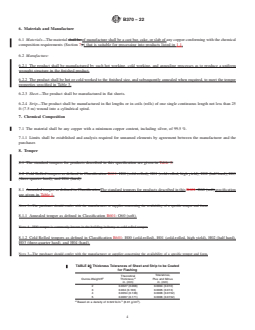
TABLE 23 Thickness Tolerances of Sheet and Strip to be Coated
for Flashing
Tolerances,
Theoretical
2 A
Ounce-Weight/ft Plus and Minus
Thickness,
in. (mm)
in. (mm)
2 0.0027 (0.068) 0.0004 (0.010)
3 0.004 (0.103) 0.0005 (0.013)
4 0.0054 (0.138) 0.0006 (0.0152)
5 0.0067 (0.171) 0.0006 (0.0152)
A 3 3
Based on a density of 0.322 lb/in. (8.91 g/cm ).
B370 − 22
TABLE 31 Mechanical Properties
B
Approximate Rockwell Hardness
A Yield Strength, at
Temper Designation Tensile Strength, ksi (MPa) (For Information Only)
0.5 % Extension Under
Scale
A
Load, min ksi (MPa)
Standard Former Min Max F Superficial 30 T
O60 soft 30 (205) 38 (260) . . . up to 65 up to 31
H00 cold-rolled 32 (220) 40 (275) 20 (135) 54–82 15–49
H01 cold-rolled, high yield 34 (235) 42 (290) 28 (190) 60–84 18–51
H02 half hard 37 (255) 46 (315) 30 (205) 77–89 43–57
H03 three-quarter hard 41 (285) 50 (345) 32 (220) 82–91 47–59
H04 hard 43 (295) 52 (360) 35 (240) 86–93 54–62
A
ksi = 1000 psi.
B
Rockwell hardness values apply as follows: The F scale applies to metal 0.020 in. (0.508 mm) and over in thickness; the superficial 30T scale applies to metal 0.012
in. 0.012 in. (0.305 mm) to 0.020 in. (0.508 mm) in thickness.
NOTE 4—H00 temper is commonly known in the building industry as cold-rolled temper.
NOTE 5—H01 temper is commonly known in the building industry as cold-rolled, high yield temper.
NOTE 5—H01 temper is commonly known in the building industry as cold-rolled, high yield temper.
9. Physical Property RequirementsGrain Size for Annealed Tempers
9.1 Grain Size—Size Requirements: Although no grain size has been established for temper O60, the product shall be
recrystallized fully as determined by Test Methods E112.
9.1.1 The soft annealed temper uncoated product furnished under this specification shall have a minimum grain size of 0.010 mm
when tested to Test Methods E112.
9.1.2 Acceptance or rejection for the soft temper based upon the physical properties shall depend on the grain size.
10. Mechanical Property Requirements
10.1 Tensile and Yield Strength Requirements:
10.1.1 The product shall conform to the requirements specified in Table 31 for the specific temper when subjected to test in
accordance with Test Methods E8/E8M.
10.1.2 Acceptance or rejection for mechanical properties shall be based upon the results of the tensile and yield strength tes
...
Questions, Comments and Discussion
Ask us and Technical Secretary will try to provide an answer. You can facilitate discussion about the standard in here.
Loading comments...