


ASTM D1435-20
(Practice)Standard Practice for Outdoor Weathering of Plastics
Standard Practice for Outdoor Weathering of Plastics
SIGNIFICANCE AND USE
4.1 Tests conducted in accordance with this practice are used to evaluate the stability of plastic materials when they are exposed outdoors. The relative durability of plastics in outdoor use can be very different depending on the location of the exposure because of differences in ultraviolet (UV) radiation, time of wetness, temperature, pollutants, and other factors. It cannot be assumed, therefore, that results from one exposure in a single location will be useful for determining relative durability in a different location. Exposures in several locations with different climates that represent a broad range of anticipated service conditions are recommended.
4.1.1 Because of year-to-year climatological variations, results from a single exposure test cannot be used to predict the absolute rate at which a material degrades. Several years of repeat exposures are needed to get an average test result for a given location.
4.2 The results of short-term exposure tests can provide an indication of relative outdoor performance, but it is recommended they not be used to predict the absolute long-term performance of a material. The results of tests conducted for less than twelve months will depend on the particular season of the year in which they begin.
SCOPE
1.1 This practice is intended to cover procedures for the exposure of plastic materials to weather.
Note 1: See Practice G24 for aging under glass.
1.2 This practice is limited to the method by which the material is to be exposed and the general procedure to be followed. It is intended for use with finished articles of commerce as well as with all sizes and shapes of test specimens.
1.3 Means of evaluation of the effects of weathering will depend on the intended use for the test material.
1.4 The values stated in SI units are to be regarded as the standard.
1.5 This standard does not purport to address all of the safety concerns, if any, associated with its use. It is the responsibility of the user of this standard to establish appropriate safety, health, and environmental practices and determine the applicability of regulatory limitations prior to use.
Note 2: This standard and ISO 877.2-2009, Method A, are technically equivalent.
1.6 This international standard was developed in accordance with internationally recognized principles on standardization established in the Decision on Principles for the Development of International Standards, Guides and Recommendations issued by the World Trade Organization Technical Barriers to Trade (TBT) Committee.
General Information
- Status
- Published
- Publication Date
- 14-Sep-2020
- Technical Committee
- D20 - Plastics
- Drafting Committee
- D20.50 - Durability of Plastics
Relations
- Effective Date
- 01-Feb-2024
- Effective Date
- 01-Nov-2023
- Effective Date
- 01-Jan-2020
- Effective Date
- 01-Aug-2019
- Effective Date
- 15-Apr-2019
- Effective Date
- 01-Feb-2019
- Effective Date
- 01-Dec-2018
- Effective Date
- 01-Nov-2018
- Refers
ASTM D1600-18 - Standard Terminology for Abbreviated Terms Relating to Plastics (Withdrawn 2024) - Effective Date
- 01-Jan-2018
- Effective Date
- 15-Aug-2017
- Effective Date
- 01-Jun-2017
- Effective Date
- 01-Mar-2014
- Effective Date
- 01-Feb-2014
- Effective Date
- 01-Sep-2013
- Effective Date
- 15-Apr-2013
Overview
ASTM D1435-20: Standard Practice for Outdoor Weathering of Plastics is a widely recognized standard published by ASTM International. It outlines procedures for exposing plastic materials to outdoor environmental conditions in order to evaluate their stability and relative durability. By adhering to this practice, manufacturers, researchers, and quality control professionals can systematically assess the performance and longevity of plastic products when subjected to natural weathering, including ultraviolet (UV) radiation, temperature fluctuations, humidity, and other environmental factors.
ASTM D1435-20 is essential for industries that require reliable data on how plastics withstand long-term outdoor exposure, enabling better product design, material selection, and prediction of service life.
Key Topics
- Exposure Procedures: Specifies how plastic test specimens should be positioned outdoors, including angles of exposure (horizontal, 5°, 45°, 90°, or latitude) to best simulate anticipated service conditions.
- Test Locations: Emphasizes the importance of conducting exposure tests at multiple sites that reflect a wide range of climates, as factors like UV radiation, temperature, rainfall, and local pollutants vary greatly.
- Specimen Preparation: Details requirements for preparing, mounting, and marking specimens to ensure standardization and accurate comparison.
- Measurement Parameters: Identifies critical variables such as total solar irradiance and solar UV irradiance, as well as the use of climatological data (temperature, humidity, rainfall) to contextualize test results.
- Test Duration: Recommends longer-term exposures-ideally over several years-to generate meaningful, averaged results, acknowledging that short-term data offers only limited insight into material degradation rates.
- Reporting Requirements: Lists information to include in test reports, such as exposure conditions, site climate data, mounting details, and observed property changes.
Applications
ASTM D1435-20 is utilized by a wide range of industries where plastics are used in outdoor environments, including:
- Construction and Building Materials: Evaluation of window frames, siding, roofing membranes, artificial turf, and more to ensure performance and durability in real-life outdoor settings.
- Automotive and Transportation: Testing exterior automotive components, such as trims, panels, and covers, for resistance to fading, cracking, or embrittlement due to environmental exposure.
- Consumer Goods: Assessment of products like lawn furniture, playground equipment, and outdoor signs to determine longevity under sun and weather stress.
- Material Research and Quality Control: Comparative analysis of new plastic formulations, additives, or coatings to identify improvements in weatherability.
By following ASTM D1435-20, stakeholders can make informed decisions about product warranties, compliance with regulations, and market claims regarding the weather resistance of plastics.
Related Standards
For comprehensive plastic weathering evaluation, ASTM D1435-20 references and closely aligns with several other national and international standards:
- ASTM G7: Practice for Atmospheric Environmental Exposure Testing of Nonmetallic Materials
- ASTM G24: Practice for Conducting Exposures to Daylight Filtered Through Glass (for aging under glass)
- ISO 877-2:2009: Plastics – Methods of exposure to solar radiation – Part 2: Direct weathering and exposure behind glass (technically equivalent to this standard)
- ASTM G141: Guide for Addressing Variability in Exposure Testing of Nonmetallic Materials
- ASTM G147: Practice for Conditioning and Handling of Nonmetallic Materials for Natural and Artificial Weathering Tests
Keywords: outdoor weathering of plastics, ASTM D1435-20, plastic durability, environmental exposure testing, UV weathering, natural weathering, plastic aging, climatological test, solar radiation exposure.
Get Certified
Connect with accredited certification bodies for this standard

Smithers Quality Assessments
US management systems and product certification.

DIN CERTCO
DIN Group product certification.
Sponsored listings
Frequently Asked Questions
ASTM D1435-20 is a standard published by ASTM International. Its full title is "Standard Practice for Outdoor Weathering of Plastics". This standard covers: SIGNIFICANCE AND USE 4.1 Tests conducted in accordance with this practice are used to evaluate the stability of plastic materials when they are exposed outdoors. The relative durability of plastics in outdoor use can be very different depending on the location of the exposure because of differences in ultraviolet (UV) radiation, time of wetness, temperature, pollutants, and other factors. It cannot be assumed, therefore, that results from one exposure in a single location will be useful for determining relative durability in a different location. Exposures in several locations with different climates that represent a broad range of anticipated service conditions are recommended. 4.1.1 Because of year-to-year climatological variations, results from a single exposure test cannot be used to predict the absolute rate at which a material degrades. Several years of repeat exposures are needed to get an average test result for a given location. 4.2 The results of short-term exposure tests can provide an indication of relative outdoor performance, but it is recommended they not be used to predict the absolute long-term performance of a material. The results of tests conducted for less than twelve months will depend on the particular season of the year in which they begin. SCOPE 1.1 This practice is intended to cover procedures for the exposure of plastic materials to weather. Note 1: See Practice G24 for aging under glass. 1.2 This practice is limited to the method by which the material is to be exposed and the general procedure to be followed. It is intended for use with finished articles of commerce as well as with all sizes and shapes of test specimens. 1.3 Means of evaluation of the effects of weathering will depend on the intended use for the test material. 1.4 The values stated in SI units are to be regarded as the standard. 1.5 This standard does not purport to address all of the safety concerns, if any, associated with its use. It is the responsibility of the user of this standard to establish appropriate safety, health, and environmental practices and determine the applicability of regulatory limitations prior to use. Note 2: This standard and ISO 877.2-2009, Method A, are technically equivalent. 1.6 This international standard was developed in accordance with internationally recognized principles on standardization established in the Decision on Principles for the Development of International Standards, Guides and Recommendations issued by the World Trade Organization Technical Barriers to Trade (TBT) Committee.
SIGNIFICANCE AND USE 4.1 Tests conducted in accordance with this practice are used to evaluate the stability of plastic materials when they are exposed outdoors. The relative durability of plastics in outdoor use can be very different depending on the location of the exposure because of differences in ultraviolet (UV) radiation, time of wetness, temperature, pollutants, and other factors. It cannot be assumed, therefore, that results from one exposure in a single location will be useful for determining relative durability in a different location. Exposures in several locations with different climates that represent a broad range of anticipated service conditions are recommended. 4.1.1 Because of year-to-year climatological variations, results from a single exposure test cannot be used to predict the absolute rate at which a material degrades. Several years of repeat exposures are needed to get an average test result for a given location. 4.2 The results of short-term exposure tests can provide an indication of relative outdoor performance, but it is recommended they not be used to predict the absolute long-term performance of a material. The results of tests conducted for less than twelve months will depend on the particular season of the year in which they begin. SCOPE 1.1 This practice is intended to cover procedures for the exposure of plastic materials to weather. Note 1: See Practice G24 for aging under glass. 1.2 This practice is limited to the method by which the material is to be exposed and the general procedure to be followed. It is intended for use with finished articles of commerce as well as with all sizes and shapes of test specimens. 1.3 Means of evaluation of the effects of weathering will depend on the intended use for the test material. 1.4 The values stated in SI units are to be regarded as the standard. 1.5 This standard does not purport to address all of the safety concerns, if any, associated with its use. It is the responsibility of the user of this standard to establish appropriate safety, health, and environmental practices and determine the applicability of regulatory limitations prior to use. Note 2: This standard and ISO 877.2-2009, Method A, are technically equivalent. 1.6 This international standard was developed in accordance with internationally recognized principles on standardization established in the Decision on Principles for the Development of International Standards, Guides and Recommendations issued by the World Trade Organization Technical Barriers to Trade (TBT) Committee.
ASTM D1435-20 is classified under the following ICS (International Classification for Standards) categories: 83.080.01 - Plastics in general. The ICS classification helps identify the subject area and facilitates finding related standards.
ASTM D1435-20 has the following relationships with other standards: It is inter standard links to ASTM D883-24, ASTM D883-23, ASTM D883-20, ASTM D883-19c, ASTM D883-19a, ASTM D883-19, ASTM D883-18a, ASTM D883-18, ASTM D1600-18, ASTM D883-17, ASTM G147-17, ASTM G113-14, ASTM D1600-14, ASTM E772-13, ASTM D1600-13. Understanding these relationships helps ensure you are using the most current and applicable version of the standard.
ASTM D1435-20 is available in PDF format for immediate download after purchase. The document can be added to your cart and obtained through the secure checkout process. Digital delivery ensures instant access to the complete standard document.
Standards Content (Sample)
This international standard was developed in accordance with internationally recognized principles on standardization established in the Decision on Principles for the
Development of International Standards, Guides and Recommendations issued by the World Trade Organization Technical Barriers to Trade (TBT) Committee.
Designation: D1435 − 20
Standard Practice for
Outdoor Weathering of Plastics
This standard is issued under the fixed designation D1435; the number immediately following the designation indicates the year of
original adoption or, in the case of revision, the year of last revision. A number in parentheses indicates the year of last reapproval. A
superscript epsilon (´) indicates an editorial change since the last revision or reapproval.
This standard has been approved for use by agencies of the U.S. Department of Defense.
1. Scope* E772 Terminology of Solar Energy Conversion
G7 Practice for Atmospheric Environmental Exposure Test-
1.1 This practice is intended to cover procedures for the
ing of Nonmetallic Materials
exposure of plastic materials to weather.
G24 Practice for Conducting Exposures to Daylight Filtered
NOTE 1—See Practice G24 for aging under glass.
Through Glass
G113 Terminology Relating to Natural andArtificial Weath-
1.2 This practice is limited to the method by which the
material is to be exposed and the general procedure to be ering Tests of Nonmetallic Materials
G141 Guide for Addressing Variability in Exposure Testing
followed. It is intended for use with finished articles of
commerce as well as with all sizes and shapes of test of Nonmetallic Materials
G147 Practice for Conditioning and Handling of Nonmetal-
specimens.
lic Materials for Natural and Artificial Weathering Tests
1.3 Means of evaluation of the effects of weathering will
2.2 ISO Standard:
depend on the intended use for the test material.
ISO 877.2-2009 Plastics—Methods of exposure to solar
1.4 The values stated in SI units are to be regarded as the
radiation—Part 2: Direct weathering and exposure behind
standard.
glass
1.5 This standard does not purport to address all of the
safety concerns, if any, associated with its use. It is the
3. Terminology
responsibility of the user of this standard to establish appro-
3.1 Definitions—For definitions of technical terms pertain-
priate safety, health, and environmental practices and deter-
ing to plastics used in this practice, see Terminologies D883,
mine the applicability of regulatory limitations prior to use.
D1600, G113, and E772.
NOTE 2—This standard and ISO 877.2-2009, MethodA, are technically
equivalent.
4. Significance and Use
1.6 This international standard was developed in accor-
4.1 Tests conducted in accordance with this practice are
dance with internationally recognized principles on standard-
used to evaluate the stability of plastic materials when they are
ization established in the Decision on Principles for the
exposed outdoors.The relative durability of plastics in outdoor
Development of International Standards, Guides and Recom-
use can be very different depending on the location of the
mendations issued by the World Trade Organization Technical
exposure because of differences in ultraviolet (UV) radiation,
Barriers to Trade (TBT) Committee.
time of wetness, temperature, pollutants, and other factors. It
cannot be assumed, therefore, that results from one exposure in
2. Referenced Documents
a single location will be useful for determining relative
2.1 ASTM Standards:
durabilityinadifferentlocation.Exposuresinseverallocations
D883 Terminology Relating to Plastics
with different climates that represent a broad range of antici-
D1600 Terminology forAbbreviatedTerms Relating to Plas-
pated service conditions are recommended.
tics
4.1.1 Because of year-to-year climatological variations, re-
sults from a single exposure test cannot be used to predict the
This practice is under the jurisdiction ofASTM Committee D20 on Plastics and
absolute rate at which a material degrades. Several years of
is the direct responsibility of Subcommittee D20.50 on Durability of Plastics.
repeat exposures are needed to get an average test result for a
Current edition approved Sept. 15, 2020. Published October 2020. Originally
given location.
approved in 1956. Last previous edition approved in 2013 as D1435 - 13. DOI:
10.1520/D1435-20.
For referenced ASTM standards, visit the ASTM website, www.astm.org, or
contact ASTM Customer Service at service@astm.org. For Annual Book of ASTM
Standards volume information, refer to the standard’s Document Summary page on Available from American National Standards Institute (ANSI), 25 W. 43rd St.,
the ASTM website. 4th Floor, New York, NY 10036, http://www.ansi.org.
*A Summary of Changes section appears at the end of this standard
Copyright © ASTM International, 100 Barr Harbor Drive, PO Box C700, West Conshohocken, PA 19428-2959. United States
D1435 − 20
4.2 The results of short-term exposure tests can provide an not constitute a backing for that portion of the material to be
indication of relative outdoor performance, but it is recom- evaluated unless it is used in relation to an end-use system.
mended they not be used to predict the absolute long-term
5.3.2 The specimen holders shall be constructed of an inert
performance of a material. The results of tests conducted for material. (Aluminum extruded shapes have been found to be
less than twelve months will depend on the particular season of
suitable.)
the year in which they begin.
5.3.3 The design of the specimen holders shall be such that
each specimen or sheet in a holder cannot shift its position, yet
5. Apparatus
is not constrained (that is, it is free to expand or contract with
thermal changes, swell because of moisture absorption, or
5.1 The test site shall conform to the requirements of
shrink because of plasticizer loss).
Practice G7. Unless otherwise specified, position exposure
5.3.4 Frame Holders—These holders are in the shape of a
racks so that they face the equator. The angle of the exposure
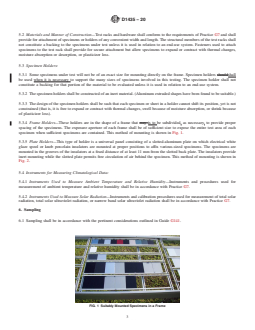
frame that is to be subdivided, as necessary, to provide proper
rack relative to the horizontal can vary depending upon the
spacing of the specimens.The exposure aperture of each frame
end-use conditions that are being evaluated.
shall be of sufficient size to expose the entire test area of each
NOTE 3—Test sites at latitudes less than 23°27' from the equator in
specimen when sufficient specimens are contained. This
either hemisphere will have a period during the year when the declination
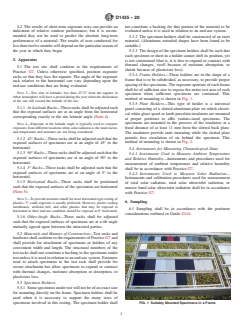
method of mounting is shown in Fig. 1.
of the sun will exceed the latitude of the site.
5.3.5 Plate Holders—This type of holder is a universal
5.1.1 At-Latitude Racks—These racks shall be adjusted such
panel consisting of a slotted-aluminum plate on which electri-
that the exposed surfaces are at an angle from the horizontal
cal white glaze spool or knob porcelain insulators are mounted
corresponding exactly to the site latitude angle (Note 4).
at proper positions to affix various-sized specimens. The
specimens are mounted in the grooves of the insulators at a
NOTE 4—Exposure at the latitude angle is typically used to compare
exposures from different locations when solar radiation is the main factor, fixed distance of at least 11 mm from the slotted back plate.
and temperature and moisture are not being considered.
The insulators provide inert mounting while the slotted plate
permits free circulation of air behind the specimen. This
5.1.2 45° Racks—Theseracksshallbeadjustedsuchthatthe
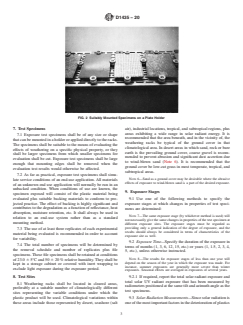
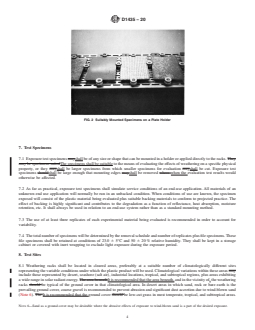
method of mounting is shown in Fig. 2.
exposed surfaces of specimens are at an angle of 45° to the
horizontal.
5.4 Instruments for Measuring Climatological Data:
5.1.3 90° Racks—Theseracksshallbeadjustedsuchthatthe
5.4.1 Instruments Used to Measure Ambient Temperature
exposed surfaces of specimens are at an angle of 90° to the
and Relative Humidity—Instruments and procedures used for
horizontal.
measurement of ambient temperature and relative humidity
5.1.4 5° Racks—These racks shall be adjusted such that the
shall be in accordance with Practice G7.
exposed surfaces of specimens are at an angle of 5° to the
5.4.2 Instruments Used to Measure Solar Radiation—
horizontal.
Instruments and calibration procedures used for measurement
5.1.5 Horizontal Racks—These racks shall be positioned
of total solar radiation, total solar ultraviolet radiation, or
such that the exposed surfaces of the specimens are horizontal
narrow band solar ultraviolet radiation shall be in accordance
(Note 5).
with Practice G7.
NOTE 5—To provide moisture runoff for most horizontal-type testing of
6. Sampling
plastics, 5° south exposure is usually preferred. However, plastic roofing
membranes, artificial turf, and other plastics that may be exposed at
6.1 Sampling shall be in accordance with the pertinent
horizontal in their end-use condition should be exposed at 0° horizontal.
considerations outlined in Guide G141.
5.1.6 Other-Angle Racks—These racks shall be adjusted
such that the exposed surfaces of specimens are at a tilt angle
mutually agreed upon between the interested parties.
5.2 Materials and Manner of Construction—Test racks and
hardware shall conform to the requirements of Practice G7 and
shall provide for attachment of specimens or holders of any
convenient width and length. The structural members of the
test racks shall not constitute a backing to the specimens under
test unless it is used in relation to an end-use system. Fasteners
used to attach specimens to the test rack shall provide for
secure attachment but allow specimens to expand or contract
with thermal changes, moisture absorption or desorption, or
plasticizer loss.
5.3 Specimen Holders:
5.3.1 Some specimens under test will not be of an exact size
for mounting directly on the frame. Specimen holders shall be
used when it is necessary to support the many sizes of
specimens involved in this testing. The specimen holder shall FIG. 1 Suitably Mounted Specimens in a Frame
D1435 − 20
FIG. 2 Suitably Mounted Specimens on a Plate Holder
7. Test Specimens air), industrial locations, tropical, and subtropical regions, plus
areas exhibiting a wide range in solar radiant energy. It is
7.1 Exposure test specimens shall be of any size or shape
recommended that the area beneath, and in the vicinity of, the
that can be mounted in a holder or applied directly to the racks.
weathering racks be typical of the ground cover in that
The specimens shall be suitable to the means of evaluating the
climatological area. In desert areas in which sand, rock or bare
effects of weathering on a specific physical property, or they
earth is the prevailing ground cover, coarse gravel is recom-
shall be larger specimens from which smaller specimens for
mended to prevent abrasion and significant dust accretion due
evaluation shall be cut. Exposu
...
This document is not an ASTM standard and is intended only to provide the user of an ASTM standard an indication of what changes have been made to the previous version. Because
it may not be technically possible to adequately depict all changes accurately, ASTM recommends that users consult prior editions as appropriate. In all cases only the current version
of the standard as published by ASTM is to be considered the official document.
Designation: D1435 − 13 D1435 − 20
Standard Practice for
Outdoor Weathering of Plastics
This standard is issued under the fixed designation D1435; the number immediately following the designation indicates the year of
original adoption or, in the case of revision, the year of last revision. A number in parentheses indicates the year of last reapproval. A
superscript epsilon (´) indicates an editorial change since the last revision or reapproval.
This standard has been approved for use by agencies of the U.S. Department of Defense.
1. Scope*
1.1 This practice is intended to cover procedures for the exposure of plastic materials to weather.
NOTE 1—See Practice G24 for aging under glass.
1.2 This practice is limited to the method by which the material is to be exposed and the general procedure to be followed. It is
intended for use with finished articles of commerce as well as with all sizes and shapes of test specimens.
1.3 Means of evaluation of the effects of weathering will depend on the intended use for the test material.
1.4 The values stated in SI units are to be regarded as the standard.
1.5 This standard does not purport to address all of the safety concerns, if any, associated with its use. It is the responsibility
of the user of this standard to establish appropriate safety safety, health, and healthenvironmental practices and determine the
applicability of regulatory limitations prior to use.
NOTE 2—This standard and ISO 877.2-2009, Method A, are technically equivalent.
1.6 This international standard was developed in accordance with internationally recognized principles on standardization
established in the Decision on Principles for the Development of International Standards, Guides and Recommendations issued
by the World Trade Organization Technical Barriers to Trade (TBT) Committee.
2. Referenced Documents
2.1 ASTM Standards:
D883 Terminology Relating to Plastics
D1600 Terminology for Abbreviated Terms Relating to Plastics
E772 Terminology of Solar Energy Conversion
G7 Practice for Atmospheric Environmental Exposure Testing of Nonmetallic Materials
G24 Practice for Conducting Exposures to Daylight Filtered Through Glass
G113 Terminology Relating to Natural and Artificial Weathering Tests of Nonmetallic Materials
G141 Guide for Addressing Variability in Exposure Testing of Nonmetallic Materials
This practice is under the jurisdiction of ASTM Committee D20 on Plastics and is the direct responsibility of Subcommittee D20.50 on Durability of Plastics.
Current edition approved June 1, 2013Sept. 15, 2020. Published July 2013October 2020. Originally approved in 1956. Last previous edition approved in 20052013 as
D1435 - 05.D1435 - 13. DOI: 10.1520/D1435-13.10.1520/D1435-20.
For referenced ASTM standards, visit the ASTM website, www.astm.org, or contact ASTM Customer Service at service@astm.org. For Annual Book of ASTM Standards
volume information, refer to the standard’s Document Summary page on the ASTM website.
*A Summary of Changes section appears at the end of this standard
Copyright © ASTM International, 100 Barr Harbor Drive, PO Box C700, West Conshohocken, PA 19428-2959. United States
D1435 − 20
G147 Practice for Conditioning and Handling of Nonmetallic Materials for Natural and Artificial Weathering Tests
2.2 ISO Standard:
ISO 877.2-2009 Plastics—Methods of exposure to solar radiation—Part 2: Direct weathering and exposure behind glass
3. Terminology
3.1 Definitions—For definitions of technical terms pertaining to plastics used in this practice, see Terminologies D883, D1600,
G113, and E772.
4. Significance and Use
4.1 Tests conducted in accordance with this practice are used to evaluate the stability of plastic materials when they are exposed
outdoors. The relative durability of plastics in outdoor use can be very different depending on the location of the exposure because
of differences in ultraviolet (UV) radiation, time of wetness, temperature, pollutants, and other factors. It cannot be assumed,
therefore, that results from one exposure in a single location will be useful for determining relative durability in a different location.
Exposures in several locations with different climates that represent a broad range of anticipated service conditions are
recommended.
4.1.1 Because of year-to-year climatological variations, results from a single exposure test cannot be used to predict the absolute
rate at which a material degrades. Several years of repeat exposures are needed to get an average test result for a given location.
4.2 The results of short-term exposure tests can provide an indication of relative outdoor performance, but they should it is
recommended they not be used to predict the absolute long-term performance of a material. The results of tests conducted for less
than twelve months will depend on the particular season of the year in which they begin.
5. Apparatus
5.1 The test site shall conform to the requirements of Practice G7. Unless otherwise specified, position exposure racks so that they
face the equator. The angle of the exposure rack relative to the horizontal can vary depending upon the end-use conditions that
are being evaluated.
NOTE 3—Test sites at latitudes less than 23°27' from the equator in either hemisphere will have a period during the year when the declination of the sun
will exceed the latitude of the site.
5.1.1 At-Latitude Racks—These racks shall be adjusted such that the exposed surfaces are at an angle from the horizontal
corresponding exactly to the site latitude angle (Note 4).
NOTE 4—Exposure at the latitude angle is typically used to compare exposures from different locations when solar radiation is the main factor, and
temperature and moisture are not being considered.
5.1.2 45° Racks—These racks shall be adjusted such that the exposed surfaces of specimens are at an angle of 45° to the horizontal.
5.1.3 90° Racks—These racks shall be adjusted such that the exposed surfaces of specimens are at an angle of 90° to the horizontal.
5.1.4 5° Racks—These racks shall be adjusted such that the exposed surfaces of specimens are at an angle of 5° to the horizontal.
5.1.5 Horizontal Racks—These racks shall be positioned such that the exposed surfaces of the specimens are horizontal (Note 5).
NOTE 5—To provide moisture runoff for most horizontal-type testing of plastics, 5° south exposure is usually preferred. However, plastic roofing
membranes, artificial turf, and other plastics that may be exposed at horizontal in their end-use condition should be exposed at 0° horizontal.
5.1.6 Other-Angle Racks—These racks shall be adjusted such that the exposed surfaces of specimens are at a tilt angle mutually
agreed upon between the interested parties.
Available from American National Standards Institute (ANSI), 25 W. 43rd St., 4th Floor, New York, NY 10036, http://www.ansi.org.
D1435 − 20
5.2 Materials and Manner of Construction—Test racks and hardware shall conform to the requirements of Practice G7 and shall
provide for attachment of specimens or holders of any convenient width and length. The structural members of the test racks shall
not constitute a backing to the specimens under test unless it is used in relation to an end-use system. Fasteners used to attach
specimens to the test rack shall provide for secure attachment but allow specimens to expand or contract with thermal changes,
moisture absorption or desorption, or plasticizer loss.
5.3 Specimen Holders:
5.3.1 Some specimens under test will not be of an exact size for mounting directly on the frame. Specimen holders shouldshall
be used when it is necessary to support the many sizes of specimens involved in this testing. The specimen holder shall not
constitute a backing for that portion of the material to be evaluated unless it is used in relation to an end-use system.
5.3.2 The specimen holders shall be constructed of an inert material. (Aluminum extruded shapes have been found to be suitable.)
5.3.3 The design of the specimen holders shall be such that each specimen or sheet in a holder cannot shift its position, yet is not
constrained (that is, it is free to expand or contract with thermal changes, swell because of moisture absorption, or shrink because
of plasticizer loss).
5.3.4 Frame Holders—These holders are in the shape of a frame that may is to be subdivided, as necessary, to provide proper
spacing of the specimens. The exposure aperture of each frame shall be of sufficient size to expose the entire test area of each
specimen when sufficient specimens are contained. This method of mounting is shown in Fig. 1.
5.3.5 Plate Holders—This type of holder is a universal panel consisting of a slotted-aluminum plate on which electrical white
glaze spool or knob porcelain insulators are mounted at proper positions to affix various-sized specimens. The specimens are
mounted in the grooves of the insulators at a fixed distance of at least 11 mm from the slotted back plate. The insulators provide
inert mounting while the slotted plate permits free circulation of air behind the specimen. This method of mounting is shown in
Fig. 2.
5.4 Instruments for Measuring Climatological Data:
5.4.1 Instruments Used to Measure Ambient Temperature and Relative Humidity—Instruments and procedures used for
measurement of ambient temperature and relative humidity shall be in accordance with Practice G7.
5.4.2 Instruments Used to Measure Solar Radiation—Instruments and calibration procedures used for measurement of total solar
radiation, total solar ultraviolet radiation, or narrow band solar ultraviolet radiation shall be in accordance with Practice G7.
6. Sampling
6.1 Sampling shall be in accordance with the pertinent considerations outlined in Guide G141.
FIG. 1 Suitably Mounted Specimens in a Frame
D1435 − 20
FIG. 2 Suitably Mounted Specimens on a Plate Holder
7. Test Specimens
7.1 Exposure test specimens mayshall be of any size or shape that can be mounted in a holder or applied directly to the racks. They
may be specimens suitedThe specimens shall be suitable to the means of evaluating the effects of weathering on a specific physical
property, or they mayshall be larger specimens from which smaller specimens for evaluation mayshall be cut. Exposure test
specimens shouldshall be large enough that mounting edges mayshall be removed where when the evaluation test results would
otherwise be affected.
7.2 As far as practical, exposure test specimens shall simulate service conditions of an end-use application. All materials of an
unknown end use application will normally be run in an unbacked condition. When conditions of use are known, the specimen
exposed will consist of the plastic material being evaluated plus suitable backing materials to conform to projected practice. The
effect of backing is highly significant and contributes to the degradation as a function of reflectance, heat absorption, moisture
retention, etc. It shall always be used in relation to an end-use system rather than as a standard mounting method.
7.3 The use of at least three replicates of each experimental material being evaluated is recommended in order to account for
variability.
7.4 The total number of specimens will be determine
...
Questions, Comments and Discussion
Ask us and Technical Secretary will try to provide an answer. You can facilitate discussion about the standard in here.
Loading comments...