


ASTM C136/C136M-19
(Test Method)Standard Test Method for Sieve Analysis of Fine and Coarse Aggregates
Standard Test Method for Sieve Analysis of Fine and Coarse Aggregates
SIGNIFICANCE AND USE
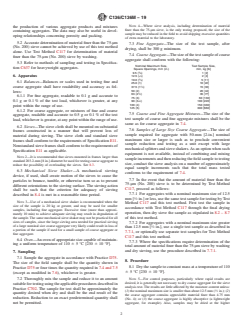
5.1 This test method is used primarily to determine the grading of materials proposed for use as aggregates or being used as aggregates. The results are used to determine compliance of the particle size distribution with applicable specification requirements and to provide necessary data for control of the production of various aggregate products and mixtures containing aggregates. The data may also be useful in developing relationships concerning porosity and packing.
5.2 Accurate determination of material finer than the 75-μm (No. 200) sieve cannot be achieved by use of this test method alone. Use Test Method C117 for determination of material finer than the 75-μm (No. 200) sieve by washing.
5.3 Refer to methods of sampling and testing in Specification C637 for heavyweight aggregates.
SCOPE
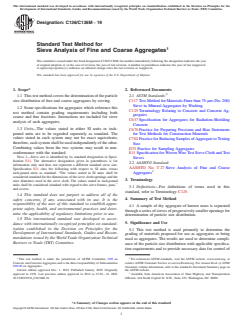
1.1 This test method covers the determination of the particle size distribution of fine and coarse aggregates by sieving.
1.2 Some specifications for aggregates which reference this test method contain grading requirements including both coarse and fine fractions. Instructions are included for sieve analysis of such aggregates.
1.3 Units—The values stated in either SI units or inch-pound units are to be regarded separately as standard. The values stated in each system may not be exact equivalents; therefore, each system shall be used independently of the other. Combining values from the two systems may result in non-conformance with the standard.
Note 1: Sieve size is identified by its standard designation in Specification E11. The alternative designation given in parentheses is for information only and does not represent a different standard sieve size. Specification E11 cites the following with respect to SI units versus inch-pound units as standard. “The values stated in SI units shall be considered standard for the dimensions of the sieve cloth openings and the wire diameters used in the sieve cloth. The values stated in inch-pound units shall be considered standard with regard to the sieve frames, pans,” and covers.
1.4 This standard does not purport to address all of the safety concerns, if any, associated with its use. It is the responsibility of the user of this standard to establish appropriate safety, health, and environmental practices and determine the applicability of regulatory limitations prior to use.
1.5 This international standard was developed in accordance with internationally recognized principles on standardization established in the Decision on Principles for the Development of International Standards, Guides and Recommendations issued by the World Trade Organization Technical Barriers to Trade (TBT) Committee.
General Information
- Status
- Published
- Publication Date
- 30-Nov-2019
- Technical Committee
- C09 - Concrete and Concrete Aggregates
- Drafting Committee
- C09.20 - Aggregates
Relations
- Effective Date
- 01-Feb-2024
- Effective Date
- 01-Jan-2024
- Effective Date
- 15-Nov-2023
- Effective Date
- 01-Jan-2020
- Effective Date
- 15-Dec-2019
- Effective Date
- 01-Jan-2019
- Effective Date
- 01-Oct-2018
- Effective Date
- 01-Jul-2018
- Effective Date
- 01-Jan-2018
- Effective Date
- 15-Dec-2016
- Effective Date
- 15-Dec-2015
- Effective Date
- 01-Jul-2015
- Effective Date
- 01-Feb-2015
- Effective Date
- 01-Aug-2014
- Effective Date
- 01-Jun-2014
Overview
ASTM C136/C136M-19, published by ASTM International, is a widely recognized standard that provides the test method for sieve analysis of both fine and coarse aggregates. This method determines the particle size distribution of aggregates-materials commonly used in concrete, asphalt, and other construction applications. Sieve analysis ensures the grading of aggregates meets specification requirements, supports quality control of aggregate production, and provides vital data for mix designs and research in construction materials.
Key Topics
- Purpose and Scope: Defines the procedures for determining aggregate particle size distribution using a series of sieves with progressively smaller openings.
- Fine and Coarse Aggregates: Applicable to a range of aggregate sizes, including precise sample preparation and handling requirements for both fine and coarse aggregates.
- Test Procedure: Outlines drying, weighing, proper sample size selection, sieving operations (by hand or mechanically), and calculation of gradation results.
- Units of Measurement: Specifies that SI and inch-pound units are treated as separate standards and should not be combined in analysis or reporting.
- Data Reporting: Details requirements for reporting the percentage of material retained or passing each sieve, as well as the calculation of the fineness modulus when required.
- Precision and Bias: Summarizes the expected repeatability and reproducibility of results in both single-operator and multi-laboratory contexts.
- Limitations: Notes that accurate determination of material finer than the 75-μm (No. 200) sieve requires supplementary washing procedures referenced in ASTM C117.
Applications
Sieve analysis is critical for several practical applications in construction, materials testing, and quality control, including:
- Aggregate Qualification: Ensures that aggregates conform to project specifications for concrete, asphalt, and mortar mixes.
- Production Control: Assists manufacturers in monitoring and adjusting aggregate production to maintain consistent sizing and gradation.
- Mix Design: Provides essential data for designing concrete and asphalt mixes with improved performance characteristics, workability, and strength.
- Porosity and Packing Studies: The grading data can be used to predict packing density and porosity, which influence the durability and performance of finished products.
- Compliance and Certification: Used by quality assurance agencies and construction teams to document and demonstrate compliance with national and international standards.
- Research and Development: Supports ongoing studies in aggregate optimization, recycled material incorporation, and advanced material development.
Related Standards
Several other ASTM and industry standards are often referenced together with ASTM C136/C136M-19 for a comprehensive approach to aggregate testing and specification:
- ASTM C117: Test Method for Materials Finer than 75-μm (No. 200) Sieve in Mineral Aggregates by Washing
- ASTM C125: Terminology Relating to Concrete and Concrete Aggregates
- ASTM C637: Specification for Aggregates for Radiation-Shielding Concrete
- ASTM C670: Precision and Bias Statements for Test Methods for Construction Materials
- ASTM C702: Practice for Reducing Samples of Aggregate to Testing Size
- ASTM D75: Practice for Sampling Aggregates
- ASTM E11: Specification for Woven Wire Test Sieve Cloth and Test Sieves
- AASHTO T 27: Sieve Analysis of Fine and Coarse Aggregates
Summary
The ASTM C136/C136M-19 Standard Test Method for Sieve Analysis of Fine and Coarse Aggregates is fundamental to ensuring accurate and consistent aggregate grading. By adhering to this standard, organizations can optimize material performance, maintain compliance with construction specifications, and enhance quality control in materials testing laboratories and construction projects worldwide. Use of sieve analysis supports better decision-making and contributes to the reliability and durability of infrastructure and building materials.
Buy Documents
ASTM C136/C136M-19 - Standard Test Method for Sieve Analysis of Fine and Coarse Aggregates
REDLINE ASTM C136/C136M-19 - Standard Test Method for Sieve Analysis of Fine and Coarse Aggregates
Get Certified
Connect with accredited certification bodies for this standard

ICC Evaluation Service
Building products evaluation and certification.

QAI Laboratories
Building and construction product testing and certification.

Aboma Certification B.V.
Specialized in construction, metal, and transport sectors.
Sponsored listings
Frequently Asked Questions
ASTM C136/C136M-19 is a standard published by ASTM International. Its full title is "Standard Test Method for Sieve Analysis of Fine and Coarse Aggregates". This standard covers: SIGNIFICANCE AND USE 5.1 This test method is used primarily to determine the grading of materials proposed for use as aggregates or being used as aggregates. The results are used to determine compliance of the particle size distribution with applicable specification requirements and to provide necessary data for control of the production of various aggregate products and mixtures containing aggregates. The data may also be useful in developing relationships concerning porosity and packing. 5.2 Accurate determination of material finer than the 75-μm (No. 200) sieve cannot be achieved by use of this test method alone. Use Test Method C117 for determination of material finer than the 75-μm (No. 200) sieve by washing. 5.3 Refer to methods of sampling and testing in Specification C637 for heavyweight aggregates. SCOPE 1.1 This test method covers the determination of the particle size distribution of fine and coarse aggregates by sieving. 1.2 Some specifications for aggregates which reference this test method contain grading requirements including both coarse and fine fractions. Instructions are included for sieve analysis of such aggregates. 1.3 Units—The values stated in either SI units or inch-pound units are to be regarded separately as standard. The values stated in each system may not be exact equivalents; therefore, each system shall be used independently of the other. Combining values from the two systems may result in non-conformance with the standard. Note 1: Sieve size is identified by its standard designation in Specification E11. The alternative designation given in parentheses is for information only and does not represent a different standard sieve size. Specification E11 cites the following with respect to SI units versus inch-pound units as standard. “The values stated in SI units shall be considered standard for the dimensions of the sieve cloth openings and the wire diameters used in the sieve cloth. The values stated in inch-pound units shall be considered standard with regard to the sieve frames, pans,” and covers. 1.4 This standard does not purport to address all of the safety concerns, if any, associated with its use. It is the responsibility of the user of this standard to establish appropriate safety, health, and environmental practices and determine the applicability of regulatory limitations prior to use. 1.5 This international standard was developed in accordance with internationally recognized principles on standardization established in the Decision on Principles for the Development of International Standards, Guides and Recommendations issued by the World Trade Organization Technical Barriers to Trade (TBT) Committee.
SIGNIFICANCE AND USE 5.1 This test method is used primarily to determine the grading of materials proposed for use as aggregates or being used as aggregates. The results are used to determine compliance of the particle size distribution with applicable specification requirements and to provide necessary data for control of the production of various aggregate products and mixtures containing aggregates. The data may also be useful in developing relationships concerning porosity and packing. 5.2 Accurate determination of material finer than the 75-μm (No. 200) sieve cannot be achieved by use of this test method alone. Use Test Method C117 for determination of material finer than the 75-μm (No. 200) sieve by washing. 5.3 Refer to methods of sampling and testing in Specification C637 for heavyweight aggregates. SCOPE 1.1 This test method covers the determination of the particle size distribution of fine and coarse aggregates by sieving. 1.2 Some specifications for aggregates which reference this test method contain grading requirements including both coarse and fine fractions. Instructions are included for sieve analysis of such aggregates. 1.3 Units—The values stated in either SI units or inch-pound units are to be regarded separately as standard. The values stated in each system may not be exact equivalents; therefore, each system shall be used independently of the other. Combining values from the two systems may result in non-conformance with the standard. Note 1: Sieve size is identified by its standard designation in Specification E11. The alternative designation given in parentheses is for information only and does not represent a different standard sieve size. Specification E11 cites the following with respect to SI units versus inch-pound units as standard. “The values stated in SI units shall be considered standard for the dimensions of the sieve cloth openings and the wire diameters used in the sieve cloth. The values stated in inch-pound units shall be considered standard with regard to the sieve frames, pans,” and covers. 1.4 This standard does not purport to address all of the safety concerns, if any, associated with its use. It is the responsibility of the user of this standard to establish appropriate safety, health, and environmental practices and determine the applicability of regulatory limitations prior to use. 1.5 This international standard was developed in accordance with internationally recognized principles on standardization established in the Decision on Principles for the Development of International Standards, Guides and Recommendations issued by the World Trade Organization Technical Barriers to Trade (TBT) Committee.
ASTM C136/C136M-19 is classified under the following ICS (International Classification for Standards) categories: 91.100.30 - Concrete and concrete products. The ICS classification helps identify the subject area and facilitates finding related standards.
ASTM C136/C136M-19 has the following relationships with other standards: It is inter standard links to ASTM C670-24a, ASTM C670-24, ASTM C117-23, ASTM C637-20, ASTM C125-19a, ASTM C125-19, ASTM C125-18b, ASTM C125-18a, ASTM C125-18, ASTM C125-16, ASTM C125-15b, ASTM C125-15a, ASTM C125-15, ASTM C125-14, ASTM C637-14. Understanding these relationships helps ensure you are using the most current and applicable version of the standard.
ASTM C136/C136M-19 is available in PDF format for immediate download after purchase. The document can be added to your cart and obtained through the secure checkout process. Digital delivery ensures instant access to the complete standard document.
Standards Content (Sample)
This international standard was developed in accordance with internationally recognized principles on standardization established in the Decision on Principles for the
Development of International Standards, Guides and Recommendations issued by the World Trade Organization Technical Barriers to Trade (TBT) Committee.
Designation: C136/C136M − 19
Standard Test Method for
Sieve Analysis of Fine and Coarse Aggregates
This standard is issued under the fixed designation C136/C136M; the number immediately following the designation indicates the year
of original adoption or, in the case of revision, the year of last revision.Anumber in parentheses indicates the year of last reapproval.
A superscript epsilon (´) indicates an editorial change since the last revision or reapproval.
This standard has been approved for use by agencies of the U.S. Department of Defense.
1. Scope* 2. Referenced Documents
2.1 ASTM Standards:
1.1 Thistestmethodcoversthedeterminationoftheparticle
C117Test Method for Materials Finer than 75-µm (No. 200)
size distribution of fine and coarse aggregates by sieving.
Sieve in Mineral Aggregates by Washing
1.2 Some specifications for aggregates which reference this
C125Terminology Relating to Concrete and Concrete Ag-
test method contain grading requirements including both
gregates
coarse and fine fractions. Instructions are included for sieve
C637Specification for Aggregates for Radiation-Shielding
analysis of such aggregates.
Concrete
1.3 Units—The values stated in either SI units or inch-
C670Practice for Preparing Precision and Bias Statements
pound units are to be regarded separately as standard. The
for Test Methods for Construction Materials
values stated in each system may not be exact equivalents;
C702PracticeforReducingSamplesofAggregatetoTesting
therefore,eachsystemshallbeusedindependentlyoftheother.
Size
Combining values from the two systems may result in non-
D75Practice for Sampling Aggregates
conformance with the standard.
E11Specification forWovenWireTest Sieve Cloth andTest
NOTE 1—Sieve size is identified by its standard designation in Speci-
Sieves
fication E11. The alternative designation given in parentheses is for
2.2 AASHTO Standard:
information only and does not represent a different standard sieve size.
AASHTO No. T27Sieve Analysis of Fine and Coarse
Specification E11 cites the following with respect to SI units versus
Aggregates
inch-pound units as standard. “The values stated in SI units shall be
consideredstandardforthedimensionsofthesieveclothopeningsandthe
3. Terminology
wire diameters used in the sieve cloth. The values stated in inch-pound
units shall be considered standard with regard to the sieve frames, pans,”
3.1 Definitions—For definitions of terms used in this
and covers.
standard, refer to Terminology C125.
1.4 This standard does not purport to address all of the
4. Summary of Test Method
safety concerns, if any, associated with its use. It is the
responsibility of the user of this standard to establish appro-
4.1 A sample of dry aggregate of known mass is separated
priate safety, health, and environmental practices and deter-
throughaseriesofsievesofprogressivelysmalleropeningsfor
mine the applicability of regulatory limitations prior to use.
determination of particle size distribution.
1.5 This international standard was developed in accor-
5. Significance and Use
dance with internationally recognized principles on standard-
ization established in the Decision on Principles for the
5.1 This test method is used primarily to determine the
Development of International Standards, Guides and Recom-
grading of materials proposed for use as aggregates or being
mendations issued by the World Trade Organization Technical
used as aggregates. The results are used to determine compli-
Barriers to Trade (TBT) Committee.
ance of the particle size distribution with applicable specifica-
tion requirements and to provide necessary data for control of
1 2
This test method is under the jurisdiction of ASTM Committee C09 on For referenced ASTM standards, visit the ASTM website, www.astm.org, or
Concrete and ConcreteAggregates and is the direct responsibility of Subcommittee contact ASTM Customer Service at service@astm.org. For Annual Book of ASTM
C09.20 on Aggregates. Standards volume information, refer to the standard’s Document Summary page on
Current edition approved Dec. 1, 2019. Published January 2020. Originally the ASTM website.
approved in 1938. Last previous edition approved in 2014 as C136–14. DOI: Available from American Association of State Highway and Transportation
10.1520/C0136_C0136M-19. Officials, 444 North Capitol St. N.W., Suite 225, Washington, DC 20001.
*A Summary of Changes section appears at the end of this standard
Copyright © ASTM International, 100 Barr Harbor Drive, PO Box C700, West Conshohocken, PA 19428-2959. United States
C136/C136M − 19
NOTE 4—Where sieve analysis, including determination of material
the production of various aggregate products and mixtures
finer than the 75-µm sieve, is the only testing proposed, the size of the
containing aggregates. The data may also be useful in devel-
sample may be reduced in the field to avoid shipping excessive quantities
oping relationships concerning porosity and packing.
of extra material to the laboratory.
5.2 Accurate determination of material finer than the 75-µm
7.3 Fine Aggregate—The size of the test sample, after
(No. 200) sieve cannot be achieved by use of this test method
drying, shall be 300 g minimum.
alone. Use Test Method C117 for determination of material
7.4 Coarse Aggregate—Thesizeofthetestsampleofcoarse
finer than the 75-µm (No. 200) sieve by washing.
aggregate shall conform with the following:
5.3 Refer to methods of sampling and testing in Specifica-
Nominal Maximum Size, Test Sample Size,
tion C637 for heavyweight aggregates.
Square Openings, mm (in.) min, kg [lb]
9.5 ( ⁄8) 1 [2]
6. Apparatus 1
12.5 ( ⁄2) 2 [4]
19.0 ( ⁄4)5[11]
6.1 Balances—Balances or scales used in testing fine and
25.0 (1) 10 [22]
coarse aggregate shall have readability and accuracy as fol- 37.5 (1 ⁄2) 15 [33]
50 (2) 20 [44]
lows:
63 (2 ⁄2) 35 [77]
6.1.1 For fine aggregate, readable to 0.1 g and accurate to
75 (3) 60 [130]
0.1 g or 0.1% of the test load, whichever is greater, at any
90 (3 ⁄2) 100 [220]
100 (4) 150 [330]
point within the range of use.
125 (5) 300 [660]
6.1.2 For coarse aggregate, or mixtures of fine and coarse
7.5 Coarse and Fine Aggregate Mixtures—The size of the
aggregate, readable and accurate to 0.5 g or 0.1% of the test
test sample of coarse and fine aggregate mixtures shall be the
load, whichever is greater, at any point within the range of use.
same as for coarse aggregate in 7.4.
6.2 Sieves—The sieve cloth shall be mounted on substantial
7.6 Samples of Large Size Coarse Aggregate—The size of
frames constructed in a manner that will prevent loss of
sample required for aggregate with 50-mm [2-in.] nominal
material during sieving. The sieve cloth and standard sieve
maximum size or larger is such as to preclude convenient
frames shall conform to the requirements of Specification E11.
sample reduction and testing as a unit except with large
Nonstandardsieveframesshallconformtotherequirementsof
mechanicalsplittersandsieveshakers.Asanoptionwhensuch
Specification E11 as applicable.
equipment is not available, instead of combining and mixing
NOTE 2—It is recommended that sieves mounted in frames larger than
sampleincrementsandthenreducingthefieldsampletotesting
standard203.2-mm[8in.]diameterbeusedfortestingcoarseaggregateto
size, conduct the sieve analysis on a number of approximately
reduce the possibility of overloading the sieves. See 8.3.
equal sample increments such that the total mass tested
6.3 Mechanical Sieve Shaker—A mechanical sieving
conforms to the requirement of 7.4.
device, if used, shall create motion of the sieves to cause the
7.7 In the event that the amount of material finer than the
particles to bounce, tumble, or otherwise turn so as to present
75-µm (No. 200) sieve is to be determined by Test Method
different orientations to the sieving surface. The sieving action
C117, proceed as follows:
shall be such that the criterion for adequacy of sieving
7.7.1 For aggregates with a nominal maximum size of 12.5
described in 8.4 is met in a reasonable time period.
mm[ ⁄2in.]orless,usethesametestsamplefortestingbyTest
NOTE 3—Use of a mechanical sieve shaker is recommended when the
Method C117 and this test method. First test the sample in
size of the sample is 20 kg or greater, and may be used for smaller
accordance with Test Method C117 through the final drying
samples, including fine aggregate. Excessive time (more than approxi-
operation, then dry sieve the sample as stipulated in 8.2 – 8.7
mately 10 min) to achieve adequate sieving may result in degradation of
thesample.Thesamemechanicalsieveshakermaynotbepracticalforall of this test method.
sizes of samples, since the large sieving area needed for practical sieving
7.7.2 For aggregates with a nominal maximum size greater
of a large nominal size coarse aggregate very likely could result in loss of
than 12.5 mm [ ⁄2 in.], use a single test sample as described in
a portion of the sample if used for a small sample of coarse aggregate or
7.7.1, or optionally use separate test samples for Test Method
fine aggregate.
C117 and this test method.
6.4 Oven—Anovenofappropriatesizecapableofmaintain-
7.7.3 Where the specifications require determination of the
ing a uniform temperature of 110 6 5 °C [230 6 10 °F].
total amount of material finer than the 75-µm sieve by washing
and dry sieving, use the procedure described in 7.7.1.
7. Sampling
7.1 Sample the aggregate in accordance with Practice D75.
8. Procedure
The size of the field sample shall be the quantity shown in
8.1 Dry the sample to constant mass at a temperature of 110
Practice D75 or four times the quantity required in 7.4 and 7.5
(except as modified in 7.6), whichever is greater. 6 5 °C [230 6 10 °F].
7.2 Thoroughly mix the sample and reduce it to an amount NOTE 5—For control purposes, particularly where rapid results are
desired, it is generally not necessary to dry coarse aggregate for the sieve
suitablefortestingusingtheapplicableproceduresdescribedin
analysis test. The results are little affected by the moisture content unless:
Practice C702. The sample for test shall be approximately the
(1) the nominal maximum size is smaller than about 12.5 mm ( ⁄2 in.); (2)
quantity desired when dry and shall be the end result of the
the coarse aggregate contains appreciable material finer than 4.75 mm
reduction. Reduction to an exact predetermined quantity shall
(No. 4); or (3) the coarse aggregate is highly absorptive (a lightweight
not be permitted. aggregate, for example). Also, samples may be dried at the higher
C136/C136M − 19
temperatures associated with the use of hot plates without affecting NOTE 6—The 7 kg/m amounts to 200 g for the usual 203-mm [8-in.]
results, provided steam escapes without generating pressures sufficient to diameter sieve (with effective sieving surface diameter of 190.5 mm [7.5
fracture the particles, and temperatures are not so great as to cause in.].
chemical breakdown of the aggregate.
8.4 Continue sieving for a sufficient period and in such
8.2 Select sieves with suitable openings to furnish the
manner that, after completion, not more than 1% by mass of
information required by the specifications covering the mate-
the material retained on any individual sieve will pass that
rial to be tested. Use additional sieves as desired or necessary
sieve during 1 min of continuous hand sieving performed as
to provide other information, such as fineness modulus, or to
follows:Holdtheindividualsieve,providedwithasnug-fitting
regulate the amount of material on a sieve. Nest the sieves in
pan and cover, in a slightly inclined position in one hand.
order of decreasing size of opening from top to bottom and
Strike the side of the sieve sharply and with an upward motion
placethesampleonthetopsieve.Agitatethesievesbyhandor
againsttheheeloftheotherhandattherateofabout150times
by mechanical apparatus for a sufficient period, established by
per minute, turn the sieve about one sixth of a revolution at
trial or checked by measurement on the actual test sample, to
intervals of about 25
...
This document is not an ASTM standard and is intended only to provide the user of an ASTM standard an indication of what changes have been made to the previous version. Because
it may not be technically possible to adequately depict all changes accurately, ASTM recommends that users consult prior editions as appropriate. In all cases only the current version
of the standard as published by ASTM is to be considered the official document.
Designation: C136/C136M − 14 C136/C136M − 19
Standard Test Method for
Sieve Analysis of Fine and Coarse Aggregates
This standard is issued under the fixed designation C136/C136M; the number immediately following the designation indicates the year
of original adoption or, in the case of revision, the year of last revision. A number in parentheses indicates the year of last reapproval.
A superscript epsilon (´) indicates an editorial change since the last revision or reapproval.
This standard has been approved for use by agencies of the U.S. Department of Defense.
1. Scope*
1.1 This test method covers the determination of the particle size distribution of fine and coarse aggregates by sieving.
1.2 Some specifications for aggregates which reference this test method contain grading requirements including both coarse and
fine fractions. Instructions are included for sieve analysis of such aggregates.
1.3 Units—The values stated in either SI units or inch-pound units are to be regarded separately as standard. The values stated
in each system may not be exact equivalents; therefore, each system shall be used independently of the other. Combining values
from the two systems may result in non-conformance with the standard.
NOTE 1—Sieve size is identified by its standard designation in Specification E11. The alternative designation given in parentheses is for information
only and does not represent a different standard sieve size. Specification E11 cites the following with respect to SI units versus inch-pound units as
standard. “The values stated in SI units shall be considered standard for the dimensions of the sieve cloth openings and the wire diameters used in the
sieve cloth. The values stated in inch-pound units shall be considered standard with regard to the sieve frames, pans,” and covers.
1.4 This standard does not purport to address all of the safety concerns, if any, associated with its use. It is the responsibility
of the user of this standard to establish appropriate safety safety, health, and healthenvironmental practices and determine the
applicability of regulatory limitations prior to use.
1.5 This international standard was developed in accordance with internationally recognized principles on standardization
established in the Decision on Principles for the Development of International Standards, Guides and Recommendations issued
by the World Trade Organization Technical Barriers to Trade (TBT) Committee.
2. Referenced Documents
2.1 ASTM Standards:
C117 Test Method for Materials Finer than 75-μm (No. 200) Sieve in Mineral Aggregates by Washing
C125 Terminology Relating to Concrete and Concrete Aggregates
C637 Specification for Aggregates for Radiation-Shielding Concrete
C670 Practice for Preparing Precision and Bias Statements for Test Methods for Construction Materials
C702 Practice for Reducing Samples of Aggregate to Testing Size
D75 Practice for Sampling Aggregates
E11 Specification for Woven Wire Test Sieve Cloth and Test Sieves
2.2 AASHTO Standard:
AASHTO No. T 27 Sieve Analysis of Fine and Coarse Aggregates
3. Terminology
3.1 Definitions—For definitions of terms used in this standard, refer to Terminology C125.
4. Summary of Test Method
4.1 A sample of dry aggregate of known mass is separated through a series of sieves of progressively smaller openings for
determination of particle size distribution.
This test method is under the jurisdiction of ASTM Committee C09 on Concrete and Concrete Aggregates and is the direct responsibility of Subcommittee C09.20 on
Normal Weight Aggregates.
Current edition approved Dec. 1, 2014Dec. 1, 2019. Published February 2015January 2020. Originally approved in 1938. Last previous edition approved in 20062014 as
C136 – 06.C136 – 14. DOI: 10.1520/C0136_C0136M-14.10.1520/C0136_C0136M-19.
For referenced ASTM standards, visit the ASTM website, www.astm.org, or contact ASTM Customer Service at service@astm.org. For Annual Book of ASTM Standards
volume information, refer to the standard’s Document Summary page on the ASTM website.
Available from American Association of State Highway and Transportation Officials, 444 North Capitol St. N.W., Suite 225, Washington, DC 20001.
*A Summary of Changes section appears at the end of this standard
Copyright © ASTM International, 100 Barr Harbor Drive, PO Box C700, West Conshohocken, PA 19428-2959. United States
C136/C136M − 19
5. Significance and Use
5.1 This test method is used primarily to determine the grading of materials proposed for use as aggregates or being used as
aggregates. The results are used to determine compliance of the particle size distribution with applicable specification requirements
and to provide necessary data for control of the production of various aggregate products and mixtures containing aggregates. The
data may also be useful in developing relationships concerning porosity and packing.
5.2 Accurate determination of material finer than the 75-μm (No. 200) sieve cannot be achieved by use of this test method alone.
Use Test Method C117 for determination of material finer than the 75-μm (No. 200) sieve by washing should be
employed.washing.
5.3 Refer to methods of sampling and testing in Specification C637 for heavyweight aggregates.
6. Apparatus
6.1 Balances—Balances or scales used in testing fine and coarse aggregate shall have readability and accuracy as follows:
6.1.1 For fine aggregate, readable to 0.1 g and accurate to 0.1 g or 0.1 % of the test load, whichever is greater, at any point within
the range of use.
6.1.2 For coarse aggregate, or mixtures of fine and coarse aggregate, readable and accurate to 0.5 g or 0.1 % of the test load,
whichever is greater, at any point within the range of use.
6.2 Sieves—The sieve cloth shall be mounted on substantial frames constructed in a manner that will prevent loss of material
during sieving. The sieve cloth and standard sieve frames shall conform to the requirements of Specification E11. Nonstandard
sieve frames shall conform to the requirements of Specification E11 as applicable.
NOTE 2—It is recommended that sieves mounted in frames larger than standard 203.2-mm [8 in.] diameter be used for testing coarse aggregate to reduce
the possibility of overloading the sieves. See 8.3.
6.3 Mechanical Sieve Shaker—A mechanical sieving device, if used, shall create motion of the sieves to cause the particles to
bounce, tumble, or otherwise turn so as to present different orientations to the sieving surface. The sieving action shall be such
that the criterion for adequacy of sieving described in 8.4 is met in a reasonable time period.
NOTE 3—Use of a mechanical sieve shaker is recommended when the size of the sample is 20 kg or greater, and may be used for smaller samples,
including fine aggregate. Excessive time (more than approximately 10 min) to achieve adequate sieving may result in degradation of the sample. The same
mechanical sieve shaker may not be practical for all sizes of samples, since the large sieving area needed for practical sieving of a large nominal size
coarse aggregate very likely could result in loss of a portion of the sample if used for a small sample of coarse aggregate or fine aggregate.
6.4 Oven—An oven of appropriate size capable of maintaining a uniform temperature of 110 6 5 °C [230 6 10 °F].
7. Sampling
7.1 Sample the aggregate in accordance with Practice D75. The size of the field sample shall be the quantity shown in Practice
D75 or four times the quantity required in 7.4 and 7.5 (except as modified in 7.6), whichever is greater.
7.2 Thoroughly mix the sample and reduce it to an amount suitable for testing using the applicable procedures described in
Practice C702. The sample for test shall be approximately the quantity desired when dry and shall be the end result of the reduction.
Reduction to an exact predetermined quantity shall not be permitted.
NOTE 4—Where sieve analysis, including determination of material finer than the 75-μm sieve, is the only testing proposed, the size of the sample may
be reduced in the field to avoid shipping excessive quantities of extra material to the laboratory.
7.3 Fine Aggregate—The size of the test sample, after drying, shall be 300 g minimum.
7.4 Coarse Aggregate—The size of the test sample of coarse aggregate shall conform with the following:
Nominal Maximum Size, Test Sample Size,
Square Openings, mm (in.) min, kg [lb]
9.5 ( ⁄8) 1 [2]
12.5 ( ⁄2) 2 [4]
19.0 ( ⁄4) 5 [11]
25.0 (1) 10 [22]
37.5 (1 ⁄2) 15 [33]
50 (2) 20 [44]
63 (2 ⁄2) 35 [77]
75 (3) 60 [130]
90 (3 ⁄2) 100 [220]
100 (4) 150 [330]
125 (5) 300 [660]
7.5 Coarse and Fine Aggregate Mixtures—The size of the test sample of coarse and fine aggregate mixtures shall be the same
as for coarse aggregate in 7.4.
7.6 Samples of Large Size Coarse Aggregate—The size of sample required for aggregate with 50-mm [2-in.] nominal maximum
size or larger is such as to preclude convenient sample reduction and testing as a unit except with large mechanical splitters and
sieve shakers. As an option when such equipment is not available, instead of combining and mixing sample increments and then
C136/C136M − 19
reducing the field sample to testing size, conduct the sieve analysis on a number of approximately equal sample increments such
that the total mass tested conforms to the requirement of 7.4.
7.7 In the event that the amount of material finer than the 75-μm (No. 200) sieve is to be determined by Test Method C117,
proceed as follows:
7.7.1 For aggregates with a nominal maximum size of 12.5 mm [ ⁄2 in.] or less, use the same test sample for testing by Test
Method C117 and this test method. First test the sample in accordance with Test Method C117 through the final drying operation,
then dry sieve the sample as stipulated in 8.2 – 8.7 of this test method.
7.7.2 For aggregates with a nominal maximum size greater than 12.5 mm [ ⁄2 in.], use a single test sample as described in 7.7.1,
or optionally use separate test samples for Test Method C117 and this test method.
7.7.3 Where the specifications require determination of the total amount of material finer than the 75-μm sieve by washing and
dry sieving, use the procedure described in 7.7.1.
8. Procedure
8.1 Dry the sample to constant mass at a temperature of 110 6 5 °C [230 6 10 °F].
NOTE 5—For control purposes, particularly where rapid results are desired, it is generally not necessary to dry coarse aggregate for the sieve analysis
test. The results are little affected by the moisture content unless: (1) the nominal maximum size is smaller than about 12.5 mm ( ⁄2 in.); (2) the coarse
aggregate contains appreciable material finer than 4.75 mm (No. 4); or (3) the coarse aggregate is highly absorptive (a lightweight aggregate, for example).
Also, samples may be dried at the higher temperatures associated with the use of hot plates without affecting results, provided steam escapes without
generating pressures sufficient to fracture the particles, and temperatures are not so great as to cause chemical breakdown of the aggregate.
8.2 Select sieves with suitable openings to furnish the information required by the specifications covering the material to be
tested. Use additional sieves as desired or necessary to provide other information, such as fineness modulus, or to regulate the
amount of material on a sieve. Nest the sieves in order of decreasing size of opening from top to bottom and place the sample on
the top sieve. Agitate the sieves by hand or by mechanical apparatus for a sufficient period, established by trial or checked by
measurement on the actual test sample, to meet the criterion for adequacy or sieving described in 8.4.
8.3 Limit the quantity of material on a given sieve so that all particles have opportunity to reach sieve openings a number of
times during the sieving operation. For sieves with openings smaller than 4.75-mm (No. 4), the quantity retained on any sieve at
the completion of the sieving operation shall not exceed 7 kg/m of sieving surface area (Note 6). For sieves with openings 4.75
mm (No. 4) and larger, the quantity retained in kg shall not exceed the product of 2.5 × (sieve opening, mm × (effective sieving
area, m )). This quantity is shown in Table 1 for five sieve-frame dimensions in common use. In no case shall the quantity retained
be so great as to cause permanent deformation of the sieve cloth.
8.3.1
...
Questions, Comments and Discussion
Ask us and Technical Secretary will try to provide an answer. You can facilitate discussion about the standard in here.
Loading comments...