

ASTM D6068-10(2018)
(Test Method)Standard Test Method for Determining J-R Curves of Plastic Materials
General Information
- Abstract
SIGNIFICANCE AND USE
5.1 A J-R curve produced in accordance with this test method characterizes the crack growth resistances of a wide range of tough polymers and polymer blends (1-5)4 that cannot be obtained in sufficient size and thickness for valid characterization by linear elastic fracture mechanics in Test Methods D5045.
5.2 The J-R curve characterizes, within the limits set forth in this test method, the resistance of a polymeric material to slow stable crack growth after initiation from a preexisting sharp flaw.
5.3 A J-R curve can be used as an index of material toughness for blend or alloy design, material selection, materials processing, and quality assurance (6).
5.4 The J-R curves from bend specimens represent lower bound estimates of J capacity as a function of crack extension, and have been observed to be conservative relative to those obtained from specimen configurations under tensile loading.
5.5 The J-R curves for a given material of constant microstructure tend to exhibit lower slope (flatter) with increasing thickness. Thus, it is recommended that the largest possible specimen with representative microstructure be used.
5.6 The J-R curve can be used to assess the stability of cracks in structures in the presence of ductile tearing, with awareness of the differences that may exist between laboratory test and field conditions.
5.7 A J-R curve may depend on the orientation and propagation of the crack in relation to the anisotropy of the material which may be induced by specimen fabrication methods.
5.8 Because of the possibility of rate dependence of crack growth resistance, J-R curves can be determined at displacement rates other than that specified in this test method (7).
SCOPE
1.1 This test method covers the determination of the J-integral versus crack growth resistance (J-R) curves for polymeric materials.
1.2 This test method is intended to characterize the slow, stable crack growth resistance of bend-type specimens in such a manner that it is geometry insensitive within limits set forth in this test method.
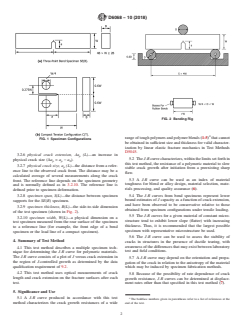
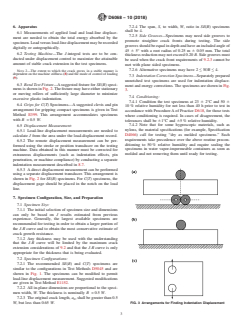
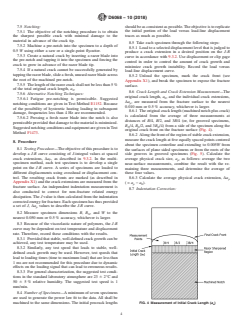
1.3 The recommended specimens are the three-point bend (SE(B)) and pin-loaded compact tension (C(T)) specimens. Both specimens have in-plane dimensions of constant proportionality for all sizes. Specimen configurations other than those recommended in this test method may require different procedures and validity requirements.
1.4 This test method describes a multiple specimen method that requires optical measurement of crack extension from fracture surfaces. It is not recommended for use with materials in which the crack front cannot be distinguished from additional deformation processes in advance of the crack tip.
1.5 The values stated in SI units are to be regarded as the standard.
1.6 This standard does not purport to address all of the safety concerns, if any, associated with its use. It is the responsibility of the user of this standard to establish appropriate safety, health, and environmental practices and determine the applicability of regulatory limitations prior to use.
Note 1: There is no known ISO equivalent to this standard.
1.7 This international standard was developed in accordance with internationally recognized principles on standardization established in the Decision on Principles for the Development of International Standards, Guides and Recommendations issued by the World Trade Organization Technical Barriers to Trade (TBT) Committee.
- Status
- Published
- Publication Date
- 30-Sep-2018
- Technical Committee
- D20 - Plastics
- Drafting Committee
- D20.10 - Mechanical Properties
Overview
ASTM D6068-10(2018) is the Standard Test Method for Determining J-R Curves of Plastic Materials, developed by ASTM International. This method provides an essential approach to evaluate the resistance of polymeric materials to crack growth, particularly for tough polymers and polymer blends not suitable for testing by linear elastic fracture mechanics. The test results, represented as J-R curves, characterize a material's toughness and its ability to resist slow, stable crack propagation after crack initiation from a sharp flaw.
The J-R curve test is especially valuable for the quality assurance, material selection, and design optimization of plastic materials, helping engineers and manufacturers ensure robust performance in demanding applications.
Key Topics
- J-R Curve Determination: Establishes the procedure to measure the J-integral versus crack growth resistance (J-R curve) for plastic materials.
- Applicability: Suitable for tough polymers and blends where standard linear elastic fracture mechanics may not apply due to limited sample size or thickness.
- Specimen Types: Recommends using three-point bend (SE(B)) and pin-loaded compact tension (C(T)) specimens with proportional dimensions.
- Test Method: Employs a multiple specimen approach, with each specimen contributing a point on the J-R curve, requiring optical measurement of crack extension.
- Data Interpretation: Provides guidelines for calculating the J-integral, validating data, and fitting results to a power law for the J-R curve.
- Material Toughness and Fracture Resistance: J-R curves serve as indices for evaluating material toughness, blend design, and processing impact.
- Geometry and Microstructure Sensitivity: Ensures results are geometry-insensitive within set limits and recommends using specimens with representative microstructure.
Applications
- Material Selection: J-R curves are widely used to compare and select plastics with optimal crack growth resistance for structural applications.
- Quality Assurance: Offers a reliable metric for assessing manufacturing consistency and performance during plastics processing.
- Component and Structure Design: Supports engineers in evaluating the stability of cracks for safety-critical components with ductile fracture behavior.
- Research and Development: Fundamental for developing and optimizing new polymer blends and alloys, providing insight into fracture mechanics properties under different specimen configurations and loading rates.
- Processing and Anisotropy Effects: Helps in assessing how fabrication methods and material orientation influence crack propagation resistance.
Related Standards
- ASTM D5045: Test Methods for Plane-Strain Fracture Toughness and Strain Energy Release Rate of Plastic Materials
- ASTM D618: Practice for Conditioning Plastics for Testing
- ASTM D4066: Classification System for Nylon Injection and Extrusion Materials (PA)
- ASTM E399: Test Method for Linear-Elastic Plane-Strain Fracture Toughness K_IC of Metallic Materials
- ASTM E1152: Test Method for Determining J-R Curves
- ASTM F1473: Test Method for Notch Tensile Test to Measure the Resistance to Slow Crack Growth of Polyethylene Pipes and Resins
Note: There is no known ISO equivalent for ASTM D6068-10(2018).
By adhering to ASTM D6068-10(2018), organizations in the plastics industry can ensure accurate, reproducible assessment of crack growth resistance, aiding in the development, selection, and validation of tough plastic materials for safety and durability in a wide range of applications. For further information, refer to the ASTM website and the standards listed above.
Relations
- Effective Date
- 01-Oct-2018
- Effective Date
- 01-Apr-2024
- Effective Date
- 01-Nov-2019
- Effective Date
- 15-Aug-2016
- Effective Date
- 01-Aug-2013
- Refers
ASTM D4066-13 - Standard Classification System for Nylon Injection and Extrusion Materials (PA) - Effective Date
- 01-Jul-2013
- Effective Date
- 15-Nov-2012
- Effective Date
- 15-Nov-2012
- Effective Date
- 15-Nov-2012
- Effective Date
- 15-Nov-2012
- Effective Date
- 01-May-2011
- Effective Date
- 01-Jul-2009
- Effective Date
- 01-Jul-2009
- Effective Date
- 15-Nov-2008
- Effective Date
- 01-Nov-2008
Get Certified
Connect with accredited certification bodies for this standard

DIN CERTCO
DIN Group product certification.

Smithers Quality Assessments
US management systems and product certification.
Sponsored listings
Frequently Asked Questions
ASTM D6068-10(2018) is a standard published by ASTM International. Its full title is "Standard Test Method for Determining <emph type="bdit">J-R </emph>Curves of Plastic Materials". This standard covers: SIGNIFICANCE AND USE 5.1 A J-R curve produced in accordance with this test method characterizes the crack growth resistances of a wide range of tough polymers and polymer blends (1-5)4 that cannot be obtained in sufficient size and thickness for valid characterization by linear elastic fracture mechanics in Test Methods D5045. 5.2 The J-R curve characterizes, within the limits set forth in this test method, the resistance of a polymeric material to slow stable crack growth after initiation from a preexisting sharp flaw. 5.3 A J-R curve can be used as an index of material toughness for blend or alloy design, material selection, materials processing, and quality assurance (6). 5.4 The J-R curves from bend specimens represent lower bound estimates of J capacity as a function of crack extension, and have been observed to be conservative relative to those obtained from specimen configurations under tensile loading. 5.5 The J-R curves for a given material of constant microstructure tend to exhibit lower slope (flatter) with increasing thickness. Thus, it is recommended that the largest possible specimen with representative microstructure be used. 5.6 The J-R curve can be used to assess the stability of cracks in structures in the presence of ductile tearing, with awareness of the differences that may exist between laboratory test and field conditions. 5.7 A J-R curve may depend on the orientation and propagation of the crack in relation to the anisotropy of the material which may be induced by specimen fabrication methods. 5.8 Because of the possibility of rate dependence of crack growth resistance, J-R curves can be determined at displacement rates other than that specified in this test method (7). SCOPE 1.1 This test method covers the determination of the J-integral versus crack growth resistance (J-R) curves for polymeric materials. 1.2 This test method is intended to characterize the slow, stable crack growth resistance of bend-type specimens in such a manner that it is geometry insensitive within limits set forth in this test method. 1.3 The recommended specimens are the three-point bend (SE(B)) and pin-loaded compact tension (C(T)) specimens. Both specimens have in-plane dimensions of constant proportionality for all sizes. Specimen configurations other than those recommended in this test method may require different procedures and validity requirements. 1.4 This test method describes a multiple specimen method that requires optical measurement of crack extension from fracture surfaces. It is not recommended for use with materials in which the crack front cannot be distinguished from additional deformation processes in advance of the crack tip. 1.5 The values stated in SI units are to be regarded as the standard. 1.6 This standard does not purport to address all of the safety concerns, if any, associated with its use. It is the responsibility of the user of this standard to establish appropriate safety, health, and environmental practices and determine the applicability of regulatory limitations prior to use. Note 1: There is no known ISO equivalent to this standard. 1.7 This international standard was developed in accordance with internationally recognized principles on standardization established in the Decision on Principles for the Development of International Standards, Guides and Recommendations issued by the World Trade Organization Technical Barriers to Trade (TBT) Committee.
SIGNIFICANCE AND USE 5.1 A J-R curve produced in accordance with this test method characterizes the crack growth resistances of a wide range of tough polymers and polymer blends (1-5)4 that cannot be obtained in sufficient size and thickness for valid characterization by linear elastic fracture mechanics in Test Methods D5045. 5.2 The J-R curve characterizes, within the limits set forth in this test method, the resistance of a polymeric material to slow stable crack growth after initiation from a preexisting sharp flaw. 5.3 A J-R curve can be used as an index of material toughness for blend or alloy design, material selection, materials processing, and quality assurance (6). 5.4 The J-R curves from bend specimens represent lower bound estimates of J capacity as a function of crack extension, and have been observed to be conservative relative to those obtained from specimen configurations under tensile loading. 5.5 The J-R curves for a given material of constant microstructure tend to exhibit lower slope (flatter) with increasing thickness. Thus, it is recommended that the largest possible specimen with representative microstructure be used. 5.6 The J-R curve can be used to assess the stability of cracks in structures in the presence of ductile tearing, with awareness of the differences that may exist between laboratory test and field conditions. 5.7 A J-R curve may depend on the orientation and propagation of the crack in relation to the anisotropy of the material which may be induced by specimen fabrication methods. 5.8 Because of the possibility of rate dependence of crack growth resistance, J-R curves can be determined at displacement rates other than that specified in this test method (7). SCOPE 1.1 This test method covers the determination of the J-integral versus crack growth resistance (J-R) curves for polymeric materials. 1.2 This test method is intended to characterize the slow, stable crack growth resistance of bend-type specimens in such a manner that it is geometry insensitive within limits set forth in this test method. 1.3 The recommended specimens are the three-point bend (SE(B)) and pin-loaded compact tension (C(T)) specimens. Both specimens have in-plane dimensions of constant proportionality for all sizes. Specimen configurations other than those recommended in this test method may require different procedures and validity requirements. 1.4 This test method describes a multiple specimen method that requires optical measurement of crack extension from fracture surfaces. It is not recommended for use with materials in which the crack front cannot be distinguished from additional deformation processes in advance of the crack tip. 1.5 The values stated in SI units are to be regarded as the standard. 1.6 This standard does not purport to address all of the safety concerns, if any, associated with its use. It is the responsibility of the user of this standard to establish appropriate safety, health, and environmental practices and determine the applicability of regulatory limitations prior to use. Note 1: There is no known ISO equivalent to this standard. 1.7 This international standard was developed in accordance with internationally recognized principles on standardization established in the Decision on Principles for the Development of International Standards, Guides and Recommendations issued by the World Trade Organization Technical Barriers to Trade (TBT) Committee.
ASTM D6068-10(2018) is classified under the following ICS (International Classification for Standards) categories: 83.040.01 - Raw materials for rubber and plastics in general. The ICS classification helps identify the subject area and facilitates finding related standards.
ASTM D6068-10(2018) has the following relationships with other standards: It is inter standard links to ASTM D6068-10, ASTM F1473-24, ASTM D4066-13(2019), ASTM F1473-16, ASTM F1473-13, ASTM D4066-13, ASTM E399-12e1, ASTM E399-12, ASTM E399-12e2, ASTM E399-12e3, ASTM F1473-11, ASTM E399-09, ASTM E399-09e1, ASTM E399-08, ASTM D618-08. Understanding these relationships helps ensure you are using the most current and applicable version of the standard.
ASTM D6068-10(2018) is available in PDF format for immediate download after purchase. The document can be added to your cart and obtained through the secure checkout process. Digital delivery ensures instant access to the complete standard document.
Standards Content (Sample)
This international standard was developed in accordance with internationally recognized principles on standardization established in the Decision on Principles for the
Development of International Standards, Guides and Recommendations issued by the World Trade Organization Technical Barriers to Trade (TBT) Committee.
Designation:D6068 −10 (Reapproved 2018)
Standard Test Method for
Determining J-R Curves of Plastic Materials
This standard is issued under the fixed designation D6068; the number immediately following the designation indicates the year of
original adoption or, in the case of revision, the year of last revision. A number in parentheses indicates the year of last reapproval. A
superscript epsilon (´) indicates an editorial change since the last revision or reapproval.
1. Scope 2. Referenced Documents
2.1 ASTM Standards:
1.1 This test method covers the determination of the
D618 Practice for Conditioning Plastics for Testing
J-integral versus crack growth resistance (J-R) curves for
D4066 Classification System for Nylon Injection and Extru-
polymeric materials.
sion Materials (PA)
1.2 This test method is intended to characterize the slow,
D5045 Test Methods for Plane-Strain Fracture Toughness
stable crack growth resistance of bend-type specimens in such
and Strain Energy Release Rate of Plastic Materials
a manner that it is geometry insensitive within limits set forth
E399 Test Method for Linear-Elastic Plane-Strain Fracture
in this test method.
Toughness K of Metallic Materials
Ic
E616 Terminology Relating to Fracture Testing (Discontin-
1.3 The recommended specimens are the three-point bend
ued 1996) (Withdrawn 1996)
(SE(B)) and pin-loaded compact tension (C(T)) specimens.
E1152 Test Method for Determining-J-R-Curves
Both specimens have in-plane dimensions of constant propor-
E1737 Test Method forJ-Integral Characterization of Frac-
tionality for all sizes. Specimen configurations other than those
ture Toughness (Withdrawn 1998)
recommended in this test method may require different proce-
F1473 Test Method for Notch Tensile Test to Measure the
dures and validity requirements.
Resistance to Slow Crack Growth of Polyethylene Pipes
and Resins
1.4 This test method describes a multiple specimen method
that requires optical measurement of crack extension from
3. Terminology
fracture surfaces. It is not recommended for use with materials
3.1 Definitions—Terminology related to fracture testing
in which the crack front cannot be distinguished from addi-
contained in Terminology E616 is applicable to this test
tional deformation processes in advance of the crack tip.
method.
1.5 The values stated in SI units are to be regarded as the
3.2 Definitions of Terms Specific to This Standard:
standard. −1
3.2.1 J-integral, J (FL )—a mathematical expression, a
line or surface integral over a path that encloses the crack front
1.6 This standard does not purport to address all of the
from one crack surface to the other, used to characterize the
safety concerns, if any, associated with its use. It is the
localstress-strainfieldaroundthecrackfront.SeeTerminology
responsibility of the user of this standard to establish appro-
E616 for additional discussion.
priate safety, health, and environmental practices and deter-
mine the applicability of regulatory limitations prior to use.
3.2.2 J-Rcurve—aplotofresistancetostablephysicalcrack
extension, ∆a .
p
NOTE 1—There is no known ISO equivalent to this standard.
3.2.3 net thickness, B (L)—the distance between the roots
N
1.7 This international standard was developed in accor-
of the side grooves in side grooved specimens.
dance with internationally recognized principles on standard-
3.2.4 original crack size, a (L)—the physical crack size at
ization established in the Decision on Principles for the
the start of testing.
Development of International Standards, Guides and Recom-
3.2.5 original uncracked ligament, b (L)—the distance
mendations issued by the World Trade Organization Technical
from the original crack front to the back edge of the specimen
Barriers to Trade (TBT) Committee.
(b =W−a' ).
0 0
For referenced ASTM standards, visit the ASTM website, www.astm.org, or
This test method is under the jurisdiction ofASTM Committee D20 on Plastics contact ASTM Customer Service at service@astm.org. For Annual Book of ASTM
and is the direct responsibility of Subcommittee D20.10 on Mechanical Properties. Standards volume information, refer to the standard’s Document Summary page on
Current edition approved Oct. 1, 2018. Published October 2018. Originally the ASTM website.
approved in 1996. Last previous edition approved in 2010 as D6068 - 10. DOI: The last approved version of this historical standard is referenced on
10.1520/D6068-10R18. www.astm.org.
Copyright © ASTM International, 100 Barr Harbor Drive, PO Box C700, West Conshohocken, PA 19428-2959. United States
D6068−10 (2018)
FIG. 2 Bending Rig
range of tough polymers and polymer blends (1-5) that cannot
FIG. 1 Specimen Configurations
be obtained in sufficient size and thickness for valid character-
ization by linear elastic fracture mechanics in Test Methods
D5045.
3.2.6 physical crack extension, ∆a (L)—an increase in
p
5.2 TheJ-Rcurvecharacterizes,withinthelimitssetforthin
physical crack size (∆a =a −a ).
p p 0
this test method, the resistance of a polymeric material to slow
3.2.7 physical crack size, a (L)—the distance from a refer-
p
stable crack growth after initiation from a preexisting sharp
ence line to the observed crack front. The distance may be a
flaw.
calculated average of several measurements along the crack
5.3 A J-R curve can be used as an index of material
front. The reference line depends on the specimen geometry
toughness for blend or alloy design, material selection, mate-
and is normally defined as in 3.2.10. The reference line is
rials processing, and quality assurance (6).
defined prior to specimen deformation.
5.4 The J-R curves from bend specimens represent lower
3.2.8 specimen span, S(L)—the distance between specimen
bound estimates of J capacity as a function of crack extension,
supports for the SE(B) specimen.
and have been observed to be conservative relative to those
3.2.9 specimen thickness, B(L)—the side-to-side dimension
obtained from specimen configurations under tensile loading.
of the test specimen (shown in Fig. 2).
5.5 The J-R curves for a given material of constant micro-
3.2.10 specimen width, W(L)—a physical dimension on a
structure tend to exhibit lower slope (flatter) with increasing
test specimen measured from the rear surface of the specimen
thickness. Thus, it is recommended that the largest possible
to a reference line (for example, the front edge of a bend
specimen with representative microstructure be used.
specimen or the load line of a compact specimen).
5.6 The J-R curve can be used to assess the stability of
4. Summary of Test Method
cracks in structures in the presence of ductile tearing, with
awareness of the differences that may exist between laboratory
4.1 This test method describes a multiple specimen tech-
test and field conditions.
nique for determining the J-R curve for polymeric materials.
The J-R curve consists of a plot of J versus crack extension in
5.7 A J-R curve may depend on the orientation and propa-
the region of J-controlled growth as determined by the data
gation of the crack in relation to the anisotropy of the material
qualification requirement of 9.2.
which may be induced by specimen fabrication methods.
4.2 This test method uses optical measurements of crack
5.8 Because of the possibility of rate dependence of crack
length and crack extension on the fracture surfaces after each
growth resistance, J-R curves can be determined at displace-
test.
ment rates other than that specified in this test method (7).
5. Significance and Use
5.1 A J-R curve produced in accordance with this test
The boldface numbers given in parentheses refer to a list of references at the
method characterizes the crack growth resistances of a wide end of the text.
D6068−10 (2018)
6. Apparatus 7.2.4 The span, S, to width, W, ratio in SE(B) specimens
shall be 4.
6.1 Measurements of applied load and load-line displace-
7.2.5 Side Grooves—Specimens may need side grooves to
ment are needed to obtain the total energy absorbed by the
promote straighter crack fronts during testing. The side
specimen.Loadversusload-linedisplacementmayberecorded
groovesshouldbeequalindepthandhaveanincludedangleof
digitally or autographically.
45 6 5° with a root radius of 0.25 m 6 0.05 mm. The total
6.2 Testing Machine—The J-integral tests are to be con-
thickness reduction may not exceed 0.20 B. Side grooves must
ducted under displacement control to maximize the attainable
be used when the crack front requirements of 9.2.3 cannot be
amount of stable crack extension in the test specimens.
met with plane sided specimens.
7.2.6 Alternative specimens may have 2 ≤ W/B ≤ 4.
NOTE 2—The extent to which the crack grows in a stable manner is
dependent on the machine stiffness (8) and the mode of control of loading
7.3 IndentationCorrectionSpecimens—Separatelyprepared
(9).
unnotched test specimens are used for indentation displace-
6.3 Bend Test Fixture—Asuggested fixture for SE(B) speci-
ment and energy corrections. The specimens are shown in Fig.
mens is shown in Fig. 2.The fixture may have either stationary
3.
or moving rollers of sufficiently large diameter to minimize
7.4 Conditioning:
excessive plastic indentation.
7.4.1 Condition the test specimens at 23 6 2°C and 50 6
6.4 Grips for C(T) Specimens—A suggested clevis and pin
10 % relative humidity for not less than 40 h prior to test in
arrangement for gripping compact specimens is given in Test
accordance with Procedure A of Practice D618, for those tests
Method E399. This arrangement accommodates specimens
where conditioning is required. In cases of disagreement, the
with B = 0.5 W.
tolerances shall be 61°C and 65 % relative humidity.
7.4.2 Note that for some hygroscopic materials, such as
6.5 Displacement Measurement:
nylons, the material specifications (for example, Specification
6.5.1 Load-line displacement measurements are needed to
D4066) call for testing “dry as molded specimens.” Such
calculate J from the area under the load-displacement record.
requirements take precedence over the above routine precon-
6.5.2 The remote displacement measurement can be per-
ditioning to 50 % relative humidity and require sealing the
formed using the stroke or position transducer on the testing
specimens in water vapor-impermeable containers as soon as
machine. Data obtained in this manner must be corrected for
molded and not removing them until ready for testing.
extraneous displacements (such as indentation effects, pin
penetration, or machine compliance) by conducting a separate
indentation measurement described in 8.7.
6.5.3 Adirect displacement measurement can be performed
using a separate displacement transducer. This arrangement is
shown in Fig. 2 for SE(B) specimens. For C(T) specimens, the
displacement gage should be placed in the notch on the load
line.
7. Specimen Configuration, Size, and Preparation
7.1 Specimen Size:
7.1.1 The initial selection of specimen size and dimensions
can only be based on J results estimated from previous
experience. Generally, the largest available specimens are
recommended for testing in order to obtain a larger portion of
the J-R curve and to obtain the most conservative estimate of
crack growth resistance.
7.1.2 Any thickness may be used with the understanding
that the J-R curve will be limited by the maximum crack
extension considerations of 9.2 and that the J-R curve is only
appropriate for the thickness that is being evaluated.
7.2 Specimen Configurations:
7.2.1 The recommended SE(B) and C(T) specimens are
similar to the configurations in Test Methods D5045 and are
shown in Fig. 1. The specimens can be modified to permit
load-line displacement measurement. Suggested modifications
are given in Test Method E1152.
7.2.2 All in-plane dimensions are proportional to the speci-
men width, W. The thickness is nominally B = 0.5 W.
7.2.3 The original crack length, a , shall be greater than 0.5
W, but less than 0.65 W. FIG. 3 Arrangements for Finding Indentation Displacement
D6068−10 (2018)
7.5 Notching: shouldbeasconsistentaspossible.Theobjectiveistoreplicate
7.5.1 The objective of the notching procedure is to obtain the initial portion of the load versus load-line displacement
traces as much as possible.
the sharpest possible crack with minimal damage to the
material in advance of the crack tip.
8.5 Take each specimen through the following steps:
7.5.2 Machine a pre-notch into the specimen to a depth of
8.5.1 Load to a selected displacement level that is judged to
0.5 W using either a saw or a single-point flycutter.
produce a crack extension in a desired position on the J-R
7.5.3 Create a natural crack by inserting a razor blade into
curve in accordance with 9.3.2. Use displacement or clip gage
the pre-notch and tapping it into the specimen and forcing the
control in order to control the amount of crack growth and
crack to grow in advance of the razor blade tip.
minimize crack growth instability. Record the load versus
7.5.4 If a natural crack cannot be successfully generated by
load-line displacement curve.
tappingtherazorblade,slideafresh,unusedrazorbladeacross
8.5.2 Unload the specimen, mark the crack front (see
the root of the machined pre-notch.
Appendix X1), and break the specimen to expose the fracture
7.5.5 Thelengthoftherazorcrackshallnotbelessthan5 %
surface.
of the total original crack length, a .
8.6 Crack Length and Crack Extension Measurement—The
7.5.6 Alternative Notching Techniques:
original crack length, a , and the individual crack extensions,
7.5.6.1 Fatigue pre-notching is permissible. Suggested
∆a , are measured from the fracture surface to the nearest
p
notching conditions are given in Test Method E1152. Because
0.010 mm or 0.5 % accuracy, whichever is larger.
of the possibility of hysteretic heating leading to subsequent
8.6.1 The original crack length (machined notch plus crack)
damage, frequencies less than 4 Hz are recommended.
is calculated from the average of three measurements at
7.5.6.2 Pressing a fresh razor blade into the notch is also
distances of B/4, B/2, and 3B/4 (or, for grooved specimens,
permissible provided that damage to the material is minimized.
B /4, B /2, and 3B /4) from a side of the specimen along the
N N N
SuggestednotchingconditionsandequipmentaregiveninTest
original crack front on the fracture surface (Fig. 4).
Method F1473.
8.6.2 Alongthefrontoftheregionofstablecrackextension,
measure the crack length at five equally spaced points centered
8. Procedure
about the specimen centerline and extending to 0.005W from
8.1 TestingProcedure—Theobjectiveofthisprocedureisto
the surfaces of plane sided specimens or from the roots of the
develop a J-R curve consisting of J-integral values at spaced
side grooves in grooved specimens (Fig. 5). Calculate the
crack extensions, ∆a , as described in 9.3.2. In the multi-
average phy
...