

ASTM D612-88(2017)
(Test Method)Standard Test Method for Carbonizable Substances in Paraffin Wax
General Information
- Abstract
SIGNIFICANCE AND USE
4.1 This test method is a means for ascertaining whether pharmaceutical paraffin wax conforms to the standards for quality prescribed by the U.S. National Formulary.
SCOPE
1.1 This test method covers determination of carbonizable substances in paraffin wax. The test method is applicable to paraffin wax for pharmaceutical use, as defined by the U.S. National Formulary, with a melting point as determined in accordance with Test Method D87, between 117 °F and 149 °F (47 °C and 65 °C).
1.2 The values stated in inch-pound units are to be regarded as standard. The values given in parentheses are mathematical conversions to SI units that are provided for information only and are not considered standard.
1.3 This standard does not purport to address all of the safety concerns, if any, associated with its use. It is the responsibility of the user of this standard to establish appropriate safety and health practices and determine the applicability of regulatory limitations prior to use. Specific warning statements are given in Annex A1.
1.4 This international standard was developed in accordance with internationally recognized principles on standardization established in the Decision on Principles for the Development of International Standards, Guides and Recommendations issued by the World Trade Organization Technical Barriers to Trade (TBT) Committee.
- Status
- Published
- Publication Date
- 31-May-2017
- Technical Committee
- D02 - Petroleum Products, Liquid Fuels, and Lubricants

Overview
ASTM D612-88(2017), titled Standard Test Method for Carbonizable Substances in Paraffin Wax, is a critical standard developed by ASTM International. This method is designed to determine the presence of carbonizable substances in paraffin wax intended for pharmaceutical use. The standard specifically supports quality control by verifying whether paraffin wax conforms to the specifications outlined in the U.S. National Formulary. Adhering to this test method is essential for manufacturers and laboratories to ensure the safety and quality of pharmaceutical paraffin wax, which is often required in pharmaceutical and personal care applications.
Key Topics
- Carbonizable substances detection: The standard outlines a procedure to assess the presence of carbonizable compounds, which can compromise wax purity and suitability.
- Applicability: The method applies to pharmaceutical-grade paraffin wax with a melting point between 117°F and 149°F (47°C and 65°C), as determined by ASTM D87.
- Quality assurance: Meeting ASTM D612 requirements is necessary for compliance with the U.S. National Formulary, emphasizing the pharmaceutical-grade standard of the wax.
- Testing procedure: Melted wax is subjected to concentrated, nitrogen-free sulfuric acid, and the resulting color is compared to a reference standard for assessment.
- Safety guidance: The standard provides essential instructions on proper handling and safety measures for chemicals and apparatus used in the test.
- International compliance: ASTM D612 is developed in line with World Trade Organization (WTO) TBT Committee principles, supporting international recognition and trade facilitation.
Applications
ASTM D612 is widely used in several key sectors where paraffin wax quality is vital:
- Pharmaceutical manufacturing: Ensures wax meets stringent purity standards for use in ointments, tablet coatings, and other medicinal preparations.
- Cosmetics and personal care: Verifies the suitability of paraffin wax for skin creams, lip balms, and other topical products where purity and safety are paramount.
- Quality control laboratories: Provides a reliable, standardized procedure for routine batch testing and supplier qualification.
- Regulatory compliance: Assists businesses in demonstrating adherence to national and international safety and quality requirements, facilitating market access and consumer trust.
- Material sourcing: Enables procurement teams to specify compliant paraffin wax grades for critical applications, reducing risk in the supply chain.
Related Standards
Several ASTM and international standards are frequently referenced alongside ASTM D612:
- ASTM D87 - Test Method for Melting Point of Petroleum Wax (Cooling Curve): Essential for confirming the correct melting point range of paraffin wax before applying D612.
- ASTM D1193 - Specification for Reagent Water: Ensures the purity of water used in laboratory procedures.
- U.S. National Formulary: Defines pharmaceutical quality benchmarks that ASTM D612 helps to verify.
- WTO TBT Principles: Provides an internationally recognized framework for standardization, enhancing global acceptance of ASTM D612.
By following ASTM D612-88(2017), organizations can ensure consistent, high-quality pharmaceutical paraffin wax, maintain regulatory compliance, and support international trade in pharmaceutical-grade materials. This standard remains a cornerstone for safety and quality assurance within the paraffin wax supply chain.
Relations
- Refers
ASTM D87-09(2014) - Standard Test Method for Melting Point of Petroleum Wax (Cooling Curve) - Effective Date
- 01-May-2014
- Effective Date
- 01-Dec-2009
- Effective Date
- 01-Nov-2007
- Effective Date
- 01-Feb-2007
- Effective Date
- 01-Mar-2006
- Effective Date
- 10-Apr-1999
- Effective Date
- 10-Feb-1999
- Effective Date
- 10-Feb-1999
Get Certified
Connect with accredited certification bodies for this standard

Element Materials Technology
Materials testing and product certification.

ABS Group Brazil
ABS Group certification services in Brazil.

ABS Quality Evaluations Inc.
American Bureau of Shipping quality certification.
Sponsored listings
Frequently Asked Questions
ASTM D612-88(2017) is a standard published by ASTM International. Its full title is "Standard Test Method for Carbonizable Substances in Paraffin Wax". This standard covers: SIGNIFICANCE AND USE 4.1 This test method is a means for ascertaining whether pharmaceutical paraffin wax conforms to the standards for quality prescribed by the U.S. National Formulary. SCOPE 1.1 This test method covers determination of carbonizable substances in paraffin wax. The test method is applicable to paraffin wax for pharmaceutical use, as defined by the U.S. National Formulary, with a melting point as determined in accordance with Test Method D87, between 117 °F and 149 °F (47 °C and 65 °C). 1.2 The values stated in inch-pound units are to be regarded as standard. The values given in parentheses are mathematical conversions to SI units that are provided for information only and are not considered standard. 1.3 This standard does not purport to address all of the safety concerns, if any, associated with its use. It is the responsibility of the user of this standard to establish appropriate safety and health practices and determine the applicability of regulatory limitations prior to use. Specific warning statements are given in Annex A1. 1.4 This international standard was developed in accordance with internationally recognized principles on standardization established in the Decision on Principles for the Development of International Standards, Guides and Recommendations issued by the World Trade Organization Technical Barriers to Trade (TBT) Committee.
SIGNIFICANCE AND USE 4.1 This test method is a means for ascertaining whether pharmaceutical paraffin wax conforms to the standards for quality prescribed by the U.S. National Formulary. SCOPE 1.1 This test method covers determination of carbonizable substances in paraffin wax. The test method is applicable to paraffin wax for pharmaceutical use, as defined by the U.S. National Formulary, with a melting point as determined in accordance with Test Method D87, between 117 °F and 149 °F (47 °C and 65 °C). 1.2 The values stated in inch-pound units are to be regarded as standard. The values given in parentheses are mathematical conversions to SI units that are provided for information only and are not considered standard. 1.3 This standard does not purport to address all of the safety concerns, if any, associated with its use. It is the responsibility of the user of this standard to establish appropriate safety and health practices and determine the applicability of regulatory limitations prior to use. Specific warning statements are given in Annex A1. 1.4 This international standard was developed in accordance with internationally recognized principles on standardization established in the Decision on Principles for the Development of International Standards, Guides and Recommendations issued by the World Trade Organization Technical Barriers to Trade (TBT) Committee.
ASTM D612-88(2017) is classified under the following ICS (International Classification for Standards) categories: 75.140 - Waxes, bituminous materials and other petroleum products. The ICS classification helps identify the subject area and facilitates finding related standards.
ASTM D612-88(2017) has the following relationships with other standards: It is inter standard links to ASTM D87-09(2014), ASTM D87-09, ASTM D87-07a, ASTM D87-07, ASTM D1193-06, ASTM D87-87(1999), ASTM D1193-99, ASTM D1193-99e1. Understanding these relationships helps ensure you are using the most current and applicable version of the standard.
ASTM D612-88(2017) is available in PDF format for immediate download after purchase. The document can be added to your cart and obtained through the secure checkout process. Digital delivery ensures instant access to the complete standard document.
Standards Content (Sample)
This international standard was developed in accordance with internationally recognized principles on standardization established in the Decision on Principles for the
Development of International Standards, Guides and Recommendations issued by the World Trade Organization Technical Barriers to Trade (TBT) Committee.
Designation: D612 − 88 (Reapproved 2017)
Standard Test Method for
Carbonizable Substances in Paraffin Wax
This standard is issued under the fixed designation D612; the number immediately following the designation indicates the year of
original adoption or, in the case of revision, the year of last revision. A number in parentheses indicates the year of last reapproval. A
superscript epsilon (´) indicates an editorial change since the last revision or reapproval.
This standard has been approved for use by agencies of the U.S. Department of Defense.
1. Scope 3. Summary of Test Method
3.1 Five millilitres of melted wax are treated with 5 mL of
1.1 This test method covers determination of carbonizable
concentrated, nitrogen-free sulfuric acid at 158 °F (70 °C). The
substances in paraffin wax. The test method is applicable to
color of the acid layer is compared with that of a colorimetric
paraffin wax for pharmaceutical use, as defined by the U.S.
reference standard. If the color is not darker than the standard,
National Formulary, with a melting point as determined in
the wax is reported as passing the test.
accordance with Test Method D87, between 117 °F and 149 °F
(47 °C and 65 °C).
4. Significance and Use
1.2 The values stated in inch-pound units are to be regarded
4.1 This test method is a means for ascertaining whether
as standard. The values given in parentheses are mathematical
pharmaceutical paraffin wax conforms to the standards for
conversions to SI units that are provided for information only
quality prescribed by the U.S. National Formulary.
and are not considered standard.
5. Apparatus
1.3 This standard does not purport to address all of the
safety concerns, if any, associated with its use. It is the
5.1 Test Tube, as shown in Fig. 1, of heat-resistant glass (see
responsibility of the user of this standard to establish appro-
Note 1) fitted with a well-ground glass stopper, the stopper and
priate safety and health practices and determine the applica- the tube bearing identical and indestructible numbers. The tube
bility of regulatory limitations prior to use. Specific warning shall be 140 mm 6 2 mm in length and between 14.5 mm and
statements are given in Annex A1. 15.0 mm in outside diameter, and shall be calibrated at the
5 mL 6 0.2 mL and 10 mL 6 0.2 mL liquid levels. The
1.4 This international standard was developed in accor-
capacity of the tube with stopper inserted shall be between
dance with internationally recognized principles on standard-
13.6 mL and 15.6 mL. A rolled edge may be provided for
ization established in the Decision on Principles for the
suspending the tube on the cover of the water bath.
Development of International Standards, Guides and Recom-
mendations issued by the World Trade Organization Technical
NOTE 1—Borosilicate glass has been found satisfactory for this pur-
Barriers to Trade (TBT) Committee. pose.
5.2 Water Bath, suitable for immersing the test tube above
2. Referenced Documents
the 10 mL line and equipped to maintain a temperature of
2 158 °F 6 1.0 °F (70 °C 6 0.5 °C). The bath shall be provided
2.1 ASTM Standards:
with a cover of any suitable material, with holes approximately
D87 Test Method for Melting Point of Petroleum Wax
16 mm in diameter through which the test tubes may be
(Cooling Curve)
suspended.
D1193 Specification for Reagent Water
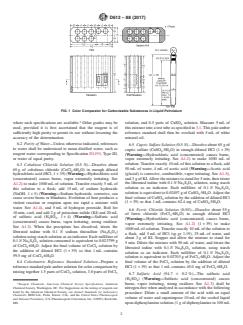
5.3 Color Comparator, of a suitable type for observing the
color of the acid layer in comparison with the reference
standard color solution. The size and shape of the comparator
This test method is under the jurisdiction of ASTM Committee D02 on
are optional, but the size and shape of the apertures shall
Petroleum Products, Liquid Fuels, and Lubricants and is the direct responsibility of
Subcommittee D02.10 on Properties of Petroleum Waxes and Alternative Wax-like conform to the dimensions prescribed in Fig. 1.
Materials.
Current edition approved June 1, 2017. Published July 2017. Originally approved
6. Reagents
in 1941. Last previous edition approved in 2012 as D612 – 88 (2012). DOI:
10.1520/D0612-88R17.
6.1 Purity of Reagents—Reagent grade chemicals shall be
For referenced ASTM standards, visit the ASTM website, www.astm.org, or
used in all tests. Unless otherwise indicated, it is intended that
contact ASTM Customer Service at service@astm.org. For Annual Book of ASTM
all reagents shall conform to the specifications of the Commit-
Standards volume information, refer to the standard’s Document Summary page on
the ASTM website. tee on Analytical Reagents of the American Chemical Society,
Copyright © ASTM International, 100 Barr Harbor Drive, PO Box C700, West Conshohocken, PA 19428-2959. United States
D612 − 88 (2017)
FIG. 1 Color Comparator for Carbonizable Substances in Liquid Petrolatum
where such specifications are available. Other grades may be solution, and 0.5 parts of CuSO solution. Measure 5 mL of
used, provided it is first ascertained that the reagent is of this mixture into a test tube as specified in 3.1. This pale amber
sufficiently high purity to permit its use without lessening the reference standard shall then be overlaid with 5 mL of white
accuracy of the determination. mineral oil.
6.2 Purity of Water—Unless otherwise indicated, references
6.5 Cupric Sulfate Solution (0.5 N)—Dissolve about 65 g of
to water shall be understood to mean distilled water, such as
cupric sulfate (CuSO ·5H O) in enough diluted HCl (1 + 39)
4 2
reagent water corresponding to Specification D1193, Type III,
(Warning—Hydrochloric acid (concentrated) causes burns,
or water of equal purity.
vapor extremely irritating. See A1.2) to make 1000 mL of
solution. Transfer exactly 10 mL of this solution to a flask, add
6.3 Cobaltous Chloride Solution (0.5 N)—Dissolve about
50 mL of water, 4 mL of acetic acid (Warning—Acetic acid
65 g of cobaltous chloride (CoCl ·6H O) in enough diluted
2 2
(glacial) is corrosive, combustible, vapor irritating. See A1.5),
hydrochloric acid (HCl, 1 + 39) (Warning—Hydrochloric acid
and 3 g of KI. Allow the mixture to stand for 5 min, then titrate
(concentrated) causes burns, vapor extremely irritating. See
the liberated iodine with 0.1 N Na S O solution, using starch
A1.2) to make 1000 mL of solution. Transfer exactly 5 mL of 2 2 3
solution as an indicator. Each millilitre of 0.1 N Na S O
this solution to a flask; add 15 mL of sodium hydroxide 2 2 3
solution is equivalent to 0.02497 g of CuSO ·5H O. Adjust the
(NaOH, 1 + 5) (Warning—Sodium hydroxide, corrosive, can 4 2
final volume of CuSO solution by the addition of diluted HCl
cause severe burns or blindness. Evolution of heat produces a 4
(1 + 39) so that 1 mL contains 62.4 mg of CuSO ·5H O.
violent reaction or eruption upon too rapid a mixture with
4 2
water. See A1.4), and 5 mL of hydrogen peroxide. Boil for
6.6 Ferric Chloride Solution (0.5N)—Dissolve about 55 g
10 min, cool, and add 2 g of potassium iodide (KI) and 20 mL
of ferric chloride (FeCl ·6H O) in enough diluted HCl
3 2
of sulfuric acid (H SO , 1 + 4) (Warning—Sulfuric acid
2 4
(Warning—Hydrochloric acid (concentrated) causes burns,
(concentrated) causes burns, vapor irritating, strong oxidizer.
vapor extremely irritating. See A1.2) (1 + 39) to make
See A1.3). When the precipitate has dissolved, titrate the
1000 mL of solution. Transfer exactly 10 mL of the solution to
liberated iodine with 0.1 N sodium thiosulfate (Na S O )
2 2 3
a flask, add 5 mL of HCl (sp gr 1.19), 25 mL of water, and
solution using starch solution as an indicator. Each millilitre of
about 3 g of KI. Stopper and allow the mixture to stand for
0.1 N Na S O solution consumed is equivalent to 0.023799 g
2 2 3
5 min. Dilute the mixture with 50 mL of water, and titrate the
of CoCl ·6H O. Adjust the final volume of CoCl solution by
2 2 2
liberated iodine with 0.1 N Na S O solution, using starch
2 2 3
the addition of diluted HCl (1 + 39) so that 1 mL contains
solution as an indicator. Each millilitre of 0.1 N Na S O
2 2 3
59.5 mg of CoCl ·6H O.
2 2
solution is equivalent to 0.02703 g of FeCl ·6H O. Adjust the
3 2
6.4 Colorimetric Reference Standard Solution—Prepare a final volume of the F
...