

ASTM C1044-24
(Practice)Standard Practice for Using a Guarded-Hot-Plate Apparatus or Thin-Heater Apparatus in the Single-Sided Mode
General Information
- Abstract
SIGNIFICANCE AND USE
4.1 This practice provides a procedure for operating the apparatus so that the heat flow, Q′, through the meter section of the auxiliary insulation is small; determining Q′; and, calculating the heat flow, Q, through the meter section of the specimen.
4.2 This practice requires that the apparatus have independent temperature controls in order to operate the cold plate and auxiliary cold plate at different temperatures. In the single-sides mode, the apparatus is operated with the temperature of the auxiliary cold plate maintained at the same temperature of the hot plate face adjacent to the auxiliary insulation.
Note 4: In principle, if the temperature difference across the auxiliary insulation is zero and there are no edge heat losses or gains, all of the power input to the meter plate will flow through the specimen. In practice, a small correction is made for heat flow, Q′, through the auxiliary insulation.
4.3 The thermal conductance, C’, of the auxiliary insulation shall be determined from one or more separate tests using either Test Method C177, C1114, or as indicated in 5.4. Values of C’ shall be checked periodically, particularly when the temperature drop across the auxiliary insulation less than 1 % of the temperature drop across the test specimen.
4.4 This practice is used when it is necessary to determine the thermal properties of a single specimen. For example, the thermal properties of a single specimen are used to calibrate a heat-flow-meter apparatus for Test Method C518.
SCOPE
1.1 This practice covers the determination of the steady-state heat flow through the meter section of a specimen when a guarded-hot-plate apparatus or thin-heater apparatus is used in the single-sided mode of operation.
1.2 This practice provides a supplemental procedure for use in conjunction with either Test Method C177 or C1114 for testing a single specimen. This practice is limited to only the single-sided mode of operation, and, in all other particulars, the requirements of either Test Method C177 or C1114 apply.
Note 1: Test Methods C177 and C1114 describe the use of the guarded-hot-plate and thin-heater apparatus, respectively, for determining steady-state heat flux and thermal transmission properties of flat-slab specimens. In principle, these methods cover both the double- and single-sided mode of operation, and at present, do not distinguish between the accuracies for the two modes of operation. When appropriate, thermal transmission properties shall be calculated in accordance with Practice C1045.
1.3 This practice requires that the cold plates of the apparatus have independent temperature controls. For the single-sided mode of operation, a (single) specimen is placed between the hot plate and the cold plate. Auxiliary thermal insulation, if needed, is placed between the hot plate and the auxiliary cold plate. The auxiliary cold plate and the hot plate are maintained at the same temperature. The heat flow from the meter plate is assumed to flow only through the specimen, so that the thermal transmission properties correspond only to the specimen.
Note 2: The double-sided mode of operation requires similar specimens placed on either side of the hot plate. The cold plates that contact the outer surfaces of these specimens are maintained at the same temperature. The electric power supplied to the meter plate is assumed to result in equal heat flow through the meter section of each specimen, so that the thermal transmission properties correspond to an average for the two specimens.
1.4 This practice does not preclude the use of a guarded-hot-plate apparatus in which the auxiliary cold plate is either larger or smaller in lateral dimensions than either the test specimen or the cold plate.
Note 3: Most guarded-hot-plate apparatus are designed for the double-sided mode of operation (1).2 Consequently, the cold plate and the auxiliary cold plate are the same size and the spec...
- Status
- Published
- Publication Date
- 29-Feb-2024
- Technical Committee
- C16 - Thermal Insulation
- Drafting Committee
- C16.30 - Thermal Measurement
Buy Documents
ASTM C1044-24 - Standard Practice for Using a Guarded-Hot-Plate Apparatus or Thin-Heater Apparatus in the Single-Sided Mode
REDLINE ASTM C1044-24 - Standard Practice for Using a Guarded-Hot-Plate Apparatus or Thin-Heater Apparatus in the Single-Sided Mode
Overview
ASTM C1044-24 is the standard practice developed by ASTM International for using a guarded-hot-plate apparatus or thin-heater apparatus in the single-sided mode. This practice provides a procedural framework to accurately determine the steady-state heat flow through the meter section of a specimen, particularly when only one test specimen is available. It supplements established thermal insulation test methods such as ASTM C177 (Guarded-Hot-Plate) and ASTM C1114 (Thin-Heater Apparatus) to enable consistent and precise measurement of thermal properties using single-sided operation.
By ensuring the apparatus operates with independent temperature controls for the cold plates, ASTM C1044-24 allows for the effective separation and calculation of heat flow through both the specimen and auxiliary insulation. This is vital for calibrating heat-flow-meter devices (as per ASTM C518) and conducting thermal measurement when dual specimens are not feasible.
Key Topics
Single-Sided Mode Operation: Establishes the requirements and procedures for using either a guarded-hot-plate or thin-heater apparatus to test a single specimen, as opposed to the traditional double-sided mode.
Thermal Barrier Controls: Ensures that the auxiliary cold plate and hot plate are maintained at the same temperature, minimizing heat flow through auxiliary insulation and providing accurate measurement of heat through the specimen.
Correction for Auxiliary Insulation: Details the necessary steps to determine and periodically verify the thermal conductance (C’) of auxiliary insulation material, with corrections made as needed for minimal heat flow through this section.
Measurement and Calculation: Describes the process to acquire essential data on temperatures and heat flow rates, followed by calculations for thermal transmission properties in line with referenced ASTM test methods.
Error and Uncertainty Analysis: Addresses common sources of experimental error, including gap heat flow in the apparatus, and recommends propagation of error analysis to determine measurement uncertainty.
Applications
ASTM C1044-24 is used in various thermal insulation and building material testing applications, including:
- Calibration of Heat-Flow-Meter Devices: Supports accurate calibration when a single reference specimen is calibrated instead of a pair.
- Testing Unique or Limited Specimens: Ideal for situations where only one physical specimen is available, such as loose-fill insulation or specialty composites.
- Product Development and Research: Enables the study of thermal properties and homogeneity checks on new or existing materials where specimen supply is limited.
- Quality Control and Certification: Used by laboratories and manufacturers to ensure material performance meets regulatory and industry standards for steady-state thermal transmission.
- Thermal Property Benchmarking: Essential for establishing reliable data on heat flow and insulation effectiveness across a range of temperatures.
- Compliance with International Standards: Aligns with globally recognized standardization principles, ensuring test results are accepted in international trade and regulatory environments.
Related Standards
For comprehensive thermal measurement and reporting, ASTM C1044-24 should be used in conjunction with the following documents:
- ASTM C177: Test Method for Steady-State Heat Flux Measurements and Thermal Transmission Properties by Means of the Guarded-Hot-Plate Apparatus.
- ASTM C1114: Test Method for Steady-State Thermal Transmission Properties by Means of the Thin-Heater Apparatus.
- ASTM C168: Terminology Relating to Thermal Insulation.
- ASTM C518: Test Method for Steady-State Thermal Transmission Properties by Means of the Heat Flow Meter Apparatus.
- ASTM C1045: Practice for Calculating Thermal Transmission Properties Under Steady-State Conditions.
- BIPM JCGM 100:2008: Evaluation of Measurement Data – Guide to the Expression of Uncertainty in Measurement.
Keywords: ASTM C1044, guarded-hot-plate apparatus, thin-heater apparatus, single-sided mode, thermal insulation testing, heat flux measurement, thermal conductance, auxiliary insulation, steady-state heat flow, calibration, ASTM standards.
Relations
- Effective Date
- 01-Mar-2024
- Effective Date
- 15-Apr-2024
- Effective Date
- 01-May-2022
- Effective Date
- 01-Mar-2024
- Effective Date
- 01-Mar-2024
- Effective Date
- 01-Mar-2024
- Effective Date
- 01-Mar-2024
- Effective Date
- 01-Mar-2024
- Referred By
ASTM C1043-24 - Standard Practice for Guarded-Hot-Plate Design Using Circular Line-Heat Sources - Effective Date
- 01-Mar-2024
- Effective Date
- 01-Mar-2024
Buy Documents
ASTM C1044-24 - Standard Practice for Using a Guarded-Hot-Plate Apparatus or Thin-Heater Apparatus in the Single-Sided Mode
REDLINE ASTM C1044-24 - Standard Practice for Using a Guarded-Hot-Plate Apparatus or Thin-Heater Apparatus in the Single-Sided Mode
Get Certified
Connect with accredited certification bodies for this standard

BSMI (Bureau of Standards, Metrology and Inspection)
Taiwan's standards and inspection authority.
Sponsored listings
Frequently Asked Questions
ASTM C1044-24 is a standard published by ASTM International. Its full title is "Standard Practice for Using a Guarded-Hot-Plate Apparatus or Thin-Heater Apparatus in the Single-Sided Mode". This standard covers: SIGNIFICANCE AND USE 4.1 This practice provides a procedure for operating the apparatus so that the heat flow, Q′, through the meter section of the auxiliary insulation is small; determining Q′; and, calculating the heat flow, Q, through the meter section of the specimen. 4.2 This practice requires that the apparatus have independent temperature controls in order to operate the cold plate and auxiliary cold plate at different temperatures. In the single-sides mode, the apparatus is operated with the temperature of the auxiliary cold plate maintained at the same temperature of the hot plate face adjacent to the auxiliary insulation. Note 4: In principle, if the temperature difference across the auxiliary insulation is zero and there are no edge heat losses or gains, all of the power input to the meter plate will flow through the specimen. In practice, a small correction is made for heat flow, Q′, through the auxiliary insulation. 4.3 The thermal conductance, C’, of the auxiliary insulation shall be determined from one or more separate tests using either Test Method C177, C1114, or as indicated in 5.4. Values of C’ shall be checked periodically, particularly when the temperature drop across the auxiliary insulation less than 1 % of the temperature drop across the test specimen. 4.4 This practice is used when it is necessary to determine the thermal properties of a single specimen. For example, the thermal properties of a single specimen are used to calibrate a heat-flow-meter apparatus for Test Method C518. SCOPE 1.1 This practice covers the determination of the steady-state heat flow through the meter section of a specimen when a guarded-hot-plate apparatus or thin-heater apparatus is used in the single-sided mode of operation. 1.2 This practice provides a supplemental procedure for use in conjunction with either Test Method C177 or C1114 for testing a single specimen. This practice is limited to only the single-sided mode of operation, and, in all other particulars, the requirements of either Test Method C177 or C1114 apply. Note 1: Test Methods C177 and C1114 describe the use of the guarded-hot-plate and thin-heater apparatus, respectively, for determining steady-state heat flux and thermal transmission properties of flat-slab specimens. In principle, these methods cover both the double- and single-sided mode of operation, and at present, do not distinguish between the accuracies for the two modes of operation. When appropriate, thermal transmission properties shall be calculated in accordance with Practice C1045. 1.3 This practice requires that the cold plates of the apparatus have independent temperature controls. For the single-sided mode of operation, a (single) specimen is placed between the hot plate and the cold plate. Auxiliary thermal insulation, if needed, is placed between the hot plate and the auxiliary cold plate. The auxiliary cold plate and the hot plate are maintained at the same temperature. The heat flow from the meter plate is assumed to flow only through the specimen, so that the thermal transmission properties correspond only to the specimen. Note 2: The double-sided mode of operation requires similar specimens placed on either side of the hot plate. The cold plates that contact the outer surfaces of these specimens are maintained at the same temperature. The electric power supplied to the meter plate is assumed to result in equal heat flow through the meter section of each specimen, so that the thermal transmission properties correspond to an average for the two specimens. 1.4 This practice does not preclude the use of a guarded-hot-plate apparatus in which the auxiliary cold plate is either larger or smaller in lateral dimensions than either the test specimen or the cold plate. Note 3: Most guarded-hot-plate apparatus are designed for the double-sided mode of operation (1).2 Consequently, the cold plate and the auxiliary cold plate are the same size and the spec...
SIGNIFICANCE AND USE 4.1 This practice provides a procedure for operating the apparatus so that the heat flow, Q′, through the meter section of the auxiliary insulation is small; determining Q′; and, calculating the heat flow, Q, through the meter section of the specimen. 4.2 This practice requires that the apparatus have independent temperature controls in order to operate the cold plate and auxiliary cold plate at different temperatures. In the single-sides mode, the apparatus is operated with the temperature of the auxiliary cold plate maintained at the same temperature of the hot plate face adjacent to the auxiliary insulation. Note 4: In principle, if the temperature difference across the auxiliary insulation is zero and there are no edge heat losses or gains, all of the power input to the meter plate will flow through the specimen. In practice, a small correction is made for heat flow, Q′, through the auxiliary insulation. 4.3 The thermal conductance, C’, of the auxiliary insulation shall be determined from one or more separate tests using either Test Method C177, C1114, or as indicated in 5.4. Values of C’ shall be checked periodically, particularly when the temperature drop across the auxiliary insulation less than 1 % of the temperature drop across the test specimen. 4.4 This practice is used when it is necessary to determine the thermal properties of a single specimen. For example, the thermal properties of a single specimen are used to calibrate a heat-flow-meter apparatus for Test Method C518. SCOPE 1.1 This practice covers the determination of the steady-state heat flow through the meter section of a specimen when a guarded-hot-plate apparatus or thin-heater apparatus is used in the single-sided mode of operation. 1.2 This practice provides a supplemental procedure for use in conjunction with either Test Method C177 or C1114 for testing a single specimen. This practice is limited to only the single-sided mode of operation, and, in all other particulars, the requirements of either Test Method C177 or C1114 apply. Note 1: Test Methods C177 and C1114 describe the use of the guarded-hot-plate and thin-heater apparatus, respectively, for determining steady-state heat flux and thermal transmission properties of flat-slab specimens. In principle, these methods cover both the double- and single-sided mode of operation, and at present, do not distinguish between the accuracies for the two modes of operation. When appropriate, thermal transmission properties shall be calculated in accordance with Practice C1045. 1.3 This practice requires that the cold plates of the apparatus have independent temperature controls. For the single-sided mode of operation, a (single) specimen is placed between the hot plate and the cold plate. Auxiliary thermal insulation, if needed, is placed between the hot plate and the auxiliary cold plate. The auxiliary cold plate and the hot plate are maintained at the same temperature. The heat flow from the meter plate is assumed to flow only through the specimen, so that the thermal transmission properties correspond only to the specimen. Note 2: The double-sided mode of operation requires similar specimens placed on either side of the hot plate. The cold plates that contact the outer surfaces of these specimens are maintained at the same temperature. The electric power supplied to the meter plate is assumed to result in equal heat flow through the meter section of each specimen, so that the thermal transmission properties correspond to an average for the two specimens. 1.4 This practice does not preclude the use of a guarded-hot-plate apparatus in which the auxiliary cold plate is either larger or smaller in lateral dimensions than either the test specimen or the cold plate. Note 3: Most guarded-hot-plate apparatus are designed for the double-sided mode of operation (1).2 Consequently, the cold plate and the auxiliary cold plate are the same size and the spec...
ASTM C1044-24 is classified under the following ICS (International Classification for Standards) categories: 17.200.10 - Heat. Calorimetry. The ICS classification helps identify the subject area and facilitates finding related standards.
ASTM C1044-24 has the following relationships with other standards: It is inter standard links to ASTM C1044-16(2020), ASTM C168-24, ASTM C168-22, ASTM C1045-19, ASTM C1470-20, ASTM C1130-24, ASTM C177-19e1, ASTM C1558-24, ASTM C1043-24, ASTM C1114-06(2019). Understanding these relationships helps ensure you are using the most current and applicable version of the standard.
ASTM C1044-24 is available in PDF format for immediate download after purchase. The document can be added to your cart and obtained through the secure checkout process. Digital delivery ensures instant access to the complete standard document.
Standards Content (Sample)
This international standard was developed in accordance with internationally recognized principles on standardization established in the Decision on Principles for the
Development of International Standards, Guides and Recommendations issued by the World Trade Organization Technical Barriers to Trade (TBT) Committee.
Designation: C1044 − 24
Standard Practice for
Using a Guarded-Hot-Plate Apparatus or Thin-Heater
Apparatus in the Single-Sided Mode
This standard is issued under the fixed designation C1044; the number immediately following the designation indicates the year of
original adoption or, in the case of revision, the year of last revision. A number in parentheses indicates the year of last reapproval. A
superscript epsilon (´) indicates an editorial change since the last revision or reapproval.
NOTE 3—Most guarded-hot-plate apparatus are designed for the double-
1. Scope
sided mode of operation (1). Consequently, the cold plate and the
1.1 This practice covers the determination of the steady-
auxiliary cold plate are the same size and the specimen and the auxiliary
state heat flow through the meter section of a specimen when insulation will have the same lateral dimensions, although the thicknesses
need not be the same. Some guarded-hot-plate apparatus, however, are
a guarded-hot-plate apparatus or thin-heater apparatus is used
designed specifically for testing only a single specimen that is either larger
in the single-sided mode of operation.
or smaller in lateral dimensions than the auxiliary insulation or the
1.2 This practice provides a supplemental procedure for use auxiliary cold plate.
in conjunction with either Test Method C177 or C1114 for
1.5 This practice is suitable for use for both low- and
testing a single specimen. This practice is limited to only the
high-temperature conditions.
single-sided mode of operation, and, in all other particulars, the
1.6 This practice shall not be used when operating an
requirements of either Test Method C177 or C1114 apply.
apparatus in a double-sided mode of operation with a known
NOTE 1—Test Methods C177 and C1114 describe the use of the
and unknown specimen, that is, with the two cold plates at
guarded-hot-plate and thin-heater apparatus, respectively, for determining
similar temperatures so that the temperature differences across
steady-state heat flux and thermal transmission properties of flat-slab
the known and unknown specimens are similar.
specimens. In principle, these methods cover both the double- and
single-sided mode of operation, and at present, do not distinguish between
1.7 This standard does not purport to address all of the
the accuracies for the two modes of operation. When appropriate, thermal
safety concerns, if any, associated with its use. It is the
transmission properties shall be calculated in accordance with Practice
responsibility of the user of this standard to establish appro-
C1045.
priate safety, health, and environmental practices and deter-
1.3 This practice requires that the cold plates of the appa-
mine the applicability of regulatory limitations prior to use.
ratus have independent temperature controls. For the single-
1.8 This international standard was developed in accor-
sided mode of operation, a (single) specimen is placed between
dance with internationally recognized principles on standard-
the hot plate and the cold plate. Auxiliary thermal insulation, if
ization established in the Decision on Principles for the
needed, is placed between the hot plate and the auxiliary cold
Development of International Standards, Guides and Recom-
plate. The auxiliary cold plate and the hot plate are maintained
mendations issued by the World Trade Organization Technical
at the same temperature. The heat flow from the meter plate is
Barriers to Trade (TBT) Committee.
assumed to flow only through the specimen, so that the thermal
transmission properties correspond only to the specimen.
2. Referenced Documents
NOTE 2—The double-sided mode of operation requires similar speci- 2.1 ASTM Standards:
mens placed on either side of the hot plate. The cold plates that contact the
C168 Terminology Relating to Thermal Insulation
outer surfaces of these specimens are maintained at the same temperature.
C177 Test Method for Steady-State Heat Flux Measure-
The electric power supplied to the meter plate is assumed to result in equal
ments and Thermal Transmission Properties by Means of
heat flow through the meter section of each specimen, so that the thermal
the Guarded-Hot-Plate Apparatus
transmission properties correspond to an average for the two specimens.
C518 Test Method for Steady-State Thermal Transmission
1.4 This practice does not preclude the use of a guarded-
Properties by Means of the Heat Flow Meter Apparatus
hot-plate apparatus in which the auxiliary cold plate is either
C1045 Practice for Calculating Thermal Transmission Prop-
larger or smaller in lateral dimensions than either the test
erties Under Steady-State Conditions
specimen or the cold plate.
1 2
This practice is under the jurisdiction of ASTM Committee C16 on Thermal The boldface numbers in parentheses refer to the list of references at the end of
Insulation and is the direct responsibility of Subcommittee C16.30 on Thermal this standard.
Measurement. For referenced ASTM standards, visit the ASTM website, www.astm.org, or
Current edition approved March 1, 2024. Published March 2024. Originally contact ASTM Customer Service at service@astm.org. For Annual Book of ASTM
approved in 1985. Last previous edition approved in 2020 as C1044 – 16 (2020). Standards volume information, refer to the standard’s Document Summary page on
DOI: 10.1520/C1044-24. the ASTM website.
Copyright © ASTM International, 100 Barr Harbor Drive, PO Box C700, West Conshohocken, PA 19428-2959. United States
C1044 − 24
C1114 Test Method for Steady-State Thermal Transmission 3.3.3 Q—heat flow rate through meter section of specimen,
Properties by Means of the Thin-Heater Apparatus W.
3.3.4 Q'—heat flow rate through meter section of auxiliary
2.2 BIPM Standard:
BIPM JCGM 100: 2008 Evaluation of measurement data – insulation, W.
3.3.5 Q —power input to meter plate, W.
Guide to the expression of uncertainty in measurement
m
(GUM) 3.3.6 T —surface temperature of cold plate, K.
c
3.3.7 T' —surface temperature of auxiliary cold plate, K.
c
3. Terminology
3.3.8 T —surface temperature of hot plate in contact with
h
specimen, K.
3.1 Definitions—For definitions of terms used in this
3.3.9 T' —surface temperature of hot plate in contact with
practice, refer to Terminology C168. For definitions of terms
h
auxiliary insulation, K.
relating to the guarded-hot-plate apparatus or thin-heater ap-
paratus refer to Test Methods C177 or C1114, respectively.
4. Significance and Use
3.2 Definitions of Terms Specific to This Standard:
4.1 This practice provides a procedure for operating the
3.2.1 auxiliary cold plate, n—the plate that provides an
apparatus so that the heat flow, Q', through the meter section of
isothermal boundary at the outside surface of the auxiliary
the auxiliary insulation is small; determining Q'; and, calculat-
insulation.
ing the heat flow, Q, through the meter section of the specimen.
3.2.2 auxiliary insulation, n—thermal insulation used in
4.2 This practice requires that the apparatus have indepen-
place of a second test specimen, when the single-sided mode of
dent temperature controls in order to operate the cold plate and
operation is used (syn. dummy specimen).
auxiliary cold plate at different temperatures. In the single-
3.2.3 cold plate, n—the plate that provides an isothermal
sides mode, the apparatus is operated with the temperature of
boundary at the cold surface of the specimen.
the auxiliary cold plate maintained at the same temperature of
3.2.4 double-sided mode, n—operation of the apparatus,
the hot plate face adjacent to the auxiliary insulation.
such that the heat input to the meter plate flows equally through
NOTE 4—In principle, if the temperature difference across the auxiliary
two specimens, each specimen placed on either side of the hot
insulation is zero and there are no edge heat losses or gains, all of the
plate (see also single-sided mode).
power input to the meter plate will flow through the specimen. In practice,
a small correction is made for heat flow, Q', through the auxiliary
3.2.5 gap, n—separation between the meter plate and guard
insulation.
plate, usually filled with a gas or thermal insulation.
4.3 The thermal conductance, C’, of the auxiliary insulation
3.2.6 guard plate, n—the outer (rectangular or circular) ring
shall be determined from one or more separate tests using
of the guarded hot plate, that encompasses the meter plate and
either Test Method C177, C1114, or as indicated in 5.4. Values
promotes one-dimensional heat flow normal to the meter plate.
of C’ shall be checked periodically, particularly when the
3.2.7 guarded hot plate, n—an assembly, consisting of a
temperature drop across the auxiliary insulation less than 1 %
meter plate and a co-planar, concentric guard plate, that
of the temperature drop across the test specimen.
provides the heat input to the specimen(s).
4.4 This practice is used when it is necessary to determine
3.2.8 meter plate, n—the inner (rectangular or circular) plate
the thermal properties of a single specimen. For example, the
of the guarded hot plate, that provides the heat input to the
thermal properties of a single specimen are used to calibrate a
meter section of the specimen(s).
heat-flow-meter apparatus for Test Method C518.
3.2.9 meter section, n—the portion of the specimen (or
auxiliary insulation) through which the heat input to the meter 5. Procedure for Single-Sided Mode of Operation
plate flows under ideal guarding conditions.
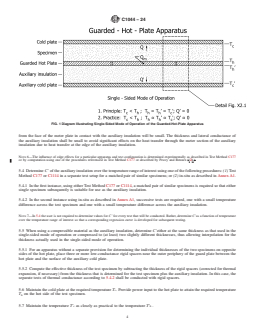
5.1 Refer to Fig. 1 for a schematic diagram of the single-
3.2.10 single-sided mode, n—operation of the apparatus
sided mode of operation of the guarded-hot-plate apparatus.
such that essentially all of the heat input to the meter plate
NOTE 5—The schematic diagram for a thin-heater apparatus (not
flows through a specimen placed on one side of the hot plate
shown) is similar, except the hot plate is much thinner and is not
(see also double-sided mode).
partitioned by a gap.
3.2.11 thin heater, n—an assembly, consisting of an unpar-
5.2 Follow the procedure of either Test Method C177 or
titioned thin-screen heater or thin-foil, that provides the heat
C1114 with the following modifications.
input to the specimen(s).
5.3 Select a rigid or semi-rigid material for the auxiliary
3.3 Symbols—The symbols used in this practice have the
insulation having a low thermal conductance so that heat gains
following significance. The prime (') denotes quantities asso-
or losses from the face of the meter plate in contact with the
ciated with the auxiliary insulation used to control heat from
auxiliary insulation will be small. The thickness and lateral
the other side of the hot plate.
conductance of the auxiliary insulation shall be small to avoid
3.3.1 A—meter section area normal to heat flow, m .
significant effects on the heat transfer through the meter section
3.3.2 C'—thermal conductance of auxiliary insulation,
of the auxiliary insulation due to heat transfer at the edge of the
W/(m • K).
auxiliary insulation.
NOTE 6—The influence of edge effects for a particular apparatus and
Available from BIPM, https://www.bipm.org/en/. test configuration is determined experimentally as described in Test
C1044 − 24
FIG. 1 Diagram Illustrating Single-Sided Mode of Operation of the Guarded-Hot-Plate Apparatus
Method C177 or by computation using one of the procedures referenced
In this case, the separate tests of thermal conductance accord-
in Test Method C177 or described by Peavy and Rennex (2).
ing to 5.4.2 shall be conducted with rigid spacers.
5.4 Determine C’ of the auxiliary insulation over the tem-
5.6 Maintain the cold plate at the required temperature T .
c
perature range of interest using one of the following proce-
Provide power input to the hot plate to attain the required
dures: (1) Test Method C177 or C1114 in a separate test setup
temperature T on the hot side of the test specimen.
h
for a matched pair of similar specimens; or (2) in-situ as
5.7 Maintain the temperature T' as closely as practical to
c
described in Annex A1.
the temperature T' .
h
5.4.1 In the first instance, using either Test Method C177 or
5.8 Establish thermal steady-state conditions in accordance
C1114, a matched pair of similar specimens is required so that
with either Test Method C177 or C1114.
either single specimen subsequently is suitable for use as the
auxiliary insulation.
5.9 Acquire the required test data and determine A, Q , T ,
m h
5.4.2 In the second instance using in-situ as described in
T' , and T' in accordance with either Test Method C177 or
h c
Annex A1, successive tests are required, one with a small
C1114.
temperature difference across the test specimen and one with a
6. Calculation
small temperature difference across the auxiliary insulation.
6.1 Calculate the heat flow through the auxiliary insulation
NOTE 7—In 5.4 the user is not required to determine values for C’ for
as follows:
every test that will be conducted. Rather, determine C’as a function of
temperature over the temperature range of interest so that a corresponding
Q' 5 C' A T' 2 T' (1)
~ !
h c
regression curve is developed for subsequent testing.
where:
5.5 When using a compressible material as the auxiliary
C’is the thermal conductance of the auxiliary insulation at a
insulation, determine C’either at the same thickness as that
temperature corresponding to (T' + T' )/2, as obtained accord-
h c
used in the single-sided mode of operation or compressed to (at
ing to 5.4.
least) two slightly different thicknesses, thus allowing interpo-
6.2 Calculate the heat flow through the specimen as follows:
lation for the thickness actually used in the single-sided mode
of operation. Q 5 Q 2 Q' (2)
m
5.5.1 For an apparatus without a separate provision for
6.3 Use the value of Q, thus obtained to calculate steady-
determining the individual thicknesses of the two specimens on
state thermal transmission properties, in accordance with either
opposite sides of the hot plate, place three or more low-
Test Method C177 or C1114. When appropriate, consult
conductance rigid spacers near the outer periphery of the guard
Practice C1045 to calculate steady-state thermal transmission
plate between the hot plate and the surface of the auxiliary cold
properties. For reference, calculation equations are provided in
plate.
Appendix X1.
5.5.2 Compute the effective thickness of the test specimen
7. Sources of Experimental Error
by subtracting the thickness of the rigid spacers (corrected for
thermal expansion, if necessary) from the thickness that is 7.1 Errors in the determination of Q, are introduced from
determined for the test specimen plus the auxiliary insulation. several sources, including measurement of the power input Q
m
C1044 − 24
to the meter plate; estimation of the heat flow, Q', through the 7.5 Refer to Appendix X3 for discussions on Precision and
auxiliary insulation and, for guarded hot plates, estimation of Bias, and Measurement Uncertainty.
the heat flow across the gap between the meter plate and guard
8. Report
plate, that is, gap error.
8.1 Report all information and measurements in accordance
7.2 Refer to either Test Method C177 or C1114 for discus-
with either Test Method C177 or C1114. Perform all calcula-
sion on the uncertainty in the measurement of the metered-area
tions in accordance with Practice C1045. The report shall note
power (Q ).
m
that the apparatus was operated in a single-sided mode in
7.3 Estimate the uncertainty (ΔQ') in Q' by a propagation of
accordance with Practice C1044 and, in addition, the report
error using the terms in Eq 1. For guidance on using error
shall include, where applicable, values for quantities associated
propagation formulas, consult Ku (3) or the BIPM GUM
with the auxiliary insulation, including Q’, T’ and T’ . The
c h
(Guide to the Expression of Uncertainty of Measurement).
report shall include a description of the apparatus and the
NOTE 8—When the terms Q and Q' in Eq 2 are different by at least two
m
procedure for determining C’in 5.4.
orders of magnitude, a large uncertainty in Q' results in a small uncertainty
in Q. For example, suppose that the ratio Q /Q' is 100 and suppose that
m
9. Keywords
the ratio ΔQ’/Q’ is 0.1. The percentage uncertainty in Q due to Δ Q’, then,
would be 0.1 %.
9.1 guarded-hot-plate apparatus; heat flow; single-sided;
7.4 Refer to Appendix X2 for a discussion of the gap error. steady state; thermal insulation; thin-heater apparatus
ANNEX
(Mandatory Information)
A1. IN-SITU DETERMINATION OF THERMAL CONDUCTANCE OF AUXILIARY INSULATION
A1.1 This annex describes an iterative procedure for deter- A1.2.4 Calculate the heat flow through the specimen as
mining the thermal conductance of the auxiliary insulation follows:
from test data acquired with the hot-plate apparatus operated in
Q 5 CA T 2 T (A1.1)
~ !
h c
the single-sided mode.
where:
A1.2 Procedure:
C is the thermal conductance of the test specimen at a
A1.2.1 Install the auxiliary insulation and specimen in the temperature corresponding to (T + T )/2, as determined in
h c
apparatus. Conduct the following sequence of tests over the
A1.2.2. Interpolation for the value of C will potentially be
temperature range of interest.
required.
A1.2.2 Following the procedure of Sections 5 and 6, calcu-
A1.2.5 Calculate the heat flow through the auxiliary insula-
late the thermal conductance, C, of the test specimen at a mean
tion as follows:
temperature corresponding to (T + T )/2. Determine C for at
h c
Q' 5 Q 2 Q (A1.2)
m
least three values of mean temperature over the temperature
range of interest selected in A1.2.1.
A1.2.6 Using the value of Q', thus obtained, calculate the
A1.2.2.1 For the first iteration, the user shall estimate a
thermal conductance of the auxiliary insulation,
...
This document is not an ASTM standard and is intended only to provide the user of an ASTM standard an indication of what changes have been made to the previous version. Because
it may not be technically possible to adequately depict all changes accurately, ASTM recommends that users consult prior editions as appropriate. In all cases only the current version
of the standard as published by ASTM is to be considered the official document.
Designation: C1044 − 16 (Reapproved 2020) C1044 − 24
Standard Practice for
Using a Guarded-Hot-Plate Apparatus or Thin-Heater
Apparatus in the Single-Sided Mode
This standard is issued under the fixed designation C1044; the number immediately following the designation indicates the year of
original adoption or, in the case of revision, the year of last revision. A number in parentheses indicates the year of last reapproval. A
superscript epsilon (´) indicates an editorial change since the last revision or reapproval.
1. Scope
1.1 This practice covers the determination of the steady-state heat flow through the meter section of a specimen when a
guarded-hot-plate apparatus or thin-heater apparatus is used in the single-sided mode of operation.
1.2 This practice provides a supplemental procedure for use in conjunction with either Test Method C177 or C1114 for testing a
single specimen. This practice is limited to only the single-sided mode of operation, and, in all other particulars, the requirements
of either Test Method C177 or C1114 apply.
NOTE 1—Test Methods C177 and C1114 describe the use of the guarded-hot-plate and thin-heater apparatus, respectively, for determining steady-state
heat flux and thermal transmission properties of flat-slab specimens. In principle, these methods cover both the double- and single-sided mode of
operation, and at present, do not distinguish between the accuracies for the two modes of operation. When appropriate, thermal transmission properties
shall be calculated in accordance with Practice C1045.
1.3 This practice requires that the cold plates of the apparatus have independent temperature controls. For the single-sided mode
of operation, a (single) specimen is placed between the hot plate and the cold plate. Auxiliary thermal insulation, if needed, is
placed between the hot plate and the auxiliary cold plate. The auxiliary cold plate and the hot plate are maintained at the same
temperature. The heat flow from the meter plate is assumed to flow only through the specimen, so that the thermal transmission
properties correspond only to the specimen.
NOTE 2—The double-sided mode of operation requires similar specimens placed on either side of the hot plate. The cold plates that contact the outer
surfaces of these specimens are maintained at the same temperature. The electric power supplied to the meter plate is assumed to result in equal heat flow
through the meter section of each specimen, so that the thermal transmission properties correspond to an average for the two specimens.
1.4 This practice does not preclude the use of a guarded-hot-plate apparatus in which the auxiliary cold plate is either larger or
smaller in lateral dimensions than either the test specimen or the cold plate.
NOTE 3—Most guarded-hot-plate apparatus are designed for the double-sided mode of operation ((1).). Consequently, the cold plate and the auxiliary
cold plate are the same size and the specimen and the auxiliary insulation will have the same lateral dimensions, although the thicknesses need not be
the same. Some guarded-hot-plate apparatus, however, are designed specifically for testing only a single specimen that is either larger or smaller in lateral
dimensions than the auxiliary insulation or the auxiliary cold plate.
1.5 This practice is suitable for use for both low- and high-temperature conditions.
This practice is under the jurisdiction of ASTM Committee C16 on Thermal Insulation and is the direct responsibility of Subcommittee C16.30 on Thermal Measurement.
Current edition approved Oct. 1, 2020March 1, 2024. Published October 2020March 2024. Originally approved in 1985. Last previous edition approved in 20162020 as
C1044 – 16.C1044 – 16 (2020). DOI: 10.1520/C1044-16R20.10.1520/C1044-24.
The boldface numbers in parentheses refer to the list of references at the end of this standard.
Copyright © ASTM International, 100 Barr Harbor Drive, PO Box C700, West Conshohocken, PA 19428-2959. United States
C1044 − 24
1.6 This practice shall not be used when operating an apparatus in a double-sided mode of operation with a known and unknown
specimen, that is, with the two cold plates at similar temperatures so that the temperature differences across the known and
unknown specimens are similar.
1.7 This standard does not purport to address all of the safety concerns, if any, associated with its use. It is the responsibility
of the user of this standard to establish appropriate safety, health, and environmental practices and determine the applicability of
regulatory limitations prior to use.
1.8 This international standard was developed in accordance with internationally recognized principles on standardization
established in the Decision on Principles for the Development of International Standards, Guides and Recommendations issued
by the World Trade Organization Technical Barriers to Trade (TBT) Committee.
2. Referenced Documents
2.1 ASTM Standards:
C168 Terminology Relating to Thermal Insulation
C177 Test Method for Steady-State Heat Flux Measurements and Thermal Transmission Properties by Means of the
Guarded-Hot-Plate Apparatus
C518 Test Method for Steady-State Thermal Transmission Properties by Means of the Heat Flow Meter Apparatus
C1045 Practice for Calculating Thermal Transmission Properties Under Steady-State Conditions
C1114 Test Method for Steady-State Thermal Transmission Properties by Means of the Thin-Heater Apparatus
2.2 BIPM Standard:
BIPM JCGM 100: 2008 Evaluation of measurement data – Guide to the expression of uncertainty in measurement (GUM)
3. Terminology
3.1 Definitions—For definitions of terms used in this practice, refer to Terminology C168. For definitions of terms relating to the
guarded-hot-plate apparatus or thin-heater apparatus refer to Test Methods C177 or C1114, respectively,respectively.
3.2 Definitions of Terms Specific to This Standard:
3.2.1 auxiliary cold plate, n—the plate that provides an isothermal boundary at the outside surface of the auxiliary insulation.
3.2.2 auxiliary insulation, n—thermal insulation used in place of a second test specimen, when the single-sided mode of operation
is used (syn. dummy specimen).
3.2.3 cold plate, n—the plate that provides an isothermal boundary at the cold surface of the specimen.
3.2.4 double-sided mode, n—operation of the apparatus, such that the heat input to the meter plate flows equally through two
specimens, each specimen placed on either side of the hot plate (see also single-sided mode).
3.2.5 gap, n—separation between the meter plate and guard plate, usually filled with a gas or thermal insulation.
3.2.6 guard plate, n—the outer (rectangular or circular) ring of the guarded hot plate, that encompasses the meter plate and
promotes one-dimensional heat flow normal to the meter plate.
3.2.7 guarded hot plate, n—an assembly, consisting of a meter plate and a co-planar, concentric guard plate, that provides the heat
input to the specimen(s).
3.2.8 meter plate, n—the inner (rectangular or circular) plate of the guarded hot plate, that provides the heat input to the meter
section of the specimen(s).
3.2.9 meter section, n—the portion of the specimen (or auxiliary insulation) through which the heat input to the meter plate flows
under ideal guarding conditions.
For referenced ASTM standards, visit the ASTM website, www.astm.org, or contact ASTM Customer Service at service@astm.org. For Annual Book of ASTM Standards
volume information, refer to the standard’s Document Summary page on the ASTM website.
Available from BIPM, https://www.bipm.org/en/.
C1044 − 24
3.2.10 single-sided mode, n—operation of the apparatus such that essentially all of the heat input to the meter plate flows through
a specimen placed on one side of the hot plate (see also double-sided mode).
3.2.11 thin heater, n—an assembly, consisting of an unpartitioned thin-screen heater or thin-foil, that provides the heat input to the
specimen(s).
3.3 Symbols—The symbols used in this practice have the following significance. The prime (') denotes quantities associated with
the auxiliary insulation used to control heat from the other side of the hot plate.
3.3.1 A—meter area of hot plate, section area normal to heat flow, m .
3.3.2 C'—thermal conductance of auxiliary insulation, W/(m • K).
3.3.3 Q—heat flow rate through meter section of specimen, W.
3.3.4 Q'—heat flow rate through meter section of auxiliary insulation, W.
3.3.5 Q —power input to meter plate, W.
m
3.3.6 T —surface temperature of cold plate, K.
c
3.3.7 T' —surface temperature of auxiliary cold plate, K.
c
3.3.8 T —surface temperature of hot plate in contact with specimen, K.
h
3.3.9 T' —surface temperature of hot plate in contact with auxiliary insulation, K.
h
4. Significance and Use
4.1 This practice provides a procedure for operating the apparatus so that the heat flow, Q', through the meter section of the
auxiliary insulation is small; determining Q'; and, calculating the heat flow, Q, through the meter section of the specimen.
4.2 This practice requires that the apparatus have independent temperature controls in order to operate the cold plate and auxiliary
cold plate at different temperatures. In the single-sides mode, the apparatus is operated with the temperature of the auxiliary cold
plate maintained at the same temperature of the hot plate face adjacent to the auxiliary insulation.
NOTE 4—In principle, if the temperature difference across the auxiliary insulation is zero and there are no edge heat losses or gains, all of the power input
to the meter plate will flow through the specimen. In practice, a small correction is made for heat flow, Q', through the auxiliary insulation.
4.3 The thermal conductance, C’, of the auxiliary insulation shall be determined from one or more separate tests using either Test
Method C177, C1114, or as indicated in 5.4. Values of C’ shall be checked periodically, particularly when the temperature drop
across the auxiliary insulation less than 1 % of the temperature drop across the test specimen.
4.4 This practice is used when it is desirablenecessary to determine the thermal properties of a single specimen. For example, the
thermal properties of a single specimen are used to calibrate a heat-flow-meter apparatus for Test Method C518.
5. Procedure for Single-Sided Mode of Operation
5.1 Refer to Fig. 1 for a schematic diagram of the single-sided mode of operation of the guarded-hot-plate apparatus.
NOTE 5—The schematic diagram for a thin-heater apparatus (not shown) is similar, except the hot plate is much thinner and is not partitioned by a gap.
5.2 Follow the procedure of either Test Method C177 or C1114 with the following modifications.
5.3 Select a rigid or semi-rigid material for the auxiliary insulation having a low thermal conductance so that heat gains or losses
C1044 − 24
FIG. 1 Diagram Illustrating Single-Sided Mode of Operation of the Guarded-Hot-Plate Apparatus
from the face of the meter plate in contact with the auxiliary insulation will be small. The thickness and lateral conductance of
the auxiliary insulation shall be small to avoid significant effects on the heat transfer through the meter section of the auxiliary
insulation due to heat transfer at the edge of the auxiliary insulation.
NOTE 6—The influence of edge effects for a particular apparatus and test configuration is determined experimentally as described in Test Method C177
or by computation using one of the procedures referenced in Test Method C177 or described by Peavy and Rennex ((2).).
5.4 Determine C’ of the auxiliary insulation over the temperature range of interest using one of the following procedures: (1) Test
Method C177 or C1114 in a separate test setup for a matched pair of similar specimens; or (2) in-situ as described in Annex A1.
5.4.1 In the first instance, using either Test Method C177 or C1114, a matched pair of similar specimens is required so that either
single specimen subsequently is suitable for use as the auxiliary insulation.
5.4.2 In the second instance using in-situ as described in Annex A1, successive tests are required, one with a small temperature
difference across the test specimen and one with a small temperature difference across the auxiliary insulation.
NOTE 7—In 5.4 the user is not required to determine values for C’ for every test that will be conducted. Rather, determine C’as a function of temperature
over the temperature range of interest so that a corresponding regression curve is developed for subsequent testing.
5.5 When using a compressible material as the auxiliary insulation, determine C’either at the same thickness as that used in the
single-sided mode of operation or compressed to (at least) two slightly different thicknesses, thus allowing interpolation for the
thickness actually used in the single-sided mode of operation.
5.5.1 For an apparatus without a separate provision for determining the individual thicknesses of the two specimens on opposite
sides of the hot plate, place three or more low-conductance rigid spacers near the outer periphery of the guard plate between the
hot plate and the surface of the auxiliary cold plate.
5.5.2 Compute the effective thickness of the test specimen by subtracting the thickness of the rigid spacers (corrected for thermal
expansion, if necessary) from the thickness that is determined for the test specimen plus the auxiliary insulation. In this case, the
separate tests of thermal conductance according to 5.4.2 shall be conducted with rigid spacers.
5.6 Maintain the cold plate at the required temperature T . Provide power input to the hot plate to attain the required temperature
c
T on the hot side of the test specimen.
h
5.7 Maintain the temperature T' as closely as practical to the temperature T' .
c h
C1044 − 24
5.8 Establish thermal steady-state conditions in accordance with either Test Method C177 or C1114.
5.9 Acquire the required test data and determine A, Q , T , T' , and T' in accordance with either Test Method C177 or C1114.
m h h c
6. Calculation
6.1 Calculate the heat flow through the auxiliary insulation as follows:
Q'5 C' A T' 2 T' (1)
~ !
h c
where:
C’is the thermal conductance of the auxiliary insulation at a temperature corresponding to (T' + T' )/2, as obtained according
h c
to 5.4.
6.2 Calculate the heat flow through the specimen as follows:
Q 5 Q 2 Q' (2)
m
6.3 Use the value of Q, thus obtained to calculate steady-state thermal transmission properties, in accordance with either Test
Method C177 or C1114. When appropriate, consult Practice C1045 to calculate steady-state thermal transmission properties. For
reference, calculation equations are provided in Appendix X1.
7. Sources of Experimental Error
7.1 Errors in the determination of Q, are introduced from several sources, including measurement of the power input Q to the
m
meter plate; estimation of the heat flow, Q', through the auxiliary insulation and, for guarded hot plates, estimation of the heat flow
across the gap between the meter plate and guard plate, that is, gap error.
7.2 Refer to either Test Method C177 or C1114 for discussion on the uncertainty in the measurement of the metered-area power
(Q ).
m
7.3 Estimate the uncertainty (ΔQ') in Q' by a propagation of error using the terms in Eq 1. Refer to Ku (For guidance on using
error propagation formulas, consult Ku (3)) for using error propagation formulas. or the BIPM GUM (Guide to the Expression of
Uncertainty of Measurement).
NOTE 8—When the terms Q and Q' in Eq 2 are different by at least two orders of magnitude, a large uncertainty in Q' results in a small uncertainty in
m
Q. For example, suppose that the ratio Q /Q' is 100 and suppose that the ratio ΔQ’/Q’ is 0.1. The percentage uncertainty in Q due to Δ Q’, then, would
m
be 0.1 %.
7.4 Refer to Appendix X2 for a discussion of the gap error.
7.5 Refer to Appendix X3 for a discussion discussions on Precision and Bias, and Measurement Uncertainty.
8. Report
8.1 Report all information and measurements in accordance with either Test Method C177 or C1114. Perform all calculations in
accordance with Practice C1045. The report shall note that the apparatus was operated in a single-sided mode in accordance with
Practice C1044 and, in addition, the report shall include, where applicable, values for quantities associated with the auxiliary
insulation, including Q’,T’ and T’ . The report shall include a description of the apparatus and the procedure for determining C’in
c h
5.4.
9. Keywords
9.1 guarded-hot-plate apparatus; heat flow; single-sided; steady state; thermal insulation; thin-heater apparatus
C1044 − 24
ANNEX
(Mandatory Information)
A1. IN-SITU DETERMINATION OF THERMAL CONDUCTANCE OF AUXILIARY INSULATION
A1.1 This annex describes an iterative procedure for determining the thermal conductance of the auxiliary insulation from test data
acquired with the hot-plate apparatus operated in the single-sided mode.
A1.2 Procedure:
A1.2.1 Install the auxiliary insulation and specimen in the apparatus. Conduct the following sequence of tests over the temperature
range of interest.
A1.2.2 Following the procedure of Sections 5 and 6, calculate the thermal conductance, C, of the test specimen at a mean
temperature corresponding to (T + T )/2. Determine C for at least three values of mean temperature over the temperature range
h c
of interest selected in A1.2.1.
A1.2.2.1 For the first iteration, the user shall estimate a value for C’ based on experience, handbook data, etc.
A1.2.3 Using the same temperature range selected in A1.2.1, establish a small temperature difference, T – T , for example, <2
h c
' '
K across the specimen and a significant temperature difference, T – T , for example, 20 K to 30 K across the auxiliary insulation.
h c
A1.2.4 Calculate the heat flow through the specimen as follows:
Q 5 CA T 2 T (A1.1)
~ !
h c
where:
C is the thermal conductance of the test specimen at a temp
...