

ASTM E103-17
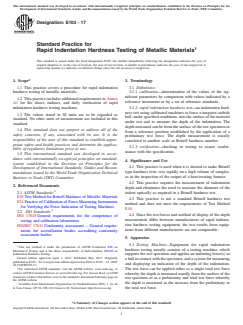
(Practice)Standard Practice for Rapid Indentation Hardness Testing of Metallic Materials
General Information
- Abstract
SIGNIFICANCE AND USE
4.1 This practice is used when it is desired to make Brinell type hardness tests very rapidly on a high volume of samples, as in the inspection of the output of a heat-treating furnace.
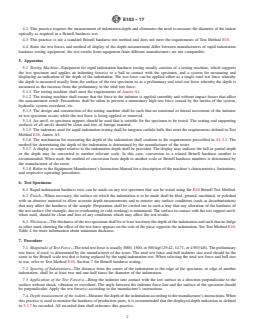
4.2 This practice requires the measurement of indentation depth and eliminates the need to measure the diameter of the indent optically as required in a Brinell hardness test.
4.3 This practice is not a standard Brinell hardness test method and does not meet the requirements of Test Method E10.
4.4 Since the test forces and method of display of the depth measurement differ between manufacturers of rapid indentation hardness testing equipment, the test results from equipment from different manufacturers are not comparable.
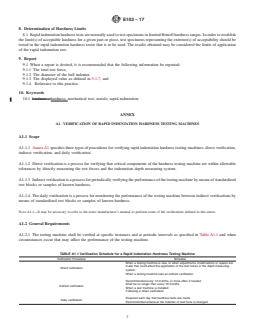
SCOPE
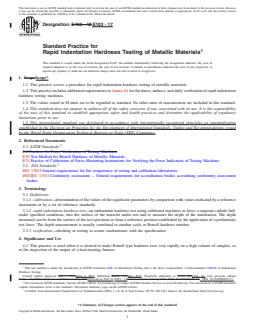
1.1 This practice covers a procedure for rapid indentation hardness testing of metallic materials.
1.2 This practice includes additional requirements in Annex A1 for the direct, indirect, and daily verification of rapid indentation hardness testing machines.
1.3 The values stated in SI units are to be regarded as standard. No other units of measurement are included in this standard.
1.4 This standard does not purport to address all of the safety concerns, if any, associated with its use. It is the responsibility of the user of this standard to establish appropriate safety and health practices and determine the applicability of regulatory limitations prior to use.
1.5 This international standard was developed in accordance with internationally recognized principles on standardization established in the Decision on Principles for the Development of International Standards, Guides and Recommendations issued by the World Trade Organization Technical Barriers to Trade (TBT) Committee.
- Status
- Published
- Publication Date
- 31-Mar-2017
- Technical Committee
- E28 - Mechanical Testing
- Drafting Committee
- E28.06 - Indentation Hardness Testing
Overview
ASTM E103-17: Standard Practice for Rapid Indentation Hardness Testing of Metallic Materials provides a procedure specifically designed for efficiently measuring the hardness of metallic materials using rapid indentation methods. This practice is particularly applicable in environments where high volumes of samples require quick and repeatable hardness testing, such as the inspection of outputs from heat-treating furnaces.
ASTM E103-17 focuses on measuring the depth of indentation rather than the optical diameter of the indent, streamlining the Brinell-type hardness assessment process. It also includes detailed verification procedures for rapid indentation hardness testing machines, ensuring consistent reliability and accuracy.
Key Topics
- Rapid Hardness Testing: This practice allows for rapid Brinell-type testing by measuring indentation depth, eliminating the slower optical measurement of indent diameters.
- Applicability: Used primarily for high-volume testing of metallic samples where fast results are required, such as industrial quality control.
- Test Specimens: Suitable for specimens that can typically be tested by Brinell methods, with specific surface preparation and thickness requirements to ensure measurement accuracy.
- Verification Procedures: Details direct, indirect, and daily verification requirements for hardness testing machines to maintain accurate and reliable measurements.
- Direct verification involves calibrating critical machine components.
- Indirect verification relies on test blocks of known hardness.
- Daily verification validates ongoing machine performance.
- Equipment Independence: Results from different manufacturers’ equipment may not be directly comparable due to variations in test forces and measurement methods.
- Report Requirements: Testing reports should include total test force, indent ball diameter, displayed value, and reference to this ASTM practice for traceability.
Applications
ASTM E103-17 is widely used for:
- High-throughput Metal Testing: Essential for production lines, especially after heat-treatment processes, to quickly verify the consistency and adequacy of metallic material hardness.
- Quality Assurance in Manufacturing: Provides rapid feedback, minimizing delays or disruptions in manufacturing by enabling real-time assessment of batch-to-batch variability.
- Machine Verification and Maintenance: Guides laboratories and industrial users in maintaining their hardness testing equipment for reliable ongoing results, aligning with modern quality management systems.
- Calibration and Traceability: Supports compliance with global standards by requiring the use of calibrated reference devices and documentation of test conditions.
Related Standards
To ensure compatibility and traceability, users of ASTM E103-17 should also be aware of the following referenced standards:
- ASTM E4 - Practices for Force Verification of Testing Machines
- ASTM E10 - Test Method for Brinell Hardness of Metallic Materials (the conventional method)
- ASTM E74 - Practice for Calibration of Force-Measuring Instruments for Testing Machines
- ISO 17025 - General requirements for the competence of testing and calibration laboratories, vital for calibration traceability.
- ISO/IEC 17011 - Conformity assessment requirements for accrediting bodies.
Practical Value
ASTM E103-17 standardizes the approach to rapid indentation hardness testing, making it invaluable for modern metalworking and manufacturing sectors seeking:
- Faster turnaround for hardness results in quality control processes.
- Reliable verification systems to ensure testing machine performance.
- Efficient procedures compatible with high-volume industrial operations.
- Traceability and seamless integration with established Brinell hardness testing frameworks.
Keywords: ASTM E103-17, rapid indentation, hardness testing, metallic materials, Brinell, verification, quality control, calibration, industrial testing, manufacturing, mechanical testing standards
Relations
- Replaces
ASTM E103-12 - Standard Practice for Rapid Indentation Hardness Testing of Metallic Materials - Effective Date
- 01-Apr-2017
- Effective Date
- 01-May-2014
- Effective Date
- 01-May-2013
- Effective Date
- 01-Mar-2013
- Effective Date
- 01-Dec-2012
- Effective Date
- 01-Jan-2012
- Effective Date
- 01-Jun-2010
- Effective Date
- 01-Dec-2008
- Effective Date
- 01-Apr-2007
- Effective Date
- 01-Jan-2007
- Effective Date
- 01-Jan-2007
- Effective Date
- 01-Mar-2006
- Effective Date
- 01-Dec-2004
- Effective Date
- 05-Apr-2002
- Effective Date
- 05-Apr-2002
Get Certified
Connect with accredited certification bodies for this standard

Element Materials Technology
Materials testing and product certification.

Inštitut za kovinske materiale in tehnologije
Institute of Metals and Technology. Materials testing, metallurgical analysis, NDT.
Sponsored listings
Frequently Asked Questions
ASTM E103-17 is a standard published by ASTM International. Its full title is "Standard Practice for Rapid Indentation Hardness Testing of Metallic Materials". This standard covers: SIGNIFICANCE AND USE 4.1 This practice is used when it is desired to make Brinell type hardness tests very rapidly on a high volume of samples, as in the inspection of the output of a heat-treating furnace. 4.2 This practice requires the measurement of indentation depth and eliminates the need to measure the diameter of the indent optically as required in a Brinell hardness test. 4.3 This practice is not a standard Brinell hardness test method and does not meet the requirements of Test Method E10. 4.4 Since the test forces and method of display of the depth measurement differ between manufacturers of rapid indentation hardness testing equipment, the test results from equipment from different manufacturers are not comparable. SCOPE 1.1 This practice covers a procedure for rapid indentation hardness testing of metallic materials. 1.2 This practice includes additional requirements in Annex A1 for the direct, indirect, and daily verification of rapid indentation hardness testing machines. 1.3 The values stated in SI units are to be regarded as standard. No other units of measurement are included in this standard. 1.4 This standard does not purport to address all of the safety concerns, if any, associated with its use. It is the responsibility of the user of this standard to establish appropriate safety and health practices and determine the applicability of regulatory limitations prior to use. 1.5 This international standard was developed in accordance with internationally recognized principles on standardization established in the Decision on Principles for the Development of International Standards, Guides and Recommendations issued by the World Trade Organization Technical Barriers to Trade (TBT) Committee.
SIGNIFICANCE AND USE 4.1 This practice is used when it is desired to make Brinell type hardness tests very rapidly on a high volume of samples, as in the inspection of the output of a heat-treating furnace. 4.2 This practice requires the measurement of indentation depth and eliminates the need to measure the diameter of the indent optically as required in a Brinell hardness test. 4.3 This practice is not a standard Brinell hardness test method and does not meet the requirements of Test Method E10. 4.4 Since the test forces and method of display of the depth measurement differ between manufacturers of rapid indentation hardness testing equipment, the test results from equipment from different manufacturers are not comparable. SCOPE 1.1 This practice covers a procedure for rapid indentation hardness testing of metallic materials. 1.2 This practice includes additional requirements in Annex A1 for the direct, indirect, and daily verification of rapid indentation hardness testing machines. 1.3 The values stated in SI units are to be regarded as standard. No other units of measurement are included in this standard. 1.4 This standard does not purport to address all of the safety concerns, if any, associated with its use. It is the responsibility of the user of this standard to establish appropriate safety and health practices and determine the applicability of regulatory limitations prior to use. 1.5 This international standard was developed in accordance with internationally recognized principles on standardization established in the Decision on Principles for the Development of International Standards, Guides and Recommendations issued by the World Trade Organization Technical Barriers to Trade (TBT) Committee.
ASTM E103-17 is classified under the following ICS (International Classification for Standards) categories: 77.040.10 - Mechanical testing of metals. The ICS classification helps identify the subject area and facilitates finding related standards.
ASTM E103-17 has the following relationships with other standards: It is inter standard links to ASTM E103-12, ASTM E10-14, ASTM E74-13a, ASTM E74-13, ASTM E74-12, ASTM E10-12, ASTM E10-10, ASTM E10-08, ASTM E10-07a, ASTM E10-07e1, ASTM E10-07, ASTM E74-06, ASTM E74-04, ASTM E74-00a, ASTM E74-01. Understanding these relationships helps ensure you are using the most current and applicable version of the standard.
ASTM E103-17 is available in PDF format for immediate download after purchase. The document can be added to your cart and obtained through the secure checkout process. Digital delivery ensures instant access to the complete standard document.
Standards Content (Sample)
This international standard was developed in accordance with internationally recognized principles on standardization established in the Decision on Principles for the
Development of International Standards, Guides and Recommendations issued by the World Trade Organization Technical Barriers to Trade (TBT) Committee.
Designation: E103 − 17
Standard Practice for
Rapid Indentation Hardness Testing of Metallic Materials
This standard is issued under the fixed designation E103; the number immediately following the designation indicates the year of
original adoption or, in the case of revision, the year of last revision. A number in parentheses indicates the year of last reapproval. A
superscript epsilon (´) indicates an editorial change since the last revision or reapproval.
1. Scope* 3. Terminology
1.1 This practice covers a procedure for rapid indentation 3.1 Definitions:
hardness testing of metallic materials. 3.1.1 calibration—determination of the values of the sig-
nificant parameters by comparison with values indicated by a
1.2 This practice includes additional requirements in Annex
reference instrument or by a set of reference standards.
A1 for the direct, indirect, and daily verification of rapid
3.1.2 rapid indentation hardness test—an indentation hard-
indentation hardness testing machines.
ness test using calibrated machines to force a tungsten carbide
1.3 The values stated in SI units are to be regarded as
ball, under specified conditions, into the surface of the material
standard. No other units of measurement are included in this
under test and to measure the depth of the indentation. The
standard.
depth measured can be from the surface of the test specimen or
1.4 This standard does not purport to address all of the
from a reference position established by the application of a
safety concerns, if any, associated with its use. It is the
preliminary test force. The depth measurement is usually
responsibility of the user of this standard to establish appro-
correlated to another scale or Brinell hardness number.
priate safety and health practices and determine the applica-
3.1.3 verification—checking or testing to assure confor-
bility of regulatory limitations prior to use.
mance with the specification.
1.5 This international standard was developed in accor-
dance with internationally recognized principles on standard-
4. Significance and Use
ization established in the Decision on Principles for the
4.1 This practice is used when it is desired to make Brinell
Development of International Standards, Guides and Recom-
type hardness tests very rapidly on a high volume of samples,
mendations issued by the World Trade Organization Technical
as in the inspection of the output of a heat-treating furnace.
Barriers to Trade (TBT) Committee.
4.2 This practice requires the measurement of indentation
2. Referenced Documents
depth and eliminates the need to measure the diameter of the
2.1 ASTM Standards:
indent optically as required in a Brinell hardness test.
E10 Test Method for Brinell Hardness of Metallic Materials
4.3 This practice is not a standard Brinell hardness test
E74 Practice of Calibration of Force-Measuring Instruments
method and does not meet the requirements of Test Method
for Verifying the Force Indication of Testing Machines
E10.
2.2 ISO Standards:
4.4 Since the test forces and method of display of the depth
ISO 17025 General requirements for the competence of
measurement differ between manufacturers of rapid indenta-
testing and calibration laboratories
tion hardness testing equipment, the test results from equip-
ISO/IEC 17011 Conformity assessment -- General require-
ment from different manufacturers are not comparable.
ments for accreditation bodies accrediting conformity
assessment bodies
5. Apparatus
5.1 Testing Machine—Equipment for rapid indentation
This test method is under the jurisdiction of ASTM Committee E28 on
hardness testing usually consists of a testing machine, which
Mechanical Testing and is the direct responsibility of Subcommittee E28.06 on
Indentation Hardness Testing.
supports the test specimen and applies an indenting force(s) to
Current edition approved April 1, 2017. Published May 2017. Originally
aballincontactwiththespecimen,andasystemformeasuring
publishedasE103 – 84.Lastpreviouseditionapprovedin2012asE103 – 12 .DOI:
and displaying an indication of the depth of the indentation.
10.1520/E0103-17.
The test force can be applied either as a single total test force
For referenced ASTM standards, visit the ASTM website, www.astm.org, or
contact ASTM Customer Service at service@astm.org. For Annual Book of ASTM
whereby the depth is measured usually from the surface of the
Standards volume information, refer to the standard’s Document Summary page on
test specimen or as a preliminary and total test force whereby
the ASTM website.
the depth is measured as the increase from the preliminary to
Available from International Organization for Standardization (ISO), 1, ch. de
la Voie-Creuse, CP 56, CH-1211 Geneva 20, Switzerland, http://www.iso.org. the total test force.
*A Summary of Changes section appears at the end of this standard
Copyright © ASTM International, 100 Barr Harbor Drive, PO Box C700, West Conshohocken, PA 19428-2959. United States
E103 − 17
5.1.1 The testing machine shall meet the requirements of on the side of the piece opposite the indentation. See Test
Annex A1. Method E10, Table 4 for more information about minimum
5.1.2 The testing machine shall ensure that the force to the thickness.
indenter is applied smoothly and without impact forces that
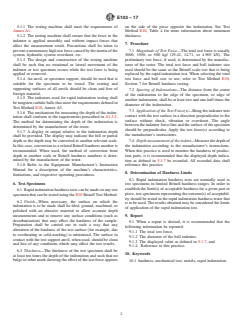
7. Procedure
affect the measurement result. Precautions shall be taken to
preventamomentaryhightestforcecausedbytheinertiaofthe 7.1 Magnitude of Test Force—The total test force is usually
system, hydraulic system overshoot, etc. 3000, 1500, or 500 kgf (29.42, 14.71, or 4.903 kN). The
5.1.3 The design and construction of the testing machine preliminary test force, if used, is determined by the manufac-
shall be such that no rotational or lateral movement of the turer of the tester. The total test force and ball indenter size
indenter or test specimen occurs while the test force is being used should be the same as the Brinell scale test that is being
applied or removed. replaced by the rapid indentation test. When selecting the total
test force and ball size to use, refer to Test Method E10,
5.1.4 An anvil, or specimen support, should be used that is
suitable for the specimen to be tested. The seating and Section 7 for Brinell hardness testing.
supporting surfaces of all anvils should be clean and free of
7.2 Spacing of Indentations—The distance from the center
foreign material.
of the indentation to the edge of the specimen, or edge of
5.1.5 The indenters used for rapid indentation testing shall
another indentation, shall be at least two and one-half times the
be tungsten carbide balls that meet the requirements defined in
diameter of the indentation.
Test Method E10, Annex A3.
7.3 Application of the Test Force(s)—Bringtheindenterinto
5.1.6 The mechanism for measuring the depth of the inden-
contact with the test surface in a direction perpendicular to the
tation shall conform to the requirements prescribed in A1.3.3.
surface without shock, vibration or overshoot. The angle
The method for determining the depth of the indentation is
betweentheindenterforce-lineandthesurfaceofthespecimen
determined by the manufacturer of the tester.
should be perpendicular. Apply the test force(s) according to
5.1.7 A display or output relative to the indentation depth
the manufacture’s instructions.
shall be provided. The display may indicate the full or partial
depth or the depth may be converted to another relevant scale. 7.4 Depth measurement of the indent—Measure the depth of
In this case, conversion to a related Brinell hardness number is
the indentation according to the manufacturer’s instructions.
recommended. When used, the method of conversion from When this practice is used to monitor the hardness of produc-
depth to another scale or Brinell hardness numbers is deter-
tion parts, it is recommended that the displayed depth indica-
mined by the manufacturer of the tester. tion as defined in 5.1.7 be recorded. All recorded data shall
5.1.8 Refer to the Equipment Manufacturer’s Instruction
reference this practice.
Manual for a description of the machine’s characteristics,
8. Determination of Hardness Limits
limitations, and respective operating procedures.
8.1 Rapid indentation hardness tests are normally used to
6. Test Specimens
test specimens in limited Brinell hardness ranges. In order to
establish the limit(s) of acceptable hardness for a given part or
6.1 Rapidindentationhardnesstestscanbemadeonanytest
piece,testspecimensrepresentingtheextreme(s)ofacceptabil-
specimen that can be tested using the E10 BrinellTest Method.
ity should be tested in the rapid indentation hardness tester that
6.2 Finish—When necessary, the surface on which the
is to be used.The results obtained may be considered the limits
indentation is to be made shall be filed, ground, machined, or
of application of the rapid indentation test.
polished with an abrasive material to allow accurate depth
measurements and to remove any surface conditions (such as 9. Report
decarburization) that may affect the hardness of the sample.
9.1 When a report is desired, it is recommended that the
Preparation shall be carried out in such a way that any
following information be reported:
alteration of the hardness of the test surface (for example, due
9.1.1 The total test force,
to overheating or cold-working) is minimized. The surface in
9.1.2 The diameter of the ball indenter,
contact with the test support anvil, when used, should be clean
9.1.3 The displayed value as defined in 5.1.7, and
and free of any conditions which may affect the test results.
9.1.4 Reference to this practice.
6.3 Thickness—The thickness of the test specimen shall be
10. Keywords
at least ten times the depth of the indentation and such that no
bulge or other mark showing the effect of the test force appears 10.1 hardness; mechanical test; metals; rapid indentation
E103 − 17
ANNEX
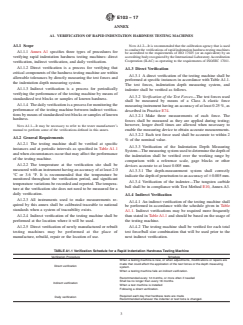
A1. VERIFICATION OF RAPID INDENTATION HARDNESS TESTING MACHINES
NOTEA1.2—It is recommended that the calibration agency that is used
A1.1 Scope
to conduct the verifications of rapid indentation hardness testing machines
A1.1.1 Annex A1 specifies three types of procedures for
be accredited to the requirements of ISO 17025 (or an equivalent) by an
verifying rapid indentation hardness testing machines: direct accrediting body recognized by the International LaboratoryAccreditation
Cooperation (ILAC) as operating to the requirements of ISO/IEC 1701
...
This document is not an ASTM standard and is intended only to provide the user of an ASTM standard an indication of what changes have been made to the previous version. Because
it may not be technically possible to adequately depict all changes accurately, ASTM recommends that users consult prior editions as appropriate. In all cases only the current version
of the standard as published by ASTM is to be considered the official document.
Designation: E103 − 12 E103 − 17
Standard Practice for
Rapid Indentation Hardness Testing of Metallic Materials
This standard is issued under the fixed designation E103; the number immediately following the designation indicates the year of
original adoption or, in the case of revision, the year of last revision. A number in parentheses indicates the year of last reapproval. A
superscript epsilon (´) indicates an editorial change since the last revision or reapproval.
1. Scope Scope*
1.1 This practice covers a procedure for rapid indentation hardness testing of metallic materials.
1.2 This practice includes additional requirements in Annex A1 for the direct, indirect, and daily verification of rapid indentation
hardness testing machines.
1.3 The values stated in SI units are to be regarded as standard. No other units of measurement are included in this standard.
1.4 This standard does not purport to address all of the safety concerns, if any, associated with its use. It is the responsibility
of the user of this standard to establish appropriate safety and health practices and determine the applicability of regulatory
limitations prior to use.
1.5 This international standard was developed in accordance with internationally recognized principles on standardization
established in the Decision on Principles for the Development of International Standards, Guides and Recommendations issued
by the World Trade Organization Technical Barriers to Trade (TBT) Committee.
2. Referenced Documents
2.1 ASTM Standards:
E4 Practices for Force Verification of Testing Machines
E10 Test Method for Brinell Hardness of Metallic Materials
E74 Practice of Calibration of Force-Measuring Instruments for Verifying the Force Indication of Testing Machines
2.2 ISO Standards:
ISO 17025 General requirements for the competence of testing and calibration laboratories
ISO/IEC 17011 Conformity assessment -- General requirements for accreditation bodies accrediting conformity assessment
bodies
3. Terminology
3.1 Definitions:
3.1.1 calibration—determination of the values of the significant parameters by comparison with values indicated by a reference
instrument or by a set of reference standards.
3.1.2 rapid indentation hardness test—an indentation hardness test using calibrated machines to force a tungsten carbide ball,
under specified conditions, into the surface of the material under test and to measure the depth of the indentation. The depth
measured can be from the surface of the test specimen or from a reference position established by the application of a preliminary
test force. The depth measurement is usually correlated to another scale or Brinell hardness number.
3.1.3 verification—checking or testing to assure conformance with the specification.
4. Significance and Use
4.1 This practice is used when it is desired to make Brinell type hardness tests very rapidly on a high volume of samples, as
in the inspection of the output of a heat-treating furnace.
This test method is under the jurisdiction of ASTM Committee E28 on Mechanical Testing and is the direct responsibility of Subcommittee E28.06 on Indentation
Hardness Testing.
Current edition approved Jan. 1, 2012April 1, 2017. Published March 2012May 2017. Originally published as E 103 – 84.E103 – 84. Last previous edition
E 103 – 84 (2002) which was withdrawn in July 2011approved in 2012 as E103 – 12and reinstated in January 2012. DOI: 10.1520/E0103-12. . DOI: 10.1520/E0103-17.
For referenced ASTM standards, visit the ASTM website, www.astm.org, or contact ASTM Customer Service at service@astm.org. For Annual Book of ASTM Standards
volume information, refer to the standard’s Document Summary page on the ASTM website.
Available from International Organization for Standardization (ISO), 1, ch. de la Voie-Creuse, CP 56, CH-1211 Geneva 20, Switzerland, http://www.iso.org.
*A Summary of Changes section appears at the end of this standard
Copyright © ASTM International, 100 Barr Harbor Drive, PO Box C700, West Conshohocken, PA 19428-2959. United States
E103 − 17
4.2 This practice requires the measurement of indentation depth and eliminates the need to measure the diameter of the indent
optically as required in a Brinell hardness test.
4.3 This practice is not a standard Brinell hardness test method and does not meet the requirements of Test Method E10.
4.4 Since the test forces and method of display of the depth measurement differ between manufacturers of rapid indentation
hardness testing equipment, the test results from equipment from different manufacturers are not comparable.
5. Apparatus
5.1 Testing Machine—Equipment for rapid indentation hardness testing usually consists of a testing machine, which supports
the test specimen and applies an indenting force(s) to a ball in contact with the specimen, and a system for measuring and
displaying an indication of the depth of the indentation. The test force can be applied either as a single total test force whereby
the depth is measured usually from the surface of the test specimen or as a preliminary and total test force whereby the depth is
measured as the increase from the preliminary to the total test force.
5.1.1 The testing machine shall meet the requirements of Annex A1.
5.1.2 The testing machine shall ensure that the force to the indenter is applied smoothly and without impact forces that affect
the measurement result. Precautions shall be taken to prevent a momentary high test force caused by the inertia of the system,
hydraulic system overshoot, etc.
5.1.3 The design and construction of the testing machine shall be such that no rotational or lateral movement of the indenter
or test specimen occurs while the test force is being applied or removed.
5.1.4 An anvil, or specimen support, should be used that is suitable for the specimen to be tested. The seating and supporting
surfaces of all anvils should be clean and free of foreign material.
5.1.5 The indenters used for rapid indentation testing shall be tungsten carbide balls that meet the requirements defined in Test
Method E10, Annex A3.
5.1.6 The mechanism for measuring the depth of the indentation shall conform to the requirements prescribed in A1.3.3. The
method for determining the depth of the indentation is determined by the manufacturer of the tester.
5.1.7 A display or output relative to the indentation depth shall be provided. The display may indicate the full or partial depth
or the depth may be converted to another relevant scale. In this case, conversion to a related Brinell hardness number is
recommended. When used, the method of conversion from depth to another scale or Brinell hardness numbers is determined by
the manufacturer of the tester.
5.1.8 Refer to the Equipment Manufacturer’s Instruction Manual for a description of the machine’s characteristics, limitations,
and respective operating procedures.
6. Test Specimens
6.1 Rapid indentation hardness tests can be made on any test specimen that can be tested using the E10 Brinell Test Method.
6.2 Finish—When necessary, the surface on which the indentation is to be made shall be filed, ground, machined, or polished
with an abrasive material to allow accurate depth measurements and to remove any surface conditions (such as decarburization)
that may affect the hardness of the sample. Preparation shall be carried out in such a way that any alteration of the hardness of
the test surface (for example, due to overheating or cold-working) is minimized. The surface in contact with the test support anvil,
when used, should be clean and free of any conditions which may affect the test results.
6.3 Thickness—The thickness of the test specimen shall be at least ten times the depth of the indentation and such that no bulge
or other mark showing the effect of the test force appears on the side of the piece opposite the indentation. See Test Method E10,
Table 4 for more information about minimum thickness.
7. Procedure
7.1 Magnitude of Test Force—The total test force is usually 3000, 1500, or 500 kgf (29.42, 14.71, or 4.903 kN). The preliminary
test force, if used, is determined by the manufacturer of the tester. The total test force and ball indenter size used should be the
same as the Brinell scale test that is being replaced by the rapid indentation test. When selecting the total test force and ball size
to use, refer to Test Method E10, Section 7 for Brinell hardness testing.
7.2 Spacing of Indentations—The distance from the center of the indentation to the edge of the specimen, or edge of another
indentation, shall be at least two and one-half times the diameter of the indentation.
7.3 Application of the Test Force(s)—Bring the indenter into contact with the test surface in a direction perpendicular to the
surface without shock, vibration or overshoot. The angle between the indenter force-line and the surface of the specimen should
be perpendicular. Apply the test force(s) according to the manufacture’s instructions.
7.4 Depth measurement of the indent—Measure the depth of the indentation according to the manufacturer’s instructions. When
this practice is used to monitor the hardness of production parts, it is recommended that the displayed depth indication as defined
in 5.1.7 be recorded. All recorded data shall reference this practice.
E103 − 17
8. Determination of Hardness Limits
8.1 Rapid indentation hardness tests are normally used to test specimens in limited Brinell hardness ranges. In order to establish
the limit(s) of acceptable hardness for a given part or piece, test specimens representing the extreme(s) of acceptability should be
tested in the rapid indentation hardness tester that is to be used. The results obtained may be considered the limits of application
of the rapid indentation test.
9. Report
9.1 When a report is desired, it is recommended that the following information be reported:
9.1.1 The total test force,
9.1.2 The diameter of the ball indenter,
9.1.3 The displayed value as defined in 5.1.7, and
9.1.4 Reference to this practice.
10. Keywords
10.1 hardness ; hardness; mechanical test; metals; rapid indentation
ANNEX
A1. VERIFICATION OF RAPID INDENTATION HARDNESS TESTING MACHINES
A1.1 Scope
A1.1.1 Annex A1 specifies three types of procedures for verifying rapid indentation hardness testing machines: direct verification,
indirect verification, and daily verification.
A1.1.2 Direct verification is a process for verifying that critical components of the hardness testing machine are within allowable
tolerances by directly measuring the test forces and th
...