

ASTM D7835/D7835M-23
(Test Method)Standard Test Method for Determining the Solvent Resistance of an Organic Coating Using a Mechanical Rubbing Machine
General Information
- Abstract
SIGNIFICANCE AND USE
5.1 Many coatings used in the coil coating and other industries achieve a degree of solvent resistance after they have experienced a bake condition characterized by exposure to elevated temperatures in an oven over time. Insufficient bake, or occasionally over bake, may affect the intended chemical bonds or physical curing of the film and result in reduced solvent resistance.
5.2 The mechanical rubbing machine provides consistent stroke length, rate, pressure, and contact area that are not subject to variables such as human fatigue (see Practice D5402).
5.3 Factors other than bake can influence degree of solvent resistance of a coated surface. Paint film chemistry and composition, surface preparation, oven dwell time, oven air velocity, ambient oven temperature, oven profiling, film thickness, etc., all are influential. The test solvent used in the rub machine has a significant effect on the number of double rubs measured. Common solvents used for these tests include Methyl Ethyl Ketone (MEK), Methyl Isobutyl Ketone (MIBK), and Isopropyl Alcohol to name a few. The specific solvent to be used and the umber of double rubs to be achieved should be agreed upon between manufacturer and user for any given coating system, thickness, and application.
SCOPE
1.1 This test method covers a mechanical rub method for assessing the solvent resistance of an organic coating that chemically and/or physically changes during the curing process. This technique can be used in the laboratory, in the field, or in the fabricating shop.
1.2 This test method does not specify the solvent, number of double rubs, or expected test results.
1.3 The values stated in either SI units or inch-pound units are to be regarded separately as standard. The values stated in each system are not necessarily exact equivalents; therefore, to ensure conformance with the standard, each system shall be used independently of the other, and values from the two systems shall not be combined.
1.4 This standard does not purport to address all of the safety concerns, if any, associated with its use. It is the responsibility of the user of this standard to establish appropriate safety, health, and environmental practices and determine the applicability of regulatory limitations prior to use.
1.5 This international standard was developed in accordance with internationally recognized principles on standardization established in the Decision on Principles for the Development of International Standards, Guides and Recommendations issued by the World Trade Organization Technical Barriers to Trade (TBT) Committee.
- Status
- Published
- Publication Date
- 30-Sep-2023
- Technical Committee
- D01 - Paint and Related Coatings, Materials, and Applications
- Drafting Committee
- D01.53 - Coil Coated Metal
Buy Documents

ASTM D7835/D7835M-23 - Standard Test Method for Determining the Solvent Resistance of an Organic Coating Using a Mechanical Rubbing Machine
REDLINE ASTM D7835/D7835M-23 - Standard Test Method for Determining the Solvent Resistance of an Organic Coating Using a Mechanical Rubbing Machine
Overview
ASTM D7835/D7835M-23, titled Standard Test Method for Determining the Solvent Resistance of an Organic Coating Using a Mechanical Rubbing Machine, is a key international standard developed by ASTM for evaluating how well organic coatings withstand solvent exposure. This test method is critical in industries like coil coating, automotive, and manufacturing, where baked coatings must demonstrate consistent solvent resistance for durability and quality assurance.
Central to the method is the use of a mechanical rubbing machine, which delivers consistent stroke length, speed, pressure, and contact area-eliminating human variability from the testing process. The test assesses the resistance of an organic coating by mechanically rubbing a solvent-saturated cloth across the coating, recording the number of double rubs until failure or breakthrough occurs.
Key Topics
Solvent Resistance and Curing
- The test reveals how the cure process (baking time, temperature, and oven conditions) affects a coating’s chemical and physical durability.
- Both under-cure and over-cure can negatively impact resistance to solvents.
Consistency in Testing
- The mechanical rubbing machine standardizes the force, rate, and contact parameters.
- By removing operator fatigue and subjectivity, results are more reproducible and comparable between labs.
Influencing Factors
- Several variables influence solvent resistance, such as:
- Coating chemistry and composition
- Film thickness
- Surface preparation
- Bake profile (dwell time, temperature, air velocity)
- The choice of solvent is not specified in the standard but is typically agreed upon by the user and manufacturer. Common solvents include Methyl Ethyl Ketone (MEK), Methyl Isobutyl Ketone (MIBK), and Isopropyl Alcohol.
Units and Reporting
- Results may be reported in either SI or inch-pound units, but values should not be intermingled.
- The report must include information on the machine and sample, the number of rubs to failure, solvent used, coating thickness, and any deviations.
Applications
Practical Uses of ASTM D7835/D7835M-23
- Product Quality Assurance: Ensures that coil coatings and other industrial paints meet required solvent resistance after curing.
- Process Control in Manufacturing: Evaluates the effects of oven conditions and curing processes for continuous improvement.
- R&D and Product Development: Assesses the impact of formulation changes, raw material lots, or process modifications on the solvent resistance of coatings.
- Comparative Analysis: Standardized method allows for side-by-side comparison of coatings, materials, or processing techniques.
- Specification Compliance: Manufacturers and end-users use the method to verify that coating systems comply with agreed-upon performance requirements.
Industry Sectors Benefiting
- Coil coating and metal finishing
- Automotive components and body shops
- Construction materials manufacturing
- Industrial equipment coating
- Quality control laboratories
Related Standards
For comprehensive coating evaluation and control, consider these ASTM standards referenced in D7835/D7835M-23:
- ASTM D5402: Practice for Assessing Solvent Resistance of Organic Coatings Using Solvent Rubs
- ASTM D740: Specification for Methyl Ethyl Ketone
- ASTM D4138, D5796, D6132, D7091: Methods for measuring dry film thickness of coatings
- ASTM E177, E691: Guidelines for test method precision and conducting interlaboratory studies
Keywords: solvent resistance, mechanical rubbing machine, organic coatings, ASTM D7835, coil coating, paint durability, quality assurance, test method, industrial coatings, solvent rub test
By adhering to ASTM D7835/D7835M-23, laboratories and manufacturers gain reliable, reproducible data on the solvent resistance of organic coatings, supporting quality, safety, and performance in demanding industrial environments.
Relations
- Effective Date
- 01-Oct-2023
Buy Documents
ASTM D7835/D7835M-23 - Standard Test Method for Determining the Solvent Resistance of an Organic Coating Using a Mechanical Rubbing Machine
REDLINE ASTM D7835/D7835M-23 - Standard Test Method for Determining the Solvent Resistance of an Organic Coating Using a Mechanical Rubbing Machine
Get Certified
Connect with accredited certification bodies for this standard

DVS-ZERT GmbH
German welding certification society.
CARES (UK Certification Authority for Reinforcing Steels)
UK certification for reinforcing steels and construction.
EWF/IIW (European/International Welding Federation)
International welding personnel certification.
Sponsored listings
Frequently Asked Questions
ASTM D7835/D7835M-23 is a standard published by ASTM International. Its full title is "Standard Test Method for Determining the Solvent Resistance of an Organic Coating Using a Mechanical Rubbing Machine". This standard covers: SIGNIFICANCE AND USE 5.1 Many coatings used in the coil coating and other industries achieve a degree of solvent resistance after they have experienced a bake condition characterized by exposure to elevated temperatures in an oven over time. Insufficient bake, or occasionally over bake, may affect the intended chemical bonds or physical curing of the film and result in reduced solvent resistance. 5.2 The mechanical rubbing machine provides consistent stroke length, rate, pressure, and contact area that are not subject to variables such as human fatigue (see Practice D5402). 5.3 Factors other than bake can influence degree of solvent resistance of a coated surface. Paint film chemistry and composition, surface preparation, oven dwell time, oven air velocity, ambient oven temperature, oven profiling, film thickness, etc., all are influential. The test solvent used in the rub machine has a significant effect on the number of double rubs measured. Common solvents used for these tests include Methyl Ethyl Ketone (MEK), Methyl Isobutyl Ketone (MIBK), and Isopropyl Alcohol to name a few. The specific solvent to be used and the umber of double rubs to be achieved should be agreed upon between manufacturer and user for any given coating system, thickness, and application. SCOPE 1.1 This test method covers a mechanical rub method for assessing the solvent resistance of an organic coating that chemically and/or physically changes during the curing process. This technique can be used in the laboratory, in the field, or in the fabricating shop. 1.2 This test method does not specify the solvent, number of double rubs, or expected test results. 1.3 The values stated in either SI units or inch-pound units are to be regarded separately as standard. The values stated in each system are not necessarily exact equivalents; therefore, to ensure conformance with the standard, each system shall be used independently of the other, and values from the two systems shall not be combined. 1.4 This standard does not purport to address all of the safety concerns, if any, associated with its use. It is the responsibility of the user of this standard to establish appropriate safety, health, and environmental practices and determine the applicability of regulatory limitations prior to use. 1.5 This international standard was developed in accordance with internationally recognized principles on standardization established in the Decision on Principles for the Development of International Standards, Guides and Recommendations issued by the World Trade Organization Technical Barriers to Trade (TBT) Committee.
SIGNIFICANCE AND USE 5.1 Many coatings used in the coil coating and other industries achieve a degree of solvent resistance after they have experienced a bake condition characterized by exposure to elevated temperatures in an oven over time. Insufficient bake, or occasionally over bake, may affect the intended chemical bonds or physical curing of the film and result in reduced solvent resistance. 5.2 The mechanical rubbing machine provides consistent stroke length, rate, pressure, and contact area that are not subject to variables such as human fatigue (see Practice D5402). 5.3 Factors other than bake can influence degree of solvent resistance of a coated surface. Paint film chemistry and composition, surface preparation, oven dwell time, oven air velocity, ambient oven temperature, oven profiling, film thickness, etc., all are influential. The test solvent used in the rub machine has a significant effect on the number of double rubs measured. Common solvents used for these tests include Methyl Ethyl Ketone (MEK), Methyl Isobutyl Ketone (MIBK), and Isopropyl Alcohol to name a few. The specific solvent to be used and the umber of double rubs to be achieved should be agreed upon between manufacturer and user for any given coating system, thickness, and application. SCOPE 1.1 This test method covers a mechanical rub method for assessing the solvent resistance of an organic coating that chemically and/or physically changes during the curing process. This technique can be used in the laboratory, in the field, or in the fabricating shop. 1.2 This test method does not specify the solvent, number of double rubs, or expected test results. 1.3 The values stated in either SI units or inch-pound units are to be regarded separately as standard. The values stated in each system are not necessarily exact equivalents; therefore, to ensure conformance with the standard, each system shall be used independently of the other, and values from the two systems shall not be combined. 1.4 This standard does not purport to address all of the safety concerns, if any, associated with its use. It is the responsibility of the user of this standard to establish appropriate safety, health, and environmental practices and determine the applicability of regulatory limitations prior to use. 1.5 This international standard was developed in accordance with internationally recognized principles on standardization established in the Decision on Principles for the Development of International Standards, Guides and Recommendations issued by the World Trade Organization Technical Barriers to Trade (TBT) Committee.
ASTM D7835/D7835M-23 is classified under the following ICS (International Classification for Standards) categories: 25.220.60 - Organic coatings. The ICS classification helps identify the subject area and facilitates finding related standards.
ASTM D7835/D7835M-23 has the following relationships with other standards: It is inter standard links to ASTM D7835/D7835M-19. Understanding these relationships helps ensure you are using the most current and applicable version of the standard.
ASTM D7835/D7835M-23 is available in PDF format for immediate download after purchase. The document can be added to your cart and obtained through the secure checkout process. Digital delivery ensures instant access to the complete standard document.
Standards Content (Sample)
This international standard was developed in accordance with internationally recognized principles on standardization established in the Decision on Principles for the
Development of International Standards, Guides and Recommendations issued by the World Trade Organization Technical Barriers to Trade (TBT) Committee.
Designation: D7835/D7835M − 23
Standard Test Method for
Determining the Solvent Resistance of an Organic Coating
Using a Mechanical Rubbing Machine
This standard is issued under the fixed designation D7835/D7835M; the number immediately following the designation indicates the
year of original adoption or, in the case of revision, the year of last revision. A number in parentheses indicates the year of last
reapproval. A superscript epsilon (´) indicates an editorial change since the last revision or reapproval.
1. Scope D5402 Practice for Assessing the Solvent Resistance of
Organic Coatings Using Solvent Rubs
1.1 This test method covers a mechanical rub method for
D5796 Test Method for Measurement of Dry Film Thickness
assessing the solvent resistance of an organic coating that
of Thin-Film Coil-Coated Systems by Destructive Means
chemically and/or physically changes during the curing pro-
Using a Boring Device
cess. This technique can be used in the laboratory, in the field,
D6132 Test Method for Nondestructive Measurement of Dry
or in the fabricating shop.
Film Thickness of Applied Organic Coatings Using an
1.2 This test method does not specify the solvent, number of
Ultrasonic Coating Thickness Gage
double rubs, or expected test results.
D7091 Practice for Nondestructive Measurement of Dry
Film Thickness of Nonmagnetic Coatings Applied to
1.3 The values stated in either SI units or inch-pound units
are to be regarded separately as standard. The values stated in Ferrous Metals and Nonmagnetic, Nonconductive Coat-
ings Applied to Non-Ferrous Metals
each system are not necessarily exact equivalents; therefore, to
ensure conformance with the standard, each system shall be E177 Practice for Use of the Terms Precision and Bias in
ASTM Test Methods
used independently of the other, and values from the two
systems shall not be combined. E691 Practice for Conducting an Interlaboratory Study to
Determine the Precision of a Test Method
1.4 This standard does not purport to address all of the
safety concerns, if any, associated with its use. It is the
3. Terminology
responsibility of the user of this standard to establish appro-
3.1 Definitions:
priate safety, health, and environmental practices and deter-
3.1.1 double rub, n—one complete forward and backward
mine the applicability of regulatory limitations prior to use.
motion over a coated surface under specific conditions, which
1.5 This international standard was developed in accor-
are characterized by the force applied normal to the surface, the
dance with internationally recognized principles on standard-
length of travel, and rate of speed.
ization established in the Decision on Principles for the
Development of International Standards, Guides and Recom-
4. Summary of Test Method
mendations issued by the World Trade Organization Technical
Barriers to Trade (TBT) Committee.
4.1 An automated machine is used to test the solvent
resistance of a coating by rubbing a cloth saturated with the
2. Referenced Documents
solvent across the coating and counting the number of strokes
2.1 ASTM Standards: (double rubs) to coating break-through or failure.
D740 Specification for Methyl Ethyl Ketone
5. Significance and Use
D4138 Practices for Measurement of Dry Film Thickness of
Protective Coating Systems by Destructive, Cross-
5.1 Many coatings used in the coil coating and other
Sectioning Means
industries achieve a degree of solvent resistance after they have
experienced a bake condition characterized by exposure to
elevated temperatures in an oven over time. Insufficient bake,
This test method is under the jurisdiction of ASTM Committee D01 on Paint
or occasionally over bake, may affect the intended chemical
and Related Coatings, Materials, and Applications and is the direct responsibility of
Subcommittee D01.53 on Coil Coated Metal.
bonds or physical curing of the film and result in reduced
Current edition approved Oct. 1, 2023. Published October 2023. Originally
solvent resistance.
approved in 2013. Last previous edition approved in 2019 as D7835/D7835M – 19.
DOI: 10.1520/D7835/D7835M-23.
5.2 The mechanical rubbing machine provides consistent
For referenced ASTM standards, visit the ASTM website, www.astm.org, or
stroke length, rate, pressure, and contact area that are not
contact ASTM Customer Service at service@astm.org. For Annual Book of ASTM
subject to variables such as human fatigue (see Practice
Standards volume information, refer to the standard’s Document Summary page on
the ASTM website. D5402).
Copyright © ASTM International, 100 Barr Harbor Drive, PO Box C700, West Conshohocken, PA 19428-2959. United States
D7835/D7835M − 23
5.3 Factors other than bake can influence degree of solvent 7. Reagents and Materials
resistance of a coated surface. Paint film chemistry and
7.1 Methyl Ethyl Ketone (MEK), conforming to Specifica-
composition, surface preparation, oven dwell time, oven air
tion D740.
velocity, ambient oven temperature, oven profiling, film
7.2 Other Solvents, as specified by the coating manufacturer
thickness, etc., all are influential. The test solvent used in the
or user.
rub machine has a significant effect on the number of double
rubs measured. Common solvents used for these tests include
7.3 100 % Cotton Cheesecloth, mesh grade 28 by 24, or
Methyl Ethyl Ketone (MEK), Methyl Isobutyl Ketone (MIBK),
other mutually agreed upon cloth.
and Isopropyl Alcohol to name a few. The specific solvent to be
7.4 Warning—Solvent vapors are flammable. The rub ma-
used and the umber of double rubs to be achieved should be
chine equipment should be located away from sources of
agreed upon between manufacturer and user for any given
electrical sparking and be placed in a well-ventilated area to
coating system, thickness, and application.
minimize the accumulation of solvent fumes.
6. Apparatus
8. Sampling, Test Specimens, and Test Units
6.1 Solvent Rub Machine with operator instructions.
6.1.1 The machine may be any suitable device that drives a 8.1 Obtain representative, coated, flat panels, and cut the
panels to an appropriate size for the test machine. If possible,
mechanical finger through double rubs across the same path on
a coated surface and has the following characteristics (see Fig. use a panel of sufficient length to allow a 200 mm [8 in.] long
test surface by 25 mm [1 in.] width. The long dimension must
1).
6.1.1.1 The mechanical finger must have a flat, smooth, be parallel to the rolling (longitudinal) direction of the coil for
coil coatings.
circular surface 1.6 cm 6 0.2 cm [0.625 in. 6 0.08 in.]
diameter.
8.2 Measure the dry film thickness of the coating on the
6.1.1.2 A weighted block must apply 3000 g 6 50 g of
selected panel in accordance with standards D4138, D5796,
pressure to the mechanical finger.
D6132, or D7091 to ensure that the coating meets thickness
6.1.1.3 Disposable cheesecloth, as specified below, is at-
requirements.
tached to the contact surface of the finger.
8.3 For items that may have varied coating thickness and
6.1.1.4 There must be some means of maintaining constant
cure across the item (for example, across a coil of coated
saturation of the cheesecloth, typically by a solvent reservoir.
metal), it is recommended that samples representing that
6.1.1.5 The double rub (stroke) length must be 20 cm 6 2
variation be collected.
cm [8 in. 6 0.8 in.
...
This document is not an ASTM standard and is intended only to provide the user of an ASTM standard an indication of what changes have been made to the previous version. Because
it may not be technically possible to adequately depict all changes accurately, ASTM recommends that users consult prior editions as appropriate. In all cases only the current version
of the standard as published by ASTM is to be considered the official document.
Designation: D7835/D7835M − 19 D7835/D7835M − 23
Standard Test Method for
Determining the Solvent Resistance of an Organic Coating
Using a Mechanical Rubbing Machine
This standard is issued under the fixed designation D7835/D7835M; the number immediately following the designation indicates the
year of original adoption or, in the case of revision, the year of last revision. A number in parentheses indicates the year of last
reapproval. A superscript epsilon (´) indicates an editorial change since the last revision or reapproval.
1. Scope
1.1 This test method covers a mechanical rub method for assessing the solvent resistance of an organic coating that chemically
and/or physically changes during the curing process. This technique can be used in the laboratory, in the field, or in the fabricating
shop.
1.2 This test method does not specify the solvent, number of double rubs, or expected test results.
1.3 The values stated in either SI units or inch-pound units are to be regarded separately as standard. The values stated in each
system are not necessarily exact equivalents; therefore, to ensure conformance with the standard, each system shall be used
independently of the other, and values from the two systems shall not be combined.
1.4 This standard does not purport to address all of the safety concerns, if any, associated with its use. It is the responsibility
of the user of this standard to establish appropriate safety, health, and environmental practices and determine the applicability of
regulatory limitations prior to use.
1.5 This international standard was developed in accordance with internationally recognized principles on standardization
established in the Decision on Principles for the Development of International Standards, Guides and Recommendations issued
by the World Trade Organization Technical Barriers to Trade (TBT) Committee.
2. Referenced Documents
2.1 ASTM Standards:
D740 Specification for Methyl Ethyl Ketone
D4138 Practices for Measurement of Dry Film Thickness of Protective Coating Systems by Destructive, Cross-Sectioning
Means
D5402 Practice for Assessing the Solvent Resistance of Organic Coatings Using Solvent Rubs
D5796 Test Method for Measurement of Dry Film Thickness of Thin-Film Coil-Coated Systems by Destructive Means Using
a Boring Device
D6132 Test Method for Nondestructive Measurement of Dry Film Thickness of Applied Organic Coatings Using an Ultrasonic
Coating Thickness Gage
D7091 Practice for Nondestructive Measurement of Dry Film Thickness of Nonmagnetic Coatings Applied to Ferrous Metals
and Nonmagnetic, Nonconductive Coatings Applied to Non-Ferrous Metals
This test method is under the jurisdiction of ASTM Committee D01 on Paint and Related Coatings, Materials, and Applications and is the direct responsibility of
Subcommittee D01.53 on Coil Coated Metal.
Current edition approved Jan. 1, 2019Oct. 1, 2023. Published January 2019October 2023. Originally approved in 2013. Last previous edition approved in 20132019 as
D7835/D7835M – 13. DOI: 10.1520/D7835/D7835M-1919. DOI: 10.1520/D7835/D7835M-23.
For referenced ASTM standards, visit the ASTM website, www.astm.org, or contact ASTM Customer Service at service@astm.org. For Annual Book of ASTM Standards
volume information, refer to the standard’s Document Summary page on the ASTM website.
Copyright © ASTM International, 100 Barr Harbor Drive, PO Box C700, West Conshohocken, PA 19428-2959. United States
D7835/D7835M − 23
E177 Practice for Use of the Terms Precision and Bias in ASTM Test Methods
E691 Practice for Conducting an Interlaboratory Study to Determine the Precision of a Test Method
3. Terminology
3.1 Definitions:
3.1.1 double rub, n—one complete forward and backward motion over a coated surface under specific conditions, which are
characterized by the force applied normal to the surface, the length of travel, and rate of speed.
4. Summary of Test Method
4.1 An automated machine is used to test the solvent resistance of a coating by rubbing a cloth saturated with the solvent across
the coating and counting the number of strokes (double rubs) to coating break-through or failure.
5. Significance and Use
5.1 Many coatings used in the coil coating and other industries achieve a degree of solvent resistance after they have experienced
a bake condition characterized by exposure to elevated temperatures in an oven over time. Insufficient bake, or occasionally over
bake, may affect the intended chemical bonds or physical curing of the film and result in reduced solvent resistance.
5.2 The mechanical rubbing machine provides consistent stroke length, rate, pressure, and contact area that are not subject to
variables such as human fatigue (see Practice D5402).
5.3 Factors other than bake can influence degree of solvent resistance of a coated surface. Paint film chemistry and composition,
surface preparation, oven dwell time, oven air velocity, ambient oven temperature, oven profiling, film thickness, etc., all are
influential. The test solvent used in the rub machine has a significant effect on the number of double rubs measured. Common
solvents used for these tests include Methyl Ethyl Ketone (MEK), Methyl Isobutyl Ketone (MIBK), and Isopropyl Alcohol to name
a few. The specific solvent to be used and the umber of double rubs to be achieved should be agreed upon between manufacturer
and user for any given coating system, thickness, and application.
6. Apparatus
6.1 Solvent Rub Machine with operator instructions.
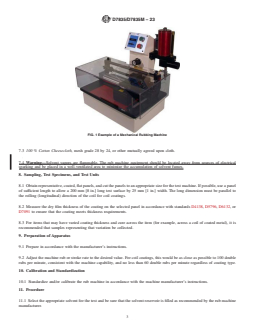
6.1.1 The machine may be any suitable device that drives a mechanical finger through double rubs across the same path on a
coated surface and has the following characteristics (see Fig. 1).
6.1.1.1 The mechanical finger must have a flat, smooth, circular surface 1.61.6 cm 6 0.2 cm [0.625 6 0.08 in.] [0.625 in. 6
0.08 in.] diameter.
6.1.1.2 A weighted block must apply 3000 6 50 g 3000 g 6 50 g of pressure to the mechanical finger.
6.1.1.3 Disposable cheesecloth, as specified below, is attached to the contact surface of the finger.
6.1.1.4 There must be some means of maintaining constant saturation of the cheesecloth, typically by a solvent reservoir.
6.1.1.5 The double rub (stroke) length must be 2020 cm 6 2 cm [8 6 0.8 in.] [8 in. 6 0.8 in.] (one direction) at a minimum rate
of 60 and maximum of 100 double rubs per minute.
6.1.1.6 The number of double strokes must be automatically counted (up or down) and displayed by the machine.
7. Reagents and Materials
7.1 Methyl Ethyl Ketone (MEK), conforming to Specification D740.
7.2 Other Solvents, as specified by the coating manufacturer or user.
D7835/D7835M − 23
FIG. 1 Example of a Mechanical Rubbing Machine
7.3 100 % Cotton Cheesecloth, mesh grade 28 by 24, or other mutually agreed upon cloth.
7.4 Warning—Solvent vapors are flammable. The rub machine equipment should be located away from sources of electrical
sparking and be placed in a well-ventilated area to minimize the accumulation of solvent fumes.
8. Sampling, Test Specimens, and Test Units
8.1 Obtain representative, coated, flat panels, and cut the panels to an appropriate size for the test machine. If possible, use a panel
of sufficient length to allow a 200 mm [8 in.] long test surface by 25 mm [1 in.] width. The long dimension must be parallel to
the rolling (longitudinal) direction of the coil
...