

ASTM D968-22
(Test Method)Standard Test Methods for Abrasion Resistance of Organic Coatings by Falling Abrasive
General Information
- Abstract
SIGNIFICANCE AND USE
5.1 Silica sand produces a slower rate of abrasion for organic coatings than that provided by silicon carbide. For some types of coatings, it may also provide greater differentiation.
5.2 The abrasion resistance scales produced by the two methods differ, but the methods provide approximately the same rankings of coatings for abrasion resistance.
5.3 Each of the methods has been found useful for rating the abrasion resistance of specific types of coatings. For example Method A (falling sand) has been used for rating floor coatings while Method B (falling silicon carbide) has been used for rating coatings for ship decks.
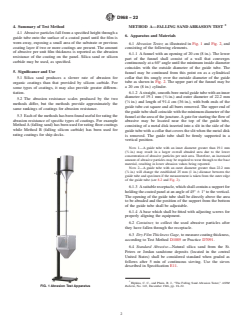
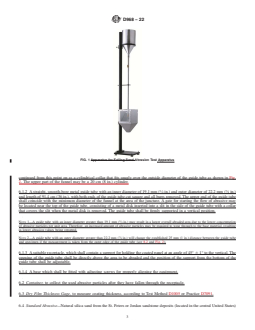
FIG. 1 Abrasion Test Apparatus
SCOPE
1.1 These test methods cover the determination of the resistance of organic coatings to abrasion produced by abrasive falling onto coatings applied to a plane rigid surface, such as a metal or glass panel.
1.2 Two test methods based on different abrasives are covered as follows:
Sections
Method A—Falling Sand Abrasion Test
6 – 13
Method B—Falling Silicon Carbide Abrasion Test
14 – 21
1.3 These methods should be restricted to testing in only one laboratory when numerical values are used because of the poor reproducibility of the methods (see 13.1.2 and 21.1.2). Interlaboratory agreement is improved significantly when ranking is used in place of numerical values.
1.4 The values stated in SI units are to be regarded as the standard. The values given in parentheses after SI units are for information only and are not considered standard.
1.5 This standard does not purport to address all of the safety concerns, if any, associated with its use. It is the responsibility of the user of this standard to establish appropriate safety, health, and environmental practices and determine the applicability of regulatory limitations prior to use.
1.6 This international standard was developed in accordance with internationally recognized principles on standardization established in the Decision on Principles for the Development of International Standards, Guides and Recommendations issued by the World Trade Organization Technical Barriers to Trade (TBT) Committee.
- Status
- Published
- Publication Date
- 31-May-2022
- Technical Committee
- D01 - Paint and Related Coatings, Materials, and Applications
- Drafting Committee
- D01.23 - Physical Properties of Applied Paint Films
Buy Documents
ASTM D968-22 - Standard Test Methods for Abrasion Resistance of Organic Coatings by Falling Abrasive
REDLINE ASTM D968-22 - Standard Test Methods for Abrasion Resistance of Organic Coatings by Falling Abrasive
Overview
ASTM D968-22 - Standard Test Methods for Abrasion Resistance of Organic Coatings by Falling Abrasive defines laboratory procedures for measuring the abrasion resistance of organic coatings applied to rigid surfaces, such as metal or glass panels. Developed by ASTM International, this standard plays a vital role in assessing the durability of coatings exposed to wear in industrial, commercial, and institutional settings. It covers two distinct test methods using different abrasives-falling sand and falling silicon carbide-to simulate real-world abrasive forces and provide insights into the protective qualities of various coating systems.
Key Topics
Purpose of the Standard:
ASTM D968-22 focuses on quantifying the abrasion resistance of organic coatings, which is essential for understanding their performance in environments exposed to physical wear and tear.Test Methods:
- Method A – Falling Sand Abrasion Test:
Utilizes naturally graded silica sand as an abrasive to determine the volume of sand required to wear through a coating. - Method B – Falling Silicon Carbide Abrasion Test:
Uses graded silicon carbide, a more aggressive abrasive, better simulating harsher service conditions such as those experienced by ship deck coatings.
- Method A – Falling Sand Abrasion Test:
Interpretation of Results:
The amount of abrasive required to wear through a specific coating thickness (measured in litres or kilograms per micrometer) is reported as the abrasion resistance value. Results are most reliable within a single laboratory and are especially useful for comparative ranking of multiple coatings rather than producing highly reproducible numerical values across laboratories.Significance of Abrasive Choice:
Silica sand produces a slower rate of abrasion and can provide finer differentiation between coatings, especially for flooring and similar applications. Silicon carbide offers a faster, more aggressive abrasion, suitable for heavy-duty environments.Lab Practices and Limitations:
Due to the variability inherent in abrasive testing, ASTM D968-22 recommends using ranking systems rather than absolute values for interlaboratory comparisons. Consistent preparation, application, and environmental control are critical for reliable results.
Applications
ASTM D968-22 is widely used in the coatings and materials industry to evaluate the abrasion resistance of paints and protective finishes. Typical practical applications include:
- Quality control and product development:
Manufacturers use these test methods to benchmark new coating formulations and ensure compliance with durability specifications. - Specification compliance:
Specifiers and procurement professionals can reference results from these tests to validate coating performance for flooring, ship decks, machinery, automotive parts, and architectural surfaces. - Research and comparative analysis:
Laboratories and research institutes use ASTM D968-22 to compare different coatings and select suitable products for aggressive service environments.
Using this standard helps industries select coatings based on measured performance under simulated wear conditions, supporting longer-lasting, cost-effective, and safer products.
Related Standards
For a comprehensive evaluation of coatings, ASTM D968-22 often works in conjunction with these related standards:
- ASTM D16: Terminology for Paint, Related Coatings, Materials, and Applications
- ASTM D823: Practices for Producing Films of Uniform Thickness on Test Panels
- ASTM D1005: Measurement of Dry-Film Thickness Using Micrometers
- ASTM D7091: Nondestructive Measurement of Dry Film Thickness of Nonmagnetic Coatings
- ASTM E11: Specifications for Woven Wire Test Sieve Cloth and Test Sieves
- ANSI B74.12: Specification for Abrasive Grain Size
- FEPA Standard 42-2: Grains of Fused Aluminum Oxide, Silicon Carbide, and Other Abrasives
Practical Value
Using ASTM D968-22 ensures reliable, repeatable testing of abrasion resistance for paints and coatings, supporting informed choices in product development, procurement, and quality control. By following these standardized methods, manufacturers and end-users can optimize coating selection for durability in demanding applications, reducing maintenance costs and enhancing product lifespan. This test method is recognized internationally, forming an important part of the quality assurance process for abrasion-resistant coatings.
Relations
- Effective Date
- 01-Jan-2024
- Effective Date
- 01-Jun-2020
- Effective Date
- 01-Dec-2017
- Effective Date
- 01-Jul-2016
- Effective Date
- 01-Dec-2014
- Effective Date
- 01-Oct-2013
- Effective Date
- 01-Nov-2012
- Effective Date
- 01-Aug-2012
- Effective Date
- 01-Apr-2012
- Effective Date
- 01-Jun-2011
- Effective Date
- 01-Jan-2011
- Effective Date
- 01-Feb-2010
- Effective Date
- 01-May-2009
- Effective Date
- 01-Jul-2008
- Effective Date
- 01-Nov-2007
Buy Documents
ASTM D968-22 - Standard Test Methods for Abrasion Resistance of Organic Coatings by Falling Abrasive
REDLINE ASTM D968-22 - Standard Test Methods for Abrasion Resistance of Organic Coatings by Falling Abrasive
Get Certified
Connect with accredited certification bodies for this standard

DVS-ZERT GmbH
German welding certification society.
CARES (UK Certification Authority for Reinforcing Steels)
UK certification for reinforcing steels and construction.
EWF/IIW (European/International Welding Federation)
International welding personnel certification.
Sponsored listings
Frequently Asked Questions
ASTM D968-22 is a standard published by ASTM International. Its full title is "Standard Test Methods for Abrasion Resistance of Organic Coatings by Falling Abrasive". This standard covers: SIGNIFICANCE AND USE 5.1 Silica sand produces a slower rate of abrasion for organic coatings than that provided by silicon carbide. For some types of coatings, it may also provide greater differentiation. 5.2 The abrasion resistance scales produced by the two methods differ, but the methods provide approximately the same rankings of coatings for abrasion resistance. 5.3 Each of the methods has been found useful for rating the abrasion resistance of specific types of coatings. For example Method A (falling sand) has been used for rating floor coatings while Method B (falling silicon carbide) has been used for rating coatings for ship decks. FIG. 1 Abrasion Test Apparatus SCOPE 1.1 These test methods cover the determination of the resistance of organic coatings to abrasion produced by abrasive falling onto coatings applied to a plane rigid surface, such as a metal or glass panel. 1.2 Two test methods based on different abrasives are covered as follows: Sections Method A—Falling Sand Abrasion Test 6 – 13 Method B—Falling Silicon Carbide Abrasion Test 14 – 21 1.3 These methods should be restricted to testing in only one laboratory when numerical values are used because of the poor reproducibility of the methods (see 13.1.2 and 21.1.2). Interlaboratory agreement is improved significantly when ranking is used in place of numerical values. 1.4 The values stated in SI units are to be regarded as the standard. The values given in parentheses after SI units are for information only and are not considered standard. 1.5 This standard does not purport to address all of the safety concerns, if any, associated with its use. It is the responsibility of the user of this standard to establish appropriate safety, health, and environmental practices and determine the applicability of regulatory limitations prior to use. 1.6 This international standard was developed in accordance with internationally recognized principles on standardization established in the Decision on Principles for the Development of International Standards, Guides and Recommendations issued by the World Trade Organization Technical Barriers to Trade (TBT) Committee.
SIGNIFICANCE AND USE 5.1 Silica sand produces a slower rate of abrasion for organic coatings than that provided by silicon carbide. For some types of coatings, it may also provide greater differentiation. 5.2 The abrasion resistance scales produced by the two methods differ, but the methods provide approximately the same rankings of coatings for abrasion resistance. 5.3 Each of the methods has been found useful for rating the abrasion resistance of specific types of coatings. For example Method A (falling sand) has been used for rating floor coatings while Method B (falling silicon carbide) has been used for rating coatings for ship decks. FIG. 1 Abrasion Test Apparatus SCOPE 1.1 These test methods cover the determination of the resistance of organic coatings to abrasion produced by abrasive falling onto coatings applied to a plane rigid surface, such as a metal or glass panel. 1.2 Two test methods based on different abrasives are covered as follows: Sections Method A—Falling Sand Abrasion Test 6 – 13 Method B—Falling Silicon Carbide Abrasion Test 14 – 21 1.3 These methods should be restricted to testing in only one laboratory when numerical values are used because of the poor reproducibility of the methods (see 13.1.2 and 21.1.2). Interlaboratory agreement is improved significantly when ranking is used in place of numerical values. 1.4 The values stated in SI units are to be regarded as the standard. The values given in parentheses after SI units are for information only and are not considered standard. 1.5 This standard does not purport to address all of the safety concerns, if any, associated with its use. It is the responsibility of the user of this standard to establish appropriate safety, health, and environmental practices and determine the applicability of regulatory limitations prior to use. 1.6 This international standard was developed in accordance with internationally recognized principles on standardization established in the Decision on Principles for the Development of International Standards, Guides and Recommendations issued by the World Trade Organization Technical Barriers to Trade (TBT) Committee.
ASTM D968-22 is classified under the following ICS (International Classification for Standards) categories: 25.220.60 - Organic coatings. The ICS classification helps identify the subject area and facilitates finding related standards.
ASTM D968-22 has the following relationships with other standards: It is inter standard links to ASTM D16-24, ASTM D1005-95(2020), ASTM D823-17, ASTM D16-16, ASTM D16-14, ASTM E11-13, ASTM D823-95(2012), ASTM D16-12, ASTM D7091-12, ASTM D16-11a, ASTM D16-11, ASTM D16-10, ASTM E11-09e1, ASTM D16-08, ASTM D1005-95(2007). Understanding these relationships helps ensure you are using the most current and applicable version of the standard.
ASTM D968-22 is available in PDF format for immediate download after purchase. The document can be added to your cart and obtained through the secure checkout process. Digital delivery ensures instant access to the complete standard document.
Standards Content (Sample)
This international standard was developed in accordance with internationally recognized principles on standardization established in the Decision on Principles for the
Development of International Standards, Guides and Recommendations issued by the World Trade Organization Technical Barriers to Trade (TBT) Committee.
Designation: D968 − 22
Standard Test Methods for
Abrasion Resistance of Organic Coatings by Falling
Abrasive
This standard is issued under the fixed designation D968; the number immediately following the designation indicates the year of
original adoption or, in the case of revision, the year of last revision.Anumber in parentheses indicates the year of last reapproval.A
superscript epsilon (´) indicates an editorial change since the last revision or reapproval.
This standard has been approved for use by agencies of the U.S. Department of Defense.
1. Scope* 2. Referenced Documents
2.1 ASTM Standards:
1.1 These test methods cover the determination of the
resistanceoforganiccoatingstoabrasionproducedbyabrasive D16TerminologyforPaint,RelatedCoatings,Materials,and
Applications
falling onto coatings applied to a plane rigid surface, such as a
metal or glass panel. D823Practices for Producing Films of Uniform Thickness
of Paint, Coatings and Related Products on Test Panels
1.2 Two test methods based on different abrasives are
D1005Test Method for Measurement of Dry-Film Thick-
covered as follows:
ness of Organic Coatings Using Micrometers
Sections
D7091Practice for Nondestructive Measurement of Dry
Method A—Falling Sand Abrasion Test 6–13
Film Thickness of Nonmagnetic Coatings Applied to
Method B—Falling Silicon Carbide Abrasion Test 14–21
Ferrous Metals and Nonmagnetic, Nonconductive Coat-
1.3 These methods should be restricted to testing in only
ings Applied to Non-Ferrous Metals
one laboratory when numerical values are used because of the
E11Specification forWovenWireTest Sieve Cloth andTest
poor reproducibility of the methods (see 13.1.2 and 21.1.2).
Sieves
Interlaboratoryagreementisimprovedsignificantlywhenrank-
2.2 Other Standards:
ing is used in place of numerical values.
ANSI B74.12Specification for the Size of Abrasive Grain
1.4 The values stated in SI units are to be regarded as the
— Grinding Wheels, Polishing and General Industrial
standard. The values given in parentheses after SI units are for
Uses
information only and are not considered standard.
FEPA Standard 42-2Grains of Fused Aluminum Oxide,
Silicon Carbide and other Abrasive Materials for Bonded
1.5 This standard does not purport to address all of the
Abrasives and for General Applications — Microgrits
safety concerns, if any, associated with its use. It is the
F230 to F2000
responsibility of the user of this standard to establish appro-
priate safety, health, and environmental practices and deter-
3. Terminology
mine the applicability of regulatory limitations prior to use.
3.1 Definitions of Terms Specific to This Standard:
1.6 This international standard was developed in accor-
3.1.1 Abrasion resistance is expressed as the amount of
dance with internationally recognized principles on standard-
abrasive required to wear through a unit film thickness of the
ization established in the Decision on Principles for the
coating.
Development of International Standards, Guides and Recom-
mendations issued by the World Trade Organization Technical
3.2 Fordefinitionsofothertermsusedinthisstandard,refer
Barriers to Trade (TBT) Committee.
to Terminology D16.
For referenced ASTM standards, visit the ASTM website, www.astm.org, or
These test methods are under the jurisdiction of ASTM Committee D01 on contact ASTM Customer Service at service@astm.org. For Annual Book of ASTM
Paint and Related Coatings, Materials, and Applications and are the direct Standards volume information, refer to the standard’s Document Summary page on
responsibility of Subcommittee D01.23 on Physical Properties of Applied Paint the ASTM website.
Films. Available fromAmerican National Standards Institute (ANSI), 25 W. 43rd St.,
CurrenteditionapprovedJune1,2022.PublishedJuly2022.Originallyapproved 4th Floor, New York, NY 10036, http://www.ansi.org.
in 1948. Last previous edition approved in 2017 as D968–17. DOI: 10.1520/ Available from Federation of European Producers ofAbrasives (FEPA), 20 av.,
D0968-22. Reille, Paris, F-75014, www.fepa-abrasives.com.
*A Summary of Changes section appears at the end of this standard
Copyright © ASTM International, 100 Barr Harbor Drive, PO Box C700, West Conshohocken, PA 19428-2959. United States
D968 − 22
4. Summary of Test Method METHOD A—FALLING SAND ABRASION TEST
4.1 Abrasive particles fall from a specified height through a
6. Apparatus and Materials
guide tube onto the surface of a coated panel until the film is
worn away, exposing a small area of the substrate or previous
6.1 Abrasion Tester, as illustrated in Fig. 1 and Fig. 2, and
coating layer if two or more coatings are present. The amount
consisting of the following elements.
of abrasive per unit film thickness is reported as the abrasion
6.1.1 Afunnel with an opening of 20 cm (8 in.). The lower
resistance of the coating on the panel. Silica sand or silicon
part of the funnel shall consist of a wall that converges
carbide may be used, as specified.
continuously at a 60° angle until the minimum inside diameter
coincides with the outside diameter of the guide tube. The
5. Significance and Use
funnel may be continued from this point on as a cylindrical
collar that fits snugly over the outside diameter of the guide
5.1 Silica sand produces a slower rate of abrasion for
tube as shown in Fig. 2. The upper part of the funnel may be
organic coatings than that provided by silicon carbide. For
a 20 cm (8 in.) cylinder.
some types of coatings, it may also provide greater differen-
tiation. 6.1.2 Astraight,smooth-boremetalguidetubewithaninner
diameter of 19.1 mm ( ⁄4in.) and outer diameter of 22.2 mm
5.2 The abrasion resistance scales produced by the two
( ⁄8in.) and length of 91.4 cm (36 in.), with both ends of the
methods differ, but the methods provide approximately the
guide tube cut square and all burrs removed. The upper end of
same rankings of coatings for abrasion resistance.
theguidetubeshallcoincidewiththeminimumdiameterofthe
5.3 Eachofthemethodshasbeenfoundusefulforratingthe
funnelattheareaofthejuncture.Agateforstartingtheflowof
abrasion resistance of specific types of coatings. For example
abrasive may be located near the top of the guide tube,
MethodA(falling sand) has been used for rating floor coatings
consisting of a metal disk inserted into a slit in the side of the
while Method B (falling silicon carbide) has been used for
guidetubewithacollarthatcoverstheslitwhenthemetaldisk
rating coatings for ship decks.
is removed. The guide tube shall be firmly supported in a
vertical position.
NOTE 1—A guide tube with an inner diameter greater than 19.1 mm
( ⁄4in.) may result in a larger overall abraded area due to the lower
concentration of abrasive particles per unit area. Therefore, an increased
amount of abrasive particles may be required to wear through to the base
material, resulting in lower abrasion values being reported.
NOTE 2—A guide tube with an outer diameter greater than 22.2 mm
( ⁄8in.) will change the established 25 mm (1 in.) distance between the
guide tube and specimen if the measurement is taken from the outer edge
of the guide tube (see 8.2 and Fig. 2).
6.1.3 Asuitablereceptacle,whichshallcontainasupportfor
holdingthecoatedpanelatanangleof45° 61°tothevertical.
The opening of the guide tube shall be directly above the area
to be abraded and the position of the support from the bottom
of the guide tube shall be adjustable.
6.1.4 Abase which shall be fitted with adjusting screws for
properly aligning the equipment.
6.2 Container, to collect the used abrasive particles after
they have fallen through the receptacle.
6.3 Dry Film Thickness Gage,tomeasurecoatingthickness,
according to Test Method D1005 or Practice D7091.
6.4 Standard Abrasive—Natural silica sand from the St.
Peters or Jordan sandstone deposits (located in the central
United States) shall be considered standard when graded as
follows after 5 min of continuous sieving. Use the sieves
described in Specification E11.
Hipkins, C. C., and Phain, R. J., “The Falling Sand Abrasion Tester,” ASTM
FIG. 1 Abrasion Test Apparatus Bulletin, No. 143, December 1946, pp. 18–22.
D968 − 22
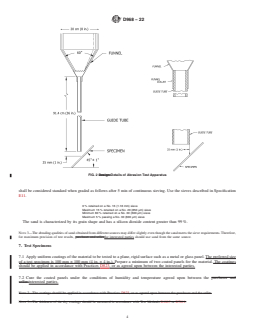
FIG. 2 Details of Abrasion Test Apparatus
8. Standardization
0 % retained on a No. 16 (1.18 mm) sieve
Maximum 15 % retained on a No. 20 (850 µm) sieve
Minimum 80 % retained on a No. 30 (600 µm) sieve 8.1 Pour a quantity of standard sand into the funnel and
Maximum 5 % passing a No. 30 (600 µm) sieve
examine the sand stream falling from the lower end of the
Thesandischaracterizedbyitsgrainshapeandhasasilicon guide tube. Align the apparatus by means of the adjusting
dioxide content greater than 99%.
screws in the base until the inner concentrated core of the sand
stream falls in the center of the flow when viewed at two
NOTE3—Theabradingqualitiesofsandobtainedfromdifferentsources
positions at 90° to each other. Introduce a measured volume of
may differ slightly even though the sand meets the sieve requirements.
sand (2 L 6 0.01 L) and determine the time of efflux. The rate
Therefore, for maximum precision of test results, the interested parties
should use sand from the same source.
of flow shall be 2 L of sand in 21s to 23.5s.
8.2 Secureatrialpanelinthetestingposition,andadjustthe
7. Test Specimens
distance from the guide tube to the coated surface face at the
7.1 Apply uniform coatings of the material to be tested to a
nearest point to 25 mm (1 in.) when measured in the vertical
plane, rigid surface such as a metal or glass panel. The
direction (see Fig. 2). Introduce the sand in increments until a
preferred size of a test specimen is 100 mm × 100 mm (4 in. ×
spot4mm( ⁄32 in.) in diameter is worn through to the base
4 in.). Prepare a minimum of two coated panels for the
material. The overall abraded area shall be elliptical in shape
material. The coatings should be applied in accordance with
with the center of the area of maximum abrasion on the
Practices D823, or as agreed upon between the interested
centerlinethroughthelongeraxisoftheabradedpattern.Slight
parties.
finaladjustmentoftheinstrumentmayberequiredtocenterthe
7.2 Cure the coated panels under the conditions of humidity abrasion spot in the pattern.
and temperature agreed upon between the interested parties.
NOTE 5—The abrasive particle distribution has an effect on the end
NOTE 4—While the minimum of two coated panels is acceptable, pointobtainedandisdependentontheproperalignmentoftheguidetube.
evaluating three or more panels per material will provide greater confi- The desired distribution consists of a concentration of particles in the
dence in your test results. center of the falling stream and a decrease in density as the tube wall is
D968 − 22
approached (see Fig. 3). When adjusting the instrument, the entire
th
...
This document is not an ASTM standard and is intended only to provide the user of an ASTM standard an indication of what changes have been made to the previous version. Because
it may not be technically possible to adequately depict all changes accurately, ASTM recommends that users consult prior editions as appropriate. In all cases only the current version
of the standard as published by ASTM is to be considered the official document.
Designation: D968 − 17 D968 − 22
Standard Test Methods for
Abrasion Resistance of Organic Coatings by Falling
Abrasive
This standard is issued under the fixed designation D968; the number immediately following the designation indicates the year of
original adoption or, in the case of revision, the year of last revision. A number in parentheses indicates the year of last reapproval. A
superscript epsilon (´) indicates an editorial change since the last revision or reapproval.
This standard has been approved for use by agencies of the U.S. Department of Defense.
1. Scope*
1.1 These test methods cover the determination of the resistance of organic coatings to abrasion produced by abrasive falling onto
coatings applied to a plane rigid surface, such as a metal or glass panel.
1.2 Two test methods based on different abrasives are covered as follows:
Sections
Method A—Falling Sand Abrasion Test 6 – 13
Method B—Falling Silicon Carbide Abrasion Test 14 – 21
1.3 These methods should be restricted to testing in only one laboratory when numerical values are used because of the poor
reproducibility of the methods (see 13.1.2 and 21.1.2). Interlaboratory agreement is improved significantly when ranking is used
in place of numerical values.
1.4 The values stated in SI units are to be regarded as the standard with the exception of mils when determining coating thickness.
standard. The values given in parentheses after SI units are for information only.only and are not considered standard.
1.5 This standard does not purport to address all of the safety concerns, if any, associated with its use. It is the responsibility
of the user of this standard to establish appropriate safety safety, health, and healthenvironmental practices and determine the
applicability of regulatory limitations prior to use.
1.6 This international standard was developed in accordance with internationally recognized principles on standardization
established in the Decision on Principles for the Development of International Standards, Guides and Recommendations issued
by the World Trade Organization Technical Barriers to Trade (TBT) Committee.
2. Referenced Documents
2.1 ASTM Standards:
D16 Terminology for Paint, Related Coatings, Materials, and Applications
D823 Practices for Producing Films of Uniform Thickness of Paint, Coatings and Related Products on Test Panels
D1005 Test Method for Measurement of Dry-Film Thickness of Organic Coatings Using Micrometers
These test methods are under the jurisdiction of ASTM Committee D01 on Paint and Related Coatings, Materials, and Applications and are the direct responsibility of
Subcommittee D01.23 on Physical Properties of Applied Paint Films.
Current edition approved June 1, 2017June 1, 2022. Published June 2017July 2022. Originally approved in 1948. Last previous edition approved in 20152017 as
D968 – 15.D968 – 17. DOI: 10.1520/D0968-17.10.1520/D0968-22.
For referenced ASTM standards, visit the ASTM website, www.astm.org, or contact ASTM Customer Service at service@astm.org. For Annual Book of ASTM Standards
volume information, refer to the standard’s Document Summary page on the ASTM website.
*A Summary of Changes section appears at the end of this standard
Copyright © ASTM International, 100 Barr Harbor Drive, PO Box C700, West Conshohocken, PA 19428-2959. United States
D968 − 22
D7091 Practice for Nondestructive Measurement of Dry Film Thickness of Nonmagnetic Coatings Applied to Ferrous Metals
and Nonmagnetic, Nonconductive Coatings Applied to Non-Ferrous Metals
E11 Specification for Woven Wire Test Sieve Cloth and Test Sieves
2.2 Other Standards:
ANSI B74.12 SpecificationsSpecification for the Size of Abrasive Grain — Grinding Wheels, Polishing and General Industrial
Uses
FEPA Standard 42-2:200642-2 Grains of Fused Aluminum Oxide, Silicon Carbide and other Abrasive Materials for Bonded
Abrasives and for General Applications — Microgrits F230 to F2000
3. Terminology
3.1 Definitions of Terms Specific to This Standard:
3.1.1 abrasion resistance, n—the amount of abrasive required to wear through a unit film thickness of the coating.
3.1 Definitions of Terms Specific to This Standard:
3.1.1 Abrasion resistance is expressed as the amount of abrasive required to wear through a unit film thickness of the coating.
3.2 For definitions of other terms used in this standard, refer to Terminology D16.
4. Summary of Test Method
4.1 Abrasive is allowed to particles fall from a specified height through a guide tube onto the surface of a coated panel until the
substrate becomes visible. film is worn away, exposing a small area of the substrate or previous coating layer if two or more
coatings are present. The amount of abrasive per unit film thickness is reported as the abrasion resistance of the coating on the
panel. Silica sand or silicon carbide may be used, as specified.
5. Significance and Use
5.1 Silica sand produces a slower rate of abrasion for organic coatings than that provided by silicon carbide. For some types of
coatings, it may also provide greater differentiation.
5.2 The abrasion resistance scales produced by the two methods differ, but the methods provide approximately the same rankings
of coatings for abrasion resistance.
5.3 Each of the methods has been found useful for rating the abrasion resistance of specific types of coatings. For example Method
A (falling sand) has been used for rating floor coatings while Method B (falling silicon carbide) has been used for rating coatings
for ship decks.
METHOD A—FALLING SAND ABRASION TEST
6. Apparatus and Materials
6.1 Abrasion Tester, as illustrated in Fig. 1 and Fig. 2. A gate for starting the flow of abrasive is located near the top of the guide
tube. It consists of a metal disk inserted into a slit in the side of the guide tube with a collar covering the slit. The guide tube shall
be firmly supported in a vertical position over a suitable receptacle, which shall contain a support for holding the coated panel at
an angle of 45° to the vertical. The opening of the tube is directly above the area to be abraded and the distance from the tube to
the coated surface face at the nearest point is 25 mm (1 in.) when measured in the vertical direction. The base of the apparatus
shall be fitted with adjusting screws for properly aligning the equipment., and consisting of the following elements.
6.1.1 A funnel with an opening of 20 cm (8 in.). The lower part of the funnel shall consist of a wall that converges continuously
at a 60° angle until the minimum inside diameter coincides with the outside diameter of the guide tube. The funnel may be
Available from American National Standards Institute (ANSI), 25 W. 43rd St., 4th Floor, New York, NY 10036, http://www.ansi.org.
Available from Federation of European Producers of Abrasives (FEPA), 20 av., Reille, Paris, F-75014, www.fepa-abrasives.com.
Hipkins, C. C., and Phain, R. J., “The Falling Sand Abrasion Tester,” ASTM Bulletin, No. 143, December 1946, pp. 18–22.
D968 − 22
FIG. 1 Apparatus for Falling Sand Abrasion Test Apparatus
continued from this point on as a cylindrical collar that fits snugly over the outside diameter of the guide tube as shown in Fig.
2. The upper part of the funnel may be a 20 cm (8 in.) cylinder.
3 7
6.1.2 A straight, smooth-bore metal guide tube with an inner diameter of 19.1 mm ( ⁄4 in.) and outer diameter of 22.2 mm ( ⁄8 in.)
and length of 91.4 cm (36 in.), with both ends of the guide tube cut square and all burrs removed. The upper end of the guide tube
shall coincide with the minimum diameter of the funnel at the area of the juncture. A gate for starting the flow of abrasive may
be located near the top of the guide tube, consisting of a metal disk inserted into a slit in the side of the guide tube with a collar
that covers the slit when the metal disk is removed. The guide tube shall be firmly supported in a vertical position.
NOTE 1—A guide tube with an inner diameter greater than 19.1 mm ( ⁄4 in.) may result in a larger overall abraded area due to the lower concentration
of abrasive particles per unit area. Therefore, an increased amount of abrasive particles may be required to wear through to the base material, resulting
in lower abrasion values being reported.
NOTE 2—A guide tube with an outer diameter greater than 22.2 mm ( ⁄8 in.) will change the established 25 mm (1 in.) distance between the guide tube
and specimen if the measurement is taken from the outer edge of the guide tube (see 8.2 and Fig. 2).
6.1.3 A suitable receptacle, which shall contain a support for holding the coated panel at an angle of 45° 6 1° to the vertical. The
opening of the guide tube shall be directly above the area to be abraded and the position of the support from the bottom of the
guide tube shall be adjustable.
6.1.4 A base which shall be fitted with adjusting screws for properly aligning the equipment.
6.2 Container, to collect the used abrasive particles after they have fallen through the receptacle.
6.3 Dry Film Thickness Gage, to measure coating thickness, according to Test Method D1005 or Practice D7091.
6.4 Standard Abrasive—Natural silica sand from the St. Peters or Jordan sandstone deposits (located in the central United States)
D968 − 22
FIG. 2 Design Details of Abrasion Test Apparatus
shall be considered standard when graded as follows after 5 min of continuous sieving. Use the sieves described in Specification
E11.
0 % retained on a No. 16 (1.18 mm) sieve
Maximum 15 % retained on a No. 20 (850 μm) sieve
Minimum 80 % retained on a No. 30 (600 μm) sieve
Maximum 5 % passing a No. 30 (600 μm) sieve
The sand is characterized by its grain shape and has a silicon dioxide content greater than 99 %.
NOTE 3—The abrading qualities of sand obtained from different sources may differ slightly even though the sand meets the sieve requirements. Therefore,
for maximum precision of test results, purchaser and sellerthe interested parties should use sand from the same source.
7. Test Specimens
7.1 Apply uniform coatings of the material to be tested to a plane, rigid surface such as a metal or glass panel. The preferred size
of a test specimen is 100 mm × 100 mm (4 in. × 4 in.). Prepare a minimum of two coated panels for the material. The coatings
should be applied in accordance with Practices D823, or as agreed upon between the interested parties.
7.2 Cure the coated panels under the conditions of humidity and temperature agreed upon between the purchaser and
seller.interested parties.
NOTE 2—The coatings should be applied in accordance with Practices D823, or as agreed upon between the purchaser and the seller.
NOTE 3—The thickness of the dry coatings should be measured in accordance with Test Methods D1005 or D7091.
D968 − 22
NOTE 4—While the minimum of two coated panels is acceptable, evaluating three or more panels per material will provide greater confidence in your
test results.
8. Standardization
8.1 Pour a quantity of standard sand into the funnel and examine the sand stream falling from the lower end of the guide tube.
Align the apparatus by means of the adjusting screws in the base until the inner concentrated core of the sand stream falls in the
center of the flow when viewed at two positions at 90° to each other. Introduce a measured volume of sand (2000 6 10 mL is a
convenient amount) (2 L 6 0.01 L) and determine the time of efflux. The rate of flow shall be 2 L of sand in 2121 s to 23.5 s.23.5 s.
8.2 Secure a trial panel in the testing position, as described and adjust the distance from the guide tube to the coated surface face
at the nearest point to 25 mm (1 in.) when measured in 6.1, and introduce thethe vertical direction (see Fig. 2). Introduce the sand
in increments until a spot 4 mm ( ⁄32 in.) in diameter is worn through to the base material. The overall abraded area shall be
elliptical in shape, about 25 mm (1 in.) in width and 30 mm (1shape with the ⁄4 in.) in length. The center of the area of maximum
9 11
abrasion shall be on the centerline through the longer axis of the abraded pattern and within 14 to 17 mm (pattern. ⁄16 to ⁄16 in.)
of the top edge. Slight final adjustment of the instrument may be required to center the abrasion spot in the pattern.
NOTE 5—The abrasive particle distribution has an effect on the end point obtained and is dependent on the proper alignment of the guide tube. The desired
distribution consists of a concentration of particles in the center of the falling stream and a decrease in density as the tube wall is approached (see Fig.
3). When adjusting the instrument, the entire apparatus should be leveled as to locate the abrasive part
...