

ASTM B812-18(2024)
(Test Method)Standard Test Method for Resistance to Environmental Degradation of Electrical Pressure Connections Involving Aluminum and Intended for Residential Applications
General Information
- Abstract
SIGNIFICANCE AND USE
5.1 The principal underlying the test is the sensitivity of the electrical contact interface to temperature and humidity cycling that electrical pressure connection systems experience as a result of usage and installation environment. The temperature cycling may cause micromotion at the mating electrical contact surfaces which can expose fresh metal to the local ambient atmosphere. The humidity exposure is known to facilitate corrosion on freshly exposed metal surfaces. Thus, for those connection systems that do not maintain stable metal-to-metal contact surfaces under the condition of thermal cycling and humidity exposure, repeated sequences of these exposures lead to degradation of the contacting surface indicated by potential drop increase.
5.2 The test is of short duration relative to the expected life of connections in residential usage. Stability of connection resistance implies resistance to deterioration due to environmental conditions encountered in residential service. Increasing connection resistance as a result of the test exposure indicates deterioration of electrical contact interfaces. Assurance of long term reliability and safety of connection types that deteriorate requires further evaluation for specific specified environments and applications.
5.3 Use—It is recommended that this test method be used in one of two ways. First, it may be used to evaluate and report the performance of a particular connection system. For such use, it is appropriate to report the results in a summary (or tabular) format such as shown in Section 17, together with the statement “The results shown in the summary (or table) were obtained for (insert description of connection) when tested in accordance with Test Method B812. Second, it may be used as the basis for specification of acceptability of product. For this use, the minimum test time and the maximum allowable increase in potential drop must be established by the specifier. Specification of connection systems in...
SCOPE
1.1 This test method covers all residential pressure connection systems. Detailed examples of application to specific types of connection systems, set-screw neutral bus connectors, and twist-on wire-splicing connectors are provided in Appendix X1 and Appendix X2.
1.2 The purpose of this test method is to evaluate the performance of residential electrical pressure connection systems under conditions of cyclic temperature change (within rating) and high humidity.
1.3 The limitations of the test method are as follows:
1.3.1 This test method shall not be considered to confirm a specific lifetime in application environments.
1.3.2 The applicability of this test method is limited to pressure connection systems rated at or below 600 V d-c or a-c RMS.
1.3.3 This test method is limited to temperature and water vapor exposure in addition to electrical current as required to measure connection resistance.
1.3.4 This test method does not evaluate degradation which may occur in residential applications due to exposure of the electrical connection system to additional environmental constituents such as (but not limited to) the following examples:
1.3.4.1 Household chemicals (liquid or gaseous) such as ammonia, bleach, or other cleaning agents.
1.3.4.2 Chemicals as may occur due to normal hobby or professional activities such as photography, painting, sculpture, or similar activities.
1.3.4.3 Environments encountered during construction or remodeling such as direct exposure to rain, uncured wet concrete, welding or soldering fluxes and other agents.
1.3.5 This test method is limited to evaluation of pressure connection systems.
1.4 This standard does not purport to address all of the safety concerns, if any, associated with its use. It is the responsibility of the user of this standard to become familiar with all hazards including those identified in the appropriate Safety Data Sheet (SDS) for this product...
- Status
- Published
- Publication Date
- 31-Mar-2024
- Technical Committee
- B02 - Nonferrous Metals and Alloys
Overview
ASTM B812-18(2024) is a standard test method developed by ASTM International for evaluating the resistance to environmental degradation of electrical pressure connections involving aluminum, specifically intended for residential applications. This method assesses how aluminum electrical connections, when subjected to temperature cycling and high humidity, fare against environmental stress that can lead to corrosion, loss of conductivity, and increased electrical resistance. The findings from this test are critical in predicting the long-term safety and reliability of pressure connection systems in typical home environments.
Key Topics
- Test Principle: The core principle of ASTM B812-18(2024) is the sensitivity of electrical contact surfaces to temperature and humidity cycles. Cycling induces micromovements at the contact interface, potentially exposing fresh aluminum to environmental moisture, which can accelerate corrosion.
- Scope and Applicability:
- Covers all types of residential pressure connection systems incorporating aluminum, including set-screw neutral bus connectors and twist-on wire-splicing connectors.
- Limited to evaluating systems rated at or below 600 V (AC or DC).
- Focuses on degradation due solely to temperature/humidity, not other environmental factors like chemicals or construction-related exposures.
- Does not establish a specific lifespan for a product but identifies degradation through measurable increases in connection resistance.
- Test Duration: The procedure is relatively short compared to the expected service life of electrical connections but is designed to identify those systems more susceptible to environmental deterioration.
- Reporting:
- Results should be documented in summary or tabular format.
- It can be used for performance evaluation or as a basis for product acceptability specifications.
Applications
ASTM B812-18(2024) delivers practical value in multiple ways:
- Product Evaluation and Compliance: Manufacturers use this test method to validate the resilience of their aluminum-based pressure connectors against real-world environmental stresses found in residential settings.
- Specification Development: Engineers and specifiers employ the method to set minimum product performance requirements, ensuring safety and reliability.
- Safety Assurance: By detecting connections that degrade under environmental cycling, the standard helps prevent potential hazards, such as overheating or fire risks, associated with increasing resistance.
- Quality Control: Helps quality assurance teams monitor batch-to-batch consistency and maintain high manufacturing standards for connectors intended for homes, hotels, hospitals, and other forms of temporary or permanent human habitation.
Typical Use Cases
- Prequalification of aluminum wire connectors for new residential constructions.
- Acceptance testing for electrical panels with aluminum busbars.
- Performance assessment of twist-on splicing connectors for home wiring installations.
- Ongoing evaluation of ground shields or straps utilizing aluminum components in safety circuits.
Related Standards
For comprehensive evaluation and compliance, ASTM B812-18(2024) may be used in conjunction with:
- ASTM B542: Terminology Relating to Electrical Contacts and Their Use
- UL 486B: Standard for Wire Connectors for Use with Aluminum Conductors
- UL 486C: Standard for Splicing Wire Connectors
- NFPA 70 (NEC): National Electrical Code for regulatory installation requirements
These related standards help define product requirements, testing procedures, and terminology necessary for the proper application and interpretation of ASTM B812-18(2024) results in residential electrical systems.
Keywords: aluminum electrical pressure connection, environmental degradation, residential wiring, humidity testing, temperature cycling, corrosion resistance, connector reliability, ASTM B812, performance specification, safety in residential electrical systems
Get Certified
Connect with accredited certification bodies for this standard

IMQ S.p.A. (Certification)
Italian electrical product certification.

SLG Prüf- und Zertifizierungs GmbH
German testing and certification body.

UL Solutions
Global safety science company with testing, inspection and certification.
Sponsored listings
Frequently Asked Questions
ASTM B812-18(2024) is a standard published by ASTM International. Its full title is "Standard Test Method for Resistance to Environmental Degradation of Electrical Pressure Connections Involving Aluminum and Intended for Residential Applications". This standard covers: SIGNIFICANCE AND USE 5.1 The principal underlying the test is the sensitivity of the electrical contact interface to temperature and humidity cycling that electrical pressure connection systems experience as a result of usage and installation environment. The temperature cycling may cause micromotion at the mating electrical contact surfaces which can expose fresh metal to the local ambient atmosphere. The humidity exposure is known to facilitate corrosion on freshly exposed metal surfaces. Thus, for those connection systems that do not maintain stable metal-to-metal contact surfaces under the condition of thermal cycling and humidity exposure, repeated sequences of these exposures lead to degradation of the contacting surface indicated by potential drop increase. 5.2 The test is of short duration relative to the expected life of connections in residential usage. Stability of connection resistance implies resistance to deterioration due to environmental conditions encountered in residential service. Increasing connection resistance as a result of the test exposure indicates deterioration of electrical contact interfaces. Assurance of long term reliability and safety of connection types that deteriorate requires further evaluation for specific specified environments and applications. 5.3 Use—It is recommended that this test method be used in one of two ways. First, it may be used to evaluate and report the performance of a particular connection system. For such use, it is appropriate to report the results in a summary (or tabular) format such as shown in Section 17, together with the statement “The results shown in the summary (or table) were obtained for (insert description of connection) when tested in accordance with Test Method B812. Second, it may be used as the basis for specification of acceptability of product. For this use, the minimum test time and the maximum allowable increase in potential drop must be established by the specifier. Specification of connection systems in... SCOPE 1.1 This test method covers all residential pressure connection systems. Detailed examples of application to specific types of connection systems, set-screw neutral bus connectors, and twist-on wire-splicing connectors are provided in Appendix X1 and Appendix X2. 1.2 The purpose of this test method is to evaluate the performance of residential electrical pressure connection systems under conditions of cyclic temperature change (within rating) and high humidity. 1.3 The limitations of the test method are as follows: 1.3.1 This test method shall not be considered to confirm a specific lifetime in application environments. 1.3.2 The applicability of this test method is limited to pressure connection systems rated at or below 600 V d-c or a-c RMS. 1.3.3 This test method is limited to temperature and water vapor exposure in addition to electrical current as required to measure connection resistance. 1.3.4 This test method does not evaluate degradation which may occur in residential applications due to exposure of the electrical connection system to additional environmental constituents such as (but not limited to) the following examples: 1.3.4.1 Household chemicals (liquid or gaseous) such as ammonia, bleach, or other cleaning agents. 1.3.4.2 Chemicals as may occur due to normal hobby or professional activities such as photography, painting, sculpture, or similar activities. 1.3.4.3 Environments encountered during construction or remodeling such as direct exposure to rain, uncured wet concrete, welding or soldering fluxes and other agents. 1.3.5 This test method is limited to evaluation of pressure connection systems. 1.4 This standard does not purport to address all of the safety concerns, if any, associated with its use. It is the responsibility of the user of this standard to become familiar with all hazards including those identified in the appropriate Safety Data Sheet (SDS) for this product...
SIGNIFICANCE AND USE 5.1 The principal underlying the test is the sensitivity of the electrical contact interface to temperature and humidity cycling that electrical pressure connection systems experience as a result of usage and installation environment. The temperature cycling may cause micromotion at the mating electrical contact surfaces which can expose fresh metal to the local ambient atmosphere. The humidity exposure is known to facilitate corrosion on freshly exposed metal surfaces. Thus, for those connection systems that do not maintain stable metal-to-metal contact surfaces under the condition of thermal cycling and humidity exposure, repeated sequences of these exposures lead to degradation of the contacting surface indicated by potential drop increase. 5.2 The test is of short duration relative to the expected life of connections in residential usage. Stability of connection resistance implies resistance to deterioration due to environmental conditions encountered in residential service. Increasing connection resistance as a result of the test exposure indicates deterioration of electrical contact interfaces. Assurance of long term reliability and safety of connection types that deteriorate requires further evaluation for specific specified environments and applications. 5.3 Use—It is recommended that this test method be used in one of two ways. First, it may be used to evaluate and report the performance of a particular connection system. For such use, it is appropriate to report the results in a summary (or tabular) format such as shown in Section 17, together with the statement “The results shown in the summary (or table) were obtained for (insert description of connection) when tested in accordance with Test Method B812. Second, it may be used as the basis for specification of acceptability of product. For this use, the minimum test time and the maximum allowable increase in potential drop must be established by the specifier. Specification of connection systems in... SCOPE 1.1 This test method covers all residential pressure connection systems. Detailed examples of application to specific types of connection systems, set-screw neutral bus connectors, and twist-on wire-splicing connectors are provided in Appendix X1 and Appendix X2. 1.2 The purpose of this test method is to evaluate the performance of residential electrical pressure connection systems under conditions of cyclic temperature change (within rating) and high humidity. 1.3 The limitations of the test method are as follows: 1.3.1 This test method shall not be considered to confirm a specific lifetime in application environments. 1.3.2 The applicability of this test method is limited to pressure connection systems rated at or below 600 V d-c or a-c RMS. 1.3.3 This test method is limited to temperature and water vapor exposure in addition to electrical current as required to measure connection resistance. 1.3.4 This test method does not evaluate degradation which may occur in residential applications due to exposure of the electrical connection system to additional environmental constituents such as (but not limited to) the following examples: 1.3.4.1 Household chemicals (liquid or gaseous) such as ammonia, bleach, or other cleaning agents. 1.3.4.2 Chemicals as may occur due to normal hobby or professional activities such as photography, painting, sculpture, or similar activities. 1.3.4.3 Environments encountered during construction or remodeling such as direct exposure to rain, uncured wet concrete, welding or soldering fluxes and other agents. 1.3.5 This test method is limited to evaluation of pressure connection systems. 1.4 This standard does not purport to address all of the safety concerns, if any, associated with its use. It is the responsibility of the user of this standard to become familiar with all hazards including those identified in the appropriate Safety Data Sheet (SDS) for this product...
ASTM B812-18(2024) is classified under the following ICS (International Classification for Standards) categories: 29.120.20 - Connecting devices. The ICS classification helps identify the subject area and facilitates finding related standards.
ASTM B812-18(2024) is available in PDF format for immediate download after purchase. The document can be added to your cart and obtained through the secure checkout process. Digital delivery ensures instant access to the complete standard document.
Standards Content (Sample)
This international standard was developed in accordance with internationally recognized principles on standardization established in the Decision on Principles for the
Development of International Standards, Guides and Recommendations issued by the World Trade Organization Technical Barriers to Trade (TBT) Committee.
Designation: B812 − 18 (Reapproved 2024)
Standard Test Method for
Resistance to Environmental Degradation of Electrical
Pressure Connections Involving Aluminum and Intended for
Residential Applications
This standard is issued under the fixed designation B812; the number immediately following the designation indicates the year of
original adoption or, in the case of revision, the year of last revision. A number in parentheses indicates the year of last reapproval. A
superscript epsilon (´) indicates an editorial change since the last revision or reapproval.
INTRODUCTION
Electrical pressure connection systems involving aluminum are those in which one or more of the
components of the system in the direct electrical path or carrying any electrical current is fabricated
of aluminum, including aluminum wires, aluminum bus bars, aluminum bolts, aluminum terminations,
or any other aluminum current-carrying member. Included are systems which must carry current for
safety purposes such as ground shields or straps attached to aluminum framing or other structural
members. Pressure connection systems can be evaluated by this test method. Such systems are
comprised of the wire or other structure being connected and the means of connection, any element
of which is made of aluminum.
Connection systems tested are exposed sequentially to ambients of high relative humidity and
temperature cycles of 75 °C, such as may be encountered by some connections in actual residential
applications. Periodic observation of the potential drop across the connection interfaces while carrying
rated current provides a measurement of connection performance.
1. Scope 1.3.4 This test method does not evaluate degradation which
may occur in residential applications due to exposure of the
1.1 This test method covers all residential pressure connec-
electrical connection system to additional environmental con-
tion systems. Detailed examples of application to specific types
stituents such as (but not limited to) the following examples:
of connection systems, set-screw neutral bus connectors, and
1.3.4.1 Household chemicals (liquid or gaseous) such as
twist-on wire-splicing connectors are provided in Appendix X1
ammonia, bleach, or other cleaning agents.
and Appendix X2.
1.3.4.2 Chemicals as may occur due to normal hobby or
1.2 The purpose of this test method is to evaluate the
professional activities such as photography, painting, sculpture,
performance of residential electrical pressure connection sys-
or similar activities.
tems under conditions of cyclic temperature change (within
1.3.4.3 Environments encountered during construction or
rating) and high humidity.
remodeling such as direct exposure to rain, uncured wet
1.3 The limitations of the test method are as follows:
concrete, welding or soldering fluxes and other agents.
1.3.1 This test method shall not be considered to confirm a
1.3.5 This test method is limited to evaluation of pressure
specific lifetime in application environments.
connection systems.
1.3.2 The applicability of this test method is limited to
1.4 This standard does not purport to address all of the
pressure connection systems rated at or below 600 V d-c or a-c
safety concerns, if any, associated with its use. It is the
RMS.
responsibility of the user of this standard to become familiar
1.3.3 This test method is limited to temperature and water
with all hazards including those identified in the appropriate
vapor exposure in addition to electrical current as required to
Safety Data Sheet (SDS) for this product/material as provided
measure connection resistance.
by the manufacturer, to establish appropriate safety, health,
and environmental practices, and determine the applicability
of regulatory limitations prior to use.
This test method is under the jurisdiction of ASTM Committee B02 on
Nonferrous Metals and Alloys and is the direct responsibility of Subcommittee
1.5 This standard should be used to measure and describe
B02.05 on Precious Metals and Electrical Contact Materials and Test Methods.
the properties of materials, products, or assemblies in response
Current edition approved April 1, 2024. Published May 2024. Originally
to electrical current flow under controlled laboratory condi-
approved in 1990. Last previous edition approved in 2018 as B812 – 18. DOI:
10.1520/B0812-18R24. tions and should not be used to describe or appraise the fire
Copyright © ASTM International, 100 Barr Harbor Drive, PO Box C700, West Conshohocken, PA 19428-2959. United States
B812 − 18 (2024)
hazard or fire risk of materials, products, or assemblies under under evaluation, but which is exposed only to a dry environ-
actual installation conditions or under actual fire conditions. ment at normal room temperature.
However, results of this test may be used as elements of a fire
3.5 residential applications, n—residential applications are
risk assessment which takes into account all of the factors
those involving a structure or vehicle used for permanent or
which are pertinent to an assessment of the fire hazard of a
temporary human habitation. Included are homes (single or
particular end use.
multiple-unit houses and mobile or modular structures),
1.6 This international standard was developed in accor- motels, hotels, dormitories, hospitals, rest homes, and recre-
dance with internationally recognized principles on standard- ational vehicles; excluded are railroad cars, boats, airplanes,
ization established in the Decision on Principles for the nonresidential, commercial (office buildings, stores) and indus-
Development of International Standards, Guides and Recom- trial applications (factories, warehouses).
mendations issued by the World Trade Organization Technical
4. Summary of Test Method
Barriers to Trade (TBT) Committee.
4.1 The environmental exposure of the connections tested
2. Referenced Documents
consists of weekly sequences consisting of five thermal cycles
of 75 °C temperature change (taking a maximum of 8 h to
2.1 ASTM Standards:
accomplish), followed by exposure for the balance of the week
B542 Terminology Relating to Electrical Contacts and Their
to conditions at or near 100 % relative humidity at room
Use
temperature. The text exposure cycle is repeated for a mini-
2.2 Underwriter Laboratory Standards:
mum of four one-week cycles. Reference connections are kept
UL486B Standard for Wire Connectors For Use With Alu-
3 in a dry environment at room temperature for the same
minum Conductors, ANSI/UL 486B
3 duration. Potential drop measurements, at rated current, are
UL486C Standard for Splicing Wire Connectors
made prior to each weekly environmental exposure cycle, and
2.3 NEC Document:
a final set of measurements is taken at the end of the test.
ANSI/NFPA 70 National Electric Code
5. Significance and Use
3. Terminology
5.1 The principal underlying the test is the sensitivity of the
3.1 aluminum, n—as the term “aluminum,” the material of
electrical contact interface to temperature and humidity cycling
which conductors (wire, cable, busbars, etc.), connection
that electrical pressure connection systems experience as a
components, and test board components may be made, includes
result of usage and installation environment. The temperature
aluminum metal and its alloys.
cycling may cause micromotion at the mating electrical contact
3.2 pressure connection system, n—an electrical connection
surfaces which can expose fresh metal to the local ambient
intended to carry current between components or conductors in
atmosphere. The humidity exposure is known to facilitate
contact under mechanical pressure.
corrosion on freshly exposed metal surfaces. Thus, for those
3.2.1 Discussion—The mechanical pressure may be applied
connection systems that do not maintain stable metal-to-metal
by clamping, tightening of threaded components, spring force,
contact surfaces under the condition of thermal cycling and
crimping, swaging, or other means. For the purpose of the test
humidity exposure, repeated sequences of these exposures lead
procedure, the connection system consists of all components
to degradation of the contacting surface indicated by potential
normally present in the application, including both current-
drop increase.
carrying and other metallic components, and non-metallic
5.2 The test is of short duration relative to the expected life
components (insulators, insulation, protective boots or sleeve,
of connections in residential usage. Stability of connection
etc.). Also see definition of “Connection, Pressure
resistance implies resistance to deterioration due to environ-
(Solderless),” in Article 100 of reference noted in Section 2.3
mental conditions encountered in residential service. Increas-
(NEC).
ing connection resistance as a result of the test exposure
3.3 reference conductor, n—a continuous length of the same
indicates deterioration of electrical contact interfaces. Assur-
conductor material (wire, cable, busbar, etc.) incorporated in
ance of long term reliability and safety of connection types that
the connection system being tested by being mounted on the
deteriorate requires further evaluation for specific specified
same test board assembly and connected in the same series
environments and applications.
circuit.
5.3 Use—It is recommended that this test method be used in
3.4 reference connection system, n—the reference connec-
one of two ways. First, it may be used to evaluate and report
tion system is the same connection system as that which is
the performance of a particular connection system. For such
use, it is appropriate to report the results in a summary (or
tabular) format such as shown in Section 17, together with the
For referenced ASTM standards, visit the ASTM website, www.astm.org, or
statement “The results shown in the summary (or table) were
contact ASTM Customer Service at service@astm.org. For Annual Book of ASTM
obtained for (insert description of connection) when tested in
Standards volume information, refer to the standard’s Document Summary page on
the ASTM website.
accordance with Test Method B812. Second, it may be used as
Available from Underwriters Laboratories (UL), 333 Pfingsten Rd.,
the basis for specification of acceptability of product. For this
Northbrook, IL 60062-2096, http://www.ul.com.
use, the minimum test time and the maximum allowable
Available from National Fire Protection Association (NFPA), 1 Batterymarch
Park, Quincy, MA 02169-7471, http://www.nfpa.org. increase in potential drop must be established by the specifier.
B812 − 18 (2024)
Specification of connection systems in accordance with this use 7.2 Humidity Vessel—The humidity vessel shall be a clean
of the standard test method would be of the form: “The sealed chamber, the bottom of which is covered with deionized
maximum potential drop increase for any connection, when water to a depth of approximately 30 mm, and a platform for
tested in accordance with Test Method B812 for a period of samples above the water level. The vessel shall include a shield
weeks, shall be mV relative to the reference connections.” to prevent condensate dripping onto test samples. The material
Connection systems that are most resistant to thermal-cycle/ of the humidity vessel shall be inert with regards to humidity
humidity deterioration, within the limitations of determination such that no contamination of test samples or deionized water
by this test method, show no increase in potential drop, relative occurs. The vessel is to be operated in a normal laboratory
to the reference connections, when tested for indefinite time. environment which has continuous temperature control during
Connections that are less resistant to thermal-cycle/humidity the period of the test.
conditions applied by this test will demonstrate progressive
NOTE 1—This apparatus is intended to expose samples to relative
increases in potential drop with increasing time on test. Thus,
humidity at or near 100 %.
the following examples of specifications are in the order of
7.3 Temperature Chamber—The temperature chamber shall
most stringent (No. 1) to least stringent (No. 3).
be capable of control at the defined upper temperature of the
Duration, weeks Maximum Potential Drop Increase, mV
thermal cycle such that chamber temperature stability,
1. 52 0
uniformity, and control accuracy shall be within 62 °C. The
2. 16 0.2
3. 4 1.0
lower temperature of the cycle may be achieved in the same
chamber, if it is capable of cooling to the lower defined
6. Interferences
temperature. Alternatively, the thermal cycle can be achieved
6.1 Temperature—Because resistance of metallic conduc-
by transfer between the high-temperature chamber and a
tors is a function of temperature, provision of a standard length room-temperature environment or cold chamber, depending on
of conductor wire has been provided to permit correction for
the prescribed low temperature of the thermal cycle.
room temperature changes for potential drop measurements.
7.4 Power—A 50 ⁄60 Hz ac constant current supply is
However, degraded electrical connections among the test
required, capable of continuously maintaining the specified test
samples can be a source of abnormal heat during the measure-
current within 61 %. For safety reasons, the maximum output
ments (when current is flowing), causing temperature varia-
potential at open circuit shall be 12 V and the supply output
tions from point-to-point on the test assembly. If individual
must be isolated from the 120/240 V alternating current (VAC)
connections are noted to be heating abnormally when potential
primary circuit.
drop measurements are being made (as determined by rela-
7.5 Test Board—A mounting board or frame shall be pro-
tively high potential drop), it is desirable to minimize tempera-
vided for the test samples such that the board or frame be inert
ture nonuniformity by using temporary thermal isolation bar-
with regard to humidity and dimensionally stable with regard
riers.
to the thermal cycle of 75 °C temperature change. To the extent
6.2 Current—Current variation during the measurement
possible, the thermal expansion coefficient shall match that of
leads to erratic results. Calibration of the required constant
the material being tested. (Example: frame shall be aluminum
current source shall be maintained.
if aluminum wire or cable is a major part of the connection
6.3 Instruments—Instrument stability shall be maintained
system being tested.) The board or frame shall provide for
by means of frequent calibration checks. Stability of reference
mechanical mounting of the test samples such that individual
voltage drop across a standard resistor should be maintained to
samples are independent of adjacent samples in regards to
within the instrument ratings by checks both before and after
effects of mounting or the process of obtaining electrical
each group of measurements.
measurements. As required by dimensions of the thermal or
humidity chambers used, the test sample population may be
6.4 Magnetic Fields—Voltage signals resulting from stray
divided among several test boards.
magnetic fields intersecting the voltage probe leads or power
supply leads need to be assessed prior to beginning each series
7.6 Temperature Measurement—Ambient and chamber tem-
of measurements. Generally, this can be done by moving the
perature shall be measured by such apparatus as can detect
leads and observing the resultant voltage changes.
0.5 °C temperature change within the desired range. A cali-
Alternatively, a source of stray magnetic field such as an
brated glass thermometer is acceptable for this purpose.
energized autotransformer can be moved adjacent to the
7.7 Current Measurement—An a-c ammeter capable of
measurement circuit for detection of voltage changes. If
resolution of 0.5 % of the applied measurement current is
voltage instability is observed, corrective action such as
required.
shielding or removal of magnetic field sources is required.
7.8 Potential Drop Measurement—A millivoltmeter capable
of resolution of 0.01 mV is required for potential drop mea-
7. Apparatus
surements.
7.1 Materials—Other than materials normally considered to
be part of the connection system being evaluated, materials
8. Hazards
selected for use in the test system (for construction of test
frames, fixturing, humidity chamber, etc.) shall be resistant to 8.1 Fire Hazards—Degradation of electrical connections
outgassing at the maximum temperature of use in the test. can lead to high resistance paths that are capable of significant
B812 − 18 (2024)
self heating at the measuring current specified. Such high- groups to be tested; 1.5X at 90 % confidence level requires a
resistance paths can generate sufficient heat to provide a means minimum of ten groups to be tested.)
of ignition of adjacent flammable material. Emergency power-
NOTE 2—Hogg, R. B., and Craig, A. T., Introduction to Mathematical
off switches shall be provided in the immediate vicinity of the
Statistics, 4th edition, Macmillan, 1974.
measurement apparatus. A fire extinguisher shall be available
10.3 Modifications to components of the connection system
adjacent to the experiment. Care must be taken to ensure
(bus bar, connectors, etc.) may be required for mounting or
freedom of the work area from stray flammable materials. If
other purposes associated with the test. Such modifications
hazardous self heating of a connection or termination is
shall be made so that the test connections and contact interfaces
observed, such connection or termination must be isolated or
are not changed relative to standard installation or application.
removed from the circuit so no further current flows through
As examples, protect contact interfaces from contamination
the degraded connection or termination before continuing with
with cutting or threading lubricant, particulate contamination,
the evaluation.
and solvent cleaning, any of which may influence connection
8.2 Electrical Hazards—The test method provides for bare
test performance. Take precautions to protect the contact
metal carrying current during the resistance measurement
interfaces and keep them in normal state prior to assembling
portion of the evaluation. Precautions shall be made to ensure
the connections. (Example: see Appendix X1 for precautions
that all test operators are informed as to the hazard associated
taken when cutting neutral bus into short sections.)
with touching bare metal current carrying conductors so as to
10.4 Mounting of Test Samples—Mount the test samples to
ensure that inadvertent contact with the test assembly is
the test board via insulating ceramic standoffs or other appro-
avoided. Voltage drop through the test samples is expected to
priate structure of an insulating material resistant to outgassing
be sufficiently low that little hazard is encountered even if
at the upper limit of the temperature cycle. Electrically isolate
inadvertent contact is made to the conductors unless the circuit
each test sample from the test board. When through-threaded
is improperly assembled such that a high resistance path is
insulating standoffs are utilized, with screws inserted from both
provided. Voltage drop to ground must be measured prior to
openings, provide at least 3 mm ( ⁄8 in.) spacing between the
any other activity in order to assure absence of hazard. The
ends of the screws to assure electrical isolation.
voltage drop for the test setup from any point in the measure-
10.5 Interconnecting Test Samples—Connect test samples
ment circuit to ground should be less than 12 Vac. Should it be
into a series circuit. To avoid unusual stresses on the test
required, the test specimens may be measured in small groups
connections due to thermal expansion or other factors, or both,
so as to facilitate limiting the open-circuit potential.
incorporate bends or offsets, or both, into the design of the
9. Test Specimens
mechanical layout (see Appendix X1 and Appendix X2 for
examples). Position and firmly fasten down all the components
9.1 Connections tested shall be made of components and
before final tightening of the test connections.
materials (connectors, aluminum conductor, bus bar, etc.) that
are representative of the application, and, whenever possible,
10.6 Provision for Making Potential Drop Measurements—
shall be products procured from the normal chain of distribu-
There are two methods of providing for potential drop mea-
tion.
surements; the choice of which one is used depends on the
configuration of the test connection.
10. Sample Preparation, Mounting, and Interconnection
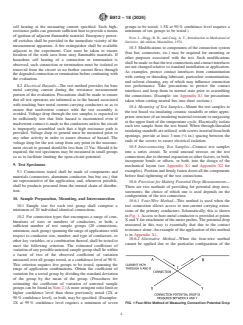
10.6.1 Four-Wire Method—This method is used when the
10.1 Sample size for each test group shall comprise a test connection allows access to non-current carrying exten-
minimum of 20 individual identical connections.
sions of the primary conductors. Schematically, this is shown
in Fig. 1. Access to bare-metal conductor is provided at points
10.2 For connection types that encompass a range of com-
X and Y for attachment of the meter probes. The potential drop
binations of sizes or numbers of conductors, or both, a
measured in this way is essentially that due to the contact
sufficient number of test sample groups (20 connections,
resistance alone. An example of the application of this method
minimum, each group) spanning the range of applications with
is in Appendix X1.
respect to conductor size, number, and type of conductors, or
10.6.2 Alternative Method—When the four-wire method
other key variables, or a combination thereof, shall be tested to
cannot be applied due to the particular configuration of the
meet the following criterion. The estimated coefficient of
variation of any possible untested sample group shall lie within
a factor of two of the observed coefficient of variation
measured over all groups tested, at a confidence level of 90 %.
This criterion requires five groups to be tested, spanning the
range of application combinations. Obtain the coefficient of
variation for a tested group by dividing the standard deviation
of the group by the mean of the group. (Procedures for
estimating the coefficient of variation of untested sample
groups can be found in Note 2.) A more stringent ratio limit or
higher confidence level than those previously noted (2X at
90 % confidence level), or both, may be specified. (Examples:
2X at 99 % confidence level requires a minimum of seven FIG. 1 Four-Wire Method of Measuring Connection Potential Drop
B812 − 18 (2024)
connection being tested, access to metallic conductor is to be conductors by thermal expansion/contraction or by mechanical
provided at points in the current path, as shown schematically handling of the test board.
in Fig. 2. The measurement access points X and Y are to be 10.9.3 Permanent Taps—To assure consistent conductor
uniformly distanced from the test connection for each sample. length between measurement points for potential drop mea-
Potential drop measured by this method includes bulk conduc- surements of the reference conductor and for connections when
tor resistance as well as contact resistance. An example of this the alternative method is used (Fig. 2 and Fig. 3), permanent
case is shown in Appendix X2. For this method, a length of taps shall be attached to the conductors. For the four-wire
reference conductor of the same material and with bulk method, (Fig. 1 and Fig. 4), permanent taps may be used at the
resistance approximately equal to the bulk resistance included connector measurement points but are not mandatory. Perma-
in the connection measurements shall be installed in the series nent taps may be pressure connections, or spot welded or
circuit of each test board. soldered. Pressure connections for this purpose may be integral
with the mechanical support provided for the measurement
10.7 Standoffs shall be used to support conductors at points
points, as is illustrated in Appendix X1 and Appendix X2. If
where potential drop measurement probes are to be applied so
welded or soldered taps are used, make a provision to assure
as to minimize the mechanical disturbance of the test connec-
that the conductor at the connection is not changed from its
tions during attachment and removal of the probes.
original (as manufactured) conditio
...