

ASTM B362-91(2020)
(Test Method)Standard Test Method for Mechanical Torque Rate of Spiral Coils of Thermostat Metal
General Information
- Abstract
SIGNIFICANCE AND USE
4.1 This test method is useful to determine the mechanical force of spiral coils of thermostat metal.
4.2 The mechanical properties of a coil may vary from lot to lot of thermostat metal material. This method is useful for determining the optimum thickness and length of the material for a given mechanical torque specification.
4.3 This test is useful as a quality test to determine acceptance or rejection of a lot of thermostat metal coils.
SCOPE
1.1 The test method covers the principles of determining the mechanical torque rate of spiral coils of thermostat metal.
Note 1: This test method has been developed particularly to cover the determination of the mechanical torque rate of spiral coils made of thermostat metal for carburetors and manifold heat controls. The method is not limited to thermostat metals and can be used for spiral coils of other materials for which the torque rate must be measured accurately.
1.2 The values stated in inch-pound units are to be regarded as the standard. The metric equivalents of inch-pound units may be approximate.
1.3 This standard does not purport to address all of the safety concerns, if any, associated with its use. It is the responsibility of the user of this standard to become familiar with all hazards including those identified in the appropriate Safety Data Sheet (SDS) for this product/material as provided by the manufacturer, to establish appropriate safety, health, and environmental practices, and determine the applicability of regulatory limitations prior to use.
1.4 This international standard was developed in accordance with internationally recognized principles on standardization established in the Decision on Principles for the Development of International Standards, Guides and Recommendations issued by the World Trade Organization Technical Barriers to Trade (TBT) Committee.
- Status
- Published
- Publication Date
- 30-Sep-2020
- Technical Committee
- B02 - Nonferrous Metals and Alloys
- Drafting Committee
- B02.10 - Thermostat Metals and Electrical Resistance Heating Materials


Overview
ASTM B362-91(2020): Standard Test Method for Mechanical Torque Rate of Spiral Coils of Thermostat Metal provides a systematic procedure for determining the mechanical torque rate of spiral coils, primarily those made from thermostat metal. Developed by ASTM International, this standard offers a valuable test method for quality assurance, material optimization, and performance validation within industries that rely on the precise mechanical properties of spiral coils. While originally developed for thermostat metals used in carburetors and manifold heat controls, ASTM B362-91(2020) is applicable to spiral coils made of any material that requires accurate torque rate measurements.
This standard is recognized globally, developed under internationally accepted guidelines, and aligns with the principles set forth by the World Trade Organization Technical Barriers to Trade (TBT) Committee.
Key Topics
- Mechanical Torque Rate Definition:
- Measures the stiffness of a spiral coil and is defined as the ratio of applied torque to the angular deflection of the coil.
- Apparatus and Methodology:
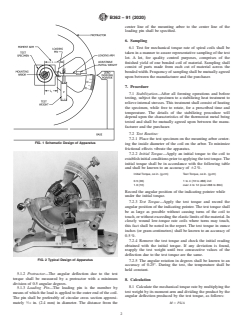
- Details on the recommended test apparatus, its components (including specimen holder, protractor, and loading pin), and procedures to ensure reliable and repeatable results.
- Testing and Reporting:
- Outlines sample preparation, stabilizing treatments, test execution, and data recording requirements.
- Emphasizes proper sampling from production lots for accurate representation.
- Significance for Quality Control:
- Enables manufacturers and purchasers to determine acceptance or rejection of thermostat metal coil lots based on mechanical performance.
- Optimization of Coil Properties:
- Provides data to select optimal material thickness and length for target mechanical torque specifications.
Applications
ASTM B362-91(2020) is instrumental in a variety of applications, particularly where mechanical torque rate is a critical property:
- Automotive Industry: Widely used for testing spiral coils in carburetors and heat control manifolds to ensure reliable engine and thermal management.
- Thermostatic Devices: Verification of coil behavior in devices like thermostats, where temperature changes must result in predictable mechanical responses.
- Quality Assurance in Manufacturing: Supports batch testing and process control for metal strip manufacturers, ensuring product consistency and compliance with mechanical requirements.
- Material Research and Selection: Assists engineers and designers in selecting appropriate combinations of material thickness and length for custom torque requirements or new applications.
- Broader Industrial Use: Relevant for any sector needing precise measurement of torque rates in spiral coils, whether metallic or composite materials.
Related Standards
To enhance your understanding and implementation of ASTM B362-91(2020), consider the following related standards:
- ASTM B388 – Standards for Thermostat Metals, often referenced for specifying material compatibility.
- ASTM E8/E8M – Standard Test Methods for Tension Testing of Metallic Materials, applicable for broader mechanical property characterization.
- ASTM E384 – Standard Test Method for Microindentation Hardness of Materials, relevant for supplementary quality assessment.
- ISO 9001 – Quality management systems standard, supporting documented control for sampling and testing processes.
- Other ASTM B-Series Standards – Covering testing and specification for nonferrous metals and metal products.
By following ASTM B362-91(2020), organizations ensure that spiral coils meet precise mechanical torque requirements, support robust quality control, and facilitate global trade by complying with internationally recognized testing methods. Regular review and application of this standard strengthen reliability within supply chains and end products across numerous industries.
Get Certified
Connect with accredited certification bodies for this standard

IMQ S.p.A. (Certification)
Italian electrical product certification.

SLG Prüf- und Zertifizierungs GmbH
German testing and certification body.

UL Solutions
Global safety science company with testing, inspection and certification.
Sponsored listings
Frequently Asked Questions
ASTM B362-91(2020) is a standard published by ASTM International. Its full title is "Standard Test Method for Mechanical Torque Rate of Spiral Coils of Thermostat Metal". This standard covers: SIGNIFICANCE AND USE 4.1 This test method is useful to determine the mechanical force of spiral coils of thermostat metal. 4.2 The mechanical properties of a coil may vary from lot to lot of thermostat metal material. This method is useful for determining the optimum thickness and length of the material for a given mechanical torque specification. 4.3 This test is useful as a quality test to determine acceptance or rejection of a lot of thermostat metal coils. SCOPE 1.1 The test method covers the principles of determining the mechanical torque rate of spiral coils of thermostat metal. Note 1: This test method has been developed particularly to cover the determination of the mechanical torque rate of spiral coils made of thermostat metal for carburetors and manifold heat controls. The method is not limited to thermostat metals and can be used for spiral coils of other materials for which the torque rate must be measured accurately. 1.2 The values stated in inch-pound units are to be regarded as the standard. The metric equivalents of inch-pound units may be approximate. 1.3 This standard does not purport to address all of the safety concerns, if any, associated with its use. It is the responsibility of the user of this standard to become familiar with all hazards including those identified in the appropriate Safety Data Sheet (SDS) for this product/material as provided by the manufacturer, to establish appropriate safety, health, and environmental practices, and determine the applicability of regulatory limitations prior to use. 1.4 This international standard was developed in accordance with internationally recognized principles on standardization established in the Decision on Principles for the Development of International Standards, Guides and Recommendations issued by the World Trade Organization Technical Barriers to Trade (TBT) Committee.
SIGNIFICANCE AND USE 4.1 This test method is useful to determine the mechanical force of spiral coils of thermostat metal. 4.2 The mechanical properties of a coil may vary from lot to lot of thermostat metal material. This method is useful for determining the optimum thickness and length of the material for a given mechanical torque specification. 4.3 This test is useful as a quality test to determine acceptance or rejection of a lot of thermostat metal coils. SCOPE 1.1 The test method covers the principles of determining the mechanical torque rate of spiral coils of thermostat metal. Note 1: This test method has been developed particularly to cover the determination of the mechanical torque rate of spiral coils made of thermostat metal for carburetors and manifold heat controls. The method is not limited to thermostat metals and can be used for spiral coils of other materials for which the torque rate must be measured accurately. 1.2 The values stated in inch-pound units are to be regarded as the standard. The metric equivalents of inch-pound units may be approximate. 1.3 This standard does not purport to address all of the safety concerns, if any, associated with its use. It is the responsibility of the user of this standard to become familiar with all hazards including those identified in the appropriate Safety Data Sheet (SDS) for this product/material as provided by the manufacturer, to establish appropriate safety, health, and environmental practices, and determine the applicability of regulatory limitations prior to use. 1.4 This international standard was developed in accordance with internationally recognized principles on standardization established in the Decision on Principles for the Development of International Standards, Guides and Recommendations issued by the World Trade Organization Technical Barriers to Trade (TBT) Committee.
ASTM B362-91(2020) is classified under the following ICS (International Classification for Standards) categories: 29.120.20 - Connecting devices. The ICS classification helps identify the subject area and facilitates finding related standards.
ASTM B362-91(2020) is available in PDF format for immediate download after purchase. The document can be added to your cart and obtained through the secure checkout process. Digital delivery ensures instant access to the complete standard document.
Standards Content (Sample)
This international standard was developed in accordance with internationally recognized principles on standardization established in the Decision on Principles for the
Development of International Standards, Guides and Recommendations issued by the World Trade Organization Technical Barriers to Trade (TBT) Committee.
Designation: B362 − 91 (Reapproved 2020)
Standard Test Method for
Mechanical Torque Rate of Spiral Coils of Thermostat Metal
This standard is issued under the fixed designation B362; the number immediately following the designation indicates the year of
original adoption or, in the case of revision, the year of last revision. A number in parentheses indicates the year of last reapproval. A
superscript epsilon (´) indicates an editorial change since the last revision or reapproval.
1. Scope 3. Summary of Test Method
1.1 The test method covers the principles of determining the
3.1 The test for mechanical torque rate of spiral coils
mechanical torque rate of spiral coils of thermostat metal.
consists of applying a torque, or moment of force, that will not
stress the material in excess of its elastic limits, to the coil and
NOTE 1—This test method has been developed particularly to cover the
determination of the mechanical torque rate of spiral coils made of measuring the resulting deflection as angular rotation. Of the
thermostat metal for carburetors and manifold heat controls. The method
several methods for obtaining this value, it is preferred that the
is not limited to thermostat metals and can be used for spiral coils of other
outer end of the spiral coil be held stationary, but not fixed, and
materials for which the torque rate must be measured accurately.
the inner end of the coil be rotated after applying a load to the
1.2 The values stated in inch-pound units are to be regarded
outer end of the coil at a fixed radius.
as the standard. The metric equivalents of inch-pound units
may be approximate.
4. Significance and Use
1.3 This standard does not purport to address all of the
4.1 This test method is useful to determine the mechanical
safety concerns, if any, associated with its use. It is the
force of spiral coils of thermostat metal.
responsibility of the user of this standard to become familiar
with all hazards including those identified in the appropriate
4.2 The mechanical properties of a coil may vary from lot to
Safety Data Sheet (SDS) for this product/material as provided
lot of thermostat metal material. This method is useful for
by the manufacturer, to establish appropriate safety, health,
determining the optimum thickness and length of the material
and environmental practices, and determine the applicability
for a given mechanical torque specification.
of regulatory limitations prior to use.
4.3 This test is useful as a quality test to determine accep-
1.4 This international standard was developed in accor-
tance or rejection of a lot of thermostat metal coils.
dance with internationally recognized principles on standard-
ization established in the Decision on Principles for the
5. Apparatus
Development of International Standards, Guides and Recom-
mendations issued by the World Trade Organization Technical
5.1 The determination of the mechanical torque rate of
Barriers to Trade (TBT) Committee.
spiral coils is subject to many variables and is sensitive to the
degree that even different apparatus employing the same test
2. Terminology
principles will give different results. Therefore it is recom-
2.1 thermostat metal, n—a composite material, usually in
mended that the apparatus be standardized. The apparatus
the form of sheet or strip, comprising two or more materials of
shown in Fig. 1 and Fig. 2 and consisting essentially of the
any appropriate nature, metallic or otherwise, that, by virtue of
following components, has been found satisfactory:
the differing expansivities of the components, tends to alter its
5.1.1 Specimen Holder—A specimen holder shall provide
curvature when its temperature is changed.
for securely holding the inner end of the test specimen.
2.2 mechanical torque rate, n—the ratio of torque to deflec-
Preferably, the holder or mounting arbor shall be of circular
tion. It is a measure of the stiffness of the coil and may have the
cross section whose diameter is as large as possible without
units of ounce inch or gram centimetre per angular degree.
touching the inner turn of the coil under any test conditions of
load. The end of the arbor shall be slotted entirely across its
2.3 spiral coil, n—a part made by winding strip on itself.
diameter, to a depth greater than the width of the specimen, and
of a width slightly narrower than the thickness of the specimen.
Thus, the inner tab will be a push or snug fit in the slot for its
This test method is under the jurisdiction of ASTM Committee B02 on
Nonferrous Metals and Alloys and is the direct responsibility of Subcommittee
entire width. The edges of the slot shall be sharp where it
B02.10 on Thermostat Metals and Electrical Resistance Heating Materials.
intersects the circumference of the arbor. The slot shall be so
Current edition approved Oct. 1, 2020. Published October 2020. Originally
positioned in the arbor that the center of rotation of the arbor
approved in 1960. Last previous edition approved in 2016 as B362 – 91 (2016).
DOI: 10.1520/B0362-91R20. and the coil will coincide.
Copyright © ASTM International, 100 Barr Harbor Drive, PO Box C700, West Conshohocken, PA 19428-2959. United S
...