

ASTM B854-98(2022)
(Guide)Standard Guide for Measuring Electrical Contact Intermittences
General Information
- Abstract
SIGNIFICANCE AND USE
4.1 This guide suggests techniques to evaluate intermittences in a contact pair while it is subjected to simulated or actual environmental stress. Such measurements are a valuable tool in predicting circuit performance under these stress conditions and in diagnosing observed problems in circuit function under such conditions.
4.2 This document is intended to provide some general guidance on the best available practices for detecting, quantifying, characterizing and reporting short duration intermittences in circuits containing electrical contacts. Certain environmental stresses such as mechanical shock, vibration or temperature change may cause intermittences. These measurement procedures include methods applicable to contacts operating under various conditions in testing or in service.
4.3 Practice B615 defines methods for measuring electrical contact noise in sliding electrical contacts. In contrast Guide B854 provides guidance to the various methods for measuring similar phenomena in static contacts.
SCOPE
1.1 The techniques described in this guide apply to electrical circuits that include one or more electrical contacts in devices such as slip rings, separable connectors, electromechanical relays or closed switch contacts. The user should determine applicability for other devices.
1.2 The range of techniques described apply to circuit discontinuities (intermittences) of durations ranging from approximately 10 nanoseconds to several seconds and of sufficient magnitude to cause alteration of the circuit function. Extension of the guide to shorter duration events may be possible with suitable instrumentation. Events of longer duration may be monitored by techniques for dc measurements such as those described in Test Methods B539 or by adaptation of methods described in this guide.
1.3 The techniques described in this guide apply to electrical circuits carrying currents typical of signal circuits. Such currents are generally less than 100 ma. Extension of these techniques to circuits carrying larger currents may be possible, but the user should evaluate applicability first.
1.4 This standard does not purport to address all of the safety concerns, if any, associated with its use. It is the responsibility of the user of this standard to become familiar with all hazards including those identified in the appropriate Safety Data Sheet (SDS) for this product/material as provided by the manufacturer, to establish appropriate safety, health, and environmental practices, and determine the applicability of regulatory limitations prior to use.
1.5 This international standard was developed in accordance with internationally recognized principles on standardization established in the Decision on Principles for the Development of International Standards, Guides and Recommendations issued by the World Trade Organization Technical Barriers to Trade (TBT) Committee.
- Status
- Published
- Publication Date
- 31-Mar-2022
- Technical Committee
- B02 - Nonferrous Metals and Alloys

Overview
ASTM B854-98(2022), Standard Guide for Measuring Electrical Contact Intermittences, provides comprehensive guidance on detecting, characterizing, and reporting short-duration circuit discontinuities, known as electrical contact intermittences. These guidelines help evaluate the performance and reliability of electrical contacts under environmental stresses such as mechanical shock, vibration, or temperature change. The standard applies to devices with one or more electrical contacts, including slip rings, separable connectors, electromechanical relays, and closed switch contacts operating with currents typical of signal circuits.
By following ASTM B854, engineers and quality professionals can predict circuit performance under stress, diagnose reliability issues, and adopt best practices for testing and reporting electrical intermittence phenomena.
Key Topics
Measuring Electrical Contact Intermittence
- Definition of Intermittence: A transient voltage increase across a pair of electrical contacts, which may cause disruption of circuit function.
- Applicable Duration Range: Techniques address events from approximately 10 nanoseconds up to several seconds.
- Environmental Stress Factors: Procedures cover intermittences triggered by mechanical shock, vibration, and rapid temperature changes.
- Instrument Selection: Guidance on choosing and configuring test apparatus such as oscilloscopes, custom circuitry, event detectors, and bit error rate detectors, matched to the duration and magnitude of interest.
- Measurement Best Practices: Recommendations include minimizing noise interference, proper shielding, control experiments to verify data integrity, and ensuring accurate cabling.
Methods for Detection
- Oscilloscope Method: For detailed analysis of voltage or resistance changes over time across one or several contacts.
- Custom Circuitry: Enables simulation of real application conditions or the use of specialized measurement components.
- Commercial Event Detectors: Suitable for monitoring multiple contacts, enabling threshold settings for event detection and recording.
- Bit Error Rate Testing: Monitors circuit quality by transmitting digital signals and measuring error rates under stress.
Applications
The techniques recommended in ASTM B854-98(2022) are widely used across industries where circuit reliability is critical:
- Connector and Relay Testing: Evaluate the durability and reliability of connectors, slip rings, and relay contacts in aerospace, automotive, telecommunications, and industrial control systems.
- Environmental Qualification: Assess the impact of harsh operating conditions on switch and connector performance to ensure compliance with reliability standards.
- Quality Control in Manufacturing: Implement intermittence measurement procedures to detect potential weaknesses in electrical assemblies before deployment.
- Root Cause Analysis: Diagnose and resolve issues in malfunctioning circuits by identifying and characterizing intermittent contact problems.
- Product Validation: Support qualification processes by providing objective data on the electrical integrity of components under realistic service or test conditions.
Related Standards
ASTM B854-98(2022) references and aligns with several other international and ASTM standards, contributing to a comprehensive approach for contact reliability and electrical testing:
- ASTM B539: Test Methods for Measuring Resistance of Electrical Connections (Static Contacts)
- ASTM B542: Terminology Relating to Electrical Contacts and Their Use
- ASTM B615: Practice for Measuring Electrical Contact Noise in Sliding Electrical Contacts
- ASTM B878: Test Method for Nanosecond Event Detection for Electrical Contacts and Connectors
- IEC 512 Test 2e: Contact Disturbance
- EIA-364-46: Continuity Test Procedure for Electrical Connectors
By integrating ASTM B854-98(2022) with these related standards, organizations can ensure robust and repeatable measurement of electrical contact intermittence, supporting product quality and reliability in demanding applications.
Keywords: electrical contact intermittence, intermittence measurement, contact reliability, ASTM B854, environmental stress testing, electrical connectors, oscilloscopes, event detectors, bit error rate, circuit discontinuity, quality assurance.
Relations
- Effective Date
- 01-Nov-2019
- Effective Date
- 01-Nov-2018
- Effective Date
- 01-Oct-2014
- Effective Date
- 01-Aug-2013
- Effective Date
- 01-Feb-2013
- Effective Date
- 01-Oct-2011
- Effective Date
- 15-Apr-2009
- Effective Date
- 01-Mar-2008
- Effective Date
- 01-May-2007
- Effective Date
- 01-Jun-2006
- Effective Date
- 01-May-2004
- Effective Date
- 10-Jun-2003
- Effective Date
- 10-May-2002
- Effective Date
- 10-May-2002
- Effective Date
- 10-Oct-2000
Get Certified
Connect with accredited certification bodies for this standard

IMQ S.p.A. (Certification)
Italian electrical product certification.

SLG Prüf- und Zertifizierungs GmbH
German testing and certification body.

UL Solutions
Global safety science company with testing, inspection and certification.
Sponsored listings
Frequently Asked Questions
ASTM B854-98(2022) is a guide published by ASTM International. Its full title is "Standard Guide for Measuring Electrical Contact Intermittences". This standard covers: SIGNIFICANCE AND USE 4.1 This guide suggests techniques to evaluate intermittences in a contact pair while it is subjected to simulated or actual environmental stress. Such measurements are a valuable tool in predicting circuit performance under these stress conditions and in diagnosing observed problems in circuit function under such conditions. 4.2 This document is intended to provide some general guidance on the best available practices for detecting, quantifying, characterizing and reporting short duration intermittences in circuits containing electrical contacts. Certain environmental stresses such as mechanical shock, vibration or temperature change may cause intermittences. These measurement procedures include methods applicable to contacts operating under various conditions in testing or in service. 4.3 Practice B615 defines methods for measuring electrical contact noise in sliding electrical contacts. In contrast Guide B854 provides guidance to the various methods for measuring similar phenomena in static contacts. SCOPE 1.1 The techniques described in this guide apply to electrical circuits that include one or more electrical contacts in devices such as slip rings, separable connectors, electromechanical relays or closed switch contacts. The user should determine applicability for other devices. 1.2 The range of techniques described apply to circuit discontinuities (intermittences) of durations ranging from approximately 10 nanoseconds to several seconds and of sufficient magnitude to cause alteration of the circuit function. Extension of the guide to shorter duration events may be possible with suitable instrumentation. Events of longer duration may be monitored by techniques for dc measurements such as those described in Test Methods B539 or by adaptation of methods described in this guide. 1.3 The techniques described in this guide apply to electrical circuits carrying currents typical of signal circuits. Such currents are generally less than 100 ma. Extension of these techniques to circuits carrying larger currents may be possible, but the user should evaluate applicability first. 1.4 This standard does not purport to address all of the safety concerns, if any, associated with its use. It is the responsibility of the user of this standard to become familiar with all hazards including those identified in the appropriate Safety Data Sheet (SDS) for this product/material as provided by the manufacturer, to establish appropriate safety, health, and environmental practices, and determine the applicability of regulatory limitations prior to use. 1.5 This international standard was developed in accordance with internationally recognized principles on standardization established in the Decision on Principles for the Development of International Standards, Guides and Recommendations issued by the World Trade Organization Technical Barriers to Trade (TBT) Committee.
SIGNIFICANCE AND USE 4.1 This guide suggests techniques to evaluate intermittences in a contact pair while it is subjected to simulated or actual environmental stress. Such measurements are a valuable tool in predicting circuit performance under these stress conditions and in diagnosing observed problems in circuit function under such conditions. 4.2 This document is intended to provide some general guidance on the best available practices for detecting, quantifying, characterizing and reporting short duration intermittences in circuits containing electrical contacts. Certain environmental stresses such as mechanical shock, vibration or temperature change may cause intermittences. These measurement procedures include methods applicable to contacts operating under various conditions in testing or in service. 4.3 Practice B615 defines methods for measuring electrical contact noise in sliding electrical contacts. In contrast Guide B854 provides guidance to the various methods for measuring similar phenomena in static contacts. SCOPE 1.1 The techniques described in this guide apply to electrical circuits that include one or more electrical contacts in devices such as slip rings, separable connectors, electromechanical relays or closed switch contacts. The user should determine applicability for other devices. 1.2 The range of techniques described apply to circuit discontinuities (intermittences) of durations ranging from approximately 10 nanoseconds to several seconds and of sufficient magnitude to cause alteration of the circuit function. Extension of the guide to shorter duration events may be possible with suitable instrumentation. Events of longer duration may be monitored by techniques for dc measurements such as those described in Test Methods B539 or by adaptation of methods described in this guide. 1.3 The techniques described in this guide apply to electrical circuits carrying currents typical of signal circuits. Such currents are generally less than 100 ma. Extension of these techniques to circuits carrying larger currents may be possible, but the user should evaluate applicability first. 1.4 This standard does not purport to address all of the safety concerns, if any, associated with its use. It is the responsibility of the user of this standard to become familiar with all hazards including those identified in the appropriate Safety Data Sheet (SDS) for this product/material as provided by the manufacturer, to establish appropriate safety, health, and environmental practices, and determine the applicability of regulatory limitations prior to use. 1.5 This international standard was developed in accordance with internationally recognized principles on standardization established in the Decision on Principles for the Development of International Standards, Guides and Recommendations issued by the World Trade Organization Technical Barriers to Trade (TBT) Committee.
ASTM B854-98(2022) is classified under the following ICS (International Classification for Standards) categories: 29.120.20 - Connecting devices. The ICS classification helps identify the subject area and facilitates finding related standards.
ASTM B854-98(2022) has the following relationships with other standards: It is inter standard links to ASTM B542-13(2019), ASTM B539-18, ASTM B878-97(2014), ASTM B539-02(2013), ASTM B542-13, ASTM B615-79(2011), ASTM B878-97(2009), ASTM B539-02(2008), ASTM B542-07, ASTM B615-79(2006), ASTM B542-04, ASTM B878-97(2003), ASTM B539-02, ASTM B539-02e1, ASTM B542-00. Understanding these relationships helps ensure you are using the most current and applicable version of the standard.
ASTM B854-98(2022) is available in PDF format for immediate download after purchase. The document can be added to your cart and obtained through the secure checkout process. Digital delivery ensures instant access to the complete standard document.
Standards Content (Sample)
This international standard was developed in accordance with internationally recognized principles on standardization established in the Decision on Principles for the
Development of International Standards, Guides and Recommendations issued by the World Trade Organization Technical Barriers to Trade (TBT) Committee.
Designation: B854 − 98 (Reapproved 2022)
Standard Guide for
Measuring Electrical Contact Intermittences
This standard is issued under the fixed designation B854; the number immediately following the designation indicates the year of
original adoption or, in the case of revision, the year of last revision. A number in parentheses indicates the year of last reapproval. A
superscript epsilon (´) indicates an editorial change since the last revision or reapproval.
This standard has been approved for use by agencies of the U.S. Department of Defense.
1. Scope 2. Referenced Documents
2.1 ASTM Standards:
1.1 The techniques described in this guide apply to electri-
B539 Test Methods for Measuring Resistance of Electrical
cal circuits that include one or more electrical contacts in
Connections (Static Contacts)
devices such as slip rings, separable connectors, electrome-
B542 Terminology Relating to Electrical Contacts and Their
chanical relays or closed switch contacts. The user should
Use
determine applicability for other devices.
B615 Practice for Measuring Electrical Contact Noise in
1.2 The range of techniques described apply to circuit
Sliding Electrical Contacts
discontinuities (intermittences) of durations ranging from ap-
B878 Test Method for Nanosecond Event Detection for
proximately 10 nanoseconds to several seconds and of suffi-
Electrical Contacts and Connectors
cient magnitude to cause alteration of the circuit function.
2.2 Other Documents:
Extension of the guide to shorter duration events may be
IEC Publication 512 Test 2e Contact Disturbance
possible with suitable instrumentation. Events of longer dura-
EIA-364-46 Continuity Test Procedure for Electrical Con-
tion may be monitored by techniques for dc measurements
nectors
such as those described in Test Methods B539 or by adaptation
of methods described in this guide.
3. Terminology
1.3 The techniques described in this guide apply to electri-
3.1 Terms relevant to this guide are defined in Terminology
cal circuits carrying currents typical of signal circuits. Such
B542 except as noted in the following section.
currents are generally less than 100 ma. Extension of these
3.2 Definitions of Terms Specific to This Standard:
techniques to circuits carrying larger currents may be possible,
3.2.1 intermittence, n—a transient increase in the voltage
but the user should evaluate applicability first.
drop across a pair of electrical contacts.
1.4 This standard does not purport to address all of the
4. Significance and Use
safety concerns, if any, associated with its use. It is the
responsibility of the user of this standard to become familiar
4.1 This guide suggests techniques to evaluate intermit-
with all hazards including those identified in the appropriate
tences in a contact pair while it is subjected to simulated or
Safety Data Sheet (SDS) for this product/material as provided
actual environmental stress. Such measurements are a valuable
by the manufacturer, to establish appropriate safety, health,
tool in predicting circuit performance under these stress
and environmental practices, and determine the applicability
conditions and in diagnosing observed problems in circuit
of regulatory limitations prior to use.
function under such conditions.
1.5 This international standard was developed in accor-
4.2 This document is intended to provide some general
dance with internationally recognized principles on standard-
guidance on the best available practices for detecting,
ization established in the Decision on Principles for the
quantifying, characterizing and reporting short duration inter-
Development of International Standards, Guides and Recom-
mittences in circuits containing electrical contacts. Certain
mendations issued by the World Trade Organization Technical
environmental stresses such as mechanical shock, vibration or
Barriers to Trade (TBT) Committee.
For referenced ASTM standards, visit the ASTM website, www.astm.org, or
contact ASTM Customer Service at service@astm.org. For Annual Book of ASTM
This guide is under the jurisdiction of ASTM Committee B02 on Nonferrous Standards volume information, refer to the standard’s Document Summary page on
Metals and Alloys and is the direct responsibility of Subcommittee B02.05 on the ASTM website.
Precious Metals and Electrical Contact Materials and Test Methods. Available from American National Standards Institute (ANSI), 25 W. 43rd St.,
Current edition approved April 1, 2022. Published April 2022. Originally 4th Floor, New York, NY 10036, http://www.ansi.org.
approved in 1998. Last previous edition approved in 2016 as B854 – 98 (2016). Available from Electronic Industries Association, 2001 Pennsylvania Ave NW,
DOI: 10.1520/B0854-98R22. Washington D.C. 20006.
Copyright © ASTM International, 100 Barr Harbor Drive, PO Box C700, West Conshohocken, PA 19428-2959. United States
B854 − 98 (2022)
temperature change may cause intermittences. These measure-
ment procedures include methods applicable to contacts oper-
ating under various conditions in testing or in service.
4.3 Practice B615 defines methods for measuring electrical
contact noise in sliding electrical contacts. In contrast Guide
B854 provides guidance to the various methods for measuring
similar phenomena in static contacts.
5. Apparatus
5.1 General Comments—The apparatus required varies de-
pending upon the technique selected and the parameters (such
FIG. 1 Schematic Representation of Oscilloscope Method
as duration and magnitude) of the intermittence that the user
wants to detect. In general, the cabling must be capable of
carrying signals of the speed to be detected in the study, and
must be isolated from sources of noise that may cause false
6.1.2 Is it necessary to monitor more than one contact
indications.
simultaneously? If so, is it acceptable to connect the contacts in
5.2 Special Precautions for Measurements Involving Events
series? If contacts cannot be connected in series, how many
Less than 1 Microsecond in Duration—Detection of events of
contacts must be measured simultaneously?
duration less than 1 microsecond will require special attention
6.2 Test results should be reported in a format appropriate
to the wiring of the detection circuits and instrumentation.
for the application and consistent with the format supplied by
Such attention may include using coaxial cable, shielding the
the test instrument.
apparatus from interferences and minimizing cable lengths.
6.3 Oscilloscope—In this method, an oscilloscope is wired
5.3 Specific Apparatus—The apparatus required will vary
to monitor the potential across the contact(s) of interest while
depending upon the measurement method selected and the
a signal is passed through the contacts. Standards such as IEC
environmental stresses imposed during the test.
Publication 512, Test 2e or EIA-364-46 are often implemented
using this method. Practice B615 provides a specific circuit
6. Procedure
that uses this method. Examples of the use of this method are
6.1 General Comments—The following sections describe,
shown in the reference by Currence and Rhoades.
in general terms, several methods that have been used to detect
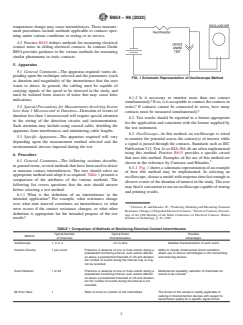
6.3.1 Fig. 1 shows a schematic representation of an example
or measure contact intermittences. The user should select an
of how this method may be implemented. In selecting an
appropriate method and adapt it as required. Table 1 presents a
oscilloscope, choose a model with response time fast enough to
comparison of the attributes of the various methods. The
observe events of the duration of interest in the study. The user
following list covers questions that the user should answer
may find it convenient to use an oscilloscope capable of storing
before selecting a test method.
and printing results.
6.1.1 What is the definition of an intermittence in the
intended application? For example, what resistance change
over what time interval constitutes an intermittence, or what
Currence, R. and Rhoades, W., “Predicting, Modeling and Measuring Transient
error occurs if the contact resistance changes, or what other
Resistance Changes of Degraded Electrical Contacts,” Electrical Contacts, Proceed-
definition is appropriate for the intended purpose of the test
ings of the 29th Meeting of the Holm Conference on Electrical Contacts, Illinois
results? Institute of Technology, p. 81, 1983.
TABLE 1 Comparison of Methods of Monitoring Electrical Contact Intermittences
Typical Number Typical Event Possible
Method
of Channels Characterization Advantages
Oscilloscope 1, 2 or 4 ΔV vs time Detailed characterization of each event
Custom Circuitry 1 per circuit Presence or absence of one or more events during a Ability to closely model actual circuit conditions,
preselected monitoring interval, such events defined allows use of various technologies in the transmitting
as above a preselected threshold of ΔR and duration, and receiving devices
the number of events during the interval may or may
not be recorded.
Event Detector 1 to 64 Presence or absence of one or more events during a Multichannel capability, selection of thresholds
...