


ASTM D2846/D2846M-24
(Specification)Standard Specification for Chlorinated Poly(Vinyl Chloride) (CPVC) Plastic Hot- and Cold-Water Distribution Systems
Standard Specification for Chlorinated Poly(Vinyl Chloride) (CPVC) Plastic Hot- and Cold-Water Distribution Systems
ABSTRACT
This specification covers requirements, test methods, and methods of marking for chlorinated poly(vinyl chloride) plastic hot- and cold-water distribution system components made in one standard dimension ratio and intended for water service up to a certain temperature. These components comprise pipe and tubing, socket-type fittings, street fittings, plastic-to-metal transition fittings, solvent cements, and adhesives. The components are intended for use in residential and commercial, hot and cold, potable water distribution systems. The products covered by this specification are intended for use with the distribution of pressurized liquids only, which are chemically compatible with the piping materials. CPVC 4120 pipe, tubing, and fittings shall be classified by a single standard dimension ratio which shall be SDR 11, by a certain maximum continuous use temperature and by a certain diameter range for nominal pipe or tubing. CPVC plastic-to-metal transition fittings intended for use up a certain temperature are classified on the basis of resistance to failure by thermocycling. The chlorinated poly(vinyl chloride) plastics are categorized by two criteria: basic short-term properties and long-term hydrostatic strength. These short-term properties include mechanical strength, heat resistance, flammability, and chemical resistance which shall be determined after performing different tests. A test shall also be conducted in order to determine the long-term hydrostatic strength of CPVC 41 pipe, tubing, and fittings.
SCOPE
1.1 This specification covers requirements, test methods, assembly, and methods of marking for chlorinated poly(vinyl chloride) plastic hot- and cold-water distribution system components made in one standard dimension ratio and intended for water service up to and including 180 °F (82 °C). These components comprise pipe and tubing, socket-type fittings, street fittings, plastic-to-metal transition fittings, solvent cements, and adhesives. Requirements and methods of test are included for materials, workmanship, dimensions and tolerances, hydrostatic sustained pressure strength, and thermocycling resistance. The components covered by this specification are intended for use in residential and commercial, hot and cold, potable water distribution systems.
1.2 The products covered by this specification are intended for use with the distribution of pressurized liquids only, which are chemically compatible with the piping materials. Due to inherent hazards associated with testing components and systems with compressed air or other compressed gases some manufacturers do not allow pneumatic testing of their products. Consult with specific product/component manufacturers for their specific testing procedures prior to pneumatic testing.
Note 1: Pressurized (compressed) air or other compressed gases contain large amounts of stored energy which present serious safety hazards should a system fail for any reason.
1.3 The text of this specification references notes, footnotes, and appendixes which provide explanatory material. These notes and footnotes (excluding those in tables and figures) shall not be considered as requirements of the specification.
1.4 The values stated in either SI units or inch-pound units are to be regarded separately as standard. The values stated in each system may not be exact equivalents; therefore, each system shall be used independently of the other. Combining values from the two systems may result in non-conformance with the standard.
Note 2: Suggested hydrostatic design stresses and hydrostatic pressure ratings for pipe, tubing, and fittings are listed in Appendix X1. Design and installation considerations are discussed in Appendix X2. An optional performance qualification and an in-plant quality control program are recommended in Appendix X3.
1.5 The following safety hazards caveat pertains only to the test method portion, Sections 9 and 10, of this specificat...
General Information
- Status
- Published
- Publication Date
- 31-Mar-2024
- Technical Committee
- F17 - Plastic Piping Systems
- Drafting Committee
- F17.61 - Water
Relations
- Effective Date
- 01-Apr-2024
- Effective Date
- 01-Apr-2024
- Effective Date
- 01-Apr-2024
- Effective Date
- 01-Apr-2024
- Effective Date
- 01-Apr-2024
Overview
ASTM D2846/D2846M-24 is the internationally recognized standard specification for chlorinated poly(vinyl chloride) (CPVC) plastic hot- and cold-water distribution systems developed by ASTM International. This standard covers the requirements, test methods, and marking procedures for components made from CPVC that are intended for potable hot and cold water distribution. The specification applies to pipes, tubing, socket-type fittings, street fittings, transition fittings (plastic-to-metal), solvent cements, and adhesives, all produced to a single standard dimension ratio (SDR 11) for service temperatures up to 180 °F (82 °C).
Key Topics
Scope and Coverage
- Defines dimensional, physical, and performance requirements for CPVC water distribution system components.
- Establishes test methods for hydrostatic sustained pressure strength, thermocycling resistance, flattening, and workmanship.
- Offers guidance for marking and assembly, as well as criteria related to safety and compliance.
Material Classification
- CPVC components are classified by short-term properties (mechanical strength, heat resistance, flammability, and chemical resistance) and long-term hydrostatic strength.
- All pipes, tubing, and fittings must meet the SDR 11 specification and maintain performance at temperatures up to 180 °F (82 °C).
Product Types
- Pipes and tubing ranging in nominal size from 1/4 inch to 2 inches (9.5 mm to 50 mm).
- Fittings (socket-type and street fittings), plastic-to-metal transition fittings, solvent cements, and adhesives.
Testing and Quality Assurance
- Specifies test methods referenced from standards such as ASTM D1598, D1599, D1784, D2122, D2444, and D2837.
- Includes hydrostatic design stresses, hydrostatic pressure ratings, drying times for joint assemblies, and thermocycling protocols.
Safety Considerations
- Components covered are intended strictly for distribution of pressurized liquids compatible with CPVC materials.
- Warning against pneumatic testing due to risks associated with pressurized air or gases.
Applications
Residential Water Systems
- Used for hot- and cold-potable water distribution in homes and apartment buildings.
- Integrates with water heaters and home plumbing fixtures.
Commercial Water Distribution
- Suitable for potable water supply in offices, hotels, schools, and other commercial properties.
- Applies to any potable water system requiring CPVC piping capable of continuous operation at up to 180 °F (82 °C).
Retrofit and Renovation
- Frequently used in system upgrades where corrosion resistance, ease of installation, and thermal performance are critical.
- Transition fittings allow for integration with metal piping networks.
Plumbing Installations
- Ideal for applications where regular exposure to varying temperatures and water quality may occur.
Related Standards
- ASTM D1598: Test Method for Time-to-Failure of Plastic Pipe Under Constant Internal Pressure
- ASTM D1599: Test Method for Resistance to Short-Time Hydraulic Pressure of Plastic Pipe, Tubing, and Fittings
- ASTM D1784: Classification System for Rigid Poly(Vinyl Chloride) (PVC) Compounds and Chlorinated Poly(Vinyl Chloride) (CPVC) Compounds
- ASTM D2122: Test Method for Determining Dimensions of Thermoplastic Pipe and Fittings
- ASTM D2444: Practice for Determination of Impact Resistance of Thermoplastic Pipe and Fittings by Means of a Tup (Falling Weight)
- ASTM F493: Specification for Solvent Cements for Chlorinated Poly(Vinyl Chloride) (CPVC) Plastic Pipe and Fittings
- NSF Standard 14: Plastic Piping System Components and Related Materials
- NSF Standard 61: Drinking Water System Components - Health Effects
- UL 1738: Standard for Venting Systems for Gas-Burning Appliances
Practical Value
Adhering to ASTM D2846/D2846M-24 ensures consistent quality, safety, and performance of CPVC hot and cold water distribution systems. It is essential for manufacturers, specifiers, plumbing contractors, and inspectors dedicated to providing reliable potable water solutions in both residential and commercial settings. The standard supports compliance with international building codes and plumbing regulations, helping to ensure safe and long-lasting service life for CPVC piping systems.
By following this standard, industry professionals uphold best practices in installation, inspection, and maintenance of CPVC water distribution networks.
Buy Documents
ASTM D2846/D2846M-24 - Standard Specification for Chlorinated Poly(Vinyl Chloride) (CPVC) Plastic Hot- and Cold-Water Distribution Systems
REDLINE ASTM D2846/D2846M-24 - Standard Specification for Chlorinated Poly(Vinyl Chloride) (CPVC) Plastic Hot- and Cold-Water Distribution Systems
Get Certified
Connect with accredited certification bodies for this standard

Institut za varilstvo d.o.o. (Welding Institute)
Slovenia's leading welding institute since 1952. ISO 3834, EN 1090, pressure equipment certification, NDT personnel, welder qualification. Only IIW Au
Sponsored listings
Frequently Asked Questions
ASTM D2846/D2846M-24 is a technical specification published by ASTM International. Its full title is "Standard Specification for Chlorinated Poly(Vinyl Chloride) (CPVC) Plastic Hot- and Cold-Water Distribution Systems". This standard covers: ABSTRACT This specification covers requirements, test methods, and methods of marking for chlorinated poly(vinyl chloride) plastic hot- and cold-water distribution system components made in one standard dimension ratio and intended for water service up to a certain temperature. These components comprise pipe and tubing, socket-type fittings, street fittings, plastic-to-metal transition fittings, solvent cements, and adhesives. The components are intended for use in residential and commercial, hot and cold, potable water distribution systems. The products covered by this specification are intended for use with the distribution of pressurized liquids only, which are chemically compatible with the piping materials. CPVC 4120 pipe, tubing, and fittings shall be classified by a single standard dimension ratio which shall be SDR 11, by a certain maximum continuous use temperature and by a certain diameter range for nominal pipe or tubing. CPVC plastic-to-metal transition fittings intended for use up a certain temperature are classified on the basis of resistance to failure by thermocycling. The chlorinated poly(vinyl chloride) plastics are categorized by two criteria: basic short-term properties and long-term hydrostatic strength. These short-term properties include mechanical strength, heat resistance, flammability, and chemical resistance which shall be determined after performing different tests. A test shall also be conducted in order to determine the long-term hydrostatic strength of CPVC 41 pipe, tubing, and fittings. SCOPE 1.1 This specification covers requirements, test methods, assembly, and methods of marking for chlorinated poly(vinyl chloride) plastic hot- and cold-water distribution system components made in one standard dimension ratio and intended for water service up to and including 180 °F (82 °C). These components comprise pipe and tubing, socket-type fittings, street fittings, plastic-to-metal transition fittings, solvent cements, and adhesives. Requirements and methods of test are included for materials, workmanship, dimensions and tolerances, hydrostatic sustained pressure strength, and thermocycling resistance. The components covered by this specification are intended for use in residential and commercial, hot and cold, potable water distribution systems. 1.2 The products covered by this specification are intended for use with the distribution of pressurized liquids only, which are chemically compatible with the piping materials. Due to inherent hazards associated with testing components and systems with compressed air or other compressed gases some manufacturers do not allow pneumatic testing of their products. Consult with specific product/component manufacturers for their specific testing procedures prior to pneumatic testing. Note 1: Pressurized (compressed) air or other compressed gases contain large amounts of stored energy which present serious safety hazards should a system fail for any reason. 1.3 The text of this specification references notes, footnotes, and appendixes which provide explanatory material. These notes and footnotes (excluding those in tables and figures) shall not be considered as requirements of the specification. 1.4 The values stated in either SI units or inch-pound units are to be regarded separately as standard. The values stated in each system may not be exact equivalents; therefore, each system shall be used independently of the other. Combining values from the two systems may result in non-conformance with the standard. Note 2: Suggested hydrostatic design stresses and hydrostatic pressure ratings for pipe, tubing, and fittings are listed in Appendix X1. Design and installation considerations are discussed in Appendix X2. An optional performance qualification and an in-plant quality control program are recommended in Appendix X3. 1.5 The following safety hazards caveat pertains only to the test method portion, Sections 9 and 10, of this specificat...
ABSTRACT This specification covers requirements, test methods, and methods of marking for chlorinated poly(vinyl chloride) plastic hot- and cold-water distribution system components made in one standard dimension ratio and intended for water service up to a certain temperature. These components comprise pipe and tubing, socket-type fittings, street fittings, plastic-to-metal transition fittings, solvent cements, and adhesives. The components are intended for use in residential and commercial, hot and cold, potable water distribution systems. The products covered by this specification are intended for use with the distribution of pressurized liquids only, which are chemically compatible with the piping materials. CPVC 4120 pipe, tubing, and fittings shall be classified by a single standard dimension ratio which shall be SDR 11, by a certain maximum continuous use temperature and by a certain diameter range for nominal pipe or tubing. CPVC plastic-to-metal transition fittings intended for use up a certain temperature are classified on the basis of resistance to failure by thermocycling. The chlorinated poly(vinyl chloride) plastics are categorized by two criteria: basic short-term properties and long-term hydrostatic strength. These short-term properties include mechanical strength, heat resistance, flammability, and chemical resistance which shall be determined after performing different tests. A test shall also be conducted in order to determine the long-term hydrostatic strength of CPVC 41 pipe, tubing, and fittings. SCOPE 1.1 This specification covers requirements, test methods, assembly, and methods of marking for chlorinated poly(vinyl chloride) plastic hot- and cold-water distribution system components made in one standard dimension ratio and intended for water service up to and including 180 °F (82 °C). These components comprise pipe and tubing, socket-type fittings, street fittings, plastic-to-metal transition fittings, solvent cements, and adhesives. Requirements and methods of test are included for materials, workmanship, dimensions and tolerances, hydrostatic sustained pressure strength, and thermocycling resistance. The components covered by this specification are intended for use in residential and commercial, hot and cold, potable water distribution systems. 1.2 The products covered by this specification are intended for use with the distribution of pressurized liquids only, which are chemically compatible with the piping materials. Due to inherent hazards associated with testing components and systems with compressed air or other compressed gases some manufacturers do not allow pneumatic testing of their products. Consult with specific product/component manufacturers for their specific testing procedures prior to pneumatic testing. Note 1: Pressurized (compressed) air or other compressed gases contain large amounts of stored energy which present serious safety hazards should a system fail for any reason. 1.3 The text of this specification references notes, footnotes, and appendixes which provide explanatory material. These notes and footnotes (excluding those in tables and figures) shall not be considered as requirements of the specification. 1.4 The values stated in either SI units or inch-pound units are to be regarded separately as standard. The values stated in each system may not be exact equivalents; therefore, each system shall be used independently of the other. Combining values from the two systems may result in non-conformance with the standard. Note 2: Suggested hydrostatic design stresses and hydrostatic pressure ratings for pipe, tubing, and fittings are listed in Appendix X1. Design and installation considerations are discussed in Appendix X2. An optional performance qualification and an in-plant quality control program are recommended in Appendix X3. 1.5 The following safety hazards caveat pertains only to the test method portion, Sections 9 and 10, of this specificat...
ASTM D2846/D2846M-24 is classified under the following ICS (International Classification for Standards) categories: 23.040.20 - Plastics pipes. The ICS classification helps identify the subject area and facilitates finding related standards.
ASTM D2846/D2846M-24 has the following relationships with other standards: It is inter standard links to ASTM D2846/D2846M-19a, ASTM F493-22, ASTM F412-23, ASTM F1970-23, ASTM F2855-19(2024). Understanding these relationships helps ensure you are using the most current and applicable version of the standard.
ASTM D2846/D2846M-24 is available in PDF format for immediate download after purchase. The document can be added to your cart and obtained through the secure checkout process. Digital delivery ensures instant access to the complete standard document.
Standards Content (Sample)
This international standard was developed in accordance with internationally recognized principles on standardization established in the Decision on Principles for the
Development of International Standards, Guides and Recommendations issued by the World Trade Organization Technical Barriers to Trade (TBT) Committee.
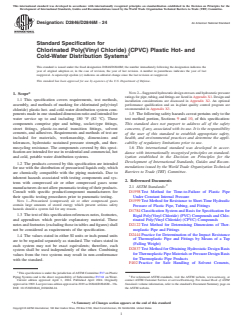
Designation: D2846/D2846M − 24 An American National Standard
Standard Specification for
Chlorinated Poly(Vinyl Chloride) (CPVC) Plastic Hot- and
Cold-Water Distribution Systems
This standard is issued under the fixed designation D2846/D2846M; the number immediately following the designation indicates the
year of original adoption or, in the case of revision, the year of last revision. A number in parentheses indicates the year of last
reapproval. A superscript epsilon (´) indicates an editorial change since the last revision or reapproval.
This standard has been approved for use by agencies of the U.S. Department of Defense.
NOTE 2—Suggested hydrostatic design stresses and hydrostatic pressure
1. Scope*
ratings for pipe, tubing, and fittings are listed in Appendix X1. Design and
1.1 This specification covers requirements, test methods,
installation considerations are discussed in Appendix X2. An optional
assembly, and methods of marking for chlorinated poly(vinyl performance qualification and an in-plant quality control program are
recommended in Appendix X3.
chloride) plastic hot- and cold-water distribution system com-
ponents made in one standard dimension ratio and intended for 1.5 The following safety hazards caveat pertains only to the
water service up to and including 180 °F (82 °C). These
test method portion, Sections 9 and 10, of this specification:
components comprise pipe and tubing, socket-type fittings, This standard does not purport to address all of the safety
street fittings, plastic-to-metal transition fittings, solvent
concerns, if any, associated with its use. It is the responsibility
cements, and adhesives. Requirements and methods of test are of the user of this standard to establish appropriate safety,
included for materials, workmanship, dimensions and
health, and environmental practices and determine the appli-
tolerances, hydrostatic sustained pressure strength, and ther- cability of regulatory limitations prior to use.
mocycling resistance. The components covered by this speci-
1.6 This international standard was developed in accor-
fication are intended for use in residential and commercial, hot dance with internationally recognized principles on standard-
and cold, potable water distribution systems.
ization established in the Decision on Principles for the
Development of International Standards, Guides and Recom-
1.2 The products covered by this specification are intended
mendations issued by the World Trade Organization Technical
for use with the distribution of pressurized liquids only, which
Barriers to Trade (TBT) Committee.
are chemically compatible with the piping materials. Due to
inherent hazards associated with testing components and sys-
2. Referenced Documents
tems with compressed air or other compressed gases some
2.1 ASTM Standards:
manufacturers do not allow pneumatic testing of their products.
D1598 Test Method for Time-to-Failure of Plastic Pipe
Consult with specific product/component manufacturers for
Under Constant Internal Pressure
their specific testing procedures prior to pneumatic testing.
NOTE 1—Pressurized (compressed) air or other compressed gases D1599 Test Method for Resistance to Short-Time Hydraulic
contain large amounts of stored energy which present serious safety
Pressure of Plastic Pipe, Tubing, and Fittings
hazards should a system fail for any reason.
D1784 Classification System and Basis for Specification for
1.3 The text of this specification references notes, footnotes, Rigid Poly(Vinyl Chloride) (PVC) Compounds and Chlo-
and appendixes which provide explanatory material. These
rinated Poly(Vinyl Chloride) (CPVC) Compounds
notes and footnotes (excluding those in tables and figures) shall D2122 Test Method for Determining Dimensions of Ther-
not be considered as requirements of the specification.
moplastic Pipe and Fittings
D2444 Practice for Determination of the Impact Resistance
1.4 The values stated in either SI units or inch-pound units
of Thermoplastic Pipe and Fittings by Means of a Tup
are to be regarded separately as standard. The values stated in
(Falling Weight)
each system may not be exact equivalents; therefore, each
D2837 Test Method for Obtaining Hydrostatic Design Basis
system shall be used independently of the other. Combining
for Thermoplastic Pipe Materials or Pressure Design Basis
values from the two systems may result in non-conformance
for Thermoplastic Pipe Products
with the standard.
F402 Practice for Safe Handling of Solvent Cements,
This specification is under the jurisdiction of ASTM Committee F17 on Plastic
Piping Systems and is the direct responsibility of Subcommittee F17.61 on Water. For referenced ASTM standards, visit the ASTM website, www.astm.org, or
Current edition approved April 1, 2024. Published April 2024. Originally contact ASTM Customer Service at service@astm.org. For Annual Book of ASTM
approved in 1969. Last previous edition approved in 2019 as D2846/D2846M – 19a. Standards volume information, refer to the standard’s Document Summary page on
DOI: 10.1520/D2846_D2846M-24. the ASTM website.
*A Summary of Changes section appears at the end of this standard
Copyright © ASTM International, 100 Barr Harbor Drive, PO Box C700, West Conshohocken, PA 19428-2959. United States
D2846/D2846M − 24
Primers, and Cleaners Used for Joining Thermoplastic 2.5 NSF Standards:
Pipe and Fittings Standard No. 14 for Plastic Piping Components and Related
F412 Terminology Relating to Plastic Piping Systems Materials
F493 Specification for Solvent Cements for Chlorinated Standard No. 61 for Drinking Water Systems Components—
Poly(Vinyl Chloride) (CPVC) Plastic Pipe and Fittings Health Effects
F645 Guide for Selection, Design, and Installation of Ther-
2.6 Underwriters Laboratory Standards:
moplastic Water- Pressure Piping Systems
UL 1738 Standard for Venting Systems for Gas-Burning
F1498 Specification for Taper Pipe Threads 60° for Thermo-
Appliances, Categories II, III, and IV
plastic Pipe and Fittings
3. Terminology
F1960 Specification for Cold Expansion Fittings with PEX
Reinforcing Rings for Use with Cross-linked Polyethylene
3.1 Definitions:
(PEX) and Polyethylene of Raised Temperature (PE-RT)
3.1.1 General—Definitions used in this specification are in
Tubing
accordance with Terminology F412, unless otherwise speci-
F1961 Specification for Metal Mechanical Cold Flare Com-
fied. The abbreviation for chlorinated poly(vinyl chloride) is
pression Fittings with Disc Spring for Crosslinked Poly-
CPVC. Plastic tubing denotes a particular diameter schedule of
ethylene (PEX) Tubing (Withdrawn 2018)
plastic pipe in which the outside diameter of the tubing is equal
F1807 Specification for Metal Insert Fittings Utilizing a
to the nominal size plus ⁄8 in. (3.18 mm).
Copper Crimp Ring, or Alternate Stainless Steel Clamps,
3.1.2 relation between standard dimension ratio, stress, and
for SDR9 Cross-linked Polyethylene (PEX) Tubing and
internal pressure—the following expression is used to relate
SDR9 Polyethylene of Raised Temperature (PE-RT) Tub-
standard dimension ratio, stress, and internal pressure for pipe
ing
and tubing:
F2080 Specification for Cold-Expansion Fittings with Metal
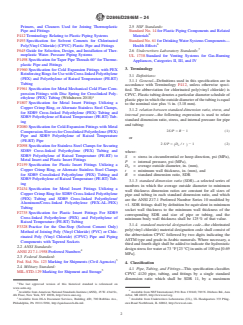
2S/P 5 R 2 1 (1)
Compression-Sleeves for Crosslinked Polyethylene (PEX)
Pipe and SDR9 Polyethylene of Raised Temperature
or
(PE-RT) Pipe
2 S/P 5 ~D / t ! 2 1 (2)
F2098 Specification for Stainless Steel Clamps for Securing
SDR9 Cross-linked Polyethylene (PEX) Tubing and
where:
SDR9 Polyethylene of Raised Temperature (PE-RT) to
S = stress in circumferential or hoop direction, psi (MPa),
Metal Insert and Plastic Insert Fittings
P = internal pressure, psi (MPa),
F2159 Specification for Plastic Insert Fittings Utilizing a
D = average outside diameter, in. (mm),
Copper Crimp Ring, or Alternate Stainless Steel Clamps
t = minimum wall thickness, in. (mm), and
for SDR9 Crosslinked Polyethylene (PEX) Tubing and
R = standard dimension ratio, SDR
SDR9 Polyethylene of Raised Temperature (PE-RT) Tub-
3.1.3 standard dimension ratio (SDR)—a selected series of
ing
numbers in which the average outside diameter to minimum
F2434 Specification for Metal Insert Fittings Utilizing a
wall thickness dimension ratios are constant for all sizes of
Copper Crimp Ring for SDR9 Cross-linked Polyethylene
pipe and tubing in each standard dimension ratio, and which
(PEX) Tubing and SDR9 Cross-linked Polyethylene/
are the ANSI Z17.1 Preferred Number Series 10 modified by
Aluminum/Cross-linked Polyethylene (PEX-AL-PEX)
+1. SDR fittings shall by definition be equivalent in minimum
Tubing
socket wall thickness to the minimum wall thickness of the
F2735 Specification for Plastic Insert Fittings For SDR9
corresponding SDR and size of pipe or tubing, and the
Cross-linked Polyethylene (PEX) and Polyethylene of
minimum body wall thickness shall be 125 % of that value.
Raised Temperature (PE-RT) Tubing
3.1.4 standard material designation code—the chlorinated
F3328 Practice for the One-Step (Solvent Cement Only)
poly(vinyl chloride) material designation code shall consist of
Method of Joining Poly (Vinyl Chloride) (PVC) or Chlo-
the abbreviation CPVC followed by two digits indicating the
rinated Poly (Vinyl Chloride) (CPVC) Pipe and Piping
ASTM type and grade in Arabic numerals. Where necessary, a
Components with Tapered Sockets
third and fourth digit shall be added to indicate the hydrostatic
2.2 ANSI Standards:
design stress for water at 73 °F [23 °C] in units of 100 psi [0.69
ANSI Z17.1-1958 Preferred Numbers
MPa].
2.3 Federal Standard:
Fed. Std. No. 123 Marking for Shipments (Civil Agencies)
4. Classification
2.4 Military Standard:
4.1 Pipe, Tubing, and Fittings—This specification classifies
MIL-STD-129 Marking for Shipment and Storage
CPVC 4120 pipe, tubing, and fittings by a single standard
dimension ratio which shall be SDR 11, by a maximum
The last approved version of this historical standard is referenced on
www.astm.org.
4 6
Available from American National Standards Institute (ANSI), 25 W. 43rd St., Available from NSF International, P.O. Box 130140, 789 N. Dixboro Rd., Ann
4th Floor, New York, NY 10036, http://www.ansi.org. Arbor, MI 48105, http://www.nsf.org.
5 7
Available from DLA Document Services, Building 4/D, 700 Robbins Ave., Available from Underwriters Laboratories (UL), UL Headquarters 333 Pfing-
Philadelphia, PA 19111-5094, http://quicksearch.dla.mil. sten Road Northbrook, IL 60062, http://www.ul.com.
D2846/D2846M − 24
A
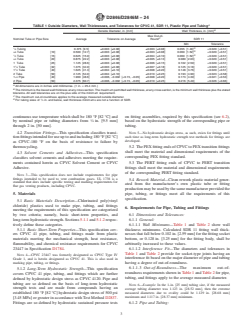
TABLE 1 Outside Diameters, Wall Thicknesses, and Tolerances for CPVC 41, SDR 11, Plastic Pipe and Tubing
B
Outside Diameter, in. [mm] Wall Thickness, in. [mm]
Max Out-of-
C
Nominal Tube or Pipe Size Average Tolerance on Average Round SDR 11
Min Tolerance
D
⁄4 Tubing 0.375 [9.5] ±0.003 [±0.08] ±0.003 [±0.08] 0.055 [1.40] +0.020 [+0.51]
D
⁄8 Tube [10] 0.500 [12.7] ±0.003 [±0.08] ±0.003 [±0.08] 0.060 [1.52] +0.020 [+0.51]
D
⁄2 Tube [15] 0.625 [15.9] ±0.003 [±0.08] ±0.004 [±0.10] 0.060 [1.52] +0.020 [+0.51]
⁄4 Tube [20] 0.875 [22.2] ±0.003 [±0.08] ±0.005 [±0.13] 0.080 [2.03] +0.020 [+0.51]
1 Tube [25] 1.125 [28.6] ±0.003 [±0.08] ±0.006 [±0.15] 0.102 [2.59] +0.020 [+0.51]
1 ⁄4 Tube [32] 1.375 [34.9] ±0.003 [±0.08] ±0.007 [±0.18] 0.125 [3.18] +0.020 [+0.51]
1 ⁄2 Tube [40] 1.625 [41.3] ±0.004 [±0.10] ±0.008 [±0.20] 0.148 [3.76] +0.020 [+0.51]
2 Tube [50] 2.125 [54.0] ±0.004 [±0.10] ±0.010 [±0.25] 0.193 [4.90] +0.023 [+0.58]
1 ⁄2 Pipe [40] 1.900 [48.6] +0.006, −0.002 [+0.15, −0.05] ±0.008 [±0.20] 0.173 [4.39] +0.021 [+0.53]
2 Pipe [50] 2.375 [60.7] +0.006, −0.002 [+0.15, −0.05] ±0.010 [±0.25] 0.216 [5.49] +0.026 [+0.66]
A
All dimensions are in inches and millimetres. (1 in. = 25.4 mm.)
B
The minimum is the lowest wall thickness at any cross section. The maximum permitted wall thickness, at any cross section, is the minimum wall thickness plus the stated
tolerance. All wall tolerances are on the plus side of the minimum requirement.
C
The maximum out-of-roundness applies to the average measured outside diameter.
D
For tubing sizes of ⁄2 in. and below, wall thickness minimums are not a function of SDR.
continuous use temperature which shall be 180 °F [82 °C] and on fitting assemblies, required by this specification (see 6.2),
by nominal pipe or tubing diameters from ⁄4 in. [9.5 mm] based on the hydrostatic strength of the corresponding pipe or
through 2 in. [50 mm]. tubing.
4.2 Transition Fittings—This specification classifies transi-
NOTE 5—No hydrostatic design stress, as such, exists for fittings until
tion fittings intended for use up to and including 180 °F [82 °C] such time as long-term hydrostatic strength test methods for fittings are
developed.
as CPVC-180 °F on the basis of resistance to failure by
thermocycling.
5.2 The PEX fitting ends of CPVC to PEX transition fittings
shall meet the material and dimensional requirements of the
4.3 Solvent Cements and Adhesives—This specification
corresponding PEX fitting standard.
classifies solvent cements and adhesives meeting the require-
ments contained herein as CPVC Solvent Cement or CPVC
5.3 The PERT fitting ends of CPVC to PERT transition
Adhesive.
fittings shall meet the material and dimensional requirements
of the corresponding PERT fitting standard.
NOTE 3—This specification does not include requirements for pipe
fittings intended to be used to vent combustion gases. UL 1738 is a
5.4 Rework Material—Clean rework plastic material gener-
standard that does include specific testing and marking requirements for
ated from the manufacturer’s own plastic tube or fitting
flue gas venting products, including CPVC.
production may be used by the same manufacturer provided the
pipe, tubing, or fittings meet all the requirements of this
5. Materials
specification.
5.1 Basic Materials Description—Chlorinated poly(vinyl
chloride) plastics used to make pipe, tubing, and fittings
6. Requirements for Pipe, Tubing and Fittings
meeting the requirements of this specification are categorized
6.1 Dimensions and Tolerances:
by two criteria; namely, basic short-term properties, and
long-term hydrostatic strength. Sections 5.1.1 and 5.1.2 respec- 6.1.1 General:
tively define these categories.
6.1.1.1 Wall Minimums—Table 1 and Table 2 show wall
5.1.1 Basic Short-Term Properties—This specification cov- thickness minimums. Calculated SDR 11 fitting wall thick-
ers CPVC 41 pipe, tubing, and fittings made from plastic
nesses that fall below 0.102 in. [2.59 mm] for the fitting socket
materials meeting the mechanical strength, heat resistance, bottom, or 0.128 in. [3.25 mm] for the fitting body, shall be
flammability, and chemical resistance requirements for CPVC
arbitrarily increased to these values.
23447 in Specification D1784.
6.1.1.2 Interference Fit—The diameters and tolerances in
Table 1 and Table 2 provide for socket-type joints having an
NOTE 4—CPVC 23447 was formerly designated as CPVC Type IV
interference fit based on the major diameter of pipe and tubing
Grade 1, and is herein designated as CPVC 41. This is also used in
marking pipe, tubing, or fittings. having a degree of out-of-roundness.
6.1.1.3 Out-of-Roundness—The maximum out-of-
5.1.2 Long-Term Hydrostatic Strength—This specification
roundness requirements shown in Table 1 and Table 2 for pipe,
covers CPVC 41 pipe, tubing, and fittings which are further
tubing, and fittings apply to the average measured diameter.
defined by hydrostatic design stress as CPVC 4120. Pipe and
tubing are so defined on the basis of long-term hydrostatic
NOTE 6—Example: In the 1-in. [25 mm] tubing size, if the measured
strength tests and are made from compounds having an average tubing diameter was 1.123 in. [28.52 mm], then the extreme
measured diameters due to ovality could be 1.129 in. [28.68 mm]
established 180 °F [82 °C] hydrostatic design stress of 500 psi
maximum and 1.117 in. [28.37 mm] minimum.
[3.45 MPa] or greater in accordance with Test Method D2837.
Fittings are so defined by hydrostatic sustained pressure tests 6.1.2 Pipe and Tubing:
D2846/D2846M − 24
A,B
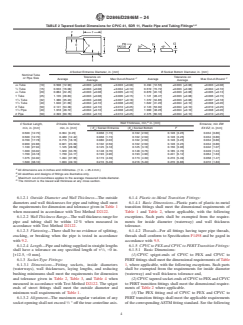
TABLE 2 Tapered Socket Dimensions for CPVC 41, SDR 11, Plastic Pipe and Tubing Fittings
A Socket Entrance Diameter, in. [mm] B Socket Bottom Diameter, in. [mm]
Nominal Tube
Tolerance on Tolerance on
C C
or Pipe Size
Average Max Out-of-Round Average Max Out-of-Round
Average Average
⁄8 Tube [10] 0.508 [12.90] ±0.003 [±0.08] ±0.003 [±0.08] 0.494 [12.55] ±0.003 [±0.08] ±0.003 [±0.08]
⁄2 Tube [15] 0.633 [16.08] ±0.003 [±0.08] ±0.004 [±0.10] 0.619 [15.72] ±0.003 [±0.08] ±0.004 [±0.10]
⁄4 Tube [20] 0.884 [22.45] ±0.003 [±0.08] ±0.005 [±0.13] 0.870 [22.10] ±0.003 [±0.08] ±0.005 [±0.13]
1 Tube [25] 1.135 [28.83] ±0.003 [±0.08] ±0.006 [±0.15] 1.121 [28.47] ±0.003 [±0.08] ±0.006 [±0.15]
1 ⁄4 Tube [32] 1.386 [35.20] ±0.003 [±0.08] ±0.007 [±0.18] 1.372 [34.85] ±0.003 [±0.08] ±0.007 [±0.18]
1 ⁄2 Tube [40] 1.640 [41.66] ±0.004 [±0.10] ±0.008 [±0.20] 1.622 [41.20] ±0.004 [±0.10] ±0.008 [±0.20]
2 Tube [50] 2.141 [54.38] ±0.004 [±0.10] ±0.010 [±0.25] 2.123 [53.92] ±0.004 [±0.10] ±0.010 [±0.25]
1 ⁄2 Pipe [40] 1.918 [48.72] ±0.004 [±0.10] ±0.008 [±0.20] 1.900 [48.26] ±0.004 [±0.10] ±0.008 [±0.20]
2 Pipe [50] 2.393 [60.78] ±0.004 [±0.10] ±0.010 [±0.25] 2.375 [60.33] ±0.004 [±0.10] ±0.010 [±0.25]
D
Wall Thickness, min, in. [mm]
C Socket Length, D Inside Diameter, Entrance; min EW
min, in. [mm] min, in. [mm] EX EZ, in. [mm]
( E ) Socket Entrance (E ) Socket Bottom F
a b
0.500 [12.70] 0.364 [9.25] 0.068 [1.73] 0.102 [2.59] 0.128 [3.25] 0.034 [0.86]
0.500 [12.70] 0.489 [12.42] 0.068 [1.73] 0.102 [2.59] 0.128 [3.25] 0.034 [0.86]
0.700 [17.78] 0.715 [18.16] 0.080 [2.03] 0.102 [2.59] 0.128 [3.25] 0.034 [0.86]
0.900 [22.86] 0.921 [23.39] 0.102 [2.59] 0.102 [2.59] 0.128 [3.25] 0.034 [0.86]
1.100 [27.94] 1.125 [28.58] 0.125 [3.18] 0.125 [3.18] 0.156 [3.96] 0.042 [1.07]
1.300 [33.02] 1.329 [33.76] 0.148 [3.76] 0.148 [3.76] 0.185 [4.70] 0.049 [1.24]
1.700 [43.18] 1.739 [44.17] 0.193 [4.90] 0.193 [4.90] 0.241 [6.12] 0.064 [1.63]
1.375 [34.92] 1.494 [37.95] 0.173 [4.39] 0.173 [4.39] 0.216 [5.49] 0.058 [1.47]
1.500 [38.10] 1.933 [49.10] 0.216 [5.49] 0.216 [5.49] 0.270 [6.86] 0.072 [1.83]
A
All dimensions are in inches and millimetres. (1 in. = 25.4 mm.)
B
All sketches and designs of fittings are illustrative only.
C
Maximum out-of-roundness applies to the average measured inside diameter.
D
The minimum is the lowest wall thickness at any cross section.
6.1.2.1 Outside Diameter and Wall Thickness—The outside 6.1.4 Plastic-to-Metal Transition Fittings:
diameters and wall thicknesses for pipe and tubing shall meet 6.1.4.1 Basic Dimensions—Plastic parts of plastic-to-metal
the requirements for dimension and tolerance given in Table 1 transition fittings shall meet the dimensional requirements of
when measured in accordance with Test Method D2122. Table 1 and Table 2, where applicable, with the following
6.1.2.2 Wall Thickness Range—The wall thickness range for exceptions. Such parts shall be exempted from the require-
pipe and tubing shall be within 12 % when measured in ments for inside diameter (waterway) and wall thickness
accordance with Test Method D2122. tolerance.
6.1.2.3 Flattening—There shall be no evidence of splitting, 6.1.4.2 Threads—For all fittings having taper pipe threads,
cracking, or breaking when the pipe is tested in accordance threads shall conform to Specification F1498 and be gaged in
with 9.2. accordance with 9.5.
6.1.2.4 Length—Pipe and tubing supplied in straight lengths 6.1.5 CPVC to PEX and CPVC to PERT Transition Fittings:
shall have a tolerance on any specified length of + ⁄2, −0 in. 6.1.5.1 Basic Dimensions:
[+12.5, −0 mm]. (1) CPVC spigot-ends of CPVC to PEX and CPVC to
6.1.3 Socket-Type Fittings: PERT fittings shall meet the dimensional requirements of Table
6.1.3.1 Dimensions—Fitting sockets, inside diameters 1, where applicable, with the following exceptions. Such parts
(waterways), wall thicknesses, laying lengths, and reducing shall be exempted from the requirements for inside diameter
bushing minimums shall meet the requirements for dimension (waterway) and wall thickness tolerance and,
and tolerance given in Table 2, Table 3, and Table 4 when (2) CPVC tapered socket-ends of CPVC to PEX and CPVC
measured in accordance with Test Method D2122. The spigot to PERT transition fittings shall meet the dimensional require-
ends of street fittings shall meet the outside diameter and ments of Table 2 where applicable.
minimum wall requirements of Table 1. (3) The PEX fitting end of CPVC to PEX and CPVC to
6.1.3.2 Alignment—The maximum angular variation of any PERT transition fittings shall meet the applicable requirements
socket opening shall not exceed ⁄2 ° off the true centerline axis. of the corresponding ASTM fitting standard. See the following
D2846/D2846M − 24
TABLE 3 Minimum Dimensions from Center to End of Socket (Laying Length) for CPVC 41, SDR 11 Plastic Pipe
A ,B,C
and Tubing Fittings
D D D
Nominal Tube or Pipe Size G Min , in. [mm] J Min , in. [mm] N Min , in. [mm]
⁄8 Tube [10] 0.359 [9.12] 0.174 [4.42] 0.102 [2.59]
⁄2 Tube [15] 0.382 [9.70] 0.183 [4.65] 0.102 [2.59]
⁄4 Tube [20] 0.507 [12.88] 0.235 [5.97] 0.102 [2.59]
1 Tube [25] 0.633 [16.08] 0.287 [7.29] 0.102 [2.59]
1 ⁄4 Tube [32] 0.758 [19.25] 0.339 [8.61] 0.102 [2.59]
1 ⁄2 Tube [40] 0.884 [22.45] 0.391 [9.93] 0.102 [2.59]
2 Tube [50] 1.134 [28.83] 0.495 [12.57] 0.102 [2.59]
1 ⁄2 Pipe [40] 1.022 [25.96] 0.448 [11.38] 0.102 [2.59]
2 Pipe [50] 1.260 [32.00] 0.547 [13.89] 0.102 [2.59]
A
All dimensions are in inches and millimetres. (1 in. = 25.4 mm.)
B
All dimensions not shown shall be in accordance with those in Table 2.
C
The sketches and designs of fittings are illustrative only.
D
Minimum dimensions have zero negative tolerance.
A,B ,C,D
TABLE 4 Dimensions of Reducer Bushings for CPVC 41, SDR 11, Socket-Type, Plastic Pipe and Tubing Fittings
A
Tubing socket dimensions, A, B, and C, and tolerances on these dimensions shall be the same as in Table 2. The minimum length of the male end of the bushing or
coupling, CM, shall be the same as C in Table 2, but in any case the male end shall bottom in the mating fitting. Minimum waterway dimensions, D and DJ, shall be the
same as D in Table 2. Minimum wall dimensions, EJ and EN, apply to the larger and smaller sizes joined respectively, and shall be the same as the corresponding values
for E in Table 2.
a
B
The minimum socket wall thickness for reducing bushings shall be 102 in. [2.59 mm]. If the socket wall thickness exceeds the total of EJ and EN calculated from the
appropriate E values in Table 2 and the reducer bushing is cored, the inner socket shall be reinforced from the outer wall by a minimum of three ribs extending the full
b
depth of the coring.
C
The transition from D to DM shall be straight, tapered as shown, or radiused, at the discretion of the manufacturer.
D
A taper on the male end of a bushing is optional. If a taper is used, it shall be a positive taper in the same direction as the taper in the socket. Whether a taper is used
or not, all diameters X shall conform to the diameter and tolerance for the corresponding size of tubing shown in Table 1.
specifications for these requirements: F1960, F1961, F1807, test for pipe and tubing and shall be used for periodic
F2080, F2098, F2159, F2434 and F2735. performance qualification. Failure to pass either test is cause
for rejection.
6.2 Hydrostatic Sustained Pressure:
6.2.3 Fitting Quality—Test Condition A shall be termed the
6.2.1 General—Pipe, tubing, and fittings (tested as assem-
primary sustained pressure test for fittings and shall be used for
blies) shall meet the minimum hydrostatic sustained pressure
quality control (see Appendix X3). Test Condition B shall be
requirements of both test conditions shown in Table 5 when
termed the secondary sustained pressure test for fittings and
tested in accordance with 9.3.
shall be used for periodic performance qualification. Failure to
6.2.2 Pipe and Tubing Quality—Test Condition B shall be
pass either test is cause for rejection.
termed the primary sustained pressure test for pipe and tubing
and shall be used for quality control (see Appendix X3). Test
NOTE 7—Drop weight impact resistance is correlatable with hydrostatic
Condition A shall be termed the secondary sustained pressure sustained pressure resistance for CPVC 41 components, and may be useful
D2846/D2846M − 24
TABLE 5 Minimum Hydrostatic Sustained Pressure Requirements TABLE 6 Minimum Hydrostatic Burst Strength Requirements for
for CPVC 4120, SDR 11, Pipe, Tubing, and Fitting Assemblies Nominal 2-in. [50-mm] CPVC Solvent Cemented Joints after 2 h
Tested in Either Water or Air Bath External Environment at 180 °F Drying at Test Temperature
A
[82 °C]
Temperature Burst Pressure
Hydrostatic Test Pressure
Test Con- Test Dura-
73.4 °F [23 °C] 400 psi [2 760 kPa]
dition tion
Water Bath Air Bath
180 °F [82 °C] 200 psi [1 380 kPa]
A 6 min 521 psi 551 psi
[3 590 kPa] [3 800 kPa]
B 4 h 364 psi 403 psi
(2 510 kPa) [2 780 kPa] 7.1.4 Safe Handling of Solvent Cement—Refer to Practice
A
F402.
Test conditions were calculated from the following experimentally derived, 95 %
confidence, rupture pressure versus time relationships for CPVC 41, SDR 11, pipe
7.2 CPVC Adhesives:
and tubing at 180 °F [82 °C]. Pressure, P, and time, t, are in psi and h respectively.
The 50 % confidence relationships are given for information only.
7.2.1 General—CPVC adhesives (other than CPVC solvent
log P = − 0.085155 log t + 2.726805 (50 % confidence in air)
cement), shall qualify for use in CPVC socket-type joints by a
log P = −0.085155 log t + 2.656225 (95 % confidence in air)
rigorous simulated use testing program as further defined in
log P = −0.097269 log t + 2.690464 (50 % confidence in water)
log P = −0.097269 log t + 2.619884 (95 % confidence in water)
7.2.2 and 7.2.3. CPVC adhesives shall be tested in the largest
size joint and in the exact type of joint for which they are
intended; that is, 2-in. [50-mm] plastic-to-metal or 2-in. [50-
mm] plastic-to-plastic.
for predicting compliance with the sustained pressure requirements of
7.2.2 Hydrostatic Sustained Pressure Strength—Socket-type
Table 5. Such correlations will necessarily differ with the size, wall
thickness, and geometry of individual components. Test Method D2444
CPVC adhesive joints, made and cured according to the
using Tup A and Holder A is suggested for nominal diameters of 1 in. [25
adhesive manufacturer’s instructions, shall not separate or leak
mm] and above. For smaller components, a guided mandrel type of
when tested in accordance with 10.2 at the hydrostatic sus-
impacter such as the Gardner Impacter equipped with a ⁄2 in. [12.7 mm]
tained pressure condition given in Table 7.
radius mandrel is suggested. Drop impact is not included in this specifi-
7.2.3 Thermocycling—Socket-type CPVC adhesive joints,
cation directly as a quality requirement because of the wide test scatter
normally associated with this test, and also because of the wide differences
made and cured according to the adhesive manufacturer’s
in value over the range of sizes and components covered in this
instructions, shall not separate or leak when thermocycled
specification.
10 000 times between the temperatures of 60 °F and 180 °F [16
6.3 Thermocycling—Transition fittings (other than metal
°C and 82 °C] in accordance with 10.2.
socket-type transitions for use with adhesives), assembled
according to the manufacturer’s instructions, shall not separate
8. Workmanship, Finish, and Appearance
or leak when thermocycled 1000 times between the tempera-
8.1 Workmanship—The pipe and fittings shall be homoge-
tures of 60 °F and 180 °F [16 °C and 82 °C] in accordance with
neous throughout and free of visible cracks, holes, foreign
9.3.
inclusions, or other defects. The pipe shall be as uniform as
commercially practicable in color, opacity, density, and other
7. Requirements for Solvent Cement and Adhesive Joints
physical properties.
7.1 CPVC Solvent Cements:
7.1.1 General—CPVC solvent cements, for use in CPVC
9. Test Methods for Pipe, Tubing, and Fittings
41, plastic-to-plastic, socket-type joints using the one-step
9.1 Sampling—A sufficient quantity of pipe, tubing, or
solvent cementing procedure (Practice F3328) shall meet the
fittings, as agreed upon between the purchaser and the seller,
requirements set forth in Specification F493.
shall be selected at random from each lot or shipment and
NOTE 8—Medium bodied viscosity cement is recommended for CPVC tested to determine conformance with this specification. In the
products in this standard requiring the one-step solvent cementing
case of no prior agreement, random samples selected by the
procedure (Practice F3328). Local or national codes often define color
testing laboratory shall be deemed adequate.
requirements for the solvent cement
9.1.1 Test Specimens—Not less than 50 % of the test speci-
7.1.2 Hydrostatic Burst Strength—2-in. [50-mm] CPVC
mens required for any pressure test shall have at least a part of
solvent cement joints shall exceed the minimum hydrostatic
the marking in their central sections. The central section is that
burst strength requirements given in Table 6 after a maximum
portion of pipe which is at least one pipe diameter away from
drying interval of 2 h when tested in accordance with 10.1.1.
an end closure.
Failure to pass the burst requirement at either temperature is
9.2 Flattening—Flatten three specimens of the pipe, 2 in.
cause for rejection.
[50-mm] long, between parallel plates in a suitable press until
7.1.3 Hydrostatic Sustained Pressure Strength— ⁄2-in. [15-
the distance between the plates is 40 % of the outside diameter
mm] CPVC solvent cement joints shall meet the requirements
of the pipe or the walls of the pipe touch, whichever occurs
of 6.2 when tested in accordance with 9.3.
first. The rate of loading shall be uniform and such that the
compression is completed within 5 min. Upon removal of the
Available from Plastics Pipe Institute (PPI), 105 Decker Court, Suite 825, load, examine the specimens for evidence of splitting,
Irving, TX 75062, http://www.plasticpipe.org.
cracking, or breaking.
Supporting data have been filed at ASTM International Headquarters and may
be obtained by requesting Research Report RR:F17-1039. 9.3 Hydrostatic Sustained Pressure:
D2846/D2846M − 24
TABLE 7 Minimum Hydrostatic Sustained Pressure Requirements TABLE 8 Minimum Suggested Drying Times for Solvent
for CPVC Socket-Type Adhesive Joint Assemblies Tested Either Cemented Fitting Assemblies in Air at 180 °F [82 °C]
A
in Water Bath or Air
...
This document is not an ASTM standard and is intended only to provide the user of an ASTM standard an indication of what changes have been made to the previous version. Because
it may not be technically possible to adequately depict all changes accurately, ASTM recommends that users consult prior editions as appropriate. In all cases only the current version
of the standard as published by ASTM is to be considered the official document.
Designation: D2846/D2846M − 19a D2846/D2846M − 24 An American National Standard
Standard Specification for
Chlorinated Poly(Vinyl Chloride) (CPVC) Plastic Hot- and
Cold-Water Distribution Systems
This standard is issued under the fixed designation D2846/D2846M; the number immediately following the designation indicates the
year of original adoption or, in the case of revision, the year of last revision. A number in parentheses indicates the year of last
reapproval. A superscript epsilon (´) indicates an editorial change since the last revision or reapproval.
This standard has been approved for use by agencies of the U.S. Department of Defense.
1. Scope*
1.1 This specification covers requirements, test methods, assembly, and methods of marking for chlorinated poly(vinyl chloride)
plastic hot- and cold-water distribution system components made in one standard dimension ratio and intended for water service
up to and including 180 °F (82 °C). These components comprise pipe and tubing, socket-type fittings, street fittings,
plastic-to-metal transition fittings, solvent cements, and adhesives. Requirements and methods of test are included for materials,
workmanship, dimensions and tolerances, hydrostatic sustained pressure strength, and thermocycling resistance. The components
covered by this specification are intended for use in residential and commercial, hot and cold, potable water distribution systems.
1.2 The products covered by this specification are intended for use with the distribution of pressurized liquids only, which are
chemically compatible with the piping materials. Due to inherent hazards associated with testing components and systems with
compressed air or other compressed gases some manufacturers do not allow pneumatic testing of their products. Consult with
specific product/component manufacturers for their specific testing procedures prior to pneumatic testing.
NOTE 1—Pressurized (compressed) air or other compressed gases contain large amounts of stored energy which present serious safety hazards should a
system fail for any reason.
1.3 The text of this specification references notes, footnotes, and appendixes which provide explanatory material. These notes and
footnotes (excluding those in tables and figures) shall not be considered as requirements of the specification.
1.4 The values stated in either SI units or inch-pound units are to be regarded separately as standard. The values stated in each
system may not be exact equivalents; therefore, each system shall be used independently of the other. Combining values from the
two systems may result in non-conformance with the standard.
NOTE 2—Suggested hydrostatic design stresses and hydrostatic pressure ratings for pipe, tubing, and fittings are listed in Appendix X1. Design and
installation considerations are discussed in Appendix X2. An optional performance qualification and an in-plant quality control program are recommended
in Appendix X3.
1.5 The following safety hazards caveat pertains only to the test method portion, Sections 9 and 10, of this specification: This
standard does not purport to address all of the safety concerns, if any, associated with its use. It is the responsibility of the user
of this standard to establish appropriate safety, health, and environmental practices and determine the applicability of regulatory
limitations prior to use.
1.6 This international standard was developed in accordance with internationally recognized principles on standardization
established in the Decision on Principles for the Development of International Standards, Guides and Recommendations issued
by the World Trade Organization Technical Barriers to Trade (TBT) Committee.
This specification is under the jurisdiction of ASTM Committee F17 on Plastic Piping Systems and is the direct responsibility of Subcommittee F17.61 on Water.
Current edition approved April 1, 2019April 1, 2024. Published April 2019April 2024. Originally approved in 1969. Last previous edition approved in 2019 as
D2846/D2846M – 19. DOI: 10.1520/D2846_D2846M-19A.– 19a. DOI: 10.1520/D2846_D2846M-24.
*A Summary of Changes section appears at the end of this standard
Copyright © ASTM International, 100 Barr Harbor Drive, PO Box C700, West Conshohocken, PA 19428-2959. United States
D2846/D2846M − 24
2. Referenced Documents
2.1 ASTM Standards:
D1598 Test Method for Time-to-Failure of Plastic Pipe Under Constant Internal Pressure
D1599 Test Method for Resistance to Short-Time Hydraulic Pressure of Plastic Pipe, Tubing, and Fittings
D1784 Classification System and Basis for Specification for Rigid Poly(Vinyl Chloride) (PVC) Compounds and Chlorinated
Poly(Vinyl Chloride) (CPVC) Compounds
D2122 Test Method for Determining Dimensions of Thermoplastic Pipe and Fittings
D2444 Practice for Determination of the Impact Resistance of Thermoplastic Pipe and Fittings by Means of a Tup (Falling
Weight)
D2837 Test Method for Obtaining Hydrostatic Design Basis for Thermoplastic Pipe Materials or Pressure Design Basis for
Thermoplastic Pipe Products
F402 Practice for Safe Handling of Solvent Cements, Primers, and Cleaners Used for Joining Thermoplastic Pipe and Fittings
F412 Terminology Relating to Plastic Piping Systems
F493 Specification for Solvent Cements for Chlorinated Poly(Vinyl Chloride) (CPVC) Plastic Pipe and Fittings
F645 Guide for Selection, Design, and Installation of Thermoplastic Water- Pressure Piping Systems
F1498 Specification for Taper Pipe Threads 60° for Thermoplastic Pipe and Fittings
F1960 Specification for Cold Expansion Fittings with PEX Reinforcing Rings for Use with Cross-linked Polyethylene (PEX)
and Polyethylene of Raised Temperature (PE-RT) Tubing
F1961 Specification for Metal Mechanical Cold Flare Compression Fittings with Disc Spring for Crosslinked Polyethylene
(PEX) Tubing (Withdrawn 2018)
F1807 Specification for Metal Insert Fittings Utilizing a Copper Crimp Ring, or Alternate Stainless Steel Clamps, for SDR9
Cross-linked Polyethylene (PEX) Tubing and SDR9 Polyethylene of Raised Temperature (PE-RT) Tubing
F2080 Specification for Cold-Expansion Fittings with Metal Compression-Sleeves for Crosslinked Polyethylene (PEX) Pipe and
SDR9 Polyethylene of Raised Temperature (PE-RT) Pipe
F2098 Specification for Stainless Steel Clamps for Securing SDR9 Cross-linked Polyethylene (PEX) Tubing and SDR9
Polyethylene of Raised Temperature (PE-RT) to Metal Insert and Plastic Insert Fittings
F2159 Specification for Plastic Insert Fittings Utilizing a Copper Crimp Ring, or Alternate Stainless Steel Clamps for SDR9
Crosslinked Polyethylene (PEX) Tubing and SDR9 Polyethylene of Raised Temperature (PE-RT) Tubing
F2434 Specification for Metal Insert Fittings Utilizing a Copper Crimp Ring for SDR9 Cross-linked Polyethylene (PEX) Tubing
and SDR9 Cross-linked Polyethylene/Aluminum/Cross-linked Polyethylene (PEX-AL-PEX) Tubing
F2735 Specification for Plastic Insert Fittings For SDR9 Cross-linked Polyethylene (PEX) and Polyethylene of Raised
Temperature (PE-RT) Tubing
F3328 Practice for the One-Step (Solvent Cement Only) Method of Joining Poly (Vinyl Chloride) (PVC) or Chlorinated Poly
(Vinyl Chloride) (CPVC) Pipe and Piping Components with Tapered Sockets
2.2 ANSI Standards:
ANSI Z17.1-1958 Preferred Numbers
2.3 Federal Standard:
Fed. Std. No. 123 Marking for Shipments (Civil Agencies)
2.4 Military Standard:
MIL-STD-129 Marking for Shipment and Storage
2.5 NSF Standards:
Standard No. 14 for Plastic Piping Components and Related Materials
Standard No. 61 for Drinking Water Systems Components—Health Effects
2.6 Underwriters Laboratory Standards:
UL 1738 Standard for Venting Systems for Gas-Burning Appliances, Categories II, III, and IV
3. Terminology
3.1 Definitions:
For referenced ASTM standards, visit the ASTM website, www.astm.org, or contact ASTM Customer Service at service@astm.org. For Annual Book of ASTM Standards
volume information, refer to the standard’s Document Summary page on the ASTM website.
The last approved version of this historical standard is referenced on www.astm.org.
Available from American National Standards Institute (ANSI), 25 W. 43rd St., 4th Floor, New York, NY 10036, http://www.ansi.org.
Available from DLA Document Services, Building 4/D, 700 Robbins Ave., Philadelphia, PA 19111-5094, http://quicksearch.dla.mil.
Available from NSF International, P.O. Box 130140, 789 N. Dixboro Rd., Ann Arbor, MI 48113-0140,48105, http://www.nsf.org.
Available from Underwriters Laboratories (UL), UL Headquarters 333 Pfingsten Road Northbrook, IL 60062, http://www.ul.com.
D2846/D2846M − 24
3.1.1 General—Definitions used in this specification are in accordance with Terminology F412, unless otherwise specified. The
abbreviation for chlorinated poly(vinyl chloride) is CPVC. Plastic tubing denotes a particular diameter schedule of plastic pipe in
which the outside diameter of the tubing is equal to the nominal size plus ⁄8 in. (3.18 mm).(3.18 mm).
3.1.2 relation between standard dimension ratio, stress, and internal pressure—the following expression is used to relate standard
dimension ratio, stress, and internal pressure for pipe and tubing:
2S/P 5 R 2 1 (1)
or
2 S/P 5 ~D / t ! 2 1 (2)
where:
S = stress in circumferential or hoop direction, psi (MPa),
P = internal pressure, psi (MPa),
D = average outside diameter, in. (mm),
t = minimum wall thickness, in. (mm), and
R = standard dimension ratio, SDR
3.1.3 standard dimension ratio (SDR)—a selected series of numbers in which the average outside diameter to minimum wall
thickness dimension ratios are constant for all sizes of pipe and tubing in each standard dimension ratio, and which are the ANSI
Z17.1 Preferred Number Series 10 modified by +1. SDR fittings shall by definition be equivalent in minimum socket wall thickness
to the minimum wall thickness of the corresponding SDR and size of pipe or tubing, and the minimum body wall thickness shall
be 125 % of that value.
3.1.4 standard material designation code—the chlorinated poly(vinyl chloride) material designation code shall consist of the
abbreviation CPVC followed by two digits indicating the ASTM type and grade in Arabic numerals. Where necessary, a third and
fourth digit shall be added to indicate the hydrostatic design stress for water at 73 °F [23 °C] 73 °F [23 °C] in units of 100 psi [0.69
MPa].
4. Classification
4.1 Pipe, Tubing, and Fittings—This specification classifies CPVC 4120 pipe, tubing, and fittings by a single standard dimension
ratio which shall be SDR 11, by a maximum continuous use temperature which shall be 180 °F [82 °C] 180 °F [82 °C] and by
nominal pipe or tubing diameters from ⁄4 in. [9.5 mm] through 2 in. [50 mm].[50 mm].
4.2 Transition Fittings—This specification classifies transition fittings intended for use up to and including 180 °F [82 °C] as
CPVC-180 °F on the basis of resistance to failure by thermocycling.
4.3 Solvent Cements and Adhesives—This specification classifies solvent cements and adhesives meeting the requirements
contained herein as CPVC Solvent Cement or CPVC Adhesive.
NOTE 3—This specification does not include requirements for pipe fittings intended to be used to vent combustion gases. UL 1738 is a standard that does
include specific testing and marking requirements for flue gas venting products, including CPVC.
5. Materials
5.1 Basic Materials Description—Chlorinated poly(vinyl chloride) plastics used to make pipe, tubing, and fittings meeting the
requirements of this specification are categorized by two criteria; namely, basic short-term properties, and long-term hydrostatic
strength. Sections 5.1.1 and 5.1.2 respectively define these categories.
5.1.1 Basic Short-Term Properties—This specification covers CPVC 41 pipe, tubing, and fittings made from plastic materials
meeting the mechanical strength, heat resistance, flammability, and chemical resistance requirements for CPVC 23447 in
Specification D1784.
D2846/D2846M − 24
A
TABLE 1 Outside Diameters, Wall Thicknesses, and Tolerances for CPVC 41, SDR 11, Plastic Pipe and Tubing
B
Outside Diameter, in. [mm] Wall Thickness, in. [mm]
Max Out-of-
C
Nominal Tube or Pipe Size Average Tolerance on Average Round SDR 11
Min Tolerance
D
⁄4 Tubing 0.375 [9.5] ±0.003 [±0.08] ±0.003 [±0.08] 0.055 [1.40] +0.020 [+0.51]
D
⁄8 Tube [10] 0.500 [12.7] ±0.003 [±0.08] ±0.003 [±0.08] 0.060 [1.52] +0.020 [+0.51]
D
⁄2 Tube [15] 0.625 [15.9] ±0.003 [±0.08] ±0.004 [±0.10] 0.060 [1.52] +0.020 [+0.51]
⁄4 Tube [20] 0.875 [22.2] ±0.003 [±0.08] ±0.005 [±0.13] 0.080 [2.03] +0.020 [+0.51]
1 Tube [25] 1.125 [28.6] ±0.003 [±0.08] ±0.006 [±0.15] 0.102 [2.59] +0.020 [+0.51]
1 ⁄4 Tube [32] 1.375 [34.9] ±0.003 [±0.08] ±0.007 [±0.18] 0.125 [3.18] +0.020 [+0.51]
1 ⁄2 Tube [40] 1.625 [41.3] ±0.004 [±0.10] ±0.008 [±0.20] 0.148 [3.76] +0.020 [+0.51]
2 Tube [50] 2.125 [54.0] ±0.004 [±0.10] ±0.010 [±0.25] 0.193 [4.90] +0.023 [+0.58]
1 ⁄2 Pipe [40] 1.900 [48.6] +0.006, −0.002 [+0.15, −0.05] ±0.008 [±0.20] 0.173 [4.39] +0.021 [+0.53]
2 Pipe [50] 2.375 [60.7] +0.006, −0.002 [+0.15, −0.05] ±0.010 [±0.25] 0.216 [5.49] +0.026 [+0.66]
A
All dimensions are in inches and millimetres. (1 in. = 25.4 mm.)
B
The minimum is the lowest wall thickness at any cross section. The maximum permitted wall thickness, at any cross section, is the minimum wall thickness plus the stated
tolerance. All wall tolerances are on the plus side of the minimum requirement.
C
The maximum out-of-roundness applies to the average measured outside diameter.
D 1
For tubing sizes of ⁄2 in. and below, wall thickness minimums are not a function of SDR.
NOTE 4—CPVC 23447 was formerly designated as CPVC Type IV Grade 1, and is herein designated as CPVC 41. This is also used in marking pipe,
tubing, or fittings.
5.1.2 Long-Term Hydrostatic Strength—This specification covers CPVC 41 pipe, tubing, and fittings which are further defined by
hydrostatic design stress as CPVC 4120. Pipe and tubing are so defined on the basis of long-term hydrostatic strength tests and
are made from compounds having an established 180 °F [82 °C] hydrostatic design stress of 500 psi [3.45 MPa] or greater in
accordance with Test Method D2837. Fittings are so defined by hydrostatic sustained pressure tests on fitting assemblies, required
by this specification (see 6.2), based on the hydrostatic strength of the corresponding pipe or tubing.
NOTE 5—No hydrostatic design stress, as such, exists for fittings until such time as long-term hydrostatic strength test methods for fittings are developed.
5.2 The PEX fitting ends of CPVC to PEX transition fittings shall meet the material and dimensional requirements of the
corresponding PEX fitting standard.
5.3 The PERT fitting ends of CPVC to PERT transition fittings shall meet the material and dimensional requirements of the
corresponding PERT fitting standard.
5.4 Rework Material—Clean rework plastic material generated from the manufacturer’s own plastic tube or fitting production may
be used by the same manufacturer provided the pipe, tubing, or fittings meet all the requirements of this specification.
6. Requirements for Pipe, Tubing and Fittings
6.1 Dimensions and Tolerances:
6.1.1 General:
6.1.1.1 Wall Minimums—Table 1 and Table 2 show wall thickness minimums. Calculated SDR 11 fitting wall thicknesses that fall
below 0.102 in. [2.59 mm] 0.102 in. [2.59 mm] for the fitting socket bottom, or 0.128 in. [3.25 mm] 0.128 in. [3.25 mm] for the
fitting body, shall be arbitrarily increased to these values.
6.1.1.2 Interference Fit—The diameters and tolerances in Table 1 and Table 2 provide for socket-type joints having an interference
fit based on the major diameter of pipe and tubing having a degree of out-of-roundness.
6.1.1.3 Out-of-Roundness—The maximum out-of-roundness requirements shown in Table 1 and Table 2 for pipe, tubing, and
fittings apply to the average measured diameter.
NOTE 6—Example: In the 1-in. [25 mm] tubing size, if the measured average tubing diameter was 1.123 in. [28.52 mm], then the extreme measured
diameters due to ovality could be 1.129 in. [28.68 mm] maximum and 1.117 in. [28.37 mm] [28.37 mm] minimum.
D2846/D2846M − 24
A,B
TABLE 2 Tapered Socket Dimensions for CPVC 41, SDR 11, Plastic Pipe and Tubing Fittings
A Socket Entrance Diameter, in. [mm] B Socket Bottom Diameter, in. [mm]
Nominal Tube
Tolerance on Tolerance on
C C
or Pipe Size
Average Max Out-of-Round Average Max Out-of-Round
Average Average
⁄8 Tube [10] 0.508 [12.90] ±0.003 [±0.08] ±0.003 [±0.08] 0.494 [12.55] ±0.003 [±0.08] ±0.003 [±0.08]
⁄2 Tube [15] 0.633 [16.08] ±0.003 [±0.08] ±0.004 [±0.10] 0.619 [15.72] ±0.003 [±0.08] ±0.004 [±0.10]
⁄4 Tube [20] 0.884 [22.45] ±0.003 [±0.08] ±0.005 [±0.13] 0.870 [22.10] ±0.003 [±0.08] ±0.005 [±0.13]
1 Tube [25] 1.135 [28.83] ±0.003 [±0.08] ±0.006 [±0.15] 1.121 [28.47] ±0.003 [±0.08] ±0.006 [±0.15]
1 ⁄4 Tube [32] 1.386 [35.20] ±0.003 [±0.08] ±0.007 [±0.18] 1.372 [34.85] ±0.003 [±0.08] ±0.007 [±0.18]
1 ⁄2 Tube [40] 1.640 [41.66] ±0.004 [±0.10] ±0.008 [±0.20] 1.622 [41.20] ±0.004 [±0.10] ±0.008 [±0.20]
2 Tube [50] 2.141 [54.38] ±0.004 [±0.10] ±0.010 [±0.25] 2.123 [53.92] ±0.004 [±0.10] ±0.010 [±0.25]
1 ⁄2 Pipe [40] 1.918 [48.72] ±0.004 [±0.10] ±0.008 [±0.20] 1.900 [48.26] ±0.004 [±0.10] ±0.008 [±0.20]
2 Pipe [50] 2.393 [60.78] ±0.004 [±0.10] ±0.010 [±0.25] 2.375 [60.33] ±0.004 [±0.10] ±0.010 [±0.25]
D
Wall Thickness, min, in. [mm]
C Socket Length, D Inside Diameter, Entrance; min EW
min, in. [mm] min, in. [mm] EX EZ, in. [mm]
( E ) Socket Entrance (E ) Socket Bottom F
a b
0.500 [12.70] 0.364 [9.25] 0.068 [1.73] 0.102 [2.59] 0.128 [3.25] 0.034 [0.86]
0.500 [12.70] 0.489 [12.42] 0.068 [1.73] 0.102 [2.59] 0.128 [3.25] 0.034 [0.86]
0.700 [17.78] 0.715 [18.16] 0.080 [2.03] 0.102 [2.59] 0.128 [3.25] 0.034 [0.86]
0.900 [22.86] 0.921 [23.39] 0.102 [2.59] 0.102 [2.59] 0.128 [3.25] 0.034 [0.86]
1.100 [27.94] 1.125 [28.58] 0.125 [3.18] 0.125 [3.18] 0.156 [3.96] 0.042 [1.07]
1.300 [33.02] 1.329 [33.76] 0.148 [3.76] 0.148 [3.76] 0.185 [4.70] 0.049 [1.24]
1.700 [43.18] 1.739 [44.17] 0.193 [4.90] 0.193 [4.90] 0.241 [6.12] 0.064 [1.63]
1.375 [34.92] 1.494 [37.95] 0.173 [4.39] 0.173 [4.39] 0.216 [5.49] 0.058 [1.47]
1.500 [38.10] 1.933 [49.10] 0.216 [5.49] 0.216 [5.49] 0.270 [6.86] 0.072 [1.83]
A
All dimensions are in inches and millimetres. (1 in. = 25.4 mm.)
B
All sketches and designs of fittings are illustrative only.
C
Maximum out-of-roundness applies to the average measured inside diameter.
D
The minimum is the lowest wall thickness at any cross section.
6.1.2 Pipe and Tubing:
6.1.2.1 Outside Diameter and Wall Thickness—The outside diameters and wall thicknesses for pipe and tubing shall meet the
requirements for dimension and tolerance given in Table 1 when measured in accordance with Test Method D2122.
6.1.2.2 Wall Thickness Range—The wall thickness range for pipe and tubing shall be within 12 % when measured in accordance
with Test Method D2122.
6.1.2.3 Flattening—There shall be no evidence of splitting, cracking, or breaking when the pipe is tested in accordance with 9.2.
6.1.2.4 Length—Pipe and tubing supplied in straight lengths shall have a tolerance on any specified length of + ⁄2, −0 in. [+12.5,
−0 mm].
6.1.3 Socket-Type Fittings:
6.1.3.1 Dimensions—Fitting sockets, inside diameters (waterways), wall thicknesses, laying lengths, and reducing bushing
minimums shall meet the requirements for dimension and tolerance given in Table 2, Table 3, and Table 4 when measured in
accordance with Test Method D2122. The spigot ends of street fittings shall meet the outside diameter and minimum wall
requirements of Table 1.
6.1.3.2 Alignment—The maximum angular variation of any socket opening shall not exceed ⁄2 ° off the true centerline axis.
D2846/D2846M − 24
TABLE 3 Minimum Dimensions from Center to End of Socket (Laying Length) for CPVC 41, SDR 11 Plastic Pipe
A ,B,C
and Tubing Fittings
D D D
Nominal Tube or Pipe Size G Min , in. [mm] J Min , in. [mm] N Min , in. [mm]
⁄8 Tube [10] 0.359 [9.12] 0.174 [4.42] 0.102 [2.59]
⁄2 Tube [15] 0.382 [9.70] 0.183 [4.65] 0.102 [2.59]
⁄4 Tube [20] 0.507 [12.88] 0.235 [5.97] 0.102 [2.59]
1 Tube [25] 0.633 [16.08] 0.287 [7.29] 0.102 [2.59]
1 ⁄4 Tube [32] 0.758 [19.25] 0.339 [8.61] 0.102 [2.59]
1 ⁄2 Tube [40] 0.884 [22.45] 0.391 [9.93] 0.102 [2.59]
2 Tube [50] 1.134 [28.83] 0.495 [12.57] 0.102 [2.59]
1 ⁄2 Pipe [40] 1.022 [25.96] 0.448 [11.38] 0.102 [2.59]
2 Pipe [50] 1.260 [32.00] 0.547 [13.89] 0.102 [2.59]
A
All dimensions are in inches and millimetres. (1 in. = 25.4 mm.)
B
All dimensions not shown shall be in accordance with those in Table 2.
C
The sketches and designs of fittings are illustrative only.
D
Minimum dimensions have zero negative tolerance.
A,B ,C,D
TABLE 4 Dimensions of Reducer Bushings for CPVC 41, SDR 11, Socket-Type, Plastic Pipe and Tubing Fittings
A
Tubing socket dimensions, A,B, and C, and tolerances on these dimensions shall be the same as in Table 2. The minimum length of the male end of the bushing or
coupling, CM, shall be the same as C in Table 2, but in any case the male end shall bottom in the mating fitting. Minimum waterway dimensions, D and DJ, shall be the
same as D in Table 2. Minimum wall dimensions, EJ and EN, apply to the larger and smaller sizes joined respectively, and shall be the same as the corresponding values
for E in Table 2.
a
B
The minimum socket wall thickness for reducing bushings shall be 102 in. [2.59 mm]. If the socket wall thickness exceeds the total of EJ and EN calculated from the
appropriate E values in Table 2 and the reducer bushing is cored, the inner socket shall be reinforced from the outer wall by a minimum of three ribs extending the full
b
depth of the coring.
C
The transition from D to DM shall be straight, tapered as shown, or radiused, at the discretion of the manufacturer.
D
A taper on the male end of a bushing is optional. If a taper is used, it shall be a positive taper in the same direction as the taper in the socket. Whether a taper is used
or not, all diameters X shall conform to the diameter and tolerance for the corresponding size of tubing shown in Table 1.
6.1.4 Plastic-to-Metal Transition Fittings:
6.1.4.1 Basic Dimensions—Plastic parts of plastic-to-metal transition fittings shall meet the dimensional requirements of Table 1
and Table 2, where applicable, with the following exceptions. Such parts shall be exempted from the requirements for inside
diameter (waterway) and wall thickness tolerance.
6.1.4.2 Threads—For all fittings having taper pipe threads, threads shall conform to Specification F1498 and be gaged in
accordance with 9.5.
6.1.5 CPVC to PEX and CPVC to PERT Transition Fittings:
6.1.5.1 Basic Dimensions:
(1) CPVC spigot-ends of CPVC to PEX and CPVC to PERT fittings shall meet the dimensional requirements of Table 1, where
applicable, with the following exceptions. Such parts shall be exempted from the requirements for inside diameter (waterway) and
wall thickness tolerance and,
D2846/D2846M − 24
TABLE 5 Minimum Hydrostatic Sustained Pressure Requirements
for CPVC 4120, SDR 11, Pipe, Tubing, and Fitting Assemblies
Tested in Either Water or Air Bath External Environment at 180 °F
A
[82 °C]
Hydrostatic Test Pressure
Test Con- Test Dura-
dition tion
Water Bath Air Bath
A 6 min 521 psi 551 psi
[3 590 kPa] [3 800 kPa]
B 4 h 364 psi 403 psi
(2 510 kPa) [2 780 kPa]
A
Test conditions were calculated from the following experimentally derived, 95 %
confidence, rupture pressure versus time relationships for CPVC 41, SDR 11, pipe
and tubing at 180 °F [82 °C]. Pressure, P, and time, t, are in psi and h respectively.
The 50 % confidence relationships are given for information only.
log P = − 0.085155 log t + 2.726805 (50 % confidence in air)
log P = −0.085155 log t + 2.656225 (95 % confidence in air)
log P = −0.097269 log t + 2.690464 (50 % confidence in water)
log P = −0.097269 log t + 2.619884 (95 % confidence in water)
(2) CPVC tapered socket-ends of CPVC to PEX and CPVC to PERT transition fittings shall meet the dimensional requirements
of Table 2 where applicable.
(3) The PEX fitting end of CPVC to PEX and CPVC to PERT transition fittings shall meet the applicable requirements of the
corresponding ASTM fitting standard. See the following specifications for these requirements: F1960, F1961, F1807, F2080,
F2098, F2159, F2434 and F2735.
6.2 Hydrostatic Sustained Pressure:
6.2.1 General—Pipe, tubing, and fittings (tested as assemblies) shall meet the minimum hydrostatic sustained pressure
requirements of both test conditions shown in Table 5 when tested in accordance with 9.3.
6.2.2 Pipe and Tubing Quality—Test Condition B shall be termed the primary sustained pressure test for pipe and tubing and shall
be used for quality control (see Appendix X3). Test Condition A shall be termed the secondary sustained pressure test for pipe and
tubing and shall be used for periodic performance qualification. Failure to pass either test is cause for rejection.
6.2.3 Fitting Quality—Test Condition A shall be termed the primary sustained pressure test for fittings and shall be used for quality
control (see Appendix X3). Test Condition B shall be termed the secondary sustained pressure test for fittings and shall be used
for periodic performance qualification. Failure to pass either test is cause for rejection.
NOTE 7—Drop weight impact resistance is correlatable with hydrostatic sustained pressure resistance for CPVC 41 components, and may be useful for
predicting compliance with the sustained pressure requirements of Table 5. Such correlations will necessarily differ with the size, wall thickness, and
geometry of individual components. Test Method D2444 using Tup A and Holder A is suggested for nominal diameters of 1 in. [25 mm] and above. For
smaller components, a guided mandrel type of impacter such as the Gardner Impacter equipped with a ⁄2 in. [12.7 mm] radius mandrel is suggested.
Drop impact is not included in this specification directly as a quality requirement because of the wide test scatter normally associated with this test, and
also because of the wide differences in value over the range of sizes and components covered in this specification.
6.3 Thermocycling—Transition fittings (other than metal socket-type transitions for use with adhesives), assembled according to
the manufacturer’s instructions, shall not separate or leak when thermocycled 1000 times between the temperatures of 60 °F and
180 °F [16 °C and 82 °C] in accordance with 9.3.
7. Requirements for Solvent Cement and Adhesive Joints
7.1 CPVC Solvent Cements:
7.1.1 General—CPVC solvent cements, for use in CPVC 41, plastic-to-plastic, socket-type joints using the one-step solvent
cementing procedure (Practice F3328) shall meet the requirements set forth in Specification F493.
Available from Plastics Pipe Institute (PPI), 105 Decker Court, Suite 825, Irving, TX 75062, http://www.plasticpipe.org.
Supporting data have been filed at ASTM International Headquarters and may be obtained by requesting Research Report RR:F17-1039.
D2846/D2846M − 24
TABLE 6 Minimum Hydrostatic Burst Strength Requirements for
Nominal 2-in. [50-mm] CPVC Solvent Cemented Joints after 2 h
Drying at Test Temperature
Temperature Burst Pressure
73.4 °F [23 °C] 400 psi [2 760 kPa]
180 °F [82 °C] 200 psi [1 380 kPa]
NOTE 8—Medium bodied viscosity cement is recommended for CPVC products in this standard requiring the one-step solvent cementing procedure
(Practice F3328). Local or national codes often define color requirements for the solvent cement
7.1.2 Hydrostatic Burst Strength—2-in. [50-mm] CPVC solvent cement joints shall exceed the minimum hydrostatic burst strength
requirements given in Table 6 after a maximum drying interval of 2 h when tested in accordance with 10.1.1. Failure to pass the
burst requirement at either temperature is cause for rejection.
7.1.3 Hydrostatic Sustained Pressure Strength— ⁄2-in. [15-mm] CPVC solvent cement joints shall meet the requirements of 6.2
when tested in accordance with 9.3.
7.1.4 Safe Handling of Solvent Cement—Refer to Practice F402.
7.2 CPVC Adhesives:
7.2.1 General—CPVC adhesives (other than CPVC solvent cement), shall qualify for use in CPVC socket-type joints by a rigorous
simulated use testing program as further defined in 7.2.2 and 7.2.3. CPVC adhesives shall be tested in the largest size joint and
in the exact type of joint for which they are intended; that is, 2-in. [50-mm] plastic-to-metal or 2-in. [50-mm] plastic-to-plastic.
7.2.2 Hydrostatic Sustained Pressure Strength—Socket-type CPVC adhesive joints, made and cured according to the adhesive
manufacturer’s instructions, shall not separate or leak when tested in accordance with 10.2 at the hydrostatic sustained pressure
condition given in Table 7.
7.2.3 Thermocycling—Socket-type CPVC adhesive joints, made and cured according to the adhesive manufacturer’s instructions,
shall not separate or leak when thermocycled 10 000 times between the temperatures of 60 °F and 180 °F [16 °C and 82 °C] in
accordance with 10.2.
8. Workmanship, Finish, and Appearance
8.1 Workmanship—The pipe and fittings shall be homogeneous throughout and free of visible cracks, holes, foreign inclusions,
or other defects. The pipe shall be as uniform as commercially practicable in color, opacity, density, and other physical properties.
9. Test Methods for Pipe, Tubing, and Fittings
9.1 Sampling—A sufficient quantity of pipe, tubing, or fittings, as agreed upon between the purchaser and the seller, shall be
selected at random from each lot or shipment and tested to determine conformance with this specification. In the case of no prior
agreement, random samples selected by the testing laboratory shall be deemed adequate.
9.1.1 Test Specimens—Not less than 50 % of the test specimens required for any pressure test shall have at least a part of the
marking in their central sections. The central section is that portion of pipe which is at least one pipe diameter away from an end
closure.
9.2 Flattening—Flatten three specimens of the pipe, 2 in. [50-mm] long, between parallel plates in a suitable press until the
distance between the plates is 40 % of the outside diameter of the pipe or the walls of the pipe touch, whichever occurs first. The
rate of loading shall be uniform and such that the compression is completed within 5 min. Upon removal of the load, examine the
specimens for evidence of splitting, cracking, or breaking.
9.3 Hydrostatic Sustained Pressure:
9.3.1 Summary of Test Method—This test method describes a pass-fail test for CPVC 41 pipe, tubing, or fittings (tested as
assemblies) subjected to a constant internal hydrostatic pressure for a predetermined period of time. Test conditions are based on
D2846/D2846M − 24
TABLE 7 Minimum Hydrostatic Sustained Pressure Requirements
for CPVC Socket-Type Adhesive Joint Assemblies Tested Either
A
in Water Bath or Air Bath External Environment at 180 °F [82 °C]
Test Pressure
Test Duration, h
Water Bath Air Bath
10 000 170 psi 207 psi
[1 170 kPa) (1 430 kPa)
A
Test conditions were calculated from the experimentally derived, 95 % c
...
Questions, Comments and Discussion
Ask us and Technical Secretary will try to provide an answer. You can facilitate discussion about the standard in here.
Loading comments...