

ASTM F1459-06(2017)
(Test Method)Standard Test Method for Determination of the Susceptibility of Metallic Materials to Hydrogen Gas Embrittlement (HGE)
General Information
- Abstract
SIGNIFICANCE AND USE
4.1 This test method will provide a guide for the choice of metallic materials for applications in high pressure hydrogen gas.
4.2 The value of the PHe/PH2 ratio will be a relative indication of the severity of degradation of the mechanical properties to be expected in hydrogen.
SCOPE
1.1 This test method covers the quantitative determination of the susceptibility of metallic materials to hydrogen embrittlement, when exposed to high pressure gaseous hydrogen.
1.2 The values stated in SI units are to be regarded as the standard. The values given in parentheses are for information only.
1.3 This standard does not purport to address all of the safety concerns, if any, associated with its use. It is the responsibility of the user of this standard to establish appropriate safety, health, and environmental practices and determine the applicability of regulatory limitations prior to use.
1.4 This international standard was developed in accordance with internationally recognized principles on standardization established in the Decision on Principles for the Development of International Standards, Guides and Recommendations issued by the World Trade Organization Technical Barriers to Trade (TBT) Committee.
- Status
- Published
- Publication Date
- 30-Nov-2017
- Technical Committee
- F07 - Aerospace and Aircraft
- Drafting Committee
- F07.04 - Hydrogen Embrittlement


Overview
ASTM F1459-06(2017) is the internationally recognized standard test method for the quantitative determination of the susceptibility of metallic materials to hydrogen gas embrittlement (HGE) under high-pressure gaseous hydrogen environments. Developed by ASTM International, this standard provides guidelines to help engineers, researchers, and materials specialists select appropriate metals for use in systems exposed to high-pressure hydrogen, such as those found in hydrogen storage, transportation, and fuel cell applications.
The standard defines procedures for evaluating material performance by comparing rupture pressures in hydrogen and an inert reference gas (typically helium), thus providing a reliable indicator of a material’s resilience or vulnerability to hydrogen embrittlement.
Key Topics
- Purpose: Identifies materials at risk of hydrogen gas embrittlement, ensuring the safe use of metals in hydrogen-rich environments.
- Test Procedure: Involves pressurizing thin disk specimens of the test material in both hydrogen and helium environments until rupture, measuring and comparing burst pressures.
- Comparative Analysis: The ratio of burst pressures in helium to those in hydrogen (PHe/PH2) serves as an index of susceptibility. A value of 1 or less suggests resistance to embrittlement, while higher values indicate increasing vulnerability.
- Specimen Preparation: Emphasizes strict specimen preparation methods to avoid altering mechanical properties at the specimen edge, with rigorous cleaning and surface requirements.
- Data Interpretation: Guides users to analyze and report results, including maximum PHe/PH2 ratios and detailed test conditions for transparent assessment.
- Safety and Compliance: Reminds users to implement appropriate safety, health, and environmental practices and to consider regulatory limitations before applying the standard.
Applications
The ASTM F1459-06(2017) standard is widely applied in industries and research areas where safety and performance of metallic materials in hydrogen environments is critical:
- Hydrogen Production and Storage: Supports the assessment and selection of materials for high-pressure hydrogen tanks, pipelines, and valves.
- Fuel Cell Technology: Ensures reliability of metallic components exposed to hydrogen in transportation and stationary power applications.
- Aerospace and Aircraft: Used by manufacturers to qualify materials for systems where hydrogen embrittlement could compromise structural integrity.
- Energy and Petrochemical Sectors: Aids refinery and energy companies in evaluating alloy suitability for hydrogen-rich process streams.
- Research and Development: Facilitates material science investigations into embrittlement phenomena and the development of new, hydrogen-tolerant alloys.
By following this test method, organizations can minimize the risk of mechanical degradation and material failure, thereby ensuring long-term operational safety and efficiency in hydrogen infrastructure.
Related Standards
For comprehensive evaluation and consistency, ASTM F1459-06(2017) is often used in conjunction with other relevant standards:
- ASTM E384: Test Method for Microindentation Hardness of Materials, referenced for confirming specimen mechanical properties.
- ASTM Guide STP 543: Covers hydrogen embrittlement testing techniques and additional guidance.
- ASTM F07 Standards: Related to testing of metallic materials for aerospace and hydrogen applications.
Practitioners are encouraged to consult related ASTM and ISO standards for hydrogen compatibility and broader materials qualification to ensure robustness in design and safety compliance.
Keywords: ASTM F1459, hydrogen gas embrittlement, metallic materials, high-pressure hydrogen, susceptibility testing, material selection, hydrogen infrastructure, safety standard.
Relations
- Effective Date
- 01-Dec-2017
- Effective Date
- 01-Feb-2010
- Effective Date
- 01-Feb-2010
- Effective Date
- 01-May-2009
- Effective Date
- 15-Mar-2008
- Effective Date
- 15-Mar-2008
- Effective Date
- 01-Jan-2008
- Effective Date
- 15-Dec-2007
- Effective Date
- 01-Jul-2007
- Effective Date
- 15-Nov-2006
- Effective Date
- 15-Aug-2005
- Effective Date
- 01-Jul-2005
- Effective Date
- 10-Nov-1999
- Effective Date
- 10-Nov-1999
- Effective Date
- 01-Dec-2017
Get Certified
Connect with accredited certification bodies for this standard

Element Materials Technology
Materials testing and product certification.

Inštitut za kovinske materiale in tehnologije
Institute of Metals and Technology. Materials testing, metallurgical analysis, NDT.
Sponsored listings
Frequently Asked Questions
ASTM F1459-06(2017) is a standard published by ASTM International. Its full title is "Standard Test Method for Determination of the Susceptibility of Metallic Materials to Hydrogen Gas Embrittlement (HGE)". This standard covers: SIGNIFICANCE AND USE 4.1 This test method will provide a guide for the choice of metallic materials for applications in high pressure hydrogen gas. 4.2 The value of the PHe/PH2 ratio will be a relative indication of the severity of degradation of the mechanical properties to be expected in hydrogen. SCOPE 1.1 This test method covers the quantitative determination of the susceptibility of metallic materials to hydrogen embrittlement, when exposed to high pressure gaseous hydrogen. 1.2 The values stated in SI units are to be regarded as the standard. The values given in parentheses are for information only. 1.3 This standard does not purport to address all of the safety concerns, if any, associated with its use. It is the responsibility of the user of this standard to establish appropriate safety, health, and environmental practices and determine the applicability of regulatory limitations prior to use. 1.4 This international standard was developed in accordance with internationally recognized principles on standardization established in the Decision on Principles for the Development of International Standards, Guides and Recommendations issued by the World Trade Organization Technical Barriers to Trade (TBT) Committee.
SIGNIFICANCE AND USE 4.1 This test method will provide a guide for the choice of metallic materials for applications in high pressure hydrogen gas. 4.2 The value of the PHe/PH2 ratio will be a relative indication of the severity of degradation of the mechanical properties to be expected in hydrogen. SCOPE 1.1 This test method covers the quantitative determination of the susceptibility of metallic materials to hydrogen embrittlement, when exposed to high pressure gaseous hydrogen. 1.2 The values stated in SI units are to be regarded as the standard. The values given in parentheses are for information only. 1.3 This standard does not purport to address all of the safety concerns, if any, associated with its use. It is the responsibility of the user of this standard to establish appropriate safety, health, and environmental practices and determine the applicability of regulatory limitations prior to use. 1.4 This international standard was developed in accordance with internationally recognized principles on standardization established in the Decision on Principles for the Development of International Standards, Guides and Recommendations issued by the World Trade Organization Technical Barriers to Trade (TBT) Committee.
ASTM F1459-06(2017) is classified under the following ICS (International Classification for Standards) categories: 77.040.99 - Other methods of testing of metals. The ICS classification helps identify the subject area and facilitates finding related standards.
ASTM F1459-06(2017) has the following relationships with other standards: It is inter standard links to ASTM F1459-06(2012), ASTM E384-10, ASTM E384-10e1, ASTM E384-09, ASTM E384-08a, ASTM E384-08ae1, ASTM E384-08, ASTM E384-07a, ASTM E384-07, ASTM E384-06, ASTM E384-05a, ASTM E384-05, ASTM E384-99, ASTM E384-99e1, ASTM F519-18. Understanding these relationships helps ensure you are using the most current and applicable version of the standard.
ASTM F1459-06(2017) is available in PDF format for immediate download after purchase. The document can be added to your cart and obtained through the secure checkout process. Digital delivery ensures instant access to the complete standard document.
Standards Content (Sample)
This international standard was developed in accordance with internationally recognized principles on standardization established in the Decision on Principles for the
Development of International Standards, Guides and Recommendations issued by the World Trade Organization Technical Barriers to Trade (TBT) Committee.
Designation: F1459 − 06 (Reapproved 2017)
Standard Test Method for
Determination of the Susceptibility of Metallic Materials to
Hydrogen Gas Embrittlement (HGE)
This standard is issued under the fixed designation F1459; the number immediately following the designation indicates the year of
original adoption or, in the case of revision, the year of last revision. A number in parentheses indicates the year of last reapproval. A
superscript epsilon (´) indicates an editorial change since the last revision or reapproval.
1. Scope ment. The ratio is dependent on the pressurization rate.Aratio
of 1 or less indicates the material is not susceptible to hydrogen
1.1 This test method covers the quantitative determination
embrittlement.Aratio greater than 1 indicates that the material
of the susceptibility of metallic materials to hydrogen
is susceptible to hydrogen embrittlement and the susceptibility
embrittlement, when exposed to high pressure gaseous hydro-
increases as the ratio increases.
gen.
4. Significance and Use
1.2 The values stated in SI units are to be regarded as the
standard. The values given in parentheses are for information
4.1 This test method will provide a guide for the choice of
only.
metallic materials for applications in high pressure hydrogen
gas.
1.3 This standard does not purport to address all of the
safety concerns, if any, associated with its use. It is the
4.2 The value of the P /P ratio will be a relative
He H2
responsibility of the user of this standard to establish appro-
indication of the severity of degradation of the mechanical
priate safety, health, and environmental practices and deter-
properties to be expected in hydrogen.
mine the applicability of regulatory limitations prior to use.
5. Apparatus
1.4 This international standard was developed in accor-
dance with internationally recognized principles on standard- 5.1 A basic test system shall consist of the following items:
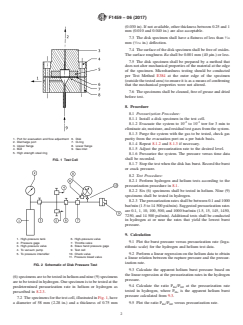
ization established in the Decision on Principles for the 5.1.1 Test Cell, consists of two flanges as shown schemati-
Development of International Standards, Guides and Recom- cally in Fig. 1.
mendations issued by the World Trade Organization Technical 5.1.1.1 The test cell shall befabricated from materials such
Barriers to Trade (TBT) Committee. as 316 stainless steel in the annealed condition that are not
susceptible to HGE (3, 4).
2. Referenced Documents
5.1.1.2 The seals shall be elastomer O-rings for helium
2.1 ASTM Standards: testing and hydrogen testing at rates of 10 bar/min (145
E384 Test Method for Microindentation Hardness of Mate-
psig/min) or higher. For hydrogen tests at a lower rate, indium
rials O-rings shall be used.
5.1.1.3 An evaluation port (Item 1 in Fig. 1) on the lower
3. Summary of Test Method
flangeisusedtocheckgaspurityandadjustpressurizationrate.
3.1 Athin disk metallic specimen is subjected to an increas-
5.1.2 The test cell is pressurized with hydrogen or helium
ing gas pressure at constant rate until failure (bursting or
throughapneumaticsystem.Fig.2schematicallyillustratesthe
cracking of the disk). The embrittlement of the material can be
pneumatic system.
evaluated by comparing the rupture pressures of identical disk
5.1.2.1 The pressurization rate shall be adjustable in the
specimens in hydrogen (P ) and in a reference inert gas such system.Athrottle valve is used to adjust the pressurization rate
H2
as helium (P ) (1, 2).
in Fig. 2.
He
3.2 The ratio P /P can be used to evaluate the suscepti-
He H2 6. Gases
bility of the metallic material to gaseous hydrogen embrittle-
6.1 Helium, purity 99.995 minimum, 6000-psig (41 400-
kPa) or higher pressure source.
This test method is under the jurisdiction of ASTM Committee F07 on
6.2 Hydrogen, purity 99.995 minimum, 6000-psig (41 400-
Aerospace and Aircraft and is the direct responsibility of Subcommittee F07.04 on
Hydrogen Embrittlement.
kPa) or higher pressure source.
Current edition approved Dec. 1, 2017. Published December 2017. Originally
approved in 1993. Last previous edition approved in 2012 as F1459 –06(2012).
7. Specimen Preparation
DOI: 10.1520/F1459-06R17.
2 7.1 Fifteen (15) specimens with identical dimensions and
The boldface numbers in parentheses refer to the list of references at the end of
this standard. temper conditions shall be prepared for each test program. Six
Copyright © ASTM International, 100 Barr Harbor Drive, PO Box C700, West Conshohocken, PA 19428-2959. United States
F1459 − 06 (2017)
(0.030 in). If not available, other thickness between 0.25 and 1
mm (0.010 and 0.040 in.) are also acceptable.
7.3 The disk specimen shall have a flatness of less than ⁄10
mm ( ⁄254 in.) deflection.
7.4 The surface of the disk specimen shall be free of oxides.
The surface roughness Ra shall be 0.001 mm (40 µin.) or less.
7.5 The disk specimen shall be prepared by a method that
does not alter mechanical properties of the material at the edge
of the specimen. Microhardness testing should be conducted
per Test Method E384 at the outer edge of the specimen
(outside the tested area) to ensure it is as a means of confirming
that the mechanical properties were not altered.
7.6 The specimens shall be cleaned, free of grease and dried
before test.
8. Procedure
8.1 Pressurization Procedure:
8.1.1 Install a disk specimen in the test cell.
-2 -3
8.1.2 Evacuate the system to 10 to 10 torr for 3 min to
eliminate air, moisture, and residual test gases from the system.
8.1.3 Purge the system with the gas to be tested, check gas
1. Port for evacuation and flow adjustment 6. Disk
purity from the evacuation por
...