


ASTM D2109-01(2016)
(Test Method)Standard Test Methods for Nonvolatile Matter in Halogenated Organic Solvents and Their Admixtures
Standard Test Methods for Nonvolatile Matter in Halogenated Organic<brk/> Solvents and Their Admixtures
SIGNIFICANCE AND USE
3.1 Nonvolatile matter in solvents can adversely affect their cleaning properties. These test methods can be used to control soil contamination in the boiling solvent, which if allowed to become too high, can decrease the stability of the solvent.
3.2 These test methods can be used to establish manufacturing and purchasing specifications.
SCOPE
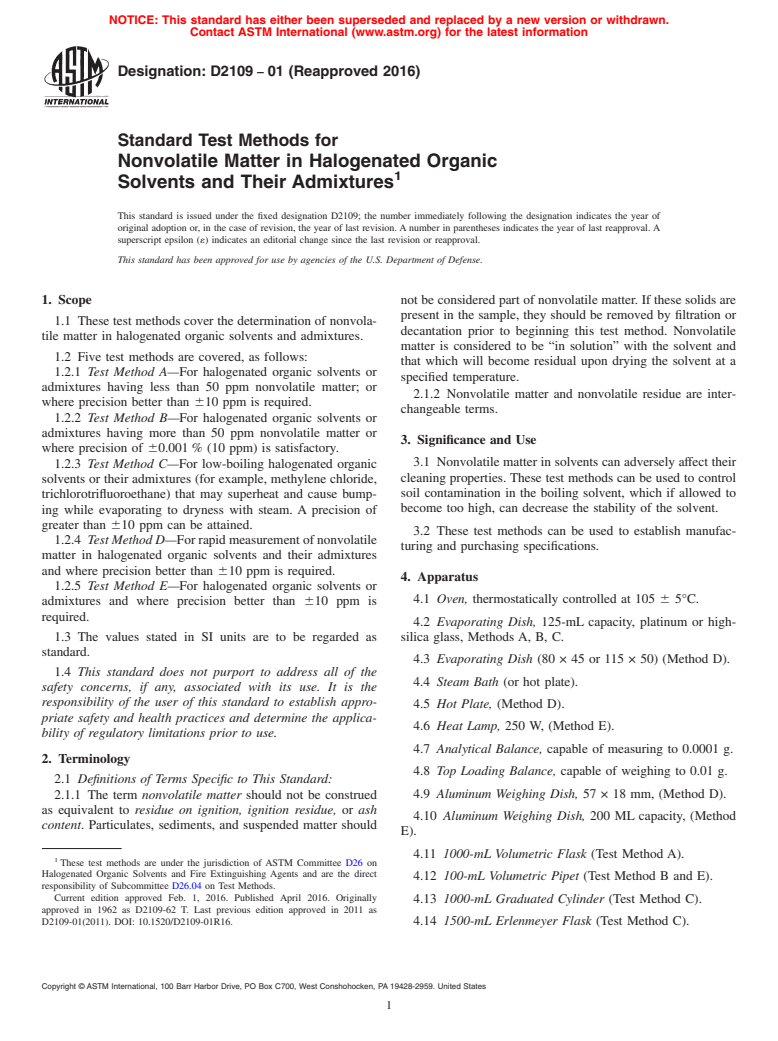
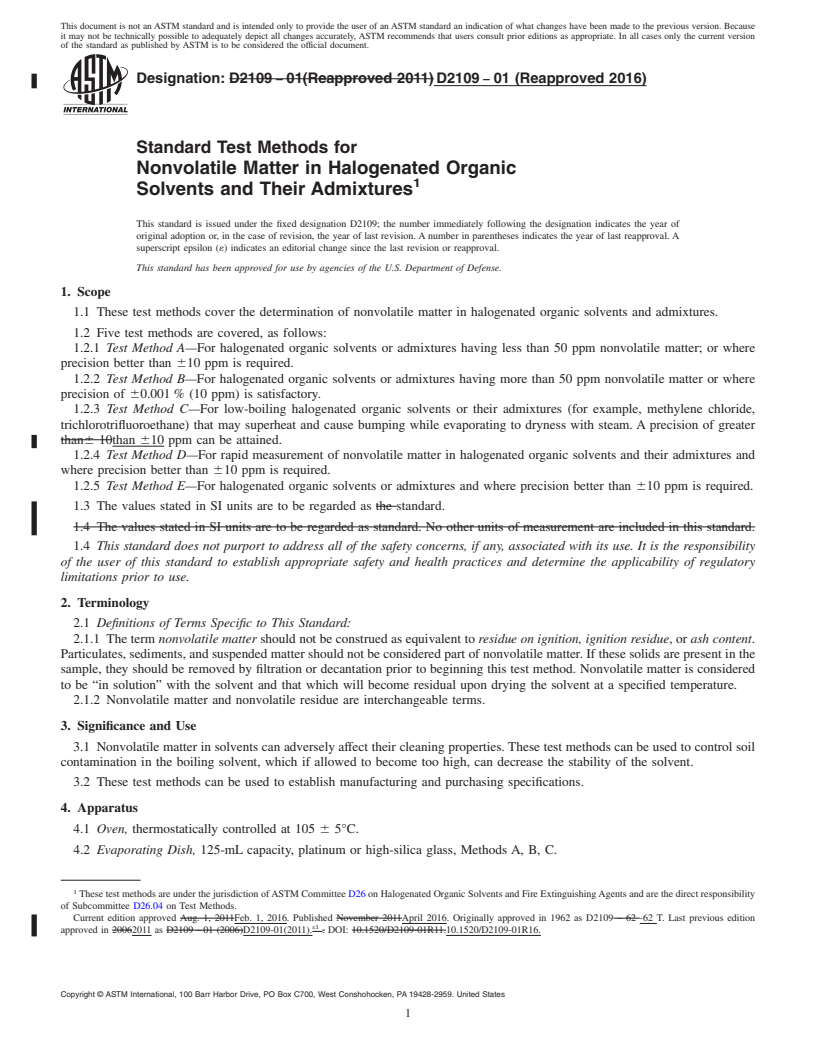
1.1 These test methods cover the determination of nonvolatile matter in halogenated organic solvents and admixtures.
1.2 Five test methods are covered, as follows:
1.2.1 Test Method A—For halogenated organic solvents or admixtures having less than 50 ppm nonvolatile matter; or where precision better than ±10 ppm is required.
1.2.2 Test Method B—For halogenated organic solvents or admixtures having more than 50 ppm nonvolatile matter or where precision of ±0.001 % (10 ppm) is satisfactory.
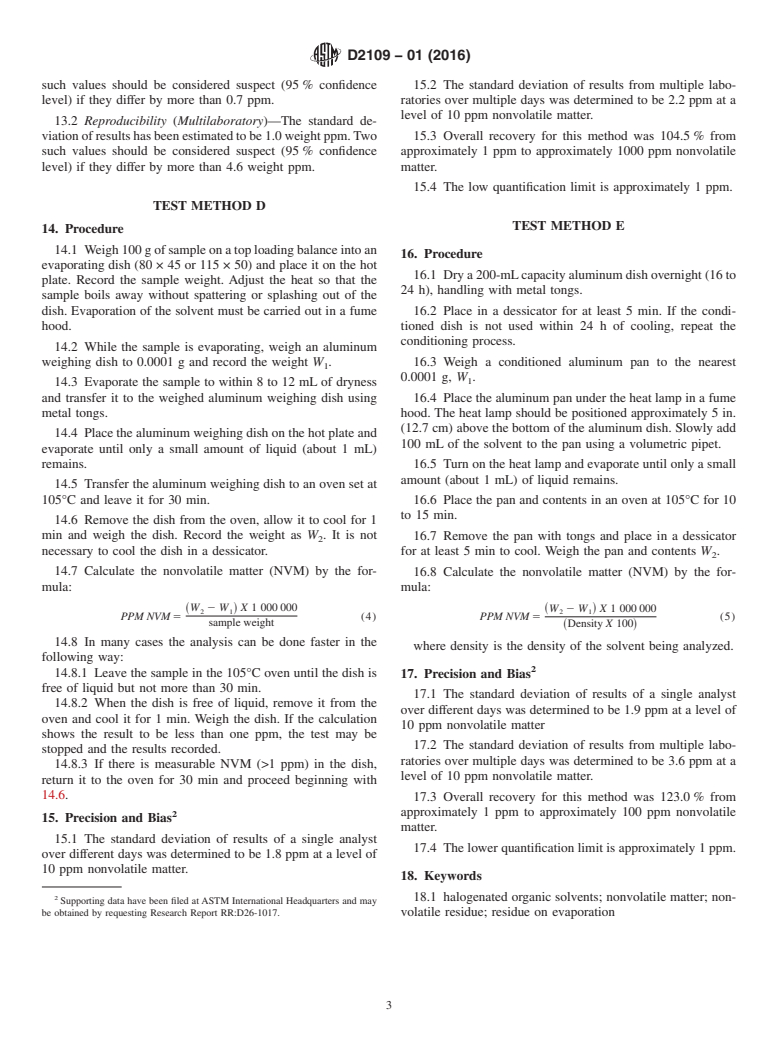
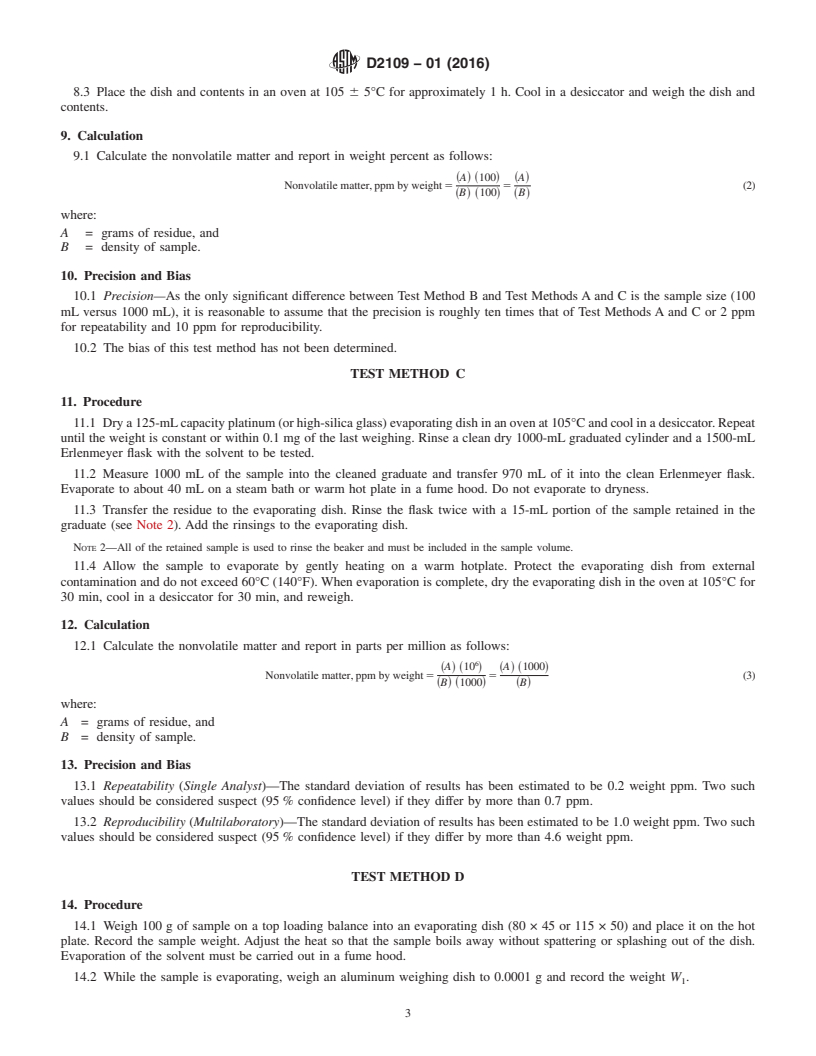
1.2.3 Test Method C—For low-boiling halogenated organic solvents or their admixtures (for example, methylene chloride, trichlorotrifluoroethane) that may superheat and cause bumping while evaporating to dryness with steam. A precision of greater than ±10 ppm can be attained.
1.2.4 Test Method D—For rapid measurement of nonvolatile matter in halogenated organic solvents and their admixtures and where precision better than ±10 ppm is required.
1.2.5 Test Method E—For halogenated organic solvents or admixtures and where precision better than ±10 ppm is required.
1.3 The values stated in SI units are to be regarded as standard.
1.4 This standard does not purport to address all of the safety concerns, if any, associated with its use. It is the responsibility of the user of this standard to establish appropriate safety and health practices and determine the applicability of regulatory limitations prior to use.
General Information
Buy Standard
Standards Content (Sample)
NOTICE: This standard has either been superseded and replaced by a new version or withdrawn.
Contact ASTM International (www.astm.org) for the latest information
Designation: D2109 − 01 (Reapproved 2016)
Standard Test Methods for
Nonvolatile Matter in Halogenated Organic
Solvents and Their Admixtures
This standard is issued under the fixed designation D2109; the number immediately following the designation indicates the year of
original adoption or, in the case of revision, the year of last revision.Anumber in parentheses indicates the year of last reapproval.A
superscript epsilon (´) indicates an editorial change since the last revision or reapproval.
This standard has been approved for use by agencies of the U.S. Department of Defense.
1. Scope not be considered part of nonvolatile matter. If these solids are
present in the sample, they should be removed by filtration or
1.1 These test methods cover the determination of nonvola-
decantation prior to beginning this test method. Nonvolatile
tile matter in halogenated organic solvents and admixtures.
matter is considered to be “in solution” with the solvent and
1.2 Five test methods are covered, as follows:
that which will become residual upon drying the solvent at a
1.2.1 Test Method A—For halogenated organic solvents or
specified temperature.
admixtures having less than 50 ppm nonvolatile matter; or
2.1.2 Nonvolatile matter and nonvolatile residue are inter-
where precision better than 610 ppm is required.
changeable terms.
1.2.2 Test Method B—For halogenated organic solvents or
admixtures having more than 50 ppm nonvolatile matter or
3. Significance and Use
where precision of 60.001% (10 ppm) is satisfactory.
3.1 Nonvolatile matter in solvents can adversely affect their
1.2.3 Test Method C—For low-boiling halogenated organic
cleaning properties. These test methods can be used to control
solvents or their admixtures (for example, methylene chloride,
soil contamination in the boiling solvent, which if allowed to
trichlorotrifluoroethane) that may superheat and cause bump-
become too high, can decrease the stability of the solvent.
ing while evaporating to dryness with steam. A precision of
greater than 610 ppm can be attained.
3.2 These test methods can be used to establish manufac-
1.2.4 Test Method D—Forrapidmeasurementofnonvolatile
turing and purchasing specifications.
matter in halogenated organic solvents and their admixtures
and where precision better than 610 ppm is required.
4. Apparatus
1.2.5 Test Method E—For halogenated organic solvents or
4.1 Oven, thermostatically controlled at 105 6 5°C.
admixtures and where precision better than 610 ppm is
required.
4.2 Evaporating Dish, 125-mL capacity, platinum or high-
1.3 The values stated in SI units are to be regarded as silica glass, Methods A, B, C.
standard.
4.3 Evaporating Dish (80 × 45 or 115 × 50) (Method D).
1.4 This standard does not purport to address all of the
4.4 Steam Bath (or hot plate).
safety concerns, if any, associated with its use. It is the
responsibility of the user of this standard to establish appro-
4.5 Hot Plate, (Method D).
priate safety and health practices and determine the applica-
4.6 Heat Lamp, 250 W, (Method E).
bility of regulatory limitations prior to use.
4.7 Analytical Balance, capable of measuring to 0.0001 g.
2. Terminology
4.8 Top Loading Balance, capable of weighing to 0.01 g.
2.1 Definitions of Terms Specific to This Standard:
4.9 Aluminum Weighing Dish, 57 × 18 mm, (Method D).
2.1.1 The term nonvolatile matter should not be construed
as equivalent to residue on ignition, ignition residue, or ash
4.10 Aluminum Weighing Dish, 200 ML capacity, (Method
content. Particulates, sediments, and suspended matter should
E).
4.11 1000-mL Volumetric Flask (Test Method A).
These test methods are under the jurisdiction of ASTM Committee D26 on
Halogenated Organic Solvents and Fire Extinguishing Agents and are the direct
4.12 100-mL Volumetric Pipet (Test Method B and E).
responsibility of Subcommittee D26.04 on Test Methods.
Current edition approved Feb. 1, 2016. Published April 2016. Originally
4.13 1000-mL Graduated Cylinder (Test Method C).
approved in 1962 as D2109-62 T. Last previous edition approved in 2011 as
D2109-01(2011). DOI: 10.1520/D2109-01R16. 4.14 1500-mL Erlenmeyer Flask (Test Method C).
Copyright © ASTM International, 100 Barr Harbor Drive, PO Box C700, West Conshohocken, PA 19428-2959. United States
D2109 − 01 (2016)
TEST METHOD A 8.3 Place the dish and contents in an oven at 105 6 5°C for
approximately1h.Coolinadesiccatorandweighthedishand
5. Procedure
contents.
5.1 Dry a 125-mL capacity platinum (or high-silica glass)
9. Calculation
evaporating dish in an oven at 105 6 5°C and cool in a
9.1 Calculate the nonvolatile matter and report in weight
desiccator.Repeatuntiltheweightisconstantorwithin0.1mg
percent as follows:
of the last weighing. Rinse a clean dry 1000-mL volumetric
flask with the solvent and fill to the 1000-mL mark with the
~A!~100! ~A!
Nonvolatilematter, ppmbyweight 5 5 (2)
solvent to be tested. Invert the evaporating dish, place it over
B 100 B
~ !~ ! ~ !
the mouth of the flask, hold it firmly in place, and invert the
where:
flask.Inthispositionplacebothdishandflaskonasteambath.
A = grams of residue, and
Adjustaringsupporttoholdtheflasksothemouthoftheflask
B = density of sample.
is approximately 25 mm above the bottom of the evaporating
dish.Thusheld,theflaskautomaticallyfeedsthesolventtothe
10. Precision and Bias
dish during the evaporation. (Warning—This test method
10.1 Precision—As the only significant difference between
must be run in a ventilated, dust-free area.)
Test Method B and Test Methods A and C is the sample size
5.2 Evaporate the 1000-mL sample to dryness. Remove the
(100 mL versus 1000 mL), it is reasonable to assume that the
dish from the steam bath with metal tongs and blot the outside
precision is roughly ten times that of Test MethodsAand C or
of the dish with lint-free paper tissue.
2 ppm for repeatability and 10 ppm for reproducibility.
NOTE 1—Hot plates develop high temperatures on the plate surface. If
10.2 The bias of this test method has not been determined.
ahotplateisusedtoevaporatethesolvent,theevaporatingdishshouldbe
placed inside a water bath while on the hot plate to prevent the sample
TEST METHOD C
from reaching temperatures exceeding 105°C.
5.3 Place the dish and contents in an oven at 105 6 5°C for 11. Procedure
approximately1h.Coolinadesiccatorandweighthedishand
11.1 Dry a 125-mL capacity platinum (or high-silica glass)
contents.
evaporating dish in an oven at 105°C and cool in a desiccator.
Repeat until the weight is constant or within 0.1 mg of the last
6. Calculation
weighing.Rinseacleandry1000-mLgraduatedcylinderanda
6.1 Calculate the nonvolatile matter and report in weight
1500-mL Erlenmeyer flask with the solvent to be tested.
percent or parts per million as follows:
11.2 Measure 1000 mL of the sample into the cleaned
A 10 A 1000
~ !~ ! ~ !~ !
graduate and transfer 970 mL of it into the clean Erlenmeyer
Nonvolatilematter, ppmbyweight 5 5 (1)
~B!~1000! ~B!
flask. Evaporate to about 40 mL on a steam bath or warm hot
plate in a fume hood. Do not evaporate to dryness.
where:
A = grams of residue, and 11.3 Transfer the residue to the evaporating dish. Rinse the
B = density of sample.
flask twice with a 15-mL portion of the sample retained in the
graduate(seeNote2).Addtherinsingstotheevaporatingdish.
7. Precision and Bias
NOTE
...
This document is not an ASTM standard and is intended only to provide the user of an ASTM standard an indication of what changes have been made to the previous version. Because
it may not be technically possible to adequately depict all changes accurately, ASTM recommends that users consult prior editions as appropriate. In all cases only the current version
of the standard as published by ASTM is to be considered the official document.
Designation: D2109 − 01(Reapproved 2011) D2109 − 01 (Reapproved 2016)
Standard Test Methods for
Nonvolatile Matter in Halogenated Organic
Solvents and Their Admixtures
This standard is issued under the fixed designation D2109; the number immediately following the designation indicates the year of
original adoption or, in the case of revision, the year of last revision. A number in parentheses indicates the year of last reapproval. A
superscript epsilon (´) indicates an editorial change since the last revision or reapproval.
This standard has been approved for use by agencies of the U.S. Department of Defense.
1. Scope
1.1 These test methods cover the determination of nonvolatile matter in halogenated organic solvents and admixtures.
1.2 Five test methods are covered, as follows:
1.2.1 Test Method A—For halogenated organic solvents or admixtures having less than 50 ppm nonvolatile matter; or where
precision better than 610 ppm is required.
1.2.2 Test Method B—For halogenated organic solvents or admixtures having more than 50 ppm nonvolatile matter or where
precision of 60.001 % (10 ppm) is satisfactory.
1.2.3 Test Method C—For low-boiling halogenated organic solvents or their admixtures (for example, methylene chloride,
trichlorotrifluoroethane) that may superheat and cause bumping while evaporating to dryness with steam. A precision of greater
than6 10than 610 ppm can be attained.
1.2.4 Test Method D—For rapid measurement of nonvolatile matter in halogenated organic solvents and their admixtures and
where precision better than 610 ppm is required.
1.2.5 Test Method E—For halogenated organic solvents or admixtures and where precision better than 610 ppm is required.
1.3 The values stated in SI units are to be regarded as the standard.
1.4 The values stated in SI units are to be regarded as standard. No other units of measurement are included in this standard.
1.4 This standard does not purport to address all of the safety concerns, if any, associated with its use. It is the responsibility
of the user of this standard to establish appropriate safety and health practices and determine the applicability of regulatory
limitations prior to use.
2. Terminology
2.1 Definitions of Terms Specific to This Standard:
2.1.1 The term nonvolatile matter should not be construed as equivalent to residue on ignition, ignition residue, or ash content.
Particulates, sediments, and suspended matter should not be considered part of nonvolatile matter. If these solids are present in the
sample, they should be removed by filtration or decantation prior to beginning this test method. Nonvolatile matter is considered
to be “in solution” with the solvent and that which will become residual upon drying the solvent at a specified temperature.
2.1.2 Nonvolatile matter and nonvolatile residue are interchangeable terms.
3. Significance and Use
3.1 Nonvolatile matter in solvents can adversely affect their cleaning properties. These test methods can be used to control soil
contamination in the boiling solvent, which if allowed to become too high, can decrease the stability of the solvent.
3.2 These test methods can be used to establish manufacturing and purchasing specifications.
4. Apparatus
4.1 Oven, thermostatically controlled at 105 6 5°C.
4.2 Evaporating Dish, 125-mL capacity, platinum or high-silica glass, Methods A, B, C.
These test methods are under the jurisdiction of ASTM Committee D26 on Halogenated Organic Solvents and Fire Extinguishing Agents and are the direct responsibility
of Subcommittee D26.04 on Test Methods.
Current edition approved Aug. 1, 2011Feb. 1, 2016. Published November 2011April 2016. Originally approved in 1962 as D2109 – 62 -62 T. Last previous edition
ε1
approved in 20062011 as D2109 – 01 (2006)D2109-01(2011). . DOI: 10.1520/D2109-01R11.10.1520/D2109-01R16.
Copyright © ASTM International, 100 Barr Harbor Drive, PO Box C700, West Conshohocken, PA 19428-2959. United States
D2109 − 01 (2016)
4.3 Evaporating Dish (80 × 45 or 115 × 50) (Method D).
4.4 Steam Bath (or hot plate).
4.5 Hot Plate, (Method D).
4.6 Heat Lamp, 250 W, (Method E).
4.7 Analytical Balance, capable of measuring to 0.0001 g.
4.8 Top Loading Balance, capable of weighing to 0.01 g.
4.9 Aluminum Weighing Dish, 57 × 18 mm, (Method D).
4.10 Aluminum Weighing Dish, 200 ML capacity, (Method E).
4.11 1000-mL Volumetric Flask (Test Method A).
4.12 100-mL Volumetric Pipet (Test Method B and E).
4.13 1000-mL Graduated Cylinder (Test Method C).
4.14 1500-mL Erlenmeyer Flask (Test Method C).
TEST METHOD A
5. Procedure
5.1 Dry a 125-mL capacity platinum (or high-silica glass) evaporating dish in an oven at 105 6 5°C and cool in a desiccator.
Repeat until the weight is constant or within 0.1 mg of the last weighing. Rinse a clean dry 1000-mL volumetric flask with the
solvent and fill to the 1000-mL mark with the solvent to be tested. Invert the evaporating dish, place it over the mouth of the flask,
hold it firmly in place, and invert the flask. In this position place both dish and flask on a steam bath. Adjust a ring support to hold
the flask so the mouth of the flask is approximately 25 mm above the bottom of the evaporating dish. Thus held, the flask
automatically feeds the solvent to the dish during the evaporation. (Warning—This test method must be run in a ventilated,
dust-free area.Warning)—This test method must be run in a ventilated, dust-free area.)
5.2 Evaporate the 1000-mL sample to dryness. Remove the dish from the steam bath with metal tongs and blot the outside of
the dish with lint-free paper tissue.
NOTE 1—Hot plates develop high temperatures on the plate surface. If a hot plate is used to evaporate the solvent, the evaporating dish should be placed
inside a water bath while on the hot plate to prevent the sample from reaching temperatures exceeding 105°C.
5.3 Place the dish and contents in an oven at 105 6 5°C for approximately 1 h. Cool in a desiccator and weigh the dish and
contents.
6. Calculation
6.1 Calculate the nonvolatile matter and report in weight percent or parts per million as follows:
A 10 A 1000
~ ! ~ ! ~ ! ~ !
Nonvolatile matter, ppm by weight 5 5 (1)
~B! ~1000! ~B!
where:
A = grams of residue, and
B = density of sample.
7. Precision and Bias
7.1 Repeatability (Single Analyst)—The standard deviation of results has been estimated to be 0.2 weight ppm. Two such values
should be considered suspect (95 % confidence level) if they differ by more than 0.7 ppm.
7.2 Reproducibility (Multilaboratory)—The standard deviation of results has been estimated to be 1.0 weight ppm. Two such
values should be considered suspect (95 % confidence level) if they differ by more than 4.6 weight ppm.
TEST METHOD B
8. Procedure
8.1 Dry a 125-mL capacity platinum (or high-silica glass) evaporating dish in an oven at 105 6 5°C and cool in a desiccator.
Repeat until the weight is constant or within 0.1 mg of the last weighing. Pipet 100 mL of sample into the dish and place on a
steam bath.
8.2 Evaporate the sample to dryness as in Section 5 (see Note 1 and Note 1). Remove the dish from the steam bath with metal
tongs and blot the outside of the dish with lint-free paper tissue.
D2109 − 01 (2016)
8.3 Place the dish and contents in an oven at 105 6 5°C for approximately 1 h. Cool in a desiccator and weigh the dish and
contents.
9. Calculation
9.1 Calculate the nonvolatile matter and report in weight percent as follows:
A 100 A
...
Questions, Comments and Discussion
Ask us and Technical Secretary will try to provide an answer. You can facilitate discussion about the standard in here.