


ASTM D3401-97(2017)
(Test Method)Standard Test Methods for Water in Halogenated Organic Solvents and Their Admixtures
Standard Test Methods for Water in Halogenated Organic Solvents and Their Admixtures
SIGNIFICANCE AND USE
4.1 High water concentrations can have a detrimental effect on many uses of halogenated solvents.
4.1.1 Water can cause corrosion and spotting when solvents are used for metal cleaning.
4.1.2 Water can reduce the shelf life of aerosol formulations.
4.1.3 Water can inhibit desired reactions when solvents are used in formulations.
SCOPE
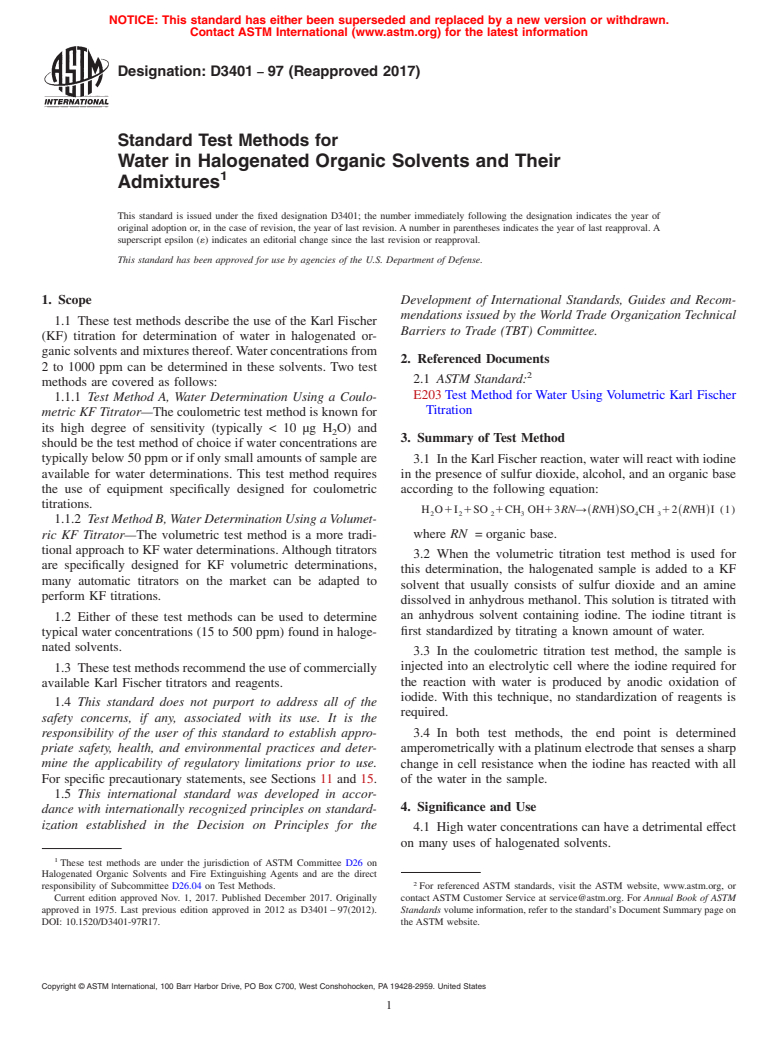
1.1 These test methods describe the use of the Karl Fischer (KF) titration for determination of water in halogenated organic solvents and mixtures thereof. Water concentrations from 2 to 1000 ppm can be determined in these solvents. Two test methods are covered as follows:
1.1.1 Test Method A, Water Determination Using a Coulometric KF Titrator—The coulometric test method is known for its high degree of sensitivity (typically 2O) and should be the test method of choice if water concentrations are typically below 50 ppm or if only small amounts of sample are available for water determinations. This test method requires the use of equipment specifically designed for coulometric titrations.
1.1.2 Test Method B, Water Determination Using a Volumetric KF Titrator—The volumetric test method is a more traditional approach to KF water determinations. Although titrators are specifically designed for KF volumetric determinations, many automatic titrators on the market can be adapted to perform KF titrations.
1.2 Either of these test methods can be used to determine typical water concentrations (15 to 500 ppm) found in halogenated solvents.
1.3 These test methods recommend the use of commercially available Karl Fischer titrators and reagents.
1.4 This standard does not purport to address all of the safety concerns, if any, associated with its use. It is the responsibility of the user of this standard to establish appropriate safety, health, and environmental practices and determine the applicability of regulatory limitations prior to use. For specific precautionary statements, see Sections 11 and 15.
1.5 This international standard was developed in accordance with internationally recognized principles on standardization established in the Decision on Principles for the Development of International Standards, Guides and Recommendations issued by the World Trade Organization Technical Barriers to Trade (TBT) Committee.
General Information
Buy Standard
Standards Content (Sample)
NOTICE: This standard has either been superseded and replaced by a new version or withdrawn.
Contact ASTM International (www.astm.org) for the latest information
Designation: D3401 − 97 (Reapproved 2017)
Standard Test Methods for
Water in Halogenated Organic Solvents and Their
Admixtures
This standard is issued under the fixed designation D3401; the number immediately following the designation indicates the year of
original adoption or, in the case of revision, the year of last revision. A number in parentheses indicates the year of last reapproval. A
superscript epsilon (´) indicates an editorial change since the last revision or reapproval.
This standard has been approved for use by agencies of the U.S. Department of Defense.
1. Scope Development of International Standards, Guides and Recom-
mendations issued by the World Trade Organization Technical
1.1 These test methods describe the use of the Karl Fischer
Barriers to Trade (TBT) Committee.
(KF) titration for determination of water in halogenated or-
ganicsolventsandmixturesthereof.Waterconcentrationsfrom
2. Referenced Documents
2 to 1000 ppm can be determined in these solvents. Two test
2.1 ASTM Standard:
methods are covered as follows:
E203 Test Method for Water Using Volumetric Karl Fischer
1.1.1 Test Method A, Water Determination Using a Coulo-
Titration
metric KF Titrator—The coulometric test method is known for
its high degree of sensitivity (typically < 10 µg H O) and
3. Summary of Test Method
should be the test method of choice if water concentrations are
typically below 50 ppm or if only small amounts of sample are 3.1 In the Karl Fischer reaction, water will react with iodine
available for water determinations. This test method requires in the presence of sulfur dioxide, alcohol, and an organic base
the use of equipment specifically designed for coulometric according to the following equation:
titrations.
H O1I 1SO 1CH OH13RN→ RNH SO CH 12 RNH I (1)
~ ! ~ !
2 2 2 3 4 3
1.1.2 TestMethodB,WaterDeterminationUsingaVolumet-
where RN = organic base.
ric KF Titrator—The volumetric test method is a more tradi-
tional approach to KF water determinations.Although titrators
3.2 When the volumetric titration test method is used for
are specifically designed for KF volumetric determinations,
this determination, the halogenated sample is added to a KF
many automatic titrators on the market can be adapted to
solvent that usually consists of sulfur dioxide and an amine
perform KF titrations.
dissolved in anhydrous methanol. This solution is titrated with
1.2 Either of these test methods can be used to determine an anhydrous solvent containing iodine. The iodine titrant is
first standardized by titrating a known amount of water.
typical water concentrations (15 to 500 ppm) found in haloge-
nated solvents.
3.3 In the coulometric titration test method, the sample is
injected into an electrolytic cell where the iodine required for
1.3 These test methods recommend the use of commercially
the reaction with water is produced by anodic oxidation of
available Karl Fischer titrators and reagents.
iodide. With this technique, no standardization of reagents is
1.4 This standard does not purport to address all of the
required.
safety concerns, if any, associated with its use. It is the
responsibility of the user of this standard to establish appro- 3.4 In both test methods, the end point is determined
priate safety, health, and environmental practices and deter- amperometrically with a platinum electrode that senses a sharp
mine the applicability of regulatory limitations prior to use. change in cell resistance when the iodine has reacted with all
For specific precautionary statements, see Sections 11 and 15. of the water in the sample.
1.5 This international standard was developed in accor-
4. Significance and Use
dance with internationally recognized principles on standard-
ization established in the Decision on Principles for the
4.1 High water concentrations can have a detrimental effect
on many uses of halogenated solvents.
These test methods are under the jurisdiction of ASTM Committee D26 on
Halogenated Organic Solvents and Fire Extinguishing Agents and are the direct
responsibility of Subcommittee D26.04 on Test Methods. For referenced ASTM standards, visit the ASTM website, www.astm.org, or
Current edition approved Nov. 1, 2017. Published December 2017. Originally contact ASTM Customer Service at service@astm.org. For Annual Book of ASTM
approved in 1975. Last previous edition approved in 2012 as D3401 – 97(2012). Standards volume information, refer to the standard’s Document Summary page on
DOI: 10.1520/D3401-97R17. the ASTM website.
Copyright © ASTM International, 100 Barr Harbor Drive, PO Box C700, West Conshohocken, PA 19428-2959. United States
D3401 − 97 (2017)
NOTE 1—Pyridine was the organic amine that was traditionally used in
4.1.1 Water can cause corrosion and spotting when solvents
Karl Fisher reagents, however, pyridine-free formulations are now avail-
are used for metal cleaning.
ableandpreferredbymostKFinstrumentmanufacturersforusewiththeir
4.1.2 Water can reduce the shelf life of aerosol formula-
equipment. Pyridine-free reagents are said to be less toxic, less odorous,
tions.
and more stable than pyridine types.
4.1.3 Water can inhibit desired reactions when solvents are
used in formulations. 8. Sampling
8.1 Since halogenated solvents normally contain low con-
5. Interferences
centrations of water, care must be taken to eliminate the
5.1 Certain compounds or classes of compounds interfere
introduction of water from sampling equipment and atmo-
with the accurate determination of water by the Karl Fischer
spheric moisture.
test method. They include aldehydes, ketones, free halogens,
8.2 Without taking the proper sampling precautions, more
ferric salts, and strong oxidizing and reducing agents.
error is typically introduced into the determination of water
5.2 Free halogens can oxidize the iodate in the KF reagents
through sampling techniques than in the titration process itself.
to form iodine; this causes erroneously low water values.
8.3 Drysamplebottlesandclosuresinanovenat110 °Cfor
5.3 A more detailed discussion of KF interferences can be
several hours. Place caps on the bottles immediately after
3,4
found in Test Method E203 and other sources.
removing from the oven.
6. Apparatus 8.4 Transfer solvent to the bottles as quickly as possible.
5 Adjust the liquid level to come within 1 in. of the top of the
6.1 Coulometric Titrator, (for Test Method A only) con-
bottle. Immediately place the cap on the bottle and tighten.
sisting of a single or dual bath electrolytic cell, dual platinum
electrode, magnetic stirrer, and control unit. 8.5 When removing a portion of sample from the bottle for
5 KF analysis, use pipets or syringes that have been thoroughly
6.2 Volumetric Titrator, (for Test Method B only) consist-
dried. Replace the cap on the bottle immediately.
ing of a titration cell, dual platinum electrode, magnetic stirrer,
dispensing buret, and control unit. 8.6 If more than one portion of sample is to be taken from
the bottle or if the sample is to be retained for further water
6.3 Syringes, 2, 5, 10, or 20-mL sizes.
analysis, it is a good practice to blanket the top of the bottle
6.4 Syringe, 5-µL size.
with dry nitrogen when removing the sample. If septum cap
closures are being used, dry nitrogen can be introduced with a
6.5 Silicon Rubber Blocks or Silicon Rubber Septa.
syringe at the same time a portion of the sample is being
6.6 Drying Oven, air circulating.
removed with a second syringe.
6.7 Desiccator.
TEST METHOD A—WATER DETERMINATION
6.8 Analytical Balance, capable of weighing to 60.01 g.
USING A COULOMETRIC KF TITRATOR
7. Reagents
9. Summary of Test Method
7.1 Anode Reagent, for dual bath titration (for Test Method
9.1 The dual bath coulometric titration cell consists of a
Aonly), use reagent recommended by manufacturer of titrator.
sealed vessel containing both an anode and cathode compart-
7.2 Cathode Reagent, for dual bath titration (for Test
ment. The anodic compartment usually contains a solution
MethodAonly), use reagent recommended by manufacturer of
consisting of sulfur dioxide, iodide, and an amine in a
titrator.
methanol/chloroform solvent. The cathodic compartment con-
7.3 Single Bath Reagent, (for Test Method A only), use
tains similar reagents optimized for cathodic reduction.
reagent recommended by manufacturer of titrator.
9.2 When a sample containing water is injected into the
7.4 Karl Fischer Volumetric Titrant, (for Test Method B
anode compartment, the electrolytic cell generates its own
only)typicallyconsistsofamixtureofanorganicamine,sulfur
supply of iodine from the iodide present. The iodine reacts
dioxide, and iodine dissolved in a non-hydroscopic solvent(s).
stoichiometrically with the water and the completion of the
Reagents with titers of 1.00, 2.00, and 5.00 mg of H O/mLcan
reaction is detected with a platinum sensing electrode. The
be commercially obtained.
coulombs of electricity required to generate the necessary
amountofiodineisthentranslatedbythemicroprocessorinthe
7.5 Karl Fischer Solvent, (for Test Method B only)
control unit into the amount of water that was present in the
typically consists of a mixture of an organic amine and sulfur
sample.
dioxide dissolved in anhydrous methanol.
9.3 The single bath coulometric titration cell consists of a
3 sealed vessel filled with single bath reagent and dual platinum
Mitchell, J., Jr. and Smith, D. M., Aquametry—A Treatise on Methods for the
electrodes.When a sample containing water is injected into the
Determination of Water, Part III—The Karl Fischer Reagent, 2nd ed., J. Wiley and
Sons, Inc., New York, NY, 1977.
vessel, the electrolytic cell generates its own supply of iodine
Hydranal—Eugen Scholz Reagents for Karl Fischer Titration, 4th ed., by
from the iodide present in the single bath reagent. The iodine
Riedel-deHaen Aktiengesellschaft (US Distributor—Cresent Chemical Co., Inc.).
reacts stoichiometrically with the water and the completion of
Automatic coulometric and volumetric titrators are manufactured by many
differentcompanies. the reaction is detected by a platinum sensing electrode. The
D3401 − 97 (2017)
TABLE 1 Recommended Sample Amount for Coulometric
coulombs of electricity required to generate the necessary
Titration
amounts of iodine is then translated by the microprocessor in
Water Content, ppm Sample Weight, g
thecontrolunitintotheamountofwaterthatwaspresentinthe
1000 0.5
sample.
500 0.5
100 1.0
10. Verification of Instrument Accuracy
50 2.0
10 5.0
10.1 Coulometric titrators do not have a titrant that needs to
be standardized since the iodine is being generated on demand
by the titration cell. However, occasional checks of the
instrument accuracy are recommended. This can be done by
Following the procedure recommended by the instrument
titrating a known amount of water and comparing this amount
manufacturer is suggested.
with the amount of water reported by the titrator.
12.3 The amount of halogenated solvent that is injected into
10.2 Use a 5-µL syringe to inject exactly 3.0 µL of water
the cell depends on the quantity of water in the solvent. Table
into the titration cell. Once the titration is complete, the titrator
1 lists recommended sample sizes for anticipated water con-
should report a value of 3000 µg (3.0 mg) H O. The deviation
centrations.
from this value should not be larger than 10 %. If the value is
12.4 Thoroughly clean and dry the sampling syringe. One
larger than 10 %, consult the instrument manual or manufac-
method is to dry it in an oven and desiccate before use.
turer to determine the cause.
12.5 Fill the syringe to the desired level with sample and
10.3 Alternatively, standard solutions containing known
draw back the plunger so that no sample remains in the needle.
amounts of water dissolved in either methanol or a non-
hydroscopic solvent are available from reagent suppliers for
12.6 Cover the syringe needle with a silicone rubber block
accuracy verification. A known volume of this solution is
or piece of silicone rubber septa to further prevent evaporation
titrated and the reported amount of water is compared with the
or spillage during the weighing process.
theoretical amount stated by the supplier.
12.7 Transfer the filled syringe to an analytical balance and
weigh the syringe and contents to the nearest 0.01 g.
11. Precautions
12.8 Remove the silicone block and insert the needle into
11.1 Amounts of coulomatic reagents usually recommended
the titration cell septum. Inject the sample slowly, taking care
for addition to the reaction cell typically have the capacity to
not to touch the needle to the surface of the anode solution.
react with approximately 100 to 200 mg of water. These
While the syringe is still inside the cell, draw any remaining
reagents must be replaced when they are depleted.
sample that may remain in the syringe needle back into the
11.2 Coulomatic reagents are hydroscopic and must be
barrel and remove the needle from the cell.
stored in tightly capped containers to reduce the absorption of
12.9 Place the silicone block back onto the tip of the needle
atmospheric moisture.
and reweigh the empty syringe.The weight difference between
11.3 Since the titrator automatically generates iodine to
the first and second weighings will be the amount of sample
keep the reaction vessel in a dehydrated state, it is important to
injected into the titration cell.
keep the cell sealed to prevent introduction of excess atmo-
12.10 The make and model of the titrator being used will
spheric moisture that will decrease reagent life.
determine the actual steps performed to carry out the titration
11.4 The total amount of solution in the anode compartment
process. In most cases, all that is required is pressing a start
can affect the KF reaction. Typically, the total volume of
titrationorrunkeyontheinstrumentkeyboardeitherjustprior
sample liquids that are added to the reaction cell should not
to or just after the sample injection.
exceed 50 % of the original reagent in the compartment. If the
12.11 Once the titration is complete, the amount of water
reagents become too dilute, the stoichiometry and rate of the
(µg or mg) that was found in the solvent will appear on the
Karl Fischer reaction can be adversely affected. This fact
instrument’s digital display. Most instruments will also calcu-
should be considered when using large sample sizes.
late concentrations (ppm or %) if the sample weight is keyed
11.5 Follow the recommended maintenance procedures of
into the instrument’s control panel.
the instrument manufacturer.
13. Calculation
12. Procedure
13.1 Calculate the water content of the solvent as follows:
12.1 Set up the coulometric titrator according to the manu-
ppm H O 5 µgH O found/grams of
...
This document is not an ASTM standard and is intended only to provide the user of an ASTM standard an indication of what changes have been made to the previous version. Because
it may not be technically possible to adequately depict all changes accurately, ASTM recommends that users consult prior editions as appropriate. In all cases only the current version
of the standard as published by ASTM is to be considered the official document.
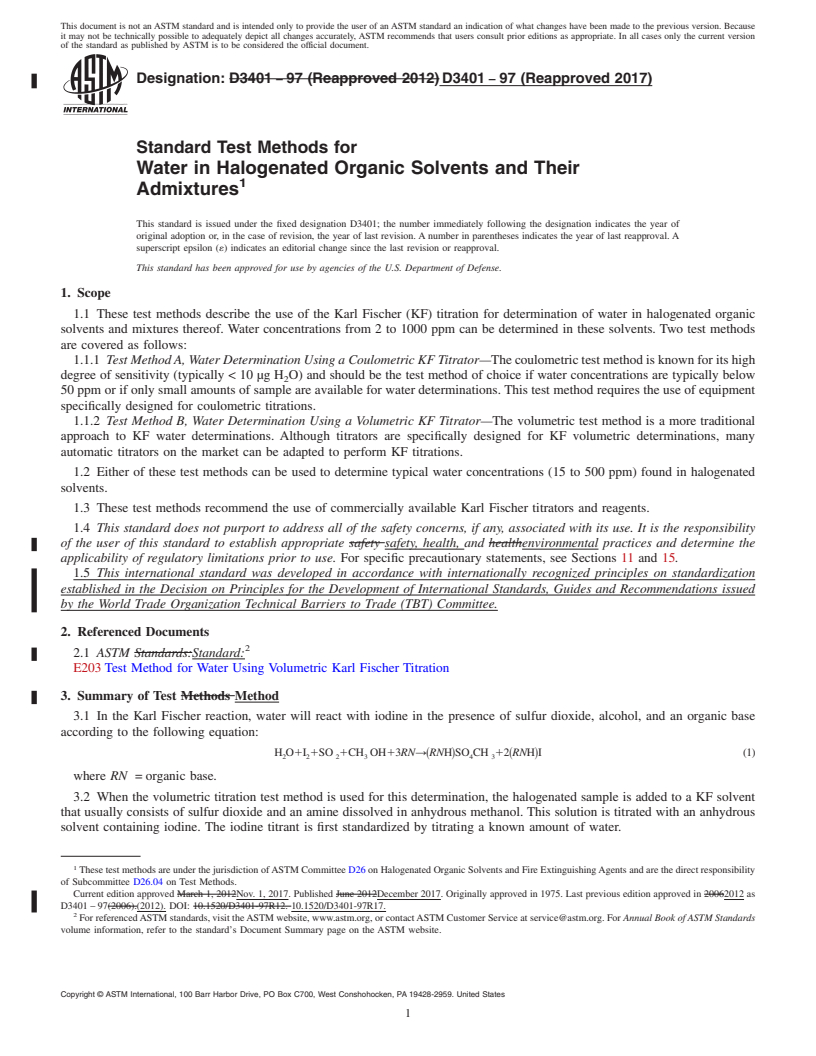
Designation: D3401 − 97 (Reapproved 2012) D3401 − 97 (Reapproved 2017)
Standard Test Methods for
Water in Halogenated Organic Solvents and Their
Admixtures
This standard is issued under the fixed designation D3401; the number immediately following the designation indicates the year of
original adoption or, in the case of revision, the year of last revision. A number in parentheses indicates the year of last reapproval. A
superscript epsilon (´) indicates an editorial change since the last revision or reapproval.
This standard has been approved for use by agencies of the U.S. Department of Defense.
1. Scope
1.1 These test methods describe the use of the Karl Fischer (KF) titration for determination of water in halogenated organic
solvents and mixtures thereof. Water concentrations from 2 to 1000 ppm can be determined in these solvents. Two test methods
are covered as follows:
1.1.1 Test Method A, Water Determination Using a Coulometric KF Titrator—The coulometric test method is known for its high
degree of sensitivity (typically < 10 μg H O) and should be the test method of choice if water concentrations are typically below
50 ppm or if only small amounts of sample are available for water determinations. This test method requires the use of equipment
specifically designed for coulometric titrations.
1.1.2 Test Method B, Water Determination Using a Volumetric KF Titrator—The volumetric test method is a more traditional
approach to KF water determinations. Although titrators are specifically designed for KF volumetric determinations, many
automatic titrators on the market can be adapted to perform KF titrations.
1.2 Either of these test methods can be used to determine typical water concentrations (15 to 500 ppm) found in halogenated
solvents.
1.3 These test methods recommend the use of commercially available Karl Fischer titrators and reagents.
1.4 This standard does not purport to address all of the safety concerns, if any, associated with its use. It is the responsibility
of the user of this standard to establish appropriate safety safety, health, and healthenvironmental practices and determine the
applicability of regulatory limitations prior to use. For specific precautionary statements, see Sections 11 and 15.
1.5 This international standard was developed in accordance with internationally recognized principles on standardization
established in the Decision on Principles for the Development of International Standards, Guides and Recommendations issued
by the World Trade Organization Technical Barriers to Trade (TBT) Committee.
2. Referenced Documents
2.1 ASTM Standards:Standard:
E203 Test Method for Water Using Volumetric Karl Fischer Titration
3. Summary of Test Methods Method
3.1 In the Karl Fischer reaction, water will react with iodine in the presence of sulfur dioxide, alcohol, and an organic base
according to the following equation:
H O1I 1SO 1CH OH13RN→ RNH SO CH 12 RNH I (1)
~ ! ~ !
2 2 2 3 4 3
where RN = organic base.
3.2 When the volumetric titration test method is used for this determination, the halogenated sample is added to a KF solvent
that usually consists of sulfur dioxide and an amine dissolved in anhydrous methanol. This solution is titrated with an anhydrous
solvent containing iodine. The iodine titrant is first standardized by titrating a known amount of water.
These test methods are under the jurisdiction of ASTM Committee D26 on Halogenated Organic Solvents and Fire Extinguishing Agents and are the direct responsibility
of Subcommittee D26.04 on Test Methods.
Current edition approved March 1, 2012Nov. 1, 2017. Published June 2012December 2017. Originally approved in 1975. Last previous edition approved in 20062012 as
D3401 – 97(2006).(2012). DOI: 10.1520/D3401-97R12. 10.1520/D3401-97R17.
For referenced ASTM standards, visit the ASTM website, www.astm.org, or contact ASTM Customer Service at service@astm.org. For Annual Book of ASTM Standards
volume information, refer to the standard’s Document Summary page on the ASTM website.
Copyright © ASTM International, 100 Barr Harbor Drive, PO Box C700, West Conshohocken, PA 19428-2959. United States
D3401 − 97 (2017)
3.3 In the coulometric titration test method, the sample is injected into an electrolytic cell where the iodine required for the
reaction with water is produced by anodic oxidation of iodide. With this technique, no standardization of reagents is required.
3.4 In both test methods, the end point is determined amperometrically with a platinum electrode that senses a sharp change
in cell resistance when the iodine has reacted with all of the water in the sample.
4. Significance and Use
4.1 High water concentrations can have a detrimental effect on many uses of halogenated solvents.
4.1.1 Water can cause corrosion and spotting when solvents are used for metal cleaning.
4.1.2 Water can reduce the shelf life of aerosol formulations.
4.1.3 Water can inhibit desired reactions when solvents are used in formulations.
5. Interferences
5.1 Certain compounds or classes of compounds interfere with the accurate determination of water by the Karl Fischer test
method. They include aldehydes, ketones, free halogens, ferric salts, and strong oxidizing and reducing agents.
5.2 Free halogens can oxidize the iodate in the KF reagents to form iodine; this causes erroneously low water values.
3,4
5.3 A more detailed discussion of KF interferences can be found in Test Method E203 and other sources.
6. Apparatus
6.1 Coulometric Titrator, (for Test Method A only) consisting of a single or dual bath electrolytic cell, dual platinum electrode,
magnetic stirrer, and control unit.
6.2 Volumetric Titrator, (for Test Method B only) consisting of a titration cell, dual platinum electrode, magnetic stirrer,
dispensing buret, and control unit.
6.3 Syringes, 2, 5, 10, or 20-mL sizes.
6.4 Syringe, 5-μL size.
6.5 Silicon Rubber Blocks or Silicon Rubber Septa.
6.6 Drying Oven, air circulating.
6.7 Desiccator.
6.8 Analytical Balance, capable of weighing to 60.01 g.
7. Reagents
7.1 Anode Reagent, for dual bath titration (for Test Method A only), use reagent recommended by manufacturer of titrator.
7.2 Cathode Reagent, for dual bath titration (for Test Method A only), use reagent recommended by manufacturer of titrator.
7.3 Single Bath Reagent, (for Test Method A only), use reagent recommended by manufacturer of titrator.
7.4 Karl Fischer Volumetric Titrant, (for Test Method B only) typically consists of a mixture of an organic amine, sulfur
dioxide, and iodine dissolved in a non-hydroscopic solvent(s). Reagents with titers of 1.00, 2.00, and 5.00 mg of H O/mL can be
commercially obtained.
7.5 Karl Fischer Solvent, (for Test Method B only) typically consists of a mixture of an organic amine and sulfur dioxide
dissolved in anhydrous methanol.
NOTE 1—Pyridine was the organic amine that was traditionally used in Karl Fisher reagents, however, pyridine-free formulations are now available
and preferred by most KF instrument manufacturers for use with their equipment. Pyridine-free reagents are said to be less toxic, less odorous, and more
stable than pyridine types.
8. Sampling
8.1 Since halogenated solvents normally contain low concentrations of water, care must be taken to eliminate the introduction
of water from sampling equipment and atmospheric moisture.
8.2 Without taking the proper sampling precautions, more error is typically introduced into the determination of water through
sampling techniques than in the titration process itself.
Mitchell, J., Jr. and Smith, D. M., Aquametry—A Treatise on Methods for the Determination of Water, Part III—The Karl Fischer Reagent, 2nd ed., J. Wiley and Sons,
Inc., New York, NY, 1977.
Hydranal—Eugen Scholz Reagents for Karl Fischer Titration, 4th ed., by Riedel-deHaen Aktiengesellschaft (US Distributor—Cresent Chemical Co., Inc.).
Automatic coulometric and volumetric titrators are manufactured by many different companies.
D3401 − 97 (2017)
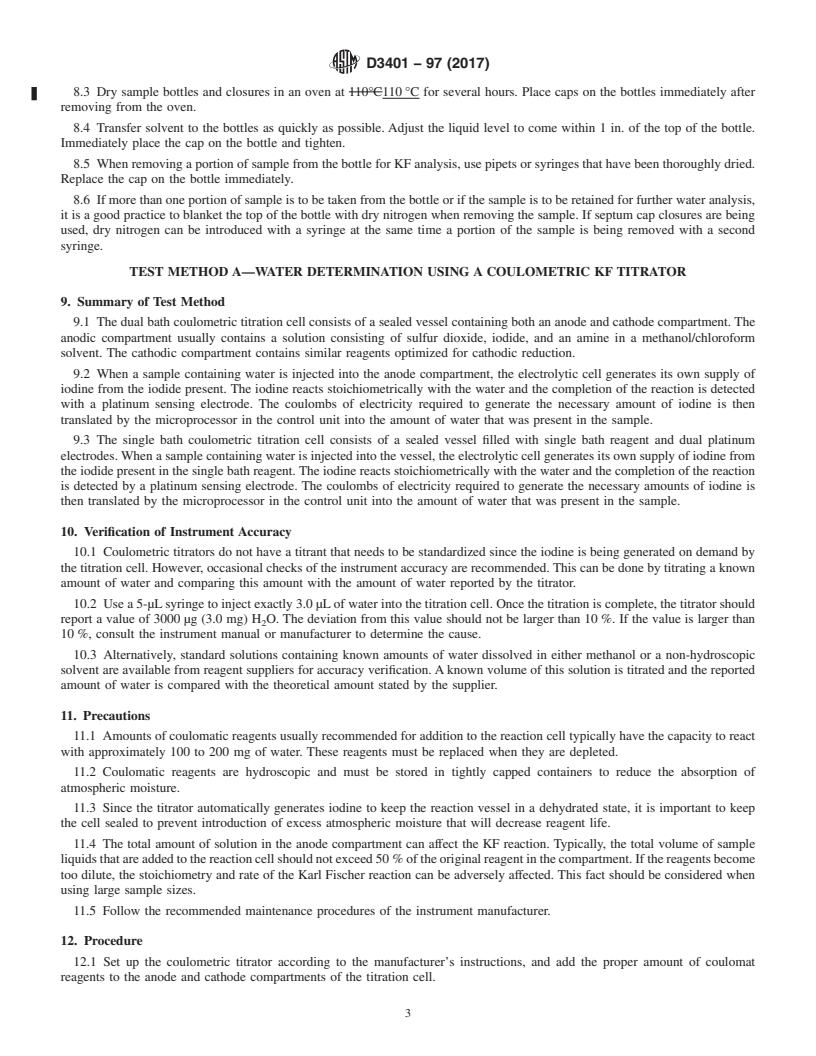
8.3 Dry sample bottles and closures in an oven at 110°C110 °C for several hours. Place caps on the bottles immediately after
removing from the oven.
8.4 Transfer solvent to the bottles as quickly as possible. Adjust the liquid level to come within 1 in. of the top of the bottle.
Immediately place the cap on the bottle and tighten.
8.5 When removing a portion of sample from the bottle for KF analysis, use pipets or syringes that have been thoroughly dried.
Replace the cap on the bottle immediately.
8.6 If more than one portion of sample is to be taken from the bottle or if the sample is to be retained for further water analysis,
it is a good practice to blanket the top of the bottle with dry nitrogen when removing the sample. If septum cap closures are being
used, dry nitrogen can be introduced with a syringe at the same time a portion of the sample is being removed with a second
syringe.
TEST METHOD A—WATER DETERMINATION USING A COULOMETRIC KF TITRATOR
9. Summary of Test Method
9.1 The dual bath coulometric titration cell consists of a sealed vessel containing both an anode and cathode compartment. The
anodic compartment usually contains a solution consisting of sulfur dioxide, iodide, and an amine in a methanol/chloroform
solvent. The cathodic compartment contains similar reagents optimized for cathodic reduction.
9.2 When a sample containing water is injected into the anode compartment, the electrolytic cell generates its own supply of
iodine from the iodide present. The iodine reacts stoichiometrically with the water and the completion of the reaction is detected
with a platinum sensing electrode. The coulombs of electricity required to generate the necessary amount of iodine is then
translated by the microprocessor in the control unit into the amount of water that was present in the sample.
9.3 The single bath coulometric titration cell consists of a sealed vessel filled with single bath reagent and dual platinum
electrodes. When a sample containing water is injected into the vessel, the electrolytic cell generates its own supply of iodine from
the iodide present in the single bath reagent. The iodine reacts stoichiometrically with the water and the completion of the reaction
is detected by a platinum sensing electrode. The coulombs of electricity required to generate the necessary amounts of iodine is
then translated by the microprocessor in the control unit into the amount of water that was present in the sample.
10. Verification of Instrument Accuracy
10.1 Coulometric titrators do not have a titrant that needs to be standardized since the iodine is being generated on demand by
the titration cell. However, occasional checks of the instrument accuracy are recommended. This can be done by titrating a known
amount of water and comparing this amount with the amount of water reported by the titrator.
10.2 Use a 5-μL syringe to inject exactly 3.0 μL of water into the titration cell. Once the titration is complete, the titrator should
report a value of 3000 μg (3.0 mg) H O. The deviation from this value should not be larger than 10 %. If the value is larger than
10 %, consult the instrument manual or manufacturer to determine the cause.
10.3 Alternatively, standard solutions containing known amounts of water dissolved in either methanol or a non-hydroscopic
solvent are available from reagent suppliers for accuracy verification. A known volume of this solution is titrated and the reported
amount of water is compared with the theoretical amount stated by the supplier.
11. Precautions
11.1 Amounts of coulomatic reagents usually recommended for addition to the reaction cell typically have the capacity to react
with approximately 100 to 200 mg of water. These reagents must be replaced when they are depleted.
11.2 Coulomatic reagents are hydroscopic and must be stored in tightly capped containers to reduce the absorption of
atmospheric moisture.
11.3 Since the titrator automatically generates iodine to keep the reaction vessel in a dehydrated state, it is important to keep
the cell sealed to prevent introduction of excess atmospheric moisture that will decrease reagent life.
11.4 The total amount of solution in the anode compartment can affect the KF reaction. Typically, the total volume of sample
liquids that are added to the reaction cell should not exceed 50 % of the original reagent in the compartment. If the reagents become
too dilute, the stoichiometry and rate of the Karl Fischer reaction can be adversely affected. This fact should be considered when
using large sample sizes.
11.5 Follow the recommended maintenance procedures of the instrument manufacturer.
12. Procedure
12.1 Set up the coulometric titrator according to the manufacturer’s instructions, and add the proper amount of coulomat
reagents to the anode and cathode compartments of the titration cell.
D3401 − 97 (2017)
12.2 The cell solutions must be anhydrous prior to introduction of the sample. This is accomplished by either pretitrating the
cell contents or by adding a small amount of an iodine/methanol solution until a faint brownish coloration appears. Following the
procedure recommended by the instrument manufacturer is suggested.
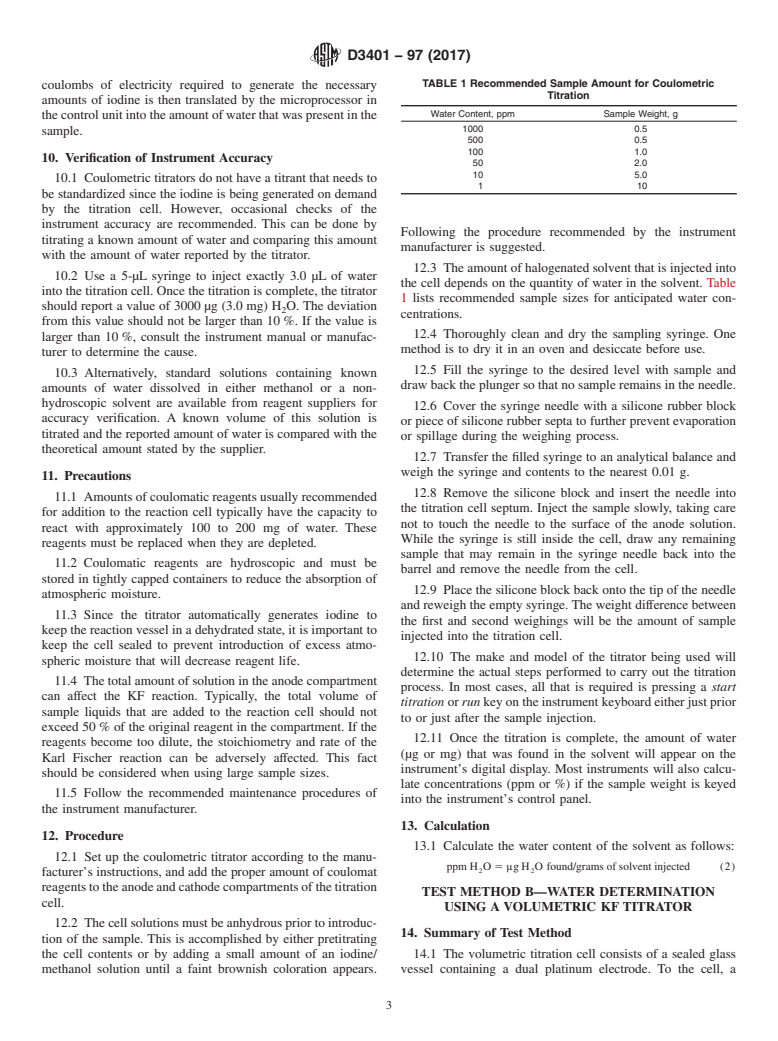
12.3 The amount of halogenated solvent that is injected into the cell depends on the quantity of water in the solvent. Table 1
lists recommended sample sizes for anticipated water concentrations.
12.4 Thoroughly clean and dry the sampling syringe. One method is to dry it in an oven and desiccate before use.
12.5 Fill the syringe to the desired level with sample and draw back the plunger so that no sample remains in the needle.
12.6 Cover the syringe needle with a silicone rubber block or piece of silicone rubber septa to further prevent evaporation or
spillage during the weighing process.
12.7 Transfer the filled syringe to an analytical balance and weigh the syringe and contents to the nearest 0.01 g.
12.8 Remove the silicone block and insert the needle into the titration cell septum. Inject the sample slowly, taking care not to
touch the needle to the surface of the anode solution. While the syringe is still inside the cell, draw any remaining sample that may
remain in the syringe needle back into the barrel and remove the needle from the cell.
12.9 Place the silicone block back onto the tip of the needle and reweigh the empty syringe. The weight difference between the
first and seco
...
Questions, Comments and Discussion
Ask us and Technical Secretary will try to provide an answer. You can facilitate discussion about the standard in here.