


ASTM G125-00(2015)
(Test Method)Standard Test Method for Measuring Liquid and Solid Material Fire Limits in Gaseous Oxidants
Standard Test Method for Measuring Liquid and Solid Material Fire Limits in Gaseous Oxidants
SIGNIFICANCE AND USE
5.1 This test method provides for measuring of the minimum conditions of a range of parameters (concentration of oxidant in a flowing mixture of oxidant and diluent, pressure, temperature) that will just support sustained propagation of combustion. For materials that exhibit flaming combustion, this is a flammability limit similar to the lower flammability limit, upper flammability limit, and minimum oxidant for combustion of gases (1).4 However, unlike flammability limits for gases, in two-phase systems, the concept of upper and lower flame limits is not meaningful. However, limits can typically be determined for variations in other parameters such as the minimum oxidant for combustion (the oxidant index), the pressure limit, the temperature limit, and others. Measurement and use of these data are analogous to the measurement and use of the corresponding data for gaseous systems. That is, the limits apply to systems likely to experience complete propagations (equilibrium combustion). Successful ignition and combustion below the measured limits at other conditions or of a transient nature are not precluded below the threshold. Flammability limits measured at one set of conditions are not necessarily the lowest thresholds at which combustion can occur. Therefore direct correlation of these data with the burning characteristics under actual use conditions is not implied.
SCOPE
1.1 This test method covers a procedure for measuring the threshold-limit conditions to allow equilibrium of combustion of materials in various oxidant gases under specific test conditions of pressure, temperature, flow condition, fire-propagation directions, and various other geometrical features of common systems.
1.2 This test method is patterned after Test Method D2863-95 and incorporates its procedure for measuring the limit as a function of oxidant concentration for the most commonly used test conditions. Sections 8, 9, 10, 11, 13, and for the basic oxidant limit (oxygen index) procedure are quoted directly from Test Method D2863-95. Oxygen index data reported in accordance with Test Method D2863-95 are acceptable substitutes for data collected with this standard under similar conditions.
1.3 This test method has been found applicable to testing and ranking various forms of materials. It has also found limited usefulness for surmising the prospect that materials will prove “oxygen compatible” in actual systems. However, its results do not necessarily apply to any condition that does not faithfully reproduce the conditions during test. The fire limit is a measurement of a behavioral property and not a physical property. Uses of these data are addressed in Guides G63 and G94.
Note 1: Although this test method has been found applicable for testing a range of materials in a range of oxidants with a range of diluents, the accuracy has not been determined for many of these combinations and conditions of specimen geometry, outside those of the basic procedure as applied to plastics.
Note 2: Test Method D2863-95 has been revised and the revised Test Method has been issued as D2863-97. The major changes involve sample dimensions, burning criteria and the method for determining the oxygen index. The aim of the revisions was to align Test Method D2863 with ISO 4589-2. Six laboratories conducted comparison round robin testing on self-supporting plastics and cellular materials using D2863-95 and D2863-97. The results indicate that there is no difference between the means provided y the two methods at the 95 % confidence level. No comparison tests were conducted on thin films. The majority of ASTM Committee G4 favors maintaining the D2863-95 as the backbone of G125 until comprehensive comparison data become available.
1.4 One very specific set of test conditions for measuring the fire limits of metals in oxygen has been codified in Test Method G124. Test Method G124 measures the minimum pressure limit in oxygen fo...
General Information
Buy Standard
Standards Content (Sample)
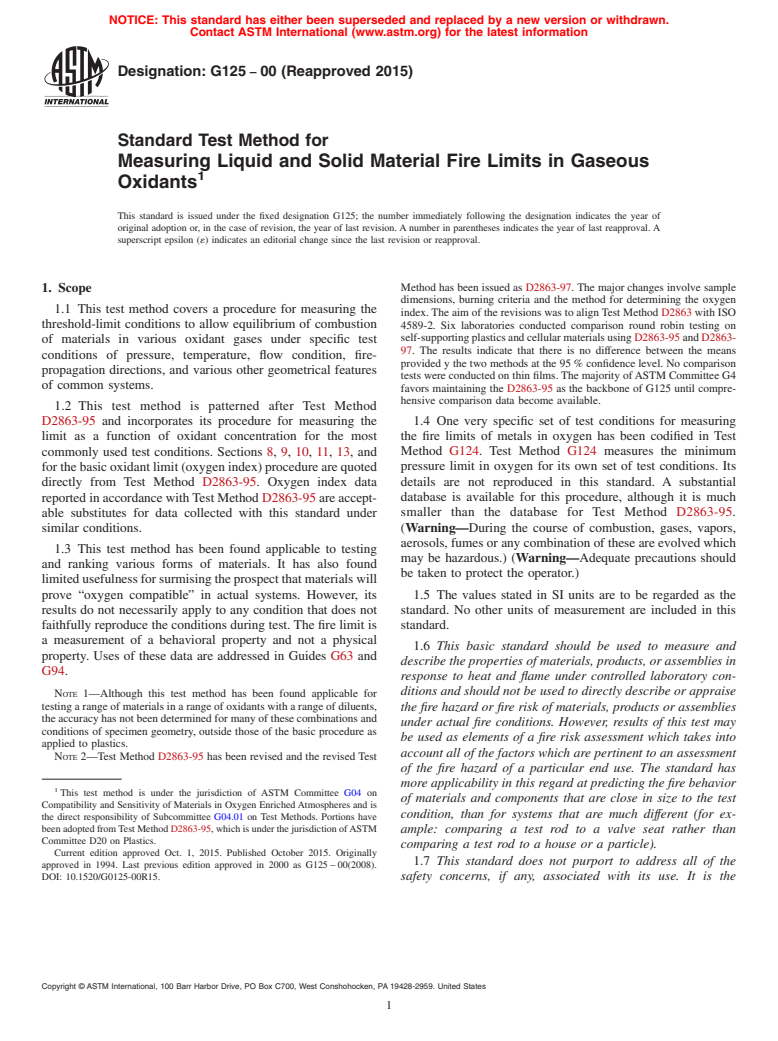
NOTICE: This standard has either been superseded and replaced by a new version or withdrawn.
Contact ASTM International (www.astm.org) for the latest information
Designation: G125 − 00 (Reapproved 2015)
Standard Test Method for
Measuring Liquid and Solid Material Fire Limits in Gaseous
Oxidants
This standard is issued under the fixed designation G125; the number immediately following the designation indicates the year of
original adoption or, in the case of revision, the year of last revision. A number in parentheses indicates the year of last reapproval. A
superscript epsilon (´) indicates an editorial change since the last revision or reapproval.
Method has been issued as D2863-97. The major changes involve sample
1. Scope
dimensions, burning criteria and the method for determining the oxygen
1.1 This test method covers a procedure for measuring the
index. The aim of the revisions was to align Test Method D2863 with ISO
threshold-limit conditions to allow equilibrium of combustion
4589-2. Six laboratories conducted comparison round robin testing on
self-supporting plastics and cellular materials using D2863-95 and D2863-
of materials in various oxidant gases under specific test
97. The results indicate that there is no difference between the means
conditions of pressure, temperature, flow condition, fire-
provided y the two methods at the 95 % confidence level. No comparison
propagation directions, and various other geometrical features
tests were conducted on thin films. The majority of ASTM Committee G4
of common systems.
favors maintaining the D2863-95 as the backbone of G125 until compre-
hensive comparison data become available.
1.2 This test method is patterned after Test Method
D2863-95 and incorporates its procedure for measuring the 1.4 One very specific set of test conditions for measuring
the fire limits of metals in oxygen has been codified in Test
limit as a function of oxidant concentration for the most
commonly used test conditions. Sections 8, 9, 10, 11, 13, and Method G124. Test Method G124 measures the minimum
pressure limit in oxygen for its own set of test conditions. Its
for the basic oxidant limit (oxygen index) procedure are quoted
directly from Test Method D2863-95. Oxygen index data details are not reproduced in this standard. A substantial
database is available for this procedure, although it is much
reported in accordance with Test Method D2863-95 are accept-
able substitutes for data collected with this standard under smaller than the database for Test Method D2863-95.
(Warning—During the course of combustion, gases, vapors,
similar conditions.
aerosols, fumes or any combination of these are evolved which
1.3 This test method has been found applicable to testing
may be hazardous.) (Warning—Adequate precautions should
and ranking various forms of materials. It has also found
be taken to protect the operator.)
limited usefulness for surmising the prospect that materials will
prove “oxygen compatible” in actual systems. However, its
1.5 The values stated in SI units are to be regarded as the
results do not necessarily apply to any condition that does not standard. No other units of measurement are included in this
faithfully reproduce the conditions during test. The fire limit is
standard.
a measurement of a behavioral property and not a physical
1.6 This basic standard should be used to measure and
property. Uses of these data are addressed in Guides G63 and
describe the properties of materials, products, or assemblies in
G94.
response to heat and flame under controlled laboratory con-
ditions and should not be used to directly describe or appraise
NOTE 1—Although this test method has been found applicable for
testing a range of materials in a range of oxidants with a range of diluents,
the fire hazard or fire risk of materials, products or assemblies
the accuracy has not been determined for many of these combinations and
under actual fire conditions. However, results of this test may
conditions of specimen geometry, outside those of the basic procedure as
be used as elements of a fire risk assessment which takes into
applied to plastics.
account all of the factors which are pertinent to an assessment
NOTE 2—Test Method D2863-95 has been revised and the revised Test
of the fire hazard of a particular end use. The standard has
more applicability in this regard at predicting the fire behavior
This test method is under the jurisdiction of ASTM Committee G04 on
of materials and components that are close in size to the test
Compatibility and Sensitivity of Materials in Oxygen Enriched Atmospheres and is
condition, than for systems that are much different (for ex-
the direct responsibility of Subcommittee G04.01 on Test Methods. Portions have
been adopted from Test Method D2863-95, which is under the jurisdiction of ASTM ample: comparing a test rod to a valve seat rather than
Committee D20 on Plastics.
comparing a test rod to a house or a particle).
Current edition approved Oct. 1, 2015. Published October 2015. Originally
1.7 This standard does not purport to address all of the
approved in 1994. Last previous edition approved in 2000 as G125 – 00(2008).
DOI: 10.1520/G0125-00R15. safety concerns, if any, associated with its use. It is the
Copyright © ASTM International, 100 Barr Harbor Drive, PO Box C700, West Conshohocken, PA 19428-2959. United States
G125 − 00 (2015)
responsibility of the user of this standard to establish appro- 3.2.2 oxidant compatibility, n—the ability of a substance to
priate safety and health practices and determine the applica- coexist with both an oxidant and a potential source(s) of
bility of regulatory limitations prior to use. ignition within the acceptable risk parameter of the user (at an
expected pressure and temperature).
2. Referenced Documents
3.2.3 oxidant index, n—the minimum concentration of an
2.1 ASTM Standards:
oxidant such as oxygen, nitrous oxide, fluorine, etc., expressed
D618 Practice for Conditioning Plastics for Testing
as a volume percent, in a mixture of the oxidant with a diluent
D1071 Test Methods for Volumetric Measurement of Gas-
such as nitrogen, helium, carbon dioxide, etc., that will just
eous Fuel Samples
support sustained combustion of a material initially at given
D2444 Test Method for Determination of the Impact Resis-
conditions of temperature, pressure, flow conditions, propaga-
tance of Thermoplastic Pipe and Fittings by Means of a
tion direction, etc. (See also, oxygen index.)
Tup (Falling Weight)
3.2.3.1 Discussion—The oxidant index may be more spe-
D2863 Test Method for Measuring the Minimum Oxygen
cifically identified by naming the oxidant: oxygen limit (or
Concentration to Support Candle-Like Combustion of
index), nitrous oxide limit (or index), fluorine limit (or index),
Plastics (Oxygen Index)
etc. Unless specified otherwise, the typical oxidant is taken to
D2863-95 Test Method for Measuring the Minimum Oxygen
be oxygen, the typical diluent is taken to be nitrogen, and the
Concentration to Support Candle-Like Combustion of
typical temperature is taken as room temperature.
Plastics (Oxygen Index)
3.2.4 pressure limit—the minimum pressure of an oxidant
D2863-97 Test Method for Measuring the Minimum Oxygen
(or mixture) that will just support sustained combustion of a
Concentration to Support Candle-Like Combustion of
material initially at given conditions of oxidant concentration,
Plastics (Oxygen Index)
temperature, flow condition, propagation direction, etc.
G63 Guide for Evaluating Nonmetallic Materials for Oxy-
gen Service 3.2.4.1 Discussion—The pressure limit may be more spe-
cifically identified by naming the oxidant: oxygen pressure
G94 Guide for Evaluating Metals for Oxygen Service
G124 Test Method for Determining the Combustion Behav- limit, nitrous oxide pressure limit, fluorine pressure limit, etc.
ior of Metallic Materials in Oxygen-Enriched Atmo-
3.2.5 temperature limit—the minimum temperature of an
spheres
oxidant (or mixture) that will just support sustained combus-
G128 Guide for Control of Hazards and Risks in Oxygen
tion of a material initially at given conditions of oxidant
Enriched Systems
concentration, temperature, flow condition, propagation
2.2 Other Standards:
direction, etc.
ISO 4589-2 Plastics—Determination of burning behavior by
3.2.5.1 Discussion—The temperature limit may be more
oxygen index—Part 2: Ambient temperature test
specifically identified by naming the oxidant: oxygen tempera-
ture limit, nitrous oxide temperature limit, fluorine temperature
3. Terminology
limit, etc.
3.1 Definitions:
3.1.1 oxygen compatibility, n—the ability of a substance to
4. Summary of Test Method
coexist with both oxygen and a potential source(s) of ignition
4.1 The threshold limit condition (minimum oxidant
within the acceptable risk parameter of the user (at an expected
concentration, minimum pressure, minimum temperature, etc.)
pressure and temperature). (See Guide G128.)
that will just support sustained combustion under equilibrium
3.1.2 oxygen index, n—the minimum concentration of
conditions is measured in a test apparatus. The equilibrium is
oxygen, expressed as a volume percent, in a mixture of oxygen
established by the relation between the heat generated from the
and nitrogen that will just support flaming combustion of a
combustion of the specimen (that may be augmented by the
material initially at room temperature under the conditions of
heat of decomposition of some oxidants) and the heat lost to
Test Method D2863. (See Test Method D2863.)
the surroundings as measured by one or the other of two
3.2 Definitions of Terms Specific to This Standard:
arbitrary criteria, namely, a time of burning or a length of
3.2.1 fire limit, n—the threshold limit conditions that will
specimen burned. This point is approached from both sides of
just support sustained combustion of a material under a
the critical threshold condition in order to establish the fire
combination of specified conditions and at least one variable
limit.
parameter (typically oxidant concentration, diluent nature,
pressure, temperature, geometry, flow or flame parameters,
5. Significance and Use
etc.).
5.1 This test method provides for measuring of the mini-
mum conditions of a range of parameters (concentration of
oxidant in a flowing mixture of oxidant and diluent, pressure,
For referenced ASTM standards, visit the ASTM website, www.astm.org, or
contact ASTM Customer Service at service@astm.org. For Annual Book of ASTM
temperature) that will just support sustained propagation of
Standards volume information, refer to the standard’s Document Summary page on
combustion. For materials that exhibit flaming combustion,
the ASTM website.
3 this is a flammability limit similar to the lower flammability
ISO 4589-2 First edition 1996-07-15, International Organization for
Standardization, Geneve, Switzerland, 1996. limit, upper flammability limit, and minimum oxidant for
G125 − 00 (2015)
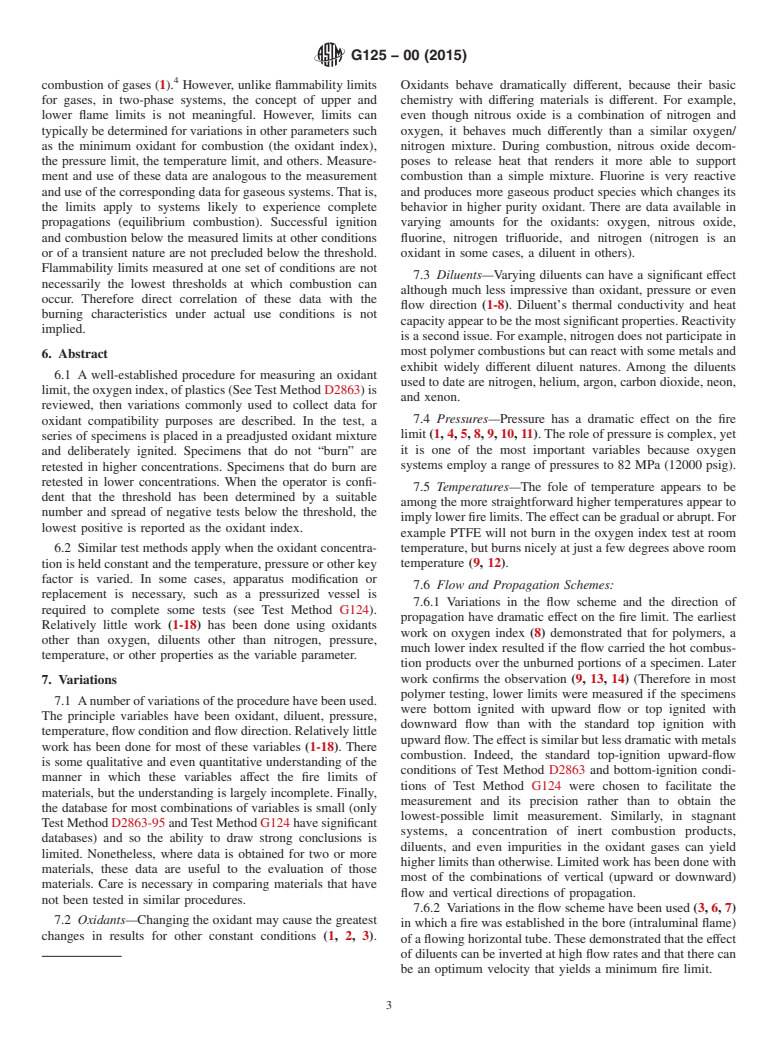
combustion of gases (1). However, unlike flammability limits Oxidants behave dramatically different, because their basic
for gases, in two-phase systems, the concept of upper and chemistry with differing materials is different. For example,
lower flame limits is not meaningful. However, limits can even though nitrous oxide is a combination of nitrogen and
typically be determined for variations in other parameters such oxygen, it behaves much differently than a similar oxygen/
as the minimum oxidant for combustion (the oxidant index), nitrogen mixture. During combustion, nitrous oxide decom-
the pressure limit, the temperature limit, and others. Measure- poses to release heat that renders it more able to support
ment and use of these data are analogous to the measurement combustion than a simple mixture. Fluorine is very reactive
and use of the corresponding data for gaseous systems. That is, and produces more gaseous product species which changes its
the limits apply to systems likely to experience complete behavior in higher purity oxidant. There are data available in
propagations (equilibrium combustion). Successful ignition varying amounts for the oxidants: oxygen, nitrous oxide,
and combustion below the measured limits at other conditions fluorine, nitrogen trifluoride, and nitrogen (nitrogen is an
or of a transient nature are not precluded below the threshold. oxidant in some cases, a diluent in others).
Flammability limits measured at one set of conditions are not
7.3 Diluents—Varying diluents can have a significant effect
necessarily the lowest thresholds at which combustion can
although much less impressive than oxidant, pressure or even
occur. Therefore direct correlation of these data with the
flow direction (1-8). Diluent’s thermal conductivity and heat
burning characteristics under actual use conditions is not
capacity appear to be the most significant properties. Reactivity
implied.
is a second issue. For example, nitrogen does not participate in
most polymer combustions but can react with some metals and
6. Abstract
exhibit widely different diluent natures. Among the diluents
6.1 A well-established procedure for measuring an oxidant
used to date are nitrogen, helium, argon, carbon dioxide, neon,
limit, the oxygen index, of plastics (See Test Method D2863) is
and xenon.
reviewed, then variations commonly used to collect data for
7.4 Pressures—Pressure has a dramatic effect on the fire
oxidant compatibility purposes are described. In the test, a
limit (1, 4, 5, 8, 9, 10, 11). The role of pressure is complex, yet
series of specimens is placed in a preadjusted oxidant mixture
it is one of the most important variables because oxygen
and deliberately ignited. Specimens that do not “burn” are
systems employ a range of pressures to 82 MPa (12000 psig).
retested in higher concentrations. Specimens that do burn are
retested in lower concentrations. When the operator is confi-
7.5 Temperatures—The fole of temperature appears to be
dent that the threshold has been determined by a suitable
among the more straightforward higher temperatures appear to
number and spread of negative tests below the threshold, the
imply lower fire limits. The effect can be gradual or abrupt. For
lowest positive is reported as the oxidant index.
example PTFE will not burn in the oxygen index test at room
6.2 Similar test methods apply when the oxidant concentra- temperature, but burns nicely at just a few degrees above room
tion is held constant and the temperature, pressure or other key temperature (9, 12).
factor is varied. In some cases, apparatus modification or
7.6 Flow and Propagation Schemes:
replacement is necessary, such as a pressurized vessel is
7.6.1 Variations in the flow scheme and the direction of
required to complete some tests (see Test Method G124).
propagation have dramatic effect on the fire limit. The earliest
Relatively little work (1-18) has
...
This document is not an ASTM standard and is intended only to provide the user of an ASTM standard an indication of what changes have been made to the previous version. Because
it may not be technically possible to adequately depict all changes accurately, ASTM recommends that users consult prior editions as appropriate. In all cases only the current version
of the standard as published by ASTM is to be considered the official document.
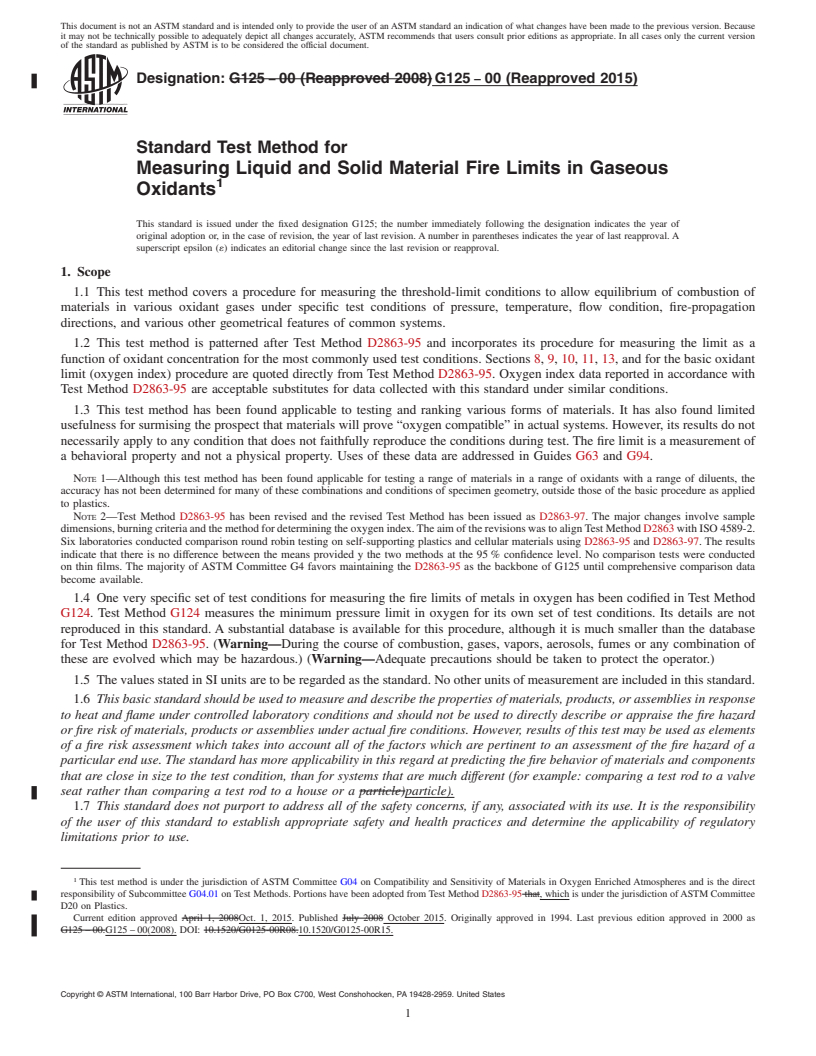
Designation: G125 − 00 (Reapproved 2008) G125 − 00 (Reapproved 2015)
Standard Test Method for
Measuring Liquid and Solid Material Fire Limits in Gaseous
Oxidants
This standard is issued under the fixed designation G125; the number immediately following the designation indicates the year of
original adoption or, in the case of revision, the year of last revision. A number in parentheses indicates the year of last reapproval. A
superscript epsilon (´) indicates an editorial change since the last revision or reapproval.
1. Scope
1.1 This test method covers a procedure for measuring the threshold-limit conditions to allow equilibrium of combustion of
materials in various oxidant gases under specific test conditions of pressure, temperature, flow condition, fire-propagation
directions, and various other geometrical features of common systems.
1.2 This test method is patterned after Test Method D2863-95 and incorporates its procedure for measuring the limit as a
function of oxidant concentration for the most commonly used test conditions. Sections 8, 9, 10, 11, 13, and for the basic oxidant
limit (oxygen index) procedure are quoted directly from Test Method D2863-95. Oxygen index data reported in accordance with
Test Method D2863-95 are acceptable substitutes for data collected with this standard under similar conditions.
1.3 This test method has been found applicable to testing and ranking various forms of materials. It has also found limited
usefulness for surmising the prospect that materials will prove “oxygen compatible” in actual systems. However, its results do not
necessarily apply to any condition that does not faithfully reproduce the conditions during test. The fire limit is a measurement of
a behavioral property and not a physical property. Uses of these data are addressed in Guides G63 and G94.
NOTE 1—Although this test method has been found applicable for testing a range of materials in a range of oxidants with a range of diluents, the
accuracy has not been determined for many of these combinations and conditions of specimen geometry, outside those of the basic procedure as applied
to plastics.
NOTE 2—Test Method D2863-95 has been revised and the revised Test Method has been issued as D2863-97. The major changes involve sample
dimensions, burning criteria and the method for determining the oxygen index. The aim of the revisions was to align Test Method D2863 with ISO 4589-2.
Six laboratories conducted comparison round robin testing on self-supporting plastics and cellular materials using D2863-95 and D2863-97. The results
indicate that there is no difference between the means provided y the two methods at the 95 % confidence level. No comparison tests were conducted
on thin films. The majority of ASTM Committee G4 favors maintaining the D2863-95 as the backbone of G125 until comprehensive comparison data
become available.
1.4 One very specific set of test conditions for measuring the fire limits of metals in oxygen has been codified in Test Method
G124. Test Method G124 measures the minimum pressure limit in oxygen for its own set of test conditions. Its details are not
reproduced in this standard. A substantial database is available for this procedure, although it is much smaller than the database
for Test Method D2863-95. (Warning—During the course of combustion, gases, vapors, aerosols, fumes or any combination of
these are evolved which may be hazardous.) (Warning—Adequate precautions should be taken to protect the operator.)
1.5 The values stated in SI units are to be regarded as the standard. No other units of measurement are included in this standard.
1.6 This basic standard should be used to measure and describe the properties of materials, products, or assemblies in response
to heat and flame under controlled laboratory conditions and should not be used to directly describe or appraise the fire hazard
or fire risk of materials, products or assemblies under actual fire conditions. However, results of this test may be used as elements
of a fire risk assessment which takes into account all of the factors which are pertinent to an assessment of the fire hazard of a
particular end use. The standard has more applicability in this regard at predicting the fire behavior of materials and components
that are close in size to the test condition, than for systems that are much different (for example: comparing a test rod to a valve
seat rather than comparing a test rod to a house or a particle)particle).
1.7 This standard does not purport to address all of the safety concerns, if any, associated with its use. It is the responsibility
of the user of this standard to establish appropriate safety and health practices and determine the applicability of regulatory
limitations prior to use.
This test method is under the jurisdiction of ASTM Committee G04 on Compatibility and Sensitivity of Materials in Oxygen Enriched Atmospheres and is the direct
responsibility of Subcommittee G04.01 on Test Methods. Portions have been adopted from Test Method D2863-95 that, which is under the jurisdiction of ASTM Committee
D20 on Plastics.
Current edition approved April 1, 2008Oct. 1, 2015. Published July 2008 October 2015. Originally approved in 1994. Last previous edition approved in 2000 as
G125 – 00.G125 – 00(2008). DOI: 10.1520/G0125-00R08.10.1520/G0125-00R15.
Copyright © ASTM International, 100 Barr Harbor Drive, PO Box C700, West Conshohocken, PA 19428-2959. United States
G125 − 00 (2015)
2. Referenced Documents
2.1 ASTM Standards:
D618 Practice for Conditioning Plastics for Testing
D1071 Test Methods for Volumetric Measurement of Gaseous Fuel Samples
D2444 Test Method for Determination of the Impact Resistance of Thermoplastic Pipe and Fittings by Means of a Tup (Falling
Weight)
D2863 Test Method for Measuring the Minimum Oxygen Concentration to Support Candle-Like Combustion of Plastics
(Oxygen Index)
D2863-95 Test Method for Measuring the Minimum Oxygen Concentration to Support Candle-Like Combustion of Plastics
(Oxygen Index)
D2863-97 Test Method for Measuring the Minimum Oxygen Concentration to Support Candle-Like Combustion of Plastics
(Oxygen Index)
G63 Guide for Evaluating Nonmetallic Materials for Oxygen Service
G94 Guide for Evaluating Metals for Oxygen Service
G124 Test Method for Determining the Combustion Behavior of Metallic Materials in Oxygen-Enriched Atmospheres
G128 Guide for Control of Hazards and Risks in Oxygen Enriched Systems
2.2 Other Standards:
ISO 4589-2 Plastics—Determination of burning behavior by oxygen index—Part 2: Ambient temperature test
3. Terminology
3.1 Definitions:
3.1.1 oxygen compatibility, n—the ability of a substance to coexist with both oxygen and a potential source(s) of ignition within
the acceptable risk parameter of the user (at an expected pressure and temperature). (See Guide G128.)
3.1.2 oxygen index, n—the minimum concentration of oxygen, expressed as a volume percent, in a mixture of oxygen and
nitrogen that will just support flaming combustion of a material initially at room temperature under the conditions of Test Method
D2863. (See Test Method D2863.)
3.2 Definitions of Terms Specific to This Standard:
3.2.1 fire limit, n—the threshold limit conditions that will just support sustained combustion of a material under a combination
of specified conditions and at least one variable parameter (typically oxidant concentration, diluent nature, pressure, temperature,
geometry, flow or flame parameters, etc.).
3.2.2 oxidant compatibility, n—the ability of a substance to coexist with both an oxidant and a potential source(s) of ignition
within the acceptable risk parameter of the user (at an expected pressure and temperature).
3.2.3 oxidant index, n—the minimum concentration of an oxidant such as oxygen, nitrous oxide, fluorine, etc., expressed as a
volume percent, in a mixture of the oxidant with a diluent such as nitrogen, helium, carbon dioxide, etc., that will just support
sustained combustion of a material initially at given conditions of temperature, pressure, flow conditions, propagation direction,
etc. (See also, oxygen index.)
For referenced ASTM standards, visit the ASTM website, www.astm.org, or contact ASTM Customer Service at service@astm.org. For Annual Book of ASTM Standards
volume information, refer to the standard’s Document Summary page on the ASTM website.
ISO 4589-2 First edition 1996-07-15, International Organization for Standardization, Geneve, Switzerland, 1996.
3.2.3.1 Discussion—
The oxidant index may be more specifically identified by naming the oxidant: oxygen limit (or index), nitrous oxide limit (or
index), fluorine limit (or index), etc. Unless specified otherwise, the typical oxidant is taken to be oxygen, the typical diluent is
taken to be nitrogen, and the typical temperature is taken as room temperature.
3.2.4 pressure limit—the minimum pressure of an oxidant (or mixture) that will just support sustained combustion of a material
initially at given conditions of oxidant concentration, temperature, flow condition, propagation direction, etc.
3.2.4.1 Discussion—
The pressure limit may be more specifically identified by naming the oxidant: oxygen pressure limit, nitrous oxide pressure limit,
fluorine pressure limit, etc.
3.2.5 temperature limit—the minimum temperature of an oxidant (or mixture) that will just support sustained combustion of a
material initially at given conditions of oxidant concentration, temperature, flow condition, propagation direction, etc.
G125 − 00 (2015)
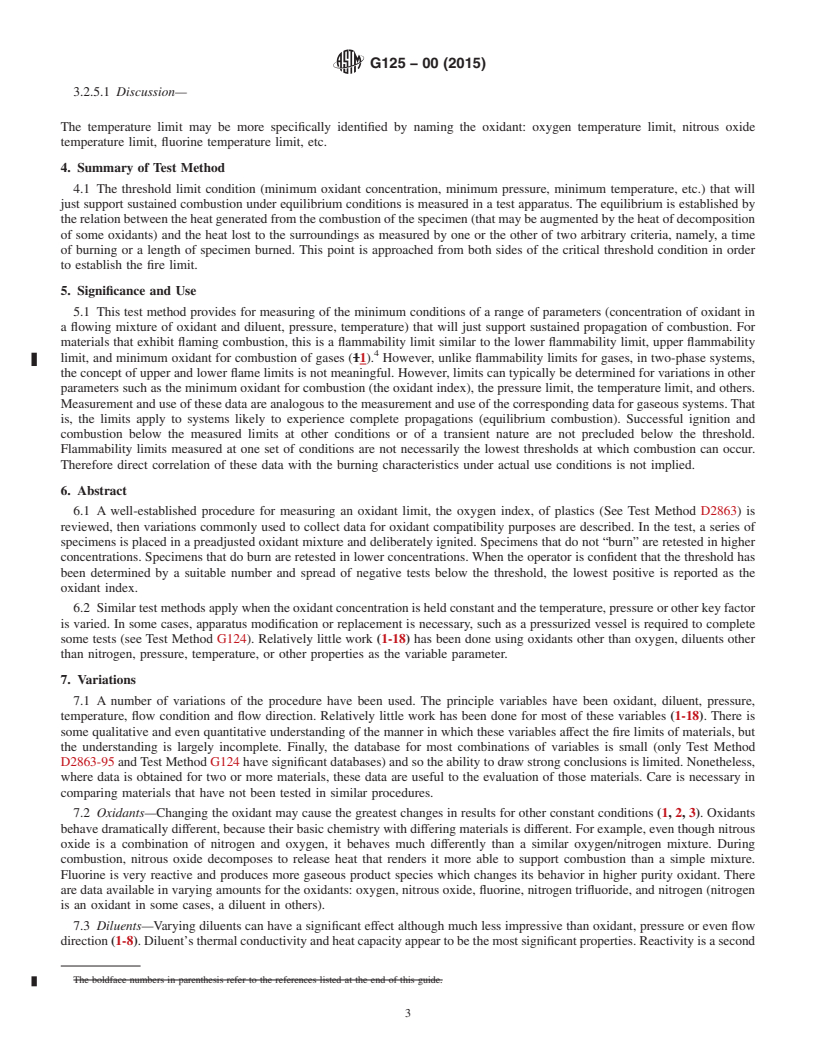
3.2.5.1 Discussion—
The temperature limit may be more specifically identified by naming the oxidant: oxygen temperature limit, nitrous oxide
temperature limit, fluorine temperature limit, etc.
4. Summary of Test Method
4.1 The threshold limit condition (minimum oxidant concentration, minimum pressure, minimum temperature, etc.) that will
just support sustained combustion under equilibrium conditions is measured in a test apparatus. The equilibrium is established by
the relation between the heat generated from the combustion of the specimen (that may be augmented by the heat of decomposition
of some oxidants) and the heat lost to the surroundings as measured by one or the other of two arbitrary criteria, namely, a time
of burning or a length of specimen burned. This point is approached from both sides of the critical threshold condition in order
to establish the fire limit.
5. Significance and Use
5.1 This test method provides for measuring of the minimum conditions of a range of parameters (concentration of oxidant in
a flowing mixture of oxidant and diluent, pressure, temperature) that will just support sustained propagation of combustion. For
materials that exhibit flaming combustion, this is a flammability limit similar to the lower flammability limit, upper flammability
limit, and minimum oxidant for combustion of gases (11). However, unlike flammability limits for gases, in two-phase systems,
the concept of upper and lower flame limits is not meaningful. However, limits can typically be determined for variations in other
parameters such as the minimum oxidant for combustion (the oxidant index), the pressure limit, the temperature limit, and others.
Measurement and use of these data are analogous to the measurement and use of the corresponding data for gaseous systems. That
is, the limits apply to systems likely to experience complete propagations (equilibrium combustion). Successful ignition and
combustion below the measured limits at other conditions or of a transient nature are not precluded below the threshold.
Flammability limits measured at one set of conditions are not necessarily the lowest thresholds at which combustion can occur.
Therefore direct correlation of these data with the burning characteristics under actual use conditions is not implied.
6. Abstract
6.1 A well-established procedure for measuring an oxidant limit, the oxygen index, of plastics (See Test Method D2863) is
reviewed, then variations commonly used to collect data for oxidant compatibility purposes are described. In the test, a series of
specimens is placed in a preadjusted oxidant mixture and deliberately ignited. Specimens that do not “burn” are retested in higher
concentrations. Specimens that do burn are retested in lower concentrations. When the operator is confident that the threshold has
been determined by a suitable number and spread of negative tests below the threshold, the lowest positive is reported as the
oxidant index.
6.2 Similar test methods apply when the oxidant concentration is held constant and the temperature, pressure or other key factor
is varied. In some cases, apparatus modification or replacement is necessary, such as a pressurized vessel is required to complete
some tests (see Test Method G124). Relatively little work (1-18) has been done using oxidants other than oxygen, diluents other
than nitrogen, pressure, temperature, or other properties as the variable parameter.
7. Variations
7.1 A number of variations of the procedure have been used. The principle variables have been oxidant, diluent, pressure,
temperature, flow condition and flow direction. Relatively little work has been done for most of these variables (1-18). There is
some qualitative and even quantitative understanding of the manner in which these variables affect the fire limits of materials, but
the understanding is largely incomplete. Finally, the database for most combinations of variables is small (only Test Method
D2863-95 and Test Method G124 have significant databases) and so the ability to draw strong conclusions is limited. Nonetheless,
where data is obtained for two or more materials, these data are useful to the evaluation of those materials. Care is necessary in
comparing materials that have not been tested in similar procedures.
7.2 Oxidants—Changing the oxidant may cause the greatest changes in results for other constant conditions (1, 2, 3). Oxidants
behave dramatically different, because their basic chemistry with differing materials is different. For example, even though nitrous
oxide is a combination of nitrogen and oxygen, it behaves much differently than a similar oxygen/nitrogen mixture. During
combustion, nitrous oxide decomposes to release heat that renders it more able to support combustion than a simple mixture.
Fluorine is very reactive and produces more gaseous product species which changes its behavior in higher purity oxidant. There
are data available in var
...
Questions, Comments and Discussion
Ask us and Technical Secretary will try to provide an answer. You can facilitate discussion about the standard in here.