

ASTM D4769-12(2018)e1
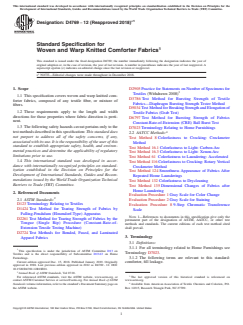
(Specification)Standard Specification for Woven and Warp Knitted Comforter Fabrics
General Information
- Abstract
SIGNIFICANCE AND USE
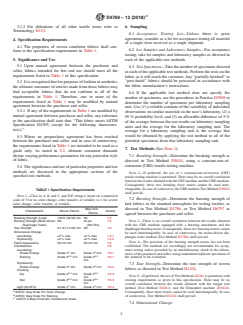
5.1 Upon mutual agreement between the purchaser and seller, fabrics intended for this end use should meet all the requirements listed in Table 1 of this specification.
5.2 It is recognized that for purposes of fashion or aesthetics the ultimate consumer of articles made from these fabrics may find acceptable fabrics that do not conform to all of the requirements in Table 1. Therefore, one or more of the requirements listed in Table 1 may be modified by mutual agreement between the purchaser and seller.
5.2.1 If any of the requirements in Table 1 are modified by mutual agreement between purchaser and seller, any reference to the specification shall state that: “This fabric meets ASTM Specification D4769, except for the following characteristic(s).”
5.3 Where no prepurchase agreement has been reached between the purchaser and seller, and in case of controversy, the requirements listed in Table 1 are intended to be used as a guide only. As stated in 5.2, ultimate consumer demands dictate varying performance parameters for any particular style of fabric.
5.4 The significance and use of particular properties and test methods are discussed in the appropriate sections of the specified test methods.
SCOPE
1.1 This specification covers woven and warp knitted comforter fabrics, composed of any textile fiber, or mixture of fibers.
1.2 These requirements apply to the length and width directions for those properties where fabric direction is pertinent.
1.3 The following safety hazards caveat pertains only to the test methods described in this specification: This standard does not purport to address all of the safety concerns, if any, associated with its use. It is the responsibility of the user of this standard to establish appropriate safety, health, and environmental practices and determine the applicability of regulatory limitations prior to use.
1.4 This international standard was developed in accordance with internationally recognized principles on standardization established in the Decision on Principles for the Development of International Standards, Guides and Recommendations issued by the World Trade Organization Technical Barriers to Trade (TBT) Committee.
- Status
- Published
- Publication Date
- 14-Dec-2018
- Technical Committee
- D13 - Textiles
- Drafting Committee
- D13.63 - Home Furnishings


Overview
ASTM D4769-12(2018)e1 is the internationally recognized Standard Specification for Woven and Warp Knitted Comforter Fabrics, published by ASTM International. This standard establishes the key quality and performance requirements for comforter fabrics made from any textile fiber or fiber blend, whether woven or warp knitted. By following this specification, manufacturers, buyers, and suppliers can ensure a minimum level of consistency and reliability in comforter fabric properties, supporting both commercial procurement and quality assurance for end-use applications.
Key Topics
- Product Scope: The specification covers comforter fabrics manufactured by either weaving or warp knitting, with no limitations on fiber composition. It applies requirements in both fabric length and width directions when fabric direction is relevant.
- Mutual Agreements: Buyers and sellers may agree to modify certain requirements in the standard to meet unique fashion, aesthetic, or end-user needs. Any such modifications must be documented alongside the standard's reference.
- Quality Requirements: The document references a table of performance characteristics, including (but not limited to) breaking strength, bursting strength, tear strength, colorfastness to laundering and drycleaning, dimensional stability, fabric appearance, and resistance to crocking and light exposure.
- Testing Methods: The standard references validated ASTM and AATCC test methods for evaluating performance, such as:
- Breaking strength (ASTM D5034)
- Tearing strength (ASTM D1424, D2261)
- Bursting strength (ASTM D3786, D6797)
- Colorfastness (AATCC Methods 8, 16, 61, 116, 124, 132, 135)
- Sampling Guidelines: Procedures for acceptance testing, lot sampling, and laboratory sample collection are outlined, with default reliance on referenced methods unless otherwise agreed upon.
- Safety and Compliance: Users are reminded that safety, health, and environmental practices must be established separately, as the standard does not provide comprehensive coverage of all potential hazards.
Applications
ASTM D4769 serves a critical role in the textile and home furnishings industry for the following:
- Procurement and Supply Chains: Provides a basis for fabric specifications in contracts between manufacturers, suppliers, and buyers of comforter fabrics, ensuring products meet agreed-upon performance standards.
- Product Development and Quality Control: Assists manufacturers in designing fabrics that consistently meet durability, appearance, and care requirements for comforters.
- Consumer Confidence: Ensures end-users receive comforter products that perform reliably in terms of color retention, dimensional stability, and resistance to tearing or fabric damage after washing or drycleaning.
- Regulatory and Trade Compliance: Developed under WTO Technical Barriers to Trade (TBT) principles, this standard facilitates international trade and reduces technical barriers for textile and home furnishing products.
Related Standards
Several referenced documents and test methods are integral to the application of ASTM D4769, including:
- ASTM Standards:
- D123: Terminology Relating to Textiles
- D1424: Tearing Strength of Fabrics by Falling-Pendulum (Elmendorf-Type) Apparatus
- D2261: Tearing Strength by Tongue (Single Rip) Procedure
- D2724: Bonded, Fused, and Laminated Apparel Fabrics
- D3786: Bursting Strength - Diaphragm Tester
- D5034: Breaking Strength and Elongation (Grab Test)
- D6797: Bursting Strength - CRE Ball Burst Test
- D7023: Terminology Relating to Home Furnishings
- AATCC Test Methods:
- Method 8: Colorfastness to Crocking
- Method 16: Colorfastness to Light
- Method 61: Colorfastness to Laundering
- Method 116: Colorfastness to Crocking (Rotary Vertical)
- Method 124: Smoothness Appearance After Laundering
- Method 132: Colorfastness to Drycleaning
- Method 135: Dimensional Changes After Laundering
Keywords: ASTM D4769, woven comforter fabric, warp knitted comforter, textile standards, colorfastness, tearing strength, bursting strength, home furnishings, quality control, international textile standard, AATCC methods.
Relations
- Effective Date
- 15-Dec-2018
- Effective Date
- 01-Jan-2024
- Effective Date
- 01-Jul-2018
- Effective Date
- 15-Jul-2017
- Effective Date
- 15-Jul-2017
- Effective Date
- 01-Mar-2017
- Effective Date
- 15-Sep-2015
- Effective Date
- 01-Sep-2015
- Effective Date
- 01-Jul-2015
- Effective Date
- 01-Jul-2015
- Effective Date
- 01-Apr-2015
- Effective Date
- 01-Jul-2013
- Effective Date
- 01-Jul-2013
- Effective Date
- 15-Jun-2013
- Effective Date
- 15-Jun-2013
Get Certified
Connect with accredited certification bodies for this standard

Control Union Certifications
Global certification for agriculture and sustainability.

Hohenstein Institut
Textile testing and certification.

Bureau Veritas Bangladesh
Bureau Veritas certification services in Bangladesh.
Sponsored listings
Frequently Asked Questions
ASTM D4769-12(2018)e1 is a technical specification published by ASTM International. Its full title is "Standard Specification for Woven and Warp Knitted Comforter Fabrics". This standard covers: SIGNIFICANCE AND USE 5.1 Upon mutual agreement between the purchaser and seller, fabrics intended for this end use should meet all the requirements listed in Table 1 of this specification. 5.2 It is recognized that for purposes of fashion or aesthetics the ultimate consumer of articles made from these fabrics may find acceptable fabrics that do not conform to all of the requirements in Table 1. Therefore, one or more of the requirements listed in Table 1 may be modified by mutual agreement between the purchaser and seller. 5.2.1 If any of the requirements in Table 1 are modified by mutual agreement between purchaser and seller, any reference to the specification shall state that: “This fabric meets ASTM Specification D4769, except for the following characteristic(s).” 5.3 Where no prepurchase agreement has been reached between the purchaser and seller, and in case of controversy, the requirements listed in Table 1 are intended to be used as a guide only. As stated in 5.2, ultimate consumer demands dictate varying performance parameters for any particular style of fabric. 5.4 The significance and use of particular properties and test methods are discussed in the appropriate sections of the specified test methods. SCOPE 1.1 This specification covers woven and warp knitted comforter fabrics, composed of any textile fiber, or mixture of fibers. 1.2 These requirements apply to the length and width directions for those properties where fabric direction is pertinent. 1.3 The following safety hazards caveat pertains only to the test methods described in this specification: This standard does not purport to address all of the safety concerns, if any, associated with its use. It is the responsibility of the user of this standard to establish appropriate safety, health, and environmental practices and determine the applicability of regulatory limitations prior to use. 1.4 This international standard was developed in accordance with internationally recognized principles on standardization established in the Decision on Principles for the Development of International Standards, Guides and Recommendations issued by the World Trade Organization Technical Barriers to Trade (TBT) Committee.
SIGNIFICANCE AND USE 5.1 Upon mutual agreement between the purchaser and seller, fabrics intended for this end use should meet all the requirements listed in Table 1 of this specification. 5.2 It is recognized that for purposes of fashion or aesthetics the ultimate consumer of articles made from these fabrics may find acceptable fabrics that do not conform to all of the requirements in Table 1. Therefore, one or more of the requirements listed in Table 1 may be modified by mutual agreement between the purchaser and seller. 5.2.1 If any of the requirements in Table 1 are modified by mutual agreement between purchaser and seller, any reference to the specification shall state that: “This fabric meets ASTM Specification D4769, except for the following characteristic(s).” 5.3 Where no prepurchase agreement has been reached between the purchaser and seller, and in case of controversy, the requirements listed in Table 1 are intended to be used as a guide only. As stated in 5.2, ultimate consumer demands dictate varying performance parameters for any particular style of fabric. 5.4 The significance and use of particular properties and test methods are discussed in the appropriate sections of the specified test methods. SCOPE 1.1 This specification covers woven and warp knitted comforter fabrics, composed of any textile fiber, or mixture of fibers. 1.2 These requirements apply to the length and width directions for those properties where fabric direction is pertinent. 1.3 The following safety hazards caveat pertains only to the test methods described in this specification: This standard does not purport to address all of the safety concerns, if any, associated with its use. It is the responsibility of the user of this standard to establish appropriate safety, health, and environmental practices and determine the applicability of regulatory limitations prior to use. 1.4 This international standard was developed in accordance with internationally recognized principles on standardization established in the Decision on Principles for the Development of International Standards, Guides and Recommendations issued by the World Trade Organization Technical Barriers to Trade (TBT) Committee.
ASTM D4769-12(2018)e1 is classified under the following ICS (International Classification for Standards) categories: 59.080.30 - Textile fabrics. The ICS classification helps identify the subject area and facilitates finding related standards.
ASTM D4769-12(2018)e1 has the following relationships with other standards: It is inter standard links to ASTM D4769-12, ASTM D2261-13(2024), ASTM D7023-06(2018), ASTM D2261-13(2017)e1, ASTM D2261-13(2017), ASTM D123-17, ASTM D123-15b, ASTM D123-15a, ASTM D6797-15, ASTM D2724-07(2015), ASTM D123-15, ASTM D1424-09(2013), ASTM D1424-09(2013)e1, ASTM D123-13ae1, ASTM D123-13a. Understanding these relationships helps ensure you are using the most current and applicable version of the standard.
ASTM D4769-12(2018)e1 is available in PDF format for immediate download after purchase. The document can be added to your cart and obtained through the secure checkout process. Digital delivery ensures instant access to the complete standard document.
Standards Content (Sample)
This international standard was developed in accordance with internationally recognized principles on standardization established in the Decision on Principles for the
Development of International Standards, Guides and Recommendations issued by the World Trade Organization Technical Barriers to Trade (TBT) Committee.
´1
Designation:D4769 −12 (Reapproved 2018)
Standard Specification for
Woven and Warp Knitted Comforter Fabrics
This standard is issued under the fixed designation D4769; the number immediately following the designation indicates the year of
original adoption or, in the case of revision, the year of last revision. A number in parentheses indicates the year of last reapproval. A
superscript epsilon (´) indicates an editorial change since the last revision or reapproval.
ε NOTE—Editorial changes were made throughout in December 2018.
1. Scope D2905 Practice for Statements on Number of Specimens for
Textiles (Withdrawn 2008)
1.1 This specification covers woven and warp knitted com-
D3786 Test Method for Bursting Strength of Textile
forter fabrics, composed of any textile fiber, or mixture of
Fabrics—Diaphragm Bursting Strength Tester Method
fibers.
D5034 TestMethodforBreakingStrengthandElongationof
1.2 These requirements apply to the length and width
Textile Fabrics (Grab Test)
directions for those properties where fabric direction is perti-
D6797 Test Method for Bursting Strength of Fabrics
nent.
Constant-Rate-of-Extension (CRE) Ball Burst Test
1.3 The following safety hazards caveat pertains only to the
D7023 Terminology Relating to Home Furnishings
test methods described in this specification: This standard does
2.2 AATCC Methods:
not purport to address all of the safety concerns, if any,
Test Method 8 Colorfastness to Crocking: Crockmeter
associated with its use. It is the responsibility of the user of this
Method
standard to establish appropriate safety, health, and environ-
Test Method 16.1 Colorfastness to Light: Carbon-Arc
mental practices and determine the applicability of regulatory
Test Method 16.3 Colorfastness to Light: Xenon-Arc
limitations prior to use.
Test Method 61 Colorfastness to Laundering: Accelerated
1.4 This international standard was developed in accor-
Test Method 116 Colorfastness to Crocking: Rotary Vertical
dance with internationally recognized principles on standard-
Crockmeter Method
ization established in the Decision on Principles for the
Test Method 124 Smoothness Appearance of Fabrics After
Development of International Standards, Guides and Recom-
Repeated Home Launderings
mendations issued by the World Trade Organization Technical
Test Method 132 Colorfastness to Drycleaning
Barriers to Trade (TBT) Committee.
Test Method 135 Dimensional Changes of Fabrics after
Home Laundering
2. Referenced Documents
Evaluation Procedure 1 Gray Scale for Color Change
2.1 ASTM Standards:
Evaluation Procedure 2 Gray Scale for Staining
D123 Terminology Relating to Textiles
Evaluation Procedure 8 9-Step Chromatic Transference
D1424 Test Method for Tearing Strength of Fabrics by
Scale
Falling-Pendulum (Elmendorf-Type) Apparatus
NOTE 1—References to documents in this specification give only the
D2261 Test Method for Tearing Strength of Fabrics by the
permanent part of the designation of ASTM, AATCC, or other test
Tongue (Single Rip) Procedure (Constant-Rate-of-
methods and standards. The current editions of each test method cited
Extension Tensile Testing Machine) shall prevail.
D2724 Test Methods for Bonded, Fused, and Laminated
3. Terminology
Apparel Fabrics
3.1 Definitions:
3.1.1 For all terminology related to Home Furnishings see
This specification is under the jurisdiction of ASTM Committee D13 on
Terminology D7023.
Textiles and is the direct responsibility of Subcommittee D13.63 on Home
Furnishings. 3.1.2 The following terms are relevant to this standard:
Current edition approved Dec. 15, 2018. Published January 2019. Originally
comforter, fill leakage.
approved in 1988. Last previous edition approved in 2012 as D4769 - 12. DOI:
10.1520/D4769-12R18E01.
Annual Book of ASTM Standards, Vol 07.01.
For referenced ASTM standards, visit the ASTM website, www.astm.org, or The last approved version of this historical standard is referenced on
contact ASTM Customer Service at service@astm.org. For Annual Book of ASTM www.astm.org.
Standards volume information, refer to the standard’s Document Summary page on Available from American Association of Textile Chemists and Colorists, P.O.
the ASTM website. Box 12215, Research Triangle Park, NC 27709.
Copyright © ASTM International, 100 Barr Harbor Drive, PO Box C700, West Conshohocken, PA 19428-2959. United States
´1
D4769−12 (2018)
3.1.3 For definitions of all other textile terms refer to 6. Sampling
Terminology D123.
6.1 Acceptance Testing Lot—Unless there is prior
agreement, consider as a lot for acceptance testing all material
4. Specification Requirements
of a single item received as a single shipment.
4.1 The properties of woven comforter fabrics shall con-
6.2 Lot Samples and Laboratory Samples—For acceptance
form to the specification requirements in Table 1.
testing, take lot samples and laboratory samples as directed in
5. Significance and Use each of the applicable test methods.
5.1 Upon mutual agreement between the purchaser and
6.3 Test Specimens—Takethenumberofspecimensdirected
seller, fabrics intended for this end use should meet all the
in each of the applicable test methods. Perform the tests on the
requirements listed in Table 1 of this specification.
fabric as it will reach the customer.Any “partially finished” or
“post-finish” fabrics should be processed in accordance with
5.2 Itisrecognizedthatforpurposesoffashionoraesthetics
the fabric manufacturer’s instructions.
the ultimate consumer of articles made from these fabrics may
find acceptable fabrics that do not conform to all of the
6.4 If the applicable test method does not specify the
requirements in Table 1. Therefore, one or more of the
number of specimens, use the procedures in Practice D2905 to
requirements listed in Table 1 may be modified by mutual
determine the number of specimens per laboratory sampling
agreement between the purchaser and seller.
unit. Use (1) a reliable estimate of the variability of individual
5.2.1 If any of the requirements in Table 1 are modified by
observations on similar materials in the user’s laboratory, (2)a
mutual agreement between purchaser and seller, any reference
95 % probability level, and (3) an allowable difference of 5 %
to the specification shall state that: “This fabric meets ASTM
of the average between the test results on laboratory sampling
Specification D4769, except for the following characteris-
units and the average for the laboratory sampling unit. The
tic(s).”
average for a laboratory sampling unit is the average that
would be obtained by app
...