

ASTM D6534-18
(Practice)Standard Practice for Determining the Peak Force-to-Actuate of a Mechanical Pump Dispenser
General Information
- Abstract
ABSTRACT
This test method covers the procedures for determining the peak force-to-actuate of a mechanical pump dispenser. The apparatus required to perform the tests include a motorized compression tester or custom force-to-action machine, a device that can display the resulting force, and a means to rigidly hold the mechanical pump dispenser during testing. Appropriate machine operating and substance handling should be taken and calibration should be performed on the equipment before testing the clean, dry, and unused pump dispensers.
SCOPE
1.1 This practice covers the determination of the peak force-to-actuate, sometimes called force-to-actuate (FTA), of a mechanical pump dispenser.
1.2 The values stated in SI units are to be regarded as the standard. The inch-pound units given in parentheses are for information only.
1.3 This standard does not purport to address all of the safety concerns, if any, associated with its use. It is the responsibility of the user of this standard to establish appropriate safety, health, and environmental practices and determine the applicability of regulatory limitations prior to use. Specific precautionary statements are given in Section 5.
1.4 This international standard was developed in accordance with internationally recognized principles on standardization established in the Decision on Principles for the Development of International Standards, Guides and Recommendations issued by the World Trade Organization Technical Barriers to Trade (TBT) Committee.
- Status
- Published
- Publication Date
- 30-Apr-2018
- Technical Committee
- F02 - Primary Barrier Packaging
- Drafting Committee
- F02.30 - Mechanical Dispensers
Buy Documents


ASTM D6534-18 - Standard Practice for Determining the Peak Force-to-Actuate of a Mechanical Pump Dispenser

REDLINE ASTM D6534-18 - Standard Practice for Determining the Peak Force-to-Actuate of a Mechanical Pump Dispenser
Overview
ASTM D6534-18 is the internationally recognized standard practice for determining the peak force-to-actuate (also known as force-to-actuate, FTA) of mechanical pump dispensers. This standard defines comprehensive procedures to measure the force required to activate various types of dispensers, such as finger pumps and trigger sprayers, ensuring product quality, consistency, and ease of use. ASTM D6534-18 is designed to support manufacturers, quality control professionals, and regulatory agencies within industrial, pharmaceutical, cosmetic, and household product sectors.
Key Topics
- Peak Force-to-Actuate Testing: Provides methods for quantifying the maximum force needed to operate mechanical pump dispensers.
- Apparatus and Equipment: Specifies the use of a motorized compression tester or a custom force-to-actuate machine with force displays and secure holding devices for precise testing.
- Specimen Preparation: Outlines requirements for clean, dry, and unused pump dispensers assembled in production fashion.
- Test Procedures: Details step-by-step instructions for setup, conditioning, and operation with attention to actuation rate, stroke length, and specimen handling.
- Data Reporting: Requires documentation of force values (mean, max, min, standard deviation), actuation rate, and stroke length for standardized reporting.
- Safety Considerations: Emphasizes safety, health, and environmental practices during testing, including proper handling of hazardous substances, equipment calibration, and operator safety.
Applications
ASTM D6534-18 is widely applicable in the following areas:
- Quality Control in Manufacturing: Ensures that mechanical pump dispensers meet force-to-actuate specifications for consumer safety and product satisfaction.
- Product Comparison: Supports comparative analysis of different designs or manufacturers by providing quantifiable FTA data, aiding in procurement and product development.
- Regulatory Compliance: Helps meet industry and international requirements for packaging and dispenser performance, aligning with WTO TBT Committee principles.
- R&D and Product Design: Guides research and design improvements to enhance the ergonomics and functionality of dispensing solutions used in pharmaceuticals, personal care, household, and industrial products.
- Customer Experience Testing: Assesses ease of use to inform labeling, instructions, and marketing, especially where user comfort and accessibility are priorities.
Related Standards
Relevant standards and references for users of ASTM D6534-18 include:
- ASTM D3890 - Practice for Number of Strokes to Prime a Mechanical Pump Dispenser, which provides additional procedures related to the priming performance of pump dispensers.
- ISO Packaging Standards - For further harmonization with international requirements in pump dispenser testing and packaging quality.
- WTO Technical Barriers to Trade (TBT) Committee Principles - The development of ASTM D6534-18 aligns with international consensus best practices in standardization.
Keywords: mechanical pump dispenser, force-to-actuate, peak force, dispenser testing standard, ASTM D6534-18, quality control, packaging standards, trigger sprays, finger pumps, dispenser ergonomics
By following ASTM D6534-18, organizations ensure reliable and reproducible testing of mechanical pump dispensers, improving safety, functionality, and regulatory compliance across a wide range of consumer and industrial products.
Relations
- Effective Date
- 01-May-2018
- Effective Date
- 01-May-2018
- Effective Date
- 01-Oct-2010
- Refers
ASTM D3890-05 - Standard Test Method for Number of Strokes to Prime a Mechanical Pump Dispenser - Effective Date
- 01-Oct-2005
- Refers
ASTM D3890-01 - Standard Test Method for Number of Strokes to Prime a Mechanical Pump Dispenser - Effective Date
- 10-Apr-2001
Buy Documents
ASTM D6534-18 - Standard Practice for Determining the Peak Force-to-Actuate of a Mechanical Pump Dispenser
REDLINE ASTM D6534-18 - Standard Practice for Determining the Peak Force-to-Actuate of a Mechanical Pump Dispenser
Get Certified
Connect with accredited certification bodies for this standard

BRCGS (Brand Reputation Compliance Global Standards)
Global food safety and quality standards owner.
Sponsored listings
Frequently Asked Questions
ASTM D6534-18 is a standard published by ASTM International. Its full title is "Standard Practice for Determining the Peak Force-to-Actuate of a Mechanical Pump Dispenser". This standard covers: ABSTRACT This test method covers the procedures for determining the peak force-to-actuate of a mechanical pump dispenser. The apparatus required to perform the tests include a motorized compression tester or custom force-to-action machine, a device that can display the resulting force, and a means to rigidly hold the mechanical pump dispenser during testing. Appropriate machine operating and substance handling should be taken and calibration should be performed on the equipment before testing the clean, dry, and unused pump dispensers. SCOPE 1.1 This practice covers the determination of the peak force-to-actuate, sometimes called force-to-actuate (FTA), of a mechanical pump dispenser. 1.2 The values stated in SI units are to be regarded as the standard. The inch-pound units given in parentheses are for information only. 1.3 This standard does not purport to address all of the safety concerns, if any, associated with its use. It is the responsibility of the user of this standard to establish appropriate safety, health, and environmental practices and determine the applicability of regulatory limitations prior to use. Specific precautionary statements are given in Section 5. 1.4 This international standard was developed in accordance with internationally recognized principles on standardization established in the Decision on Principles for the Development of International Standards, Guides and Recommendations issued by the World Trade Organization Technical Barriers to Trade (TBT) Committee.
ABSTRACT This test method covers the procedures for determining the peak force-to-actuate of a mechanical pump dispenser. The apparatus required to perform the tests include a motorized compression tester or custom force-to-action machine, a device that can display the resulting force, and a means to rigidly hold the mechanical pump dispenser during testing. Appropriate machine operating and substance handling should be taken and calibration should be performed on the equipment before testing the clean, dry, and unused pump dispensers. SCOPE 1.1 This practice covers the determination of the peak force-to-actuate, sometimes called force-to-actuate (FTA), of a mechanical pump dispenser. 1.2 The values stated in SI units are to be regarded as the standard. The inch-pound units given in parentheses are for information only. 1.3 This standard does not purport to address all of the safety concerns, if any, associated with its use. It is the responsibility of the user of this standard to establish appropriate safety, health, and environmental practices and determine the applicability of regulatory limitations prior to use. Specific precautionary statements are given in Section 5. 1.4 This international standard was developed in accordance with internationally recognized principles on standardization established in the Decision on Principles for the Development of International Standards, Guides and Recommendations issued by the World Trade Organization Technical Barriers to Trade (TBT) Committee.
ASTM D6534-18 is classified under the following ICS (International Classification for Standards) categories: 55.130 - Aerosol containers. The ICS classification helps identify the subject area and facilitates finding related standards.
ASTM D6534-18 has the following relationships with other standards: It is inter standard links to ASTM D6534-05(2010), ASTM D3890-18, ASTM D3890-05(2010), ASTM D3890-05, ASTM D3890-01. Understanding these relationships helps ensure you are using the most current and applicable version of the standard.
ASTM D6534-18 is available in PDF format for immediate download after purchase. The document can be added to your cart and obtained through the secure checkout process. Digital delivery ensures instant access to the complete standard document.
Standards Content (Sample)
This international standard was developed in accordance with internationally recognized principles on standardization established in the Decision on Principles for the
Development of International Standards, Guides and Recommendations issued by the World Trade Organization Technical Barriers to Trade (TBT) Committee.
Designation: D6534 − 18
Standard Practice for
Determining the Peak Force-to-Actuate of a Mechanical
Pump Dispenser
This standard is issued under the fixed designation D6534; the number immediately following the designation indicates the year of
original adoption or, in the case of revision, the year of last revision. A number in parentheses indicates the year of last reapproval. A
superscript epsilon (´) indicates an editorial change since the last revision or reapproval.
1. Scope 4. Apparatus
1.1 This practice covers the determination of the peak
4.1 Motorized Compression Tester, or Custom Force-to-
force-to-actuate, sometimes called force-to-actuate (FTA), of a
Action Machine, with the capability to actuate the mechanical
mechanical pump dispenser.
pump dispenser at a constant velocity and adjustable stroke
lengths while accurately measuring the resulting force (that is,
1.2 The values stated in SI units are to be regarded as the
load cell).
standard. The inch-pound units given in parentheses are for
information only.
NOTE 1—Since the velocity during actuation will affect the FTA of
certain mechanical pump dispenser designs, care must be taken in
1.3 This standard does not purport to address all of the
selecting the correct type of equipment with the sufficient actuation
safety concerns, if any, associated with its use. It is the
velocity.
responsibility of the user of this standard to establish appro-
priate safety, health, and environmental practices and deter- 4.2 A device connected to the compression tester that can
mine the applicability of regulatory limitations prior to use. display the resulting force in newtons (N) or pounds force (lbf)
of 0.1 accuracy.
Specific precautionary statements are given in Section 5.
1.4 This international standard was developed in accor-
4.3 Ameans to rigidly hold the mechanical pump dispenser
dance with internationally recognized principles on standard-
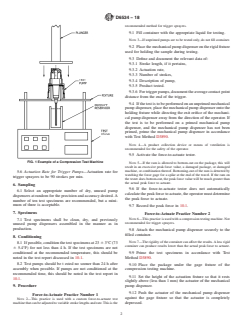
during testing (that is, glass bottle or a holding fixture; see Fig.
ization established in the Decision on Principles for the
1).
Development of International Standards, Guides and Recom-
mendations issued by the World Trade Organization Technical
5. Precautions
Barriers to Trade (TBT) Committee.
5.1 Appropriate handling considerations should be given to
2. Referenced Documents
flammable, toxic, caustic, or other potentially hazardous ma-
2.1 ASTM Standards: terials used.
D3890 Test Method for Number of Strokes to Prime a
5.2 Appropriate operating considerations should be taken
Mechanical Pump Dispenser
with pinch points on the motorized compression tester.
3. Significance and Use
5.3 Ensure that the exit orifice of the mechanical pump
3.1 This practice can be used to compare the peak force-to- dispenser is pointed away from the operator and other people.
actuate performance of different mechanical pump dispensers.
5.4 Ensure that the motorized compression tester is properly
3.2 This practice can be used to determine the perceived
calibrated.
ease of use of a mechanical pump dispenser.
5.5 ActuationRateforFingerPumps—Care should be taken
3.3 This practice can be used to determine the peak force-
when selecting the travel speed of the ram. For some mechani-
to-actuate of a mechanical pump dispenser.
cal pump dispenser styles, the speed of actuation and length of
stroke can affect the peak force to actuate. As a rule of thumb,
This practice is under the jurisdiction of ASTM Committee F02 on Primary
mechanical pump dispensers with a stroke length of 7 mm or
Barrier Packaging and is the direct responsibility of Subcommittee F02.30 on
greater should use an actuation velocity of 35 to 75 mm per
Mechanical Dispensers.
second,whilemechanicalpumpdispenserswithastrokelength
Current edition approved May 1, 2018. Published June 2018. Originally
of less than 7 mm should use an actuation velocity of 35 mm
approved in 2000. Last previous edition approved in 2010 as D6534 – 05(2010).
DOI: 10.1520/D6534-18.
per second or less. Especially for fine mist spray pumps, the
For referenced ASTM standards, visit the ASTM website, www.astm.org, or
above mentioned rates are preferred. A different rate may be
contact ASTM Customer Service at service@astm.org. For Annual Book of ASTM
used; however, the true force-to-actuate during use may not be
Standards volume information, refer to the standard’s Document Summary page on
the ASTM website. measured. The actuation rate used should be recorded in 10.
Copyright © ASTM International, 100 Barr Harbor Drive, PO Box C700, West Conshohocken, PA 19428-2959. United States
D6534 − 18
recommended method for trigger sprayers.
9.1 Fill container with the appropriate liquid for testing.
NOTE 3—If unprimed pumps are to be tested only, do not fill container.
9.2 Placethemechanicalpumpdispenserontherigidfixture
used for holding the sample during testing.
9.3 Define and document the relevant data of:
9.3.1 Stroke length, if it pertains,
9.3.2 Actuation rate,
9.3.3 Number of strokes,
9.3.4 Description of pump,
9.3.5 Product tested.
9.3.6 Fortriggerpumps,documenttheaveragecontactpoint
distance from the end of the trigger.
9.4 If the test is to be performed on an unprimed mechanical
pump dispenser, place the mechanical pump dispenser onto the
holding fixture while directing the exit orifice of the mechani-
cal pump dispenser away from the direction of the operator. If
the test is to be performed on a primed mechanical pump
dispenser, and the mechanical pump dispenser has not been
primed, prime the mechanical pump dispenser in accordance
with Test Method D3890.
NOTE 4—A product collection device or means of ventilation is
recommended for the safety of the operator.
9.5 Activate the force-to-actuate tester.
FIG. 1 Example of a Compression Test Machine
NOTE 5—If the ram is allowed to bottom-out on the package, this will
res
...
This document is not an ASTM standard and is intended only to provide the user of an ASTM standard an indication of what changes have been made to the previous version. Because
it may not be technically possible to adequately depict all changes accurately, ASTM recommends that users consult prior editions as appropriate. In all cases only the current version
of the standard as published by ASTM is to be considered the official document.
Designation: D6534 − 05 (Reapproved 2010) D6534 − 18
Standard Test Method Practice for
Determining the Peak Force-to-Actuate of a Mechanical
Pump Dispenser
This standard is issued under the fixed designation D6534; the number immediately following the designation indicates the year of
original adoption or, in the case of revision, the year of last revision. A number in parentheses indicates the year of last reapproval. A
superscript epsilon (´) indicates an editorial change since the last revision or reapproval.
1. Scope
1.1 This test method practice covers the determination of the peak force-to-actuate, sometimes called force-to-actuate (FTA),
of a mechanical pump dispenser.
1.2 The values stated in SI units are to be regarded as the standard. The inch-pound units given in parentheses are for
information only.
1.3 This standard does not purport to address all of the safety concerns, if any, associated with its use. It is the responsibility
of the user of this standard to establish appropriate safety safety, health, and healthenvironmental practices and determine the
applicability of regulatory limitations prior to use. Specific precautionary statements are given in Section 5.
1.4 This international standard was developed in accordance with internationally recognized principles on standardization
established in the Decision on Principles for the Development of International Standards, Guides and Recommendations issued
by the World Trade Organization Technical Barriers to Trade (TBT) Committee.
2. Referenced Documents
2.1 ASTM Standards:
D3890 Practice for Number of Strokes to Prime a Mechanical Pump Dispenser
3. Significance and Use
3.1 This test method practice can be used to compare the peak force-to-actuate performance of different mechanical pump
dispensers.
3.2 This test method practice can be used to determine the perceived ease of use of a mechanical pump dispenser.
3.3 This test method practice can be used to determine the peak force-to-actuate of a mechanical pump dispenser.
4. Apparatus
4.1 Motorized Compression Tester, or Custom Force-to-Action Machine, with the capability to actuate the mechanical pump
dispenser at a constant velocity and adjustable stroke lengths while accurately measuring the resulting force (that is, load cell).
NOTE 1—Since the velocity during actuation will affect the FTA of certain mechanical pump dispenser designs, care must be taken in selecting the
correct type of equipment with the sufficient actuation velocity.
4.2 A device connected to the compression tester that can display the resulting force in newtons (N) or pounds force (lbf) of
0.1 accuracy.
4.3 A means to rigidly hold the mechanical pump dispenser during testing (that is, glass bottle or a holding fixture; see Fig. 1).
5. Precautions
5.1 Appropriate handling considerations should be given to flammable, toxic, caustic, or other potentially hazardous materials
used.
This test method practice is under the jurisdiction of ASTM Committee F02 on FlexiblePrimary Barrier Packaging and is the direct responsibility of Subcommittee F02.30
on Mechanical Pump Dispensers.
Current edition approved Oct. 1, 2010May 1, 2018. Published March 2011June 2018. Originally approved in 2000. Last previous edition approved in 20052010 as
D6534 – 05.D6534 – 05(2010). DOI: 10.1520/D6534-05R10.10.1520/D6534-18.
For referenced ASTM standards, visit the ASTM website, www.astm.org, or contact ASTM Customer Service at service@astm.org. For Annual Book of ASTM Standards
volume information, refer to the standard’s Document Summary page on the ASTM website.
Copyright © ASTM International, 100 Barr Harbor Drive, PO Box C700, West Conshohocken, PA 19428-2959. United States
D6534 − 18
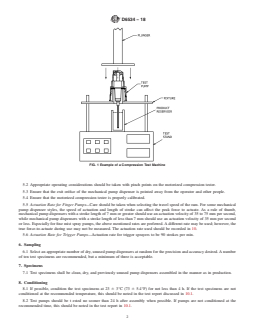
FIG. 1 Example of a Compression Test Machine
5.2 Appropriate operating considerations should be taken with pinch points on the motorized compression tester.
5.3 Ensure that the exit orifice of the mechanical pump dispenser is pointed away from the operator and other people.
5.4 Ensure that the motorized compression tester is properly calibrated.
5.5 Actuation Rate for Finger Pumps—Care should be taken when selecting the travel speed of the ram. For some mechanical
pump dispenser styles, the speed of actuation and length of stroke can affect the peak force to actuate. As a rule of thumb,
mechanical pump dispensers with a stroke length of 7 mm or greater should use an actuation velocity of 35 to 75 mm per second,
while mechanical pump dispensers with a stroke length of less than 7 mm should use an actuation velocity of 35 mm per second
or less. Especially for fine mist spray pumps, the above mentioned rates are preferred. A different rate may be used; however, the
true force-to-actuate during use may not be measured. The actuation rate used should be recorded in 10.
5.6 Actuation Rate for Trigger Pumps—Actuation rate for trigger sprayers to be 90 strokes per min.
6. Sampling
6.1 Select an appropriate number of dry, unused pump dispensers at random for the precision and accuracy desired. A number
of ten test specimens are recommended, but a minimum of three is acceptable.
7. Specimens
7.1 Test specimens shall be clean, dry, and previously unused pump dispensers assembled in the manner as in production.
8. Conditioning
8.1 If possible, condition the test specimens at 23 6 3°C (73 6 5.4°F) for not less than 4 h. If the test specimens are not
conditioned at the recommended temperature, this should be noted in the test report discussed in 10.1.
8.2 Test pumps should be t ested no sooner than 24 h after assembly when possible. If pumps are not conditioned at the
recommended time, this should be noted in the test report in 10.1.
D6534 − 18
9. Procedure
Force-to-Actuate Test Method Practice Number 1
NOTE 2—This test method practice is used with a custom force-to-actuate test machine that can be adjusted to variable stroke lengths and rate. This
is th
...