

ASTM D6654-18
(Practice)Standard Practice for Basic Storage Stability of a Mechanical Pump Dispenser
General Information
- Abstract
SIGNIFICANCE AND USE
3.1 Determining the storage of a mechanical pump dispenser for consumer usage. Products of consumer usage are of the personal care, household, insecticides, food, automotive, and institutional nature. Pharmaceutical and cosmetic products including perfume are not covered under this practice.
SCOPE
1.1 This practice covers the determination of the basic storage stability of a mechanical pump dispenser with a product.
1.2 This practice covers an evaluation of the weight lost during storage of mechanical pump dispensers (spray or flow types) with a product.
1.3 This standard does not purport to address all of the safety concerns, if any, associated with its use. It is the responsibility of the user of this standard to establish appropriate safety, health, and environmental practices and determine the applicability of regulatory limitations prior to use.
1.4 This international standard was developed in accordance with internationally recognized principles on standardization established in the Decision on Principles for the Development of International Standards, Guides and Recommendations issued by the World Trade Organization Technical Barriers to Trade (TBT) Committee.
- Status
- Published
- Publication Date
- 30-Apr-2018
- Technical Committee
- F02 - Primary Barrier Packaging
- Drafting Committee
- F02.30 - Mechanical Dispensers


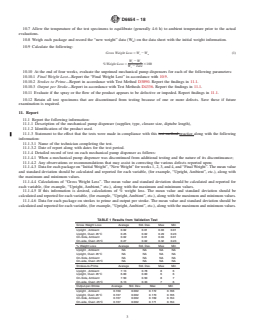

Overview
ASTM D6654-18: Standard Practice for Basic Storage Stability of a Mechanical Pump Dispenser provides industry-accepted procedures for assessing the storage stability of mechanical pump dispensers used in a range of consumer products. This standard is valuable for manufacturers, brand owners, and quality assurance professionals seeking to evaluate how well pump dispensers maintain integrity and function during storage, particularly in personal care, household, insecticide, food, automotive, and institutional applications. Notably, pharmaceutical and cosmetic products, including perfumes, are excluded from this scope.
The standard focuses on evaluating storage-related weight loss and basic functional performance, such as leakage, strokes to prime, and output per stroke, under various environmental conditions. Adhering to ASTM D6654-18 contributes to robust quality assurance and consistency in packaging solutions.
Key Topics
- Storage Stability Assessments: Defines a systematic approach for determining the ability of mechanical pump dispensers to retain product and prevent leakage over a defined storage period.
- Weight Loss Measurement: Instructs on quantifying product loss from dispensers during storage by calculating gross and percentage weight loss.
- Environmental Testing: Covers procedures for evaluating dispensers in different environments such as ambient temperature, elevated temperatures (oven at 45°C), and optional thermal cycling.
- Performance Evaluation: Includes tests for prime strokes and output per stroke, ensuring that the pump remains functional and delivers consistent dosage after storage.
- Sample Preparation and Conditioning: Details requirements for sampling, cleaning, preconditioning at controlled temperatures, and proper labeling of specimens.
- Reporting Requirements: Specifies the essential data and format for reporting results, including mean and standard deviation calculations for key variables.
Applications
ASTM D6654-18 is applicable to a wide range of consumer product packaging involving mechanical pump dispensers, including:
- Personal Care Products: Such as liquid soaps, hair care products, and lotions.
- Household Cleaners: Spray disinfectants, all-purpose cleaners, and similar solutions.
- Insecticides and Pesticides: Domestic and institutional sprayer applications.
- Food and Beverage Industry: Products dispensed by pump, excluding pharmaceuticals.
- Automotive Fluids: Windshield cleaners, polishes, and other pump-dispensed products.
- Institutional Use: Bulk dispensers in public or commercial facilities.
Utilizing this standard helps ensure that packaging maintains product integrity and minimizes waste or safety issues caused by leaks or pump failures during typical storage conditions.
Related Standards
Several other ASTM standards complement or are referenced by ASTM D6654-18:
- ASTM D2063: Test Methods for Measurement of Torque Retention for Packages with Continuous Thread Closures.
- ASTM D3890: Practice for Number of Strokes to Prime a Mechanical Pump Dispenser.
- ASTM D4336: Practice for Determination of the Output Per Stroke of a Mechanical Pump Dispenser.
- ASTM E122: Practice for Calculating Sample Size to Estimate, With Specified Precision, the Average for a Characteristic of a Lot or Process.
For organizations that use or specify mechanical pump dispensers, ASTM D6654-18 offers a reliable framework to standardize storage stability evaluations, reduce product returns, and enhance consumer satisfaction.
Keywords: ASTM D6654-18, storage stability, mechanical pump dispenser, package integrity, consumer products, leakage testing, weight loss, output per stroke, prime strokes, dispenser performance, packaging standards.
Relations
- Effective Date
- 01-May-2018
- Effective Date
- 01-May-2018
- Effective Date
- 01-May-2018
- Effective Date
- 01-Aug-2011
- Effective Date
- 01-Oct-2010
- Effective Date
- 01-Oct-2010
- Effective Date
- 01-Aug-2009
- Effective Date
- 01-Oct-2007
- Effective Date
- 01-Oct-2005
- Refers
ASTM D3890-05 - Standard Test Method for Number of Strokes to Prime a Mechanical Pump Dispenser - Effective Date
- 01-Oct-2005
- Effective Date
- 10-Apr-2001
- Refers
ASTM D3890-01 - Standard Test Method for Number of Strokes to Prime a Mechanical Pump Dispenser - Effective Date
- 10-Apr-2001
- Effective Date
- 10-Oct-2000
- Effective Date
- 10-Oct-2000
- Effective Date
- 15-Jun-1991
Get Certified
Connect with accredited certification bodies for this standard

BRCGS (Brand Reputation Compliance Global Standards)
Global food safety and quality standards owner.
IMP NDT d.o.o.
Non-destructive testing services. Radiography, ultrasonic, magnetic particle, penetrant, visual inspection.
Inštitut za kovinske materiale in tehnologije
Institute of Metals and Technology. Materials testing, metallurgical analysis, NDT.
Sponsored listings
Frequently Asked Questions
ASTM D6654-18 is a standard published by ASTM International. Its full title is "Standard Practice for Basic Storage Stability of a Mechanical Pump Dispenser". This standard covers: SIGNIFICANCE AND USE 3.1 Determining the storage of a mechanical pump dispenser for consumer usage. Products of consumer usage are of the personal care, household, insecticides, food, automotive, and institutional nature. Pharmaceutical and cosmetic products including perfume are not covered under this practice. SCOPE 1.1 This practice covers the determination of the basic storage stability of a mechanical pump dispenser with a product. 1.2 This practice covers an evaluation of the weight lost during storage of mechanical pump dispensers (spray or flow types) with a product. 1.3 This standard does not purport to address all of the safety concerns, if any, associated with its use. It is the responsibility of the user of this standard to establish appropriate safety, health, and environmental practices and determine the applicability of regulatory limitations prior to use. 1.4 This international standard was developed in accordance with internationally recognized principles on standardization established in the Decision on Principles for the Development of International Standards, Guides and Recommendations issued by the World Trade Organization Technical Barriers to Trade (TBT) Committee.
SIGNIFICANCE AND USE 3.1 Determining the storage of a mechanical pump dispenser for consumer usage. Products of consumer usage are of the personal care, household, insecticides, food, automotive, and institutional nature. Pharmaceutical and cosmetic products including perfume are not covered under this practice. SCOPE 1.1 This practice covers the determination of the basic storage stability of a mechanical pump dispenser with a product. 1.2 This practice covers an evaluation of the weight lost during storage of mechanical pump dispensers (spray or flow types) with a product. 1.3 This standard does not purport to address all of the safety concerns, if any, associated with its use. It is the responsibility of the user of this standard to establish appropriate safety, health, and environmental practices and determine the applicability of regulatory limitations prior to use. 1.4 This international standard was developed in accordance with internationally recognized principles on standardization established in the Decision on Principles for the Development of International Standards, Guides and Recommendations issued by the World Trade Organization Technical Barriers to Trade (TBT) Committee.
ASTM D6654-18 is classified under the following ICS (International Classification for Standards) categories: 19.060 - Mechanical testing; 55.130 - Aerosol containers. The ICS classification helps identify the subject area and facilitates finding related standards.
ASTM D6654-18 has the following relationships with other standards: It is inter standard links to ASTM D6654-05(2010), ASTM D4336-18, ASTM D3890-18, ASTM E122-09e1, ASTM D3890-05(2010), ASTM D4336-05(2010), ASTM E122-09, ASTM E122-07, ASTM D4336-05, ASTM D3890-05, ASTM D4336-01, ASTM D3890-01, ASTM E122-99, ASTM E122-00, ASTM D2063-91(2002). Understanding these relationships helps ensure you are using the most current and applicable version of the standard.
ASTM D6654-18 is available in PDF format for immediate download after purchase. The document can be added to your cart and obtained through the secure checkout process. Digital delivery ensures instant access to the complete standard document.
Standards Content (Sample)
This international standard was developed in accordance with internationally recognized principles on standardization established in the Decision on Principles for the
Development of International Standards, Guides and Recommendations issued by the World Trade Organization Technical Barriers to Trade (TBT) Committee.
Designation: D6654 − 18
Standard Practice for
Basic Storage Stability of a Mechanical Pump Dispenser
This standard is issued under the fixed designation D6654; the number immediately following the designation indicates the year of
original adoption or, in the case of revision, the year of last revision. A number in parentheses indicates the year of last reapproval. A
superscript epsilon (´) indicates an editorial change since the last revision or reapproval.
1. Scope the personal care, household, insecticides, food, automotive,
and institutional nature. Pharmaceutical and cosmetic products
1.1 This practice covers the determination of the basic
including perfume are not covered under this practice.
storage stability of a mechanical pump dispenser with a
product.
4. Apparatus
1.2 This practice covers an evaluation of the weight lost
4.1 Containers, that will allow the mechanical pump dis-
during storage of mechanical pump dispensers (spray or flow
penser to be affixed to them (see Note 1) and also be capable
types) with a product.
of containing product for a period of time at various environ-
1.3 This standard does not purport to address all of the
mental conditions (see Note 2).
safety concerns, if any, associated with its use. It is the NOTE 1—If possible, the actual container to be marketed should be
used.
responsibility of the user of this standard to establish appro-
priate safety, health, and environmental practices and deter-
4.2 Product, a sufficient amount to fill the number of
mine the applicability of regulatory limitations prior to use.
containers in accordance with 4.1, reference 10.2.
1.4 This international standard was developed in accor-
4.3 Balance, with direct reading to 0.01 g. Top loading or
dance with internationally recognized principles on standard-
analytical style is recommended.
ization established in the Decision on Principles for the
4.4 Environments, where the mechanical pump dispenser
Development of International Standards, Guides and Recom-
and product will be kept during the test period.
mendations issued by the World Trade Organization Technical
4.4.1 Ambient Area, maintained at 23 6 3°C (73 6 5.4°F).
Barriers to Trade (TBT) Committee.
4.4.2 Oven (45°C), maintained at 45 6 3°C (113 6 5.4°F).
2. Referenced Documents
NOTE 2—The oven temperature can be changed according to product
2.1 ASTM Standards: formulation. If different temperatures are used, this should be noted in the
test report discussed in 11.1.
D2063 Test Methods for Measurement of Torque Retention
for Packages with Continuous Thread Closures
4.4.3 Cycle Chamber, optional, alternating 5 to 50°C (41 to
D3890 Test Method for Number of Strokes to Prime a
122°F) every 24 h.
Mechanical Pump Dispenser
4.5 Oven-Safe Tray, with absorbent paper towels laid in the
D4336 Test Methods for Determination of the Output Per
tray.
Stroke of a Mechanical Pump Dispenser
4.6 Food Coloring or Dye, optional.
E122 Practice for Calculating Sample Size to Estimate,With
Specified Precision, the Average for a Characteristic of a
5. Precautions
Lot or Process
5.1 Appropriate handling considerations should be given to
3. Significance and Use
flammable, toxic, caustic, or other potentially hazardous ma-
terial used. When testing at any temperature, safety should be
3.1 Determining the storage of a mechanical pump dis-
the number one consideration and special attention should be
penser for consumer usage. Products of consumer usage are of
used on the flash points of the products tested.
This practice is under the jurisdiction of ASTM Committee F02 on Primary
6. Sampling
Barrier Packaging and is the direct responsibility of Subcommittee F02.30 on
Mechanical Dispensers.
6.1 Based upon the desired precision, sampling shall be
Current edition approved May 1, 2018. Published June 2018. Originally
performed in accordance with Practice E122.
approved in 2001. Last previous edition approved in 2010 as D6654 –05(2010).
DOI: 10.1520/D6654-18.
6.2 In the absence of any special sampling plan, perfor-
For referenced ASTM standards, visit the ASTM website, www.astm.org, or
mance shall be based on not less than the number of represen-
contact ASTM Customer Service at service@astm.org. For Annual Book of ASTM
tative specimens exposed to any of the environmental condi-
Standards volume information, refer to the standard’s Document Summary page on
the ASTM website. tions as specified in Section 9.
Copyright ©ASTM International, 100 Barr Harbor Drive, PO Box C700, West Conshohocken, PA19428-2959. United States
D6654 − 18
7. Test Specimens 10.5 Place all of the test specimens, as prepared in 9.1 in
their respective environments as indicated by the appropriate
7.1 Test specimens shall be clean, dry, and previously
label on each unit. Specimens labeled “On-Side” should be
unused mechanical pump dispensers.
placed with the orifice facing down excluding trigger sprayers.
8. Conditioning Trigger sprayers may have the orifice to the side. If the
mechanical pump dispensers use a protective hood or overcap,
8.1 Ifpossible,conditionthetestspecimensat23 63°C(73
these test specimens should be stored without these protective
6 5.4°F) for not less than 4 h. If the test specimens are not
devices in place. If the mechanical pump dispensers have a
conditioned at the recommended temperature and humidity,
locking feature, these test specimens should be in the locked
this should be noted in the test report discussed in section 11.1.
position during storage and the unlocked position during
8.2 Test pumps should be tested no sooner than 24 h after
inspection and testing.
assembly when possible. If pumps are not conditioned at the
10.6 Once a week for a period of four weeks, (generally on
recommended time, this should be noted in the test report
the same day of the week as the test start day), remove all of
discussed in 11.1.
the test specimens from their respective environments and
9. Test Specimen Preparation
inspect the test specimens for leakage.
9.1 Prepare a minimum of twelve unprimed mechanical
10.7 Allow the temperature of the test specimens to equili-
pump dispensers with product and containers to be used for
brate (generally 4-6 h) to ambient temperature prior to the
evaluation.
actual evaluations.
9.1.1 Label all of the assembled units with the product
10.8 Weigh each package and record the “new weight” data
name, any safety hazards for the product, name of the
(W ) on the data sheet with the initial weight information.
n
technician completing the test, and the test number or means of
10.9 Calculate the following:
identifying the test along with the following :
9.1.1.1 Minimum three units labeled, “Upright, Ambient.”
GrossWeightLoss 5 W 2 W (1)
i n
9.1.1.2 Minimum three units labeled, “Upright, Oven 45°C”
W 2 W
9.1.1.3 Optional—Minimum three units labeled, “Upright,
i n
%WeightLoss 5 3100
Cycle Chamber.” W 2 Tare
i
9.1.1.4 Minimum three units labeled, “On-Side, Ambient.”
10.10 At the end of four weeks, evaluate the unprimed
9.1.1.5 Minimum three units labeled, “On-Side, Oven
mechanical pump dispensers for each of the followi
...
This document is not an ASTM standard and is intended only to provide the user of an ASTM standard an indication of what changes have been made to the previous version. Because
it may not be technically possible to adequately depict all changes accurately, ASTM recommends that users consult prior editions as appropriate. In all cases only the current version
of the standard as published by ASTM is to be considered the official document.
Designation: D6654 − 05 (Reapproved 2010) D6654 − 18
Standard Test Method Practice for
Basic Storage Stability of a Mechanical Pump Dispenser
This standard is issued under the fixed designation D6654; the number immediately following the designation indicates the year of
original adoption or, in the case of revision, the year of last revision. A number in parentheses indicates the year of last reapproval. A
superscript epsilon (´) indicates an editorial change since the last revision or reapproval.
1. Scope
1.1 This test method practice covers the determination of the basic storage stability of a mechanical pump dispenser with a
product.
1.2 This test method practice covers an evaluation of the weight lost during storage of mechanical pump dispensers (spray or
flow types) with a product.
1.3 This standard does not purport to address all of the safety concerns, if any, associated with its use. It is the responsibility
of the user of this standard to establish appropriate safety safety, health, and healthenvironmental practices and determine the
applicability of regulatory limitations prior to use.
1.4 This international standard was developed in accordance with internationally recognized principles on standardization
established in the Decision on Principles for the Development of International Standards, Guides and Recommendations issued
by the World Trade Organization Technical Barriers to Trade (TBT) Committee.
2. Referenced Documents
2.1 ASTM Standards:
D2063 Test Methods for Measurement of Torque Retention for Packages with Continuous Thread Closures
D3890 Practice for Number of Strokes to Prime a Mechanical Pump Dispenser
D4336 Practice for Determination of the Output Per Stroke of a Mechanical Pump Dispenser
E122 Practice for Calculating Sample Size to Estimate, With Specified Precision, the Average for a Characteristic of a Lot or
Process
3. Significance and Use
3.1 Determining the storage of a mechanical pump dispenser for consumer usage. Products of consumer usage are of the
personal care, household, insecticides, food, automotive, and institutional nature. Pharmaceutical and cosmetic products including
perfume are not covered under this practice.
4. Apparatus
4.1 Containers, that will allow the mechanical pump dispenser to be affixed to them (see Note 1) and also be capable of
containing product for a period of time at various environmental conditions (see Note 2).
NOTE 1—If possible, the actual container to be marketed should be used.
4.2 Product, a sufficient amount to fill the number of containers in accordance with 4.1, reference 10.2.
4.3 Balance, with direct reading to 0.01 g. Top loading or analytical style is recommended.
4.4 Environments, where the mechanical pump dispenser and product will be kept during the test period.
4.4.1 Ambient Area, maintained at 23 6 3°C (73 6 5.4°F).
4.4.2 Oven (45°C), maintained at 45 6 3°C (113 6 5.4°F).
NOTE 2—The oven temperature can be changed according to product formulation. If different temperatures are used, this should be noted in the test
report discussed in 11.1.
This test method practice is under the jurisdiction of ASTM Committee F02 on FlexiblePrimary Barrier Packaging and is the direct responsibility of Subcommittee F02.30
on Mechanical Pump Dispensers.
Current edition approved Oct. 1, 2010May 1, 2018. Published March 2011June 2018. Originally approved in 2001. Last previous edition approved in 20052010 as
D6654 –05. –05(2010). DOI: 10.1520/D6654-05R10.10.1520/D6654-18.
For referenced ASTM standards, visit the ASTM website, www.astm.org, or contact ASTM Customer Service at service@astm.org. For Annual Book of ASTM Standards
volume information, refer to the standard’s Document Summary page on the ASTM website.
Copyright © ASTM International, 100 Barr Harbor Drive, PO Box C700, West Conshohocken, PA 19428-2959. United States
D6654 − 18
4.4.3 Cycle Chamber, optional, alternating 5 to 50°C (41 to 122°F) every 24 h.
4.5 Oven-Safe Tray, with absorbent paper towels laid in the tray.
4.6 Food Coloring or Dye, optional.
5. Precautions
5.1 Appropriate handling considerations should be given to flammable, toxic, caustic, or other potentially hazardous material
used. When testing at any temperature, safety should be the number one consideration and special attention should be used on the
flash points of the products tested.
6. Sampling
6.1 Based upon the desired precision, sampling shall be performed in accordance with Practice E122.
6.2 In the absence of any special sampling plan, performance shall be based on not less than the number of representative
specimens exposed to any of the environmental conditions as specified in Section 9.
7. Test Specimens
7.1 Test specimens shall be clean, dry, and previously unused mechanical pump dispensers.
8. Conditioning
8.1 If possible, condition the test specimens at 23 6 3°C (73 6 5.4°F) for not less than 4 h. If the test specimens are not
conditioned at the recommended temperature and humidity, this should be noted in the test report discussed in section 11.1.
8.2 Test pumps should be tested no sooner than 24 h after assembly when possible. If pumps are not conditioned at the
recommended time, this should be noted in the test report discussed in 11.1.
9. Test Specimen Preparation
9.1 Prepare a minimum of twelve unprimed mechanical pump dispensers with product and containers to be used for evaluation.
9.1.1 Label all of the assembled units with the product name, any safety hazards for the product, name of the technician
completing the test, and the test number or means of identifying the test along with the following :
9.1.1.1 Minimum three units labeled, “Upright, Ambient.”
9.1.1.2 Minimum three units labeled, “Upright, Oven 45°C”
9.1.1.3 Optional—Minimum three units labeled, “Upright, Cycle Chamber.”
9.1.1.4 Minimum three units labeled, “On-Side, Ambient.”
9.1.1.5 Minimum three units labeled, “On-Side, Oven (45°C).”
9.1.1.6 Optional—Minimum three units labeled “On-Side, Cycle Chamber.”
NOTE 3—Since the output of this test is weight loss of product for the total package of container with a mechanical pump dispenser, it may be
advantages for a control package of the test container with a standard closure to be included at each condition so that the effect of the mechanical pump
dispenser may be determined.
10. Procedure
10.1 If the data is to be presented as gross weight lost only, then proceed to 10.2. If the data is to be presented as weight lost
as a percentage of the weight of the product, weigh each container with its intended pump at the beginning of testing and record
that data on the data sheet as “Unfilled Packaging Weight.” (Tare).
10.2 Fill each container with the desired amount of product. The level of product in the container should represent the level used
for commercial use. To better identify leakage, food coloring or dye may be added.
10.3 Affix the mechanical pump dispensers to each container securely to prevent leakage between the container at the minimum
recommended torque load in accordance with Test Method D2063.
NOTE 4—It is extremely important that the test specimens exhibit the minimal recommended torque load so that the wo
...