

ASTM D3890-18
(Practice)Standard Practice for Number of Strokes to Prime a Mechanical Pump Dispenser
General Information
- Abstract
SIGNIFICANCE AND USE
2.1 This practice can be used to visually compare priming characteristics of different pump dispensers and different products.
2.2 This practice is suitable for establishing specifications for both the pump dispenser and the final package.
SCOPE
1.1 This practice covers the determination of the number of actuations required to prime a pump dispenser (spray and flow types) with a consumer-type product.
1.2 This standard does not purport to address all of the safety concerns, if any, associated with its use. It is the responsibility of the user of this standard to establish appropriate safety, health, and environmental practices and determine the applicability of regulatory limitations prior to use.
1.3 This international standard was developed in accordance with internationally recognized principles on standardization established in the Decision on Principles for the Development of International Standards, Guides and Recommendations issued by the World Trade Organization Technical Barriers to Trade (TBT) Committee.
- Status
- Published
- Publication Date
- 30-Apr-2018
- Technical Committee
- F02 - Primary Barrier Packaging
- Drafting Committee
- F02.30 - Mechanical Dispensers




Overview
ASTM D3890-18: Standard Practice for Number of Strokes to Prime a Mechanical Pump Dispenser provides essential procedures for determining the number of actuations required to prime spray and flow-type mechanical pump dispensers with consumer-type products. Developed by ASTM International, this standard enables manufacturers, packaging engineers, and quality control professionals to visually compare the priming characteristics of different mechanical pump dispensers and products. The practice also aids in establishing clear specifications for both pump dispensers and final packages, ensuring reliable and consistent performance for consumer products.
By following the guidelines in ASTM D3890-18, organizations can improve the quality control, packaging design, and user experience associated with mechanical pump dispensers. This standard emphasizes reproducible testing procedures while accounting for the variations in pump styles and product types.
Key Topics
- Determining Strokes to Prime: Provides a standard method to measure the exact number of actuations needed for a mechanical pump dispenser to achieve consistent product output.
- Visual Comparison: Facilitates direct visual comparison of priming characteristics across different pump designs and product formulations.
- Applicability: Relevant for both spray-type and flow-type mechanical pump dispensers attached to consumer packaging, such as those used for lotions, soaps, sanitizers, and cleaning agents.
- Test Procedure:
- Recommends using dry, unused dispensers and final package containers to ensure realistic testing conditions.
- Considers critical variables like dip tube length and conditioning time, with documentation required for any deviations from recommended conditions.
- Specifies the importance of recording test variables, including product type, pump style, dosage setting, and actuation rate.
- Statistical Reporting: Instructs reporting of mean, maximum, minimum, and standard deviation of strokes required to prime dispensers for robust process control and quality assurance benchmarking.
- Precision and Bias: Recognizes that precision is highly dependent on the specific pump style and product combination, advising users to reference previous test results for similar systems.
Applications
ASTM D3890-18 is widely applicable in industries where mechanical pump dispensers are a key packaging component, including:
- Cosmetics and Personal Care: Ensures consistency and reliability in products such as lotions, creams, and liquid soaps by standardizing the priming process for pump dispensers.
- Household and Industrial Cleaners: Provides a reproducible testing method for spray and flow dispensers on cleaning products, supporting product quality and customer satisfaction.
- Healthcare and Sanitization: Supports consistent delivery and operation of pump dispensers in packaging for sanitizers and other health-related products.
- Manufacturing Quality Control: Assists packaging engineers and QA teams in setting acceptance criteria for new dispenser designs and verifying lot-to-lot consistency in finished goods.
Related Standards
Organizations using ASTM D3890-18 may also reference the following standards for comprehensive packaging and dispenser performance evaluation:
- ASTM F815 - Standard Test Method for Mechanical Pump Dispensers Used in Consumer Products
- ASTM F897 - Standard Practice for Packaging Design and Validation
- ISO 8317 - Child-Resistant Packaging - Requirements and Testing Procedures for Reclosable Packages
- ISO 18604 - Packaging and the Environment - Material Recycling
By implementing ASTM D3890-18 alongside related standards, companies can strengthen quality assurance strategies, meet regulatory requirements, and enhance consumer confidence in their packaged products featuring mechanical pump dispensers.
Relations
- Effective Date
- 01-May-2018
- Effective Date
- 01-May-2018
- Referred By
ASTM D6654-18 - Standard Practice for Basic Storage Stability of a Mechanical Pump Dispenser - Effective Date
- 01-May-2018
- Effective Date
- 01-May-2018
- Referred By
ASTM D6633-18 - Standard Practice for Basic Functional Stability of a Mechanical Pump Dispenser - Effective Date
- 01-May-2018
- Effective Date
- 01-May-2018
Get Certified
Connect with accredited certification bodies for this standard

BRCGS (Brand Reputation Compliance Global Standards)
Global food safety and quality standards owner.
Sponsored listings
Frequently Asked Questions
ASTM D3890-18 is a standard published by ASTM International. Its full title is "Standard Practice for Number of Strokes to Prime a Mechanical Pump Dispenser". This standard covers: SIGNIFICANCE AND USE 2.1 This practice can be used to visually compare priming characteristics of different pump dispensers and different products. 2.2 This practice is suitable for establishing specifications for both the pump dispenser and the final package. SCOPE 1.1 This practice covers the determination of the number of actuations required to prime a pump dispenser (spray and flow types) with a consumer-type product. 1.2 This standard does not purport to address all of the safety concerns, if any, associated with its use. It is the responsibility of the user of this standard to establish appropriate safety, health, and environmental practices and determine the applicability of regulatory limitations prior to use. 1.3 This international standard was developed in accordance with internationally recognized principles on standardization established in the Decision on Principles for the Development of International Standards, Guides and Recommendations issued by the World Trade Organization Technical Barriers to Trade (TBT) Committee.
SIGNIFICANCE AND USE 2.1 This practice can be used to visually compare priming characteristics of different pump dispensers and different products. 2.2 This practice is suitable for establishing specifications for both the pump dispenser and the final package. SCOPE 1.1 This practice covers the determination of the number of actuations required to prime a pump dispenser (spray and flow types) with a consumer-type product. 1.2 This standard does not purport to address all of the safety concerns, if any, associated with its use. It is the responsibility of the user of this standard to establish appropriate safety, health, and environmental practices and determine the applicability of regulatory limitations prior to use. 1.3 This international standard was developed in accordance with internationally recognized principles on standardization established in the Decision on Principles for the Development of International Standards, Guides and Recommendations issued by the World Trade Organization Technical Barriers to Trade (TBT) Committee.
ASTM D3890-18 is classified under the following ICS (International Classification for Standards) categories: 55.130 - Aerosol containers. The ICS classification helps identify the subject area and facilitates finding related standards.
ASTM D3890-18 has the following relationships with other standards: It is inter standard links to ASTM D3890-05(2010), ASTM D4336-18, ASTM D6654-18, ASTM D5071-06(2021), ASTM D6633-18, ASTM D6534-18. Understanding these relationships helps ensure you are using the most current and applicable version of the standard.
ASTM D3890-18 is available in PDF format for immediate download after purchase. The document can be added to your cart and obtained through the secure checkout process. Digital delivery ensures instant access to the complete standard document.
Standards Content (Sample)
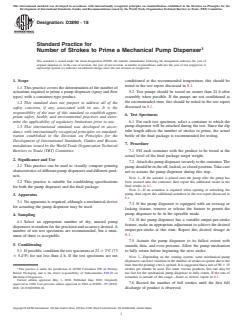
This international standard was developed in accordance with internationally recognized principles on standardization established in the Decision on Principles for the
Development of International Standards, Guides and Recommendations issued by the World Trade Organization Technical Barriers to Trade (TBT) Committee.
Designation: D3890 − 18
Standard Practice for
Number of Strokes to Prime a Mechanical Pump Dispenser
This standard is issued under the fixed designation D3890; the number immediately following the designation indicates the year of
original adoption or, in the case of revision, the year of last revision. A number in parentheses indicates the year of last reapproval. A
superscript epsilon (´) indicates an editorial change since the last revision or reapproval.
1. Scope conditioned at the recommended temperature, this should be
noted in the test report discussed in 8.1.
1.1 This practice covers the determination of the number of
actuations required to prime a pump dispenser (spray and flow 5.2 Test pumps should be tested no sooner than 24 h after
types) with a consumer-type product. assembly when possible. If the pumps are not conditioned at
the recommended time, this should be noted in the test report
1.2 This standard does not purport to address all of the
discussed in 8.1.
safety concerns, if any, associated with its use. It is the
responsibility of the user of this standard to establish appro-
6. Test Specimens
priate safety, health, and environmental practices and deter-
6.1 For each test specimen, select a container to which the
mine the applicability of regulatory limitations prior to use.
pump dispenser will be attached during the test. Since the dip
1.3 This international standard was developed in accor-
tube length affects the number of strokes to prime, the actual
dance with internationally recognized principles on standard-
bottle of the final package is recommended for testing.
ization established in the Decision on Principles for the
Development of International Standards, Guides and Recom-
7. Procedure
mendations issued by the World Trade Organization Technical
Barriers to Trade (TBT) Committee. 7.1 Fill each container with the product to be tested at the
actual level of the final package target weight.
2. Significance and Use
7.2 Attachthepumpdispensersecurelytothecontainer.The
2.1 This practice can be used to visually compare priming
pump should be in the off, locked, or closed position.Take care
characteristics of different pump dispensers and different prod-
not to actuate the pump dispenser during this step.
ucts.
NOTE 1—If the actuator is placed onto the pump after the pump has
2.2 This practice is suitable for establishing specifications
been secured onto the container, then report this additional stroke in the
final results in 8.1.
for both the pump dispenser and the final package.
NOTE 2—If an actuation is required when opening or unlocking the
pump, then report this additional actuation in the test report discussed in
3. Apparatus
8.1.
3.1 No apparatus is required, although a mechanical device
7.3 If the pump dispenser is equipped with an overcap or
for actuating the pump dispenser may be used.
locking feature, remove or release the feature to permit the
pump dispenser to be in the operable mode.
4. Sampling
7.4 If the pump dispenser has a variable output-per-stroke
4.1 Select an appropriate number of dry, unused pump
feature, make an appropriate adjustment to achieve the desired
dispensers at random for the precision and accuracy desired.A
output-per-stroke at this time. Report this desired dosage in
number of ten test specimens are recommended, but a mini-
8.1.
mum of three is acceptable.
7.5 Actuate the pump dispenser to its fullest extent with
5. Conditioning
smooth, firm, and even pressure. Allow the pump mechanism
to fully return before beginning the next stroke.
5.1 If possible, condition the test specimens at 23 6 3°C (73
6 5.4°F) for not less than 4 h. If the test specimens are not
NOTE 3—Depending on the venting system, some mechanical pump
dispensers can have variation in the number of strokes-to-prime due to the
time that the priming vent is opened. It is suggested that a rate of 90 6 15
This practice is under the jurisdiction of ASTM Committee F02 on Pri
...
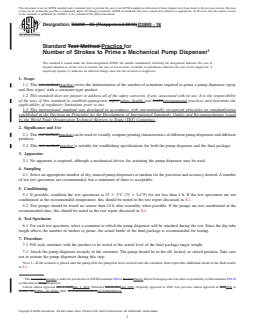
This document is not an ASTM standard and is intended only to provide the user of an ASTM standard an indication of what changes have been made to the previous version. Because
it may not be technically possible to adequately depict all changes accurately, ASTM recommends that users consult prior editions as appropriate. In all cases only the current version
of the standard as published by ASTM is to be considered the official document.
Designation: D3890 − 05 (Reapproved 2010) D3890 − 18
Standard Test Method Practice for
Number of Strokes to Prime a Mechanical Pump Dispenser
This standard is issued under the fixed designation D3890; the number immediately following the designation indicates the year of
original adoption or, in the case of revision, the year of last revision. A number in parentheses indicates the year of last reapproval. A
superscript epsilon (´) indicates an editorial change since the last revision or reapproval.
1. Scope
1.1 This test method practice covers the determination of the number of actuations required to prime a pump dispenser (spray
and flow types) with a consumer-type product.
1.2 This standard does not purport to address all of the safety concerns, if any, associated with its use. It is the responsibility
of the user of this standard to establish appropriate safety safety, health, and healthenvironmental practices and determine the
applicability of regulatory limitations prior to use.
1.3 This international standard was developed in accordance with internationally recognized principles on standardization
established in the Decision on Principles for the Development of International Standards, Guides and Recommendations issued
by the World Trade Organization Technical Barriers to Trade (TBT) Committee.
2. Significance and Use
2.1 This test method practice can be used to visually compare priming characteristics of different pump dispensers and different
products.
2.2 This test method practice is suitable for establishing specifications for both the pump dispenser and the final package.
3. Apparatus
3.1 No apparatus is required, although a mechanical device for actuating the pump dispenser may be used.
4. Sampling
4.1 Select an appropriate number of dry, unused pump dispensers at random for the precision and accuracy desired. A number
of ten test specimens are recommended, but a minimum of three is acceptable.
5. Conditioning
5.1 If possible, condition the test specimens at 23 6 3°C (73 6 5.4°F) for not less than 4 h. If the test specimens are not
conditioned at the recommended temperature, this should be noted in the test report discussed in 8.1.
5.2 Test pumps should be tested no sooner than 24 h after assembly when possible. If the pumps are not conditioned at the
recommended time, this should be noted in the test report discussed in 8.1.
6. Test Specimens
6.1 For each test specimen, select a container to which the pump dispenser will be attached during the test. Since the dip tube
length affects the number of strokes to prime, the actual bottle of the final package is recommended for testing.
7. Procedure
7.1 Fill each container with the product to be tested at the actual level of the final package target weight.
7.2 Attach the pump dispenser securely to the container. The pump should be in the off, locked, or closed position. Take care
not to actuate the pump dispenser during this step.
NOTE 1—If the actuator is placed onto the pump after the pump has been secured onto the container, then report this additional stroke in the final results
in 8.1.
This test method practice is under the jurisdiction of ASTM Committee F02 on FlexiblePrimary Barrier Packaging and is the direct responsibility of Subcommittee F02.30
on Mechanical Pump Dispensers.
Current edition approved Oct. 1, 2010May 1, 2018. Published March 2011June 2018. Originally approved in 1980. Last previous edition approved in 20052010 as
D3890 – 05.D3890 – 05 (2010). DOI: 10.1520/D3890-05R10.10.1520/D3890-18.
Copyright © ASTM International, 100 Barr Harbor Drive, PO Box C700, West Conshohocken, PA 19428-2959. United States
D3890 − 18
NOTE 2—If an actuation is required when opening or unlocking the pump, then report this additional actuation in the test report discussed in 8.1.
7.3 If the pump dispenser is equipped with an overcap or locking feature, remove or release the feature to permit the pump
dispenser to be in the oper
...