


ASTM D5257-17
(Test Method)Standard Test Method for Dissolved Hexavalent Chromium in Water by Ion Chromatography
Standard Test Method for Dissolved Hexavalent Chromium in Water by Ion Chromatography
SIGNIFICANCE AND USE
5.1 Hexavalent chromium salts are used extensively in the metal finishing and plating industries, in the leather industry as a tanning agent, and in the manufacture of paints, dyes, explosives, and ceramics. Trivalent chromium salts are used as mordants in textile dying, in the ceramic and glass industry, and in photography. Chromium, in either oxidation state, may be present in wastewater from these industries and may also be discharged from chromate-treated cooling waters.
5.2 Hexavalent chromium is toxic to humans, animals, and aquatic life. It can produce lung tumors when inhaled and readily induces skin sensitization. It is not known whether cancer will result from ingestion of chromium in any of its valence states.
5.3 Ion chromatography provides a means of separating the hexavalent chromium from other species present in the sample, many of which interfere with other detection methods. The combination of this separation with a sensitive colorimetric detection method provides a selective and sensitive analytical method for hexavalent chromium with minimal sample preparation.
SCOPE
1.1 This test method covers procedures for the determination of dissolved hexavalent chromium in wastewater, surface water, and drinking water.
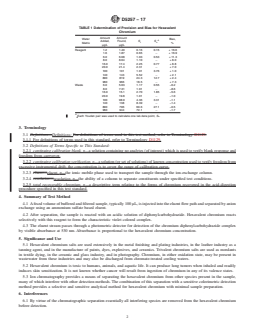
1.2 The precision and bias of this test method has been tested in reagent water and industrial wastewater and has been found suitable over the range of approximately 1 to 1000 μg/L. Higher levels can be determined by appropriate dilution.
1.3 Samples containing very high levels of anionic species (that is, chloride, sulfate, etc.) may cause column overload. Samples containing high levels of reducing species (that is, sulfides, sulfites, etc.) may cause reduction of Cr(VI) to Cr(III). This can be minimized by buffering the sample to a pH of 9 to 9.5, filtering it, storing it at
1.4 The values stated in SI units are to be regarded as standard. The values given in parentheses are mathematical conversions to inch-pound units that are provided for information only and are not considered standard.
1.5 This standard does not purport to address all of the safety concerns, if any, associated with its use. It is the responsibility of the user of this standard to establish appropriate safety, health, and environmental practices and determine the applicability of regulatory limitations prior to use.
1.6 This international standard was developed in accordance with internationally recognized principles on standardization established in the Decision on Principles for the Development of International Standards, Guides and Recommendations issued by the World Trade Organization Technical Barriers to Trade (TBT) Committee.
General Information
- Status
- Published
- Publication Date
- 30-Nov-2017
- Technical Committee
- D19 - Water
- Drafting Committee
- D19.05 - Inorganic Constituents in Water
Relations
- Effective Date
- 01-Dec-2017
- Effective Date
- 01-May-2020
- Effective Date
- 01-Aug-2018
- Effective Date
- 01-Aug-2018
- Effective Date
- 15-Jun-2012
- Effective Date
- 15-Jun-2011
- Effective Date
- 01-May-2011
- Effective Date
- 01-Dec-2010
- Effective Date
- 01-Mar-2010
- Effective Date
- 01-Oct-2008
- Effective Date
- 15-Jan-2008
- Effective Date
- 01-Dec-2007
- Effective Date
- 15-Dec-2006
- Effective Date
- 01-Sep-2006
- Effective Date
- 01-Sep-2006
Overview
ASTM D5257-17 is the internationally recognized standard test method for the determination of dissolved hexavalent chromium [Cr(VI)] in water samples using ion chromatography. Published by ASTM International, this method is essential for laboratories analyzing water quality in various industries due to the toxicity and environmental significance of hexavalent chromium. This standard outlines procedures for testing wastewater, surface water, and drinking water, supporting compliance with regulatory and environmental monitoring requirements.
Chromium compounds, particularly in the hexavalent state, are widely used in metal finishing, plating, leather tanning, and the manufacturing of dyes, paints, explosives, and ceramics. Both hexavalent and trivalent chromium may be present in industrial discharges, posing risks to human health and aquatic life. Accurate determination of Cr(VI) is crucial for meeting environmental standards and ensuring public safety.
Key Topics
Hexavalent Chromium Toxicity: Cr(VI) is hazardous to humans, animals, and aquatic life, known to induce skin sensitization and potentially cause lung tumors upon inhalation. Proper monitoring is necessary to mitigate health risks.
Ion Chromatography Method: The method utilizes ion chromatography combined with sensitive colorimetric detection using diphenylcarbohydrazide. This process efficiently separates Cr(VI) from other interfering species, providing selectivity, sensitivity, and minimal sample preparation.
Sample Types and Range: Suitable for wastewater, surface water, and drinking water, the method is validated for concentrations from approximately 1 to 1000 μg/L, with higher levels determined by sample dilution.
Precision and Reliability: The standard includes rigorous calibration, quality control, and bias/precision assessment tools, ensuring repeatable and trustworthy results.
Sample Handling and Interferences: The procedure addresses challenges posed by high levels of anions or reducing agents in samples, recommending pH buffering and proper filtration to maintain analytical integrity.
Applications
Environmental Monitoring: Widely used for compliance testing of industrial effluents, municipal wastewater, and natural water sources for hexavalent chromium contamination.
Industrial Waste Management: Essential for facilities in metal processing, electroplating, leather tanning, textile dyeing, and chemical manufacturing to monitor and control chromium levels in wastewater.
Water Treatment and Drinking Water Assessment: Used by water treatment plants and water utilities to ensure that drinking water meets safe limits for Cr(VI) as set by environmental regulations.
Research and Regulatory Compliance: Supports laboratories conducting research or fulfilling federal and regional requirements, such as U.S. EPA guidelines (e.g., EPA Method 218.6), for chromium analysis.
Related Standards
For comprehensive quality assurance and compatibility with other water analysis procedures, ASTM D5257-17 references or aligns with these standards and methods:
- ASTM D1129: Terminology Relating to Water
- ASTM D1193: Standard Specification for Reagent Water
- ASTM D2777: Practice for Determination of Precision and Bias in Water Test Methods
- ASTM D3370: Practices for Sampling Water from Closed Conduits
- ASTM D5847: Practice for Writing Quality Control Specifications for Standard Test Methods for Water Analysis
- U.S. EPA 40 CFR 136: Guidelines for the analysis of pollutants
- U.S. EPA Method 218.6: Determination of Dissolved Hexavalent Chromium by Ion Chromatography
Practical Value
Using ASTM D5257-17 ensures laboratories and industrial operators can reliably detect and quantify hexavalent chromium in water, promoting public health, regulatory compliance, and environmental protection. The standard’s robust methodology and detailed quality control measures make it a key resource for accurate, consistent, and defensible analytical results.
Buy Documents
ASTM D5257-17 - Standard Test Method for Dissolved Hexavalent Chromium in Water by Ion Chromatography
REDLINE ASTM D5257-17 - Standard Test Method for Dissolved Hexavalent Chromium in Water by Ion Chromatography
Get Certified
Connect with accredited certification bodies for this standard

ECOCERT
Organic and sustainability certification.

Eurofins Food Testing Global
Global leader in food, environment, and pharmaceutical product testing.

Intertek Bangladesh
Intertek certification and testing services in Bangladesh.
Sponsored listings
Frequently Asked Questions
ASTM D5257-17 is a standard published by ASTM International. Its full title is "Standard Test Method for Dissolved Hexavalent Chromium in Water by Ion Chromatography". This standard covers: SIGNIFICANCE AND USE 5.1 Hexavalent chromium salts are used extensively in the metal finishing and plating industries, in the leather industry as a tanning agent, and in the manufacture of paints, dyes, explosives, and ceramics. Trivalent chromium salts are used as mordants in textile dying, in the ceramic and glass industry, and in photography. Chromium, in either oxidation state, may be present in wastewater from these industries and may also be discharged from chromate-treated cooling waters. 5.2 Hexavalent chromium is toxic to humans, animals, and aquatic life. It can produce lung tumors when inhaled and readily induces skin sensitization. It is not known whether cancer will result from ingestion of chromium in any of its valence states. 5.3 Ion chromatography provides a means of separating the hexavalent chromium from other species present in the sample, many of which interfere with other detection methods. The combination of this separation with a sensitive colorimetric detection method provides a selective and sensitive analytical method for hexavalent chromium with minimal sample preparation. SCOPE 1.1 This test method covers procedures for the determination of dissolved hexavalent chromium in wastewater, surface water, and drinking water. 1.2 The precision and bias of this test method has been tested in reagent water and industrial wastewater and has been found suitable over the range of approximately 1 to 1000 μg/L. Higher levels can be determined by appropriate dilution. 1.3 Samples containing very high levels of anionic species (that is, chloride, sulfate, etc.) may cause column overload. Samples containing high levels of reducing species (that is, sulfides, sulfites, etc.) may cause reduction of Cr(VI) to Cr(III). This can be minimized by buffering the sample to a pH of 9 to 9.5, filtering it, storing it at 1.4 The values stated in SI units are to be regarded as standard. The values given in parentheses are mathematical conversions to inch-pound units that are provided for information only and are not considered standard. 1.5 This standard does not purport to address all of the safety concerns, if any, associated with its use. It is the responsibility of the user of this standard to establish appropriate safety, health, and environmental practices and determine the applicability of regulatory limitations prior to use. 1.6 This international standard was developed in accordance with internationally recognized principles on standardization established in the Decision on Principles for the Development of International Standards, Guides and Recommendations issued by the World Trade Organization Technical Barriers to Trade (TBT) Committee.
SIGNIFICANCE AND USE 5.1 Hexavalent chromium salts are used extensively in the metal finishing and plating industries, in the leather industry as a tanning agent, and in the manufacture of paints, dyes, explosives, and ceramics. Trivalent chromium salts are used as mordants in textile dying, in the ceramic and glass industry, and in photography. Chromium, in either oxidation state, may be present in wastewater from these industries and may also be discharged from chromate-treated cooling waters. 5.2 Hexavalent chromium is toxic to humans, animals, and aquatic life. It can produce lung tumors when inhaled and readily induces skin sensitization. It is not known whether cancer will result from ingestion of chromium in any of its valence states. 5.3 Ion chromatography provides a means of separating the hexavalent chromium from other species present in the sample, many of which interfere with other detection methods. The combination of this separation with a sensitive colorimetric detection method provides a selective and sensitive analytical method for hexavalent chromium with minimal sample preparation. SCOPE 1.1 This test method covers procedures for the determination of dissolved hexavalent chromium in wastewater, surface water, and drinking water. 1.2 The precision and bias of this test method has been tested in reagent water and industrial wastewater and has been found suitable over the range of approximately 1 to 1000 μg/L. Higher levels can be determined by appropriate dilution. 1.3 Samples containing very high levels of anionic species (that is, chloride, sulfate, etc.) may cause column overload. Samples containing high levels of reducing species (that is, sulfides, sulfites, etc.) may cause reduction of Cr(VI) to Cr(III). This can be minimized by buffering the sample to a pH of 9 to 9.5, filtering it, storing it at 1.4 The values stated in SI units are to be regarded as standard. The values given in parentheses are mathematical conversions to inch-pound units that are provided for information only and are not considered standard. 1.5 This standard does not purport to address all of the safety concerns, if any, associated with its use. It is the responsibility of the user of this standard to establish appropriate safety, health, and environmental practices and determine the applicability of regulatory limitations prior to use. 1.6 This international standard was developed in accordance with internationally recognized principles on standardization established in the Decision on Principles for the Development of International Standards, Guides and Recommendations issued by the World Trade Organization Technical Barriers to Trade (TBT) Committee.
ASTM D5257-17 is classified under the following ICS (International Classification for Standards) categories: 71.060.50 - Salts. The ICS classification helps identify the subject area and facilitates finding related standards.
ASTM D5257-17 has the following relationships with other standards: It is inter standard links to ASTM D5257-11, ASTM D1129-13(2020)e2, ASTM D1066-18, ASTM D1066-18e1, ASTM D2777-12, ASTM D1066-11, ASTM D5810-96(2011), ASTM D3370-10, ASTM D1129-10, ASTM D3370-08, ASTM D2777-08, ASTM D3370-07, ASTM D1066-06, ASTM D1129-06a, ASTM D1129-06ae1. Understanding these relationships helps ensure you are using the most current and applicable version of the standard.
ASTM D5257-17 is available in PDF format for immediate download after purchase. The document can be added to your cart and obtained through the secure checkout process. Digital delivery ensures instant access to the complete standard document.
Standards Content (Sample)
This international standard was developed in accordance with internationally recognized principles on standardization established in the Decision on Principles for the
Development of International Standards, Guides and Recommendations issued by the World Trade Organization Technical Barriers to Trade (TBT) Committee.
Designation: D5257 − 17
Standard Test Method for
Dissolved Hexavalent Chromium in Water by Ion
Chromatography
This standard is issued under the fixed designation D5257; the number immediately following the designation indicates the year of
original adoption or, in the case of revision, the year of last revision. A number in parentheses indicates the year of last reapproval. A
superscript epsilon (´) indicates an editorial change since the last revision or reapproval.
1. Scope* 2. Referenced Documents
2.1 ASTM Standards:
1.1 This test method covers procedures for the determina-
D1066 Practice for Sampling Steam
tion of dissolved hexavalent chromium in wastewater, surface
D1129 Terminology Relating to Water
water, and drinking water.
D1193 Specification for Reagent Water
1.2 The precision and bias of this test method has been
D2777 Practice for Determination of Precision and Bias of
tested in reagent water and industrial wastewater and has been
Applicable Test Methods of Committee D19 on Water
found suitable over the range of approximately 1 to 1000 µg/L.
D3370 Practices for Sampling Water from Closed Conduits
Higher levels can be determined by appropriate dilution.
D5810 Guide for Spiking into Aqueous Samples
D5847 Practice for Writing Quality Control Specifications
1.3 Samples containing very high levels of anionic species
for Standard Test Methods for Water Analysis
(that is, chloride, sulfate, etc.) may cause column overload.
2.2 U.S. EPA Standards:
Samples containing high levels of reducing species (that is,
U.S. EPA 40 CFR 136 Guidelines Establishing Test Proce-
sulfides,sulfites,etc.)maycausereductionofCr(VI)toCr(III).
dures for the Analysis of Pollutants
This can be minimized by buffering the sample to a pH of 9 to
U.S. EPA Method 218.6 Determination of Dissolved
9.5, filtering it, storing it at <6°C. A holding time of 28 days
Hexavalent Chromium in Drinking Water, Groundwater
may be used if the user can demonstrate that such holding time
and Industrial Wastewater Effluents by Ion Chromatogra-
does not affect sample integrity in accordance with U.S. EPA
phy
40 CFR 136, Part II.
1.4 The values stated in SI units are to be regarded as 3. Terminology
standard. The values given in parentheses are mathematical
3.1 Definitions:
conversions to inch-pound units that are provided for informa-
3.1.1 For definitions of terms used in this standard, refer to
tion only and are not considered standard.
Terminology D1129.
1.5 This standard does not purport to address all of the
3.2 Definitions of Terms Specific to This Standard:
safety concerns, if any, associated with its use. It is the
3.2.1 continuing calibration blank, n—a solution containing
responsibility of the user of this standard to establish appro-
no analytes (of interest) which is used to verify blank response
priate safety, health, and environmental practices and deter-
and freedom from carryover.
mine the applicability of regulatory limitations prior to use.
3.2.2 continuing calibration verification, n—a solution (or
1.6 This international standard was developed in accor-
setofsolutions)ofknownconcentrationusedtoverifyfreedom
dance with internationally recognized principles on standard-
from excessive instrumental drift; the concentration is to cover
ization established in the Decision on Principles for the
the range of calibration curve.
Development of International Standards, Guides and Recom-
3.2.3 eluent, n—the ionic mobile phase used to transport the
mendations issued by the World Trade Organization Technical
sample through the ion-exchange column.
Barriers to Trade (TBT) Committee.
For referenced ASTM standards, visit the ASTM website, www.astm.org, or
This test method is under the jurisdiction of ASTM Committee D19 on Water contact ASTM Customer Service at service@astm.org. For Annual Book of ASTM
and is the direct responsibility of Subcommittee D19.05 on Inorganic Constituents Standards volume information, refer to the standard’s Document Summary page on
in Water. the ASTM website.
Current edition approved Dec. 1, 2017. Published December 2017. Originally Available from U.S. Government Printing Office, Superintendent of
approved in 1992. Last previous edition approved in 2011 as D5257 – 11. DOI: Documents, 732 N. Capitol St., NW, Washington, DC 20401-0001, http://
10.1520/D5257-17. www.access.gpo.gov.
*A Summary of Changes section appears at the end of this standard
Copyright © ASTM International, 100 Barr Harbor Drive, PO Box C700, West Conshohocken, PA 19428-2959. United States
D5257 − 17
3.2.4 resolution, n—the ability of a column to separate 6.5 Trace amounts of Cr are sometimes found in reagent
constituents under specified test conditions. grade salts. Since a concentrated buffer solution is used in this
test method to adjust the pH of samples, reagent blanks should
3.2.5 total recoverable chromium, n—a descriptive term
be analyzed to assess the potential for Cr(VI) contamination.
relating to the forms of chromium recovered in the acid-
Contamination can also come from improperly cleaned glass-
digestion procedure specified in this test standard.
ware or contact with caustic or acidic reagents with chromium
4. Summary of Test Method containing stainless steel or pigmented materials.
4.1 Afixedvolumeofbufferedandfilteredsample,typically
7. Apparatus
100 µL, is injected into the eluent flow path and separated by
7.1 Ion Chromatograph—An ion chromatograph having the
anion exchange using an ammonium sulfate based eluent.
following components configured as shown in Fig. 1.
4.2 After separation, the sample is reacted with an acidic
7.1.1 Pump, capable of delivering a constant flow in the
solution of diphenylcarbohydrazide. Hexavalent chromium
range of 1 to 5 mL/min at a pressure of 1379 to 13 790 kPa
reacts selectively with this reagent to form the characteristic
(200 to 2000 psi).
violet colored complex.
7.1.2 Injection Valve—A high pressure, low dead volume
4.3 Theeluentstreampassesthroughaphotometricdetector
valve that allows introduction of 50 to 250 µL of sample into
for detection of the chromium diphenylcarbohydrazide com-
the eluent stream at up to 13 790 kPa (2000 psi).
plex by visible absorbance at 530 nm. Absorbance is propor-
7.1.3 Guard Column—Acolumnplacedbeforetheseparator
tional to the hexavalent chromium concentration.
column to protect the separator column from fouling by
particles or strongly absorbed organic constituents.
5. Significance and Use
5.1 Hexavalent chromium salts are used extensively in the
metal finishing and plating industries, in the leather industry as
a tanning agent, and in the manufacture of paints, dyes,
explosives, and ceramics. Trivalent chromium salts are used as
mordants in textile dying, in the ceramic and glass industry,
and in photography. Chromium, in either oxidation state, may
be present in wastewater from these industries and may also be
discharged from chromate-treated cooling waters.
5.2 Hexavalent chromium is toxic to humans, animals, and
aquatic life. It can produce lung tumors when inhaled and
readily induces skin sensitization. It is not known whether
cancer will result from ingestion of chromium in any of its
valence states.
5.3 Ion chromatography provides a means of separating the
hexavalentchromiumfromotherspeciespresentinthesample,
many of which interfere with other detection methods. The
combination of this separation with a sensitive colorimetric
detection method provides a selective and sensitive analytical
method for hexavalent chromium with minimal sample prepa-
ration.
6. Interferences
6.1 By virtue of the chromatographic separation essentially
all interfering species are removed from the hexavalent chro-
mium before detection.
6.2 Interferences may result from overloading of the ana-
lytical column capacity with high concentrations of anionic
species in the sample. Concentrations of chloride ion or sulfate
ion up to the equivalent of 1 % NaCl and 3 % Na SO do not
2 4
affect the separation or detection when using an anion ex-
change column and a 100 µL sample loop.
6.3 The response of 1 mg/L of hexavalent chromium is not
affected by 1 g/L of chromic ion.
6.4 Reducing species may reduce hexavalent chromium in
acidic matrices. Preservation at a pH 9 to 9.5 will minimize the
FIG. 1 Diagram of an Ion Chromatograph Using Post-Column
effect of these species. Reagent Addition and Photometric Detection
D5257 − 17
7.1.4 Analytical Column—A liquid chromatographic col- affecting the bias and precision of this test method. Type II
umn packed with a polymeric anion exchange resin capable of water was specified at the time of round robin testing of this
separating chromate from other anions in a sample containing test method.
high total dissolved solids (for example 3 % Na SO ).
2 4
8.3 Chromium Solution, Stock (1000 mg Cr/L)—Dissolve
7.1.5 Reagent Delivery Module—Adevice capable of deliv-
0.2828 g of potassium dichromate (K Cr O that has been
2 2 7
ering 0 to 2 mL/min of reagent against a backpressure of up to
dried at 105°C for 1 h) in water. Add 0.1 mL of eluent
60 psi.
concentrate (8.6) to ensure analyte stability. Dilute to 100 mL
7.1.6 Mixing Tee and Reaction Coil—A device capable of
in a volumetric flask. Alternatively, certified chromium stock
mixingtwoflowingstreamsprovidingasufficientreactiontime
solutions are commercially available through chemical supply
for post column reaction with minimal band spreading.
vendors and may be used.
7.1.7 Detector—A low-volume, flow-through UV-visible
8.4 Chromium Solution, Standard (1000 µg Cr/L)—Pipet
absorbance detector with a non-metallic flow path. The recom-
1.00 mL of chromium stock solution (see 8.3)and1mLof
mended detection wavelength for hexavalent chromium is 530
eluentconcentrateintoa1-Lvolumetricflask.Dilutetovolume
nm.
with water.
7.2 Recorder, Integrator, Computer—A device compatible
8.5 Reagent Blank—Add1mLofeluentconcentrate(8.6)to
with detector output, capable of recording detector response as
a 1-Lflask and dilute to volume with the water used to prepare
a function of time for the purpose of measuring peak height or
the chromium standards.
area.
8.6 eluent Concentrate (2.5 M (NH ) SO , 1.0 M
4 2 4
7.3 Eluent Reservoir—A container suitable for storing elu-
NH OH)—Dissolve 330 g of ammonium sulfate (NH ) SO in
4 4 2 4
ent.
about500mLofwater.Add65mLofconcentratedammonium
7.4 Syringe—A syringe equipped with a male luer type
hydroxide (NH OH to sp gr 0.90). Mix well and dilute to 1 L
fitting and a capacity of at least 1 mL.
in a volumetric flask.
7.5 Summary of Column Requirements:
8.7 Eluent—Two different analytical anion exchange col-
7.5.1 Guard Column—A short liquid chromatographic col-
umns proved satisfactory in the collaborative test that is
umn capable of removing organics from the injected sample so
summarized in Section 13.Accordingly, the eluent appropriate
as to minimize organic fouling of the separator column.
for each column is described in 8.7.1 and 8.7.2. Eluents should
7.5.2 Analytical Column—An anion exchange column ca-
be filtered through a 0.45-µm filter and degassed.
pable of providing suitable retention and chromatographic 8.7.1 eluent for IonPac AS7 Column (0.250 M (NH ) SO ,
4 2 4
efficiency for chromate ion even in the presence of high
0.1 M NH OH)—Add 100 mL of eluent concentrate (8.6)toa
amounts of dissolved solids that can occur in wastewater 1 L volumetric flask and dilute to volume with water.
samples. Note that high capacity columns will tolerate higher
8.7.2 Eluent for IC Pac Anion HC Column (0.025 M
dissolved solids before becoming overloaded. See Section 13 (NH ) SO , 0.01 M NH OH)—Add 10 mL of eluent concen-
4 2 4 4
for details of the columns used in the collaborative test of this trate (8.6) to a 1 L volumetric flask and dilute to volume with
test method. water.
8.8 Diphenylcarbohydrazide Reagent—Dissolve 0.5 g of
8. Reagents
1,5-diphenylcarbohydrazidein100mLofreagentgrademetha-
nol. Add to about 500 mL of water containing 28 mL of
8.1 Purity of Reagents—Reagent grade chemicals shall be
concentrated sulfuric acid. Dilute with water, while stirring, to
used in all tests. Unless otherwise indicated, it is intended that
1Linavolumetricflask.Filteranddegasifnecessarytoensure
all reagents shall conform to the specifications of the Commit-
reliable delivery.
tee on Analytical Reagents of the American Chemical Society
where such specifications are available. Other grades may be
8.9 Filter Paper—Purchase suitable filter paper. Typically
used, provided it is first ascertained that the reagent is of
the filter papers have a pore size of 0.45-µm membrane.
sufficiently high purity to permit its use without lessening the
Material such as fine-textured, acid-washed, ashless paper, or
accuracy of the determination.
glass fiber paper are acceptable. The user must first ascertain
that the filter paper is of sufficient purity to use without
8.2 Purity of Water—Unless otherwise indicated, references
adversely affecting the bias and precision of this test method.
towatershallbeunderstoodtomeanreagentwaterconforming
to Specification D1193, Type I. Other reagent water types may
9. Sampling
be used provided it is first ascertained that the water is of
sufficiently high purity to permit its use without adversely 9.1 Collect the sample in accordance with the applicable
ASTM standards as follows: Practice D1066, or Practices
D3370.
9.2 Filter samples and adjust pH immediately upon sam-
Reagent Chemicals, American Chemical Society Specifications, American
Chemical Society, Washington, DC. For suggestions on the testing of reagents not
pling to minimize any interconversion between Cr(III) and
listed by the American Chemical Society, see Analar Standards for Laboratory
Cr(VI)species.Filterthesamplethrougha0.45-µmfilter(8.9).
Chemicals, BDH Ltd., Poole, Dorset, U.K., and the United States Pharmacopeia
Collect the filtrate and adjust its pH to 9 to 9.5 using the eluent
and National Formulary, U.S. Pharmacopeial Convention, Inc. (USPC), Rockville,
MD. concentrate (see 8.6). Ship and store samples at <6°C. Bring to
D5257 − 17
ambient temperature prior to analysis. The sample should be 11.4 Ifusingafixedvolumesampleloop(typically100µL),
analyzed within 28 days as long as the pH is above 9.0.Adjust load at least 1 mL of sample through the sample port using an
final calculations to account for sample dilution. The holding appropriate syringe. Inject the sample into the eluent stream
time is based on changes to U.S. EPA 40 CFR 136, Part II, and record the chromatogram (see Fig. 2). If using a variable
Table II. volume injector, inject the desired sample volume into the
eluent stream and record the chromatogram.
10. Calibration
12. Calculation
10.1 Prepare at least three levels of standards for each
decade of the concentration range of interest. For standards of
12.1 Read directly or refer the hexavalent chromium peak
1 to 1000 µg/L, prepare by diluting measured volumes of the
height or peak area to the calibration curve to determine the
standard chromium solution (see 8.4) with water in separate
hexavalent chromium concentration of the injected sample in
volumetric flasks.
µg/L.
10.2 Determine the chromium response for each of the
12.2 For samples that have been diluted, calculate the
standards and blank using the procedure defined in Section 11.
original hexavalent chromium concentration in µg/L by:
10.3 Read directly in concentration if this capability is µgCr VI /L 5 C 3F/V (1)
~ !
provided with the instrument or plot a calibration curve by
where:
using a linear plot of the peak height or area as a function of
C = µg Cr(VI)/L read from the calibration curve,
standard concentration. Do not force the calibration curve
F = volume of diluted sample, in mL, and
through zero. The response of the reagent blank should be less
V = volume of undiluted sample in mL.
than 0.1 µg/L hexavalent chromium.
10.4 Prepare a new calibration curve when new reagents are
13. Precision and Bias
made or the hardware is altered.
13.1 The following separator columns were used in the
collaborative test high capacity separator column and low
11. Procedure
capacity separator column.
11.1 Set up the ion chromatograph in accordance with the
13.2 The collaborative test of this test method was per-
manufacturer’s instructions.
formed in reagent water and wastewater by fifteen laboratories
11.2 Adjust the eluent flow rate to 1.5 mL/min. Increase the
using one operator each. For reagent water the test used ten
flow of the post-column reagent until the flow rate from the
levels of concentration comprised of fiveYouden p
...
This document is not an ASTM standard and is intended only to provide the user of an ASTM standard an indication of what changes have been made to the previous version. Because
it may not be technically possible to adequately depict all changes accurately, ASTM recommends that users consult prior editions as appropriate. In all cases only the current version
of the standard as published by ASTM is to be considered the official document.
Designation: D5257 − 11 D5257 − 17
Standard Test Method for
Dissolved Hexavalent Chromium in Water by Ion
Chromatography
This standard is issued under the fixed designation D5257; the number immediately following the designation indicates the year of
original adoption or, in the case of revision, the year of last revision. A number in parentheses indicates the year of last reapproval. A
superscript epsilon (´) indicates an editorial change since the last revision or reapproval.
1. Scope*
1.1 This test method covers procedures for the determination of dissolved hexavalent chromium in wastewater, surface water,
and drinking water.
1.2 The precision and bias of this test method has been tested in reagent water and industrial wastewater and has been found
suitable over the range of approximately 1 to 1000 μg/L. See Table 1 for details. Higher levels can be determined by appropriate
dilution.
1.3 Samples containing very high levels of anionic species (that is, chloride, sulfate, etc.) may cause column overload. Samples
containing high levels of reducing species (that is, sulfides, sulfites, etc.) may cause reduction of Cr(VI) to Cr(III). This can be
minimized by buffering the sample to a pH of 9 to 9.5, filtering it, storing it at <6°C. aAA holding time of 28 days may be used
if the user can demonstrate that such holding time does not affect sample integrity per US in accordance with U.S. EPA 40 CFR
136, Part II.
1.4 The values stated in either SI or inch-pound units are to be regarded as the standard. The values given in parentheses are
for information only.mathematical conversions to inch-pound units that are provided for information only and are not considered
standard.
1.5 This standard does not purport to address all of the safety concerns, if any, associated with its use. It is the responsibility
of the user of this standard to establish appropriate safety safety, health, and healthenvironmental practices and determine the
applicability of regulatory limitations prior to use.
1.6 This international standard was developed in accordance with internationally recognized principles on standardization
established in the Decision on Principles for the Development of International Standards, Guides and Recommendations issued
by the World Trade Organization Technical Barriers to Trade (TBT) Committee.
2. Referenced Documents
2.1 ASTM Standards:
D1066 Practice for Sampling Steam
D1129 Terminology Relating to Water
D1193 Specification for Reagent Water
D2777 Practice for Determination of Precision and Bias of Applicable Test Methods of Committee D19 on Water
D3370 Practices for Sampling Water from Closed Conduits
D5810 Guide for Spiking into Aqueous Samples
D5847 Practice for Writing Quality Control Specifications for Standard Test Methods for Water Analysis
2.2 U.S. EPA StandardStandards:
U.S. EPA 40 CFR 136 Guidelines Establishing Test Procedures for the Analysis of Pollutants
U.S. EPA Method 218.6 Determination of Dissolved Hexavalent Chromium in Drinking Water, Groundwater and Industrial
Wastewater Effluents by Ion Chromatography
US EPA 40 CFR 136
This test method is under the jurisdiction of ASTM Committee D19 on Water and is the direct responsibility of Subcommittee D19.05 on Inorganic Constituents in Water.
Current edition approved March 15, 2011Dec. 1, 2017. Published April 2011December 2017. Originally approved in 1992. Last previous edition approved in 20092011
as D5257 – 09.D5257 – 11. DOI: 10.1520/D5257-11.10.1520/D5257-17.
For referenced ASTM standards, visit the ASTM website, www.astm.org, or contact ASTM Customer Service at service@astm.org. For Annual Book of ASTM Standards
volume information, refer to the standard’s Document Summary page on the ASTM website.
Available from Superintendent of Documents, U.S. Government Printing Office, Washington, DC 20402.Superintendent of Documents, 732 N. Capitol St., NW,
Washington, DC 20401-0001, http://www.access.gpo.gov.
*A Summary of Changes section appears at the end of this standard
Copyright © ASTM International, 100 Barr Harbor Drive, PO Box C700, West Conshohocken, PA 19428-2959. United States
D5257 − 17
TABLE 1 Determination of Precision and Bias for Hexavalent
Chromium
Amount Amount
Water Bias,
A
Added, Found, S S
t o
Matrix %
μg/L μg/L
Reagent 1.2 1.40 0.16 0.15 + 16.6
1.6 1.87 0.65 . + 16.9
6.0 6.68 1.03 0.53 + 11.3
8.0 8.64 1.10 . + 8.0
16.0 17.4 2.25 0.77 + 8.8
20.0 21.4 2.31 . + 7.0
100 101 1.91 3.76 + 1.0
140 143 5.52 . + 2.1
800 819 24.3 12.7 + 2.4
960 966 18.5 . + 7.3
Waste 6.0 5.63 1.17 0.55 −6.2
8.0 7.31 1.91 . −8.6
16.0 15.1 2.70 1.85 −5.6
20.0 19.8 1.01 . −1.0
100 98.9 4.36 3.31 −1.1
140 138 8.39 . −1.4
800 796 60.6 27.1 −0.5
960 944 72.1 . −1.7
A
Each Youden pair was used to calculate one lab data point, S .
o
3. Terminology
3.1 Definitions—Definitions: For definitions of terms used in this test method, refer to Terminology D1129.
3.1.1 For definitions of terms used in this standard, refer to Terminology D1129.
3.2 Definitions of Terms Specific to This Standard:
3.2.1 continuing calibration blank, n—a solution containing no analytes (of interest) which is used to verify blank response and
freedom from carryover.
3.2.2 continuing calibration verification, n—a solution (or set of solutions) of known concentration used to verify freedom from
excessive instrumental drift; the concentration is to cover the range of calibration curve.
3.2.3 eluent—eluent, n—the ionic mobile phase used to transport the sample through the ion-exchange column.
3.2.4 resolution—resolution, n—the ability of a column to separate constituents under specified test conditions.
3.2.5 total recoverable chromium, n—a descriptive term relating to the forms of chromium recovered in the acid-digestion
procedure specified in this test standard.
4. Summary of Test Method
4.1 A fixed volume of buffered and filtered sample, typically 100 μL, is injected into the eluent flow path and separated by anion
exchange using an ammonium sulfate based eluent.
4.2 After separation, the sample is reacted with an acidic solution of diphenylcarbohydrazide. Hexavalent chromium reacts
selectively with this reagent to form the characteristic violet colored complex.
4.3 The eluent stream passes through a photometric detector for detection of the chromium diphenylcarbohydrazide complex
by visible absorbance at 530 nm. Absorbance is proportional to the hexavalent chromium concentration.
5. Significance and Use
5.1 Hexavalent chromium salts are used extensively in the metal finishing and plating industries, in the leather industry as a
tanning agent, and in the manufacture of paints, dyes, explosives, and ceramics. Trivalent chromium salts are used as mordants
in textile dying, in the ceramic and glass industry, and in photography. Chromium, in either oxidation state, may be present in
wastewater from these industries and may also be discharged from chromate-treated cooling waters.
5.2 Hexavalent chromium is toxic to humans, animals, and aquatic life. It can produce lung tumors when inhaled and readily
induces skin sensitization. It is not known whether cancer will result from ingestion of chromium in any of its valence states.
5.3 Ion chromatography provides a means of separating the hexavalent chromium from other species present in the sample,
many of which interfere with other detection methods. The combination of this separation with a sensitive colorimetric detection
method provides a selective and sensitive analytical method for hexavalent chromium with minimal sample preparation.
6. Interferences
6.1 By virtue of the chromatographic separation essentially all interfering species are removed from the hexavalent chromium
before detection.
D5257 − 17
6.2 Interferences may result from overloading of the analytical column capacity with high concentrations of anionic species in
the sample. Concentrations of chloride ion or sulfate ion up to the equivalent of 1 % NaCl and 3 % Na SO do not affect the
2 4
separation or detection when using an anion exchange column and a 100 μL sample loop.
6.3 The response of 1 mg/L of hexavalent chromium is not affected by 1 g/L of chromic ion.
6.4 Reducing species may reduce hexavalent chromium in acidic matrices. Preservation at a pH 9 to 9.5 will minimize the effect
of these species.
6.5 Trace amounts of Cr are sometimes found in reagent grade salts. Since a concentrated buffer solution is used in this test
method to adjust the pH of samples, reagent blanks should be analyzed to assess the potential for Cr(VI) contamination.
Contamination can also come from improperly cleaned glassware or contact with caustic or acidic reagents with chromium
containing stainless steel or pigmented materials.
7. Apparatus
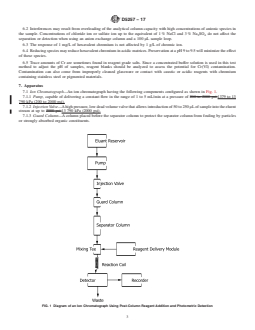
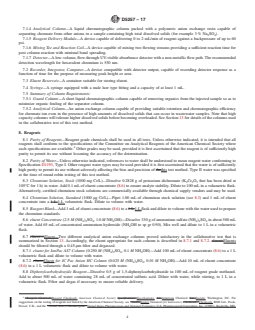
7.1 Ion Chromatograph—An ion chromatograph having the following components configured as shown in Fig. 1.
7.1.1 Pump, capable of delivering a constant flow in the range of 1 to 5 mL/min at a pressure of 200 to 2000 psi.1379 to 13
790 kPa (200 to 2000 psi).
7.1.2 Injection Valve—A high pressure, low dead volume valve that allows introduction of 50 to 250 μL of sample into the eluent
stream at up to 2000 psi.13 790 kPa (2000 psi).
7.1.3 Guard Column—A column placed before the separator column to protect the separator column from fouling by particles
or strongly absorbed organic constituents.
FIG. 1 Diagram of an Ion Chromatograph Using Post-Column Reagent Addition and Photometric Detection
D5257 − 17
7.1.4 Analytical Column—A liquid chromatographic column packed with a polymeric anion exchange resin capable of
separating chromate from other anions in a sample containing high total dissolved solids (for example 3 % Na SO ).
2 4
7.1.5 Reagent Delivery Module—A device capable of delivering 0 to 2 mL/min of reagent against a backpressure of up to 60
psi.
7.1.6 Mixing Tee and Reaction Coil—A device capable of mixing two flowing streams providing a sufficient reaction time for
post column reaction with minimal band spreading.
7.1.7 Detector—A low-volume, flow-through UV-visible absorbance detector with a non-metallic flow path. The recommended
detection wavelength for hexavalent chromium is 530 nm.
7.2 Recorder, Integrator, Computer—A device compatible with detector output, capable of recording detector response as a
function of time for the purpose of measuring peak height or area.
7.3 Eluent Reservoir—A container suitable for storing eluent.
7.4 Syringe—A syringe equipped with a male luer type fitting and a capacity of at least 1 mL.
7.5 Summary of Column Requirements:
7.5.1 Guard Column—A short liquid chromatographic column capable of removing organics from the injected sample so as to
minimize organic fouling of the separator column.
7.5.2 Analytical Column—An anion exchange column capable of providing suitable retention and chromatographic efficiency
for chromate ion even in the presence of high amounts of dissolved solids that can occur in wastewater samples. Note that high
capacity columns will tolerate higher dissolved solids before becoming overloaded. See Section 13 for details of the columns used
in the collaborative test of this test method.
8. Reagents
8.1 Purity of Reagents—Reagent grade chemicals shall be used in all tests. Unless otherwise indicated, it is intended that all
reagents shall conform to the specifications of the Committee on Analytical Reagents of the American Chemical Society where
such specifications are available. Other grades may be used, provided it is first ascertained that the reagent is of sufficiently high
purity to permit its use without lessening the accuracy of the determination.
8.2 Purity of Water—Unless otherwise indicated, references to water shall be understood to mean reagent water conforming to
Specification D1193, Type I. Other reagent water types may be used provided it is first ascertained that the water is of sufficiently
high purity to permit its use without adversely affecting the bias and precision of thethis test method. Type II water was specified
at the time of round robin testing of this test method.
8.3 Chromium Solution, Stock (1000 mg Cr/L)—Dissolve 0.2828 g of potassium dichromate (K Cr O that has been dried at
2 2 7
105°C for 1 h) in water. Add 0.1 mL of eluent concentrate (8.6) to ensure analyte stability. Dilute to 100 mL in a volumetric flask.
Alternatively, certified chromium stock solutions are commercially available through chemical supply vendors and may be used.
8.4 Chromium Solution, Standard (1000 μg Cr/L)—Pipet 1.00 mL of chromium stock solution (see 8.3) and 1 mL of eluent
concentrate into a 1 L 1-L volumetric flask. Dilute to volume with water.
8.5 Reagent Blank—Add 1 mL of eluent concentrate (8.6) to a 1 L 1-L flask and dilute to volume with the water used to prepare
the chromium standards.
8.6 eluent Concentrate (2.5 M (NH ) SO , 1.0 M NH OH)—Dissolve 330 g of ammonium sulfate (NH ) SO in about 500 mL
4 2 4 4 4 2 4
of water. Add 65 mL of concentrated ammonium hydroxide (NH OH to sp gr 0.90). Mix well and dilute to 1 L in a volumetric
flask.
8.7 eluent—Eluent—Two different analytical anion exchange columns proved satisfactory in the collaborative test that is
summarized in Section 13. Accordingly, the eluent appropriate for each column is described in 8.7.1 and 8.7.2. eluentsEluents
should be filtered through a 0.45-μm filter and degassed.
8.7.1 eluent for IonPac AS7 Column (0.250 M (NH ) SO , 0.1 M NH OH)—Add 100 mL of eluent concentrate (8.6) to a 1 L
4 2 4 4
volumetric flask and dilute to volume with water.
8.7.2 eluentEluent for IC Pac Anion HC Column (0.025 M (NH ) SO , 0.01 M NH OH)—Add 10 mL of eluent concentrate
4 2 4 4
(8.6) to a 1 L volumetric flask and dilute to volume with water.
8.8 Diphenylcarbohydrazide Reagent—Dissolve 0.5 g of 1,5-diphenylcarbohydrazide in 100 mL of reagent grade methanol.
Add to about 500 mL of water containing 28 mL of concentrated sulfuric acid. Dilute with water, while stirring, to 1 L in a
volumetric flask. Filter and degas if necessary to ensure reliable delivery.
“Reagent ChemicalsReagent Chemicals, American Chemical Society Specifications”Specifications, Am.American Chemical Soc.,Society, Washington, DC. For
suggestions on the testing of reagents not listed by the American Chemical Society, see “AnalarAnalar Standards for Laboratory Chemicals,”Chemicals, BDH Ltd., Poole,
Dorset, U.K., and the “United States Pharmacopeia.”United States Pharmacopeia and National Formulary, U.S. Pharmacopeial Convention, Inc. (USPC), Rockville, MD.
D5257 − 17
8.9 Filter Paper—Purchase suitable filter paper. Typically the filter papers have a pore size of 0.45-μm membrane. Material such
as fine-textured, acid-washed, ashless paper, or glass fiber paper are acceptable. The user must first ascertain that the filter paper
is of sufficient purity to use without adversely affecting the bias and precision of this test method.
9. Sampling
9.1 Collect the sample in accordance with the applicable ASTM Standardsstandards as follows: Practice D1066, or Practices
D3370.
9.2 Filter samples and adjust pH immediately upon sampling to minimize any interconversion between Cr III and Cr VI Cr(III)
and Cr(VI) species. Filter the sample through a 0.45 μm filter.0.45-μm filter (8.9). Collect the filtrate and adjust its pH to 9 to 9.5
using the eluent concentrate (see 8.6). Ship and store samples at <6°C. Bring to ambient temperature prior to analysis. The sample
should be analyzed within 28 days as long as the pH is above 9.0. Adjust final calculations to account for sample dilution. The
holding time is based on changes to USU.S. EPA 40 CFR 136 part136, Part II, tableTable II.
10. Calibration
10.1 Prepare at least three levels of standards for each decade of the concentration range of interest. For standards of 1 to 1000
μg/L, prepare by diluting measured volumes of the standard chromium solution (see 8.4) with water in separate volumetric flasks.
10.2 Determine the chromium response for each of the standards and blank using the procedure defined in Section 11.
10.3 Prepare Read directly in concentration if this capability is provided with the instrument or plot a calibration curve by using
a linear plot of the peak height or area as a function of standard concentration. Do not force the calibration curve through zero.
The response of the reagent blank should be less than 0.1 μg/L hexavalent chromium.
10.4 Prepare a new calibration curve when new reagents are made or the hardware is altered.
11. Procedure
11.1 Set up the ion chromatograph in accordance with the manufacturer’s instructions.
11.2 Adjust the eluent flow rate to 1.5 mL/min. Increase the flow of the post-column reagent until the flow rate from the detector
outlet line is 2.0 mL/min.mL/min so as to have a reagent flow of 0.5 mL/min under operating conditions. Measure the pH of the
detector effluent to confirm it is 2 or lower.
11.3 After the flow rates are adjusted, allow the system to equilibrate for about 15 min.
11.4 If using a fixed volume sample loop (typically 100 μL), load at least 1 mL of sample through the sample port using an
appropriate syringe. Inject the sample into the eluent stream and record the chromatogram (see Fig. 2). If using a variable volume
injector, inject the desired sample volume into the eluent stream and record the chromatogram.
FIG. 2 Ion Chromatographic Determination of Hexavalent Chromium
D5257 − 17
12. Calculation
12.1 Refer Read directly or refer the hexavalent chromium peak height or peak area
...
Questions, Comments and Discussion
Ask us and Technical Secretary will try to provide an answer. You can facilitate discussion about the standard in here.
Loading comments...