

ASTM E1486-14(2022)
(Test Method)Standard Test Method for Determining Floor Tolerances Using Waviness, Wheel Path and Levelness Criteria
General Information
- Abstract
SIGNIFICANCE AND USE
5.1 This test method provides statistical and graphical information concerning floor surface profiles.
5.2 Results of this test method are for the purpose of:
5.2.1 Establishing compliance of random or fixed-path trafficked floor surfaces with specified tolerances,
5.2.2 Evaluating the effect of different construction methods on the waviness of the resulting floor surface,
5.2.3 Investigating the curling and deflection of concrete floor surfaces,
5.2.4 Establishing, evaluating, and investigating the profile characteristics of other surfaces, and
5.2.5 Establishing, evaluating, and investigating the levelness characteristics of surfaces.
5.3 Application:
5.3.1 Random Traffic—When the traffic patterns across a floor are not fixed, two sets of survey lines, approximately equally spaced and at right angles to each other, shall be used. The survey lines shall be spaced across the test section to produce lines of approximately equal total length, both parallel to and perpendicular to the longest test section boundary. Limits are specified in 7.2.2 and 7.3.2.
5.3.2 Defined Wheel Path Traffic—For surfaces primarily intended for defined wheel path traffic, only two wheel paths and the initial transverse elevation difference (“side-to-side”) between wheels shall be surveyed.
5.3.3 Time of Measurement—For new concrete floor construction, the elevation measurements shall be made within 72 h of final concrete finishing. For existing structures, measurements shall be taken as appropriate.
5.3.4 Elevation Conformance—Use is restricted to shored, suspended surfaces.
5.3.5 RMS Levelness—Use is unrestricted, except that it is excluded from use with cambered surfaces and unshored, elevated surfaces.
SCOPE
1.1 This test method covers data collection and analysis procedures to determine surface flatness and levelness by calculating waviness indices for survey lines and surfaces, elevation differences of defined wheel paths, and levelness indices using the inch-pound system of units.
Note 1: This test method is the companion to SI Test Method E1486M; therefore, no SI equivalents are shown in this test method.
Note 2: This test method was not developed for, and does not apply to, clay or concrete paver units.
1.1.1 The purpose of this test method is to provide the user with floor tolerance estimates as follows:
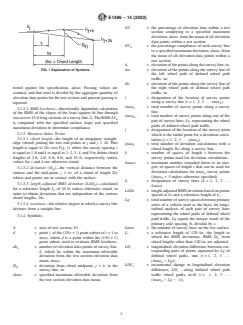
1.1.1.1 Local survey line waviness and overall surface waviness indices for floors based on deviations from the midpoints of imaginary chords as they are moved along a floor elevation profile survey line. End points of the chords are always in contact with the surface. The imaginary chords cut through any points in the concrete surface higher than the chords.
1.1.1.2 Defined wheel path criteria based on transverse and longitudinal elevation differences, change in elevation difference, and root mean square (RMS) elevation difference.
1.1.1.3 Levelness criteria for surfaces characterized by either of the following methods: the conformance of elevation data to the test section elevation data mean or the conformance of the RMS slope of each survey line to a specified slope for each survey line.
1.1.2 The averages used throughout these calculations are RMS (that is, the quadratic means). This test method gives equal importance to humps and dips, measured up (+) and down (−), respectively, from the imaginary chords.
1.1.3 Appendix X1 is a commentary on this test method. Appendix X2 provides a computer program for waviness index calculations based on this test method.
1.2 The values stated in inch-pound units are to be regarded as standard. No other units of measurement are included in this standard.
1.3 This standard does not purport to address all of the safety concerns, if any, associated with its use. It is the responsibility of the user of this standard to establish appropriate safety, health, and environmental practices and determine the applicab...
- Status
- Published
- Publication Date
- 30-Sep-2022
- Technical Committee
- E06 - Performance of Buildings
- Drafting Committee
- E06.21 - Serviceability
Overview
ASTM E1486-14(2022) is the Standard Test Method for Determining Floor Tolerances Using Waviness, Wheel Path, and Levelness Criteria, developed by ASTM International. This standard outlines procedures for collecting and analyzing data to assess the flatness and levelness of floor surfaces in terms of waviness, wheel path performance, and levelness indices-all using inch-pound units. The method is applicable for both new and existing floor surfaces (excluding clay or concrete paver units) and serves as a crucial tool for evaluating floor profile quality in various construction and operational contexts.
Key Topics
- Surface Waviness: Measures the degree to which a floor deviates from a perfectly flat plane by assessing deviations from chord midpoints along survey lines. The calculation uses root mean square (RMS) principles, giving equal importance to both humps and dips in the floor surface.
- Wheel Path Criteria: Focuses on surfaces traversed by vehicles with defined wheel paths. It evaluates both transverse (side-to-side) and longitudinal (front-to-rear) elevation differences and their RMS values for compliance with specified tolerances.
- Levelness Criteria: Assesses how well the surface elevation data conform to the mean elevation of the test section (elevation conformance) and checks the RMS slope along survey lines against specified limits.
- Statistical and Graphical Analysis: The standard guides users in computing statistical indices and producing graphical representations of floor surface profiles, facilitating clear communication of compliance and surface characteristics.
Applications
- Quality Control in Construction: Use ASTM E1486-14(2022) for verifying that floor installations meet flatness and levelness requirements. It is instrumental for acceptance testing of random-traffic or fixed-path trafficked floors in commercial and industrial buildings.
- Evaluation of Construction Methods: Compare how different concreting and finishing techniques impact floor waviness, which can help optimize processes for future projects.
- Investigating Floor Behavior: Assess floor curling and deflection-key issues in concrete slabs-to diagnose service performance or remediate potential issues.
- Profile Characterization: Analyze the characteristics of various surface types, not limited to floors, to establish performance benchmarks or diagnose irregularities.
- Defined vs. Random Traffic: Adapt the testing approach based on whether the floor is intended for random pedestrian/vehicular use or has dedicated wheel paths (e.g., warehouses, manufacturing facilities).
Related Standards
- ASTM E1486M: Companion test method using the metric SI system for similar floor tolerance assessments.
- ASTM E1155: Standard Test Method for Determining FF Floor Flatness and FL Floor Levelness Numbers, often referenced for floor flatness and levelness using different indices.
- ASTM E1155M: Metric version of ASTM E1155, compatible with international measurement preferences.
- International Standardization Principles: ASTM E1486-14(2022) is developed according to globally recognized principles, supporting compliance with the WTO's Technical Barriers to Trade (TBT) recommendations.
Practical Value
Implementing ASTM E1486-14(2022) provides stakeholders-contractors, engineers, architects, and facility managers-with a standardized, reliable method for evaluating floor profile tolerance. It supports:
- Ensuring Compliance: Confirm that floors meet specified flatness and levelness criteria, critical for safety and proper functioning of equipment.
- Documenting Performance: Generate reproducible, detailed reports and graphical profiles for project documentation, dispute resolution, or ongoing maintenance planning.
- Optimizing Floor Maintenance: Early detection and correction of floor irregularities saves long-term repair costs and reduces downtime.
- Supporting International Trade and Construction: Facilitates fair assessment in international projects, ensuring quality across borders.
For anyone involved in building construction, facility management, or quality assurance, ASTM E1486-14(2022) is an essential reference for achieving and certifying high standards of floor flatness and levelness.
Relations
- Effective Date
- 01-Oct-2010
- Effective Date
- 01-Apr-2004
- Effective Date
- 10-Sep-1998
Get Certified
Connect with accredited certification bodies for this standard

DIBt (Deutsches Institut für Bautechnik)
German Institute for Building Technology.
DIN CERTCO
DIN Group product certification.

Aboma Certification B.V.
Specialized in construction, metal, and transport sectors.
Sponsored listings
Frequently Asked Questions
ASTM E1486-14(2022) is a standard published by ASTM International. Its full title is "Standard Test Method for Determining Floor Tolerances Using Waviness, Wheel Path and Levelness Criteria". This standard covers: SIGNIFICANCE AND USE 5.1 This test method provides statistical and graphical information concerning floor surface profiles. 5.2 Results of this test method are for the purpose of: 5.2.1 Establishing compliance of random or fixed-path trafficked floor surfaces with specified tolerances, 5.2.2 Evaluating the effect of different construction methods on the waviness of the resulting floor surface, 5.2.3 Investigating the curling and deflection of concrete floor surfaces, 5.2.4 Establishing, evaluating, and investigating the profile characteristics of other surfaces, and 5.2.5 Establishing, evaluating, and investigating the levelness characteristics of surfaces. 5.3 Application: 5.3.1 Random Traffic—When the traffic patterns across a floor are not fixed, two sets of survey lines, approximately equally spaced and at right angles to each other, shall be used. The survey lines shall be spaced across the test section to produce lines of approximately equal total length, both parallel to and perpendicular to the longest test section boundary. Limits are specified in 7.2.2 and 7.3.2. 5.3.2 Defined Wheel Path Traffic—For surfaces primarily intended for defined wheel path traffic, only two wheel paths and the initial transverse elevation difference (“side-to-side”) between wheels shall be surveyed. 5.3.3 Time of Measurement—For new concrete floor construction, the elevation measurements shall be made within 72 h of final concrete finishing. For existing structures, measurements shall be taken as appropriate. 5.3.4 Elevation Conformance—Use is restricted to shored, suspended surfaces. 5.3.5 RMS Levelness—Use is unrestricted, except that it is excluded from use with cambered surfaces and unshored, elevated surfaces. SCOPE 1.1 This test method covers data collection and analysis procedures to determine surface flatness and levelness by calculating waviness indices for survey lines and surfaces, elevation differences of defined wheel paths, and levelness indices using the inch-pound system of units. Note 1: This test method is the companion to SI Test Method E1486M; therefore, no SI equivalents are shown in this test method. Note 2: This test method was not developed for, and does not apply to, clay or concrete paver units. 1.1.1 The purpose of this test method is to provide the user with floor tolerance estimates as follows: 1.1.1.1 Local survey line waviness and overall surface waviness indices for floors based on deviations from the midpoints of imaginary chords as they are moved along a floor elevation profile survey line. End points of the chords are always in contact with the surface. The imaginary chords cut through any points in the concrete surface higher than the chords. 1.1.1.2 Defined wheel path criteria based on transverse and longitudinal elevation differences, change in elevation difference, and root mean square (RMS) elevation difference. 1.1.1.3 Levelness criteria for surfaces characterized by either of the following methods: the conformance of elevation data to the test section elevation data mean or the conformance of the RMS slope of each survey line to a specified slope for each survey line. 1.1.2 The averages used throughout these calculations are RMS (that is, the quadratic means). This test method gives equal importance to humps and dips, measured up (+) and down (−), respectively, from the imaginary chords. 1.1.3 Appendix X1 is a commentary on this test method. Appendix X2 provides a computer program for waviness index calculations based on this test method. 1.2 The values stated in inch-pound units are to be regarded as standard. No other units of measurement are included in this standard. 1.3 This standard does not purport to address all of the safety concerns, if any, associated with its use. It is the responsibility of the user of this standard to establish appropriate safety, health, and environmental practices and determine the applicab...
SIGNIFICANCE AND USE 5.1 This test method provides statistical and graphical information concerning floor surface profiles. 5.2 Results of this test method are for the purpose of: 5.2.1 Establishing compliance of random or fixed-path trafficked floor surfaces with specified tolerances, 5.2.2 Evaluating the effect of different construction methods on the waviness of the resulting floor surface, 5.2.3 Investigating the curling and deflection of concrete floor surfaces, 5.2.4 Establishing, evaluating, and investigating the profile characteristics of other surfaces, and 5.2.5 Establishing, evaluating, and investigating the levelness characteristics of surfaces. 5.3 Application: 5.3.1 Random Traffic—When the traffic patterns across a floor are not fixed, two sets of survey lines, approximately equally spaced and at right angles to each other, shall be used. The survey lines shall be spaced across the test section to produce lines of approximately equal total length, both parallel to and perpendicular to the longest test section boundary. Limits are specified in 7.2.2 and 7.3.2. 5.3.2 Defined Wheel Path Traffic—For surfaces primarily intended for defined wheel path traffic, only two wheel paths and the initial transverse elevation difference (“side-to-side”) between wheels shall be surveyed. 5.3.3 Time of Measurement—For new concrete floor construction, the elevation measurements shall be made within 72 h of final concrete finishing. For existing structures, measurements shall be taken as appropriate. 5.3.4 Elevation Conformance—Use is restricted to shored, suspended surfaces. 5.3.5 RMS Levelness—Use is unrestricted, except that it is excluded from use with cambered surfaces and unshored, elevated surfaces. SCOPE 1.1 This test method covers data collection and analysis procedures to determine surface flatness and levelness by calculating waviness indices for survey lines and surfaces, elevation differences of defined wheel paths, and levelness indices using the inch-pound system of units. Note 1: This test method is the companion to SI Test Method E1486M; therefore, no SI equivalents are shown in this test method. Note 2: This test method was not developed for, and does not apply to, clay or concrete paver units. 1.1.1 The purpose of this test method is to provide the user with floor tolerance estimates as follows: 1.1.1.1 Local survey line waviness and overall surface waviness indices for floors based on deviations from the midpoints of imaginary chords as they are moved along a floor elevation profile survey line. End points of the chords are always in contact with the surface. The imaginary chords cut through any points in the concrete surface higher than the chords. 1.1.1.2 Defined wheel path criteria based on transverse and longitudinal elevation differences, change in elevation difference, and root mean square (RMS) elevation difference. 1.1.1.3 Levelness criteria for surfaces characterized by either of the following methods: the conformance of elevation data to the test section elevation data mean or the conformance of the RMS slope of each survey line to a specified slope for each survey line. 1.1.2 The averages used throughout these calculations are RMS (that is, the quadratic means). This test method gives equal importance to humps and dips, measured up (+) and down (−), respectively, from the imaginary chords. 1.1.3 Appendix X1 is a commentary on this test method. Appendix X2 provides a computer program for waviness index calculations based on this test method. 1.2 The values stated in inch-pound units are to be regarded as standard. No other units of measurement are included in this standard. 1.3 This standard does not purport to address all of the safety concerns, if any, associated with its use. It is the responsibility of the user of this standard to establish appropriate safety, health, and environmental practices and determine the applicab...
ASTM E1486-14(2022) is classified under the following ICS (International Classification for Standards) categories: 91.060.30 - Ceilings. Floors. Stairs. The ICS classification helps identify the subject area and facilitates finding related standards.
ASTM E1486-14(2022) has the following relationships with other standards: It is inter standard links to ASTM E1486M-98(2010), ASTM E1486M-98(2004), ASTM E1486M-98. Understanding these relationships helps ensure you are using the most current and applicable version of the standard.
ASTM E1486-14(2022) is available in PDF format for immediate download after purchase. The document can be added to your cart and obtained through the secure checkout process. Digital delivery ensures instant access to the complete standard document.
Standards Content (Sample)
This international standard was developed in accordance with internationally recognized principles on standardization established in the Decision on Principles for the
Development of International Standards, Guides and Recommendations issued by the World Trade Organization Technical Barriers to Trade (TBT) Committee.
Designation: E1486 − 14 (Reapproved 2022)
Standard Test Method for
Determining Floor Tolerances Using Waviness, Wheel Path
and Levelness Criteria
This standard is issued under the fixed designation E1486; the number immediately following the designation indicates the year of
original adoption or, in the case of revision, the year of last revision.Anumber in parentheses indicates the year of last reapproval.A
superscript epsilon (´) indicates an editorial change since the last revision or reapproval.
1. Scope 1.2 The values stated in inch-pound units are to be regarded
asstandard.Nootherunitsofmeasurementareincludedinthis
1.1 This test method covers data collection and analysis
standard.
procedures to determine surface flatness and levelness by
1.3 This standard does not purport to address all of the
calculating waviness indices for survey lines and surfaces,
safety concerns, if any, associated with its use. It is the
elevation differences of defined wheel paths, and levelness
responsibility of the user of this standard to establish appro-
indices using the inch-pound system of units.
priate safety, health, and environmental practices and deter-
NOTE 1—This test method is the companion to SI Test Method
mine the applicability of regulatory limitations prior to use.
E1486M; therefore, no SI equivalents are shown in this test method.
1.4 This international standard was developed in accor-
NOTE2—Thistestmethodwasnotdevelopedfor,anddoesnotapplyto,
dance with internationally recognized principles on standard-
clay or concrete paver units.
ization established in the Decision on Principles for the
1.1.1 The purpose of this test method is to provide the user
Development of International Standards, Guides and Recom-
with floor tolerance estimates as follows:
mendations issued by the World Trade Organization Technical
1.1.1.1 Local survey line waviness and overall surface
Barriers to Trade (TBT) Committee.
waviness indices for floors based on deviations from the
2. Referenced Document
midpoints of imaginary chords as they are moved along a floor
elevation profile survey line. End points of the chords are
2.1 ASTM Standard:
always in contact with the surface. The imaginary chords cut
E1486MTest Method for Determining Floor Tolerances
through any points in the concrete surface higher than the
UsingWaviness,WheelPathandLevelnessCriteria(Met-
chords.
ric)
1.1.1.2 Defined wheel path criteria based on transverse and
3. Terminology
longitudinal elevation differences, change in elevation
difference, and root mean square (RMS) elevation difference.
3.1 Definitions of Terms Specific to This Standard:
1.1.1.3 Levelness criteria for surfaces characterized by ei-
3.1.1 defined wheel path traffıc—traffic on surfaces, or
ther of the following methods: the conformance of elevation
specifically identifiable portions thereof, intended for defined
datatothetestsectionelevationdatameanortheconformance
linear traffic by vehicles with two primary axles and four
of the RMS slope of each survey line to a specified slope for
primary load wheel contact points on the floor and with
each survey line.
corresponding front and rear primary wheels in approximately
1.1.2 The averages used throughout these calculations are the same wheel paths.
RMS (that is, the quadratic means). This test method gives
3.1.2 levelness—describedintwoways:theconformanceof
equal importance to humps and dips, measured up (+) and
surface elevation data to the mean elevation of a test section
down (−), respectively, from the imaginary chords.
(elevation conformance), and as the conformance of survey
1.1.3 Appendix X1 is a commentary on this test method.
line slope to a specified slope (RMS levelness).
AppendixX2providesacomputerprogramforwavinessindex
3.1.2.1 elevation conformance—the percentage of surface
calculations based on this test method.
elevation data, h, that lie within the tolerance specified from
i
the mean elevation of a test section. The absolute value of the
distance of all points, h, from the test section data mean is
i
This test method is under the jurisdiction of ASTM Committee E06 on
Performance of Buildings and is the direct responsibility of Subcommittee E06.21
on Serviceability. For referenced ASTM standards, visit the ASTM website, www.astm.org, or
Current edition approved Oct. 1, 2022. Published October 2022. Originally contact ASTM Customer Service at service@astm.org. For Annual Book of ASTM
approved in 1994. Last previous edition approved in 2014 as E1486–14. DOI: Standards volume information, refer to the standard’s Document Summary page on
10.1520/E1486-14R22. the ASTM website.
Copyright © ASTM International, 100 Barr Harbor Drive, PO Box C700, West Conshohocken, PA 19428-2959. United States
E1486 − 14 (2022)
EC = the percentage of elevation data within a test
section complying to a specified maximum
deviation,dmax,fromthemeanofallelevation
data points within a test section.
EC = the percentage compliance of each survey line
L
to a specified maximum deviation, dmax, from
the mean of all elevation data points within a
test section.
h = elevationofthepointsalongthesurveyline,in.
i
ha = elevation of the points along the survey line of
FIG. 1 Explanation of Symbols
i
the left wheel path of defined wheel path
traffic, in.
hb = elevation of the points along the survey line of
i
tested against the specification, dmax. Passing values are
the right wheel path of defined wheel path
counted, and that total is divided by the aggregate quantity of traffic, in.
elevation data points for the test section and percent passing is i = designation of the location of survey points
along a survey line (i =1, 2, 3 . imax ).
reported.
L
imax = total number of survey points along a survey
L
3.1.2.2 RMS levelness—directionally dependent calculation
line.
of the RMS of the slopes of the least squares fit line through
imax = total number of survey points along one of the
Lx
successive15ftlongsectionsofasurveyline,L.TheRMSLV
L
pair of survey lines, Lx, representing the wheel
is compared with the specified surface slope and specified
paths of defined wheel path traffic.
maximum deviation to determine compliance.
j = designation of the location of the survey point
3.1.3 Waviness Index Terms:
which is the initial point for a deviation calcu-
3.1.3.1 chord length—the length of an imaginary straight-
lation (j =1, 2, 3 . jmax ).
k
edge (chord) joining the two end points at j and j + 2k. This
jmax = total number of deviation calculations with a
k
length is equal to 2ks (see Fig. 1) where the survey spacing s
chord length 2ks along a survey line.
isequalto1ftand kisequalto1,2,3,4,and5todefinechord
k = number of spaces of length s between the
lengths of 2ft, 4ft, 6ft, 8ft, and 10 ft, respectively, unless
survey points used for deviation calculations.
values for s and k are otherwise stated. kmax = maximum number (rounded down to an inte-
L
ger) of spaces of length s that can be used for
3.1.3.2 deviation (D )—the vertical distance between the
kj
deviation calculations for imax survey points
surface and the mid-point, j + ks, of a chord of length 2ks L
(kmax =5 unless otherwise specified).
whose end points are in contact with the surface. L
L = designation of survey lines (L =1, 2, 3 .
3.1.3.3 length adjusted RMS deviation (LAD )—calculated
k
Lmax).
for a reference length L of 10 ft, unless otherwise stated, in
r
LAD = length-adjustedRMSdeviationbasedonpoints
k
order to obtain deviations that are independent of the various
spaced at ks and a reference length of L .
r
chord lengths, 2ks.
Lg = totalnumberofsurveyspacesbetweenprimary
3.1.3.4 waviness—therelativedegreetowhichasurveyline
axles of a vehicle used as the basis for longi-
deviates from a straight line. tudinal analysis of each pair of survey lines
representing the wheel paths of defined wheel
3.1.4 Symbols:
path traffic. Lg equals the integer result of the
primary axle spacing, ft, divided by s.
A = area of test section, ft . Lmax = the number of survey lines on the test surface.
L = a reference length of 120 in., the length to
d = point i,ofthe(15/s+1)pointsubsetof i=1to
r
imax, where d is a point within the (15/s+1) which the RMS deviations, RMS D , from
k
chord lengths other than 120 in. are adjusted.
point subset, used to evaluate RMS levelness.
LD = longitudinal elevation difference between cor-
dh = number of elevation data points of survey line,
i
L
responding pairs of points separated by Lg of
L, which lie within the maximum allowable
defined wheel paths, mm (i =1, 2, 3 .
deviation from the test section elevation data
(imax − Lg)).
mean, dmax.
L
LDC = incremental change in longitudinal elevation
D = deviation from chord midpoint,j+k, to the
i
kj
survey line, in. difference, LD , along defined wheel path
i
dmax = specified maximum allowable deviation from traffic wheel paths, in./ft (i = 1, 2, 3 .
the test section elevation data mean. (imax −Lg− 1)).
L
E1486 − 14 (2022)
4.1.2.3 RMS TD =RMS transverse elevation difference
Lx = designation of the pair of survey lines used for
Lx
between wheel paths of defined wheel path traffic (see Eq 11).
defined wheel path traffic analysis.
4.1.2.4 LD=longitudinalelevationdifferencebetweenfront
mh = mean elevation of each 15ft section of survey
i
d
and rear axles on wheel paths of defined wheel path traffic (see
line, L, mm (d =1, 2, 3 . (imax −15⁄s)).
L
ms = mean slope of the least squares fit line of each Eq 12).
d
15ft section of survey line, L, in./ft (d = 1, 2,
4.1.2.5 LDC=Longitudinal change in elevation difference
i
3 . . . (imax −15/s)). between front and rear axles on wheel paths of defined wheel
L
n = total number of calculated deviations for sur-
path traffic (see Eq 13).
L
vey line L (equal to the sum of the values of
4.1.2.6 RMS LD =RMS longitudinal elevation difference
Lx
jmax for all values of k that are used). The
betweenaxlesonwheelpathsofdefinedwheelpathtraffic(see
k
symbol n is a weighting factor used in calcu-
L Eq 14).
lating both the waviness and surface waviness
4.1.3 Levelness Equations:
indices.
4.1.3.1 mh =mean elevation of survey line, L, calculated
L
RMS D = root mean square of chord midpoint offset
k
for use only in calculating mh (see Eq 15).
TS
deviations, D , based on points spaced at ks.
kj
4.1.3.2 mh =mean elevation of a test section, calculated
TS
RMS LD = root mean square of longitudinal elevation
Lx
for use only in calculating dh (see Eq 16).
L
differences, LD, on paired wheel path survey
i
4.1.3.3 dh =numberofelevationdatapointsofsurveyline,
L
lines for defined wheel path traffic, with pri-
L, passing the specification, dmax, used for calculating both
mary axles separated by L , in.
g
EC and EC (see Eq 17 and 18).
L
RMS TD = root mean square of transverse elevation
Lx
4.1.3.4 EC =percentage of elevation data points on survey
L
differences, TD, on paired wheel path survey
i
line, L, that comply with dmax (see Eq 19).
lines for defined wheel path traffic, in.
4.1.3.5 EC =percentage of elevation data points within a
RMS LV = RMS levelness, calculated as the root mean
L
test section complying with dmax (see Eq 20).
square slope of each survey line, L, in./ft.
4.1.3.6 mh =meanelevationofeach15ftsectionofsurvey
s = spacingbetweenadjacentsurveypointsalonga d
line, L,calculatedforuseonlyincalculatingRMS LV (seeEq
survey line (1 ft unless a smaller value is L
21).
stated), ft.
SWI = surfacewavinessindexdeterminedbycombin- 4.1.3.7 ms =meanslopeoftheleastsquaresfitlineofeach
d
15ft section of survey line, L, calculated for use only in
ing the waviness indices of all the survey lines
on the test surface, in. calculating RMS LV (see Eq 22).
L
TD = transverse elevation difference between corre-
4.1.3.8 RMSLV =RMSofleastsquaresfit15ftslopes(see
i
L
sponding points of defined wheel path traffic Eq 23).
wheel paths, in.(i = 1, 2, 3 . . . imax ).
Lx
4.2 Waviness Index—Chord Length Range:
TDC = incremental change in transverse elevation
i
4.2.1 Unless a different range is specified, the waviness
difference, TD alongdefinedwheelpathtraffic
i
index,WI ,shallbecalculatedfora2ft,4ft,6ft,8ft,and10ft
L
wheel paths, in./ft (i = 1, 2, 3 . . . (im-
chord length range.
ax −1)).
Lx
4.2.2 Thechordlength,2ks,islimitedbythetotalnumberof
WI = waviness index for survey line L with chord
L
survey points along a survey line. To ensure that the elevation
length range from 2.0ft to 10 ft unless a
of every survey point is included in the deviation calculation
different range is stated, in.
thatusesthelargestvalueof k,themaximumvalueof k,called
3.2 Sign Convention—Up is the positive direction;
kmax , is determined by:
L
consequently, the higher the survey point, the larger its h
i
value.
kmax 5 imax /3 roundeddowntoaninteger (1)
~ !
L L
4. Summary of Test Method
4.2.3 Reduce the maximum chord length so that 2(kmax )s
L
4.1 Equations—Equations are provided to determine the
is approximately equal to the maximum length that is of
following characteristics:
concern to the user.
4.1.1 Waviness Index Equations:
NOTE 3—For longer survey lines, kmax , which is determined using Eq
L
4.1.1.1 RMS D =RMS deviation (see Eq 4).
k
1, permits the use of chord lengths, 2ks, longer than those of interest or
4.1.1.2 LAD =length-adjusted deviation (see Eq 5).
k
concern to the floor user.
4.1.1.3 WI =waviness index (see Eq 6 and 7).
L
4.2.4 The maximum chord length for suspended floor slabs
4.1.1.4 SWI =surface waviness index (see Eq 8).
shall be 4 ft, unless the slab has been placed without camber
4.1.1.5 |D | =absolute value of the length adjusted devia-
kj
and the shoring remains in place.
tion (see Eq 24).
4.1.2 Defined Wheel Path Traffıc Equations: 4.3 Waviness Index—Maximum Number of Deviation Mea-
surements per Chord Length:
4.1.2.1 TD =transverse elevation difference between the
i
wheel paths of defined wheel path traffic (see Eq 9). 4.3.1 As the values of k are increased from 1 to kmax , the
L
4.1.2.2 TDC =transverse change in elevation difference number of deviation calculations decreases.
i
between wheel paths of defined wheel path traffic (see Eq 10).
E1486 − 14 (2022)
jmax 5 imax 22k (2) TDC 5 TD 2 TD /sin./ft (10)
~ !
k L i i11 i
where TDC is positive when the vehicle tilted left from its
i
4.4 Waviness Index—Deviation:
previous position and negative when it is tilted right from its
4.4.1 As shown in Fig. 1, the deviation, D , is
kj
previous position (i =1, 2, 3 . imax ).
Lx
4.9.3 Transverse RMS Elevation Difference—RMS TD is
Lx
calculated for a pair of wheel path survey lines using Eq 11.
D 5 h 2 h 1h in. (3)
~ !
kj j1k j j12k
4.5 Waviness Index—RMS Deviation:
imax
Lx
4.5.1 RMS D is calculated for each chord length using all
k
TD
i
(
i51
points along the survey line.
RMSTD 5 in. (11)
!
Lx
imax
Lx
jmax 4.9.4 Longitudinal Elevation Difference—LDis calculated
k
i
D
forapairofwheelpathsurveylinesusingEq12(i =1,2,3.
( kj
i51
RMSD 5 in. (4)
! (imax − Lg)).
k
Lx
jmax
k
4.6 Waviness Index—Length-Adjusted Deviations: LAD is
k
ha 1hb ha 1hb
i1Lg i1Lg i i
calculated for a reference length, L , using Eq 5.
r
LD 5 2 in. (12)
SS D S DD
i
2 2
4.9.5 Longitudinal Change in Elevation Difference—LDCis
jmax j
k
L
r
calculated for a pair of wheel path survey lines using Eq 13
D
F G
kj
(
2ks
i51
(j =1, 2, 3 . ( imax −Lg− 1)).
LAD 5 in. (5) Lx
!
k
jmax
k
4.7 Waviness Index—The values of LAD obtained for each
k
LDC 5 ~LD 2 LD !/sin./ft (13)
i i11 i
value of k shall be combined with other LAD values for each
4.9.6 Longitudinal RMS Elevation Difference—RMS LD is
line L by weighing the values in proportion to jmax to obtain
Lx
k
calculated for a pair of wheel path survey lines using Eq 14.
the waviness index, WI .
L
imax 2Lg
kmax ~ Lx !
L
2 2
~jmax LAD ! LD
( k k ( i
k51 i51
WI 5 in. (6) RMSLD 5 in. (14)
! !
L Lx
n ~imax 2 Lg!
L Lx
where:
4.10 Calculations for Elevation Conformance:
4.10.1 MeanElevationofSurveyLine—mh iscalculatedfor
L
kmax
L
survey line, L, using Eq 15.
n 5 jmax (7)
L ( k
k51
4.8 SurfaceWavinessIndex—Theindividualvaluesofwavi-
imax
L
ness index, WI , obtained for each survey line shall be
L h
( i
i51
combined to give a surface waviness index, SWI, by combin-
mh 5 in. (15)
!
L
imax
L
ing them in proportion to n .
L
4.10.2 Mean Elevation of a Test Section—mh is calculated
TS
for a test section using Eq 16.
L
max
n WI
( L L
L51
SWI 5 in. (8)
L
Lmax
max
L
!
n
mh
( L
( L
L51
L51
mh 5 in. (16)
!
TS
Lmax
4.9 Defined Wheel Path Calculations: L
4.9.1 Transverse Elevation Difference—TDis calculated for
i
4.10.3 Elevation Points Passing—dh the number of eleva-
L
a pair of wheel path survey lines, using Eq 9(i=1,2,3.
tion data points that lie within the maximum allowable
imax ).
Lx
deviation, dmax, from the test section elevation data mean is
calculated using Eq 17 and 18.
TD 5 ~hb 2 ha !in. (9)
i i i
where TD is positive when the right wheel path is higher
Lmax imax
i
L
x
? ?
1/2
than the left and negative when the right wheel path is lower
dh 5 11 (17)
S D
L
( (
x
L51 imax
than the left.
where:
4.9.2 Transverse Change in Elevation Difference—TDCis
i
calculatedforeachpairofwheelpathsurveylinesusingEq10
x 5 dmax 2 h 2 mh (18)
? i TS?
(i =1, 2, 3 . (imax −1)).
and
Lx
E1486 − 14 (2022)
x 5.3 Application:
? ?
5 0 when x 5 0
x
5.3.1 Random Traffıc—When the traffic patterns across a
floor are not fixed, two sets of survey lines, approximately
4.10.4 Elevation Conformance of a Survey Line—EC is
L
equally spaced and at right angles to each other, shall be used.
calculated using Eq 19.
The survey lines shall be spaced across the test section to
producelinesofapproximatelyequaltotallength,bothparallel
dh
L
to and perpendicular to the longest test section boundary.
EC 5 100 percent (19)
F G
L
imax
L Limits are specified in 7.2.2 and 7.3.2.
5.3.2 Defined Wheel Path Traffıc—For surfaces primarily
4.10.5 Elevation Conformance of a Test Section—EC is
intended for defined wheel path traffic, only two wheel paths
calculated using Eq 20.
and the initial transverse elevation difference (“side-to-side”)
between wheels shall be surveyed.
Lmax
5.3.3 Time of Measurement—For new concrete floor
dh
( L
L51
construction, the elevation measurements shall be made within
EC 5 100 percent (20)
Lmax
3 4 72 h of final concrete finishing. For existing structures,
imax
( L
L51
measurements shall be taken as appropriate.
4.11 Calculations for RMS Levelness—RMS LV ,the RMS
5.3.4 Elevation Conformance—Use is restricted to shored,
L
of the successive 15ft least squares fit slopes of each survey suspended surfaces.
line, L, is calculated using Eq 21-23.
5.3.5 RMS Levelness—Use is unrestricted, except that it is
4.11.1 Mean Elevation over 15 ft—mh ,the mean elevation
excluded from use with cambered surfaces and unshored,
d
for each 15ft section of survey line, L, is calculated using Eq elevated surfaces.
21 (d =1, 2, 3 . (imax −15/s)).
L
6. Apparatus
d115/s
h
6.1 Point Elevation Measurement Device:
i
mh 5 in. (21)
d
(
15/s11
i5d
6.1.1 Type I Apparatus—a device capable of measuring the
elevationsofaseriesofpointsspacedatregularintervalsalong
4.11.2 Least Squares Fit Slope over 15 ft—ms ,the mean
d
astraightlinemarkedonthefloorsurfaceshallbeusedforthis
slope of the least squares fit line through each 15ft section of
test. Examples of Type I point elevation measurement devices
survey line, L, is calculated using Eq 22 (d = 1, 2, 3 .
include, but are not limited to:
(imax −15/s)).
L
6.1.1.1 Leveled Straight-edge,
6.1.1.2 Optical or Laser Level with vernier or scaled target,
d115/s
6.1.1.3 Taut Level Wire with gage to measure vertical
2 i 2 d11 h
~ !
i
(
i5d
F G
distance from wire to floor,
ms 5 2 mh in./ft (22)
d d
15 15/s11 15/s12
~ !~ !
6.1.1.4 Floor Profilometer—a device that moves along a
line on the floor’s surface and produces a continuous record of
4.11.3 RMS Levelness—RMS LV ,the RMS of the slopes of
L
the elevation, and
all 15ft sections of survey line, L, is calculated using Eq 23
(d =1, 2, 3 . (imax −15/s)). 6.1.1.5 Laser Imaging Device.
L
6.1.2 Type IIApparatus—a device capable of measuring the
elevation differences between sequential points spaced at
imax 215/s
~ !
L
2 regular specified intervals along a straight line across the floor
ms
( d
d51
surface shall be used for this test. Since the results obtained
RMSLV 5 in./ft (23)
!
L
imax 2 15/s
~ !
L
with this test method vary slightly depending on the particular
measurement device employed, all project participants shall
5. Significance and Use
agree on the measurement device to be used prior to the
5.1 This test method provides statistical and graphical application of this test method for contract specification
enforcement. Examples of Type II point elevation measure-
information concerning floor surface profiles.
ment devices include, but are not limited to:
5.2 Results of this test method are for the purpose of:
6.1.2.1 Inclinometer—a device that measures the angle be-
5.2.1 Establishing compliance of random or fixed-path traf-
tween horizontal and the line joining the two points of contact
ficked floor surfaces with specified tolerances,
with the floor’s surface, and
5.2.2 Evaluatingtheeffectofdifferentconstructionmethods
6.1.2.2 Longitudinal Differential Floor Profilometer—a de-
on the waviness of the resulting floor surface,
vicethatmovesalongalineonthefloor’ssurfaceandproduces
5.2.3 Investigating the curling and deflection of concrete
a record of the individual elevation differences.
floor surfaces,
6.2 Ancillary Equipment:
5.2.4 Establishing, evaluating, and investigating the profile
6.2.1 Measurement Tape, and
characteristics of other surfaces, and
5.2.5 Establishing, evaluating, and investigating the level- 6.2.2 Chalk Line (or other means for marking straight lines
ness characteristics of surfaces. on the test surface).
E1486 − 14 (2022)
6.3 Data Recorder—a convenient means for recording the 7.4.1 For each survey line of the test section, measure and
readingsandtheinformationdescribedintheproceduresection record in sequence.
shall be suitable for this test. Examples of means for data
7.4.1.1 The elevations of all survey points if a Type I
recording include, but are not limited to: apparatus is used, or
6.3.1 Manual Data Sheet, 7.4.1.2 The differences in elevation between all adjacent
6.3.2 Magnetic Tape Recorder (voice or direct input), survey points if a Type II apparatus is used.
6.3.3 Paper Chart Recorder, and
8. Calculation of Results
6.3.4 Direct Computer Input.
8.1 Elevations—Calculate the elevation of all survey points
7. Procedure
along each survey line. Designate these elevations as: h,h ,
1 2
...h,...h except for defined wheel path traffic, which
7.1 Test Sections—Divide the test surface into test sections.
i imax
L
shall be designated as either:
Assignadifferentidentificationnumbertoeachtestsectionand
record the locations of all test section boundaries. No portion
ha ,ha , … ha, … ha
1 2 i imax
Lx
of the test surface shall be associated with more than one test
hb ,hb , . hb,.hb or
1 2 i imax
Lx
section.
where ha is used for left wheel paths and hb is used for
7.2 Survey Lines. right wheel paths, and the a and b designations are ignored
except in Eq 9 and Eq 12.
7.2.1 Establishthenumberandlocationofsurveylinestobe
used in each test section. Assign a different identification
8.2 Maximum Chord Length for Waviness Index:
number to each survey line and mark each survey line on the
8.2.1 Using Eq 1, determine kmax . Reduce kmax so that
L L
test surface. Survey lines shall be parallel to the principal axes
2kmax s equals the maximum chord length of interest.
L
of each concrete placement.
8.2.2 Chooseallvaluesofkstartingwith1andincreasingto
kmax .
NOTE4—Typicalspacingofsurveylinesshouldbe30ftorlessinorder L
to obtain a sufficiently large statistical sample.
8.2.3 For each value of k, calculate the total number of
deviationswithachordlength2ksalongasurveylineusingEq
7.2.2 No survey line shall be shorter than 15 s.
2.
7.2.3 Survey lines shall not be prohibited from crossing
control joints and construction joints but shall not cross 8.3 Deviation—For each value of k, choose all values of j
planned changes in surface slope. Record location of joints in
starting with 1 and increasing to jmax . Using Eq 3, calculate
k
data collected. the deviation from the elevations of the three survey points.
7.2.4 For defined wheel path traffic, survey lines shall be 2
8.4 RMS Deviation—Sum the values of D and calculate
kj
equalinlength,measuredinthesamedirection,andthesurvey
the RMS D using Eq 4.
k
points on each line shall be directly opposite each other,
8.5 Length-Adjusted Deviation—Calculate the LAD using
numbered in identical sequence. Each survey line shall be k
Eq 5 for a reference length, L .
centereduponthemidpointofthewheelwidth.Labeleachpair
r
of wheel path survey lines as L , where L is the pair
x x 8.6 Waviness Index—WI is calculated using Eq 6 by com-
L
designator, for example, (L =1x, 2x, 3x .).
x bining all the LAD values for that line. Eq 7 is used to
k
7.2.5 For elevation conformance, measure each h for all
determine n .
L
survey lines, in inches deviation from a common benchmark,
8.7 Location of the Largest Deviations—For the different
within each test section to be evaluated; and either measure or
values of k, determine the locations where the length adjusted
calculate all successive h so that each is relative to the
i
deviations are larger in magnitude than twice the waviness
common benchmark.
index. This occurs where:
7.2.6 For RMS levelness, orient each survey line, L, in line
with each specified slope to be tested.
2ks
7.3 Survey Points:
D .2WI in. (24)
Œ
? kj? L
L
r
7.3.1 Subdivide each survey line into spaces of length, s.
Sequentially number each successive point down the survey
where:
line as 1, 2, 3, and so forth.
|D | = the absolute value of D
kj kj
7.3.2 The minimum total number of survey points in a test
8.8 Repeat steps 8.1 – 8.7 for all survey lines on the test
section with an area, A, in ft , shall be A/16 for random traffic
section.
floors.
7.3.3 For defined wheel path traffic, points on each pair of 8.9 Surface Waviness Index—Combine all WI values to
L
wheel path survey lines shall be located directly opposite each obtain the SWI, using Eq 8.
other.
8.10 Additional Requirements for Defined Wheel Path Traf-
7.3.4 For defined wheel path traffic, assign the total number
fic:
ofsurveypoints,imax ,ofeithersurveylineofthepairtoimax
L
8.10.1 Transverse Elevation Difference—Calculate the
Lx.
transverse elevation differences, TD, between corresponding
i
7.4 Elevation Measurement: p
...