

ASTM D2022-89(2016)
(Test Method)Standard Test Methods of Sampling and Chemical Analysis of Chlorine-Containing Bleaches
General Information
- Abstract
ABSTRACT
These test methods detail the standard procedures for the sampling and chemical analysis of chlorine-containing bleaches including sodium hypochlorite (soda bleach) solutions, calcium hypochlorite, and chloroisocyanuric acids and their derived salts. Tests for sodium hypochlorite include the determination of available chlorine, sodium chlorate, total chorine, sodium chloride, total alkalinity as sodium oxide, and free alkali as sodium hydroxide. Tests for calcium hypochlorite include the determination of available chlorine, and water. And finally, tests for chloroisocyanuric acids and their derived salts include the determination of available chlorine by iodometric-thiosulfate and arsenite-iodometric methods, and moisture.
SCOPE
1.1 These test methods cover the sampling and chemical analysis of chlorine-containing bleaches. The methods appear in the following order:
Sections
Sodium Hypochlorite (Soda Bleach) Solutions:
Sampling
5
Available Chlorine
6 – 9
Sodium Chlorate
10 – 14
Total Chlorine
15 – 18
Sodium Chloride
19 and 20
Total Alkalinity as Sodium Oxide (Na2O)
21 – 24
Free Alkali as Sodium Hydroxide (NaOH)
25 – 28
Calcium Hypochlorite:
Sampling
30
Available Chlorine
31 – 34
Water
35 – 40
Chloroisocyanuric Acids and Their Derived Salts:
Sampling
42
Available Chlorine (Iodometric—Thiosulfate Method)
43 – 46
Available Chlorine (Arsenite—Iodometric Method)
47 – 50
Moisture
51 – 54
1.2 This standard does not purport to address all of the safety concerns, if any, associated with its use. It is the responsibility of the user of this standard to establish appropriate safety and health practices and determine the applicability of regulatory limitations prior to use. Material Safety Data Sheets are available for reagents and materials. Review them for hazards prior to usage.
- Status
- Published
- Publication Date
- 30-Jun-2016
- Technical Committee
- D12 - Soaps and Other Detergents
Overview
ASTM D2022-89(2016): Standard Test Methods of Sampling and Chemical Analysis of Chlorine-Containing Bleaches establishes uniform procedures for the sampling and chemical analysis of chlorine-containing bleaches. This standard, developed by ASTM International, covers widely used bleaching agents including sodium hypochlorite (soda bleach), calcium hypochlorite, and chloroisocyanuric acids along with their salts. The focus is on determining critical qualities such as available chlorine, water content, sodium chlorate, sodium chloride, alkalinity, and free alkali.
By following ASTM D2022-89(2016), manufacturers, quality control laboratories, and regulatory bodies can ensure reliable and comparable results when analyzing chlorine-based bleaching materials. This leads to improved safety, product quality, and regulatory compliance across multiple industries.
Key Topics
- Sampling Methods: Procedures ensure representative and stable samples for analysis, with special attention to sample preservation due to the reactive nature of bleach solutions.
- Analysis of Sodium Hypochlorite (Soda Bleach) Solutions:
- Available chlorine
- Sodium chlorate
- Total chlorine
- Sodium chloride
- Total alkalinity (as sodium oxide)
- Free alkali (as sodium hydroxide)
- Analysis of Calcium Hypochlorite:
- Available chlorine
- Water content
- Analysis of Chloroisocyanuric Acids & Salts:
- Available chlorine via iodometric-thiosulfate and arsenite-iodometric methods
- Moisture determination
- Chemical Test Methods: These include iodometric titrations, gravimetric analysis, and classic titration techniques, all detailed for standard reagent usage and accurate end-point determination.
- Safety and Handling Recommendations: Emphasis on following relevant safety procedures and consulting material safety data sheets for all reagents.
Applications
Adherence to ASTM D2022-89(2016) provides assurance of accuracy and reliability in the quality assessment and regulatory control of chlorine-containing bleaches. Common applications of these test methods include:
- Quality Control: Ensures each batch of bleach meets specified available chlorine content and purity requirements.
- Regulatory Compliance: Satisfies mandatory local and international regulations for chemical products used in water treatment, sanitation, food processing, and industrial cleaning.
- Manufacturing: Supports routine monitoring and adjustment in production processes for sodium hypochlorite, calcium hypochlorite, and chloroisocyanuric acid-based products.
- Laboratory Standardization: Facilitates interlaboratory consistency in chemical analysis results, supporting certification and accreditation programs.
- Product Labeling: Provides the necessary data to substantiate label claims for concentration and composition.
Industries that benefit from this standard include water treatment, textile manufacturing, pulp and paper production, food and beverage sanitation, swimming pool maintenance, and household and industrial cleaning product formulation.
Related Standards
For a comprehensive approach to chemical analysis and product safety, the following ASTM and international standards are frequently referenced alongside ASTM D2022-89(2016):
- ASTM D1193 - Specification for Reagent Water
- ASTM E200 - Standard Practice for Preparation, Standardization, and Storage of Standard and Reagent Solutions for Chemical Analysis
- ASTM E300 - Standard Practice for Sampling Industrial Chemicals
- ISO 7393-2 - Water quality-Determination of free chlorine and total chlorine-Colorimetric method using N,N-diethyl-1,4-phenylenediamine for water of drinking quality
Applying ASTM D2022-89(2016) in conjunction with these related standards enhances the control and consistency of chemical testing for chlorine-containing bleaches, resulting in better product quality and safety across diverse applications.
Keywords: ASTM D2022-89(2016), chlorine-containing bleaches, sodium hypochlorite analysis, calcium hypochlorite, chloroisocyanuric acids, sampling, available chlorine determination, bleach quality control, chemical analysis standards.
Relations
- Effective Date
- 01-Jul-2016
- Effective Date
- 01-Mar-2006
- Effective Date
- 10-Feb-1999
- Effective Date
- 10-Feb-1999
- Effective Date
- 01-Jul-2016
- Effective Date
- 01-Jul-2016
Get Certified
Connect with accredited certification bodies for this standard

ECOCERT
Organic and sustainability certification.

Eurofins Food Testing Global
Global leader in food, environment, and pharmaceutical product testing.

Intertek Bangladesh
Intertek certification and testing services in Bangladesh.
Sponsored listings
Frequently Asked Questions
ASTM D2022-89(2016) is a standard published by ASTM International. Its full title is "Standard Test Methods of Sampling and Chemical Analysis of Chlorine-Containing Bleaches". This standard covers: ABSTRACT These test methods detail the standard procedures for the sampling and chemical analysis of chlorine-containing bleaches including sodium hypochlorite (soda bleach) solutions, calcium hypochlorite, and chloroisocyanuric acids and their derived salts. Tests for sodium hypochlorite include the determination of available chlorine, sodium chlorate, total chorine, sodium chloride, total alkalinity as sodium oxide, and free alkali as sodium hydroxide. Tests for calcium hypochlorite include the determination of available chlorine, and water. And finally, tests for chloroisocyanuric acids and their derived salts include the determination of available chlorine by iodometric-thiosulfate and arsenite-iodometric methods, and moisture. SCOPE 1.1 These test methods cover the sampling and chemical analysis of chlorine-containing bleaches. The methods appear in the following order: Sections Sodium Hypochlorite (Soda Bleach) Solutions: Sampling 5 Available Chlorine 6 – 9 Sodium Chlorate 10 – 14 Total Chlorine 15 – 18 Sodium Chloride 19 and 20 Total Alkalinity as Sodium Oxide (Na2O) 21 – 24 Free Alkali as Sodium Hydroxide (NaOH) 25 – 28 Calcium Hypochlorite: Sampling 30 Available Chlorine 31 – 34 Water 35 – 40 Chloroisocyanuric Acids and Their Derived Salts: Sampling 42 Available Chlorine (Iodometric—Thiosulfate Method) 43 – 46 Available Chlorine (Arsenite—Iodometric Method) 47 – 50 Moisture 51 – 54 1.2 This standard does not purport to address all of the safety concerns, if any, associated with its use. It is the responsibility of the user of this standard to establish appropriate safety and health practices and determine the applicability of regulatory limitations prior to use. Material Safety Data Sheets are available for reagents and materials. Review them for hazards prior to usage.
ABSTRACT These test methods detail the standard procedures for the sampling and chemical analysis of chlorine-containing bleaches including sodium hypochlorite (soda bleach) solutions, calcium hypochlorite, and chloroisocyanuric acids and their derived salts. Tests for sodium hypochlorite include the determination of available chlorine, sodium chlorate, total chorine, sodium chloride, total alkalinity as sodium oxide, and free alkali as sodium hydroxide. Tests for calcium hypochlorite include the determination of available chlorine, and water. And finally, tests for chloroisocyanuric acids and their derived salts include the determination of available chlorine by iodometric-thiosulfate and arsenite-iodometric methods, and moisture. SCOPE 1.1 These test methods cover the sampling and chemical analysis of chlorine-containing bleaches. The methods appear in the following order: Sections Sodium Hypochlorite (Soda Bleach) Solutions: Sampling 5 Available Chlorine 6 – 9 Sodium Chlorate 10 – 14 Total Chlorine 15 – 18 Sodium Chloride 19 and 20 Total Alkalinity as Sodium Oxide (Na2O) 21 – 24 Free Alkali as Sodium Hydroxide (NaOH) 25 – 28 Calcium Hypochlorite: Sampling 30 Available Chlorine 31 – 34 Water 35 – 40 Chloroisocyanuric Acids and Their Derived Salts: Sampling 42 Available Chlorine (Iodometric—Thiosulfate Method) 43 – 46 Available Chlorine (Arsenite—Iodometric Method) 47 – 50 Moisture 51 – 54 1.2 This standard does not purport to address all of the safety concerns, if any, associated with its use. It is the responsibility of the user of this standard to establish appropriate safety and health practices and determine the applicability of regulatory limitations prior to use. Material Safety Data Sheets are available for reagents and materials. Review them for hazards prior to usage.
ASTM D2022-89(2016) is classified under the following ICS (International Classification for Standards) categories: 71.100.99 - Other products of the chemical industry. The ICS classification helps identify the subject area and facilitates finding related standards.
ASTM D2022-89(2016) has the following relationships with other standards: It is inter standard links to ASTM D2022-89(2008), ASTM D1193-06, ASTM D1193-99e1, ASTM D1193-99, ASTM E1229-21, ASTM D4610-98(2021). Understanding these relationships helps ensure you are using the most current and applicable version of the standard.
ASTM D2022-89(2016) is available in PDF format for immediate download after purchase. The document can be added to your cart and obtained through the secure checkout process. Digital delivery ensures instant access to the complete standard document.
Standards Content (Sample)
This international standard was developed in accordance with internationally recognized principles on standardization established in the Decision on Principles for the
Development of International Standards, Guides and Recommendations issued by the World Trade Organization Technical Barriers to Trade (TBT) Committee.
Designation: D2022 − 89 (Reapproved 2016)
Standard Test Methods of
Sampling and Chemical Analysis of Chlorine-Containing
Bleaches
This standard is issued under the fixed designation D2022; the number immediately following the designation indicates the year of
original adoption or, in the case of revision, the year of last revision. A number in parentheses indicates the year of last reapproval. A
superscript epsilon (´) indicates an editorial change since the last revision or reapproval.
This standard has been approved for use by agencies of the U.S. Department of Defense.
1. Scope 2. Referenced Documents
2.1 ASTM Standards:
1.1 These test methods cover the sampling and chemical
D1193 Specification for Reagent Water
analysis of chlorine-containing bleaches. The methods appear
in the following order:
3. Terminology
Sections
3.1 Definitions:
Sodium Hypochlorite (Soda Bleach) Solutions:
Sampling 5
3.1.1 availablechlorine—themeasureoftheoxidizingpow-
Available Chlorine 6–9
der of the chlorine present as hypochlorite. It is expressed in
Sodium Chlorate 10–14
terms of chlorine with a gram-equivalent weight of 35.46.
Total Chlorine 15–18
Sodium Chloride 19 and 20
4. Reagents
Total Alkalinity as Sodium Oxide (Na O) 21–24
Free Alkali as Sodium Hydroxide (NaOH) 25–28
4.1 Purity of Reagents—Reagent grade chemicals shall be
Calcium Hypochlorite:
used in all tests. Unless otherwise indicated, it is intended that
Sampling 30
Available Chlorine 31–34
all reagents shall conform to the specifications of the Commit-
Water 35–40
tee onAnalytical Reagents of theAmerican Chemical Society,
Chloroisocyanuric Acids and Their Derived Salts:
Sampling 42 where such specifications are available. Other grades may be
Available Chlorine (Iodometric—Thiosulfate Method) 43–46
used, provided it is first ascertained that the reagent is of
Available Chlorine (Arsenite—Iodometric Method) 47–50
sufficiently high purity to permit its use without lessening the
Moisture 51–54
accuracy of the determination.
1.2 This standard does not purport to address all of the
4.2 Unless otherwise indicated, references to water shall be
safety concerns, if any, associated with its use. It is the
understood to mean reagent water conforming to Specification
responsibility of the user of this standard to establish appro-
D1193.
priate safety and health practices and determine the applica-
bility of regulatory limitations prior to use. Material Safety
Data Sheets are available for reagents and materials. Review
them for hazards prior to usage.
For referenced ASTM standards, visit the ASTM website, www.astm.org, or
contact ASTM Customer Service at service@astm.org. For Annual Book of ASTM
Standards volume information, refer to the standard’s Document Summary page on
These test methods are under the jurisdiction of ASTM Committee D12 on the ASTM website.
Soaps and Other Detergents and are the direct responsibility of Subcommittee Reagent Chemicals, American Chemical Society Specifications , American
D12.12 on Analysis and Specifications of Soaps, Synthetics, Detergents and their Chemical Society, Washington, DC. For suggestions on the testing of reagents not
Components. listed by the American Chemical Society, see Analar Standards for Laboratory
Current edition approved July 1, 2016. Published August 2016. Originally Chemicals, BDH Ltd., Poole, Dorset, U.K., and the United States Pharmacopeia
approved in 1962. Last previous edition approved in 2008 as D2022 – 89(2008). and National Formulary, U.S. Pharmacopeial Convention, Inc. (USPC), Rockville,
DOI: 10.1520/D2022-89R16. MD.
SODIUM HYPOCHLORITE (SODA BLEACH) SOLUTIONS
5. Sampling
5.1 The stability of soda bleach is influenced to a consider- of metal contamination from equipment. Owing to the rela-
able degree by the purity of the alkali used in its preparation, tively unstable nature of bleach solutions, special attention
by the excess of alkali remaining, and by the kind and amount shall be given to the collection and preservation of the sample.
Copyright © ASTM International, 100 Barr Harbor Drive, PO Box C700, West Conshohocken, PA 19428-2959. United States
D2022 − 89 (2016)
Exposure to heat and sunlight promotes decomposition, and 8. Procedure
shall be avoided. Samples shall be kept cool in a dark place (or
8.1 Dissolve 2 to3gofKI crystals in 50 mL of water in a
in dark-colored bottles) until analyzed, which shall be done
250-mLErlenmeyer flask.Add 10 mLof acetic acid, then pipet
without unnecessary delay.
the aliquot of sample into the solution, keeping the tip of the
5.2 Strong solutions of bleach shall be accurately diluted pipetbeneaththesurfaceofthesolutionuntildrained.Titrateat
and aliquots taken for determination of available chlorine,
once with 0.1 N Na S O solution until the iodine color is
2 2 3
chlorate, and total chlorine. The size of aliquots shall be such nearly gone, then add 1 mL of starch indicator solution and
that approximately 40 mLof the 0.1 N reagent is required. The
complete the titration to the disappearance of the blue color.
alkali determinations shall be made directly on the sample Record the titration as A (see Section 14).
received and sample sizes to require about 10 mL of 0.1 N
9. Calculation
reagent are recommended.
9.1 Calculate the available chlorine as follows:
5.3 Precision results will require sampling at a standard
temperaturesuchas20°C.Resultsexpressedintermsofweight
Available chlorine as Cl, g/L 5 AN 335.46 /V (2)
~ !
percent will require determination of the density or specific
Available chlorine as Cl, weight % 5 @~AN 30.03546!/VS# 3100
gravity. This may be determined with a hydrometer or by
weighing the sample, after pipetting the amount to be diluted
9.2 Calculate the sodium hypochlorite content as follows:
for analysis into a tared weighing bottle. The weighed sample
Sodium hypochlorite NaOCl , g/L 5 AN 337.22 /V (3)
~ ! ~ !
may be transferred to a volumetric flask and used for subse-
quent analysis.
Sodium hypochlorite ~NaOCl!, weight %
AVAILABLE CHLORINE
5@~AN 30.03722!/VS# 3100
6. Summary of Test Method
where:
6.1 The sample is added to an acidified solution of potas-
A =Na S O solution required for titration of the sample,
2 2 3
sium iodide and the released iodine is titrated with standard
mL
sodium thiosulfate solution to the usual starch end point. N = normality of the Na S O solution,
2 2 3
V = original sample in aliquot used, mL, and
7. Reagents
S = specific gravity of the sample.
7.1 Acetic Acid, glacial.
SODIUM CHLORATE
7.2 Potassium Iodide (KI), crystals, iodate-free.
7.3 Sodium Thiosulfate Solution Standard, (0.1 N)— 10. Summary of Test Method
Dissolve 25 g of sodium thiosulfate (Na S O ·5H O) crystals
2 2 3 2
10.1 Sodium chlorate is reduced with sodium bromide in 8
4,5
in freshly boiled and cooled water and dilute to 1 L. The
Nhydrochloricacid. Afterdilutionandadditionofpotassium
solution is more stable if the glassware is cleaned with
iodide, the released iodine (equivalent to the hypochlorite plus
sulfuric-chromic acid and thoroughly rinsed with water. Stan-
chlorate) is titrated with standard sodium thiosulfate solution
dardize against potassium iodate as follows: Weigh out accu-
and starch indicator.
rately 3.567 g of dry potassium iodate (KIO ) and transfer to a
1-L volumetric flask. Dissolve with water, make up to the
11. Apparatus
mark, and mix thoroughly.This solution will be exactly 0.1000
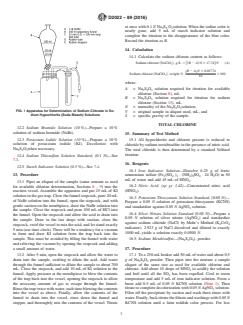
11.1 The apparatus (Fig. 1) consists of 1-L wide-mouth
N. To standardize the Na S O solution, carefully pipet a 50-
2 2 3
reaction vessel, A (a 1-qt fruit jar will serve), fitted with a 2-
mL aliquot of the KIO solution into a 250-mL Erlenmeyer
hole rubber stopper carrying a separatory funnel, B, conve-
flask and dilute to 100 mL with water. Add1gofKI crystals.
niently graduated or marked at the 10, 20, and 100-mL levels,
Whenitisdissolved,add15mLof1.0Nhydrochloricacidand
and a delivery tube leading to a 50-mL test-tube gas trap, C,
titrate immediately with the Na S O solution. When the solu-
2 2 3
which is fitted with rubber tubing and a glass mouthpiece, D.
tion becomes light yellow, add 1 mL of starch indicator
solution and complete the titration to the disappearance of the
12. Reagents
blue color. Standardize at least monthly. Calculate the normal-
12.1 Hydrochloric Acid (sp gr 1.42)—Concentrated hydro-
ity of the Na S O solution as follows:
2 2 3
chloric acid (HCl). For highest accuracy, it should be checked
Normality 5 50 30.1 /A (1)
~ !
forthepresenceofoxidizingorreducingmatter.Whenusedfor
ananalysisofpurepotassiumchlorate(KClO )bythismethod,
where: 3
there should be no fading or return of the end point, and the
A =Na S O solution required for titration of the
2 2 3
assay error should not exceed 60.5 %.
KIO solution, mL.
7.4 Starch Indicator Solution (0.5 %)—Mix 0.5 g of soluble
Ditz, Hugo, “Determination of Chlorates in Electrolytic Bleaching Lyes and in
starch with 5 mL of cold water and add to 95 mL of boiling
Lyes Obtained from Absorption Vessels During the Production of Potassium
water. Mix, cool, and store in a sterilized bottle. Replace
Chlorate,” Chemiker Zeitung, Vol 25, 1901 p. 727.
frequently or add 0.1 % salicylic acid to minimize deteriora-
White, J. F., “Determination of Available Chlorine in Solutions Containing
tion. Textone (NaClO ),” American Dye-stuff Reporter, Vol 31, 1942 pp. 484–7.
D2022 − 89 (2016)
at once with 0.1 N Na S O solution. When the iodine color is
2 2 3
nearly gone, add 5 mL of starch indicator solution and
complete the titration to the disappearance of the blue color.
Record the titration as B.
14. Calculation
14.1 Calculate the sodium chlorate content as follows:
Sodium chlorate NaClO , g/L 5 B 2 A N 317.74 /V (4)
~ ! @~ ! #
~B 2 A!N 30.01774
Sodium chlorate NaClO , weight % 3100
~ !
VS
where:
A =Na S O solution required for titration for available
2 2 3
chlorine (Section 8), mL
B =Na S O solution required for titration for sodium
2 2 3
chlorate (Section 13), mL
N = normality of the Na S O solution,
2 2 3
FIG. 1 Apparatus for Determination of Sodium Chlorate in So-
V = original sample in aliquot used, mL, and
dium Hypochlorite (Soda Bleach) Solutions
S = specific gravity of the sample.
TOTAL CHLORINE
12.2 Sodium Bromide Solution (10 %)—Prepare a 10 %
solution of sodium bromide (NaBr).
15. Summary of Test Method
12.3 Potassium Iodide Solution (10 %)—Prepare a 10 %
15.1 All hypochlorite and chlorate present is reduced to
solution of potassium iodide (KI). Decolorize with
chloride by sodium metabisulfite in the presence of nitric acid.
Na S O when necessary.
The total chloride is then determined by a standard Volhard
2 2 3
titration.
12.4 Sodium Thiosulfate Solution Standard, (0.1 N)—See
7.3.
16. Reagents
12.5 Starch Indicator Solution (0.5 %)—See 7.4.
16.1 Iron Indicator Solution—Dissolve 6.25 g of ferric
13. Procedure ammonium sulfate (Fe (SO ) · (NH ) SO ·24H O) in 50
2 4 3 4 2 4 2
mL of water and add 45 mL of HNO .
13.1 Pipet an aliquot of the sample (same amount as used
16.2 Nitric Acid, (sp gr 1.42)—Concentrated nitric acid
for available chlorine determination, Sections6–9) into the
reaction vessel. Assemble the apparatus and put 25 mL of KI (HNO ).
solution in the gas trap. Close the funnel stopcock, pour 20 mL
16.3 Potassium Thiocyanate Solution Standard, (0.05 N)—
of NaBr solution into the funnel, open the stopcock, and with
Prepare a 0.05 N solution of potassium thiocyanate (KCNS)
gentle suction on the mouthpiece, draw the NaBr solution into
and standardize against 0.05 N AgNO solution.
the sample. Close the stopcock and pour 100 mL of HCl into
16.4 Silver Nitrate Solution Standard (0.05 N)—Prepare a
the funnel. Open the stopcock and allow the acid to drain into
0.05 N solution of silver nitrate (AgNO ) and standardize
the sample. Draw in the last drops with suction, close the
against sodium chloride (NaCl) by Mohr’s Method (K CrO
2 4
stopcock, swirl the vessel to mix the acid, and let stand exactly
indicator). 2.923 g of NaCl dissolved and diluted to exactly
5 min (use time clock). There will be a tendency for a vacuum
1000 mL yields a solution exactly 0.0500 N.
to form and draw KI solution from the trap back into the
sample. This must be avoided by filling the funnel with water 16.5 Sodium Metabisulfite—(Na S O ), powder.
2 2 5
and relieving the vacuum by opening the stopcock and adding
a small amount of water. 17. Procedure
13.2 After 5 min, open the stopcock and allow the water to 17.1 To a 250-mLbeaker add 50 mLof water and about 0.5
drain into the sample, swirling to dilute the acid. Add water gofNa S O powder. Then pipet into the mixture a sample
2 2 5
through the funnel sufficient to dilute the sample to about 700 aliquot of the same size as used for available chlorine and
mL. Close the stopcock, and add 10 mL of KI solution to the chlorate. Add about 10 drops of HNO to acidify the solution
funnel. Apply pressure at the mouthpiece to blow the contents and boil until all the SO has been expelled. Cool to room
of the trap back into the vessel, opening the stopcock to allow temperature and add 5 mL of iron indicator solution. From a
the necessary amount of gas to escape through the funnel. buret add 0.5 mL of 0.05 N KCNS solution (Note 1). Then
Rinsethetraptwicewithwater,eachtimeblowingthecontents titrate to complete decolorization with 0.05 NAgNO solution.
into the vessel as above. Finally, allow the contents of the Filter off the precipitate by suction and wash three times with
funnel to drain into the vessel, rinse down the funnel and water.Finally,back-titratethefiltrateandwashingswith0.05N
stopper, and thoroughly mix the contents of the vessel. Titrate KCNS solution until a faint reddish color persists. For less
D2022 − 89 (2016)
accurate work the filtration may be avoided by adding 1 mLof 22.2 Hydrogen Peroxide Solution (3 %)—Prepare a 3 %
nitrobenzene to coagulate the suspension before back-titrating solution of hydrogen peroxide (H O ).
2 2
the excess AgNO .
22.3 Methyl Red Mixed Indicator Solution—Dissolve 0.2 g
of methyl red in 100 mL of Formula 30 alcohol and 0.3 g
NOTE 1—This small amount of KCNS solution serves as an indicator to
show when an excess of AgNO solution has been added. The back
bromcresol green in 300 mL of Formula 30 alcohol. Grinding
titration is continued from the same buret and the total volume of KCNS
of the methyl red may be necessary to ensure complete
solution used is noted and used in the calculation.
solution. When reagents are completely dissolved, mix the two
solutions thoroughly.
18. Calculation
22.4 Sodium Hydroxide Solution (4 g/L)—Dissolve4gof
18.1 Calculate the total chlorine content as follows:
sodium hydroxide (NaOH) in water and dilute to 1 L.
Total Chlorine as Cl, g/L 5 CN 2 DN 335.46 /V (5)
@~ ! ~ ! #
1 2
23. Procedure
Total chlorine as Cl, weight %
23.1 Neutralize 30 mL of H O solution (or three times the
2 2
@~CN ! 2 ~DN ! 30.03546#
1 2
volume of sample used) in a 250-mL Erlenmeyer flask with
5 3100
VS
NaOH solution, using methyl red mixed indicator solution.
Pipet10mLofthesampleofliquidbleach(ormore,sothatthe
where:
total volume of 0.1 N HCl required will be at least 10 mL into
C = AgNO solution required for titration of the sample,
the neutralized H O solution, shake vigorously for 1 min, and
2 2
mL,
titrate with 0.1 N HCl, using methyl red mixed indicator
D = KCNS solution required for back-titration, total mL
solution.
N = normality of the AgNO solution,
1 3
N = normality of the KCNS solution,
24. Calculation
V = original sample in aliquot used, mL, and
S = specific gravity of the sample.
24.1 Calculate the total alkalinity as Na O as follows:
SODIUM CHLORIDE Total alkalinity as Na O, g/L 5 ~KN 331!/V (7)
2 3
19. Summary of Test Method Total alkalinity as Na O, weight % 5 @~KN 30.031!/VS# 3100
2 3
19.1 Any chlorine present as a sodium chloride is deter-
where:
mined by calculation as the difference between the total
K = mL of HCl required for titration of the sample,
chlorine and the sum of the chlorine present as hypochlorite
N = normality of the HCl,
and as chlorate.
V = mL of original sample used, and
S = specific gravity of the sample.
20. Calculation
FREE ALKALI AS SODIUM HYDROXIDE (NaOH)
20.1 Calculate the sodium chloride content as follows:
Sodium chloride ~NaCl!, g/L 5 @E 2 ~F/2! 2 ~G/3!# 31.649 (6)
25. Summary of Test Method
Sodium chloride NaCl , weight % 5 J 2 K/2 2 L/3 31.649
~ ! @ ~ ! ~ !# 25.1 A sample is added to a neutralized, mixed solution of
bariumchlorideandhydrogenperoxide,whichprecipitatesany
where:
carbonate and reduces the hypochlorite to chloride. The free
E = total chlorine, g/L (Section 18),
alkali is then titrated with standard hydrochloric acid using
F = available chlorine, g/L (Section 9),
phenolphthalein indicator.
G = sodium chlorate, g/L (Section 14),
J = total chlorine, in weight percent (Section 18),
26. Reagents
K = available chlorine, in weight percent (Section 9), and
L = sodium chlorate, in weight percent (Section 14).
26.1 Barium Chloride Solution (100 g/L)—Dissolve 100 g
of barium chloride (BaCl ·2H O) in water and dilute to 1 L.
2 2
TOTAL ALKALINITY AS SODIUM OXIDE (Na O)
Filter if turbid.
21. Summary of Test Metho
...