

ASTM D2243-20
(Test Method)Standard Test Method for Freeze-Thaw Resistance of Water-Borne Coatings
General Information
- Abstract
SIGNIFICANCE AND USE
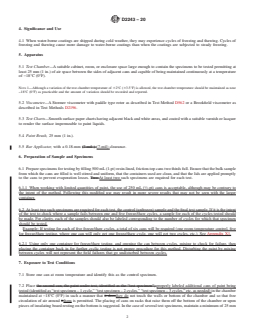
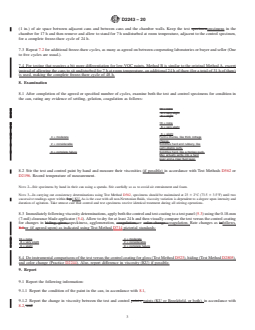
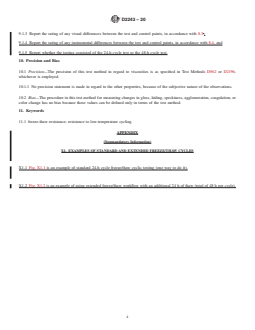
4.1 When water-borne coatings are shipped during cold weather, they may experience cycles of freezing and thawing. Cycles of freezing and thawing cause more damage to water-borne coatings than when the coatings are subjected to steady freezing.
SCOPE
1.1 This test method covers a procedure for evaluating the effect of freeze/thaw cycling on the viscosity and visual film properties of water-borne coatings.
1.2 The values stated in SI units are to be regarded as the standard. The values given in parentheses are for information only.
1.3 This standard does not purport to address all of the safety concerns, if any, associated with its use. It is the responsibility of the user of this standard to establish appropriate safety, health, and environmental practices and determine the applicability of regulatory limitations prior to use.
1.4 This international standard was developed in accordance with internationally recognized principles on standardization established in the Decision on Principles for the Development of International Standards, Guides and Recommendations issued by the World Trade Organization Technical Barriers to Trade (TBT) Committee.
- Status
- Published
- Publication Date
- 30-Nov-2020
- Technical Committee
- D01 - Paint and Related Coatings, Materials, and Applications
- Drafting Committee
- D01.42 - Architectural Coatings

Overview
ASTM D2243-20: Standard Test Method for Freeze-Thaw Resistance of Water-Borne Coatings defines a procedure for evaluating how water-borne coatings withstand cycles of freezing and thawing. This standard is essential for assessing the durability and long-term performance of paints and coatings that may be exposed to low-temperature environments, especially during storage or transportation in cold climates. The test measures changes in viscosity and evaluates visual film properties after repeated freeze-thaw cycles.
Key Topics
- Freeze-Thaw Cycling: Detailing the impact of repeated freezing and thawing, which typically causes more damage to water-borne coatings than exposure to steady freezing conditions.
- Test Procedure: Involves preparing coating samples, subjecting them to controlled freeze-thaw cycles at −18°C (0°F), and comparing them against control specimens kept at room temperature.
- Assessment Criteria:
- Viscosity Change: Using viscometers (such as Stormer or Brookfield) to measure consistency differences before and after cycling.
- Visual Inspection: Rating changes in settlement, gelation, and coagulation using a standardized numeric scale.
- Film Properties: Applying coatings to panels for further evaluation of hiding power, gloss, speckiness, color change, and surface defects.
- Safety and Compliance: The standard advises users to adhere to health, safety, and environmental regulations, ensuring appropriate practices during all phases of testing.
Applications
The ASTM D2243-20 standard is widely used in several key applications:
- Quality Control in Manufacturing: Paint and coating manufacturers utilize this test method to ensure that formulations remain stable and maintain performance after shipping and handling in cold conditions.
- Product Development: Research and development teams use freeze-thaw testing data to innovate and improve the durability of water-borne coatings for architectural, automotive, and industrial uses.
- Regulatory Compliance: By following this internationally recognized method, organizations demonstrate compliance with specifications required by clients, regulatory agencies, or as part of product certification processes.
- Supply Chain Assurance: Suppliers and purchasers of coatings can reference ASTM D2243-20 to communicate clear expectations around freeze-thaw resistance for products shipped or stored in temperature-sensitive environments.
Related Standards
A number of ASTM standards are referenced in conjunction with ASTM D2243-20 to provide a comprehensive approach to evaluating paint quality and appearance:
- ASTM D562 - Test Method for Consistency of Paints Measuring Krebs Unit (KU) Viscosity Using a Stormer-Type Viscometer
- ASTM D2196 - Test Methods for Rheological Properties of Non-Newtonian Materials by Rotational Viscometer
- ASTM D523 - Test Method for Specular Gloss
- ASTM D714 - Test Method for Evaluating Degree of Blistering of Paints
- ASTM D2244 - Practice for Calculation of Color Tolerances and Color Differences from Instrumentally Measured Color Coordinates
- ASTM D2805 - Test Method for Hiding Power of Paints by Reflectometry
Together, these standards support a full range of performance evaluations for water-borne paints and coatings, ensuring robust data for freeze-thaw resistance, appearance, and product reliability.
Keywords: ASTM D2243-20, freeze-thaw resistance, water-borne coatings, freeze-thaw cycles, coating durability, paint testing, viscosity measurement, film properties, gloss, hiding power, color change, paint quality standards.
Relations
- Effective Date
- 01-Jun-2018
- Effective Date
- 01-Aug-2015
- Effective Date
- 01-Jan-2015
- Effective Date
- 01-Jan-2015
- Effective Date
- 01-Dec-2014
- Effective Date
- 01-May-2014
- Effective Date
- 01-Jan-2014
- Effective Date
- 01-Jun-2011
- Effective Date
- 01-Jun-2011
- Effective Date
- 01-Jul-2010
- Effective Date
- 01-Jul-2010
- Effective Date
- 01-Aug-2009
- Effective Date
- 01-Jul-2009
- Effective Date
- 01-Jul-2009
- Effective Date
- 01-Jun-2008
Frequently Asked Questions
ASTM D2243-20 is a standard published by ASTM International. Its full title is "Standard Test Method for Freeze-Thaw Resistance of Water-Borne Coatings". This standard covers: SIGNIFICANCE AND USE 4.1 When water-borne coatings are shipped during cold weather, they may experience cycles of freezing and thawing. Cycles of freezing and thawing cause more damage to water-borne coatings than when the coatings are subjected to steady freezing. SCOPE 1.1 This test method covers a procedure for evaluating the effect of freeze/thaw cycling on the viscosity and visual film properties of water-borne coatings. 1.2 The values stated in SI units are to be regarded as the standard. The values given in parentheses are for information only. 1.3 This standard does not purport to address all of the safety concerns, if any, associated with its use. It is the responsibility of the user of this standard to establish appropriate safety, health, and environmental practices and determine the applicability of regulatory limitations prior to use. 1.4 This international standard was developed in accordance with internationally recognized principles on standardization established in the Decision on Principles for the Development of International Standards, Guides and Recommendations issued by the World Trade Organization Technical Barriers to Trade (TBT) Committee.
SIGNIFICANCE AND USE 4.1 When water-borne coatings are shipped during cold weather, they may experience cycles of freezing and thawing. Cycles of freezing and thawing cause more damage to water-borne coatings than when the coatings are subjected to steady freezing. SCOPE 1.1 This test method covers a procedure for evaluating the effect of freeze/thaw cycling on the viscosity and visual film properties of water-borne coatings. 1.2 The values stated in SI units are to be regarded as the standard. The values given in parentheses are for information only. 1.3 This standard does not purport to address all of the safety concerns, if any, associated with its use. It is the responsibility of the user of this standard to establish appropriate safety, health, and environmental practices and determine the applicability of regulatory limitations prior to use. 1.4 This international standard was developed in accordance with internationally recognized principles on standardization established in the Decision on Principles for the Development of International Standards, Guides and Recommendations issued by the World Trade Organization Technical Barriers to Trade (TBT) Committee.
ASTM D2243-20 is classified under the following ICS (International Classification for Standards) categories: 87.040 - Paints and varnishes. The ICS classification helps identify the subject area and facilitates finding related standards.
ASTM D2243-20 has the following relationships with other standards: It is inter standard links to ASTM D2196-18, ASTM D2244-15a, ASTM D2244-15, ASTM D2244-15e1, ASTM D562-10(2014), ASTM D2244-14, ASTM D523-14, ASTM D2244-11, ASTM D2805-11, ASTM D562-10, ASTM D2196-10, ASTM D2244-09a, ASTM D2244-09, ASTM D714-02(2009), ASTM D523-08. Understanding these relationships helps ensure you are using the most current and applicable version of the standard.
ASTM D2243-20 is available in PDF format for immediate download after purchase. The document can be added to your cart and obtained through the secure checkout process. Digital delivery ensures instant access to the complete standard document.
Standards Content (Sample)
This international standard was developed in accordance with internationally recognized principles on standardization established in the Decision on Principles for the
Development of International Standards, Guides and Recommendations issued by the World Trade Organization Technical Barriers to Trade (TBT) Committee.
Designation: D2243 − 20
Standard Test Method for
Freeze-Thaw Resistance of Water-Borne Coatings
This standard is issued under the fixed designation D2243; the number immediately following the designation indicates the year of
original adoption or, in the case of revision, the year of last revision.Anumber in parentheses indicates the year of last reapproval.A
superscript epsilon (´) indicates an editorial change since the last revision or reapproval.
This standard has been approved for use by agencies of the U.S. Department of Defense.
1. Scope D2805Test Method for Hiding Power of Paints by Reflec-
tometry
1.1 This test method covers a procedure for evaluating the
effect of freeze/thaw cycling on the viscosity and visual film
3. Summary of Test Method
properties of water-borne coatings.
3.1 Thewater-bornecoatingisputintoatleasttwopint-size
1.2 The values stated in SI units are to be regarded as the
(500-mL) resin-lined cans. One can is stored at room
standard. The values given in parentheses are for information
temperature, while the other cans are subjected to cycles of
only.
freezing and thawing. After cycling, the paint samples are
1.3 This standard does not purport to address all of the
examined for changes in viscosity and visual film properties.
safety concerns, if any, associated with its use. It is the
responsibility of the user of this standard to establish appro-
3.2 It is critical that the test cans be undisturbed until they
priate safety, health, and environmental practices and deter- reach the number of freeze-thaw cycles at which they are to be
mine the applicability of regulatory limitations prior to use.
tested.This condition simulates actual freeze-thaw behavior of
1.4 This international standard was developed in accor- paints in the field.
dance with internationally recognized principles on standard-
ization established in the Decision on Principles for the
4. Significance and Use
Development of International Standards, Guides and Recom-
4.1 When water-borne coatings are shipped during cold
mendations issued by the World Trade Organization Technical
weather, they may experience cycles of freezing and thawing.
Barriers to Trade (TBT) Committee.
Cycles of freezing and thawing cause more damage to water-
borne coatings than when the coatings are subjected to steady
2. Referenced Documents
freezing.
2.1 ASTM Standards:
D523Test Method for Specular Gloss
5. Apparatus
D562Test Method for Consistency of Paints Measuring
5.1 Test Chamber—A suitable cabinet, room, or enclosure
KrebsUnit(KU)ViscosityUsingaStormer-TypeViscom-
space large enough to contain the specimens to be tested
eter
permittingatleast25mm(1in.)ofairspacebetweenthesides
D714Test Method for Evaluating Degree of Blistering of
of adjacent cans and capable of being maintained continuously
Paints
at a temperature of −18°C (0°F).
D2196Test Methods for Rheological Properties of Non-
Newtonian Materials by Rotational Viscometer
NOTE1—Althoughavariationofthetestchambertemperatureof 62°C
D2244Practice for Calculation of Color Tolerances and
(63.5°F) is allowed, the test chamber temperature should be maintained
Color Differences from Instrumentally Measured Color
as near −18°C (0°F) as practicable and the amount of variation should be
Coordinates recorded and reported.
5.2 Viscometer—A Stormer viscometer with paddle type
rotor as described in Test Method D562 or a Brookfield
This test method is under the jurisdiction of ASTM Committee D01 on Paint
viscometer as described in Test Methods D2196.
and Related Coatings, Materials, andApplications and is the direct responsibility of
Subcommittee D01.42 on Architectural Coatings.
5.3 Test Charts—Smooth surface paper charts having adja-
Current edition approved Dec. 1, 2020. Published December 2020 Originally
cent black and white areas, and coated with a suitable varnish
approved in 1964. Last previous edition approved in 2014 as D2243–95(2014).
DOI: 10.1520/D2243-20.
or lacquer to render the surface impermeable to paint liquids.
For referenced ASTM standards, visit the ASTM website, www.astm.org, or
contact ASTM Customer Service at service@astm.org. For Annual Book of ASTM
5.4 Paint Brush, 25 mm (1 in.).
Standards volume information, refer to the standard’s Document Summary page on
the ASTM website. 5.5 Bar Applicator, with a 0.18-mm (7-mil) clearance.
Copyright © ASTM International, 100 Barr Harbor Drive, PO Box C700, West Conshohocken, PA 19428-2959. United States
D2243 − 20
6. Preparation of Sample and Specimens 8. Examination
6.1 Prepare specimens for testing by filling 500 mL (1-pt)
8.1 After completion of the agreed or specified number of
resin-lined, friction-top cans two thirds full. Ensure that the
cycles, examine both the test and control specimens for
bulk sample from which the cans are filled is well stirred and
condition in the can, rating any evidence of settling, gelation,
uniform,thatthecontainersusedareclean,andthatthelidsare
coagulation as follows:
applied promptly to the cans to prevent evaporation losses.At
10 = none Good consistency paint that can
least two such specimens are required for each test. be measured on a Stormer
Viscometer.
6.1.1 Whenworkingwithlimitedquantitiesofpaint,theuse
8 = very slight Forms a thick (or thin), flowable
of250mL( ⁄2-pt)cansisacceptable,althoughmaybecontrary
paint that cannot be read on a
Stormer Viscometer. Also may
to the intent of the method. Following this modified use may
have settled into a thick layer and
result in more severe results that may not be seen with the
a clear layer (settled out), that can
larger container.
be mixed back together, but still
cannot be read on Stormer
6.2 At least two such specimens are required for each test,
Viscometer.
the control (unfrozen) sample and the final test sample. If it is
6 = slight Forms a thick mass, with a dough-
like consistency.
theintentofthetesttocheckwhereasamplefailsbetweenone
4 = moderate Forms chunks, like thick cottage
and five freeze/thaw cycles, a sample for each of the cycles
cheese.
tested should be made. For clarity, each of the samples should
2 = considerable Solidifies hard and rubbery, like
semi-pliable putty.
also be labeled corresponding to the number of cycles for
0 = complete failure Solidifies hard, like a hockey puck.
which that specimen should be tested.
May actually settle into a hard
Example: If testing for each of five freeze/thaw cycles, a
layer and a clear fluid layer.
total of six cans will be required (one room temperature
8.2 Stir the test and control paint by hand and measure their
control, five for freeze/thaw testing, where one can will only
viscosities (if possible) in accordance withTest MethodsD5
...
This document is not an ASTM standard and is intended only to provide the user of an ASTM standard an indication of what changes have been made to the previous version. Because
it may not be technically possible to adequately depict all changes accurately, ASTM recommends that users consult prior editions as appropriate. In all cases only the current version
of the standard as published by ASTM is to be considered the official document.
Designation: D2243 − 95 (Reapproved 2014) D2243 − 20
Standard Test Method for
Freeze-Thaw Resistance of Water-Borne Coatings
This standard is issued under the fixed designation D2243; the number immediately following the designation indicates the year of
original adoption or, in the case of revision, the year of last revision. A number in parentheses indicates the year of last reapproval. A
superscript epsilon (´) indicates an editorial change since the last revision or reapproval.
This standard has been approved for use by agencies of the U.S. Department of Defense.
1. Scope
1.1 This test method covers a procedure for evaluating the effect of freeze/thaw cycling on the viscosity and visual film properties
of water-borne coatings.
1.2 The values stated in SI units are to be regarded as the standard. The values given in parentheses are for information only.
1.3 This standard does not purport to address all of the safety concerns, if any, associated with its use. It is the responsibility
of the user of this standard to establish appropriate safety safety, health, and healthenvironmental practices and determine the
applicability of regulatory limitations prior to use.
1.4 This international standard was developed in accordance with internationally recognized principles on standardization
established in the Decision on Principles for the Development of International Standards, Guides and Recommendations issued
by the World Trade Organization Technical Barriers to Trade (TBT) Committee.
2. Referenced Documents
2.1 ASTM Standards:
D523 Test Method for Specular Gloss
D562 Test Method for Consistency of Paints Measuring Krebs Unit (KU) Viscosity Using a Stormer-Type Viscometer
D714 Test Method for Evaluating Degree of Blistering of Paints
D2196 Test Methods for Rheological Properties of Non-Newtonian Materials by Rotational Viscometer
D2244 Practice for Calculation of Color Tolerances and Color Differences from Instrumentally Measured Color Coordinates
D2805 Test Method for Hiding Power of Paints by Reflectometry
3. Summary of Test Method
3.1 The water-borne coating is put into at least two pint-size (500-mL) resin-lined cans. One can is stored at room temperature,
while the other can iscans are subjected to cycles of freezing and thawing. After cycling, the coating is paint samples are examined
for changes in viscosity and visual film properties.
3.2 It is critical that the test cans be undisturbed until they reach the number of freeze-thaw cycles at which they are to be tested.
This condition simulates actual freeze-thaw behavior of paints in the field.
This test method is under the jurisdiction of ASTM Committee D01 on Paint and Related Coatings, Materials, and Applications and is the direct responsibility of
Subcommittee D01.42 on Architectural Coatings.
Current edition approved Dec. 1, 2014Dec. 1, 2020. Published December 2014December 2020 Originally approved in 1964. Last previous edition approved in 20082014
as D2243 – 95 (2008).(2014). DOI: 10.1520/D2243-95R14.10.1520/D2243-20.
For referenced ASTM standards, visit the ASTM website, www.astm.org, or contact ASTM Customer Service at service@astm.org. For Annual Book of ASTM Standards
volume information, refer to the standard’s Document Summary page on the ASTM website.
Copyright © ASTM International, 100 Barr Harbor Drive, PO Box C700, West Conshohocken, PA 19428-2959. United States
D2243 − 20
4. Significance and Use
4.1 When water-borne coatings are shipped during cold weather, they may experience cycles of freezing and thawing. Cycles of
freezing and thawing cause more damage to water-borne coatings than when the coatings are subjected to steady freezing.
5. Apparatus
5.1 Test Chamber—A suitable cabinet, room, or enclosure space large enough to contain the specimens to be tested permitting at
least 25 mm (1 in.) of air space between the sides of adjacent cans and capable of being maintained continuously at a temperature
of −18°C (0°F).
NOTE 1—Although a variation of the test chamber temperature of 62°C (63.5°F) is allowed, the test chamber temperature should be maintained as near
−18°C (0°F) as practicable and the amount of variation should be recorded and reported.
5.2 Viscometer—A Stormer viscometer with paddle type rotor as described in Test Method D562 or a Brookfield viscometer as
described in Test Methods D2196.
5.3 Test Charts—Smooth surface paper charts having adjacent black and white areas, and coated with a suitable varnish or lacquer
to render the surface impermeable to paint liquids.
5.4 Paint Brush, 25 mm (1 in.).
5.5 Bar Applicator, with a 0.18-mm (7-mil ) (7-mil) clearance.
6. Preparation of Sample and Specimens
6.1 Prepare specimens for testing by filling 500 mL (1-pt) resin-lined, friction-top cans two thirds full. Ensure that the bulk sample
from which the cans are filled is well stirred and uniform, that the containers used are clean, and that the lids are applied promptly
to the cans to prevent evaporation losses. Two At least two such specimens are required for each test.
6.1.1 When working with limited quantities of paint, the use of 250 mL ( ⁄2-pt) cans is acceptable, although may be contrary to
the intent of the method. Following this modified use may result in more severe results that may not be seen with the larger
container.
6.2 At least two such specimens are required for each test, the control (unfrozen) sample and the final test sample. If it is the intent
of the test to check where a sample fails between one and five freeze/thaw cycles, a sample for each of the cycles tested should
be made. For clarity, each of the samples should also be labeled corresponding to the number of cycles for which that specimen
should be tested.
Example: If testing for each of five freeze/thaw cycles, a total of six cans will be required (one room temperature control, five
for freeze/thaw testing, where one can will only get one freeze/thaw cycle, one will get two cycles, etc.). See Appendix X1.
6.2.1 Using only one container for freeze/thaw testing, and opening the can between cycles, mixing to check for failure, then
placing the container back in for further cyclic testing is not proper procedure for this method. Disturbing the paint by mixing
between cycles will not represent the field failures that go undisturbed between cycles.
7. Exposure to Test Conditions
7.1 Store one can at room temperature and identify this as the control specimen.
7.2 Place the second can, the paint under test, identified as the “test specimen”, properly labeled additional cans of paint being
tested (identified as “test specimen – 1 cycle,” “test specimen – 2 cycles,” “test specimen – 3 cycles,” etc. as needed) in the chamber
maintained at −18°C (0°F) in such a manner that it doesthey do not touch
...