


ASTM D8222-21
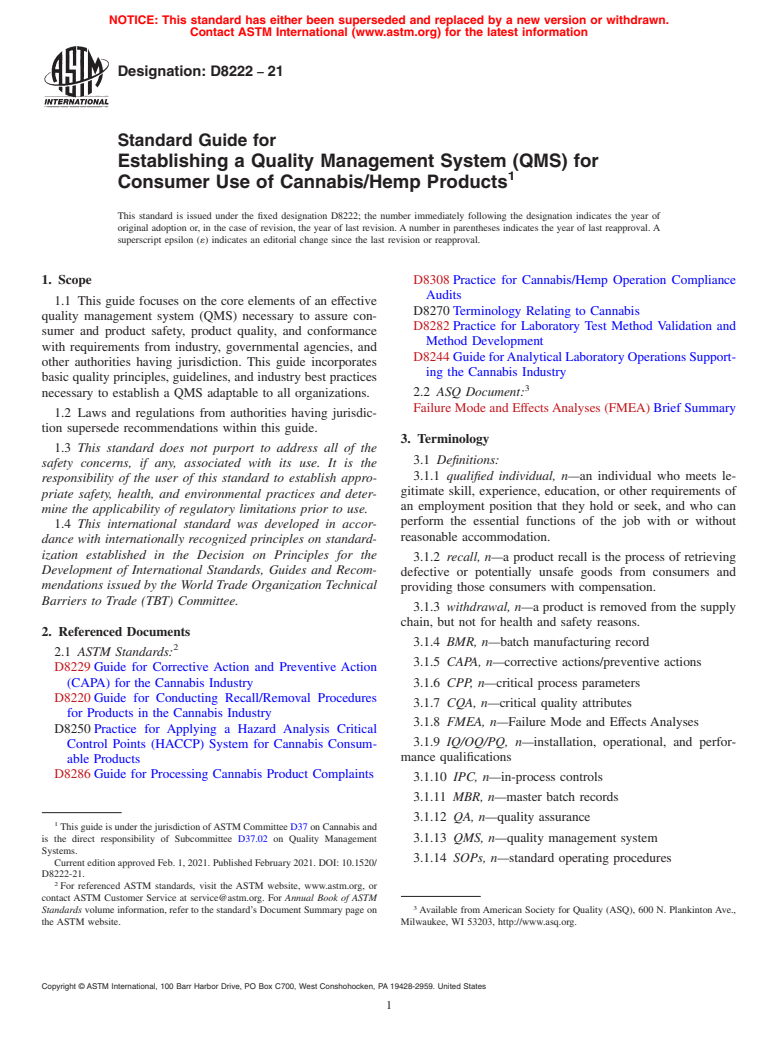
(Guide)Standard Guide for Establishing a Quality Management System (QMS) for Consumer Use of Cannabis/Hemp Products
Standard Guide for Establishing a Quality Management System (QMS) for Consumer Use of Cannabis/Hemp Products
SIGNIFICANCE AND USE
5.1 Effective decision-making in a quality systems-controlled environment comes from an informed understanding of quality issues and associated risks. As such, management should monitor and review the performance of the QMS at planned intervals to ensure the system’s effectiveness and identify opportunities for improvement of the QMS itself. Management should also provide oversight of the QMS by an independent quality practitioner(s) to assure its effectiveness.
5.2 Moreover, risk-based decision-making encompasses all elements of the QMS and should be at the forefront of each decision. Consumer safety is the top priority, regardless of other considerations.
5.3 Aspects of risk should be considered relative to intended (or unintended) uses of a product to ensure consumer safety. Management should assign priorities and adequate resources to activities or actions based on assessing the risk, including the probability of harm and the potential severity of that harm. It is essential to engage appropriate parties in evaluating the risk. Such parties may include:
5.3.1 Consumers;
5.3.2 Manufacturing personnel;
5.3.3 Marketing personnel; and
5.3.4 Other stakeholders, as needed.
5.4 Implementation of risk management includes assessing the risks, implementing risk management controls commensurate with the level of risk, and evaluating the risk management efforts’ results. Risk management assessment is an iterative process and continues when additional information emerges that changes the potential risk’s nature.
5.5 Risk management works in conjunction with process understanding to manage and control change and helps drive continuous improvement.
SCOPE
1.1 This guide focuses on the core elements of an effective quality management system (QMS) necessary to assure consumer and product safety, product quality, and conformance with requirements from industry, governmental agencies, and other authorities having jurisdiction. This guide incorporates basic quality principles, guidelines, and industry best practices necessary to establish a QMS adaptable to all organizations.
1.2 Laws and regulations from authorities having jurisdiction supersede recommendations within this guide.
1.3 This standard does not purport to address all of the safety concerns, if any, associated with its use. It is the responsibility of the user of this standard to establish appropriate safety, health, and environmental practices and determine the applicability of regulatory limitations prior to use.
1.4 This international standard was developed in accordance with internationally recognized principles on standardization established in the Decision on Principles for the Development of International Standards, Guides and Recommendations issued by the World Trade Organization Technical Barriers to Trade (TBT) Committee.
General Information

Standards Content (Sample)
NOTICE: This standard has either been superseded and replaced by a new version or withdrawn.
Contact ASTM International (www.astm.org) for the latest information
Designation: D8222 − 21
Standard Guide for
Establishing a Quality Management System (QMS) for
1
Consumer Use of Cannabis/Hemp Products
This standard is issued under the fixed designation D8222; the number immediately following the designation indicates the year of
original adoption or, in the case of revision, the year of last revision. A number in parentheses indicates the year of last reapproval. A
superscript epsilon (´) indicates an editorial change since the last revision or reapproval.
1. Scope D8308 Practice for Cannabis/Hemp Operation Compliance
Audits
1.1 This guide focuses on the core elements of an effective
D8270 Terminology Relating to Cannabis
quality management system (QMS) necessary to assure con-
D8282 Practice for Laboratory Test Method Validation and
sumer and product safety, product quality, and conformance
Method Development
with requirements from industry, governmental agencies, and
D8244 Guide forAnalytical Laboratory Operations Support-
other authorities having jurisdiction. This guide incorporates
ing the Cannabis Industry
basic quality principles, guidelines, and industry best practices
3
necessary to establish a QMS adaptable to all organizations. 2.2 ASQ Document:
Failure Mode and EffectsAnalyses (FMEA) Brief Summary
1.2 Laws and regulations from authorities having jurisdic-
tion supersede recommendations within this guide.
3. Terminology
1.3 This standard does not purport to address all of the
3.1 Definitions:
safety concerns, if any, associated with its use. It is the
3.1.1 qualified individual, n—an individual who meets le-
responsibility of the user of this standard to establish appro-
gitimate skill, experience, education, or other requirements of
priate safety, health, and environmental practices and deter-
an employment position that they hold or seek, and who can
mine the applicability of regulatory limitations prior to use.
perform the essential functions of the job with or without
1.4 This international standard was developed in accor-
reasonable accommodation.
dance with internationally recognized principles on standard-
ization established in the Decision on Principles for the
3.1.2 recall, n—a product recall is the process of retrieving
Development of International Standards, Guides and Recom-
defective or potentially unsafe goods from consumers and
mendations issued by the World Trade Organization Technical
providing those consumers with compensation.
Barriers to Trade (TBT) Committee.
3.1.3 withdrawal, n—a product is removed from the supply
chain, but not for health and safety reasons.
2. Referenced Documents
3.1.4 BMR, n—batch manufacturing record
2
2.1 ASTM Standards:
3.1.5 CAPA, n—corrective actions/preventive actions
D8229 Guide for Corrective Action and Preventive Action
(CAPA) for the Cannabis Industry 3.1.6 CPP, n—critical process parameters
D8220 Guide for Conducting Recall/Removal Procedures
3.1.7 CQA, n—critical quality attributes
for Products in the Cannabis Industry
3.1.8 FMEA, n—Failure Mode and Effects Analyses
D8250 Practice for Applying a Hazard Analysis Critical
3.1.9 IQ/OQ/PQ, n—installation, operational, and perfor-
Control Points (HACCP) System for Cannabis Consum-
mance qualifications
able Products
D8286 Guide for Processing Cannabis Product Complaints
3.1.10 IPC, n—in-process controls
3.1.11 MBR, n—master batch records
3.1.12 QA, n—quality assurance
1
This guide is under the jurisdiction ofASTM Committee D37 on Cannabis and
is the direct responsibility of Subcommittee D37.02 on Quality Management 3.1.13 QMS, n—quality management system
Systems.
3.1.14 SOPs, n—standard operating procedures
Current edition approved Feb. 1, 2021. Published February 2021. DOI: 10.1520/
D8222-21.
2
For referenced ASTM standards, visit the ASTM website, www.astm.org, or
contact ASTM Customer Service at service@astm.org. For Annual Book of ASTM
3
Standards volume information, refer to the standard’s Document Summary page on Available from American Society for Quality (ASQ), 600 N. Plankinton Ave.,
the ASTM website. Milwaukee, WI 53203, http://www.asq.org.
Copyright © ASTM International, 100 Barr Harbor Drive, PO Box C700, West Conshohocken, PA 19428-2959. United States
1
---------------------- Page: 1 ----------------------
D8222 − 21
4. Summary of Guide 6. Quality Manual
4.1 Thisguideencompassesbothrecreationalandmedicinal 6.1 The quality manual is a document that summarizes the
cannabis activities associated with processing, packaging, implemented components of the QMS. It provides a general
labeling, quality control, and distribution activities. summary of the key elements comprising the content of the
QMS.
4.2 This guide does not cover QMS elements as they relate
to laboratory operations. (See Practice D8282 and Guide 6.2 The quality manual presents an overview of the func-
D8244.) tional QMS elements d
...
Questions, Comments and Discussion
Ask us and Technical Secretary will try to provide an answer. You can facilitate discussion about the standard in here.