

ASTM D1199-86(2020)
(Specification)Standard Specification for Calcium Carbonate Pigments
General Information
- Abstract
ABSTRACT
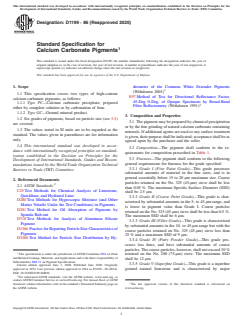
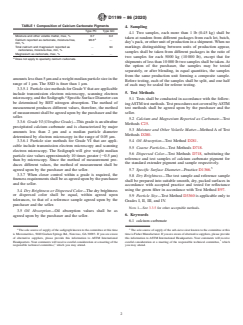
This specification covers two types of high-content calcium carbonate pigments, Type PC and Type GC. Pigments shall be classified into six grades based on particle size, namely: Grade I (fine paint grade); Grade II (coarse paint grade); Grade III (filler grade); Grade IV (putty powder grade); Grade V (superfine grade); and Grade VI (ultrafine grade). Tests shall be conducted in accordance with the following test methods: calcium and magnesium reported as carbonate; moisture and other volatile matter; oil absorption; coarse particles; and dispersed color.
SCOPE
1.1 This specification covers two types of high-content calcium carbonate pigments, as follows:
1.1.1 Type PC—Calcium carbonate precipitate, prepared either by complete solution or by carbonation of lime.
1.1.2 Type GC—Ground mineral product.
1.2 Six grades of pigments, based on particle size (see 3.3) are covered.
1.3 The values stated in SI units are to be regarded as the standard. The values given in parentheses are for information only.
1.4 This international standard was developed in accordance with internationally recognized principles on standardization established in the Decision on Principles for the Development of International Standards, Guides and Recommendations issued by the World Trade Organization Technical Barriers to Trade (TBT) Committee.
- Status
- Published
- Publication Date
- 31-May-2020
- Technical Committee
- D01 - Paint and Related Coatings, Materials, and Applications
- Drafting Committee
- D01.31 - Pigment Specifications


Overview
ASTM D1199-86(2020): Standard Specification for Calcium Carbonate Pigments provides the requirements for two primary types of high-content calcium carbonate pigments: precipitated and ground forms. This international standard, developed by ASTM International, outlines the classification, composition, properties, and test methods for calcium carbonate used as pigments in various industrial applications.
Calcium carbonate pigments are widely employed for their whiteness, brightness, and particle size characteristics in coatings, paints, plastics, rubber, paper, and other materials. The specification ensures pigment quality, supporting consistency and compatibility for manufacturers, suppliers, and end-users while adhering to globally recognized standardization principles.
Key Topics
Types of Calcium Carbonate Pigments
- Type PC: Precipitated calcium carbonate, manufactured through either total solution or carbonation of lime.
- Type GC: Ground calcium carbonate, produced from finely ground natural mineral sources.
Grades Based on Particle Size
- Grade I: Fine paint grade
- Grade II: Coarse paint grade
- Grade III: Filler grade
- Grade IV: Putty powder grade
- Grade V: Superfine grade
- Grade VI: Ultrafine grade
Quality Requirements
- Moisture content, calcium and magnesium concentrations, and oil absorption must comply with established limits specific to each pigment type.
- Particle size and specific surface diameter (SSD) are tightly defined to ensure consistent performance across applications.
- Surface treatment or additives must be declared and mutually agreed upon by buyer and seller.
Testing and Sampling
- Required tests include moisture and volatile matter, chemical analysis, oil absorption, particle size distribution, and dispersed color.
- Testing methods reference established ASTM test procedures, promoting reproducibility and accuracy.
Applications
Calcium carbonate pigments produced in accordance with ASTM D1199-86(2020) are essential in a broad range of industries, providing performance and cost benefits:
- Paints and Coatings: Used as white pigments and extenders to enhance opacity, brightness, and coverage.
- Paper Industry: Integral in paper coating and filling for improved brightness and printability.
- Plastics and Rubber: Enhances whiteness, dispersion, and mechanical properties.
- Construction: Used in putties, plasters, and construction materials for surface smoothness and color consistency.
- Adhesives and Sealants: Contributes to viscosity, filler content, and stability.
These applications benefit from precise control over calcium carbonate particle size, composition, and surface characteristics as defined by the standard.
Related Standards
Organizations implementing or referencing ASTM D1199-86(2020) should also be aware of the following relevant standards:
- ASTM C25: Test Methods for Chemical Analysis of Limestone, Quicklime, and Hydrated Lime
- ASTM D280: Test Methods for Hygroscopic Moisture (and Other Matter Volatile Under the Test Conditions) in Pigments
- ASTM D281: Test Method for Oil Absorption of Pigments by Spatula Rub-out
- ASTM D718: Test Methods for Analysis of Aluminum Silicate Pigment
- ASTM D1366: Practice for Reporting Particle Size Characteristics of Pigments
- ASTM D3360: Test Method for Particle Size Distribution by Hydrometer
Using ASTM D1199-86(2020) in conjunction with related standards ensures reliable pigment characterization and supports regulatory compliance and quality control in global supply chains.
Keywords: calcium carbonate pigments, ASTM D1199-86, pigment grades, particle size specification, paint pigment standards, ground calcium carbonate, precipitated calcium carbonate, pigment testing, pigment classification, industrial pigments.
Relations
- Effective Date
- 01-Jun-2020
- Effective Date
- 01-Jun-2020
- Refers
ASTM D1366-86(2019) - Standard Practice for Reporting Particle Size Characteristics of Pigments - Effective Date
- 01-Oct-2019
- Effective Date
- 01-May-2019
- Effective Date
- 01-Dec-2014
- Refers
ASTM D1366-86(2012) - Standard Practice for Reporting Particle Size Characteristics of Pigments - Effective Date
- 01-Nov-2012
- Effective Date
- 01-Nov-2012
- Effective Date
- 15-Apr-2012
- Effective Date
- 01-Jun-2011
- Effective Date
- 01-Feb-2008
- Refers
ASTM D1366-86(2007) - Standard Practice for Reporting Particle Size Characteristics of Pigments - Effective Date
- 01-Nov-2007
- Effective Date
- 01-Jul-2007
- Effective Date
- 01-Feb-2007
- Refers
ASTM C25-06 - Standard Test Methods for Chemical Analysis of Limestone, Quicklime, and Hydrated Lime - Effective Date
- 15-Feb-2006
- Effective Date
- 01-Oct-2003
Frequently Asked Questions
ASTM D1199-86(2020) is a technical specification published by ASTM International. Its full title is "Standard Specification for Calcium Carbonate Pigments". This standard covers: ABSTRACT This specification covers two types of high-content calcium carbonate pigments, Type PC and Type GC. Pigments shall be classified into six grades based on particle size, namely: Grade I (fine paint grade); Grade II (coarse paint grade); Grade III (filler grade); Grade IV (putty powder grade); Grade V (superfine grade); and Grade VI (ultrafine grade). Tests shall be conducted in accordance with the following test methods: calcium and magnesium reported as carbonate; moisture and other volatile matter; oil absorption; coarse particles; and dispersed color. SCOPE 1.1 This specification covers two types of high-content calcium carbonate pigments, as follows: 1.1.1 Type PC—Calcium carbonate precipitate, prepared either by complete solution or by carbonation of lime. 1.1.2 Type GC—Ground mineral product. 1.2 Six grades of pigments, based on particle size (see 3.3) are covered. 1.3 The values stated in SI units are to be regarded as the standard. The values given in parentheses are for information only. 1.4 This international standard was developed in accordance with internationally recognized principles on standardization established in the Decision on Principles for the Development of International Standards, Guides and Recommendations issued by the World Trade Organization Technical Barriers to Trade (TBT) Committee.
ABSTRACT This specification covers two types of high-content calcium carbonate pigments, Type PC and Type GC. Pigments shall be classified into six grades based on particle size, namely: Grade I (fine paint grade); Grade II (coarse paint grade); Grade III (filler grade); Grade IV (putty powder grade); Grade V (superfine grade); and Grade VI (ultrafine grade). Tests shall be conducted in accordance with the following test methods: calcium and magnesium reported as carbonate; moisture and other volatile matter; oil absorption; coarse particles; and dispersed color. SCOPE 1.1 This specification covers two types of high-content calcium carbonate pigments, as follows: 1.1.1 Type PC—Calcium carbonate precipitate, prepared either by complete solution or by carbonation of lime. 1.1.2 Type GC—Ground mineral product. 1.2 Six grades of pigments, based on particle size (see 3.3) are covered. 1.3 The values stated in SI units are to be regarded as the standard. The values given in parentheses are for information only. 1.4 This international standard was developed in accordance with internationally recognized principles on standardization established in the Decision on Principles for the Development of International Standards, Guides and Recommendations issued by the World Trade Organization Technical Barriers to Trade (TBT) Committee.
ASTM D1199-86(2020) is classified under the following ICS (International Classification for Standards) categories: 87.060.10 - Pigments and extenders. The ICS classification helps identify the subject area and facilitates finding related standards.
ASTM D1199-86(2020) has the following relationships with other standards: It is inter standard links to ASTM D1199-86(2014), ASTM D718-86(2020), ASTM D1366-86(2019), ASTM C25-19e1, ASTM D718-86(2014), ASTM D1366-86(2012), ASTM D280-01(2012), ASTM D281-12, ASTM C25-11e1, ASTM D718-86(2008), ASTM D1366-86(2007), ASTM D281-95(2007), ASTM D280-01(2007), ASTM C25-06, ASTM D718-86(2003). Understanding these relationships helps ensure you are using the most current and applicable version of the standard.
ASTM D1199-86(2020) is available in PDF format for immediate download after purchase. The document can be added to your cart and obtained through the secure checkout process. Digital delivery ensures instant access to the complete standard document.
Standards Content (Sample)
This international standard was developed in accordance with internationally recognized principles on standardization established in the Decision on Principles for the
Development of International Standards, Guides and Recommendations issued by the World Trade Organization Technical Barriers to Trade (TBT) Committee.
Designation: D1199 −86 (Reapproved 2020)
Standard Specification for
Calcium Carbonate Pigments
This standard is issued under the fixed designation D1199; the number immediately following the designation indicates the year of
original adoption or, in the case of revision, the year of last revision. A number in parentheses indicates the year of last reapproval. A
superscript epsilon (´) indicates an editorial change since the last revision or reapproval.
This standard has been approved for use by agencies of the U.S. Department of Defense.
1. Scope drometer of the Common White Extender Pigments
(Withdrawn 2003)
1.1 This specification covers two types of high-content
E97 Method of Test for Directional Reflectance Factor,
calcium carbonate pigments, as follows:
45-Deg 0-Deg, of Opaque Specimens by Broad-Band
1.1.1 Type PC—Calcium carbonate precipitate, prepared
Filter Reflectometry (Withdrawn 1991)
either by complete solution or by carbonation of lime.
1.1.2 Type GC—Ground mineral product.
3. Composition and Properties
1.2 Six grades of pigments, based on particle size (see 3.3)
3.1 The pigment may be prepared by chemical precipitation
are covered.
or by the fine grinding of natural calcium carbonate containing
1.3 The values stated in SI units are to be regarded as the
minerals. If additional agents are used or any surface treatment
standard. The values given in parentheses are for information
isgiven,theirpurposeshallbeindicated;acceptanceshallbeas
only.
agreed upon by the purchaser and the seller.
1.4 This international standard was developed in accor-
3.2 Composition—The pigment shall conform to the re-
dance with internationally recognized principles on standard-
quirements for composition prescribed in Table 1.
ization established in the Decision on Principles for the
3.3 Fineness—The pigment shall conform to the following
Development of International Standards, Guides and Recom-
general requirements for fineness for the grade specified:
mendations issued by the World Trade Organization Technical
3.3.1 Grade I (Fine Paint Grade)—This grade possesses
Barriers to Trade (TBT) Committee.
substantial amounts of material in the fine sizes, and is in
general essentially below 15 to 20 µm maximum size. Coarse
2. Referenced Documents
particles retained on the No. 325 (45-µm) sieve shall be less
2.1 ASTM Standards:
than 0.05 %. The maximum Specific Surface Diameter (SSD)
C25 Test Methods for Chemical Analysis of Limestone,
shall be 2.5 µm.
Quicklime, and Hydrated Lime
3.3.2 Grade II (Coarse Paint Grade)—This grade is char-
D280 Test Methods for Hygroscopic Moisture (and Other
acterized by substantial amounts in the 5- to 45-µm range, and
Matter Volatile Under the Test Conditions) in Pigments
is lower in pigment value than Grade I. Coarse particles
D281 Test Method for Oil Absorption of Pigments by
retained on the No. 325 (45-µm) sieve shall be less than 0.5 %.
Spatula Rub-out
The maximum SSD shall be 6 µm.
D718 Test Methods for Analysis of Aluminum Silicate
3.3.3 Grade III (Filler Grade)—This grade is characterized
Pigment
by substantial amounts in the 10- to 45-µm range but with the
D1366 PracticeforReportingParticleSizeCharacteristicsof
coarse particles retained on No. 325 (45-µm) sieve less than
Pigments
25 % and a maximum SSD of 9 µm.
D3360 Test Method for Particle Size Distribution by Hy-
3.3.4 Grade IV (Putty Powder Grade)—This grade pos-
sesses less fines, and have substantial amounts of coarse
particles. The coarse particles, however, shall not exceed 30 %
This specification is under the jurisdiction of ASTM Committee D01 on Paint
retained on the No. 200 (75-µm) sieve. The maximum SSD
and Related Coatings, Materials, andApplications and is the direct responsibility of
shall be 12 µm.
Subcommittee D01.31 on Pigment Specifications.
3.3.5 Grade V (Superfine Grade)—This grade is a superfine
Current edition approved June 1, 2020. Published June 2020. Originally
ground natural limestone and is characterized by major
approved in 1952. Last previous edition approved in 2014 as D1199 – 86 (2014).
DOI: 10.1520/D1199-86R20.
For referenced ASTM standards, visit the ASTM website, www.astm.org, or
contact ASTM Customer Service at service@astm.org. For Annual Book of ASTM
Standards volume information, refer to the standard’s Document Summary page on The last approved version of this historical standard is referenced on
the ASTM website. www.astm.org.
Copyright © ASTM International, 100 Barr Harbor Drive, PO Box C700, West Conshohocken, PA 19428-2959. United States
D1199 − 86 (2020)
TABLE 1 Composition of Calcium Carbonate Pigments
4. Sampling
Type PC Type GC
4.1 Two samples, each more than 1 lb (0.45 kg) shall be
Moisture and other volatile matter, max, % 0.7 0.2
taken at random from different packages from each lot, batch,
A
Calcium reported as carbonate, moisture-free, 96.5 .
day’s pack, or other unit of production in a shipment.When no
min, %
Total calcium and magnesium reported as . 94
markings distinguishing between units of production appear,
carbonates, moisture-free, min, %
...