

ASTM E2382-04(2020)
(Guide)Standard Guide to Scanner and Tip Related Artifacts in Scanning Tunneling Microscopy and Atomic Force Microscopy
General Information
- Abstract
SIGNIFICANCE AND USE
4.1 This compilation is limited to artifacts observed in scanning tunneling microscopes and contact-mode atomic force microscopes. In particular, this document focuses on artifacts related to probe motion and geometrical considerations of the tip and surface interaction. Many of the artifacts described here extend to other scanned probe microscopies where piezoscanners are used as positioning elements or where tips of similar geometries are used. These are not the only artifacts associated with measurements obtained by STM or AFM. Artifacts can also arise from the following: control electronics (for example, improper feedback gains); noise (mechanical, acoustic, or electronic); drift (thermal or mechanical); problems unique to signal detection methods (for example, laser spillover in optical lever schemes); improper use of image processing (real time or post processed); sample preparation, environment (for example, humidity) and tip-surface interaction (for example, excessive electrostatic, adhesive, shear, and compressive forces). It is suggested that these other types of artifacts form the basis of future ASTM guides.
SCOPE
1.1 All microscopes are subject to artifacts. The purpose of this document is to provide a description of commonly observed artifacts in scanning tunneling microscopy (STM) and atomic force microscopy (AFM) relating to probe motion and geometric considerations of the tip and surface interaction, provide literature references of examples and, where possible, to offer an interpretation as to the source of the artifact. Because the scanned probe microscopy field is a burgeoning one, this document is not meant to be comprehensive but rather to serve as a guide to practicing microscopists as to possible pitfalls one may expect. The ability to recognize artifacts should assist in reliable evaluation of instrument operation and in reporting of data.
1.2 A limited set of terms will be defined here. A full description of terminology relating to the description, operation, and calibration of STM and AFM instruments is beyond the scope of this document.
1.3 The values stated in SI units are to be regarded as standard. No other units of measurement are included in this standard.
1.4 This international standard was developed in accordance with internationally recognized principles on standardization established in the Decision on Principles for the Development of International Standards, Guides and Recommendations issued by the World Trade Organization Technical Barriers to Trade (TBT) Committee.
- Status
- Published
- Publication Date
- 30-Nov-2020
- Technical Committee
- E42 - Surface Analysis
- Drafting Committee
- E42.14 - STM/AFM
Overview
ASTM E2382-04(2020) is the Standard Guide to Scanner and Tip Related Artifacts in Scanning Tunneling Microscopy (STM) and Atomic Force Microscopy (AFM). Developed by ASTM International, this document is essential for scientists, engineers, and technical specialists working with STM and AFM technologies. Its primary focus is to help practitioners recognize, understand, and interpret common imaging artifacts related to probe motion and tip-sample interactions, enabling more reliable data analysis and reporting. The guide is particularly relevant for users of contact-mode atomic force microscopy and scanning tunneling microscopy but is also applicable to other scanned probe microscopy techniques relying on piezoscanners or similar probe geometries.
Key Topics
- Types of Artifacts: The guide categorizes imaging artifacts primarily as effects of scanner motion (e.g., non-linearity, hysteresis, creep, ringing) and tip-related issues (e.g., geometric mixing, tip shape, and contamination).
- Probe Motion and Scanner Behavior: Details how deviations from ideal scanner movement (such as non-linear response, delay-known as 'creep', and coupled motion between axes) create image distortions.
- Tip-Sample Geometric Interactions: Explores how the physical characteristics of the scanning tip (shape, radius of curvature, material, orientation) affect image accuracy, including broadening, missing details, or ghosting effects.
- Sources Beyond Scope: Notes that artifacts may also arise from sample preparation, electronic noise, drift, feedback control, image processing, and environmental factors; these are not deeply discussed but acknowledged as significant.
- Terminology: Provides clear definitions for key terms relevant to STM and AFM, such as “artifact,” “tip,” and “scanner.”
Applications
- Instrument Diagnostics: Facilitates the identification of artifacts that could signal instrument misalignment, malfunction, or tip wear, improving instrument maintenance and troubleshooting.
- Data Interpretation: Helps microscopists and researchers distinguish between true surface features and distortions caused by the instrument or probe, increasing confidence in experimental results for nanoscience, materials science, and surface characterization.
- Tip Characterization and Correction: Enables users to anticipate and, where possible, correct for specific artifact types by considering tip geometry, scanner calibration, and appropriate software adjustments.
- Quality Control: Supports laboratories and manufacturing environments in achieving consistent, reproducible high-resolution imaging-essential for industries such as semiconductors, biotechnology, and advanced materials.
- Training and Standardization: Serves as a reference for developing protocols, training materials, and best practices in laboratories using scanning probe microscopes.
Related Standards
- ASTM E1813: Practice for Measuring and Reporting Probe Tip Shape in Scanning Probe Microscopy, referenced for methods related to tip analysis.
- ASTM E42 Series: Standards covering broad aspects of surface analysis, including STM and AFM methods.
- International Standards Compliance: Aligns with principles from the World Trade Organization Technical Barriers to Trade (TBT) Committee, ensuring the guide’s applicability in global technical harmonization.
Keywords: scanning tunneling microscopy, atomic force microscopy, STM, AFM, scanner artifacts, probe tip artifacts, tip-sample interaction, microscopy calibration, imaging artifacts, piezoscanner, nanometrology, ASTM standards
Practical Value: ASTM E2382-04(2020) is an indispensable tool for anyone seeking to improve the reliability and validity of scanning probe microscopy results by understanding and mitigating scanner and tip-related artifacts.
Relations
- Effective Date
- 01-Jun-2007
- Effective Date
- 10-Jun-1996
- Effective Date
- 10-Jun-1996
Get Certified
Connect with accredited certification bodies for this standard

BSMI (Bureau of Standards, Metrology and Inspection)
Taiwan's standards and inspection authority.
Sponsored listings
Frequently Asked Questions
ASTM E2382-04(2020) is a guide published by ASTM International. Its full title is "Standard Guide to Scanner and Tip Related Artifacts in Scanning Tunneling Microscopy and Atomic Force Microscopy". This standard covers: SIGNIFICANCE AND USE 4.1 This compilation is limited to artifacts observed in scanning tunneling microscopes and contact-mode atomic force microscopes. In particular, this document focuses on artifacts related to probe motion and geometrical considerations of the tip and surface interaction. Many of the artifacts described here extend to other scanned probe microscopies where piezoscanners are used as positioning elements or where tips of similar geometries are used. These are not the only artifacts associated with measurements obtained by STM or AFM. Artifacts can also arise from the following: control electronics (for example, improper feedback gains); noise (mechanical, acoustic, or electronic); drift (thermal or mechanical); problems unique to signal detection methods (for example, laser spillover in optical lever schemes); improper use of image processing (real time or post processed); sample preparation, environment (for example, humidity) and tip-surface interaction (for example, excessive electrostatic, adhesive, shear, and compressive forces). It is suggested that these other types of artifacts form the basis of future ASTM guides. SCOPE 1.1 All microscopes are subject to artifacts. The purpose of this document is to provide a description of commonly observed artifacts in scanning tunneling microscopy (STM) and atomic force microscopy (AFM) relating to probe motion and geometric considerations of the tip and surface interaction, provide literature references of examples and, where possible, to offer an interpretation as to the source of the artifact. Because the scanned probe microscopy field is a burgeoning one, this document is not meant to be comprehensive but rather to serve as a guide to practicing microscopists as to possible pitfalls one may expect. The ability to recognize artifacts should assist in reliable evaluation of instrument operation and in reporting of data. 1.2 A limited set of terms will be defined here. A full description of terminology relating to the description, operation, and calibration of STM and AFM instruments is beyond the scope of this document. 1.3 The values stated in SI units are to be regarded as standard. No other units of measurement are included in this standard. 1.4 This international standard was developed in accordance with internationally recognized principles on standardization established in the Decision on Principles for the Development of International Standards, Guides and Recommendations issued by the World Trade Organization Technical Barriers to Trade (TBT) Committee.
SIGNIFICANCE AND USE 4.1 This compilation is limited to artifacts observed in scanning tunneling microscopes and contact-mode atomic force microscopes. In particular, this document focuses on artifacts related to probe motion and geometrical considerations of the tip and surface interaction. Many of the artifacts described here extend to other scanned probe microscopies where piezoscanners are used as positioning elements or where tips of similar geometries are used. These are not the only artifacts associated with measurements obtained by STM or AFM. Artifacts can also arise from the following: control electronics (for example, improper feedback gains); noise (mechanical, acoustic, or electronic); drift (thermal or mechanical); problems unique to signal detection methods (for example, laser spillover in optical lever schemes); improper use of image processing (real time or post processed); sample preparation, environment (for example, humidity) and tip-surface interaction (for example, excessive electrostatic, adhesive, shear, and compressive forces). It is suggested that these other types of artifacts form the basis of future ASTM guides. SCOPE 1.1 All microscopes are subject to artifacts. The purpose of this document is to provide a description of commonly observed artifacts in scanning tunneling microscopy (STM) and atomic force microscopy (AFM) relating to probe motion and geometric considerations of the tip and surface interaction, provide literature references of examples and, where possible, to offer an interpretation as to the source of the artifact. Because the scanned probe microscopy field is a burgeoning one, this document is not meant to be comprehensive but rather to serve as a guide to practicing microscopists as to possible pitfalls one may expect. The ability to recognize artifacts should assist in reliable evaluation of instrument operation and in reporting of data. 1.2 A limited set of terms will be defined here. A full description of terminology relating to the description, operation, and calibration of STM and AFM instruments is beyond the scope of this document. 1.3 The values stated in SI units are to be regarded as standard. No other units of measurement are included in this standard. 1.4 This international standard was developed in accordance with internationally recognized principles on standardization established in the Decision on Principles for the Development of International Standards, Guides and Recommendations issued by the World Trade Organization Technical Barriers to Trade (TBT) Committee.
ASTM E2382-04(2020) is classified under the following ICS (International Classification for Standards) categories: 17.040.20 - Properties of surfaces. The ICS classification helps identify the subject area and facilitates finding related standards.
ASTM E2382-04(2020) has the following relationships with other standards: It is inter standard links to ASTM E1813-96(2007), ASTM E1813-96e1, ASTM E1813-96(2002). Understanding these relationships helps ensure you are using the most current and applicable version of the standard.
ASTM E2382-04(2020) is available in PDF format for immediate download after purchase. The document can be added to your cart and obtained through the secure checkout process. Digital delivery ensures instant access to the complete standard document.
Standards Content (Sample)
This international standard was developed in accordance with internationally recognized principles on standardization established in the Decision on Principles for the
Development of International Standards, Guides and Recommendations issued by the World Trade Organization Technical Barriers to Trade (TBT) Committee.
Designation: E2382 − 04 (Reapproved 2020)
Standard Guide to
Scanner and Tip Related Artifacts in Scanning Tunneling
Microscopy and Atomic Force Microscopy
This standard is issued under the fixed designation E2382; the number immediately following the designation indicates the year of
original adoption or, in the case of revision, the year of last revision.Anumber in parentheses indicates the year of last reapproval.A
superscript epsilon (´) indicates an editorial change since the last revision or reapproval.
1. Scope Shape in Scanning Probe Microscopy (Withdrawn 2016)
1.1 All microscopes are subject to artifacts. The purpose of
3. Terminology
this document is to provide a description of commonly
3.1 Definitions of Terms Specific to This Standard:
observed artifacts in scanning tunneling microscopy (STM)
3.1.1 artifact—any feature of an image generated by an
and atomic force microscopy (AFM) relating to probe motion
AFM or STM that deviates from the true surface.Artifacts can
andgeometricconsiderationsofthetipandsurfaceinteraction,
have origins in sample preparation, instrument hardware/
provide literature references of examples and, where possible,
software, operation, post processing of data, etc.
to offer an interpretation as to the source of the artifact.
Because the scanned probe microscopy field is a burgeoning 3.1.2 image—surface topography represented by plotting
one,thisdocumentisnotmeanttobecomprehensivebutrather the z value for feature height as a function of x and y position.
to serve as a guide to practicing microscopists as to possible Typically the z height value is derived from the necessary z
pitfalls one may expect. The ability to recognize artifacts voltage applied to the scanner to allow the feedback value to
should assist in reliable evaluation of instrument operation and remain constant during the generation of the image. The
in reporting of data.
“image” is therefore a contour plot of a constant value of the
surfacepropertyunderstudy(forexample,tunnelingcurrentin
1.2 A limited set of terms will be defined here. A full
STM or lever deflection in AFM).
description of terminology relating to the description,
3.1.3 tip—the physical probe used in either STM or AFM.
operation, and calibration of STM and AFM instruments is
For STM the tip is made from a conductive metal wire (for
beyond the scope of this document.
example, tungsten or Pt/Ir) while for AFM the tip can be
1.3 The values stated in SI units are to be regarded as
conductive(forexample,dopedsilicon)ornon-conductive(for
standard. No other units of measurement are included in this
example, silicon nitride). The important performance param-
standard.
eters for tips are the aspect ratio, the radius of curvature, the
1.4 This international standard was developed in accor- opening angle, the overall geometrical shape, and the material
of which they are made.
dance with internationally recognized principles on standard-
ization established in the Decision on Principles for the
3.1.4 cantilever or lever—the flexible beam onto which the
Development of International Standards, Guides and Recom-
AFM tip is placed at one end with the other end anchored
mendations issued by the World Trade Organization Technical
rigidly to the microscope. The important performance param-
Barriers to Trade (TBT) Committee.
eters for cantilevers are the force constant (expressed in N/m)
and resonance frequency (expressed in kHz typically). These
2. Referenced Documents
values will depend on the geometry and material properties of
the lever.
2.1 ASTM Standards:
E1813Practice for Measuring and Reporting Probe Tip 3.1.5 scanner—the device used to position the sample and
tip relative to one another. Generally either the tip or sample is
scanned in either STM or AFM. The scanners are typically
made from piezoelectric ceramics. Tripod scanners use three
This guide is under the jurisdiction of ASTM Committee E42 on Surface
independent piezo elements to provide motion in x, y, and z.
Analysis and is the direct responsibility of Subcommittee E42.14 on STM/AFM.
Current edition approved Dec. 1, 2020. Published December 2020. Originally
Tube scanners are single element piezo materials that provide
approved in 2004. Last previous edition approved in 2012 as E2382 – 04 (2012).
coupled x,y,z motion. The important performance parameters
DOI: 10.1520/E2382-04R20.
For referenced ASTM standards, visit the ASTM website, www.astm.org, or
contact ASTM Customer Service at service@astm.org. For Annual Book of ASTM
Standards volume information, refer to the standard’s Document Summary page on The last approved version of this historical standard is referenced on
the ASTM website. www.astm.org.
Copyright © ASTM International, 100 Barr Harbor Drive, PO Box C700, West Conshohocken, PA 19428-2959. United States
E2382 − 04 (2020)
for scanners are the distance of movement per applied volt
(expressed as nm/V) and the lateral and vertical scan ranges
(expressed in microns).
3.1.6 scan angle—the angle of rotation of the x scan axis
relative to the x-axis of the sample
3.1.7 tip characterizer—a special sample used to determine
thegeometryofthetip.Thetipinquestionisusedtoimagethe
characterizer.Theimagethenbecomesaninputtoanalgorithm
for determining the tip geometry.
3.2 Abbreviations:
3.2.1 AFM—atomic force microscopy (microscope). We
refer here to contact mode AFM as opposed to non-contact
techniques.
3.2.2 STM—scanning tunneling microscopy (microscope).
4. Significance and Use
4.1 This compilation is limited to artifacts observed in
scanning tunneling microscopes and contact-mode atomic
force microscopes. In particular, this document focuses on
artifacts related to probe motion and geometrical consider-
FIG. 1 Ideal Behavior of a Piezoelectric Scanner in One
ations of the tip and surface interaction. Many of the artifacts
Dimension (Either x, y, or z)
described here extend to other scanned probe microscopies
wherepiezoscannersareusedaspositioningelementsorwhere
5.1.1 Non-Linearity—Non-linearitymeansthattheresponse
tips of similar geometries are used. These are not the only
of the scanner in nm/V changes as a function of applied
artifacts associated with measurements obtained by STM or
voltage.Typicallytheresponsedeviatesmoreatlargerpositive
AFM. Artifacts can also arise from the following: control
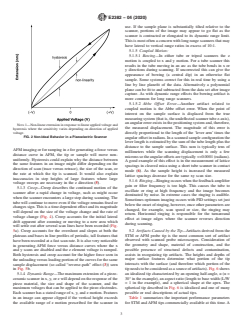
or negative voltages than near zero applied volts (2) (Fig. 2).
electronics (for example, improper feedback gains); noise
Non-linear effects in the lateral direction (x,y) can be observed
(mechanical, acoustic, or electronic); drift (thermal or me-
most clearly when scanning a periodic structure with known
chanical); problems unique to signal detection methods (for
spatial frequencies such as a diffraction grating. Since the
example, laser spillover in optical lever schemes); improper
scanner does not move linearly with applied voltage, the
use of image processing (real time or post processed); sample
measurement points will not be equally spaced. The observed
preparation, environment (for example, humidity) and tip-
spacingswillvaryovertheimageandsomelinearfeatureswill
surface interaction (for example, excessive electrostatic,
appear curved. While obvious for test structures, this effect
adhesive, shear, and compressive forces). It is suggested that
could go unnoticed on other samples that do not have evenly
these other types of artifacts form the basis of future ASTM
spaced surface features. This effect can be compensated for in
guides.
software by applying a non-linear voltage ramp during scan-
ning based on prior calibration (open loop method) or by
5. Artifacts in STM and AFM
independently measuring the position of the scanner using an
5.1 Artifacts arising from Scanner Motion—Scanners are
additionalpositionsensorsuchasacapacitorplate(closedloop
made from piezoelectric ceramic materials used to accurately
method) (5).Anexampleoftheopenloopcorrectionmethodis
position the tip relative to the surface on the nanometer scale.
given in Fig. 3. Non-linear effects in z or height measurements
They exhibit an inverse piezoelectric effect where the material
are less obvious but can be detected using vertical height
will undergo dimensional change in an applied electric field.
standards (4).Theyaremostnoticeablewhentryingtomeasure
Ideal behavior is often assumed when using these devices in
small features (small changes in V) and large features (large
STM or AFM microscopes. Ideal behavior implies: (1) linear
changes in V) within the same scan. They are also more
response in dimensional change per applied volt; (2)no
difficulttocorrectforduetothecomplexcouplingofmotionof
dependenceofthedimensionalresponseonthedirectionofthe
x and y to z, in say, a tube scanner.
voltage change, the magnitude of the voltage change, or the
5.1.2 Hysteresis—Hysteresis occurs in piezoelectric materi-
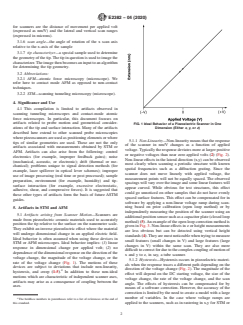
rate of the voltage change (Fig. 1). The motions of these
als when the response traces a different path depending on the
devices are subject to deviations that include non-linearity,
direction of the voltage change (Fig. 2). The magnitude of the
hysteresis, and creep (1-5). In addition to these non-ideal
effect will depend on the DC starting voltage, the size of the
motions which are characteristic of independent scanner axes,
voltage change, the rate of the voltage change, and the scan
artifacts may arise as a consequence of coupling between the
angle. The effects of hysteresis can be compensated for by
axes.
means of a software correction. However, the accuracy of the
correction is limited by the need to create a model with a large
number of variables. In the case where voltage ramps are
The boldface numbers in parentheses refer to a list of references at the end of
this standard. applied to the scanners, such as in rastering in x,y for STM or
E2382 − 04 (2020)
use. If the sample plane is substantially tilted relative to the
scanner, portions of the image may appear to go flat as the
scanner is contracted or elongated to its dynamic range limit.
Thisismostoftenaconcernwithlongrangescannersthatmay
have lateral to vertical range ratios in excess of 10:1.
5.1.5 Coupled Motion:
5.1.5.1 Bowing—In either tube or tripod scanners the z
motion is coupled to x and y motion. For a tube scanner this
results in the tube moving in an arc as the tube bends in x or
y directions during scanning. If uncorrected this can give the
appearance of bowing (a central dip) in an otherwise flat
sample. Some systems correct for this in real time by using a
line by line planefit of the data. Alternatively a polynomial
plane can be fit to and subtracted from the data set after image
capture. As with dynamic range effects the bowing artifact is
more common for long range scanners.
5.1.5.2 Abbe Offset Error—Another artifact related to
coupled motion is the Abbe offset error. When the point of
interest on the sample surface is displaced from the true
measuringsystem(thatis,theundeflectedscannertubez-axis),
anangularerrorexistsinthepositioningsystemand,therefore,
NOTE1—Non-linearextensioninresponsetolinearappliedvoltageand
the measured displacement. The magnitude of this error is
hysteresis where the sensitivity varies depending on direction of applied
voltage. directly proportional to the length of the ‘lever arm’times the
FIG. 2 Non-Ideal Behavior in a Piezoelectric Scanner
angularoffsetinradians.Inascannedsampleconfigurationthe
lever length is estimated by the sum of the tube length plus the
distance to the sample surface. This sum is typically tens of
AFMimagingorforrampinginzforgeneratingaforceversus
millimeters while the scanning displacement is only a few
distance curve in AFM, the tip or sample will move non-
micronssotheangularoffsetsaretypically<<0.0001(radians).
uniformly. Hysteresis could explain why the distance between
Agood example of this effect is in the measurement of lattice
the same features in an image might differ depending on the
spacings in cleaved mica using a short tube scanner in contact
direction of scan (trace versus retrace), the size of the scan, or
mode (6). As the sample height is increased the measured
the rate at which the tip is scanned. It would also explain
lattice spacings decrease for the same xy scan size.
inaccuracies in step heights of large features where large
5.1.6 Ringing—Ringingoccurswhenthefeedbackamplifier
voltage sweeps are necessary in the z direction (5).
gain or filter frequency is too high. This causes the tube to
5.1.3 Creep—Creep describes the continued motion of the
oscillate or ring at high frequency and the image becomes
scanner after a rapid change in voltage, such as might occur
dominated by noise. In extreme cases the ringing is audible.
when the scanner encounters a large step during scanning.The
Sometimes optimum imaging occurs with PID settings set just
tubewillcontinuetomoveevenifthevoltageremainsfixedor
belowtheonsetofringing,however,onceotherparametersare
changessign.Thisisatimedependenteffectanditsmagnitude
changed, for example, scan speed or size, the ringing may
will depend on the size of the voltage change and the rate of
return. Horizontal ringing is responsible for the turnaround
voltage change (Fig. 4). Creep accounts for the initial lateral
effect at image edges where the scanner reverses direction
drift apparent after zooming or moving to a new area which
during scanning.
will settle out after several scan lines have been recorded (Fig.
5.2 Artifacts Caused by the Tip—Artifacts derived from the
5a). Creep accounts for the overshoot and slopes at both the
STM or AFM probe tip is the most common sort of artifact
plateaus and bases in line profiles of periodic, tall features that
observed with scanned probe microscopes. Consideration of
havebeenrecordedatafastscanrate.Itisalsoverynoticeable
the geometry and shape, material of construction, and the
in generating AFM force versus distance curves where the x
possible presence of structural defects and contamination,
and y scans are disabled and the z element voltage is ramped.
assists in recognizing tip artifacts. The heights and depths of
Both hysteresis and creep account for the higher force seen in
major surface features determine what portion of the tip
theunloadingversusloadingportionofthecurvesforthesame
interacts with the surface (and therefore which portion of the
sample displacement (so called “reverse-path” effect (3)) seen
tipneedstobeconsideredasasourceofartifacts).Fig.6shows
in Fig. 5b.
an idealized tip characterized by an opening half-angle, α (α =
5.1.4 Dynamic Range—Themaximumextensionofapiezo-
30°intheexample),anaspectratio(lengthtobasewidth(L/W
ceramicscannerinx,y,orzwilldependontheresponseofthe
= 1 in the example), and a spherical shape at the apex. The
piezo material, the size and shape of the scanner, and the
spherical tip described in Fig. 6 is idealized and one of many
maximum voltages that can be applied to the piezo electrodes.
possible or real descriptions of actual tips.
Each scanner has a stated range of x, y, and z motion. Features
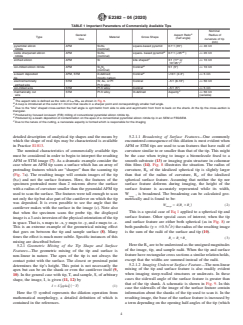
in an image can appear clipped if the vertical height exceeds Table 1 summarizes the important performance parameters
the available range of z motion prescribed for the scanner in for STM andAFM tips commercially available at this time.A
E2382 − 04 (2020)
TABLE 1 Important Parameters of Commercially Available Tips
Nominal
A
General Radius of
Aspect Ratio
Type Material Gross Shape
(half angle)
Use curvature of tip
(nm)
pyramidal silicon AFM Si N square-based pyramid 0.7:1 (35°) <= 40 nm
3 4
nitride (nominal)
B B
oxide sharpened silicon AFM Si N square- based pyramid 0.7:1 (<35° ) <=20nm
3 4
nitride (nominal)
C
etched silicon AFM Si kite shaped 3:1 (17° or <= 10 nm
C
10°/25°)
D
ion-milled silicon nitride AFM Si N Conical 5:1 (5°) <= 10 nm
3 4
(nominal)
E
e-beam deposited AFM, STM ill-defined; Conical >10:1 (2-3°) <= 5 nm
tip mostly carbon
electrochemically STM W, Au, or Pt Conical ~5:1 (8-10°) <= 50 nm
etched wire Pt ⁄Ir alloy
ion-milled wire STM Pt ⁄Ir alloy Conical ~5:1 (5°) <= 5 nm
F
mechanically cut STM Pt ⁄Ir alloy Ill-defined Asperity <= 50 nm
wire (variable)
A
The aspect ratio is defined as the ratio of L :W as shown in Fig. 6.
tip tip
B
A cusp is introduced at the outer 0.1 micron that results in a sharper point and correspondingly smaller half angle.
C
Due to the “kite” shaped cross-section the half angle is symmetric from side to side and asymmetric from front to back on the shank. At the tip the cross-section is
triangular.
D
Produced by focused ion-beam (FIB) milling of conventional pyramidal silicon nitride tip.
E
Produced by e-beam deposition of contamination on the apex of a conventional pyramidal silicon nitride tip in an SEM or FEGSEM.
F
Due to the nature of the cutting, a nanoscale asperity is formed which is responsible for the imaging
detailed description of analytical tip shapes and the means by 5.2.1.1 Broadening of Surface Features—One commonly
which the shape of real tips may be characterized is available encountered consequence of this dilation is most evident when
in Practice E1813. AFM or STM tips are used to scan features that have radii of
The nominal characteristics of commercially available tips curvature similar to or smaller than that of the tip. This might
must be considered in order to begin to interpret the resulting be the case when trying to image a biomolecule fixed to a
AFM or STM image (7). As a dramatic example consider the smooth substrate (13) or imaging grain structure in columnar
case where an AFM tip scans a surface which has an array of thin films (14). Fig. 8 illustrates the situation. The radius of
protruding features which are “sharper” than the scanning tip curvature, R, of the idealized spherical tip is slightly larger
t
(Fig. 7a). The resulting image will contain images of the tip than that of the radius of curvature, R , of the idealized
s
(b,c) and not the surface features. Here, the features of the spherical surface feature. Assuming that neither the tip nor
specimen protruded more than 2 microns above the surface surface feature deforms during imaging, the height of the
with a radius of curvature smaller than the pyramidalAFM tip surface feature is accurately represented while its width,
used to scan the surface.The features were tall enough to scan W , is broadened. The broadening can be calculated geo-
image
not only the tip but also part of the cantilever on which the tip metrically and is found to be:
was deposited. It is even possible to see the angle that the
W 54 R 3R (2)
~ !
image t s
cantilever makes with the surface in the image (c). Note also
This is a special case of Eq 1 applied to a spherical tip and
that when the specimen scans the probe tip, the displayed
surface feature. Other special cases of interest; when the tip
imageisa3-axisinversionofthephysicalorientationofthetip
and surface feature are either both spherical (as in Fig. 8)or
inspace.Thatis,xmapsto–x,ymapsto–y,andzmapsto–z.
both parabolic (y = 60.5x /r) the radius of the resulting image
This is an extreme example of the geometrical mixing effect
is the sum of the radii of the surface and tip (10).
that goes on between the tip and sample surface (8). Many
times the effect is much more subtle. Specific instances of this
R 5 R 1R (3)
i t s
mixing are described below:
HeretheR aretobeunderstoodastheunsignedmagnitudes
x
5.2.1 Geometric Mixing of the Tip Shape and Surface
of the image, tip, and sample radii. When the tip and surface
Features—The geometric mixing of the tip and surface is
featurehaverectangularcrosssectionsasimilarrelationholds,
non-linear in nature. The apex of the tip is not always the
except that the widths are summed instead of the radii.
contact point with the surface. The closest or proximal point
5.2.1.2 Imaging Undercut Surface Feature—The non-linear
determines the tip’s height. This point is not necessarily the
mixing of the tip and surface feature is also readily evident
apex but can be on the shank or even the cantilever itself (9,
when imaging steep-walled structures or undercuts. In these
10). In the general case with tip, T, and sample, S, of arbitrary
cases the sidewall angle of the surface feature is greater than
shape, the image, I, is given (11, 12) by
that of the tip shank. A schematic is shown in Fig. 9. In this
I 5 S oplus 2T (1)
@ # ~ !
case the sidewalls of the image of the surface feature contain
Here the% symbol represents the dilation operation from information about the shanks of the tip used to scan it. In the
mathematical morphology, a detailed definition of which is resulting image, the base of the surface feature is increased by
contained in the references. a term depending on the opening half-angles of the tip (which
E2382
...